
The Arctic Food Chain Was Already Dead in 2009 — Science Just Took 17 Years to Admit It **category**: science
Summary
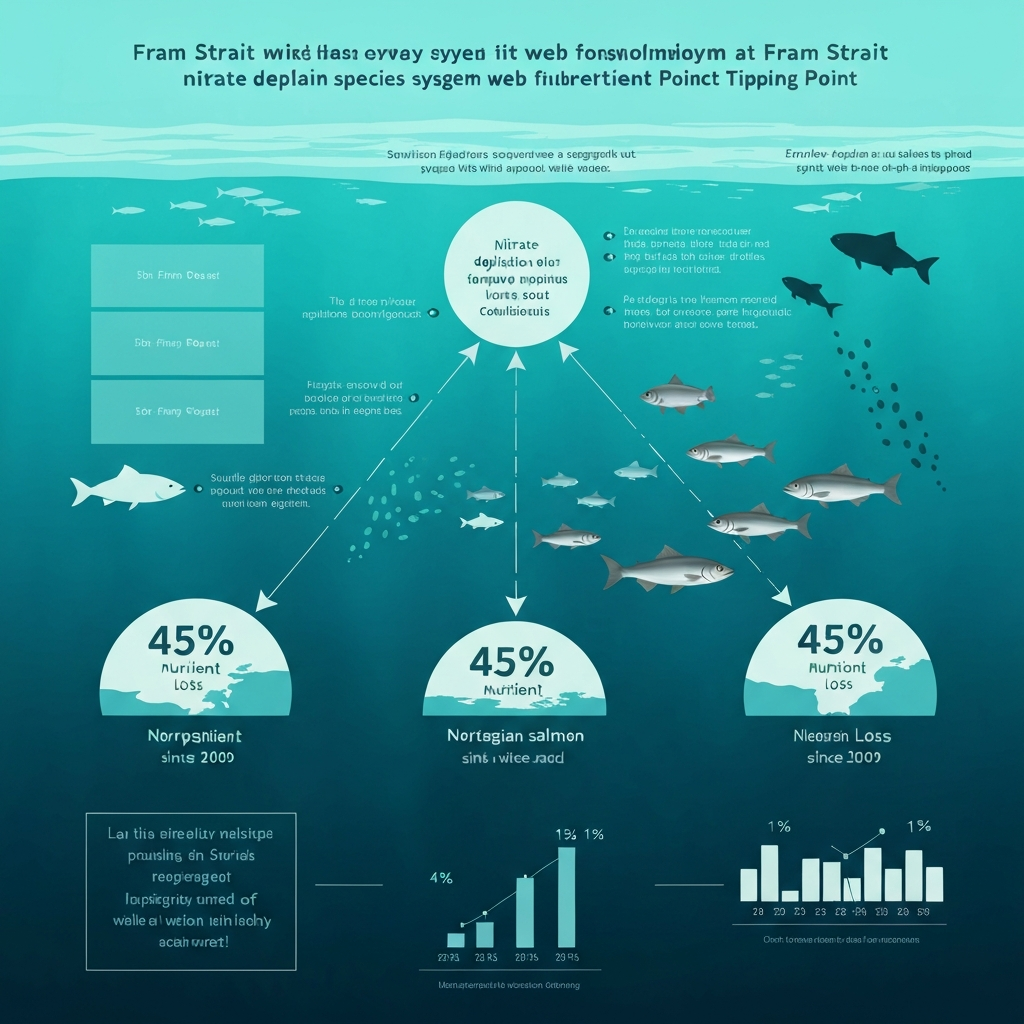
The chemical tipping point at which the Arctic Ocean shifted from a light-limited to a nitrate-limited ecosystem was crossed in 2009, a fact confirmed only in May 2026 by a University of Edinburgh study drawing on 26 years of Fram Strait observational data. Surface nitrate concentrations dropped approximately 45% — from 3.1 to 1.7 μmol/L — across an area covering roughly half of the Arctic's shallow continental shelves, and researchers declared the change effectively irreversible given its structural dependence on sea ice coverage. The real story here isn't just ecological collapse; it's the 17-year chasm between the moment the tipping point was crossed and the moment science officially acknowledged it — a failure with consequences for governance as much as for ecology. Nitrate depletion has already restructured phytoplankton communities toward smaller, less carbon-efficient species, weakening both the marine food chain and the Arctic's biological carbon pump simultaneously, threatening the $452 billion global fishing industry and the livelihoods of 61.8 million people who depend on it. Whether the declaration of irreversibility serves to obscure polluter accountability or to sharpen the evidentiary edge of fisheries liability lawsuits — like New York State's $3 billion climate damages claim — will define the political economy of Arctic climate policy for decades to come.
Key Points
The 2009 Inflection Point: What 26 Years of Hard Data Actually Shows
The core scientific claim of this paper rests on 26 years of direct water-column sampling from the Fram Strait, collected between 1998 and 2023. The analysis reveals that Arctic surface nitrate concentrations dropped from 3.1 μmol/L to 1.7 μmol/L around 2009 — a roughly 45% decline — affecting an area covering approximately half of the Arctic's shallow continental shelf, including the Chukchi and East Siberian shelves. What makes this number significant isn't just the magnitude of the drop; it's what the drop represents at a systems level. The Arctic Ocean has fundamentally changed its limiting-nutrient regime, transitioning from a light-limited ecosystem — where the constraint on phytoplankton growth was insufficient sunlight — to a nitrate-limited one, where the constraint is insufficient nitrogen.
In my view, this is the most consequential aspect of the finding, because it means the system's fundamental operating logic has been rewritten. Skeptics like to point out that 26 years is "just a moment in geological time," but what matters for these purposes isn't the duration relative to deep time — it's whether the rate of change exceeds natural variability. The researchers' analysis indicates it does, by a wide margin. The fact that we can now identify a specific year — 2009 — as the inflection point isn't just scientifically satisfying; it's practically important, because a precise date creates a precise legal and policy target. It makes causal chains between emissions trajectories, policy decisions, and ecosystem outcomes legible in ways that "sometime in the 21st century" never could. This kind of temporal precision is new, and it matters enormously for what comes next in both science and governance.
Locked Into Irreversibility: Sea Ice Holds the Key — And It's Disappearing
The reason the Edinburgh researchers declared this change "highly unlikely to reverse" isn't pessimism — it's mechanism. To restore nitrate levels, you need to stop the denitrification feedback loop. To stop the loop, you need to reduce the organic matter sinking to the seafloor. To do that, you need to reduce the phytoplankton blooms generating the organic matter. And to reduce those blooms, you need less light penetrating the water — which means you need sea ice back. That chain of prerequisites is scientifically coherent. The problem is the physical context it sits in.
In March 2025, Arctic winter maximum sea ice extent hit 14.33 million km² — the lowest in 47 years of continuous satellite observation, and 1.306 million km² below the 1981–2010 average. For reference, that deficit is larger than the entire state of Alaska. September sea ice is declining at roughly 12.1% per decade. Perennial multiyear ice — the thick, stable ice that once dominated the Arctic — now covers only about half of its historical extent. The probability of an essentially ice-free Arctic summer in the 2030s sits at approximately 60% under current emissions trajectories. When you add all of this up, "restore the sea ice" as a precondition for "restore the nitrate" reads less like a policy recommendation and more like a requirement to reverse several decades of atmospheric chemistry. This is fundamentally different from the kelp forest recovery stories people sometimes invoke as analogies. The urchin-kelp tipping point could be reversed by removing urchins. This one cannot be reversed by any intervention that operates at the ecosystem level alone.
The 17-Year Gap: A Governance Failure as Much as a Scientific One
I want to be direct about what I think the 17-year delay actually represents. It's not simply that science takes time — though it does. It's that the institutions responsible for translating scientific findings into policy have structural incentives to move slowly. Climate science builds consensus through peer review, and peer review is designed to be conservative. That's valuable — it prevents bad science from becoming bad policy. But it also means the urgency of the underlying physical reality routinely outruns the formal scientific record. Scientific American and the Bulletin of the Atomic Scientists have both documented how the IPCC systematically underestimates worst-case scenarios, describing the phenomenon as a form of institutionalized scientific conservatism.
A Council on Foreign Relations report was more direct: "policy responses to tipping points lag significantly behind scientific understanding." This lag is not politically neutral. The period 2009–2026 includes the entire Paris Agreement process, the Glasgow commitments, a full U.S. withdrawal and re-entry into the accord, and a complete electoral cycle in every major democracy. During all of that, the Arctic was operating in a different state than the maps politicians were working from. I'd argue the 17-year delay doesn't just reflect scientific caution — it reflects a system in which uncertainty is systematically exploited as a reason to defer action. The IPCC revised its estimate of the critical tipping-point temperature threshold from 4°C (early 2000s) to 1.5–2°C (2016) to meaningful probabilities at 1°C (2021). Each revision moved the boundary closer to the present. The 2009 Arctic inflection point was visible in hindsight — but the political framework we were operating in made it easy to discount until a 26-year dataset made denial untenable.
The Political Economy of "Irreversible": Who Benefits From Declaring It Over?
There's a word in the Edinburgh paper that I keep coming back to: "irreversible." On the surface, it's a scientific term meaning "the mechanism driving this change makes recovery highly unlikely." But in public discourse, it functions as something else — a final verdict that closes the case. A 2025 PNAS Nexus study examined how language like "irreversible change" and "irreversible loss" operates in climate communication, finding that these framings simultaneously transmit high-stakes warnings and serve as rhetorical devices that shift attention forward — to the next crisis — rather than sustaining accountability for the current one.
I think this is one of the most underappreciated dynamics in climate politics. Once a system is declared irreversibly lost, the political energy that might have gone into assigning blame redirects itself toward the next problem. The next candidates are already queuing: AMOC disruption, Amazon dieback, Siberian permafrost methane release. In each case, the "irreversibility" framing could perform the same function — generating momentary alarm followed by the diffuse resignation that is most useful to parties who'd prefer not to face the bill. The research on fear-based environmental communication is also relevant here: people are motivated to act when they believe their actions can make a difference. "It's already over" is precisely the message that produces learned helplessness rather than mobilization. I'm not arguing scientists should soften their findings — the 45% nitrate decline is what it is. But I do think the public and media need to be more alert to the way irreversibility language can be instrumentalized, and that each declaration of a lost system should function as a siren for protecting the next one, not a permission slip for those who broke the first.
The Bill Goes to Fisheries First — And That's Creating a New Legal Landscape
Here's an asymmetry that will define the next decade of climate litigation: the entities that caused the most damage to the Arctic ecosystem are not the same entities that will absorb the economic consequences first. Fossil fuel companies — whose emissions constitute the primary driver of Arctic warming and sea ice loss — will face the legal reckoning eventually. But the economic pain hits fisheries nations first, hardest, and most directly. Norway recorded NOK 174.7 billion in seafood exports in 2024 — a record high — with 70% of that driven by salmon. Hokkaido's salmon catch in 2025 was one-fifth of its 2022 level. Globally, fisheries and aquaculture employ 61.8 million people directly in a $452 billion sector, with 500 million more depending on small-scale fishing for subsistence.
This mismatch between who causes the harm and who absorbs it is what makes Arctic ocean chemistry data potentially explosive in a courtroom. The 2018 Pacific Coast Federation of Fishermen's Associations lawsuit against ExxonMobil, Chevron, Shell, BP, and 26 other fossil fuel companies established the legal template. New York State's December 2024 climate damage law, requiring energy producers to pay $3 billion, added a state-level mechanism. What the Fram Strait data does is provide a 26-year, peer-reviewed, inflection-point-precise evidentiary record connecting a specific year — 2009 — to specific corporate decisions about emissions and disclosure. In litigation terms, that's not a weak correlation — it's a documented causal chain. I believe we are at the beginning of a multi-decade wave of climate-fisheries litigation that will ultimately transfer significant costs from public budgets and fishing communities back onto the companies most responsible for the underlying warming.
Positive & Negative Analysis
Positive Aspects
- Observational Science Can Now Pinpoint the Exact Year a Tipping Point Was Crossed
The most unambiguous positive to emerge from this research is methodological: we now have scientific tools capable of identifying not just that a tipping point occurred, but precisely when. The 26-year Fram Strait dataset allowed the Edinburgh team to statistically identify 2009 as the inflection point, verified not just by nitrate concentrations but by corroborating biogeochemical ratios including nitrate-to-phosphate and silicate-to-nitrate. Before the era of sustained ocean monitoring, change of this kind would have been reconstructed from proxies — sediment cores, isotope records, biological surveys — and the dating would have carried substantial uncertainty. The precision we now have is a genuine asset for everything that comes after this discovery.
Long-term monitoring stations are rare and expensive, but the Fram Strait data represents decades of scientific investment that is now paying dividends far beyond what anyone expected when those samples were first collected. I'd argue the same monitoring infrastructure, if extended and replicated across the Arctic, could provide 3-to-5-year warning on emerging chemical shifts in other sub-regions — potentially catching the next tipping point before 17 more years pass. The Edinburgh team explicitly called for continued monitoring, and that recommendation deserves serious institutional backing. The difference between governing in the present and governing in the past is exactly this kind of proactive analytical capability. This kind of tool, deployed before rather than after the fact, is one of the few genuine levers we have for breaking the pattern of discovering crises after they've become irreversible.
- The Short-Term Productivity Surge Gives Fishing Nations a Transition Window
Counterintuitively, the ecological transformation of the Arctic has actually boosted total primary productivity in the near term. Arctic net primary production increased 30.5% from 2003 to 2025, with 8 out of 9 monitored sub-regions exceeding average levels. Eurasia's Arctic sector saw an 80.2% productivity surge. Barents Sea cod is projected to see further near-term increases through 2049 as warming water expands habitat range. For fishing-dependent economies, this creates a window that shouldn't be wasted.
If Norway, Iceland, Canada, and Japan are currently operating in a period of transitional abundance — even if that abundance is structurally different from historical productivity — the capital being generated now could fund the adaptation that the long term will require. Species diversification programs, investment in cold-water aquaculture, renegotiation of fisheries agreements to account for range-shifting stocks, development of monitoring capacity in under-observed sub-regions: all of these require capital, and that capital exists right now. I'd argue the most strategically intelligent response to a record export year isn't to distribute the surplus — it's to invest it in the infrastructure that will still be valuable when the current boom ends. Norway's record NOK 174.7 billion export year is either the last chapter of a golden era or the opening chapter of a smart transition. Which one it turns out to be depends entirely on what decisions are made with that capital over the next three to five years.
- The Arctic Nitrate Data Dramatically Strengthens Climate Liability Lawsuits
One concrete positive outcome of the Edinburgh paper is the precision it adds to climate litigation. The 2018 Pacific Coast Federation of Fishermen's Associations lawsuit against 30 fossil fuel companies, and New York State's 2024 climate damages law demanding $3 billion from energy producers, represent the leading edge of a legal movement that needs exactly this kind of evidence to succeed. The challenge in climate liability cases has always been causation: proving that specific corporate decisions led to specific, measurable harms. A 26-year, peer-reviewed dataset that identifies 2009 as the year when Arctic nitrate chemistry crossed a threshold — and links that threshold to sea ice loss driven by warming — directly strengthens the causal case.
I believe this kind of evidence will accelerate the timeline for successful climate liability rulings. Columbia University's Sabin Center for Climate Change Law tracks these cases globally, and the trend is clear: suits are expanding in number, geographic scope, and legal sophistication. The Arctic nitrate data makes the fisheries-focused suits more likely to survive causation challenges — and when they do, the precedents they set will reverberate across every category of climate litigation. The externalized costs of fossil fuel combustion are beginning, slowly, to find their way back to their source. When markets finally price in those costs accurately, the incentive structure around fossil fuel extraction changes in ways that decades of voluntary corporate pledges haven't managed to deliver. This is how accountability is supposed to function, and it's genuinely encouraging that the legal infrastructure to enforce it is taking shape.
- The 17-Year Delay Creates Urgency Around Protecting Still-Reversible Systems
Perhaps the most valuable thing about the 2009 revelation isn't what it tells us about the Arctic, but what it tells us about our other climate commitments. AMOC disruption, Amazon dieback, and Siberian permafrost methane release are all systems that climate science has identified as potential tipping points — and none has yet been officially declared irreversible. I'd argue that the Arctic experience should function as an alarm clock for all three. The IPCC has progressively revised its tipping-point temperature threshold downward — from 4°C (early 2000s) to 1.5–2°C (2016) to meaningful probabilities at just 1°C (2021). That revision history shows science getting more concerned, not less, as data accumulates.
If the pattern with the Arctic holds — where physical reality outruns the formal scientific record by 17 years — then "not yet confirmed" on AMOC or the Amazon is not a reassurance. It's a prediction. Institutions that internalize this lesson have an opportunity to fund monitoring, establish early-warning protocols, and design policy responses before the next confirmation study lands. The international precedent also exists: the 9-nation Arctic high-seas fishing moratorium demonstrated that pre-emptive multilateral action based on future-projected risk is politically achievable when the stakes are made concrete enough. The 2009 Arctic tipping point should be the model case study in every climate policy curriculum — not as a story of failure, but as the clearest possible illustration of what proactive governance could have prevented.
Concerns
- Short-Term Productivity Growth Is a Structural Trap for Both Carbon and Food Chains
The most dangerous misconception about the Arctic ecosystem transformation is that increasing productivity equals increasing health. The phytoplankton responsible for the 30.5% production increase are predominantly small-celled species — specifically pico- and nanoplankton — that have fundamentally different ecological roles than the larger diatoms they are replacing. Larger diatoms are the workhorses of the biological carbon pump: when they die, they form relatively dense aggregates that sink quickly to the deep ocean, taking carbon with them and effectively removing it from the atmosphere on timescales of centuries to millennia. Small phytoplankton are recycled in the surface ocean through the microbial loop, which means the carbon they fix stays near the surface and is more likely to be released back into the atmosphere.
A 2025 Nature Climate Change study by Oziel and colleagues estimates that Arctic biological carbon pump efficiency will decline by 40% by 2100, with terrestrial organic matter inputs adding a further minimum of 33 TgC annually to the carbon not being sequestered. The implication is stark: the Arctic Ocean is simultaneously becoming more biologically active and less ecologically functional in the specific ways that matter for climate regulation and food chain support. I'd argue that's a far more insidious form of degradation than obvious collapse, because the "productivity up" headline obscures the "carbon sequestration down" and "food chain efficiency down" dynamics running underneath it. When investors and policymakers see a 30.5% productivity increase, they don't immediately ask "but what kind of productivity?" — and that question is exactly the one that determines whether the Arctic is a climate asset or a climate liability going forward.
- The Precondition for Recovery — Sea Ice — Is Structurally Disappearing
Every pathway to restoring Arctic nitrate levels runs through sea ice recovery. That physical prerequisite is becoming more distant, not less, with each passing year. Arctic winter maximum sea ice in March 2025 reached 14.33 million km² — the lowest in 47 years of satellite observation, a deficit of 1.306 million km² below the 1981–2010 average, larger than the entire state of Alaska. September sea ice is declining at 12.1% per decade, roughly 78,000 km² per year. Multiyear perennial ice — the thick, stable ice that once dominated the Arctic Ocean — now covers only about half of its historical extent. The probability of an essentially ice-free Arctic summer in the 2030s sits at approximately 60% under current emissions trajectories.
When sea ice retreats, ocean albedo falls — the dark water surface absorbs far more solar radiation than reflective ice — which accelerates warming locally, which further reduces ice extent. This is the albedo feedback loop that makes Arctic warming self-sustaining once it crosses a certain threshold. The denitrification loop destroying Arctic nitrate and the albedo loop destroying Arctic ice reinforce each other in a compound feedback. There is no plausible intervention at the ecosystem level that breaks this compound dynamic without addressing the atmospheric forcing driving it. I want to be direct: the scenario in which Arctic nitrate levels recover without massive global decarbonization is not a realistic policy option. The recovery pathway exists only in the models; the destruction pathway is already in the data.
- Fishing Economies and Global Food Security Face a Multi-Decade Reckoning
The economic consequences of Arctic food chain degradation are asymmetrically distributed in ways that make political response particularly difficult. Norway, which posted record seafood exports of NOK 174.7 billion in 2024, is simultaneously the most successful fishing economy on Earth right now and the most exposed to structural reversal. When 70% of your record export revenue comes from a single species — Atlantic salmon — and the broader ecosystem underpinning wild-catch recruitment is degrading, your celebrated record high is also a peak that marks maximum vulnerability. Hokkaido's salmon catch already fell to one-fifth of its 2022 level by 2025, and Japan's seafood industry can't easily absorb that kind of structural decline.
Globally, the stakes are enormous: 61.8 million people are directly employed in fisheries and aquaculture in a $452 billion sector, with an additional 500 million small-scale fishers depending on wild catch for subsistence. A Science Advances 2025 study projects that 37% of transboundary fish stocks will cross EEZ borders by 2030, and 54% by 2050 — meaning species currently harvested in one nation's waters will increasingly be found in another's. The Bering Sea pollock dispute between the U.S. and Russia is already intensifying, and the WWF identified 20 climate-driven fisheries conflict hotspots for 2030, with the Arctic prominently included. I'd argue this is the vector through which the Arctic ecosystem story transforms from an environmental issue into a food security and geopolitical issue — and it doesn't need to wait until 2050 to start affecting national budgets and diplomatic relationships.
- "Irreversibility" Language Can Enable Accountability Avoidance and Public Resignation
I'll be direct about what concerns me most in the current framing of this story. When a system is declared beyond recovery, public attention — and political energy — naturally flows toward the next crisis. The people and institutions responsible for the previous one step out of the accountability spotlight. The 2025 PNAS Nexus analysis documented exactly this dynamic: "irreversible change" and "irreversible loss" language functions as high-stakes warning and rhetorical device simultaneously. The specific pattern of the Arctic story — tipping point in 2009, official confirmation in 2026, irreversibility declaration accompanying that confirmation — is almost perfectly structured to produce political resignation rather than accountability.
Meanwhile, the Trump administration is actively working to preempt state-level climate litigation — the primary legal mechanism through which accountability could actually be enforced. On one side, science confirms a 17-year-old tipping point and declares it irreversible. On the other side, the legal mechanisms for assigning responsibility are being actively blocked. The net effect is a situation in which the scientific record acknowledges the damage and the legal system denies the remedy simultaneously. The research on climate communication shows that people act when they believe change is possible. "It's already over for the Arctic" is not a mobilizing message. With AMOC, the Amazon, and Arctic permafrost all still in the "not yet officially crossed" category, what the irreversibility framing does to public motivation and political will is not an abstract concern — it's a direct determinant of whether the next tipping point gets caught in time or ratified 17 years late.
Outlook
Let me think through what the next several years actually look like — not as a wish list, but as a serious attempt to map the probability landscape across short-term, medium-term, and long-term horizons, including bull, base, and bear scenarios.
In the near term — from the second half of 2026 through early 2027 — I expect the primary action to happen in scientific discourse and legal positioning simultaneously. The Edinburgh paper landed in a Nature-family journal, which means follow-up research is coming. I expect analyses of the Chukchi and East Siberian shelves to confirm similar inflection points, likely in the 2007–2011 window. If multiple Arctic sub-regions confirm tipping points from around the same era, the cumulative scientific picture becomes hard to dismiss, even by the most determined skeptics.
At the same time, the skeptic counter-narrative will be loud. The argument "Arctic primary productivity is up 30.5% — the ocean is more alive than ever" will continue circulating, and it will mislead many people who don't understand the difference between gross biological activity and structural food chain function. I think the framing battle — not the science battle — will dominate 2026–2027 media coverage. And the outcome of that framing contest matters enormously for what policy follows.
The legal dimension is where I see the most near-term momentum. New York State signed a law in December 2024 requiring energy producers to pay $3 billion in climate damages, and the Trump administration is pushing to block such state-level suits. The question of whether federal preemption can shut down state climate litigation is one of the most consequential legal fights of the next two years. I believe Arctic fisheries data — specifically the 26-year Fram Strait record pinpointing 2009 as the inflection point — will be incorporated as evidence in these cases within the next 12 to 18 months. The 2018 Pacific Coast Federation of Fishermen's Associations lawsuit against ExxonMobil, Chevron, Shell, BP, and 26 other companies provides the legal template. The Edinburgh nitrate data sharpens the causal chain between specific corporate emissions decisions and quantifiable fisheries losses in ways prior litigation evidence often couldn't achieve.
Norway's 2024 record export figure of NOK 174.7 billion is worth flagging in this context. It's a peak — and peaks are both the best and the worst time to be in an industry. Best, because you have capital. Worst, because you're most exposed to structural reversal. A record export figure makes Norway simultaneously the most profitable fishing nation on Earth and the one with the most to lose if the underlying ecosystem continues its transformation.
Moving into the medium term — 2027 through 2029 — I expect the industrial structure of global fisheries to start showing real strain. The Science Advances 2025 study projects that 37% of transboundary fish stocks will shift across EEZ borders by 2030, and 54% by 2050. When fish move across national boundaries, yesterday's Norwegian catch becomes today's Russian catch. The Bering Sea pollock dispute between the U.S. and Russia is already intensifying. A WWF Oceans Futures analysis identified 20 climate-driven fisheries conflict hotspots for 2030, with the Arctic prominently included. I'd argue this is the phase where the ecosystem story quietly transforms into a geopolitical one — without needing any single dramatic event to trigger it.
Capital markets and insurance will also start repricing risk in this window. The fishing industry has looked, from a distance, like a climate-beneficiary sector — Arctic productivity numbers support that read in the short term. But when you combine Hokkaido's collapse with the Arctic nitrate story and the carbon pump efficiency decline, a serious analyst has to ask whether the sector's "climate upside" was always borrowed from the future. I think credit rating agencies and underwriters will begin building Arctic ecosystem risk into fisheries sector assessments by late 2028. And here's the compounding twist: as climate litigation against fossil fuel companies gains traction, those costs eventually pass through to energy prices — which means the Arctic plankton problem circles back to show up in your electricity bill and your grocery store, not just in marine biology journals.
The historical analogy that feels most relevant is the 1992 Newfoundland Grand Banks cod collapse. Thirty thousand people lost their livelihoods within months when the Canadian government finally acknowledged what the data had been showing for years. That fishery, 33 years on, still hasn't fully recovered. But here's the critical structural difference: the cod collapse was driven by overfishing, which meant stopping the boats could theoretically allow recovery. What the Edinburgh paper describes is a chemical tipping point locked to a physical condition — sea ice — that no fishing moratorium can reverse. The Newfoundland scenario had a lever. The Arctic nitrate scenario doesn't have one that operates at human timescales.
Now let me map the long-term scenarios explicitly. In the optimistic bull scenario — which I'd assign roughly 20% probability — the 40% of possible futures where the Arctic doesn't go ice-free in summer turns out to be the actual one. Sea ice holds longer than projected, the denitrification feedback loop slows, and international agreements like the 9-nation Arctic high-seas fishing moratorium manage to protect enough biomass to maintain food chain function. In this scenario, Barents Sea cod increases as projected through 2049, AMOC doesn't collapse within this century, and major fishing nations use their current prosperity window to invest aggressively in aquaculture, species diversification, and adaptive management. I want to be honest: this scenario requires aggressive carbon mitigation that bends the warming curve significantly. It doesn't happen by accident, and it doesn't happen without political will that currently doesn't exist at the required scale. If current trends continue without significant policy change, the 20% probability I'm assigning here will fall further.
The base scenario — which I'd put at approximately 55% probability — is "current trajectory holds." The 45% nitrate decline and the small-phytoplankton structural transition become permanent features of the Arctic ecosystem. The 2030s see the first ice-free summer, accelerating denitrification further. The biological carbon pump declines along the 40%-by-2100 pathway projected by Oziel and colleagues. Norway, Iceland, and Japan spend the next decade restructuring their fisheries sectors, absorbing lower yields and shifting species mix. Climate litigation expands from New York to other states and eventually to European and Pacific jurisdictions, but judgments take years and compensation payments are slow. The Arctic degrades quietly — not in a single dramatic event, but through a slow process of productive impoverishment that rarely makes front-page news because it never produces a single catastrophic moment. This is the scenario I find most quietly terrifying, because its gradual nature is designed to be ignored until the accumulation becomes impossible to miss.
The pessimistic bear scenario — which I assign about 25% probability — involves compound tipping points triggering in sequence. The AMOC collapse confidence interval runs from 2025 to 2095, with a modal estimate around 2065. If North Atlantic circulation disruption compounds the Arctic nutrient collapse, the cumulative effect on global fisheries would be far more severe than either event alone. Add 54% of transboundary fish stocks crossing borders simultaneously and 20 conflict hotspots activating at once, and you get the failure of multilateral fisheries agreements and a Hokkaido-style collapse spreading across multiple ocean basins simultaneously. This scenario is genuinely dangerous not because any single element is improbable, but because each element amplifies the others — sea ice loss accelerates albedo feedback, which releases permafrost methane, which accelerates warming further. The chain doesn't have obvious breakpoints once it starts running hot.
Let me close with what might make my analysis wrong, and what I'd suggest to people reading this. The strongest counter to my bearish lean is the observation that 26 years is geologically brief — it's possible the 2009 inflection point reflects natural variability rather than a permanent structural shift. If that turns out to be correct, the story looks very different. I hold that possibility seriously, but the mechanism is clear enough, and the sea ice trend is unambiguous enough, that I still think the weight of probability sits with base and bear.
For anyone who has read this far: if you're a seafood consumer, start reading fish price changes as structural signals rather than temporary supply fluctuations. If you're an investor, run a genuine climate exposure audit on any position in fisheries, food processing, or marine insurance. And as a citizen, don't let the "irreversibility" framing convince you that the next tipping point is already lost — it isn't. The 17-year delay wasn't inevitable. It was distributed across thousands of individual decisions about funding, publication, and political will. The next invoice is still being written, and the amount depends on what we do right now. The Arctic has already shown us the answer. The only question left is whether we're willing to read it in time.
Sources / References
- Sea ice loss drives a regime shift in Arctic Ocean nitrogen biogeochemistry — Communications Earth & Environment
- Arctic Ocean Food Chain Disrupted — EurekAlert!/AAAS
- The Arctic has warmed nearly four times faster than the globe — Communications Earth & Environment
- Arctic sea ice sets record low maximum in 2025 — National Snow and Ice Data Center
- Arctic Ocean Primary Productivity 2025 — NOAA Arctic Report Card 2025
- Climate change reduces the efficiency of the Arctic biological carbon pump — Nature Climate Change
- 2024 was the best year ever for Norwegian seafood exports — Norwegian Seafood Council
- The State of World Fisheries and Aquaculture 2024 — Food and Agriculture Organization
- Climate-driven fisheries conflict hotspots — World Wildlife Fund
- Climate change heavily affecting fish stocks in Japan — SeafoodSource
- The language of irreversibility in climate communication — PNAS Nexus
- Climate Litigation Updates — Columbia University Sabin Center for Climate Change Law
- Range shifts of transboundary fish stocks across EEZ borders — Science Advances