
A Rock That Fell Off the Moon Has Been Orbiting Earth — and China Is Going to Pick It Up
Summary
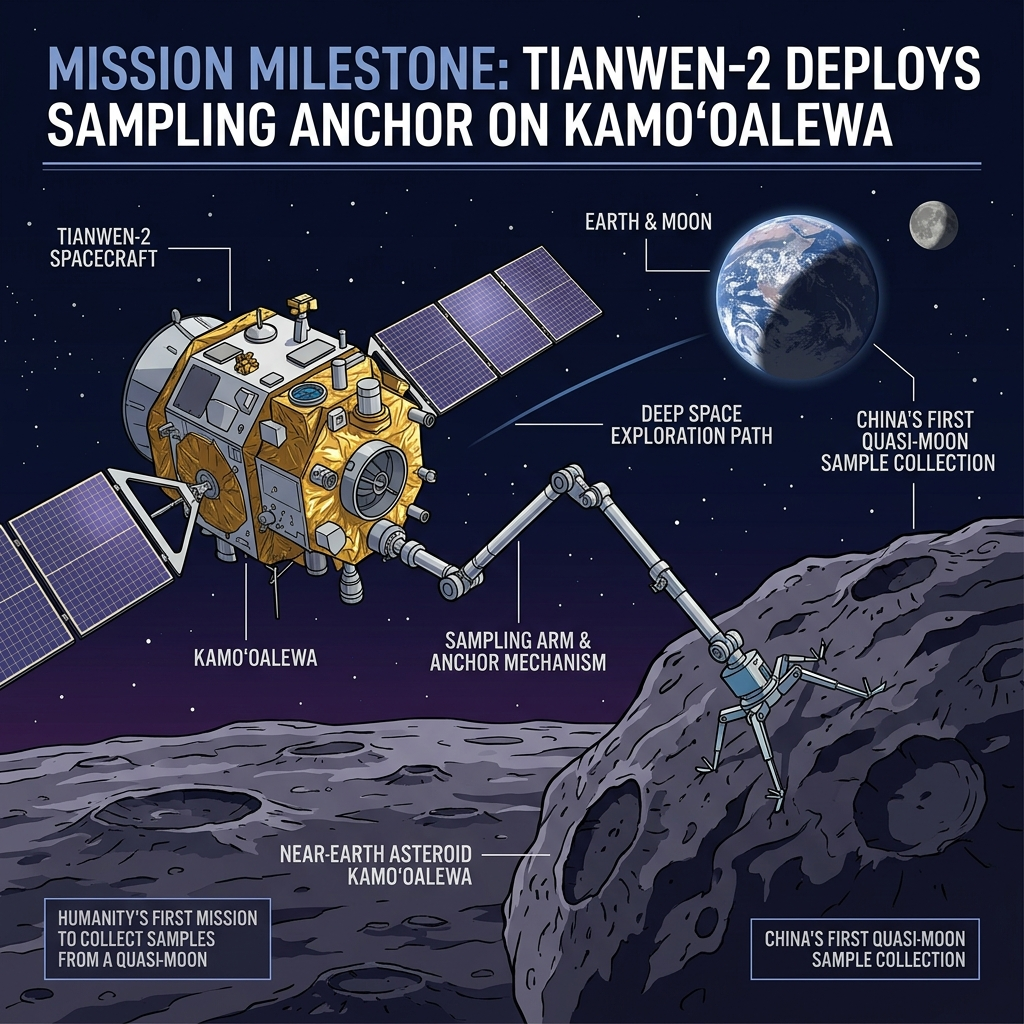
Kamo'oalewa (469219 Kamo'oalewa), a 40–100 meter quasi-satellite locked in a 1:1 orbital resonance with Earth, has attracted intense scientific scrutiny since spectral analyses revealed a striking compositional similarity to lunar surface rocks, giving rise to the "lunar fragment" hypothesis first formally proposed by University of Arizona researchers in 2021. China's Tianwen-2 spacecraft, launched in May 2025, is set to approach within 20 kilometers of the asteroid on July 4, 2026, executing the world's first anchor-and-attach sample retrieval — a technique fundamentally more demanding than the touch-and-go methods used by Japan's Hayabusa2 and NASA's OSIRIS-REx. The fact that a U.S. survey telescope discovered and named this object while a Chinese mission is first to physically reach it captures a defining structural shift in 21st-century space geopolitics with unusual clarity. Should isotope analysis of the returned 200–1,000 gram sample confirm a lunar origin, it would constitute the first direct physical evidence that the Moon has actively supplied material to Earth's orbital neighborhood through large impacts, forcing a comprehensive revision of Earth-Moon system material exchange models. This mission sits at the intersection of planetary defense, space resource economics, and solar system formation history in ways that make it one of the most consequential unmanned space science events of the decade.
Key Points
The Science Behind the Lunar Fragment Hypothesis
Kamo'oalewa's reflectance spectrum matches Apollo lunar rock samples with a level of statistical consistency that is genuinely difficult to dismiss as coincidence. In 2021, University of Arizona researcher Ben Sharkey and colleagues published the first systematic argument for a lunar origin, noting that the spectral match extended across multiple wavelength ranges in ways that point specifically toward highland-type lunar material rather than any known class of ordinary asteroid. The leading physical mechanism proposes that Kamo'oalewa was ejected from the Moon's surface approximately 10 million years ago by the impact that created Giordano Bruno crater — one of the youngest large craters on the Moon — and that computer simulations of the ejection velocity and subsequent orbital evolution are consistent with this scenario. A 2026 paper in Nature Communications introduced a significant counterargument: extremely space-weathered silica-rich asteroids can develop spectral signatures that resemble lunar material, meaning remote spectroscopy alone cannot definitively establish origin. The only way to resolve the debate with scientific finality is through direct sample analysis, specifically oxygen isotope ratios — the Δ17O value functions as a near-definitive chemical fingerprint that distinguishes lunar material from other solar system bodies with a precision no telescope can approach. If the returned sample confirms a lunar origin, it would be the first direct physical evidence that the Moon has episodically supplied its own surface material to Earth's orbital neighborhood through large impact events, a finding that would force fundamental revisions to Earth-Moon system material exchange models and potentially reshape how we classify the near-Earth small-body population.
World-First Anchor-and-Attach Sampling Technology
Every major asteroid sample-return mission before Tianwen-2 relied on some form of touch-and-go collection: brief contact with the surface, a rapid mechanical sampling action, and immediate departure. Hayabusa2's touchdown on Ryugu in 2019 and OSIRIS-REx's contact with Bennu in 2020 both operated on this principle, and the approach is sensible — it minimizes the time the spacecraft spends in uncertain contact with a small body whose surface properties are not fully characterized from orbit. Tianwen-2's anchor-and-attach method is categorically different in ambition: it involves physically embedding a locking mechanism into the asteroid's surface to hold the spacecraft in stable contact while samples are collected over an extended period, rather than in a burst of seconds. This is substantially harder on a body like Kamo'oalewa, which spins once every 28 minutes, because the anchoring system must overcome centrifugal effects and penetrate a surface with unknown regolith depth and compaction while the spacecraft maintains attitude control. ESA's Philae lander provided the cautionary precedent in 2014 — its harpoon anchoring system failed to fire when it touched comet 67P, causing the lander to bounce twice and settle in a shadowed location that ended its primary science operations. If Tianwen-2 succeeds, the technology validated here is directly applicable to future asteroid resource extraction scenarios and planetary defense operations where sustained physical contact with a small body is required — applications where touch-and-go is categorically insufficient and anchor-and-attach is the only workable approach.
Discovery vs. Exploration — The New Shape of Space Geopolitics
Kamo'oalewa was detected by the U.S.-operated Pan-STARRS survey at Haleakalā Observatory in Hawaii, named in consultation with Hawaiian cultural tradition from the Kumulipo creation chant, and analyzed in its early years primarily by American and international research teams. The spacecraft traveling to physically investigate it is Chinese. This outcome is not a fluke or an oversight — it is the direct product of deliberate strategic choices on both sides. NASA has been allocating approximately $7.5 billion annually to the Artemis human lunar return program, a commitment that structurally displaces smaller-scale unmanned science missions from the priority tier. China's CNSA assessed that Kamo'oalewa offered exceptional scientific impact per unit of mission cost, recognized the strategic opening created by NASA's focus on Artemis, and moved to fill it. China's overall civil space budget is estimated at roughly one-third of NASA's, yet its mission targeting over the past decade has produced a consistent pattern of high-visibility scientific firsts achieved at comparatively modest cost: the first sample return from the lunar far side with Chang'e 6, the first Chinese Mars lander with Tianwen-1, and now the first quasi-satellite mission. The pattern this represents — the discoverer and the explorer being different nations — will recur, and space program planners in the U.S. and Europe need to account for it when designing the next generation of planetary science priorities, because the window for first-arrival scientific credibility keeps closing as Chinese deep-space capability matures.
Quasi-Satellites as an Undervalued Scientific and Strategic Target Class
A quasi-satellite is an object in a 1:1 mean-motion resonance with a planet — in Kamo'oalewa's case, with Earth — that appears from the ground to orbit Earth but is technically on a heliocentric trajectory. This orbital configuration causes it to remain in Earth's general vicinity for decades before gradually departing, only to potentially return. Only about five Earth quasi-satellites are currently confirmed, and none has been physically visited before Tianwen-2, meaning this entire target class has been scientifically underexplored relative to its significance. The delta-v required to reach Kamo'oalewa in favorable launch windows can be lower than what's needed to reach the Moon, making quasi-satellites energetically accessible in ways that matter for both scientific mission planning and eventual commercial resource missions. If Kamo'oalewa is confirmed as a lunar fragment, it immediately raises the follow-on question: are any of the other confirmed quasi-satellites also lunar debris? A positive answer would make this population a scientifically and commercially extraordinary class of objects — natural waypoints in Earth's orbital neighborhood that may contain lunar material at far lower access cost than an actual lunar mission requires. I think the planetary science community and the emerging space resource industry are not yet paying sufficient attention to quasi-satellites as a target category, and a confirmed lunar origin for Kamo'oalewa would rapidly and permanently change that calculus.
What the 2027 Sample Return Means for Planetary Science
When Tianwen-2's return capsule enters Earth's atmosphere in November 2027, it will deliver what could be the largest asteroid sample in history — up to 1,000 grams, compared to OSIRIS-REx's record 121.6 grams from Bennu. Sample volume matters enormously in analytical science: larger quantities allow more measurement techniques to run simultaneously without consuming the entire supply, and more institutions worldwide can receive aliquots for independent verification. The critical analyses — oxygen isotope ratios, noble gas concentrations, cosmogenic radionuclide age dating, and comparative mineralogy against Apollo and Chang'e lunar samples — will likely produce a definitive verdict on Kamo'oalewa's origin within six to twelve months of return. If lunar origin is confirmed, the downstream implications include mandatory revision of the Giordano Bruno crater's impact chronology, new constraints on the rate at which the Moon loses surface material to near-Earth space, and fresh impetus to survey quasi-satellites systematically as a new target class for both science and resources. If lunar origin is disproven, the mission still delivers an unprecedented sample mass from an unusual spectral type of asteroid, calibrating future mission planning in ways that have genuine long-term value. Either way, the 2027–2028 period will generate one of the most significant publication cycles in planetary science in a decade, and I expect the leading results to rival the scientific excitement that greeted the Ryugu and Bennu sample analyses.
Positive & Negative Analysis
Positive Aspects
- First Direct Evidence of Moon-to-Earth Material Transfer
If sample analysis confirms a lunar origin for Kamo'oalewa, science will have secured its first direct physical evidence that the Moon actively distributes its own surface material to Earth's orbital neighborhood through large impact events — a mechanism that has been hypothesized but never empirically confirmed with a physical sample. This finding would fundamentally reframe how we model the material history of the inner solar system, opening productive new lines of inquiry into how lunar ejecta has contributed to the near-Earth small-body population over billions of years of impact bombardment. Comparisons with Apollo and Chang'e lunar samples already available on Earth would allow researchers to pin down the ejection event's timing and energy with high precision, placing the Giordano Bruno impact on a much firmer chronological footing than any remote observation currently supports. The ripple effects through related subfields would be substantial: geochemists would gain new constraints on lunar surface evolution, dynamicists would have a calibration point for ejecta transport models, and astrobiologists would have fresh motivation to examine whether lunar material delivered to Earth's vicinity has played any role in the planet's chemical history. I think this outcome, if confirmed, would rank as one of the most significant discoveries in planetary science since the Apollo missions, and the scientific community will process its implications for decades.
- Anchor-and-Attach Technology Enables the Next Generation of Space Operations
A successful anchoring demonstration at Kamo'oalewa would establish the technical foundation that commercial asteroid mining and active planetary defense have been waiting for. Touch-and-go sampling is scientifically valuable but commercially inadequate — you cannot build a resource extraction economy on six seconds of surface contact. Anchor-and-attach enables the sustained physical engagement with a small body that meaningful resource harvesting requires, and a successful demonstration at a real asteroid under genuine operational conditions is the proof-of-concept that changes the investment calculus for the entire sector. For companies like AstroForge and TransAstra that are already raising capital for asteroid resource ventures, a validated anchoring demonstration from a CNSA mission would provide the technological credibility data that institutional investors have been waiting for before committing serious capital. The same technology applies directly to planetary defense scenarios where a threatening asteroid must be physically contacted to alter its trajectory — touch-and-go approaches are categorically insufficient for the sustained force application required to meaningfully deflect a large body. I believe this technological proof-of-concept could ultimately generate more economic value in the long run than the scientific discovery itself, even if the science commands more headlines at the time.
- International Sample Distribution Sustains Science Diplomacy
Japan's decision to share Hayabusa2's Ryugu samples with research institutions worldwide established a constructive precedent that Chinese scientists are well aware of, and I believe China is likely to follow it with Kamo'oalewa material. International sample distribution serves China's scientific interests directly: independent verification from the world's best analytical facilities strengthens the credibility of whatever result Chinese labs establish first, and it builds the international scientific goodwill that supports China's broader ambitions for respect and recognition in global science. Even under the constraints of the Wolf Amendment — which prohibits direct NASA-China scientific collaboration — samples can reach American researchers through third-country intermediaries or multilateral consortium arrangements, as precedents from Chang'e sample distribution have shown. The history of lunar sample sharing from Apollo missions, and more recently from Chang'e missions, suggests China understands the reputational value of scientific openness in this domain. Scientific cooperation at the sample-analysis level has proven remarkably resilient to geopolitical friction compared to other forms of U.S.-China engagement, and the Kamo'oalewa case offers an opportunity to reinforce that positive exception to an otherwise difficult bilateral relationship.
- Triggering a New Wave of International Asteroid Missions
A successful Tianwen-2 mission will almost certainly catalyze a new cycle of asteroid sample-return proposals across multiple space agencies, following the same dynamic by which Apollo inspired lunar programs worldwide and Hayabusa2's success energized OSIRIS-REx and its international contemporaries. When a mission category produces landmark results, space agencies find it politically easier to fund follow-on programs because the risk register is updated and public interest provides a favorable policy environment. NASA's NEO Surveyor, ESA's post-Hera planning, Japan's informal Hayabusa3 discussions, and India's emerging asteroid science ambitions would all gain momentum from a Tianwen-2 success. I predict that by 2028, at least three national space agencies will have publicly announced or meaningfully advanced new asteroid sample-return mission proposals in direct response to Tianwen-2's results — a genuine asteroid exploration renaissance driven by competitive emulation. This competitive dynamic, while geopolitically motivated, is ultimately productive for science: more missions mean more samples, more samples mean more data, and more data means faster progress on the foundational questions about solar system formation and near-Earth object population diversity that define the field's frontier.
- Public Engagement and STEM Momentum
The story of a rock that may have broken off the Moon and been drifting silently near Earth for 10 million years is one of the most naturally gripping science narratives available today, requiring no technical background to find immediately fascinating. As Tianwen-2 progresses through its mission timeline, the global science media will have multiple natural inflection points for compelling coverage: the initial close approach in July 2026, the anchoring attempt, sample collection, and finally the November 2027 return. Each moment is a global science event with built-in dramatic tension. The precedent from OSIRIS-REx's Bennu sample return in 2023 — when U.S. STEM-related web searches spiked by more than 40 percent in the following week — suggests that asteroid sample return missions generate public enthusiasm that translates into sustained pressure for science funding. The Hawaiian name Kamo'oalewa adds a distinctive cultural and educational dimension, connecting Pacific indigenous knowledge traditions to cutting-edge planetary science in a way that broadens the audience well beyond the typical space enthusiast community. I think this mission has unusually strong public communication potential that the international science community should leverage deliberately throughout the mission timeline.
Concerns
- Space Resource Competition Without Governing Rules
If China successfully retrieves material from Kamo'oalewa, it establishes a de facto precedent that first arrival at an asteroid confers practical resource rights — even though no binding international legal framework explicitly governs this claim. The 1967 Outer Space Treaty prohibits national appropriation of celestial bodies as sovereign territory, but it says nothing definitive about extracting and owning resources from them, leaving a legal gap that has widened as extraction capability approaches practical reality. The U.S. Commercial Space Launch Competitiveness Act of 2015 grants American companies the right to own resources they extract from space, and Luxembourg enacted similar domestic legislation, but neither carries international binding authority, meaning a Chinese mission and an American company could theoretically make conflicting claims over the same asteroid's resources with no agreed mechanism for resolution. As more nations and private actors gain deep-space capability, the absence of a multilateral resource governance framework becomes an increasingly urgent structural problem — one with troubling historical analogies in 19th-century colonial competition for unregulated territories. I think the international community has already waited too long to begin serious negotiations on space resource governance, and Tianwen-2's success will make the urgency undeniable while simultaneously hardening the negotiating positions of the major actors, making consensus harder to reach at precisely the moment it becomes most necessary.
- Anchoring Technology Carries Real Failure Risk
The anchor-and-attach method has never been attempted at a real asteroid, and the failure modes are serious, partially unpredictable, and not fully addressable through ground testing alone. Kamo'oalewa's surface properties — regolith grain size distribution, compaction state, subsurface rock hardness, internal structural homogeneity — can only be characterized with meaningful precision once the spacecraft is actually in contact with the surface. ESA's Philae lander provided the cautionary case study in 2014: despite extensive preparation, its harpoon anchoring system failed to fire at comet 67P, and the lander bounced twice before settling in a scientifically suboptimal location that ended its primary mission prematurely. A comparable outcome at Kamo'oalewa would mean 14 months of interplanetary cruise, hundreds of millions of dollars in mission investment, and the entire scientific objective unrealized. Beyond the direct mission loss, a prominent anchoring failure would set back the credibility of the technique for future missions, making it politically harder to fund follow-on programs that depend on the same approach at a time when the asteroid science community needs momentum. China's recent deep-space track record is impressive, but this operation is genuinely unprecedented in both method and target type, and every novel operation in the outer solar environment carries irreducible risk.
- Geopolitical Barriers to Full Scientific Validation
The Wolf Amendment's prohibition on direct NASA-China scientific collaboration means that the most capable planetary science analytical facilities in the United States cannot officially partner with CNSA on Kamo'oalewa sample analysis, regardless of the scientific importance of the results. Even if China is willing to share samples internationally — which remains uncertain and would likely be negotiated on China's schedule and terms — American researchers would need to access material through third-country intermediaries or multilateral arrangements that add time, cost, and procedural friction to the verification process. If geopolitical tensions between the U.S. and China sharpen further in the 2026–2028 timeframe, China might choose to publish findings unilaterally and delay or restrict third-party sample access, which would undermine the independent cross-validation process that makes major scientific claims credible in the broader research community. The scientific norms of openness, reproducibility, and international verification are in fundamental tension with the national-security and competitive motivations that increasingly shape space program decision-making. I think this structural friction is the most underappreciated risk in the mission's potential legacy — a world where the most important planetary science results of the decade are disputed or delayed because the two leading space powers cannot formally collaborate is bad for human knowledge in ways that go well beyond geopolitical scorekeeping.
- Risk of Deflated Public Interest If Lunar Origin Is Disproven
The dominant public narrative around this mission is the dramatic possibility that Kamo'oalewa is a piece of the Moon. If isotope analysis definitively rules out a lunar origin — showing instead that it is an ancient, heavily space-weathered silica asteroid with coincidentally lunar-like spectra — the story becomes substantially harder to communicate compellingly to a non-specialist audience, even though the scientific value of returning a large, well-characterized sample from an unusual spectral class is genuinely significant on its own terms. Governments and the public have relatively short attention spans for space missions that don't affirmatively resolve their headline question, as the complicated history of Mars science communication demonstrates repeatedly. In the aftermath of a non-lunar finding, follow-on asteroid science budgets could face increased headwinds, political enthusiasm could cool, and the momentum that a successful Tianwen-2 was expected to generate for the next cycle of asteroid exploration proposals might partially dissipate. The scientific community and CNSA need to develop clear, accessible communication strategies for a non-confirmation outcome in advance — emphasizing the technology demonstration, the sample mass record, and the compositional data value — rather than defaulting to a "we were wrong about the Moon" frame that invites public disappointment and erodes confidence in the broader research program.
- Overstated Near-Term Economics of Quasi-Satellite Resource Extraction
Some of the more optimistic commentary around Kamo'oalewa frames it as an early step toward commercially viable space resource extraction, but the honest timeline here is significantly longer than the enthusiasm suggests. Kamo'oalewa is 40–100 meters wide — a body from which commercially meaningful resource volumes would be extraordinarily difficult to extract using any technology that exists today or is likely to exist within the next two decades at competitive cost. Terrestrial resource recovery technology — urban mining, enhanced recycling of electronics and rare earth materials, emerging deep-sea nodule recovery — is advancing rapidly and may well outcompete space extraction on cost-effectiveness long before a commercially viable asteroid mine becomes operational. Quasi-satellites like Kamo'oalewa also exhibit orbital instability on century timescales: they periodically exit and re-enter their quasi-satellite configurations, making them impractical as permanent extraction facilities without continuous station-keeping that itself consumes significant propellant. The danger of premature economic hype is well-documented in adjacent sectors: it attracts speculative capital, generates a boom-bust investment cycle, and ultimately discredits legitimate long-term development when promised timelines fail to materialize. A measured, evidence-grounded framing of the economic potential — significant in principle, realistically decades away in practice — serves the space resource field better than overstatement, and I think the science community has a responsibility to provide that calibration even when it's less exciting.
Outlook
On July 4, 2026, when Tianwen-2 closes to within 20 kilometers of Kamo'oalewa, humanity will get its first close-range look at a quasi-satellite. The imagery alone — surface topology, crater density, regolith texture, color patterns — will allow planetary scientists to make a preliminary assessment of whether the lunar fragment hypothesis is gaining or losing credibility. I expect the initial data release to touch off a significant wave of rapid-communication research papers before CNSA has even begun selecting a landing site. The near-Earth object science community has been waiting years for observational data at this resolution on this target, and the July 2026 flyby phase will deliver it. CNSA is expected to complete a detailed surface map by mid-July and begin evaluating anchor sites through August and September. Even before a single gram of material is retrieved, the scientific yield from this orbital reconnaissance phase alone will be substantial.
The anchor-and-attach attempt will likely come between September and December 2026. I estimate the first attempt carries a 55–65 percent success probability — not pessimism, but an honest assessment of the engineering unknowns involved in locking onto a body with gravity barely above zero, spinning once every 28 minutes, with surface material properties that cannot be fully characterized until contact is made. China has reportedly reserved enough propellant for two to three additional attempts if the first fails, which pushes the overall mission success probability to roughly 80–85 percent in my assessment. A complete anchoring failure across all attempts is something I put at 15–20 percent. If anchoring succeeds on the first try, this moment will rank among the most technically impressive achievements in the history of robotic space exploration — comparable in ambition to OSIRIS-REx's Bennu touchdown, but more mechanically demanding.
If anchoring succeeds, sample collection proceeds through 2027, with the return capsule entering Earth's atmosphere in November 2027. The target sample mass of 200–1,000 grams compares strikingly with OSIRIS-REx's 121.6-gram record return from Bennu. Tianwen-2 will equal or substantially exceed that record, delivering the largest asteroid sample ever returned to Earth. Volume matters enormously in sample science: larger quantities allow more analytical techniques to run simultaneously without depleting the supply, and more material can be distributed to international research institutions for independent verification. Multiple isotopic systems, organic compound surveys, cosmogenic radionuclide age dating, and detailed comparative mineralogy with Apollo and Chang'e lunar samples can all proceed in parallel rather than sequentially.
I think the definitive result on Kamo'oalewa's origin will emerge six to twelve months after the sample lands — meaning somewhere around mid-2028. The decisive measurement is the Δ17O oxygen isotope ratio, which distinguishes lunar material from ordinary asteroidal material with high precision. If the Δ17O value matches the lunar signature, that is essentially the scientific ballgame. A result at that level would produce a Nature or Science cover story and rank among the most-cited papers in planetary science for the following decade. I predict this paper, when it arrives, will prompt a comprehensive reassessment of near-Earth object classification standards that has been informally discussed in the community for years but lacked the empirical anchor to drive formal action.
Looking at the medium-term trajectory through 2028–2030: China has already planned Tianwen-2's second mission phase — a flyby of comet 311P/PANSTARRS in 2033. Whether that mission receives its full budget allocation depends significantly on how Phase 1 performs. On the U.S. side, I expect NASA to accelerate internal discussions around NEO Surveyor's scientific priorities and potentially fast-track a dedicated quasi-satellite mission concept now that Tianwen-2 has demonstrated the target class's viability. ESA's Hera mission, already operational as a planetary defense technology demonstrator following DART, will find its planning community energized around sample-return capability additions. Japan's JAXA has an informal Hayabusa3 concept in discussion, and India's ISRO has signaled ambitions in asteroid science. I predict that by 2028, at least three national space agencies or major institutional actors will have publicly announced new asteroid sample-return mission proposals directly catalyzed by Tianwen-2's results — a genuine asteroid exploration renaissance.
The longer-range scenarios depend heavily on what the samples reveal. In the bullish scenario — lunar origin confirmed, anchor-and-attach technology validated, 800+ grams returned — I see the global asteroid resource sector growing from its current roughly $5 billion valuation to $12 billion or more by 2030. This scenario triggers a systematic observational campaign for additional Earth quasi-satellites, and I expect two to three new quasi-satellites to be catalogued by 2030 as survey programs prioritize the target class. Commercial asteroid mining ventures like AstroForge and TransAstra would gain both credible technical precedent and a dramatically stronger investor narrative. If lunar material is genuinely accessible from quasi-satellite orbits at lower delta-v than the Moon itself, the economic breakeven point for space resource development shifts in ways that current models haven't fully priced in. This bullish scenario has a probability I put at roughly 35–40 percent.
In the baseline scenario — lunar origin remains ambiguous or partially confirmed, but anchor-and-attach succeeds and a substantial sample mass is returned — the scientific value is still very high, but the public narrative is harder to package compellingly. Two to three follow-on missions would likely receive approval internationally, market growth for the asteroid resource sector would be more modest (to perhaps $7–8 billion by 2030), and the primary legacy of the mission would be the anchoring technology demonstration itself. I assign this scenario a probability of roughly 35–40 percent as well. In the pessimistic scenario — anchoring failure or outright disproof of lunar origin — post-mission momentum slows measurably. Follow-on asteroid science funding tightens, public interest drops, and the next mission cycle faces harder political conditions. I put this at about 25–30 percent combined probability. Even in this scenario, though, China retains the strategic benefit of demonstrated deep-space anchoring capability, regardless of scientific outcome — the geopolitical upside is partially decoupled from the scientific result.
There are genuine risks to these projections that I want to be honest about. The largest wildcard is international data access. Under the Wolf Amendment, direct NASA-China scientific collaboration is legally prohibited, which means even if China is willing to share samples, American researchers must access them through multilateral channels that add time and bureaucratic friction. If U.S.-China tensions sharpen further and China restricts sample access — either for geopolitical leverage or simply to establish publication priority — the independent validation timeline stretches from months to potentially years. I also want to be clear that the commercial upside I described for asteroid resource extraction is a 2040s story at the earliest, not a 2030s one. Commercially viable extraction from a 40–100 meter body requires technology that doesn't yet exist at scale, and terrestrial alternatives — urban mining, enhanced recycling, deep-sea nodule recovery — are advancing rapidly enough that they may outcompete space extraction on cost long before the first commercial asteroid mine becomes operational. My near-term projections on mission science and follow-on missions are on solid ground; my longer-range resource economics projections carry substantially higher uncertainty, and I'd rather be honest about that than inflate the story.
My concrete recommendation: follow the CNSA data releases closely in the July through September 2026 window. Those initial orbital reconnaissance images and updated spectral readings will be the first moment when the scientific community can meaningfully narrow the probability range on the lunar fragment hypothesis. If you are tracking the commercial space sector, circle November 2027 and spring 2028 on your calendar — those are the two moments that will matter most for the long-term narrative. And if you are a student or educator in the sciences, this mission is about as good a living case study as you can find at the intersection of planetary science, engineering, geopolitics, and resource economics. Whatever Kamo'oalewa turns out to be, the story of humanity's first close encounter with a quasi-satellite is already being written, and we are fortunate enough to be watching it happen in real time.
Sources / References
- Scientific American — China's Tianwen-2 Spacecraft Arrives at One of Earth's Mysterious Quasi-Moons — Scientific American
- The Planetary Society — Tianwen-2 Closes In on Kamo'oalewa — The Planetary Society
- SpaceNews — China Launches Tianwen-2 Mission to Sample Near-Earth Asteroid — SpaceNews
- Nature Communications — Kamo'oalewa Composition Study 2026 — Nature Portfolio
- University of Hawaiʻi News — UH-Discovered Kamooalewa — University of Hawaiʻi
- WION — A Moon Fragment or Something Else? Tianwen-2 Is Closing In on Kamo'oalewa — WION