
We "Solved" Ebola. That Illusion Is Now Killing 700 People in Congo.
Summary
The 2026 Ebola outbreak in the Democratic Republic of Congo, driven by Bundibugyo ebolavirus rather than the better-known Zaire strain, has recorded 1,963 confirmed cases and 719 deaths as of mid-July, making it the largest non-Zaire Ebola event in recorded history. Every licensed medical countermeasure — Ervebo, Inmazeb, and Ebanga — was engineered exclusively against Zaire ebolavirus, and a 2026 CDC study confirmed that cross-reactive antibody titers against Bundibugyo fall 73% lower than Zaire-specific responses, prompting WHO to explicitly prohibit Ervebo's programmatic use against this species. Nineteen years elapsed between Bundibugyo's first confirmed emergence in Uganda in 2007 and this outbreak, and during that entire period no species-specific vaccine, therapeutic, or rapid diagnostic test was developed — a direct consequence of the pathogen's rarity eliminating commercial investment incentives. WHO declared a Public Health Emergency of International Concern on May 17, 2026, yet the sole available control tools remain isolation, contact tracing, and safe burial, the same non-pharmacological measures used since 1976. This outbreak constitutes a systemic indictment of a global R&D incentive structure that prices human lives against commercial viability, and of the structural illusion that defeating one ebolavirus species constitutes preparedness against the entire genus.
Key Points
The Zaire-Only Problem: Why Every Licensed Ebola Drug Fails Against Bundibugyo
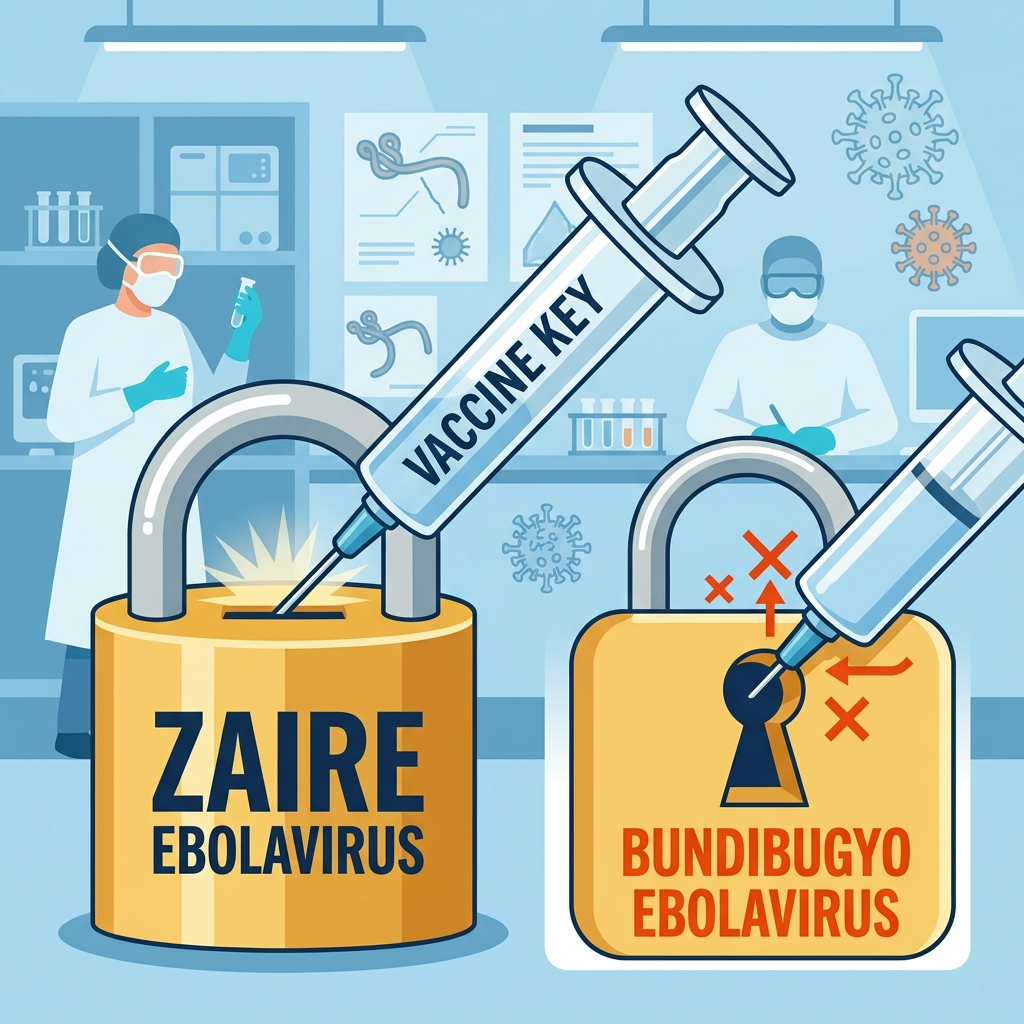
Ervebo, Inmazeb, and Ebanga — the three licensed Ebola countermeasures that transformed Zaire ebolavirus into a manageable disease — were all engineered against a single molecular target: the surface glycoprotein of Zaire ebolavirus. Bundibugyo ebolavirus belongs to the same genus but is a distinct species with a meaningfully different glycoprotein structure, and that difference is not cosmetic. The glycoprotein is precisely what vaccines train the immune system to recognize, and it is what monoclonal antibody therapeutics physically bind to neutralize the virus. When the glycoprotein structure changes between species, the immune response built against one does not transfer cleanly to the other. A 2026 study in CDC Emerging Infectious Diseases quantified exactly how much that transfer fails: Ervebo-vaccinated ferrets showed Zaire-specific antibody geometric mean titers of 56,554, versus just 16,582 for Bundibugyo cross-reactive antibodies — a 73% reduction, statistically significant at p = 1.6×10⁻⁴. WHO's Strategic Advisory Group of Experts reviewed these data and explicitly prohibited Ervebo's programmatic deployment against Bundibugyo outside controlled research settings. The consequence is stark: as of July 2026, not a single approved medical countermeasure can be administered to a Bundibugyo patient. Every case is being managed with the same tools available in the 1970s — supportive care, isolation, and hope.
The 19-Year Gap: How Market Logic Becomes a Death Sentence
Bundibugyo ebolavirus was first identified in Bundibugyo District, Uganda, in 2007, following an outbreak that infected 116 people and killed 39 at a case fatality rate of approximately 34%. Then, for 19 years, it disappeared from confirmed outbreak records entirely. From a pharmaceutical economics standpoint, this perfect rarity made Bundibugyo invisible as an R&D target. The pathogen's infrequency eliminated the market justification that drives drug development under the current global system — no anticipated patient population, no revenue model, no investment case. A Springer Nature analysis of neglected tropical disease R&D found that the annual funding shortfall exceeds $400 million, and that in the entire decade from 2000 to 2011, just four new drugs (0.5% of total approvals) specifically addressed neglected tropical diseases. A 2026 Wellcome Trust analysis confirmed the structural double neglect for Bundibugyo: in 19 years since its discovery, no species-specific vaccine, no therapeutic agent, and no rapid diagnostic test was developed. GeneXpert, the international field standard for Ebola rapid diagnostics, was designed for Zaire and cannot detect Bundibugyo. This meant that clinicians in Ituri Province were managing febrile patients without knowing they were dealing with Ebola at all, because the only available diagnostic tool returned false negatives. What the 19-year gap reveals is a system operating on an implicit principle worth stating directly: under current market-driven R&D structures, people who contract pathogens with insufficient commercial viability are not factored into the investment calculus.
The Diagnostic Black Hole: How GeneXpert's Blind Spot Enabled Silent Spread
The role of diagnostic failure in amplifying this outbreak is one of the most underreported elements of the crisis. GeneXpert RT-PCR is the gold-standard point-of-care diagnostic for Ebola in field settings — rapid, deployable without laboratory infrastructure, widely trusted, and endorsed by WHO as the recommended first-line confirmatory tool. It was designed and validated specifically for Zaire ebolavirus. It does not detect Bundibugyo, because the target sequences are species-specific. According to an International Pathogen Preparedness Secretariat Day 15 briefing, this diagnostic gap delayed case confirmation by multiple weeks during the critical early phase of the outbreak, allowing the virus to spread within health facilities before any Ebola-specific infection control measures were activated. The first known confirmed case was a healthcare worker — infected before the outbreak was identified as Ebola, before GeneXpert's failure mode was understood, and before alternative confirmatory testing was deployed. MSF reports that 102 healthcare workers have been infected and 25 have died, numbers that represent both an immense human tragedy and a direct degradation of response capacity. The practical implication for clinicians is severe: without a Bundibugyo-specific rapid diagnostic, every febrile patient with hemorrhagic symptoms must be treated as a potential Ebola case, placing impossible demands on already-strained facilities. Until a deployable Bundibugyo-specific rapid diagnostic is developed and distributed, this triple deficit of no vaccine, no therapeutic, and no fast diagnostic will make every subsequent cluster harder to contain than it should be.
Non-Pharmacological Control: What the 70% Isolation Threshold Actually Means
With no vaccine and no therapeutic available, the entire burden of Bundibugyo control falls on the same public health fundamentals that have been used against Ebola since 1976: rapid case identification, patient isolation, 21-day contact monitoring, safe burial, and community engagement. These tools work. DRC has successfully ended 16 previous Ebola outbreaks using exactly these approaches, which is a fact that deserves more weight than it typically receives. What CDC MMWR scenario modeling does is make the performance requirements for these tools precise and quantifiable. The modeling is stark: at the current approximately 20% isolation rate, the probability of exceeding 20,000 cumulative cases within 90 days is 65%. Push that isolation rate to 70%, and the probability of exceeding 10,000 cases in the same period drops to 5%. That is not a marginal improvement — it is a categorical shift in outbreak trajectory. The distance between a 20% and a 70% isolation rate is not a scientific problem; it is a logistical and operational one, requiring enough trained contact tracers, enough functional isolation facilities, enough community trust, and enough physical access to transmission hotspots. WHO reports that some health zones in Ituri have already achieved 70–100% contact tracing coverage, demonstrating that the threshold is operationally achievable. The evidence-based response to Bundibugyo is not border closure; it is massive, sustained investment in the contact tracing and isolation infrastructure that the modeling shows can actually contain transmission.
CEPI's Three-Platform Vaccine Strategy: Portfolio Insurance in a Crisis
CEPI's decision to simultaneously fast-track three Bundibugyo vaccine candidates represents a different strategic logic than conventional drug development — closer to a portfolio hedge than a linear pipeline. The three platforms in the portfolio each carry distinct risk profiles: IAVI's rVSV-based candidate (up to $3.2 million committed, 100% non-human primate protection confirmed), Oxford's ChAdOx1 adenovirus vector candidate (up to $8.6 million, using the same platform as AstraZeneca's COVID-19 vaccine), and Moderna's mRNA candidate (up to $50 million, still in preclinical development). Running three fundamentally different technical approaches simultaneously means that a failure mode specific to one platform does not collapse the entire effort. The U.S. State Department has committed $270 million in total Ebola response funding, including a $50 million additional commitment to CEPI in June 2026. CEPI's total Bundibugyo vaccine portfolio represents the largest coordinated R&D mobilization for any non-Zaire ebolavirus species in history. CEPI CEO Richard Hatchett's statement that every day counts in the race against this deadly disease reflects a genuine urgency that the investment figures support. However, the gap between funding commitment and field-deployable countermeasure remains measured in months to years — IAVI's rVSV candidate requires 7–9 months just to secure clinical trial materials, and Oxford's ChAdOx1 lacks any human safety data for its Bundibugyo construct despite manufacturing readiness. The most optimistic realistic scenario has at least one candidate reaching limited emergency use authorization by late 2027.
Positive & Negative Analysis
Positive Aspects
- CEPI's Three-Platform Vaccine Portfolio: Genuine Strategic Insurance
CEPI's decision to simultaneously fast-track three Bundibugyo vaccine candidates across fundamentally different technical platforms is the most substantive positive development in this outbreak response. The rVSV platform (IAVI), the adenovirus vector platform (Oxford ChAdOx1), and the mRNA platform (Moderna) each carry distinct risk profiles and distinct development timelines, providing insurance against platform-specific failure modes that a single-track approach could not offer. If the rVSV candidate encounters an unexpected safety signal, the ChAdOx1 and mRNA programs continue independently. If manufacturing constraints affect one approach, the others can partially compensate. This is portfolio strategy applied to emergency medicine, and it reflects a genuine institutional learning from COVID-19 about how to hedge R&D risk in outbreak conditions. The Oxford ChAdOx1 candidate carries particular near-term significance because it uses manufacturing infrastructure and quality control protocols already established for AstraZeneca's COVID-19 vaccine, eliminating a development bottleneck that would otherwise require years to resolve. CEPI's total Bundibugyo portfolio investment exceeds $60 million — the largest coordinated R&D mobilization for any non-Zaire ebolavirus species in history. If the multi-platform strategy succeeds, it will serve as a precedent for how to mount rapid medical countermeasure responses to emerging pathogens that lack a pre-existing development program, and that precedent matters beyond this single outbreak.
- DRC's Seventeen Outbreaks, Seventeen Terminations: An Irreplaceable Track Record
The Democratic Republic of Congo has faced Ebola seventeen times since the disease was first identified in 1976, and it has successfully ended all sixteen previous outbreaks — a record no other country on Earth can claim. WHO Director-General Tedros, speaking at a press conference in Bunia, stated that this history provides genuine grounds for operational confidence, and I think that framing is empirically accurate rather than merely diplomatic. What this track record represents in practical terms is deep institutional memory in the most specific possible domain: Ebola outbreak control in DRC's particular geographic, social, and political context, where trust is earned through direct community relationships rather than official channels. DRC health workers know how to conduct safe burials in communities deeply resistant to changing burial practices. They know which community leaders have credibility when official government messaging does not reach people. Contact tracing infrastructure and community health volunteer networks built during previous Zaire Ebola responses are being adapted and deployed for Bundibugyo now. WHO reports that some health zones have already achieved 70–100% contact tracing rates, demonstrating that the institutional capability is real. The absence of a species-specific vaccine does not eliminate this accumulated human expertise, and that expertise is a genuine structural advantage in an otherwise challenging situation.
- International Funding at Unprecedented Scale for a Non-Zaire Ebolavirus
The U.S. State Department's $270 million total Ebola response commitment, combined with CEPI's $60+ million vaccine portfolio and bilateral contributions from multiple European governments, represents the largest international financial response to a non-Zaire Ebola outbreak in history. WHO's PHEIC declaration on May 17 provided the legal and political triggering mechanism that unlocked this mobilization, demonstrating that the PHEIC framework can function as intended when circumstances clearly warrant its use. The scale of international commitment at least demonstrates that the global health architecture is capable of recognizing and responding to a non-Zaire ebolavirus crisis, which was not obvious before this outbreak. The composition of the funding matters as much as its scale. Investment concentrated in upstream MCM development at the expense of field operational capacity will produce vaccine candidates that arrive after the outbreak has run its course. Early signals suggest the portfolio includes both development funding and operational support for isolation infrastructure, contact tracing, and healthcare worker safety. That the international community mobilized at this scale for a non-Zaire ebolavirus outbreak is itself a meaningful departure from the historical neglect that allowed the 19-year Bundibugyo R&D vacuum to persist.
- High-Performing Health Zones Prove the 70% Threshold Is Achievable
WHO's Disease Outbreak News DON608 reports that some health zones in Ituri Province have already achieved 70–100% contact tracing coverage despite having no pharmacological countermeasure available. This is empirically significant because the CDC MMWR scenario model identifies the 70% isolation rate as the threshold at which outbreak trajectory shifts from alarming to manageable — reducing the probability of exceeding 10,000 cases in 90 days to just 5%. The performance of high-functioning zones proves that this threshold is not theoretical; it is operationally achievable in the actual geographic and social context of eastern DRC, with the human resources currently available. The mechanism enabling this performance is the community health worker and contact tracing infrastructure built through sixteen previous Ebola responses in DRC. The fact that infrastructure built for Zaire is partially transferable to Bundibugyo despite the absence of a species-specific vaccine reflects the underlying quality of the public health system being leveraged. Scaling what high-performing health zones are already demonstrating to all 26 infected health zones is the single most actionable short-term intervention available. International support concentrated on this operational gap — more contact tracers, more isolation capacity, more healthcare worker protection in conflict-affected zones — is where marginal resources will have the highest impact on outbreak trajectory in the immediate term.
Concerns
- The Vaccine-to-Field Timeline: Lives Lost in the Development Gap
The single most sobering constraint in this outbreak is the irreducible time gap between fast-tracking vaccine development and the moment a validated, deployable vaccine can actually be administered to at-risk populations. Even the most advanced CEPI candidate — IAVI's rVSV platform with confirmed non-human primate protection — requires 7–9 months just to secure clinical trial materials. Oxford's ChAdOx1 can begin manufacturing rapidly but carries zero human safety data for its Bundibugyo construct, which means regulatory agencies must navigate genuinely difficult risk-benefit tradeoffs before authorizing emergency use. The COVID-19 emergency use authorization precedent is real but has limits. COVID-19 created political and public health conditions — a global pandemic affecting every country simultaneously — under which the scientific community and regulatory agencies broadly agreed that fast-track authorization benefits dramatically outweighed incomplete safety data risks. Bundibugyo is concentrated in DRC and Uganda, with isolated exported cases in Europe. The population directly at risk is different, political will in high-income countries is lower, and the ethical calculus of deploying unvalidated vaccines in specific African populations carries historical weight that cannot be ignored. I anticipate ChAdOx1 can realistically reach a limited emergency use scenario in Q4 2026, with Q1 2027 as the more probable timeline. During every month of that interval, the disease will continue killing at its untreated 30–50% case fatality rate.
- The 69.3% South Sudan Spillover Probability: Ebola Meets Infrastructure Collapse
The Lancet Infectious Diseases probabilistic spillover model estimates a 69.3% probability of Bundibugyo importation into South Sudan within 12 weeks. That number demands sustained attention because South Sudan's health system is not merely under-resourced — in large portions of the country, it is functionally absent. Decades of civil war have destroyed hospital infrastructure, depleted the healthcare workforce, and created governance gaps that make sustained contact tracing operations essentially impossible to establish from scratch during an active outbreak. Ugandan spillover has already been confirmed at 20 cases and 2 deaths. France has received an exported case. A U.S. citizen humanitarian worker tested positive on July 10 and was medically evacuated to Germany three days later. The export geography tells us that this is no longer a containment scenario in any simple geographic sense. If Bundibugyo establishes sustained transmission in South Sudan, the modeling assumptions that produce the Lancet's base-case median of 8,210 cases by September 2026 will no longer hold. A secondary outbreak in South Sudan could push cumulative figures into ranges previously considered worst-case projections, and could do so without the institutional knowledge and community health infrastructure that gives DRC its relative operational advantage.
- Healthcare Worker Mortality: Systemic Degradation of Response Capacity
MSF has reported 102 healthcare worker infections and 25 healthcare worker deaths in this outbreak. The first known confirmed case was a healthcare worker — infected before the outbreak was identified as Ebola, before infection prevention protocols were activated, and before GeneXpert's failure to detect Bundibugyo was understood. This is not a coincidence; it is the direct operational consequence of the diagnostic black hole, illustrating precisely how single system failures cascade into compound ones when the underlying infrastructure was never designed for the actual pathogen at hand. Healthcare workers are not interchangeable inputs in outbreak response. They are the irreplaceable human infrastructure through which every non-pharmacological control measure operates. Each infected healthcare worker is a trained contact tracer removed from the field. Each death is an experienced clinician who cannot staff isolation units, teach safe burial procedures, or identify new cases before they generate secondary transmission chains. The 25 deaths represent approximately a 24.5% case fatality rate among infected healthcare workers, roughly consistent with the general population rate. Protecting healthcare worker safety is not a secondary priority in this response — it is a precondition for every other intervention functioning at all.
- Armed Conflict in Eastern DRC: The Variable That Derails Every Model
Ituri Province, the epicenter of this outbreak, sits in one of the most persistently conflict-affected regions in the world. Multiple armed groups operate across the area, healthcare worker access to active transmission zones is physically blocked in some areas, and the security situation means that international personnel face risks that standard humanitarian access principles do not fully mitigate. This variable does not appear explicitly in the CDC MMWR scenario models, but it directly determines whether the 20% isolation rate that drives worst-case projections can realistically be improved. The 2018–2020 Zaire Ebola response in eastern DRC was repeatedly disrupted by attacks on Ebola treatment centers — a documented pattern that extended the outbreak timeline and almost certainly increased total case counts above what would have occurred in a stable environment. That response eventually succeeded, but only with vaccine and therapeutic tools that are not available for Bundibugyo. The current response is operating in the same region, with similar security dynamics, and without the pharmacological safety net that ultimately supported the earlier effort. CDC's scenario in which a 20% isolation rate persists is not pessimistic abstraction; it is what happens when access constraints prevent the contact tracing and isolation operations from reaching the populations that most urgently need them.
- GeneXpert's Bundibugyo Blind Spot: The Diagnostic Failure That Amplified Everything
The GeneXpert RT-PCR system's inability to detect Bundibugyo ebolavirus represents perhaps the most systematically underappreciated risk factor in this outbreak. GeneXpert is the international field standard for Ebola rapid diagnostics — deployable without laboratory infrastructure, delivering results in under two hours, and trusted by WHO as the recommended first-line confirmatory tool. None of that functionality applies to Bundibugyo, because the assay was designed around Zaire-specific genetic sequences. When a febrile patient with hemorrhagic symptoms tests GeneXpert-negative, clinicians have no diagnostic signal to maintain Ebola-grade infection control precautions. This failure was not a technical defect in GeneXpert's implementation; it was an inherent consequence of the same commercial logic that left Bundibugyo therapeutically orphaned for nineteen years. Zaire ebolavirus has a large established diagnostic market; Bundibugyo had not caused a confirmed outbreak for two decades, eliminating any incentive to develop or validate species-specific assays. The Bundibugyo-specific RT-PCR assays that can actually detect this outbreak strain require specialized laboratory infrastructure unavailable at the community health center level where most initial patient contact occurs. Until a field-deployable Bundibugyo-specific rapid diagnostic is developed, validated, and distributed at scale, clinicians will face unresolvable diagnostic uncertainty with every febrile patient in an affected area.
Outlook
Looking at the next one to six months — the short-term horizon — I believe this outbreak has not yet reached its peak. The clearest quantitative frame for the stakes comes from CDC MMWR scenario modeling: if the DRC and international partners can push the patient isolation rate from its current approximately 20% to 70%, the probability of exceeding 10,000 cumulative cases within three months drops to just 5%. Maintain the current 20% rate, and the probability of exceeding 20,000 cases in the same window climbs to 65%. That is not a marginal difference — it is a categorical shift in outbreak trajectory, achievable without a vaccine or therapeutic, through operational improvements alone. The distance between those two scenarios is the operational gap this response is currently racing to close.
WHO has reported that some health zones in Ituri Province have already achieved 70–100% contact tracing rates. That is genuinely important evidence: it demonstrates that the 70% isolation threshold is operationally achievable in the actual geographic and social context of eastern DRC, with the human resources currently available. The problem is that this reflects the performance of specific high-functioning zones, not the average across all 26 infected health zones, many of which include conflict-affected areas where healthcare workers cannot safely operate. What some zones can do and what all zones are doing are separated by a logistical and security gap that determines everything in the short term. The 736 patients currently in isolation represent a baseline of functioning infrastructure; whether that baseline scales fast enough is the operative question.
The single most urgent short-term variable is South Sudan. The Lancet Infectious Diseases probabilistic spillover model places the 12-week importation probability at 69.3%, and South Sudan's health system — devastated by decades of civil conflict — lacks the institutional capacity to mount even a baseline contact tracing operation from scratch during an active outbreak. Ugandan spillover has already materialized at 20 confirmed cases and 2 deaths. A French export case has been confirmed, and a U.S. citizen humanitarian worker who tested positive on July 10 was medically evacuated to Germany three days later. The question is no longer whether Bundibugyo will cross international borders. It is whether secondary transmission chains will establish themselves in receiving countries and, critically, whether South Sudan can contain an imported case before it seeds a parallel outbreak.
On the vaccine front, the short-term picture is more constrained than public announcements suggest. Oxford's ChAdOx1 candidate can realistically begin manufacturing scale-up within two to three months, given that it uses the same adenovirus vector platform as AstraZeneca's COVID-19 vaccine and the manufacturing processes are already established. But no human safety data exists for this specific Bundibugyo construct. The COVID-19 precedent for emergency use authorization is real, but the political and social context is different: COVID-19 created overwhelming global pressure for compressed regulatory timelines, while Bundibugyo remains concentrated in DRC and Uganda. My realistic expectation is that ChAdOx1 could enter a limited emergency use scenario in Q4 2026, with Q1 2027 as the more probable timeline.
Turning to the medium-term view — six months to two years — the pivotal questions are whether IAVI's rVSV candidate can clear human safety trials and whether the Lancet's base-case scenario of approximately 8,210 cumulative cases by September 2026 holds. The researchers behind the Lancet model have assessed that the recent case trajectory appears closer to the median-to-lower range than to the worst-case projection, which is the best available piece of relative good news in an otherwise grim picture. IAVI's rVSV platform showed 100% non-human primate protection, with CEPI committing up to $3.2 million. But clinical material procurement alone takes 7–9 months, meaning the earliest realistic field deployment is late 2027. The Moderna mRNA candidate, with the single largest CEPI Bundibugyo investment at $50 million, remains in preclinical development. The most optimistic realistic medium-term expectation is that at least one candidate reaches limited emergency deployment in the second half of 2027.
The therapeutic pipeline is even further from the field. Mapp Biopharmaceutical's MBP134 aims to be a pan-ebolavirus monoclonal antibody cocktail that would address multiple species simultaneously. In vitro data suggests that maftivimab — a component of Inmazeb — may retain activity against Bundibugyo, and combinations of remdesivir with monoclonal antibodies are under evaluation. The translation time from in vitro activity to validated human clinical efficacy is typically measured in years, not months, and a realistic expectation for a Bundibugyo-specific therapeutic with clinical validation is 2027–2028 in the most optimistic scenario. Between now and then, thousands of people will face a 30–50% case fatality rate with no pharmacological option. The $270 million committed by the U.S. State Department will have meaningful impact only if a substantial portion reaches field diagnostic and isolation infrastructure rather than concentrating entirely in upstream development pipelines.
For the long-term view of two to five years, I want to lay out three scenarios with analytical honesty about what I consider probable. In the optimistic scenario, at least one CEPI candidate receives regulatory approval and WHO prequalification between 2027 and 2028. A pan-ebolavirus vaccine strategy covering multiple species is actively developed. The outbreak ends in late 2026 or early 2027 with total cases in the 5,000–8,000 range. South Sudan spillover occurs but is contained early through sustained international operational support. This scenario requires isolation rates to reach 70% or higher across all affected health zones and for international field operational capacity to dramatically increase.
In the base-case scenario — which I consider the most probable trajectory — the outbreak extends into early 2027, accumulating 8,000–15,000 total cases. Sporadic cross-border spillover to South Sudan and neighboring countries occurs but does not produce large-scale secondary outbreaks. At least one vaccine candidate enters emergency use during 2027, but mass vaccination campaigns require additional months. The outbreak eventually ends through a combination of intensified non-pharmacological control and early vaccine access, but not before substantial additional mortality.
The pessimistic scenario is the one I find genuinely disturbing when I think through the specific mechanisms that would produce it. If isolation rates remain near the current 20% level — driven by persistent armed conflict blocking healthcare access to transmission hotspots — the Lancet's worst-case projection of 66,000+ cases becomes a live probability. Spillover to South Sudan at scale, followed by cascading spread into Central African Republic and other infrastructure-depleted neighbors, would test whether the international community has genuinely absorbed the lessons it claimed to learn from 2014–2016. That West Africa outbreak also began with early reassurances that the situation was under control. The virus spread because of response delays and resource shortfalls, not because of inherent biological inevitability. The same dynamics are present and active today.
The deepest long-term question is structural: will this outbreak change the R&D incentive problem that created the Bundibugyo gap? I am skeptical but not without hope. The Lancet's framing of this PHEIC as "a turning point for solidarity and health equity" is aspirational language, and aspirational language has historically not translated into the $400 million annual neglected tropical disease R&D funding shortfall getting closed. What would actually close that gap requires binding commitments in whatever pandemic treaty framework emerges from ongoing WHO negotiations, mandatory pathogen-platform licensing for rare but high-consequence pathogens, and advance market commitment mechanisms for pathogens that clear an epidemiological risk threshold even when they lack commercial viability. If the pandemic treaty being negotiated by member states focuses primarily on the next COVID-19 and fails to account for the next Bundibugyo, it will be institutionally obsolete before it is ratified. That is the generational lesson that 719 deaths — and counting — are writing in the clearest possible terms.
Sources / References
- Epidemic of Ebola Disease Caused by Bundibugyo Virus Declared a PHEIC — WHO
- Ebola Disease Caused by Bundibugyo Virus, DRC & Uganda — Disease Outbreak News DON608 — WHO
- Bundibugyo Virus Disease in 2026 — Clinical and Public Health Responses — New England Journal of Medicine
- Antibodies Cross-Reactive with Bundibugyo Virus in Ferrets Vaccinated with Ebola Virus Vaccine — CDC Emerging Infectious Diseases
- Size of the 2026 Ebola Outbreak and Risk of Cross-Border Spillover from Bundibugyo Virus — The Lancet Infectious Diseases
- CEPI Fast-Tracks Three Bundibugyo Ebolavirus Vaccine Candidates — CEPI
- Modeled Scenario Projections for the Ebola Disease Outbreak Caused by Bundibugyo Virus, 2026 — CDC MMWR
- Bundibugyo Virus: Why This Ebola Disease Outbreak Is Different — Doctors Without Borders / MSF
- Bundibugyo Ebola Without Vaccines or Therapeutics: Why Public Health Fundamentals Matter More Than Border Closures — Africa CDC / Nature Medicine
- Ebola Response Update — June 12, 2026 — U.S. Department of State
- The Pharmaceutical Industry's Multifaceted Role in Neglected Tropical Disease Control — Springer Nature / Tropical Medicine and Health