
The Sun's Neutrinos Are Lying — Or the Textbook Is Wrong
Summary
China's JUNO (Jiangmen Underground Neutrino Observatory), the world's largest liquid scintillator neutrino detector buried 700 meters underground in Guangdong province, has achieved the most precise measurement of neutrino oscillation parameters ever recorded — sin²θ₁₂ = 0.3092 and Δm²₂₁ = 7.50 × 10⁻⁵ eV² — using just 59.1 days of operational data, earning the cover of Nature in June 2026. Crucially, the results confirm that the so-called "solar neutrino tension" — a persistent 1.5-sigma discrepancy between solar neutrino and reactor antineutrino measurements — remains unresolved, suggesting that physics beyond the Standard Model may be lurking in the neutrino sector. This tension has been consistently observed across independent experiments including SNO, Super-Kamiokande, Borexino, and KamLAND, making it far too systematic and multi-decade to dismiss as a statistical fluke. Built for $300 million, JUNO is already delivering world-leading science six years ahead of the $3+ billion U.S. DUNE experiment, marking a structural shift in the geography of fundamental physics. With China surpassing the U.S. in Nature Index publications in 2024 by a margin of 37,273 to 31,930, JUNO's Nature cover is simultaneously a scientific milestone and an unmistakable geopolitical statement about the realignment of global science leadership.
Key Points
JUNO's 59-Day World Record Precision
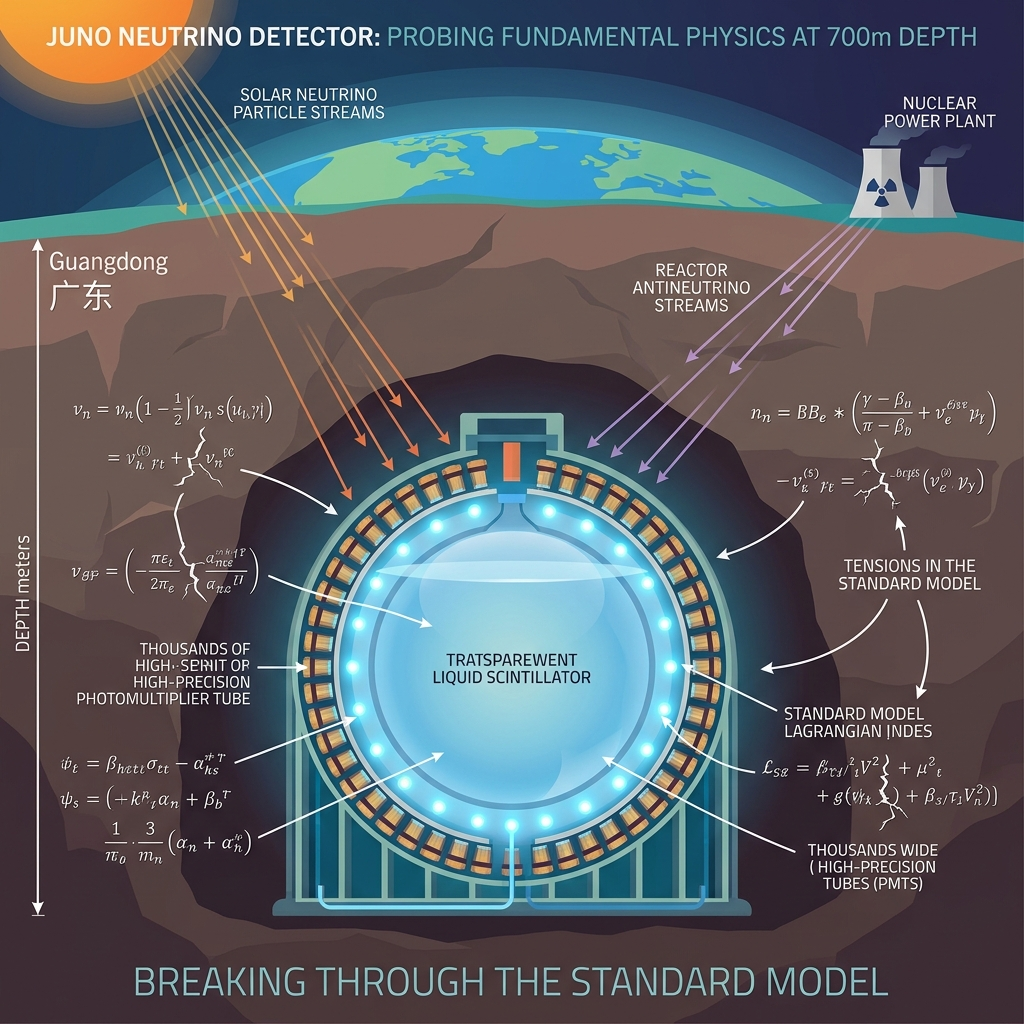
JUNO (Jiangmen Underground Neutrino Observatory) is the world's largest liquid scintillator neutrino detector, positioned 700 meters underground in Kaiping, Guangdong province, China, housing 20,000 tons of liquid scintillator inside a 35.4-meter acrylic sphere surrounded by 20,000 twenty-inch photomultiplier tubes and 25,600 three-inch photomultiplier tubes — a configuration that dwarfs the previous record-holder, KamLAND, by a factor of 20. In just 59.1 days of operation after its August 2025 completion, JUNO achieved sin²θ₁₂ = 0.3092 ± 0.0087 and Δm²₂₁ = (7.50 ± 0.12) × 10⁻⁵ eV² — the highest-precision neutrino oscillation measurements ever recorded, improving θ₁₂ precision 1.6-fold and Δm²₂₁ precision 1.8-fold over all prior experiments combined. Nobel laureate Arthur McDonald praised the detector's exceptional radiopurity, energy resolution, and detector stability, confirming that these extraordinary results reflect genuine engineering achievement rather than statistical fortune. UC Irvine's Juan Pedro Ochoa-Ricoux, a JUNO co-leader, independently verified that the physics result is already world-leading in the areas that it touches, underscoring the consensus across the collaboration and the broader community. With a design lifetime exceeding 30 years, JUNO's first 59-day dataset functions as a proof-of-concept for what a full decade of data will deliver — and the long-term scientific potential is without parallel in the neutrino physics field.
Solar Neutrino Tension — Two Decades of a Stubborn Discrepancy
The solar neutrino tension confirmed by JUNO refers to a 1.5-sigma discrepancy between neutrino oscillation parameter values obtained from solar neutrino experiments — such as SNO and Borexino — and those obtained from reactor antineutrino experiments like KamLAND and JUNO itself, with solar measurements consistently yielding higher values than reactor measurements. Italy's INFN stated officially that JUNO confirms this tension, which the experiment will be able to verify definitively, marking the first time a single experiment with world-leading precision has directly corroborated this long-standing discrepancy. What elevates this beyond a typical statistical anomaly is its multi-experiment consistency: SNO, Super-Kamiokande, Borexino, and KamLAND — each using entirely different detector technologies, geographic locations, and analysis frameworks — all observe the offset in the same direction over more than two decades of independent measurement. The Standard Model originally predicted that neutrinos have precisely zero mass; the discovery of neutrino oscillations in 1998 forced a major revision of that prediction, and the solar tension suggests that the 1998 revision may itself be incomplete. If confirmed at higher statistical significance, this would represent the second time in thirty years that the neutrino sector has exposed a fundamental gap in our most successful theory of particle physics, with implications far broader than the neutrino field alone.
Three New Physics Hypotheses — And JUNO Already Began Eliminating Territory
Three leading explanations compete to account for the solar neutrino tension: sterile neutrinos (hypothetical particles interacting only gravitationally, outside the Standard Model's forces), non-standard interactions or NSI (undiscovered forces coupling neutrinos to ordinary matter through exchange particles beyond the Standard Model's gauge structure), and CPT symmetry violation (physics operating asymmetrically for neutrinos versus antineutrinos). Even with just 59 days of data, JUNO has already constrained all three scenarios meaningfully: sterile neutrino mixing down to sin²2θ₁₄ ~ O(10⁻¹) across mass-squared splittings spanning 10⁻⁵ to 10⁻² eV², and NSI parameters bounded to −0.0036 < ηee < 0.0034 at 90% confidence, per arXiv:2603.24677. The NSI hypothesis is currently the most physically motivated candidate because the Sun's extreme matter density amplifies NSI effects, naturally producing a wedge between solar and reactor oscillation parameters — a mechanism that emerges from first principles rather than requiring exotic ad hoc particles. The stakes of these three explanations differ enormously: sterile neutrinos would expand the Standard Model's particle inventory without changing its theoretical architecture; NSI would demand a new gauge interaction altering the Standard Model's mathematical structure; CPT violation would require a fundamental reexamination of the foundations of quantum field theory itself. JUNO's accumulation of data over the next six years is what will ultimately discriminate between these scenarios and determine which category of revolution physics is facing.
Geopolitical Shift — One-Tenth the Cost, Six Years Ahead
JUNO is as significant geopolitically as it is scientifically, representing a concrete data point in the ongoing realignment of where the world's frontier basic science infrastructure is built and operated. At a construction cost of approximately $300 million, JUNO is delivering world-leading neutrino physics six years before the U.S. DUNE experiment, which has exceeded $3 billion in costs and won't begin operations until 2031 — a ten-to-one cost differential that reflects structural differences in how large-scale science is planned and executed in China versus the United States. In the 2024 Nature Index, China produced 37,273 high-quality research articles versus the U.S.'s 31,930, a 17% margin representing a complete reversal from 2020, when the U.S. led by 53%, with China's annual research growth rate of 18% dwarfing the U.S. rate of 2.3%. The Chinese Academy of Sciences has topped the world institutional research rankings for 13 consecutive years, and China's basic research budget crossed 7% of total R&D spending for the first time in 2025, reaching 280 billion yuan. JUNO's Nature cover in this context is not coincidental — it is the flagship event in a structural realignment of where fundamental science gets done, who sets the research agenda, and who trains the next generation of theoretical and experimental physicists.
JUNO's Unique Advantage — Observing Solar and Reactor Neutrinos Simultaneously
The most important technical distinction of JUNO over every other neutrino experiment is that it can observe both solar neutrinos and reactor antineutrinos in the same detector, under identical conditions, analyzed through the same pipeline — an experimental configuration that no other facility in the world can replicate. Every previous comparison between solar and reactor neutrino oscillation parameter values was comparing results from two different experiments, with two independent sets of systematic uncertainties, detector biases, and calibration assumptions — a comparison of apples and oranges that can never fully close the experimental artifact objection. JUNO eliminates that inter-experiment systematic by design: if the solar tension persists within a single, unified detector measuring both simultaneously, the argument that it is merely an artifact of comparing dissimilar experimental setups becomes essentially indefensible. Per JUNO's Technical Design Report, ten years of operation will yield approximately 60,000 signal events from solar neutrinos alone, with additional spectroscopic capability for multiple solar neutrino channels across the full energy spectrum. Combined with its precise 53-kilometer baseline from multiple reactor cores — optimized for detecting the subtle energy-spectrum interference pattern that distinguishes normal from inverted mass ordering — JUNO is the only currently operating experiment simultaneously attacking the two largest open questions in neutrino physics: the mass ordering and the solar-reactor tension.
Positive & Negative Analysis
Positive Aspects
- Detector Performance Is Proven Beyond Any Reasonable Doubt
JUNO's ability to surpass the combined precision of decades of global neutrino measurements using just 59 days of data is a definitive proof of engineering excellence, not a lucky statistical fluctuation. Improving θ₁₂ precision 1.6-fold and Δm²₂₁ precision 1.8-fold over all prior experiments combined confirms that the detector's energy resolution and radiopurity genuinely meet or exceed the design specifications that were promised during the funding and construction phases. UC Irvine's Juan Pedro Ochoa-Ricoux confirmed that the physics result is already world-leading in the areas that it touches, a sentiment echoed independently by Nobel laureate Arthur McDonald, who called the detector's performance exceptional — rare praise from scientists trained to understate. These record-breaking results validate not just the 59-day dataset but the entire three-year construction and commissioning process, and they establish a credibility baseline for every result JUNO will publish over the next 30 years. Given a design lifetime of three decades, a detector performing at this level from day one will ultimately produce a neutrino dataset with no parallel in the history of experimental physics — the long-term scientific return on this investment is extraordinary.
- JUNO Demonstrates the Enduring Value of Pure Basic Science
Neutrino research will not make your phone faster, cure a disease this year, or generate electricity — and that is precisely the point worth defending. The history of physics shows repeatedly that useless basic research becomes indispensable technology thirty to fifty years downstream: Maxwell's electromagnetic equations became power grids and radio; quantum mechanics became semiconductors and MRI scanners; general relativity became GPS navigation accurate to within meters. JUNO project manager Yifang Wang captured the deeper motivation well: by studying neutrinos, we can understand why the universe has become what it is today. The involvement of more than 700 scientists from 75 institutions across 17 countries is itself powerful evidence that pure science retains its unique ability to unite people across geopolitical fault lines in pursuit of shared understanding. The willingness to spend hundreds of millions of dollars to understand a particle that passes through the entire Earth without noticing — that kind of irreducibly human curiosity about fundamental reality — is, in my view, one of the clearest markers of what civilization actually is for. JUNO is a monument to that impulse, and the monument is producing results.
- International Scientific Collaboration Proved It Still Works at Scale
At a moment when U.S.-China relations are under severe strain across technology sectors, trade, and security policy, JUNO stands as an existence proof that deep scientific collaboration between these two countries — alongside 15 others — remains not just viable but productive. Italy's INFN, Germany's DESY, and France's IN2P3 are all active JUNO partners, meaning the experiment simultaneously bridges the major physics powers of three continents under Chinese leadership and international intellectual ownership. Nature's reviewers described JUNO as a key player in the emerging precision era of neutrino oscillation physics, an institutional endorsement of both the science and the collaborative model that produced it. I believe the JUNO template — Chinese-led, internationally co-executed, globally published with full authorship credit — could serve as a workable model for scientific cooperation on other challenges where global coordination matters, from climate monitoring infrastructure to fusion energy research. The fact that this model worked, at unprecedented scale, roughly on schedule, and significantly ahead of the competing Western program says something important about science's resilience as a connector across political divisions.
- JUNO Creates a Clear Path Toward Resolving Neutrino Mass Ordering
The neutrino mass ordering question — whether the third mass eigenstate is heavier (normal ordering) or lighter (inverted ordering) than the other two — is one of the most consequential unresolved questions in contemporary particle physics, carrying implications for neutrinoless double beta decay searches, cosmological neutrino mass constraints, and leptogenesis models that explain matter-antimatter asymmetry. JUNO's detector geometry, positioned precisely 53 kilometers from multiple reactor cores, is specifically optimized to detect the subtle interference pattern in the antineutrino energy spectrum that distinguishes normal from inverted ordering, and the experiment is designed to resolve this question at better than 3-sigma confidence. Combined with NOvA and T2K data already showing roughly 3-sigma preference for normal ordering, JUNO could deliver a definitive mass-ordering result before 2028, setting boundary conditions that constrain or enable entire classes of theoretical physics beyond the Standard Model. Once mass ordering is resolved, JUNO's simultaneous solar neutrino dataset becomes even more diagnostic for the solar tension, since the two observables are physically correlated and cannot be optimally interpreted in isolation from each other. This dual capability — attacking both the mass ordering and the solar tension with a single instrument — makes JUNO's long-term scientific program uniquely efficient and mutually reinforcing.
Concerns
- 1.5 Sigma Is Still a Statistically Fragile Signal
The fundamental problem with the solar neutrino tension is that 1.5 sigma does not meet any standard threshold for scientific significance in particle physics. A 5-sigma significance level is required for a formal discovery announcement; even strong evidence typically demands a minimum of 3 sigma, and at 1.5 sigma, there is roughly a 13% probability of observing this discrepancy by chance even if absolutely no new physics exists. The history of particle physics is densely populated with 2-to-3-sigma anomalies that vanished under the weight of additional data — the 750 GeV diphoton signal at the LHC in 2015 generated hundreds of theoretical papers and genuine excitement before disappearing entirely, and the reactor antineutrino anomaly (RAA) rose to 2.2 sigma before retreating below 1 sigma after improved reactor flux modeling. JUNO's solar tension could follow the same trajectory if systematic errors in reactor antineutrino flux modeling or solar neutrino flux prediction prove larger than currently estimated. Until the significance crosses at least 3 sigma and is confirmed independently by a separate experiment, framing this as evidence for new physics is scientifically premature, and premature framing of this kind risks eroding public trust in scientific announcements when results require subsequent qualification.
- Media Overinterpretation Threatens Long-Term Public Trust in Science
Headlines declaring Standard Model collapse or physics revolution are already circulating in response to JUNO's results, despite the underlying signal being a 1.5-sigma discrepancy that the JUNO team itself consistently describes in cautious language as requiring substantially more data before any strong claim is warranted. When exciting physics results get amplified into falsely definitive media narratives, and the community subsequently has to walk claims back, the public learns to distrust not just that particular result but scientific announcements in general — a form of institutional credibility damage that accumulates slowly and is very difficult to reverse. The 2011 OPERA superluminal neutrino incident — ultimately traced to a faulty cable connector — created lasting cynicism about particle physics headlines among educated non-specialists. JUNO's scientists have been appropriately measured in their public statements; the responsibility now falls on science journalists and communicators to match that standard of precision. Accurately communicating this is a compelling, multi-decade, multi-experiment anomaly with roughly 1-in-8 odds of being pure statistical noise is both honest and genuinely compelling — there is simply no need to oversell what is already a remarkable and important scientific moment.
- Data Access and Independent Verification Remain Structurally Uncertain
JUNO is legally owned and operationally controlled by the Chinese Academy of Sciences, and while international partners currently receive data access through bilateral collaborative agreements, the long-term stability of these arrangements under changing political conditions cannot be assumed. The gold standard for large physics collaborations is CERN-style open data practice, where full detector datasets are released to independent analysts through public repositories several years after initial publication, enabling genuinely independent verification by researchers who had no role in the original analysis. It is not clear that JUNO has committed to an equivalent transparency standard, and the experiment's governance structure gives the Chinese Academy of Sciences unilateral authority over data access policy going forward. Independent reproducibility is not a procedural nicety in fundamental physics — it is the mechanism by which results become established knowledge rather than mere institutional claims, and it is especially critical when results may eventually carry the weight of overturning a foundational theoretical framework. If future JUNO results on the solar tension cannot be verified by external groups working directly with raw data, the scientific value of those results will be materially diminished regardless of publication venue, and the community's ability to distinguish real new physics from a persistent but undetected systematic error will be compromised.
- Growing Concentration of Basic Science Infrastructure Creates Systemic Risk
The pattern emerging from JUNO's success, China's CEPC planning, and the ongoing trajectory of China's R&D budget suggests that an increasing fraction of the world's frontier basic science infrastructure will be concentrated in a single country within the next decade. Healthy fundamental science depends on methodological diversity — multiple independent groups attacking the same questions simultaneously with different instruments, different systematic error profiles, and different institutional cultures — and that diversity is materially reduced when cost efficiency and scale advantages concentrate infrastructure in one geography. The U.S. DUNE experiment's cost overruns and six-year delay are partly symptoms of a broader slowdown in Western physics infrastructure investment; if that trend continues, JUNO will have no peer-review partner operating at comparable sensitivity for the most consequential measurements in its program. Hyper-Kamiokande's planned 2027 startup and DUNE's eventual operation are critical countermeasures to this concentration risk, and sustaining investment in both programs — despite JUNO's competitive head start — matters not just for national prestige but for the structural integrity of the global physics enterprise. Science optimally functions as a distributed, redundant system of independent verification; single points of failure in infrastructure create single points of failure in the knowledge-production process.
Outlook
In the short term — within the next six months — the JUNO team is highly likely to publish a second set of results incorporating data accumulated since the initial Nature paper. The first measurement used 59.1 days; by the end of 2026, the experiment will have logged more than 300 days of operation. With a five-fold increase in statistics, the uncertainty on sin²θ₁₂ could shrink from ±0.0087 to approximately ±0.004, and the statistical significance of the solar neutrino tension could climb from 1.5 sigma toward 2.0 to 2.5 sigma. If this inflection point arrives — and I think it will, somewhere between Q4 2026 and Q1 2027 — it will fundamentally change how the community frames the tension. A crossing of 2.0 sigma would move the solar tension from "interesting hint" to "anomaly requiring serious investigation" in the language that physicists and funding agencies actually respond to. Internally, the JUNO collaboration will also run blind cross-analysis: multiple independent analysis groups processing the same data through different pipelines to verify that the tension isn't an artifact of a particular analysis choice.
The same six-month window will see independent experiments weigh in. Japan's Super-Kamiokande and the upcoming Hyper-Kamiokande project, plus the U.S. NOvA experiment, will be re-examining their own datasets for consistency with JUNO's reported values. I expect the Neutrino 2026 international conference to be the most heated and consequential neutrino meeting in a decade — JUNO may preview updated analysis results, while competing groups present their own cross-checks. The combined NOvA and T2K datasets already show a roughly 3-sigma preference for normal mass ordering; how that finding interacts with JUNO's tension will be the central debate topic. Watch that conference closely, because what gets said there will set the research agenda for the entire neutrino physics community through at least 2028.
Moving into the medium term of 2027 to 2028, JUNO will have accumulated approximately two years of operational data, at which point it should produce initial hints about neutrino mass ordering. Per arXiv:2606.14121, JUNO is projected to show first mass-ordering hints by 2027 and a definitive result by around 2030. This matters enormously for interpreting the solar tension. If normal ordering is confirmed — which I lean toward based on the existing T2K and NOvA evidence — it strengthens the case for non-standard interactions as the tension's root cause, since NSI effects in the solar matter environment are more pronounced under normal-ordering assumptions. Inverted ordering would, by contrast, give sterile neutrino models a meaningful boost. The mass ordering determination will be JUNO's first Nobel-caliber result even if the solar tension never exceeds 3 sigma on its own — it is that significant a question for the field.
On the geopolitical competition front, the medium-term picture is equally charged. If JUNO reaches 3-sigma confirmation of the solar tension by 2028, China's political case for funding the CEPC — a 100-kilometer circular electron-positron collider — becomes essentially unanswerable. "Beyond-Standard-Model physics demonstrably exists in the neutrino sector" is precisely the argument needed to justify a multi-billion-dollar next-generation collider. Europe's FCC and China's CEPC are already competing for the mandate to build the post-LHC generation of accelerators, and JUNO's results will function as a decisive thumb on that scale. I believe this competition will intensify sharply between 2027 and 2029, and will ultimately accelerate investment on both sides — scientific competition, unlike the geopolitical variety, tends to be positive-sum for humanity.
Looking at the long-term horizon from 2029 to 2031, JUNO will have accumulated roughly six years of data, approaching the range where meaningful B-8 solar neutrino spectroscopy becomes possible. At that point, a near-definitive verdict on the solar tension is achievable. I see three distinct scenarios. The bullish scenario — roughly 25% probability — is that the tension exceeds 3 sigma and the physics community reaches a working consensus that new physics beyond the Standard Model genuinely exists in the neutrino sector. This would trigger a cascade: wholesale revision of neutrino chapters in graduate textbooks, dedicated experimental programs targeting sterile neutrino or NSI parameter spaces at facilities worldwide, and a structural reassessment of cosmological models that assumed Standard Model neutrino behavior. The base scenario — roughly 50% probability — is that the tension stabilizes between 2 and 3 sigma, remaining a "strong hint but not conclusive," with DUNE and Hyper-Kamiokande required to provide the independent confirmation before a definitive claim can responsibly be made. The bearish scenario — roughly 25% probability — is that the tension fades below 1 sigma as improvements in reactor antineutrino flux modeling resolve the discrepancy, following the precedent of the reactor antineutrino anomaly, which peaked at 2.2 sigma before retreating.
On the grand unified theory front, the long-term implications of a confirmed solar tension extend into what some physicists are beginning to call the "post-Standard-Model era." If NSI is confirmed, it implies the existence of a new mediating boson or scalar field coupling neutrinos to ordinary matter — potentially connected to the seesaw mechanism that explains why neutrino masses are so extraordinarily small compared to other particles. Per arXiv:2305.06384, combining JUNO data with current CPT-violation tests could improve constraints on Lorentz-violating theories by an order of magnitude. I believe there is a genuine possibility that by the early 2030s, the phrase "post-Standard-Model era" enters the physics lexicon as a formal periodization term — the way "post-Newtonian" or "post-classical" became standard usage after each prior paradigm shift. China's CEPC timeline and the proliferation of next-generation neutrino detectors globally suggest that fundamental physics data production will shift decisively toward Asia by 2035, reshaping Nobel Prize patterns and where the next generation of theorists chooses to build their careers.
I want to be transparent about where my outlook could be wrong. The most dangerous systematic error in JUNO's measurement is the modeling of reactor antineutrino flux — specifically, what fraction of the spectrum comes from each fissile isotope in the reactor cores JUNO monitors. If that flux model carries an unidentified bias, the tension could be an artifact of modeling rather than a physical signal. The ongoing solar metallicity problem — the fact that helioseismology and standard solar models still don't fully agree on the Sun's interior composition — means solar neutrino flux predictions also carry non-trivial uncertainty. It is worth recalling that the original solar neutrino problem, first identified by Ray Davis in the 1960s, took nearly 40 years to resolve definitively through SNO's 2002 measurement. Modern instrumentation is vastly more capable, but the difficulty of eliminating systematic errors scales proportionally with the precision being chased. One thing is certain across all scenarios: as JUNO accumulates statistics over the coming years, the question "is the Standard Model complete?" will get a sharper answer than humanity has ever been able to give. I am personally rooting for the answer that breaks something.
Sources / References
- Nature - JUNO First Results — Nature
- INFN - JUNO Precision Report — INFN
- Scientific American - JUNO Results — Scientific American
- Physics World - JUNO Completion — Physics World
- arXiv:2603.24677 - Sterile Neutrino/NSI Constraints — arXiv/Phys. Rev. D
- Newsweek - JUNO vs DUNE Cost Comparison — Newsweek
- Nature Index 2025 — Nature Index
- IceCube - 1998 Super-K History — IceCube/UW-Madison
- SciTechDaily - JUNO Mass Mystery — SciTechDaily