
350 Million Years Apart, Same Answer: What an Octopus Just Revealed About the True Nature of Intelligence
Summary
A landmark June 2026 study published in Current Biology by Dartmouth College researchers documents the first-ever case of mirror-mediated spatial cognition in an invertebrate, with California two-spot octopuses successfully identifying hidden prey locations through mirror reflection at a striking 73% accuracy rate. This finding is historically significant because mirror-mediated spatial navigation had previously been documented exclusively in vertebrate species, including select mammals and birds, making the octopus discovery a genuine first for the invertebrate kingdom. The octopus and vertebrate lineages diverged from a common ancestor approximately 350 to 500 million years ago and subsequently evolved entirely distinct nervous system architectures, making the independent convergence on an identical cognitive solution one of the most remarkable findings in comparative cognition research to date. This evidence of convergent evolution directly challenges the longstanding premise that higher cognitive functions are the exclusive product of specific brain structures, providing powerful biological support for the substrate independence hypothesis. Beyond illuminating octopus cognition, the study exposes fundamental limitations in anthropocentric intelligence measurement tools like the mirror self-recognition test, forcing an urgent reckoning with whether our very concept of intelligence needs to be reconceived from the ground up.
Key Points
First Documented Case of Mirror-Mediated Spatial Cognition in an Invertebrate
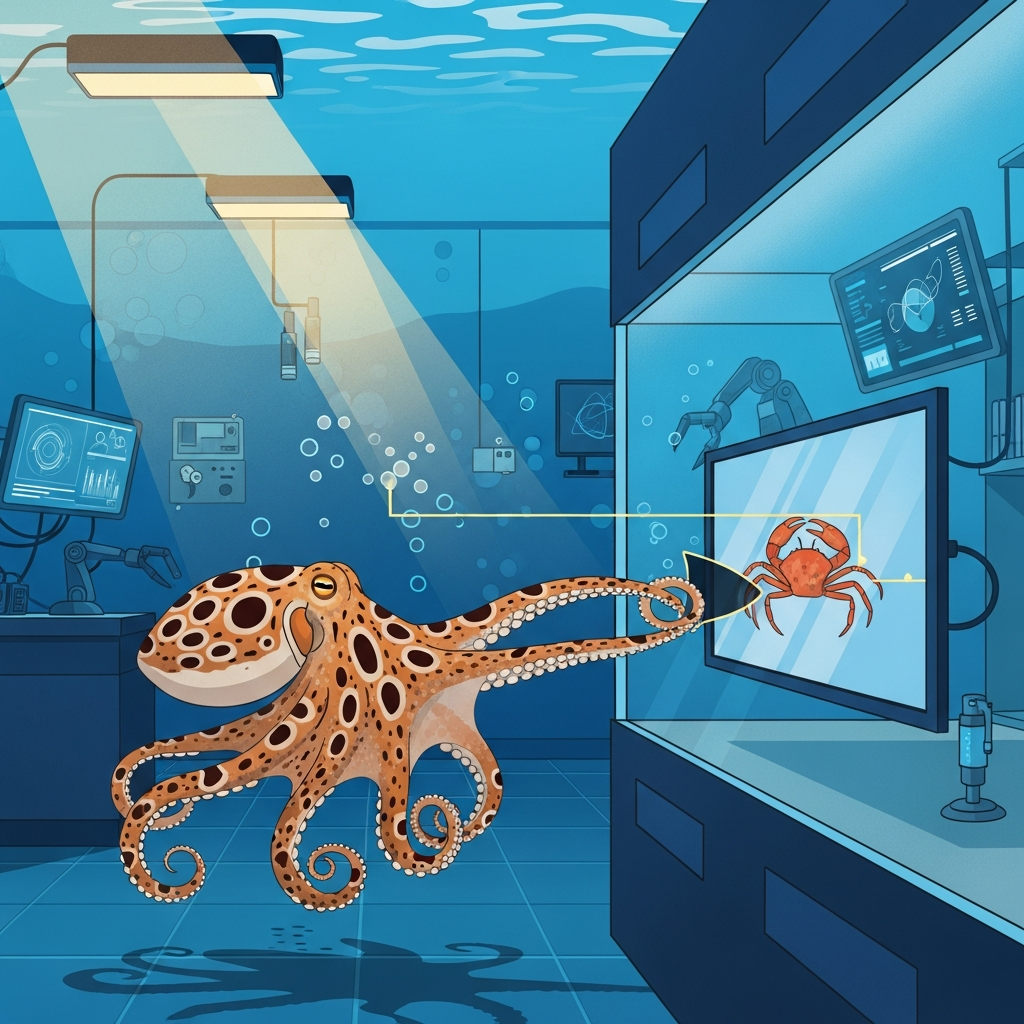
A breakthrough study published in Current Biology in June 2026 by Mary Kieseler of the University of Fribourg and Peter Tse of Dartmouth College presents the first documented case of mirror-mediated spatial cognition in an invertebrate, establishing a landmark in comparative cognitive science. Three California two-spot octopuses (Octopus bimaculoides) were tested in a mirror-based spatial navigation task in which a virtual crab image was projected at a location invisible to the animal without using the mirror's reflection to infer the prey's actual position. The octopuses achieved a 73% accuracy rate in this binary-choice task — a figure 23 percentage points above random chance, which constitutes systematic spatial comprehension rather than accidental success. Critically, performance speed increased across repeated trials, indicating that the animals were learning the spatial relationship between the mirror and the physical space it reflected, rather than responding through reflexive behavior. This capacity for mirror-mediated spatial navigation had previously been observed only in select vertebrate species — including great apes, certain cetaceans, and some corvid birds — making the octopus finding a historically significant first for the invertebrate kingdom. The study's experimental design was particularly rigorous in its use of virtual imagery to eliminate chemical cue contamination, a persistent methodological challenge in prior cephalopod cognition research, lending the findings strong methodological credibility that positions them for serious scientific scrutiny and follow-up replication.
The Fundamental Limits of Anthropocentric Cognitive Measurement
Gordon Gallup's Mirror Self-Recognition Test, developed in 1970, has served as the field's gold standard for animal self-awareness for over five decades, and the test's pass/fail verdict has functioned as a proxy for higher cognitive status across the animal kingdom. This study exposes a critical flaw in that framework: the octopuses demonstrated the ability to use a mirror as a spatial navigation tool — instrumentally understanding its geometrical properties — without demonstrating self-recognition in the conventional sense. Researcher Kieseler explicitly noted that this finding does not constitute evidence of self-awareness, which means the test has been measuring one specific cognitive capacity — visually grounded self-modeling — while the field has treated it as a general intelligence index. This distinction aligns with Alexandra Horowitz's 2017 research showing that dogs recognize themselves through olfaction rather than vision, a sensory channel the mirror test was never designed to detect. What the mirror test actually captures, the octopus data now suggests, is cognitive performance on a task calibrated to species with visual-dominant sensory systems, not intelligence in any broader sense. The implication is that cognitive science needs a multi-modal assessment framework calibrated to the dominant sensory modality and ecological context of each species under study, rather than a single instrument derived from human-centric experimental design.
Convergent Evolution as Evidence for Cognitive Substrate Independence
The octopus and vertebrate lineages diverged from a common ancestor approximately 350 to 500 million years ago, according to EurekAlert's coverage of the Dartmouth research team's findings, and subsequently developed entirely distinct neural architectures with no structural homology. The octopus nervous system distributes roughly two-thirds of its 500 million neurons across eight semi-autonomous arms, with no cerebral cortex, hippocampus, or neocortex — the structures neuroscience has traditionally associated with higher cognition in vertebrates. Despite this radical architectural divergence, both lineages independently arrived at the capacity for mirror-mediated spatial reasoning — a textbook case of convergent evolution in the cognitive domain. This convergence carries direct implications for the substrate independence hypothesis, the philosophical claim that intelligence and higher cognition are not intrinsically tied to any specific physical substrate but can emerge wherever information-processing complexity crosses a sufficient threshold. The Royal Society's review of mirror test evolutionary origins (2025) and multiple Philosophical Transactions papers on convergent brain evolution provide independent scholarly context confirming that complex cognition has emerged independently across multiple lineages. The octopus case strengthens the biological foundation of substrate independence in a way that is difficult to dismiss, because the neural architecture gap between cephalopods and vertebrates is vastly larger than comparisons within the vertebrate family.
The Decoupling of Instrumental Mirror Use from Self-Recognition
Traditional cognitive science has treated mirror understanding and self-recognition as closely linked, with the assumption that the capacity to understand a mirror's reflection is a byproduct of — or precursor to — self-awareness. This study provides the first direct empirical evidence that the two capacities can exist independently: the octopuses showed robust mirror-based spatial navigation without passing any self-recognition criterion. Understanding that a mirror accurately encodes the geometry of surrounding space and using that encoding for real-time three-dimensional navigation requires constructing an abstract spatial model — a cognitive operation that is, by any reasonable standard, sophisticated and non-trivial. Human infants do not achieve an understanding of mirror spatial properties until 14 to 18 months of age, a developmental milestone treated as cognitively significant. The decoupling demonstrated by the octopus suggests that what cognitive science has labeled "mirror understanding" is not a single unitary capacity but a cluster of separable cognitive modules — one governing self-modeling and one governing environmental spatial modeling — that can evolve and exist independently. This "cognitive mosaic" model, in which various cognitive capacities develop along separate axes rather than in a fixed hierarchical sequence, is more consistent with what comparative cognition research has been accumulating evidence for over the past two decades, and the octopus data provides the most decisive single empirical argument for it.
The Biological Case Against Substrate-Dependent Consciousness
Among the most significant implications of this research is the challenge it poses to substrate-dependency arguments in the consciousness debate, while simultaneously marking the limits of what the data can actually demonstrate. The claim that consciousness or high-order cognition requires a carbon-based brain of vertebrate architecture has received its strongest biological counterevidence not from artificial systems but from the octopus itself — an animal that shares the carbon-based substrate but runs an entirely different neural architecture. The 2025 Bengio-Chalmers framework in Trends in Cognitive Sciences, which examined AI consciousness indicators from a neuroscience-informed perspective, argued that no current AI systems are conscious but that no obvious technical barriers to building such systems exist — and the octopus case strengthens the biological plausibility of that conclusion. The 2012 Cambridge Declaration on Consciousness and the 2024 New York Declaration on Animal Consciousness both explicitly named octopuses among animals with meaningful evidence for conscious experience, providing a scientific and philosophical context that this study's findings reinforce. The critical nuance, however, is that octopuses and humans are both carbon-based and share the electrochemical signaling mechanism of neuronal computation, which means the inferential step from "different carbon architectures converge" to "non-carbon substrates can also support cognition" requires additional evidence beyond what the current study provides. The octopus is the most compelling biological argument against the most naive form of substrate-dependency — but it is not yet the final answer to the deeper question.
Positive & Negative Analysis
Positive Aspects
- Paradigm Expansion in Cognitive Science and a New Research Program
This study delivers the empirical justification that the comparative cognition field has long needed to formally move beyond single-instrument intelligence assessment. The mirror self-recognition test has operated as an unquestioned standard for decades, but its fundamental limitation — that it measures one type of visually grounded self-modeling in species with visual-dominant sensory systems — has been increasingly apparent in the literature. The octopus finding makes that limitation undeniable, which creates the intellectual and institutional mandate to develop species-appropriate cognitive assessments. Comparative cognitive science has already been growing at approximately 15% annually in published research volume through the 2020s, and this study is likely to catalyze a new wave of funding and design investment. The methodological innovation of using virtual prey imagery to separate chemical from visual cues is itself immediately applicable to other invertebrate species, opening research pathways into squid, cuttlefish, and potentially certain arthropod cognition that have been methodologically blocked. The broader effect is a genuine research program expansion: from a field organized around vertebrate cognition and human-like task design, toward a pluralistic framework that asks what intelligence looks like when you build it from different materials under different evolutionary pressures.
- Strengthening the Scientific Foundation for Animal Welfare Policy
The practical, immediate positive consequence of this research is the additional scientific weight it provides for expanding invertebrate protection under animal welfare legislation. England's Animal Welfare (Sentience) Act of 2022 already recognized cephalopods as sentient beings on the basis of 300-plus scientific studies, establishing that legal recognition of invertebrate cognition is politically and legislatively achievable. The 2024 New York Declaration on Animal Consciousness extended moral consideration to invertebrates and arthropods, and the 2026 Biological Reviews assessment found strong evidence of sentience in octopuses and cuttlefish across six of eight evaluation criteria. This study adds another direct empirical data point to that converging scientific consensus, making it progressively more difficult to justify current laboratory and commercial practices that treat cephalopods as cognitively simple organisms. Hundreds of thousands of cephalopods are used in scientific research annually, and millions are harvested commercially; the ethical standards governing their treatment now face a more concentrated scientific case for reform than at any prior point. This is a case where basic science has direct and meaningful policy implications, and those implications are already beginning to shape regulatory conversations across multiple jurisdictions.
- Biological Inspiration for Distributed AI Architecture and Technology
The octopus's nervous system architecture — roughly one-third of neurons centrally located, two-thirds distributed across eight semi-autonomous processing units — is a radically different model of intelligence than the centralized deep learning paradigms dominating current AI development. The demonstration that this distributed architecture supports higher-order spatial cognition creates a direct research agenda for edge computing, distributed AI systems, and soft robotics. The U.S. Navy's Office of Naval Research has committed $7.5 million to the Cyberoctopus program, and research papers on octopus-inspired technology grew from 760 in 2021 to 1,170 in 2024 — a 54% increase driven by interest in flexible, distributed mechanical systems. Until now, that interest has focused primarily on hardware: soft actuators, flexible arms, adaptive gripping mechanisms. The cognitive architecture data this study provides opens a new research direction in which the question is not just how octopus arms move but how octopus nervous systems coordinate distributed processing to support spatial reasoning. For AI researchers interested in reducing dependence on centralized computation, this represents a genuinely novel biological design principle backed by direct empirical evidence of its cognitive performance.
- Exceptional Accessibility for Science Communication and Education
Octopuses occupy a rare position among science communication subjects: they are genuinely fascinating to general audiences, have an established popular culture presence through documentaries and social media, and provide an immediately approachable entry point for rigorous and philosophically demanding ideas. The question this study raises — "what does it actually mean to be intelligent?" — is among the most important questions in cognitive science, but it is typically communicated through dry methodological debates that fail to reach general audiences. The octopus gives science communicators a way to deliver that question with emotional and visual appeal, and the stakes of getting the answer right extend well into AI ethics, animal welfare policy, and legal philosophy. At the secondary and university education level, this study is a nearly ideal pedagogical vehicle for teaching critical thinking about how scientific knowledge is generated, what makes a measurement tool valid or limited, and how assumptions about "normal" cognition can systematically exclude valid forms of intelligence. The broader cultural message — that intelligence is diverse, distributed, and not a human monopoly — is one that serves both scientific literacy and the kind of ethical sophistication that increasingly complex relationships between humans, animals, and AI systems will require.
Concerns
- Critical Limitations Imposed by the Sample Size
The most obvious and important weakness of this study is that it was conducted on three octopuses — a sample size that falls significantly short of what behavioral science requires for confident generalization to a species or to the invertebrate kingdom at large. In standard behavioral research, three individuals would typically be considered a pilot study, a preliminary investigation generating hypotheses for subsequent rigorous testing rather than a basis for making historically significant claims. The 73% accuracy figure is striking, but without knowing individual variance across the three animals, we cannot determine whether this represents a species-wide capacity or the performance of three unusually capable individuals. Science history provides ample cautionary examples of extraordinary small-sample results that failed to survive replication at scale — the "Mozart effect" in cognitive psychology, early results on ego depletion, and numerous findings in social priming research all followed a similar trajectory from celebrated discovery to failed replication. The researchers acknowledge this limitation, and the practical constraints of laboratory cephalopod research are genuine; octopuses are difficult to maintain, short-lived, and sensitive to captivity stress. But those constraints cannot change the epistemological reality: the "first invertebrate ever" designation requires substantially more evidence before it can bear the theoretical weight being placed on it.
- The Risk of Overclaiming and Anthropomorphic Distortion
The gap between what this study actually demonstrates and what popular coverage will inevitably claim is wide, and the consequences of that gap materializing are real. The study shows that octopuses can use mirrors as spatial navigation tools — a precise and remarkable finding. It does not show that octopuses are self-aware, that they have rich subjective experience, or that invertebrates broadly possess consciousness. Researcher Kieseler explicitly stated in interviews that this is not evidence of self-recognition, but that careful qualification will not survive the headline compression that popular science communication routinely imposes. Anthropomorphism — the projection of human psychological attributes onto non-human animals — is one of the oldest and most persistent biases in comparative cognition research, and this study's high public visibility makes it an unusually inviting target. The danger is not just inaccuracy: overclaiming generates a skeptical backlash that eventually damages the credibility of the genuine findings. If "octopus mirror study" becomes associated in the public mind with inflated claims about cephalopod consciousness, the legitimate insight — that cognitive diversity is much broader than our measurement tools have been detecting — gets buried in the noise of the subsequent correction. The cognitive diversity story is important, defensible, and worth telling carefully; a consciousness proclamation is neither supported nor beneficial.
- The Logical Gap Between Convergent Evolution and Substrate Independence
The inference from convergent evolution to substrate independence is intellectually compelling and philosophically important, but it requires careful handling because the octopus evidence does not fully close the logical gap. Convergent evolution means that similar selection pressures — in this case, the ecological need for effective spatial navigation — produced similar adaptive solutions across independent lineages. What it does not mean is that any physical substrate is capable of supporting the same cognitive outcomes. Octopuses and vertebrates are both carbon-based organisms, and both rely fundamentally on neurons as the computational unit, using electrochemical signaling across synaptic connections. The architectural differences between cephalopod and vertebrate nervous systems are dramatic, but the underlying biochemical substrate shares critical common ground. Moving from "different carbon-based neural architectures can support similar cognition" to "non-carbon-based substrates can also support cognition" requires an additional inferential step that the octopus data alone does not provide. Using the octopus finding as definitive biological proof of AI consciousness potential overstates the argument in a way that invites justified criticism, and that criticism can spill back onto the legitimate findings about convergent cognitive evolution and the limits of anthropocentric measurement.
- The Ethical Circularity of Invertebrate Cognition Research
There is a structural paradox embedded in this research that deserves explicit acknowledgment: the more convincingly science demonstrates that octopuses possess high-order cognitive abilities, the more ethically problematic it becomes to conduct the experiments that generate that demonstration. Great ape research has largely been restricted or prohibited in many countries precisely because their cognitive sophistication has been established — the same cognitive capacities that make them scientifically interesting make their experimental use ethically untenable. If octopuses possess spatial reasoning, learning, and potentially the early precursors of self-modeling, the experimental protocols that reveal those capacities raise similar ethical questions. The circularity is real: you need to run the experiments to establish the cognitive capacity, but establishing the cognitive capacity may create grounds for restricting or prohibiting the experiments. This is not a problem unique to octopus research — it is a structural challenge for comparative cognitive science as a whole — but the octopus case brings it into sharp relief because the research is advancing quickly and the ethical framework has not kept pace. Non-invasive observation methods, naturalistic study settings, and ex-situ welfare protocols are developing, but they are not yet sufficient replacements for controlled laboratory experimentation in most cognitive research contexts.
Outlook
In the near term — the next three to six months — the most predictable and important consequence of this publication is a wave of independent replication attempts. The Kieseler-Tse methodology is clean and reproducible enough that other labs with cephalopod research infrastructure can attempt it, and the magnitude of the claim — "first invertebrate ever to demonstrate mirror-mediated spatial cognition" — guarantees that the scientific community will want independent verification before treating this as settled. My expectation is that at least two or three independent research teams will attempt mirror-navigation experiments with other octopus species within this window. The most likely candidates are Octopus vulgaris, the common octopus, and Enteroctopus dofleini, the giant Pacific octopus, both of which already have established laboratory populations and existing cognitive research protocols. If comparable performance emerges across multiple species, the finding shifts from a potential single-species anomaly to a cephalopod-level evolutionary feature, substantially strengthening the statistical and theoretical case.
The short-term media and public response will be substantial, because octopuses are already pop-science celebrities. Since My Octopus Teacher's Oscar win in 2020, cephalopod intelligence has maintained an unusually high public profile, and this study hands science communicators an immediately accessible story with real intellectual depth. I expect Scientific American, New Scientist, and National Geographic to feature deep-dive coverage on mirror cognition and intelligence redefinition in the second half of 2026, and TED talks and science podcasts will follow rapidly. The cognitive neuroscience market, valued at $41.2 billion in 2025 and projected to grow to $77 billion by 2035 at a 7.2% compound annual growth rate, will feel an accelerant from this kind of high-visibility research. The near-term risk, however, is the inevitable "octopus has self-awareness" overreach story, which will almost certainly get written and widely believed despite being directly contradicted by the researchers' own careful statements.
In the medium term — the two-to-four year window — the most structurally significant change will be the systematic reconsideration of cognitive assessment methodology. The mirror self-recognition test has operated as the gold standard for animal self-awareness research since 1970, more than fifty years. This study doesn't invalidate the test, but it definitively demonstrates that mirror-based cognition and self-recognition are separable cognitive operations, which means the test has been measuring a narrower phenomenon than its widespread use in the literature has implied. By 2027 or 2028, I expect the comparative cognition field to begin formally developing what might be called a multi-modal cognitive assessment framework: a suite of evaluation tools calibrated to the dominant sensory modality of each species under study. This would include olfactory self-recognition protocols for dogs, electroreception-based spatial cognition tests for weakly electric fish, and chemical gradient navigation assessments for invertebrates. "Species-fair cognitive assessment" will likely become a prominent agenda item at major cognitive science conferences.
The policy and regulatory environment will also shift meaningfully in the medium term. The UK's Animal Welfare (Sentience) Act of 2022 — which incorporated octopuses, squid, and cuttlefish as legally recognized sentient beings on the basis of over 300 scientific studies — has established a legislative template that other jurisdictions are actively watching. The European Union has been in active regulatory discussions about cephalopod welfare since 2023. As evidence for higher cognitive function in invertebrates continues to accumulate, I expect between three and five additional countries to adopt specific ethical guidelines for cephalopod research by 2027 or 2028. The NIH BRAIN Initiative, which funded over 150 new neuroscience projects and $220 million in 2023 alone — a 22.2% increase over the prior year — is well-positioned to accelerate this methodological expansion through dedicated invertebrate cognition funding tracks. On the technology side, the Navy's $7.5 million Cyberoctopus program and the 54% growth in octopus-inspired technology research papers from 2021 to 2024 signal an accelerating trajectory that the addition of cognitive architecture data will push further.
In the long term — the five-to-ten year horizon — the deepest impact of this research may be the sustained pressure it generates for what some researchers are beginning to call a Universal Theory of Intelligence. Current cognitive science operates under an implicit hierarchy placing human cognition at the apex, using it as the reference frame for evaluating everything else. But if convergent evolution can produce similar cognitive solutions across radically different neural substrates, intelligence begins to look less like the product of specific biological architecture and more like a phase transition — an emergent phenomenon occurring when information-processing complexity crosses a threshold, regardless of the physical substrate. This framing, borrowed from physics and complexity science, suggests that around 2028 to 2030, we may see the emergence of an interdisciplinary field — already called "cognitive physics" in some quarters — in which neuroscience, evolutionary biology, computer science, and theoretical physics converge to search for substrate-independent laws governing the emergence of cognition. Just as thermodynamics began with the engineering problem of steam engine efficiency and developed into universal physical law, cognitive physics might begin with octopus mirror navigation and develop toward general principles of intelligence emergence.
The consciousness debate will feel this research's long-term influence in ways that are harder to predict but potentially more consequential for law, ethics, and public policy. The dominant discourse around consciousness remains trapped in a binary — "is it there or isn't it?" — that the octopus data helps destabilize. Cognitive capacity is a multidimensional space, not a single switch. The ability to use mirrors instrumentally while lacking conventional self-recognition is exactly the kind of finding that argues for what we might call a Consciousness Spectrum Framework — an evaluative approach situating minds along multiple cognitive axes rather than applying a single yes/no criterion. Within this framework, questions about AI consciousness stop being "does it have one?" and begin being "along which dimensions, and to what degree?" That reframing carries enormous implications for AI ethics, AI rights discourse, and the evolving legal philosophy of personhood as AI systems become more deeply integrated into economic and social life.
In terms of scenario planning, the bull case — roughly 30% probability — unfolds as follows: replication studies across multiple cephalopod species succeed within 12 to 18 months; major research institutions formally adopt multi-modal cognitive assessment frameworks by 2028; invertebrate welfare protection expands in legislation across Europe, Australia, and North America; and distributed-cognition architecture principles from the octopus nervous system are incorporated into next-generation AI design. Under this scenario, the cognitive neuroscience market hits its $77 billion projection ahead of schedule, and the 2028-to-2030 window sees a genuine paradigm shift in how intelligence is legally and scientifically defined. The base case — approximately 50% probability — is more measured: replication studies yield mixed results across species, with mirror-mediated spatial cognition understood as a conditional ecological adaptation rather than a universal cephalopod trait. Progress on measurement methodology and welfare regulation continues, but over a decade rather than five years. The AI consciousness implications are actively debated in academic circles without a definitive resolution.
The bear case — around 20% probability — is the scenario in which large-scale replication fails, or in which an uncontrolled confounding variable is identified that explains the 73% figure through a non-cognitive mechanism, such as differential light patterns processed by skin photoreceptors or subtle water current cues correlated with mirror position. Under this scenario, the study is remembered as intriguing but unreproduced preliminary work, and the paradigm challenge it mounted is deferred rather than delivered. The three-animal sample size is precisely what makes this scenario non-negligible; science has a documented history of extraordinary small-sample results that collapsed on replication. Crucially, even in the bear case, the methodological critique of anthropocentric intelligence measurement — arguably the most important intellectual payload of this research — remains valid and will eventually be vindicated through alternative empirical pathways. The question this paper has placed on the table — whether intelligence is the exclusive product of specific neural architectures or a convergent emergent property of sufficiently complex information processing — is now impossible to ignore regardless of how the replication story unfolds.
Sources / References
- Octopuses Use Mirrors to Find Prey. — ScienceDaily
- Study Shows Octopuses' Impressive Ability to Navigate Space. — Dartmouth College News
- Mirror-mediated spatial cognition in Octopus bimaculoides. — Current Biology
- Octopus Mirror Spatial Cognition: First Invertebrate Evidence. — Neuroscience News
- Octopuses can use mirrors to find prey, study shows. — Phys.org
- On the mirror test and the evolutionary origin of self-recognition. — Royal Society Publishing
- Cephalopod cognition and comparative psychology. — Springer Animal Cognition