
Glaciers Are Melting Six Times Faster Than Predicted — If the Climate Models Were Wrong, How Much Time Do We Actually Have?
Summary
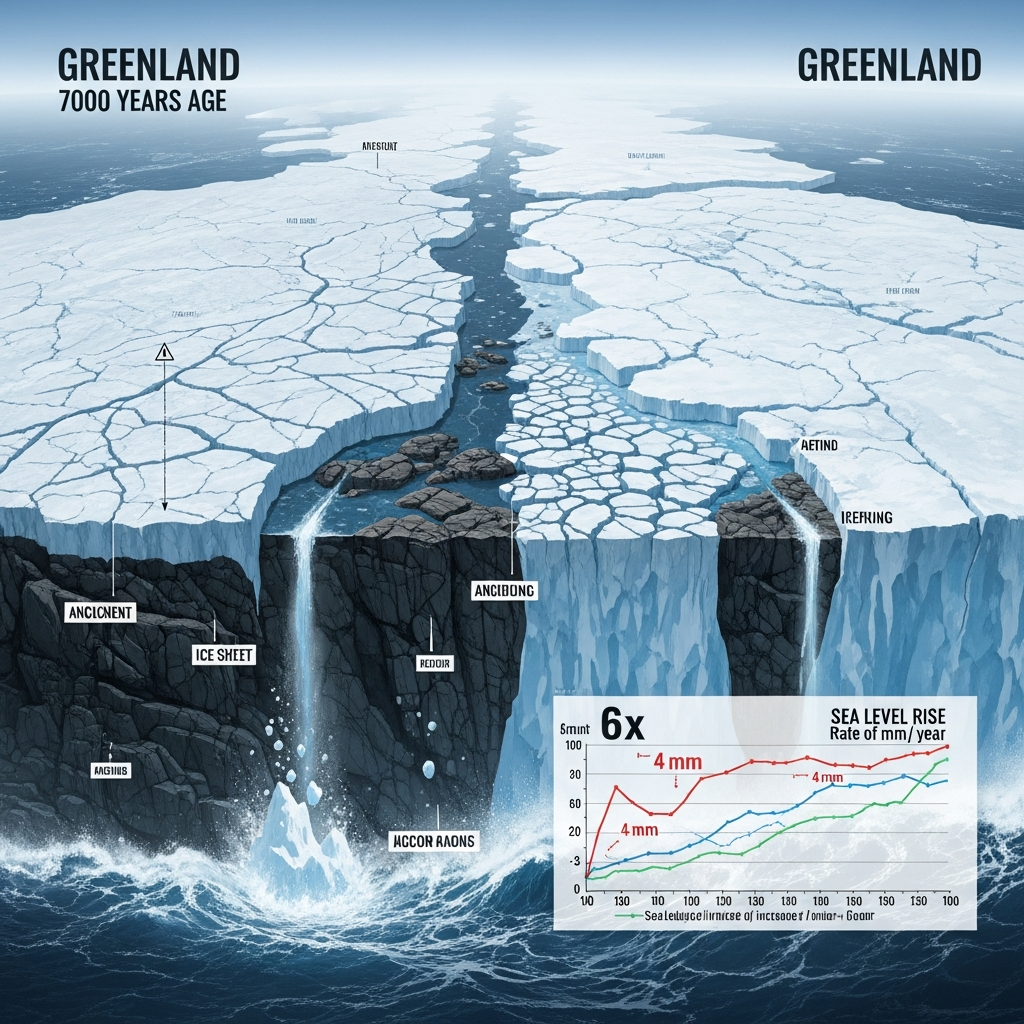
Peer-reviewed research published in Nature Communications in May 2026 confirms that extreme melt events on the Greenland ice sheet have accelerated sixfold over the past five decades, dramatically exceeding projections embedded in current-generation climate models. A companion study in Nature Geoscience presents geological evidence that Greenland's Prudhoe Dome ice cap disappeared completely approximately 7,000 years ago under natural warming of just 3–5°C above pre-industrial baselines — a temperature range aligning almost exactly with IPCC projections for 2100 under moderate-to-high emissions scenarios. Antarctica's Hektoria Glacier retreated 25 kilometers in just 15 months, setting a record for the fastest glacial collapse in satellite observation history, while global sea level rise has simultaneously doubled from approximately 2 millimeters per year to 4 millimeters annually. Research from the Chinese Academy of Sciences, published in Science Advances, for the first time quantifies the proportional contribution of each forcing factor to sea level rise — finding that ocean thermal expansion at 43% is the dominant driver, a counterintuitive finding that fundamentally reorders climate mitigation priorities. These four concurrent publications from April–May 2026 collectively indicate that existing climate models have systematically underestimated glacial dynamics, and that the crossing of irreversible tipping points may already be underway rather than a distant future possibility.
Key Points
Greenland's Extreme Melt Events Have Accelerated Sixfold in 50 Years
A study published in Nature Communications on May 4, 2026, confirmed that extreme melt events on the Greenland ice sheet have accelerated sixfold over the past half-century, dramatically exceeding projections from existing climate models. Extreme melt events refer to summer periods when glacial surface melt rates spike dramatically above historical norms — episodes that used to occur roughly once a decade but now happen approximately every two years. The research synthesized 50 years of integrated satellite observation and field measurement data, making it the most comprehensive longitudinal analysis of Greenland glacial dynamics produced to date. This sixfold number isn't a quantitative shift within a linear trend — it signals a qualitative transition, suggesting the system has crossed from a regime of gradual, predictable change into one of structural disruption with nonlinear characteristics. The Greenland ice sheet holds approximately 7.5% of Earth's total freshwater reserves; its complete melting would raise global sea levels by more than 7 meters, enough to permanently inundate major coastal cities including New York, Shanghai, Jakarta, and Busan. The research team explicitly warns that under high-emissions scenarios this acceleration could intensify further, making the case for treating current melt rates not as the new stable ceiling but as a trajectory that will continue to exceed prior projections unless the underlying forcing changes substantially.
The 7,000-Year Precedent: Greenland's Ice Sheet Has Vanished Before
Research published in Nature Geoscience in early 2026 and analyzed by Columbia Climate School presents compelling geological evidence that the Prudhoe Dome ice cap in northwestern Greenland disappeared completely approximately 7,000 years ago during the Holocene Warm Period. The temperature anomaly driving that disappearance was just 3 to 5 degrees Celsius above pre-industrial baselines — a range mapping almost exactly onto IPCC projections for 2100 under moderate-to-high greenhouse gas emissions scenarios. Crucially, this vanishing occurred under entirely natural warming driven by orbital mechanics, at a time when atmospheric CO₂ concentrations were approximately 280 parts per million. Current CO₂ levels have exceeded 425 ppm, and the warming being generated now is entirely anthropogenic — driven by industrial emissions moving faster than any natural cycle preserved in the geological record. The implications challenge some foundational assumptions underlying optimistic climate projections: if natural warming of 3 to 5 degrees eliminated the ice sheet once before, the argument that the same temperature range produced by faster, more powerful anthropogenic forcing would yield a fundamentally different outcome requires scientific justification that hasn't been satisfactorily provided. Columbia Climate School researchers indicate this finding demands a fundamental reconsideration of the assumed stability of the Greenland ice sheet under the warming trajectories the planet is currently tracking.
Sea Level Rise Has Doubled — and Ocean Warming, Not Ice Melt, Is the Dominant Driver
Published May 22, 2026, in Science Advances, a Chinese Academy of Sciences study produced the first-ever quantitative breakdown of global sea level rise by contributing factor — and its central finding inverts the conventional public understanding of the problem. Ocean thermal expansion, the physical swelling of seawater as it absorbs heat, accounts for 43% of total sea level rise — more than the combined contributions of all melting ice sources globally. Mountain glacier melt adds 27%, Greenland contributes 15%, and Antarctic ice accounts for 12%. The overall rate of sea level rise has doubled: from approximately 2 millimeters per year to 4 millimeters annually, confirmed as a sustained structural trend rather than a measurement anomaly. The counterintuitive policy implication is significant: strategies focused exclusively on preserving polar ice address less than 30% of the sea level rise problem. Actually slowing sea level rise requires slowing ocean warming itself — which means reducing atmospheric greenhouse gas concentrations at a pace that allows ocean heat uptake to stabilize. This data is expected to serve as a critical input into IPCC's Seventh Assessment Report, where it will likely contribute to an upward revision of sea level projections and a rebalancing of adaptation priorities toward ocean temperature management as a primary strategic concern.
Antarctica's Hektoria Glacier Sets the Record for Fastest-Ever Glacial Collapse
From January 2022 to April 2023, Antarctica's Hektoria Glacier retreated approximately 25 kilometers in just 15 months — the fastest glacial collapse ever documented in the history of NASA satellite observation. Confirmed by a University of Colorado research team analyzing NASA satellite data and published through ScienceDaily in May 2026, this event gives the scientific community its first high-resolution empirical baseline for nonlinear glacial dynamics under modern warming conditions. What makes this case particularly consequential is the structural mechanism involved: the collapse of the ice shelf buttressing the glacier — effectively the structural plug holding back inland ice flow — triggered a cascade that dramatically accelerated the retreat of the glacier body itself. This mechanism, observable in real time through satellite imagery, demonstrates that glacial collapses can be both sudden and self-reinforcing once critical structural thresholds are exceeded. The fact that this record collapse occurred simultaneously with the Greenland melt acceleration — in two independent glacial systems at opposite poles — confirms that accelerated glacial dynamics is not a regional anomaly but a systemic global-scale response to current atmospheric forcing. Researchers have noted that Hektoria's collapse data could serve as a calibration reference for modeling potential collapse timelines for other structurally vulnerable glaciers around both Antarctica and Greenland.
Climate Models Have Systematically Underestimated Glacial Dynamics — and AMOC Weakening Compounds the Risk
The convergence of the April–May 2026 research papers carries a meta-finding that may be the most consequential of all: existing climate models have systematically underestimated the pace of glacial change. Observed melt rates and sea level rise acceleration both substantially exceed what IPCC-class models projected under equivalent forcing scenarios, suggesting that scenarios labeled "worst case" were in practice closer to central estimates. University of Miami researchers added a compounding dimension: the Atlantic Meridional Overturning Circulation — the ocean current system that functions as Western Europe's primary heat distribution mechanism — could weaken by as much as 50% under continued warming. More critically, they found that current climate models had underestimated this weakening by a full 60%. A 50% AMOC slowdown would paradoxically produce significant cooling across Western Europe — dropping average regional temperatures by 3 to 5 degrees Celsius — disrupting agricultural systems, reshaping energy demand patterns, and destabilizing marine economies across the continent. The combined implications of model underestimation in both glacial dynamics and AMOC projections strongly indicate that IPCC AR7 will need to substantially revise both ice loss trajectories and regional climate projections, and the scientific community is increasingly converging on the view that nonlinear glacial collapse mechanics must be incorporated into next-generation modeling frameworks as a core methodological requirement rather than an optional refinement.
Positive & Negative Analysis
Positive Aspects
- Science's Self-Correction Mechanism Is Operating Exactly as Designed
The most significant positive embedded in this set of findings is what it demonstrates about the scientific process itself. These studies were not produced by critics exposing the failures of climate science from the outside — they were produced by the scientific system's own internal peer review and empirical verification mechanisms operating exactly as they should. Nature Communications, Nature Geoscience, and Science Advances are among the highest-tier peer-reviewed journals in the world. The fact that findings of this magnitude passed through rigorous review and were published openly — where they can be further tested, challenged, and replicated — exemplifies the self-correcting foundation of scientific inquiry that separates it from ideology or political narrative. Climate skeptics often invoke "science can be wrong" as a reason to delay action. But what these papers actually demonstrate is that science finds and corrects its own errors even when those corrections are uncomfortable for the field itself. The willingness to publish findings that challenge prior model assumptions is a sign of institutional strength, not weakness, and it is precisely the mechanism that allows policy to improve over time as the underlying knowledge base improves. The longitudinal rigor of the methodology — 50 years of integrated satellite and field data for the Greenland study alone — further reinforces these findings as a stable and reliable foundation for updated policy frameworks rather than preliminary signals requiring further confirmation.
- Quantified Sea Level Rise Attribution Enables Precision Climate Policy
The Chinese Academy of Sciences' first-ever quantified breakdown of sea level rise by contributing factor gives policymakers a genuinely new and powerful tool that didn't exist before May 2026. Ocean thermal expansion at 43%, mountain glaciers at 27%, Greenland at 15%, Antarctica at 12% — these proportions create the basis for a data-driven, prioritized resource allocation framework in a policy domain that has historically operated on generalized targets. Knowing the relative contributions of each forcing factor means that "address ocean warming" becomes a quantifiable strategic priority rather than a rhetorical aspiration, and that the political emphasis on dramatic glacial collapse narratives — while physically real and important — can be calibrated to reflect that these sources currently represent less than 30% of the combined sea level rise problem. For national governments building adaptation budgets, this data provides scientific justification for specific investment choices rather than generalized climate spending, enabling the kind of measurable accountability that large-scale public investment programs require. For IPCC AR7, this represents a foundational input that will reshape both emissions pathway analysis and regional sea level projection methodology in ways that make downstream adaptation planning more precise and therefore more cost-effective. The transparency of the quantification also enables direct comparison across future study cycles, building cumulative scientific understanding that qualitative assessments cannot support.
- Hektoria's Collapse Data Creates a Real-World Baseline for Early Warning Systems
The 25-kilometer, 15-month retreat of Antarctica's Hektoria Glacier gives the scientific community something genuinely new: a high-resolution empirical reference case for rapid, nonlinear glacial collapse under current atmospheric forcing conditions. Before this event, projecting when and how fast a glacier would undergo structural collapse involved substantial modeling uncertainty, because the physical dynamics had never been observed at this resolution in a modern warming context. Now, researchers have a concrete calibration case — a real-world example of what the collapse sequence looks like, how fast it unfolds, what the triggering mechanism was, how far the retreat extended, and how the process interacted with surrounding ice structures. Combined with NASA's satellite monitoring capabilities, this creates a foundation for building predictive early warning systems for other vulnerable glaciers across both Antarctica and Greenland. Identifying which glaciers are structurally analogous to Hektoria — similar size, similar ice shelf configuration, similar exposure to warming ocean currents — allows scientists to prioritize monitoring resources and potentially provide coastal communities with years of lead time before similar events unfold elsewhere. For low-lying nations like the Maldives, Tuvalu, and Bangladesh, whose physical survival depends on the precision of long-range sea level rise projections, improved predictive capability is not an academic benefit. It is a survival tool with direct operational value for every infrastructure investment decision these nations make over the next several decades.
- Simultaneous Publication Creates a Rare Narrative Inflection Point for Public Awareness
Climate science has always faced a fundamental communication problem: changes are real and measurable but unfold too slowly for human intuition to register as genuinely urgent. Sea level rising 4 millimeters per year is physically invisible in daily life. But when "sixfold acceleration," "25 kilometers in 15 months," "7,000 years ago all of it was gone," and "doubled rate" all land in the public conversation within the same month, the narrative frame shifts in a way that no individual paper can achieve alone. The density of specific, dramatic numbers arriving simultaneously from multiple independent research teams across multiple top-tier journals creates a moment of convergent credibility — where even audiences habitually skeptical of single-study headlines face a pattern too coherent to dismiss as anomaly or cherry-picking. Historically, inflection points in public climate awareness have been driven more by narrative density than by any single finding: the IPCC's first assessment cycle in 1990, the extreme heat and hurricane seasons of 2003–2005, the 2018 "twelve years" coverage of the IPCC Special Report. May 2026 has the structural characteristics of a similar moment — not because the underlying findings are unprecedented in kind, but because their simultaneous emergence creates a convergent signal strong enough to penetrate public consciousness in ways that months of individual paper coverage had not.
Concerns
- Systematic Model Underestimation Threatens the Entire Global Policy Architecture
The most structurally damaging implication of these findings is what they mean for the credibility of the climate policy architecture built on existing models. Global NDC commitments under the Paris Agreement, national carbon budget calculations, international adaptation fund allocation, and infrastructure investment frameworks for coastal cities — every one of these rests on the assumption that IPCC-class models are substantially accurate representations of the physical future. If extreme melt events are running at six times the modeled rate, sea level rise has doubled ahead of projected timelines, and AMOC weakening has been underestimated by 60%, the analytical foundations of that entire architecture need to be rebuilt from a new baseline. This is not a minor recalibration exercise. It is the policy equivalent of discovering that structural load calculations for a large building were based on incorrect material assumptions — the right response is not to add another floor, it's to reassess the structure from the foundation upward. The political costs of this reassessment are enormous: governments that staked reputations on existing 2030 and 2050 targets face the prospect of explaining why those targets need upward revision again, in political environments already fatigued by years of climate goal-setting. Climate skeptics will weaponize the underestimation narrative to argue that science cannot be trusted — a rhetorically effective move that inverts the actual lesson, which is that the underestimates ran in the direction of optimism, not catastrophism, and that the corrected models require more aggressive action, not less.
- The Structural Lag Between Scientific Urgency and Political Response Remains Fundamentally Unresolved
The gap between the pace of glacial change and the pace of political response is not new — but these findings make it starker and more consequential than at any previous point in the climate policy era. UNEP projections indicate that most countries are on track to miss their 2030 NDC targets by significant margins even before accounting for the updated forcing data from May 2026. The political systems that need to translate scientific findings into binding policy are structurally optimized for four-to-five-year electoral cycles, not for multi-decade physical processes with compounding consequences. Long-term climate investment competes directly with short-term economic pressures in every national political environment — and in virtually every case, short-term pressures carry greater immediate electoral weight. COP31 in November 2026 will be the first major venue where these findings formally enter the policy arena. The probability that COP31 produces a structural shift in implementation — as opposed to a structural shift in stated ambition — is low by any realistic assessment. The pattern across three decades of climate negotiations is remarkably consistent: target-setting runs ahead of implementation, and the gap between what's promised and what's funded grows rather than closes. The incentive structures producing this pattern — the political costs of climate leadership in fossil fuel-dependent economies, the free-rider dynamics of international public goods provision, the temporal mismatch between costs (now) and benefits (decades hence) — have not materially shifted.
- Irreversible Positive Feedback Loops May Already Be Running at Self-Sustaining Scale
The most physically alarming implication of these findings is the possibility — increasingly consistent with observed data — that positive feedback loops in the climate system may already be operating at a scale that gives them self-sustaining momentum independent of near-term human emissions decisions. The mechanism is well-established: as glaciers melt, they expose darker land and ocean surfaces, reducing planetary albedo and increasing solar heat absorption, which accelerates further melting, which reduces albedo further. Once this loop is running at sufficient scale, reversing it requires not just halting additional emissions but actively removing heat from the system — a far more demanding intervention than stabilizing emissions alone. The Greenland sixfold melt acceleration and the Hektoria collapse data together suggest this loop may no longer be theoretical. Layering AMOC weakening on top extends the feedback dynamics to continental scale: if AMOC slows substantially, it disrupts heat redistribution patterns across the Northern Hemisphere, altering precipitation regimes, destabilizing agricultural systems from Western Europe to the African Sahel, and creating food insecurity conditions that place hundreds of millions of people at risk even as global average temperatures continue rising. The cascading structure of these feedbacks — from ice loss to ocean circulation changes to agricultural disruption to economic instability to reduced national capacity for climate adaptation investment — represents a self-reinforcing deterioration cycle that becomes progressively harder to interrupt the longer effective intervention is delayed.
- Climate Inequality Deepens as Physical Consequences Accelerate Beyond Model Projections
The acceleration of sea level rise and glacial melt deepens what was already the most morally indefensible dimension of the climate crisis: the inverse relationship between historical emissions responsibility and physical consequences. The nations facing the most existential physical consequences of sea level rise are overwhelmingly those whose entire cumulative contribution to atmospheric greenhouse gas loading is negligible compared to industrialized economies. Tuvalu, Kiribati, and the Marshall Islands face national-level territorial extinction from less than one meter of sea level rise. Bangladesh — whose per-capita emissions are roughly one-tenth those of the United States — stands to lose 17% of its national territory and displace approximately 20 million people at that same threshold. These countries did not create this problem. They are absorbing its most catastrophic consequences with the fewest resources available to respond. The international adaptation finance commitments that exist — anchored around the long-unfulfilled $100 billion annual pledge from developed nations — were already inadequate against the pre-2026 pace of change. Against the updated forcing data from May 2026, they are dramatically so. The political tensions this disparity generates are not abstract: they will increasingly fracture international climate negotiations, fuel geopolitical conflict over loss-and-damage liability frameworks, and drive climate migration at a scale that challenges the social cohesion and governance capacity of receiving countries in ways that no existing international framework is designed to manage.
Outlook
Let me start with the immediate horizon — the next one to six months — because several things are already in motion. Summer 2026 will be the first real-world empirical stress test of the Nature Communications findings. Multiple research teams will intensify Greenland field operations this season, motivated almost certainly by the paper's May publication timing. NASA's successor monitoring programs to IceBridge and ESA's CryoSat satellite constellation will serve as the primary verification instruments, and I'll say plainly: the probability that summer 2026 data validates the sixfold acceleration finding is substantially higher than the probability it refutes it. The 2025 Greenland melt season was already exceptional by historical standards. There's no physical mechanism that makes 2026 materially better, and several atmospheric factors — including current Northern Hemisphere heat accumulation patterns — that could make it measurably worse.
On the policy front, COP31 in November 2026 becomes the first major international climate forum to formally confront these spring 2026 findings. The research published this May will function as the most robust scientific argument yet for substantially expanding climate adaptation financing for vulnerable nations — precisely the countries facing the most acute physical consequences with the fewest financial resources to respond. My honest probability estimate: there's at least a 60% chance COP31 produces another iteration of the familiar pattern — serious acknowledgment of the science, upward revision of stated targets, and deferred implementation timelines. The structural incentive problems that have defined three decades of climate negotiations haven't fundamentally shifted. What will likely move faster than COP commitments is the private risk market. Swiss Re, Munich Re, and other major reinsurers have been raising coastal property premiums by 15 to 25% since 2024. With the May 2026 observational data now integrated into actuarial models, another round of significant premium adjustments in the second half of 2026 seems highly probable.
Looking at the medium-term window — six months to roughly two years out — structural shifts are becoming increasingly hard to avoid across several key sectors. The most immediate impact zone is coastal real estate. Sea level rising at 4 millimeters per year compounds to 4 centimeters over a decade and 12 centimeters over three decades. Layered on top of storm surge events and tidal amplification, that level of baseline shift produces infrastructure stress significantly beyond what most coastal property insurance and mortgage models were designed to handle. Miami, Jakarta, Bangkok, and Ho Chi Minh City aren't confronting theoretical future risk anymore. They're confronting a confirmed, accelerating physical reality that will force a market repricing of coastal assets — not gradually, but in the pattern that historically characterizes slowly accumulated risk: invisible for years, then adjusted all at once.
I expect at least three major coastal jurisdictions to formally incorporate sea level rise projections into municipal planning codes by the end of 2027. The Netherlands and Singapore have been ahead of this curve for years, operating frameworks that treat sea level rise not as a future scenario but as a current engineering standard. The new entrants will likely include multiple U.S. East Coast states and urban centers across South Korea, Japan, Vietnam, and the Philippines — places where the gap between the physical risk timeline and the political response timeline has become structurally untenable. The insurance sector transformation will run in parallel: as private flood insurance becomes actuarially unviable in high-exposure coastal areas, governments will be pushed progressively into the role of insurer of last resort. No national budget framework anywhere in the world has priced in the fiscal liability this represents at the scale that's actually coming. That mismatch is a slow-motion fiscal crisis concealed in plain sight.
Climate modeling itself will undergo major revision during this period. The IPCC's Seventh Assessment Report (AR7) is advancing through its drafting cycle in 2026 and 2027, and the May 2026 research papers will be among the most consequential inputs into AR7's glacial dynamics and sea level rise modules. The question I'm tracking most closely is whether AR7 integrates nonlinear glacial collapse mechanics into its core modeling framework. Current IPCC models treat ice sheet dynamics primarily as linear processes — steady incremental losses that scale predictably with temperature. What Hektoria demonstrated, and what the Greenland sixfold acceleration confirms, is that real-world glacial behavior is emphatically nonlinear: slow, slow, slow — then abruptly catastrophic. Updating models to reflect this physical reality would likely push the AR7 median sea level rise projection for 2100 from the current approximately 0.5 meters to somewhere in the 0.8 to 1.2 meter range. That difference is not a technical footnote. It's the difference between coastal adaptation that's expensive but achievable and displacement scenarios affecting hundreds of millions of people across Bangladesh, the Mekong Delta, the U.S. Gulf Coast, and dozens of Pacific island nations.
The long view — two to five years out — is where the implications become most consequential for how human civilization actually organizes itself. I believe the period between 2028 and 2030 marks the inflection point where the center of gravity in global climate discourse definitively shifts from mitigation to adaptation as the primary organizing frame. Let me be precise: this is not a concession that emissions reductions should be abandoned — they absolutely should not, and every fraction of a degree of warming prevented matters significantly for long-term outcomes. What it means is formally acknowledging what the physics of greenhouse gas inertia has been telling us for years: some significant further warming over the next two to three decades is already locked into the system regardless of what policy decisions are made today. The international community has been unable to state this clearly, because saying it sounds like giving up. But it isn't giving up. It's the precondition for building adaptation systems that actually protect people from consequences that are already coming regardless of near-term policy choices.
The Dutch Delta Works program offers a useful reference scale for what serious adaptation investment looks like in practice. The Netherlands manages roughly 26% of its national territory — land sitting below sea level — through an integrated system of dikes, storm surge barriers, and precision water management infrastructure, at a sustained investment of approximately 1% of GDP annually. Scaling a comparable commitment globally suggests the world needs something in the range of $300 billion to $500 billion per year in dedicated climate adaptation finance. Current international climate finance commitments fall dramatically short of this figure. The gap between what's needed and what's committed isn't a political rounding error. It's a structural failure that will express itself through preventable disasters and forced displacement at a scale no existing international emergency response system is designed to absorb.
Climate migration will transition from background policy concern to front-page governance crisis during this window. Bangladesh is already experiencing annual internal displacement of hundreds of thousands of people from sea level rise, saltwater intrusion, and intensified flooding. World Bank projections — developed before the May 2026 data was available — estimated global climate-driven migration could exceed 200 million people by 2030. With updated forcing data, that figure is almost certainly an underestimate. The legal status of climate refugees, the design of managed migration corridors, and the social and political tensions large-scale climate migration generates in receiving communities will shift from future scenario planning to active policy necessity faster than most governments are currently planning for. If AMOC weakening proceeds toward the 50% threshold projected by University of Miami researchers, Western European agricultural systems face destabilization not from heat but from paradoxical cooling — adding food security pressure in countries that currently function as significant global agricultural exporters, with cascading effects on global commodity markets and food prices that would be felt most acutely in the world's most food-insecure regions.
Now let me put three scenarios on the table explicitly. The bull case — roughly 15 to 20% probability in my assessment — is one where these May 2026 findings catalyze a genuine inflection in international climate governance: adaptation financing is substantially expanded at COP31 and subsequent negotiations, nonlinear glacial dynamics are incorporated into AR7's modeling framework within the next 18 months, and the resulting improved projections trigger a coordinated recalibration of coastal infrastructure investment globally. In this scenario, the physical consequences of sea level rise are not avoidable, but the humanitarian and economic costs are substantially reduced through earlier, better-funded adaptation.
The base case — 50 to 55% probability — is one where scientific warnings gradually filter into policy, but at a pace that consistently lags behind the physical rate of change. Most developed nations implement some degree of coastal adaptation; most developing nations lack the resources to do so adequately. By 2030, annual economic losses from coastal climate impacts exceed $1 trillion globally, and climate migration generates measurable social and political tension in multiple receiving countries.
The bear case — 25 to 30% probability — is one where political polarization, energy price volatility, and geopolitical conflict collectively delay adaptation investment, the positive feedback loops currently underway in glacial systems accelerate beyond the pace of any plausible policy response, and AMOC weakening proceeds faster than current models project. In this scenario, global food security is threatened not just in climate-vulnerable nations but in historically stable agricultural regions, and climate-related economic losses cross 3% of global GDP by 2030.
I want to be honest about where my analysis could be wrong, because intellectual honesty matters here. Undiscovered negative feedback mechanisms in glacial dynamics remain a genuine possibility. Some research suggests meltwater discharged from Greenland into the North Atlantic may alter regional circulation patterns in ways that create temporary cooling offsets — buffering some of the projected acceleration. Technological development in carbon removal and solar radiation management is advancing faster than expected in several research pipelines, and I can't rule out one or more of these reaching meaningful deployment scale ahead of current projections. And geopolitical black swans are real: history shows that civilizational-scale crises can sometimes generate unprecedented international cooperation — though history also shows that such cooperation has far more often arrived after catastrophe than before it.
Here's what I want to leave you with. If you own coastal real estate, the most immediately actionable takeaway from this body of research is simple: re-read your insurance policy now, while it still covers what you think it covers. The repricing of sea level rise risk in the private market is following a structural pattern similar to the 2008 subprime mortgage crisis — risk accumulates slowly and diffusely, and then markets adjust all at once when the accumulated exposure becomes impossible to ignore. The gradual phase is where we are right now. The sudden repricing is coming; the only real uncertainty is timing. Knowing your property's elevation relative to current and projected sea levels, understanding your municipality's coastal adaptation plans and their funding status, and honestly assessing your financial exposure to flood and storm surge risk are no longer optional exercises in long-range planning. They are basic due diligence for anyone whose assets are tied to low-elevation coastal geographies. For businesses, the equivalent exercise is analyzing supply chain exposure to coastal ports and logistics infrastructure — which represents an enormous fraction of global trade. The glaciers melting thousands of miles away will eventually translate into conditions affecting the ports, rail lines, warehouses, and shipping routes your operations depend on. Adaptation starts with knowing where you're exposed.
Sources / References
- Greenland ice sheet extreme melt events accelerate sixfold over 50 years — Nature Communications
- Greenland's Prudhoe Dome ice cap vanished 7,000 years ago: new geological evidence — Columbia Climate School
- Antarctica's Hektoria Glacier: fastest glacial collapse in satellite observation history confirmed — ScienceDaily
- Sea level rise doubled: first quantification of contributing factors identifies ocean thermal expansion as dominant driver — ScienceDaily
- AMOC Atlantic current could weaken 50%; existing models underestimated risk by 60% — Phys.org
- Hektoria Glacier collapse: NASA satellite record of fastest ice retreat in history — Earth.com
- Greenland ice sheet: record melt events synthesis and analysis — Scienmag