
When the Middle East War Ends, Does Africa's Tourism Boom End With It?
Summary
Africa's international tourist arrivals grew 8% in 2025 to reach a record 81 million visitors, simultaneously outpacing Europe's 4% and Asia-Pacific's 6% to become the world's fastest-growing tourism region by a meaningful margin. Morocco's Q1 2026 receipts of $3.1 billion and Kenya's full-year revenue of $3.85 billion from 7.9 million visitors demonstrate that this momentum extends well beyond a single market. Yet structural analysis points to an uncomfortable truth: at least 60% of this growth appears driven by exogenous shocks — over 52,000 Middle East flight cancellations, Europe's hardening overtourism regulations, and Asia's jet-fuel-driven travel cost inflation — redirecting global demand to Africa by default rather than design. Revenue leakage data from UNCTAD and the World Bank shows that 55–80% of every tourism dollar leaves the continent through foreign hotel chains, international carriers, and offshore tour operators, systematically decoupling visitor growth from genuine local economic development. Africa has a window of roughly 3–5 years to convert this geopolitical windfall into structural resilience through local revenue retention mandates, intra-continental connectivity reform, and culture-led tourism diversification before external conditions normalize and the boom reverses.
Key Points
The 8% Growth Mirage — Why Exogenous Forces Dominate Africa's Tourism Surge
Africa's 8% growth in international tourist arrivals in 2025 — reaching 81 million visitors and outperforming both Europe (4%) and Asia-Pacific (6%) — is a genuinely impressive headline that demands structural interrogation before celebration. In my assessment, at least 60% of this expansion is attributable to external shocks rather than Africa's independently cultivated appeal. The Middle East conflict triggered over 52,000 flight cancellations and disrupted the Gulf hub-and-spoke networks that normally route enormous volumes of global traffic, pushing redirected travelers toward North and East African alternatives. Europe's overtourism crackdown simultaneously reduced the attractiveness of its traditional flagship destinations, with Venice extending its day-tripper fee to 60 days and Barcelona imposing €10–15 nightly hotel levies that significantly raised the cost of visiting. Asian travel costs surged as jet fuel prices rose over 50% in early 2026 and currencies like the Thai baht appreciated 9%, making previously budget-friendly destinations materially more expensive for the global traveler. The three shocks struck simultaneously, creating a demand vacuum that Africa happened to fill — a meaningfully different phenomenon from earning market share through superior product development. Exogenous growth is structurally fragile by definition: when external conditions normalize, the demand they redirected normalizes with them, often faster than the infrastructure built to serve that demand can be repurposed. The real question for Africa isn't whether the 8% is real; it's whether the continent has built the structural foundations to hold that ground when geopolitical winds inevitably shift direction.
Morocco's Breakaway Lead — How FIFA 2030 Is Redrawing the Continental Tourism Map
Morocco's Q1 2026 performance — 4.3 million visitors and $3.1 billion in receipts — is the single most compelling data point in Africa's tourism story, and simultaneously the most revealing illustration of the continent's structural polarization. That quarterly revenue figure represents a 24% year-over-year increase and surpasses the annual tourism income of dozens of African nations combined, driven by both higher visitor volumes and significantly higher per-trip spending. The FIFA World Cup 2030 co-hosting confirmation is the engine behind Morocco's exceptional trajectory, catalyzing $5–6 billion in infrastructure investments: high-speed rail extensions from Casablanca to Marrakech and on to Fez, terminal expansions at six airports, and the construction of 50,000 new hotel rooms. Unlike Qatar's 2022 World Cup facilities, which sat underutilized post-tournament in a country with limited ongoing sporting demand, Morocco is deliberately anchoring new infrastructure to existing heritage tourism assets in Marrakech, Fez, and Essaouira — maximizing legacy value over decades rather than weeks. Annual tourism revenue that stands around $13–14 billion in 2026 carries a plausible trajectory toward $20 billion by 2030 if the infrastructure delivers as projected. But this success story is simultaneously the starkest illustration of Africa's tourism polarization: while Morocco deploys billions in FIFA-driven infrastructure, most of Africa's other 47+ nations struggle to fund basic airport runway maintenance. The "Africa tourism boom" narrative is largely the story of 5–7 nations packaged as a continental triumph, which is a kind of statistical generosity that obscures more than it reveals.
The Revenue Leakage Trap — Why Tourism Growth Doesn't Equal Local Prosperity
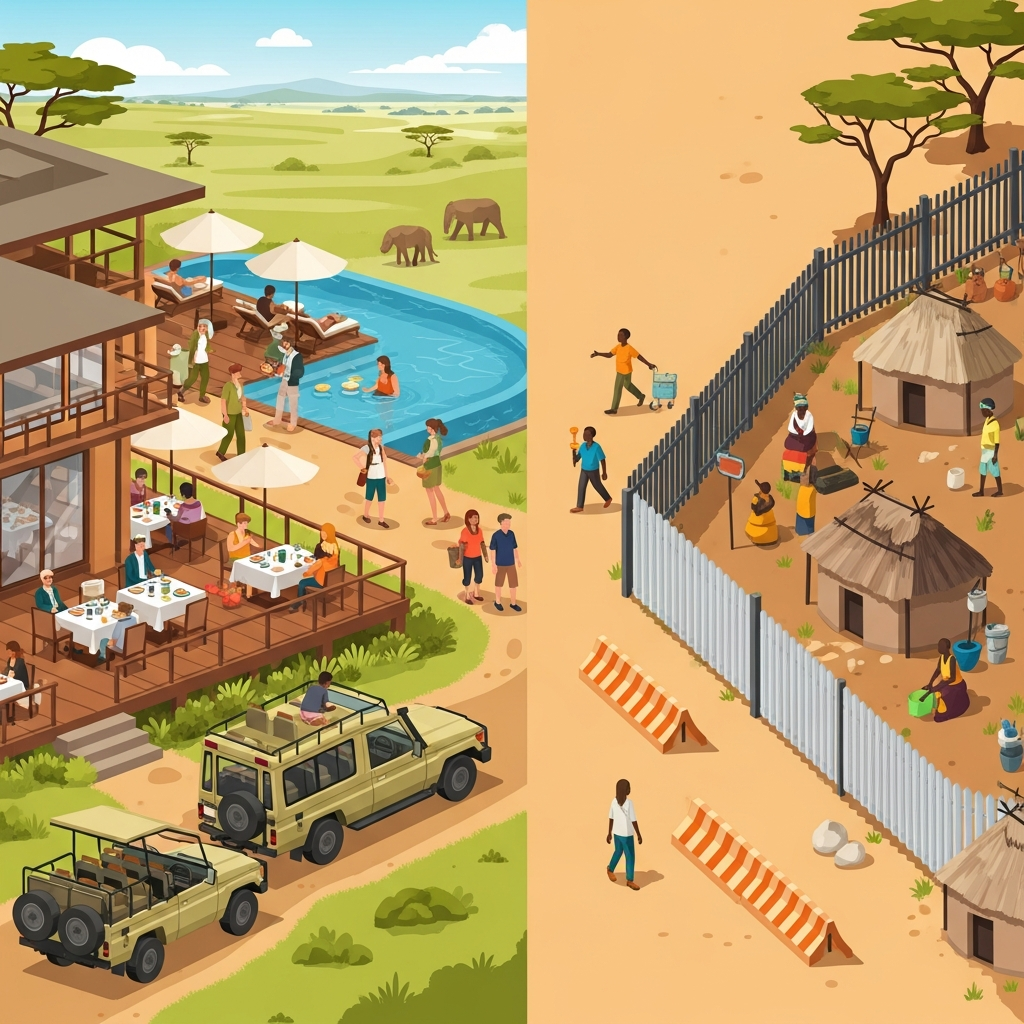
The most politically inconvenient fact about Africa's tourism boom is that a majority of the money generated doesn't stay in Africa. UNCTAD's analysis estimates that 55–80% of every dollar spent on African tourism is repatriated through foreign hotel chain profits, international airline revenues, and offshore tour operator margins — a structural leakage that completely decouples visitor growth from local economic progress. In Tanzania, World Bank analysis puts leakage at approximately 60%, with 70% of luxury resorts majority foreign-owned and structured to repatriate their earnings efficiently. The Zanzibar case is even starker: only 17% of tourism goods and services are locally sourced, and local workers hold just 11% of management positions despite comprising 25% of the total hospitality workforce. The Ritz-Carlton Masai Mara Safari Camp charges nightly rates starting at $3,500 — roughly 30% more than the average Kenyan's annual income — yet a 2025 legal challenge alleged the operation blocked critical wildlife corridors while generating minimal community benefit. Rwanda's gorilla trekking model offers the most credible counterexample: 10% of all park revenue flows directly to surrounding communities through a government-mandated Revenue Sharing Scheme that has measurably lifted local household incomes. But Rwanda is the exception, not the template. Scaling that exception to become the continental norm requires government regulation compelling international hotel chains to meet minimum local employment and procurement ratios — something only a handful of African governments are currently preparing to legislate. Without those mandates, the boom in visitor counts is essentially a boom in foreign corporation quarterly earnings that happens to be located in Africa.
The Connectivity Paradox — Africans Face Greater Barriers Traveling Their Own Continent Than Foreigners Do
One of the most structurally absurd facts about African tourism is that the continent's own 1.3 billion residents face greater barriers traveling to neighboring African countries than Europeans face visiting the same destinations as outsiders. IATA data shows that only 19% of intra-African routes offer direct flights, with over 80% of routes classified as underserved — meaning that a Kenyan flying to Accra, roughly 4,500 kilometers away, often finds the cheapest routing goes through a European hub. African Union data indicates that 46% of intra-African travel still requires pre-arranged visas, despite years of AU commitments to liberalize, meaning the pan-African movement of people remains administratively fragmented in ways that frustrate both business travel and leisure tourism. The Single African Air Transport Market has 34+ signatories on paper but operational implementation that lags far behind the signed agreements. This connectivity failure matters for two interconnected reasons: it means Africa's current tourism growth relies almost entirely on external visitors — a structurally fragile dependency — and it means the continent is leaving its most durable long-term growth engine completely untapped. Africa's middle class is growing at 5% annually, and as disposable incomes rise, pent-up demand for intra-continental travel will surge. Ethiopian Airlines' aggressive pan-African expansion represents the most credible private-sector bet on this dynamic. If the intra-continental market unlocks, it provides the structural independence from geopolitical disruption that Africa's tourism industry currently lacks entirely.
Sustainability vs. Growth — When Safari Expansion Displaces the Communities It Claims to Protect
The collision between tourism expansion and local community rights takes its sharpest form in the Maasai lands of Kenya and Tanzania, where the mechanics of "conservation" are functioning as cover for displacement. As luxury safari lodges expand outward from the Maasai Mara Game Reserve, adjacent Maasai communities face systematic reduction of their traditional grazing corridors — the movement routes their livestock have followed for generations are being legally restricted as conservation boundaries expand to accommodate new eco-lodge footprints. Two presidential commissions in Tanzania have formally recommended large-scale Maasai evictions from UNESCO World Heritage conservation areas, and documented allegations of killings, sexual violence, and livestock confiscation have emerged in connection with enforcement operations. In Morocco, the pattern takes urban form: the frenzy of foreign real estate investment in Marrakech's medina has reportedly pushed local residential rents up more than 30%, displacing the working families whose daily rhythms historically gave the medina its authentic character. Kilimanjaro's glaciers are projected to vanish completely by the 2030s — threatening one of Africa's most iconic tourism assets and signaling that climate change will physically alter the product tourism operators are selling. The gentrification of Africa's most visited destinations mirrors what Barcelona and Lisbon experienced, except that African communities typically have weaker statutory land protections and less organized political voice than European residents who mounted successful legal challenges. The bitter irony is that the communities with the least power to influence tourism development are absorbing its most severe costs while capturing the smallest share of its revenue.
Positive & Negative Analysis
Positive Aspects
- Experience Diversification — Africa's Tourism Portfolio Is Finally Getting Interesting
The most genuinely encouraging structural change in Africa's tourism landscape is the real and accelerating diversification of the experiences on offer. For decades, international perception compressed African tourism into two dominant images: the East African safari and the Egyptian pyramid. That framing is finally cracking, with Marrakech's medina walking tours and cooking classes drawing urban food travelers, Rwanda's mountain gorilla trekking and Kilimanjaro trail running attracting premium adventure demographics, Dakar's Afrobeats festival circuit pulling a younger global traveler demographic, and Accra's Year of Return diaspora tourism program creating an entirely new category built on cultural identity rather than natural spectacle. This diversification carries specific structural advantages: safari tourism is highly seasonal, concentrated in dry months when wildlife congregates at water sources, while urban cultural tourism, food experiences, and music festivals operate year-round, smoothing revenue curves and reducing the occupancy feast-famine cycles that have historically plagued Africa's hospitality sector. The more diversified Africa's tourism product, the less vulnerable its revenue base is to any single disruption — whether a Middle East ceasefire, a climate anomaly affecting one ecosystem, or a health advisory targeting one region. I regard this diversification as the most healthy structural trend in African tourism precisely because it builds resilience across multiple axes simultaneously, and unlike infrastructure investment, it doesn't require massive capital outlays from governments with constrained budgets.
- Morocco's Infrastructure Legacy — Building Tourism Assets That Outlast Any World Cup
The scale and strategic intelligence of Morocco's FIFA 2030-driven infrastructure investment sets it apart from the cautionary tale of Qatar's 2022 World Cup, where purpose-built stadiums sat underutilized in a country with limited post-tournament sporting demand. Morocco is approaching the event with a fundamentally different logic: existing tourism heritage sites — Marrakech, Fez, Essaouira, Chefchaouen — form the anchor assets, and new infrastructure is being built to increase connectivity between them rather than to create standalone showcase facilities. The Casablanca-Marrakech high-speed rail extension to Fez will, for the first time, link Morocco's three major heritage cities by fast rail, enabling multi-city itineraries that today don't exist at scale. Six airport terminal expansions and 50,000 additional hotel rooms give Morocco the supply headroom to absorb the visitor volumes its marketing machine is now generating from the UK, US, Germany, India, and China simultaneously. Annual tourism revenue that stands around $13–14 billion in 2026 carries a plausible trajectory toward $20 billion by 2030, representing growth that would establish Morocco as Africa's unambiguous tourism anchor economy for the foreseeable future. Morocco's management of the 2023 earthquake's tourism impact — which saw visitor confidence restored faster than most analysts expected — suggests an operational resilience that other African nations would do well to study closely.
- Mobile Money Infrastructure — How M-Pesa Is Quietly Reducing Tourism Revenue Leakage
Africa holds a quietly underappreciated competitive advantage in tourism that no other region can fully replicate: a mature and widely adopted mobile money infrastructure that allows local operators to receive international payments without routing revenue through global platform intermediaries. M-Pesa, which processes over $300 billion in transactions annually across East Africa, enables local guesthouses, independent guides, and community-based lodges to accept payment directly via WhatsApp conversation and mobile transfer — bypassing the 15–20% commission that Booking.com, Airbnb, and similar platforms extract from every booking. A family-run guesthouse in coastal Kenya that would historically have needed a bank account, an international payment gateway, or a foreign-owned platform listing can now receive a booking from a German traveler, confirm via WhatsApp, collect payment via M-Pesa, and pocket the full transaction value. This structural bypass of global platform mediation is already operating at meaningful scale in several Kenyan tourism corridors and is expanding into Tanzania, Uganda, and Rwanda as operators discover its economic logic. The broader significance is substantial: if this model scales continent-wide, it structurally attacks one of the core mechanisms of revenue leakage, particularly for the locally-owned accommodation and guiding segments where retained money is most likely to recirculate within the local economy through food purchases, transport, and household spending. This is a uniquely African solution to a problem that no amount of marketing can fix.
- Afrobeats and Nollywood — African Culture Is Building Tourism Demand That Doesn't Depend on Geopolitics
The rise of African cultural content to genuine global mainstream status represents the most promising development for Africa's long-term tourism independence from external shocks. Nigerian Afrobeats artists now chart regularly on the Billboard Global 200, with performers selling out arenas in New York, London, and Paris, and that cultural prestige directly generates tourism demand from an entirely different mechanism than geopolitical rerouting. Nollywood has secured Netflix deals that give West African storytelling visibility in 190 countries, seeding curiosity about the places where those stories originate. Ghana's Year of Return campaign invited the African diaspora to visit UNESCO World Heritage slave fortresses and reconnect with ancestral lands, generating an estimated $1.9 billion in economic activity and establishing diaspora tourism as a distinct and scalable category that operates independently of what's happening in the Middle East. Senegal's contemporary art scene and Ethiopia's coffee origin tourism are similarly creating visitor demand that exists regardless of Venice's entry fee or Doha's airspace status. Among Gen Z global travelers specifically, African music, fashion, and food have achieved cultural cachet that functions as a genuine pull factor — a reason to go, not a fallback position. This cultural-demand mechanism is what I consider Africa's most durable long-term tourism asset, because it operates entirely within Africa's own sphere of cultural influence rather than depending on external conditions it cannot control.
- Visa Liberalization — Africa's 1.3 Billion People as the Ultimate Tourism Domestic Market
The gradual but real progress toward African visa liberalization and continental air connectivity carries implications that most tourism analysis undersells significantly. The African Union's visa openness data shows directional improvement, with Rwanda and Kenya's e-visa implementations substantially reducing friction for regional travel, and Ethiopian Airlines' aggressive expansion of pan-African routes representing the most credible private-sector commitment to actually connecting the continent to itself. The fundamental argument for this trend's importance is demographic and economic: Africa's middle class — households spending $20–100 per day — is growing at approximately 5% annually, adding tens of millions of new potential travelers who currently find intra-continental travel prohibitively expensive and logistically complicated due to missing direct flights and visa requirements. If the Single African Air Transport Market achieves meaningful implementation across 42–45 countries by 2028, driving intra-African airfare reductions of 25–35% through increased competition, the dormant demand for Lagos-to-Nairobi holidays, Accra-to-Cape Town family visits, and Dakar-to-Addis business trips will activate at scale that no external factor can suppress. This intra-continental market is ultimately the only tourism engine that cannot be switched off by a Middle East ceasefire, a European economic recovery, or an Asian currency depreciation — because it is driven entirely by the income growth and travel aspirations of Africans themselves.
Concerns
- Geopolitical Dependency — The Boom That a Ceasefire Could End
Africa's tourism surge carries a foundational structural fragility: a substantial share of its current momentum is borrowed from geopolitical disruption rather than earned through competitive development. More than 52,000 flight cancellations from Middle East airspace closures and the disruption of Gulf hub-and-spoke networks have artificially elevated Africa's relative attractiveness as a travel destination in ways that are difficult to disentangle from genuine demand growth. When — not if — the Middle East achieves meaningful de-escalation and Gulf carriers restore their hub dominance, the rerouted demand currently flowing to African airports will migrate back toward Dubai and Doha at a pace determined by Emirates and Qatar Airways' operational capacity, not by Africa's tourism quality. My estimate is that this geopolitical normalization could reduce Africa's headline growth rate from approximately 8% to 4–5% within two to three quarters of the stabilization event. The East African emerging destinations that expanded accommodation infrastructure on current trajectory assumptions face the greatest exposure: hotels and resorts built with international debt at projected 70–80% occupancy could see bookings fall to the 40–50% range, testing debt-servicing capacity and potentially triggering localized sector distress. This vulnerability is not hypothetical — it is the pattern that played out in Tunisia after 2011, when Arab Spring-era tourism rerouting reversed as Egypt and Jordan recovered, leaving Tunisia's over-extended hospitality infrastructure as a liability rather than an asset for years afterward.
- Revenue Leakage — Africa Gets the Traffic, Foreign Corporations Get the Money
The persistent structural problem of tourism revenue leakage represents the sharpest possible challenge to the optimism embedded in Africa's growth figures. When 81 million visitors travel to Africa and spend hundreds of billions of dollars, the question of where those dollars actually land matters enormously. UNCTAD's analysis estimates that 55–80% of tourism spending is repatriated — a range reflecting dramatic variance between countries, but consistent in direction: toward foreign hotel chain headquarters in London and New York, toward international airline balance sheets in Dubai and Doha, and toward European tour operator profit pools. World Bank analysis estimated Tanzania's leakage at 60%, with 70% of luxury resorts majority foreign-owned and structured to repatriate profits efficiently, and Zanzibar's data showing 83% of highest-end hospitality properties are foreign-owned. University of Manchester research published in the African Studies Review directly challenged the World Bank's historic position that luxury tourism benefits African host nations, finding instead that high-end development typically minimizes local hiring, procures minimally from local suppliers, and excludes local residents from premium amenities. The leakage problem is structural and will not self-correct as visitor numbers rise — it requires active policy intervention including mandatory minimum local employment ratios, required local procurement percentages, and community co-investment obligations. Without those policies, 8% tourism growth is essentially a mechanism for extracting value from African landscapes and workers to benefit shareholders who may never set foot on the continent.
- Tourism Gentrification — The More Successful the Boom, the Faster Communities Are Displaced
The paradox of tourism success — that it actively displaces the communities whose presence makes destinations authentic — is playing out across Africa's most visited sites with a severity that the growth headlines completely obscure. In Marrakech's medina, foreign buyers have acquired historic family Riads for boutique accommodation conversion at such scale that local residential rents reportedly rose more than 30%, pricing out working families whose daily routines historically formed the authentic character attracting visitors in the first place. Kenya's Maasai Mara region sees recurring cycles of luxury lodge expansion encroaching on traditional Maasai grazing territory, with conservation boundary extensions serving as the legal mechanism for restricting nomadic livestock movement — a process that two Tanzanian presidential commissions have recommended applying at even larger scale through formal evictions from UNESCO World Heritage zones. This gentrification dynamic is not uniquely African — Barcelona and Lisbon have confronted identical pressures — but Africa's communities are navigating it from a more legally vulnerable baseline, with weaker statutory indigenous land rights protections and less politically organized resistance. As climate change adds pressure by limiting viable grazing land, the squeeze on traditional communities intensifies from multiple directions simultaneously. The bitter irony is that the more successful Africa's tourism boom becomes, the more intense the displacement pressure on the communities with the least power to resist it and the smallest share of the revenue generated in their territories to compensate for what they lose.
- Infrastructure Polarization — The 'Africa Boom' Is Really a 5-Country Story Borrowing a Continental Name
The phrase "Africa tourism boom" performs an act of geographic generosity that deserves challenge: it packages the performance of 5–7 high-functioning nations into a continental narrative that the other 47+ nations share by name but not by economic reality. Morocco, Egypt, South Africa, Kenya, and Tanzania generate the overwhelming majority of Africa's international tourist arrivals and receipts, having built competitive airport capacity, established brand recognition in high-income source markets, and accumulated hotel inventory to service large visitor volumes. The remaining nations observe this performance from a position of infrastructural exclusion that is widening, not narrowing. While Morocco channels $5–6 billion in FIFA 2030 investment into tourism infrastructure, many West and Central African nations lack capital to fund basic runway maintenance at their primary international airports. The gap between Africa's tourism leaders and its followers widens each year, because leaders' revenues compound into further competitive investment while followers struggle to maintain existing capacity. The risk is not just unequal distribution of current benefits — it's that structural divergence creates a new form of intra-continental tourism dependency, where smaller nations' hospitality sectors become suppliers of cheap labor to infrastructure and booking systems controlled by wealthier regional neighbors, replicating within the continent the same extractive dynamics that UNCTAD documents between Africa and the global economy.
- Climate Change — Africa's Most Iconic Tourism Assets Are Being Slowly Destroyed
Climate change represents the medium-to-long-term risk most consistently underweighted in Africa's tourism growth projections, partly because its impacts compound over decades rather than quarters. Kilimanjaro's glaciers are projected to disappear completely by the 2030s, removing one of Africa's most symbolically powerful natural landmarks and a significant draw for Tanzania's high-altitude trekking and photography tourism. East Africa's dry-wet season cycles, which structure the wildlife viewing windows that luxury safari pricing models depend upon, are becoming less predictable as climate patterns shift — effectively shortening the optimal tourism season that eco-lodges and conservation area revenues are built around, while making it harder for operators to guarantee the wildlife concentrations that premium pricing requires. Malaria vectors are extending their range to higher altitudes, placing historically "safe" highland tourism destinations at increasing public health risk — a development that directly affects travel insurance premiums, government health advisories, and the willingness of travelers with children or health concerns to visit. Coastal tourism infrastructure in Dar es Salaam, Mombasa, and Dakar faces compounding threat from sea-level rise and intensified Indian Ocean cyclone activity. Building climate-resilient coastal infrastructure, developing drought-resistant alternative tourism products, and funding highland malaria vector control all require capital that most African tourism economies currently redirect toward marketing rather than adaptation. If investment priorities don't shift, Africa's most iconic assets will be materially degraded precisely when the continent needs them to carry the most weight in a competitive global tourism market.
Outlook
Over the next six months, the clearest near-term development will be Morocco's continued and accelerating separation from the rest of the continent as its FIFA 2030 infrastructure enters its showcase phase. The Marrakech-Fez-Tangier tourism belt — connecting Morocco's three most internationally recognized heritage zones — will reach operational readiness at a new level of connectivity as high-speed rail extensions and airport upgrades complete their current construction cycles. Annual tourism revenue that reached an estimated $13–14 billion in 2026 has a plausible trajectory toward $16–17 billion by end of 2027, which would represent the largest single-nation tourism economy on the continent by a substantial margin. Kenya and Tanzania are benchmarking aggressively against Morocco's model, but the fiscal reality creates a hard constraint: Morocco can redeploy FIFA-related tax receipts and accelerated foreign direct investment into further infrastructure development, while East African nations are working within far tighter capital budgets. The near-term outlook, bluntly, is that Morocco extends its lead rather than the continent converges.
The most significant wildcard in the near-term is the trajectory of Middle East geopolitics. If a ceasefire or meaningful de-escalation materializes in the second half of 2026 — which multilateral negotiation momentum makes non-trivial — Gulf carriers will begin restoring their hub-and-spoke dominance over Europe-Asia traffic flows. Emirates, Qatar Airways, and Etihad have the scale, route density, and brand positioning to recapture redirected traffic quickly once Dubai and Doha airspace stabilizes. My estimate is that this normalization, if it occurs, could reduce Africa's headline tourism growth rate from approximately 8% to 4–5% within two to three quarters. The East African destinations that expanded accommodation supply on current trajectory assumptions face the sharpest exposure: hotels and lodges built with international debt at projected 70–80% occupancy could see bookings fall to the 40–50% range, testing debt-servicing capacity. The second half of 2026 is when Africa's tourism resilience gets its first real examination, and I'd advise treating it as a financial stress test rather than an opportunity to extend credit further.
Moving into the 2027–2028 window, three simultaneous structural developments will determine whether Africa can hold its tourism momentum independently of geopolitical tailwinds. The Single African Air Transport Market is projected to expand from 34+ current signatories to 42–45 member states, which IATA modeling suggests could increase intra-continental air seat capacity by 30–40% and generate 155,000 additional jobs and $1.3 billion in additional GDP across participating economies. The Pan-African passport pilot is expected to scale from the East African Community's six nations to ECOWAS's 15 member states, dramatically reducing the visa friction that currently makes intra-African travel more complicated than it should be for a continent of 1.3 billion people. Ethiopian Airlines' hub-and-spoke network is targeting connections to 40+ African cities, which would make Addis Ababa a functional continental hub with genuine alternatives to Gulf carrier routing. If these three developments materialize on schedule — a meaningful 'if' given the pace of African institutional implementation historically — the intra-continental tourism market, currently massively underserviced, could become a growth engine that operates entirely independently of what's happening in the Middle East.
The mid-term period is also when local value chain regulation will reach a critical policy threshold. Kenya and Rwanda are reportedly preparing legislation that would mandate minimum local employment ratios and local procurement percentages for foreign-operated tourism businesses. If enacted by 2027, these regulations will likely cause a short-term reduction in foreign direct investment of 5–10% as international hotel chains reassess their margin structures. However, the medium-to-long-term effect on local revenue retention would be far more significant: UNCTAD modeling suggests that raising local procurement from the current 17–20% range to 40–50% could lift the share of tourism spending circulating within African economies from 20–45% to 60–70%. Rwanda's gorilla trekking model has demonstrated this framework's operational viability — its mandatory 10% community revenue share hasn't collapsed demand; trekking revenue has grown 28% year-over-year. If East Africa scales that model to target community revenue shares of 15–20% per tourism dollar, African tourism would achieve its most meaningful structural advance since the industry began generating significant receipts.
Looking further ahead into 2028–2032, three distinct trajectories appear plausible and deserve explicit probability assessments. In the optimistic scenario, the 2030 Morocco FIFA World Cup delivers genuine continental impact: over one million international visitors transit Morocco during the tournament, spill-over demand reaches Senegal, Mauritania, and Algeria as travelers extend itineraries, and sustained global media attention lifts Africa's collective tourism brand in ways that persist for years. SAATM achieves full implementation across all 54 African Union member states, at least ten countries adopt the Pan-African passport, and the Rwanda-Kenya local revenue model gets adopted by 20+ nations. Continental tourism revenue rises from approximately $50 billion today to $70–80 billion by 2031 — a 40–60% gain reflecting genuine structural advancement. I assign this optimistic scenario approximately 25% probability: the requirements are real and achievable, but the coordination demands across institutions, governments, and markets are severe.
The base scenario — which I assign roughly 50% probability — projects continuation of the current concentration pattern: Morocco, Egypt, South Africa, Kenya, and Tanzania drive the overwhelming majority of continental growth while other nations see marginal gains. Annual growth stabilizes at 5–6%, and continental receipts reach $55–60 billion by 2030. Cape Town and Nairobi establish themselves as genuine competitors to European cities in the digital nomad long-stay market. Lagos Afrobeats tourism and Accra diaspora programming create vibrant niche demand without moving the continental aggregate significantly. The bear scenario — 25% probability — envisions Middle East peace delivering a demand reversal that hits over-leveraged East African accommodation markets in 2029–2030. Climate change compounds the pressure by shortening prime safari seasons as dry-wet cycle patterns shift, and malaria vectors extend their range to highland zones previously considered safe. Continental growth falls to 2–3%, some markets see negative arrivals, occupancy rates drop below 50%, and tourism employment declines 15–20%. This pattern closely mirrors what happened to Tunisia after its Arab Spring-era boom reversed — a historical rhyme that African tourism planners should keep visible on their walls.
The chain effects of continued tourism growth deserve explicit attention because they extend well beyond the hospitality sector balance sheet. First-order effects are positive: employment in aviation, hotels, restaurants, and guiding grows. Second-order effects are mixed: new employment stimulates urbanization pressure around tourism hubs, driving real estate demand upward. Third-order effects become increasingly problematic: real estate demand from high-income tourism operators and wealthy foreign buyers displaces existing residents, raises rents for local households, and fragments the community fabric that originally made destinations attractive. Marrakech's medina has already seen this dynamic, with foreign riad purchases reportedly pushing local residential rents more than 30% higher in key neighborhoods. The pattern is spreading toward Dakar, Nairobi, and Cape Town at different stages of intensity. Barcelona and Lisbon developed resident-rights frameworks to constrain tourism gentrification after communities organized politically; Africa's communities are starting this journey from a more legally vulnerable baseline with weaker statutory land protections, meaning the damage could accumulate faster and prove harder to reverse.
I want to be transparent about the conditions under which my analysis could be materially wrong. The most significant potential error in the exogenous-growth thesis is underestimating how rapidly African cultural content is building self-sustaining tourist demand. Afrobeats is no longer a niche genre — it is mainstream global pop commanding arena crowds in New York, London, and Sao Paulo. Nollywood reaches 190 countries through Netflix deals. Ethiopian coffee culture has seeded a global specialty coffee movement that sends origin-curious travelers directly to Addis Ababa. Senegal's contemporary art scene draws collectors and curators from European capitals. If this cultural momentum continues maturing into destination-pull demand at a pace that outstrips geopolitical influence — if people are visiting Lagos because Lagos is irreplaceable, not because Dubai was temporarily inconvenient — then the structural fragility I've described becomes far less threatening. Early signals from Instagram and TikTok travel content suggest this transformation is underway. My practical recommendation: stop watching visitor-count headlines and start tracking local revenue retention rates, intra-African travel volume growth, and the proportion of trips motivated by cultural pull rather than geographic default. Those indicators will reveal whether Africa is building a genuinely new kind of tourism — or whether 2025's 8% number will look very different once the guns go quiet in the Middle East.
Sources / References
- Africa Builds Momentum and Challenges Europe and Asia in Global Tourism Race — Euronews Travel
- Morocco's Tourism Revenue Hits Record $3.1 Billion in Q1 2026 — Travel And Tour World
- Africa Surges as Global Tourism Powerhouse: Visitor Growth Outpaces Europe and Asia — Travel And Tour World
- Africa Tourism Up by 8% as Global Travel Reaches New Peak — African Leadership Magazine
- Africa Steps into the Tourism Spotlight — TravelWiseWay
- Africa Tourism Record Growth 2026: Global Energy Crisis Context — Nomad Lawyer