
The Border Between Ramen and Ramyeon Has Already Dissolved — And That's Actually a Good Thing
Summary
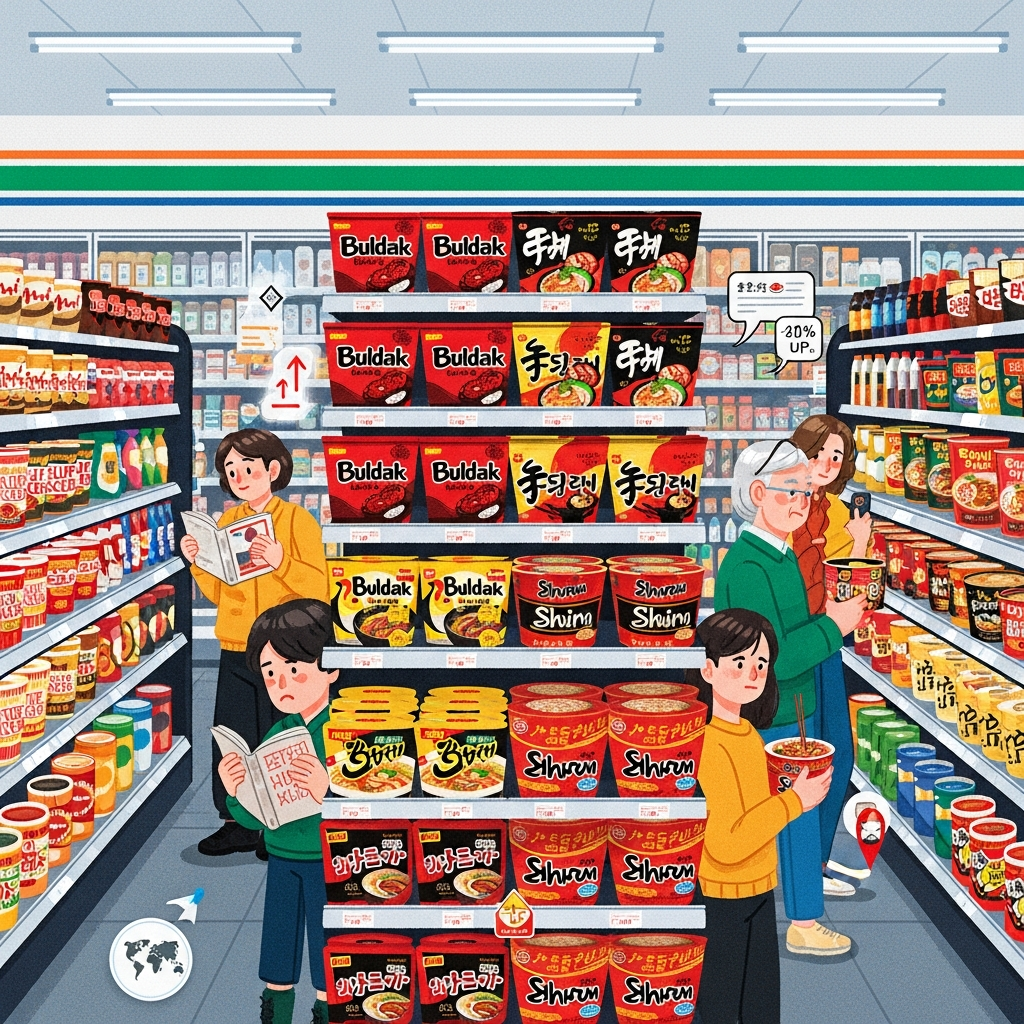
Korean instant noodles have surpassed 110 billion yen in cumulative sales in Japan — the country that invented ramen — marking a cultural inversion that goes far beyond food export statistics. Nongshim's Shin Ramyeon is growing at over 20 percent annually in Japan while Samyang's Buldak recorded 2.35 trillion won in 2025 revenue, a historic high driven by 65 percent export growth, with 77 percent of those exports coming from the Buldak product line alone. Behind Korean noodles' advance lies a structural crisis in Japan's domestic ramen industry, where 2024 saw a record 79 ramen shop bankruptcies as ingredient costs surged 41 percent since 2020 and consumer resistance to crossing the so-called "1,000-yen wall" eliminated any path to price increases. This essay argues that Korean ramen's conquest of Japan is not simply a food export achievement but a new and more durable form of soft power — quieter than K-pop, unsubsidized by government strategy, and built entirely on spontaneous consumer choice driven by the K-content flywheel. As the global instant noodle market grows toward $98 billion by 2032, the national-identity distinction between "ramen" and "ramyeon" is dissolving in real time, and that dissolution is one of the more revealing cultural stories of this decade.
Key Points
The 110-Billion-Yen Milestone and What It Actually Signals
Nongshim's cumulative Japan sales crossing 110 billion yen — reported by Seoul Economic Daily in April 2026 — is not primarily a revenue story. It is evidence that a foreign brand has crossed the threshold from "imported novelty" to "mainstream daily choice" in the most competitive noodle market on earth. Japan consumes approximately 5.9 billion servings of instant noodles annually, ranks as the world's fifth-largest market, and launches over 1,000 new noodle products every year from domestic manufacturers with deep distribution relationships and established consumer loyalty. In this context, a Korean brand sustaining over 20 percent annual growth and publicly targeting a top-six market position is not incremental success — it represents a structural reconfiguration of how Japanese consumers think about the noodle category. Nongshim has been building Japan distribution infrastructure since the 1990s, accumulating over 30 years of channel relationships, and the current explosive growth is happening on top of that patient long-term investment. The Busan export factory coming online in late 2026 indicates that Nongshim is committing further supply capacity to Japan specifically — a decision that only makes sense if the company believes current momentum is structurally durable rather than trend-driven.
Japan's Structural Ramen Crisis Created the Market Opening
The record 79 ramen shop bankruptcies in Japan in 2024 — a 49 percent surge from 2023, according to Teikoku Databank — is not cyclical business failure. It reflects the convergence of three structural forces that are not going to reverse: ingredient cost inflation of 41 percent since 2020, consumer resistance to crossing the 1,000-yen price point per bowl, and labor shortage-driven operating cost increases in a country where the restaurant workforce is aging out. Survey data showing 34 percent of ramen operators running at a loss in fiscal 2023 underscores that the squeeze is industry-wide rather than confined to weak operators. Korean instant noodles — priced at 300 to 500 yen per serving in Japanese convenience stores — have stepped directly into this structural gap, offering what the market calls "premium flavor at an affordable price." The value equation is not "cheap noodles versus expensive noodles." It is "satisfying, distinctive, trend-relevant food at a price point the market will accept," which is precisely what the domestic ramen industry cannot currently deliver at scale. The 2025 data showing Japanese bankruptcies declining to 59 suggests the domestic industry is finding some adaptive responses, meaning Korean noodles will face a more competitive landscape going forward — but the structural opening has been captured and the distribution positions established.
The Buldak Phenomenon: Single-Product Risk Meets Antifragile Brand
Samyang's extraordinary 2025 numbers — 2.35 trillion won total revenue, 36 percent year-over-year growth, 65 percent export growth — are remarkable but come with a structural concentration risk that serious analysis cannot ignore. Seventy-seven percent of Samyang's export revenue flows from the Buldak product line, which means the company's entire global growth story is essentially a single-product bet. This concentration is both Samyang's greatest strength and its most significant vulnerability. The 2024 Denmark recall illustrated the brand's remarkable antifragility: a regulatory suppression attempt transformed into the most effective viral marketing event in Samyang's history, demonstrating that Buldak's cultural resonance is deep enough to convert adversity into amplification. But this same dynamic could run in reverse if spicy food trends plateau or health-conscious consumption shifts accelerate — the brand that benefits from polarization could be hurt by it too. Samyang's February 2025 launch of the MEP premium brand in Japan is the company's most visible strategic response to this concentration risk, and its success or failure over the next 12 months will be a leading indicator of whether Samyang can successfully build a multi-product premium portfolio or remains dependent on Buldak's continued dominance.
The K-Content Flywheel: Why This Soft Power Is Different
Korean ramen's global success is the latest extension of the K-wave flywheel that connects Korean dramas, K-pop, K-beauty, and K-food into a mutually reinforcing cultural export ecosystem. But what makes the food dimension qualitatively different from the entertainment dimensions is the mechanism of consumer conversion. K-pop and K-drama require deliberate cultural consumption choices — you have to choose to watch a show or stream an album. Food consumption can happen accidentally, habitually, and with far less conscious cultural decision-making. When a Japanese Gen Z consumer buys Buldak at a convenience store, they may not even be thinking about Korea as a cultural reference point — they are buying something their friends talked about, that they saw in a mukbang video, that tastes genuinely good and hits a flavor profile nothing else in the store matches. This lower-friction conversion from cultural affinity to purchasing behavior is what makes food the most durable component of the K-wave. The K-food export data supports this: Korea's total food exports reached $13.03 billion in 2024, an all-time record, with instant noodles posting the highest growth rate of any single category at 31.1 percent. Food is not the flashiest part of the Korean Wave, but it may ultimately be the most permanent.
The Ramen-Ramyeon Boundary Dissolution and Its Long-Term Meaning
The most strategically significant development in this story is not the sales numbers — it is the gradual erosion of the cultural distinction between Japanese ramen and Korean ramyeon in the minds of actual consumers. Ramen has historically been so strongly associated with Japanese national and regional identity that any foreign incursion into the category carried a cultural weight beyond pure market competition. The fact that this distinction is visibly weakening — that Japanese consumers in their twenties and thirties now buy Korean instant noodles as unremarkably as they buy other convenience food — represents a genuine paradigm shift in how food-based national identity works. The historical irony worth noting is that ramen itself arrived in Japan from China in the late 19th century and was further developed by a Japanese-Taiwanese inventor, making its claimed status as a purely Japanese food already somewhat constructed. What's happening now is simply the next chapter in a longer story of noodles crossing borders and reinventing themselves in new cultural contexts. By 2030, expecting a Japanese consumer to feel cultural ambivalence about Korean instant noodles will be as anachronistic as expecting an American to feel ambivalence about Japanese sushi.
Positive & Negative Analysis
Positive Aspects
- Japan's Structural Ramen Crisis Creates a Non-Reversible Competitive Advantage Window
The forces driving Japan's domestic ramen shop bankruptcies — cumulative ingredient cost inflation, consumer price resistance, and demographic labor shortage — are structural rather than cyclical, and they have created a sustained opening for Korean instant noodles that would not have existed in a healthier domestic market. The "1,000-yen wall" is not going to dissolve quickly: Japanese consumer price psychology for commodity food categories changes slowly, and the structural gap between what it costs to run a ramen shop profitably and what consumers will pay has been widening for years. Korean instant noodles fill that gap precisely because their production economics are fundamentally different from a fresh-cooking restaurant model — they benefit from scale manufacturing, consistent quality, and a price point that the domestic industry cannot match with handcrafted product. Japan's convenience food market growing from $24.99 billion in 2024 to a projected $38.7 billion by 2033 provides the expanding channel volume that gives Korean brands room to grow without displacing other categories. The combination of structural domestic competitor weakness and expanding channel volume is about as favorable a market entry condition as any food brand could hope for.
- The K-Content Flywheel Is Self-Reinforcing and Highly Durable
The mechanism linking K-pop and K-drama consumption to Korean food purchasing is not a single causal thread — it is a multi-strand flywheel that reinforces itself across multiple content types simultaneously. When K-pop loses momentum in a particular demographic, K-drama often picks it up; when both slow, K-beauty or K-gaming fills the attention space. Korean food benefits from all of these pathways simultaneously because food is the most accessible and repeatable conversion from cultural interest to consumer behavior. Japanese Gen Z consumers who engage with Korean content across any of these channels are more likely to try Korean food, and repeated positive food experiences deepen the broader cultural affinity, which feeds back into more content consumption. K-food exports crossing $13 billion in 2024 is evidence that this flywheel has reached a self-sustaining scale — the food exports are no longer dependent on any single content trend to maintain momentum. The durability here is genuine and structural, not dependent on any individual artist, show, or product maintaining its current popularity level.
- The Denmark Recall Proved Buldak's Brand Is Antifragile Under Pressure
The 2024 Denmark food safety recall — a regulatory action that should by conventional brand logic have produced a sales decline and reputational damage — instead triggered a global viral phenomenon that drove Buldak awareness to levels no marketing budget could have purchased. This demonstrated something genuinely rare: that the Buldak brand has "antifragile" properties in Nassim Taleb's sense — the capacity to absorb shocks and emerge stronger rather than weaker. The mechanism is specific to Buldak's identity as a challenge food: anything that frames the product as extreme, dangerous, or boundary-pushing reinforces exactly the brand story that drives its core consumer appeal. The November 2024 reversal of the recall on two of the three products meant the full arc — recall, global attention, partial reversal — played out as what was effectively a multi-month free advertising campaign. Samyang's 2025 all-time revenue record cannot be understood without accounting for this viral amplification effect, which arrived at essentially zero marketing cost. No other Korean food brand has demonstrated this level of brand resilience under adversarial conditions, and it represents a durable competitive advantage in an attention economy where controversy is difficult to engineer and even harder to survive productively.
- Long-Term Infrastructure Investment Signals Structural Market Commitment
Nongshim's construction of a dedicated Busan export factory — scheduled for H2 2026 operation — and Samyang's launch of the MEP premium brand in Japan are not the decisions of companies riding a temporary viral wave. Building production infrastructure takes years and commits capital at a scale that only makes sense if the investing company believes the market opportunity is durable across at least a five-to-ten-year horizon. This infrastructure commitment transforms the strategic narrative around Korean ramen in Japan from "viral trend" to "structural market entry." The difference matters enormously for how competitors, retail channel partners, and investors should price the long-term positioning. Nongshim's three-decade history in Japan — steadily building distribution relationships since the 1990s — provides the institutional knowledge and channel trust that makes rapid scaling possible when the cultural moment arrives. The current explosive growth phase is not happening in a vacuum; it is happening on top of a foundation that took 30 years to construct, which means it is far more defensible than the growth rate alone might suggest to an outside observer.
Concerns
- Samyang's 77 Percent Buldak Revenue Concentration Is a Structural Vulnerability
When 77 percent of a company's export revenue flows from a single product line, the business is one trend shift away from a significant growth reversal. For Samyang specifically, the risk scenario is not hypothetical: the global spicy food trend, while currently robust, is not immune to the kind of consumer fatigue that periodically resets viral food categories. The health-conscious consumption shift is already visible in Japan — with over 125 low-sodium, gluten-free, and plant-based instant noodle products launched in Japan in 2023-2024 alone — and if that trend accelerates faster than Samyang's portfolio evolution can match, Buldak's core demand base could erode before the company has established alternative revenue pillars. MEP's premium brand launch in Japan is the right strategic response, but it is early and unproven, and the history of global food companies successfully transitioning from a single viral hit product to a durable multi-product portfolio is not an encouraging track record. Korean food industry precedent does not provide many examples of companies that successfully maintained growth after the initial viral product plateaued, which means Samyang is operating without a clear roadmap for the scenario it most needs to plan for.
- Yen Weakness and Japanese Demographics Create Compounding Headwinds
Prolonged yen depreciation has a direct adverse effect on Korean ramen's Japanese market competitiveness that cannot be managed away through brand positioning alone. When the yen is weak against the Korean won, Korean instant noodles become more expensive for Japanese consumers even if the Korean manufacturer holds prices constant — which erodes the value proposition that is a core part of the category's appeal. Simultaneously, Japan's demographic structure — with over one-third of the population now past 65 and the working-age population shrinking — is reducing the absolute size of the young adult consumer cohort that drives Korean noodle purchasing. These two headwinds could compound in a scenario where yen weakness persists for several more years while Japanese health-food regulations tighten, creating a triple pressure that no amount of brand equity or marketing execution can fully offset. Korean companies that fail to develop credible low-sodium, lower-calorie product lines for the Japanese market within the next two to three years are exposing themselves to a scenario where demographic and health-preference shifts produce a sudden demand deceleration, rather than the gradual slowdown that allows time for strategic adjustment.
- Japanese Convenience Store PB Retaliation Is a Near-Certainty in the Medium Term
Seven-Eleven, FamilyMart, and Lawson — Japan's "Big Three" convenience store chains — collectively operate tens of thousands of stores and have both the manufacturing relationships and the shelf allocation control to develop credible private-label alternatives to Korean noodle products once they are satisfied that the category has durable consumer demand. At the current rate of Korean noodle growth, that threshold has almost certainly been crossed. PB "Korean-style spicy noodles" from any of these chains would immediately have distribution scale that no Korean brand — however well-established — can match on price or placement convenience. The Korean brands' defense in this scenario rests primarily on brand story, authentic origin claims, and the cultural cachet of being "the real thing." These are real advantages, but they are advantages that erode as consumers habituate and PB products improve in quality. The pasta category in Europe offers a relevant parallel: authentic Italian brands like Barilla maintain significant premium positioning against store-brand pasta, but the premium is smaller than it once was as retailer own-label quality has improved. Korean ramen brands should expect a similar dynamic to play out in Japan within two to four years.
- Korea-Japan Political Risk Remains an Unquantifiable but Real Tail Risk
The current Korea-Japan diplomatic relationship is in a relatively constructive phase, and the growing data showing that food consumption decisions among younger Japanese consumers are increasingly decoupled from political sentiment is genuinely encouraging. But political relationships are inherently unstable, and a sharp deterioration triggered by historical grievance issues, fishing rights disputes, or territorial tensions could create pressure on Korean-branded consumer products in a way that is difficult to fully predict or manage. Korean food brands like Nongshim and Samyang are clearly identified as Korean-origin products in Japan — this is part of their appeal — but that identification also means they carry geopolitical exposure that global brands with ambiguous national identity do not. Japanese convenience store chains, under nationalist consumer or government pressure during a diplomatic crisis, have historically adjusted shelf allocation decisions for Korean products in ways that produced significant short-term sales impacts. The probability of this scenario occurring in any given year is low — probably under 10 percent — but the potential impact on a business where Japan represents a significant portion of total export revenue is large enough that scenario planning for it is not optional.
Outlook
The next one to six months will bring a further intensification of Korean noodle presence in Japan's retail channels. Nongshim has publicly stated its ambition to nearly double Japan sales by 2026, and the Busan export factory coming online in the second half of the year provides the supply capacity to support that target. If the factory ramps as planned, current 20 percent annual growth could accelerate rather than plateau. Samyang's MEP premium brand, launched in Japan in February 2025, adds an important new dimension — this is Buldak's parent company deliberately moving beyond the "cheap spicy noodles" positioning to attack premium convenience store segments with a higher average selling price. Within three to six months, we should have initial market data on whether MEP is gaining traction, and that data will signal whether Korean ramen's Japan strategy is evolving from a single-category play into a multi-tier market structure. I expect at least one additional Korean ramen brand — likely Ottogi's Jin Ramen — to meaningfully accelerate its Japan convenience store presence in this same window, which would add internal competitive pressure among Korean brands on Japanese shelves.
The restructuring of Japan's ramen industry will also continue accelerating in the medium term. Yoshinoya's aggressive 40-billion-yen ramen revenue target by 2029 signals that major Japanese food conglomerates view the wave of small shop bankruptcies not as a crisis but as a consolidation opportunity — an opening to acquire distressed independents and build chains at scale. The Skylark group's 24-billion-yen M&A in the noodle space points the same direction. Within the next six months, additional M&A announcements in Japan's ramen sector are likely. What makes this strategically interesting is that the Japanese response is being mounted through the restaurant and fresh-cooking channel, not the packaged goods channel. Korea attacks via the bag; Japan defends via the bowl. These are parallel strategies aimed at different consumption occasions, which means they are not as directly competitive as they might appear — but they are both ultimately competing for the same stomach.
Over the medium term of six months to two years, the most consequential variable for Korean ramen's Japan performance will be the compounding effect of yen exchange rates and Japanese demographic trends. If yen weakness persists, Korean noodles will become more expensive in real consumer terms, eroding part of the value proposition. Japan's accelerating aging — with over one-third of the population now past 65 — structurally shrinks the young adult consumer base that is Korean noodles' core audience. Between 2023 and 2024, over 125 new low-sodium, gluten-free, and plant-based instant noodle products launched in Japan, reflecting where the market is heading. Nongshim and Samyang need to show credible health-oriented product extensions within this window. Without them, the demographic headwinds could translate into growth deceleration well before the market fully matures.
On the global stage, the structural tailwinds are clearly favorable in the medium term. WINA data shows global instant noodle consumption crossed 123 billion servings in 2024, and the market is forecast to grow at a CAGR of 6.19 percent through 2032 to reach $98.4 billion. Japan's convenience food market is itself growing from $24.99 billion in 2024 to a projected $38.7 billion by 2033. Korean brands have already secured dedicated shelf space in convenience store chains — one of the most valuable and sticky distribution positions in the Japanese retail system. My projection is that by 2027 to 2028, Korean instant noodle exports will cross $2 billion annually, and Korean ramen's Japan market share will stabilize at 15 to 20 percent — a highly defensible position given the brand equity already accumulated. The threat to watch in this timeframe is Japanese convenience store private-label products. Seven-Eleven, Lawson, and FamilyMart have the manufacturing relationships and shelf control to develop "Korean-style spicy noodles" under their own labels, and once they are convinced the category has long-term consumer demand, PB development is essentially inevitable.
Looking further out at the two-to-five-year horizon, I believe the most significant transformation will be conceptual rather than commercial. The category distinction between "ramen" and "ramyeon" will become functionally obsolete among Japanese consumers under 40. This isn't wishful thinking — it's the logical endpoint of the trend already visible in purchasing data. For Gen Z consumers in Tokyo, buying Korean instant noodles at a convenience store is already as unremarkable as buying Italian pasta at a supermarket. The national-origin framing is not part of their decision process. What matters is flavor, price, and whether their friends are talking about it. By 2030, expecting a Japanese consumer to feel any cultural ambivalence about eating Korean noodles will be like expecting an American to feel ambivalent about eating Japanese sushi. The category will simply have normalized.
The long-term scenario I find most interesting — and most likely — is that Korean brands use their current momentum to complete a repositioning from "cheap spicy import" to "global food category leader in spicy noodles," much like what Japanese car brands did with fuel efficiency in the 1980s. Samyang's MEP launch and Nongshim's premium product development are early moves in this repositioning. If they execute well over the next two to three years — developing low-sodium lines, plant-based variants, and premium collaborations with Japanese chefs or local flavors — the "Korean ramen" category could achieve a level of cultural authority in Japan that is self-sustaining regardless of whatever the broader K-wave is doing at any given moment. That is the bull case, and I'd put it at roughly 30 percent probability. The base case — sustained 10 to 15 percent annual growth, stable 15 percent market share, gradual PB competition eroding premium positioning — is around 50 percent. The bear case — yen depreciation combined with demographic headwind and PB substitution producing growth stagnation by 2028 — is around 20 percent.
I should be honest about the conditions under which my forecasts would need revision. A sharp deterioration in Korea-Japan diplomatic relations remains a non-trivial tail risk, even though the current trajectory of food consumption becoming decoupled from political sentiment makes it less severe than it once was. The 2023 data point — where Japanese-brand Asahi beer was selling out in Korea even during periods of political tension, rather than facing boycotts — suggests the decoupling is real and advancing. But in an extreme diplomatic crisis scenario, convenience store chains in Japan could make de-shelving decisions for reputational or political reasons, and that supply-chain exposure for Korean brands is real. Separately, the entry of major Chinese instant noodle manufacturers into the global premium spicy noodle segment — brands like Wanlong with manufacturing cost advantages that Korean companies cannot easily match — could compress margins and market share if they move aggressively in Japan in the next two years. That is a competitive scenario worth tracking closely.
The final thing I want to note for anyone reading this as an investor, an entrepreneur, or simply a curious observer is the meta-lesson here. Korean ramen's Japan success story is not primarily about noodles. It is about what happens when authentic cultural content — Korean drama, Korean music, Korean lifestyle — creates genuine consumer affinity that then converts spontaneously into food purchasing. The K-content flywheel is real, it is self-reinforcing, and it is doing for Korean food brands in 2026 what Japanese pop culture did for Japanese food brands in the 1980s and 1990s. The difference is that social media amplifies the conversion from cultural affinity to consumer behavior by orders of magnitude compared to what was possible thirty years ago. Korean food companies are the beneficiaries of a cultural infrastructure they mostly did not build themselves — and the smart ones understand that sustaining the advantage requires continuously delivering products good enough to justify the cultural goodwill. Buldak earned it. The question for the next decade is who earns it next.
Sources / References
- Seoul Economic Daily — Nongshim Wins Over Japan's Ramen Market — Seoul Economic Daily
- CNBC — South Korean noodle companies betting on overseas growth — CNBC
- UPI — Samyang Foods sales exceed 2 trillion won — UPI
- Nikkei Asia — Yoshinoya ramen expansion — Nikkei Asia
- WINA — Global Instant Noodle Demand — World Instant Noodles Association
- Korea MAFRA — K-Food Plus Exports 2024 — Korea Ministry of Agriculture, Food and Rural Affairs
- Teikoku Databank via Unseen Japan — Ramen Shop Closures — Unseen Japan / Teikoku Databank