
200,000 Fans Descend on Budapest Tonight — And District 6 Residents Are Already Packing Up
Summary
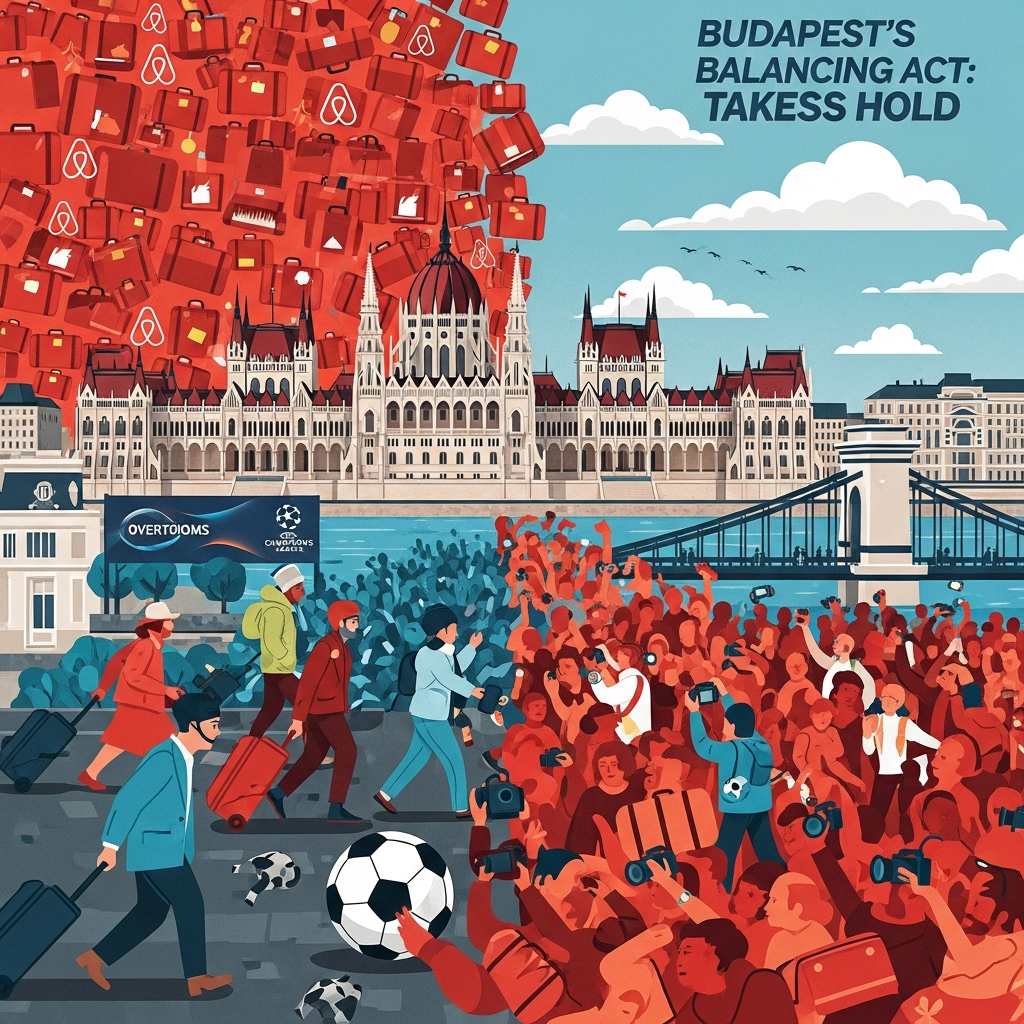
Budapest's hosting of the 2026 UEFA Champions League Final has sent over 200,000 visitors flooding into a city already stretched close to its overtourism limits, catalyzing a long-simmering structural housing crisis into a moment of acute public debate. Hungary recorded the EU's steepest housing price increase — 173% between 2015 and 2023, more than 3.5 times the bloc's average — while post-COVID Airbnb proliferation removed an estimated 16,000 apartments from the regular rental market, driving young residents to spend 40–60% of their incomes on rent. Emergency policy responses including a full short-term rental ban in Terézváros (District 6), a national freeze on new short-term rental permits, and a fourfold tourist tax hike represent meaningful interventions, yet Barcelona's experience — where a decade of aggressive Airbnb restrictions still produced a 62.1% cumulative rent surge — illustrates why platform regulation alone cannot solve structural displacement. Vienna presents the most instructive counterexample: statistically near-identical to Budapest in annual tourist volume, yet largely free from a housing crisis because 50% of its housing stock is publicly subsidized, pointing to large-scale public investment rather than Airbnb bans as the genuine long-term solution. This analysis unpacks the true economic value behind the €140 million headline figure, traces the self-destruction template common to European overtourism victims from Venice to Dubrovnik, and maps three probability-weighted scenarios for Budapest's trajectory between now and 2030.
Key Points
The €140 Million Economic Impact Figure — and Why It's More Complicated Than It Looks
GKI Economic Research estimates the direct economic impact of Budapest's Champions League Final at €90–140 million, a figure that sounds overwhelming on its face. But looking at the methodology reveals a more nuanced picture than the headline suggests. The same GKI report that produces this number explicitly acknowledges a "displacement effect" — meaning regular tourists actively avoid Budapest during the final, redistributing their travel plans and reducing the ordinary visitor base that would otherwise be generating steady revenue across hotels, restaurants, and cultural sites during those same days. The foreign supporter base — estimated at 50,000–70,000 visitors spending €700–1,000 each, with Mastercard data showing average card spend at €850 — does generate real and tangible cash flow. But once you subtract the government's direct outlays on security, transportation, logistics, and infrastructure upgrades, plus whatever hosting commitments Budapest made to UEFA, the net figure is substantially lower than the gross. For context, London's 2024 final generated approximately €63 million in direct spending, and Madrid's 2019 final reached €123 million, so Budapest's estimate is on the high end of the range rather than uniquely exceptional. A peer-reviewed systematic review published in Frontiers in Sports and Active Living makes the uncomfortable observation that most mega-event economic impact studies are commissioned to justify political decisions already made, not to rigorously examine economic truth. That caveat doesn't make the economic benefits disappear — it means the €140 million number should be treated as a ceiling, not a guaranteed floor, and net public benefit requires considerably more careful accounting than the headline implies.
District 6's Airbnb Ban — Short-Term Wins, Medium-Term Questions
Terézváros District 6 became Hungary's first municipality to impose a full short-term rental ban, effective January 2026, and the immediate empirical data is genuinely encouraging: long-term rental supply in the district increased 34%, and average monthly rents fell from HUF 300,000 to approximately 280,000 — a 6.7% reduction that represents real, measurable relief for residents. Before the ban took effect, roughly 2,700 Airbnb listings occupied 8–10% of the district's total housing stock of 29,000 units, an extraordinary level of market penetration by any international standard. Hungary's Supreme Court upheld the ban's legality in November 2025, and the enforcement framework carries meaningful teeth: violations trigger personal fines of HUF 200,000, corporate fines of HUF 2 million, and up to 45-day forced closure orders. On the surface, the policy appears to be functioning precisely as intended. The complications emerge when you examine Barcelona's parallel trajectory over a longer timeframe: Barcelona implemented some of Europe's most aggressive Airbnb restrictions, eventually announcing cancellation of all 10,101 HUT licenses by 2028, yet the result included black-market license premiums jumping to €60,000–€120,000, prices on remaining legal listings rising, hotel average daily rates and occupancy climbing in tandem, and rents still increasing 62.1% over ten years of increasingly strict regulation. Homever's Budapest analysis directly predicts that District 6's gains will "recover toward global trends in the medium term." The policy is a meaningful and defensible intervention — but the international evidence suggests it is rearranging the pressure rather than structurally releasing it.
EU's Steepest Housing Price Surge — 173% and Counting
Eurostat official data confirms that Hungary's housing prices rose 173% between 2015 and 2023 — the single highest rate across the entire European Union, and 3.5 times the EU average of 48% over the same period. Budapest apartments have tripled in value compared to 2015, and Q1 2025 added another 19% year-over-year, bringing the average price per square meter to HUF 1.2 million (approximately €3,000). The drivers of this compression are multiple and self-reinforcing: tourism-driven short-term rental investment demand, the post-COVID doubling of Airbnb listings now numbering approximately 16,000 units, structural demand from 37,500 international students, digital nomad inflows, and Budapest's continued relative price discount versus Western Europe. The most direct victims of this market compression are young residents, who now allocate 40–60% of their incomes to rent — well above the internationally recognized 30% "housing cost burden" threshold that defines a housing crisis by any standard measure. At this level of income share, household formation is suppressed, birth rates fall, and the demographic composition of affected neighborhoods begins shifting away from permanent residents toward a transient, rental-dependent population that lacks political voice and community investment. Tourism generates 14% of Hungary's GDP and roughly 10% of central government revenue — these are real and significant economic contributions that deserve acknowledgment. But when the mechanism producing that GDP growth is systematically destroying the housing stability of the people who live in the marketed city, it becomes genuinely difficult to characterize it as success by any holistic or long-term measure.
Vienna vs. Budapest — Identical Tourist Volume, Completely Different Housing Reality
The Vienna-Budapest comparison may be the single most important data point in this entire overtourism debate, and it consistently receives less attention than it deserves. In 2024, Vienna hosted 8.2 million visitors and recorded 18.9 million overnight stays; Budapest hosted 8.1 million visitors and recorded 18.5 million overnight stays. The two cities are statistically tied on tourism footprint — they are running essentially the same experiment in terms of visitor load. Yet the term "housing crisis" barely registers in Viennese public discourse, while it dominates Budapest's neighborhood politics and drives community organizing campaigns. The structural explanation is Vienna's social housing system: 50% of the city's total housing stock is social housing, with approximately 220,000 publicly subsidized units covering 25–30% of the population and rents set to construction and maintenance cost rather than to whatever the market will bear. Vienna is currently running its "Housing Offensive 2024+" program, committing €2.8 billion to build an additional 22,200 subsidized units for 45,000 residents — a model recognized by UN-Habitat as the world's most successful social housing operation today. Vienna's "Optimum Tourism" strategy explicitly targets two-thirds of its visitors being "core visitors who appreciate culture and contribute positively," representing a qualitative tourism vision that Budapest lacks entirely. Hungary's "Turizmus 2.0" strategy, by contrast, is organized around a single quantitative objective: raise tourism's GDP contribution to 16% by 2030. The philosophical difference between these two frameworks is the most accurate predictor of where each city is headed over the next decade.
The European Overtourism Playbook — and Where Budapest Already Fits
European cities destroyed by overtourism have followed a near-identical self-destruction sequence that has played out across cultures, geographies, and governance systems: affordable discovery leads to social media virality, which attracts real estate investment inflows, which drive short-term rental conversions, which accelerate resident exodus, which ultimately destroys the authentic city identity that attracted tourists in the first place. Venice's historic center declined from 175,000 residents in the 1950s to below 50,000 today — a 70-plus-year erosion that has reduced a UNESCO World Heritage site to a primarily day-tripper attraction where peak daily visitor counts (approximately 70,000) now routinely exceed the permanent population (approximately 49,000). Dubrovnik's old town dropped from 5,000 residents in 1991 to 1,157 in 2024 — a 77% collapse — with a resident-to-tourist ratio of 1:27.4, the highest in Europe. Prague reached a Czech Republic record of 22.8 million visitors in 2024, but city-center rents surged 40% versus pre-COVID levels, and anti-tourism protests erupted in the streets in June 2025. Budapest sits at a meaningfully different absolute scale — a metropolis of 1.7 million versus these smaller historic centers — but the relevant variable isn't aggregate city size. It's neighborhood-level concentration and the velocity of change. Districts 6 and 7, where Airbnb density hit 8–10% of total housing stock and where residents organized formal community resistance campaigns, have already entered the early stages of the same structural sequence. The national freeze on new short-term rental permits is itself an implicit government acknowledgment that the pattern has been identified as genuinely alarming.
Positive & Negative Analysis
Positive Aspects
- Global Brand Exposure Worth More Than Any Paid Campaign
The Champions League Final broadcasts to hundreds of millions of viewers worldwide, and every aerial shot of the Danube, every crowd scene outside the Puskás Aréna, every establishing frame of the Hungarian Parliament is free international advertising at a scale no tourism marketing budget could ever match. This scale of global visibility translates directly into measurable downstream effects: spikes in Google search volumes for "Budapest travel," increases in flight booking queries, and a sustained lift in destination awareness that persists for weeks after the event itself concludes. Prior Champions League host cities consistently maintained above-average travel interest for multiple weeks post-event, and the brand association with a world-class sporting event carries a quality signal that generic promotional campaigns cannot replicate. The strategic opportunity for Budapest is whether it can redirect this surge of attention specifically toward its authentic cultural assets — thermal bath culture, Ottoman-Habsburg architectural heritage, the Danube promenade — rather than allowing the "cheap drinks destination" association to dominate the global narrative once more. If Budapest's tourism authorities execute this reframing with precision, the branding dividend from tonight's final extends well beyond the weekend's direct visitor spending and compounds over multiple future travel cycles.
- Luxury Hotel Development Breaks the Low-Budget Tourist Trap
Twenty-two new luxury hotels totaling approximately 3,000 rooms are either open or under construction in Budapest, including global flagships like Mandarin Oriental, St. Regis, and Radisson Collection. Nine new properties with around 800 rooms opened this year alone, representing a genuine structural upgrade to the city's accommodation profile. This development breaks what had become a self-reinforcing economic trap: cheap accommodation attracted budget tourists, who cemented the cheap-destination image, which attracted more cut-price accommodation operators, which made repositioning increasingly difficult. Luxury hotel guests typically spend two to three times more per night than budget Airbnb visitors, generating proportionally greater economic value at lower visitor volume. Formal hotel properties also integrate more effectively into the city's economic fabric: they create direct stable employment, pay full occupancy and corporate taxes, invest in local supply chains, and contribute to formal economic infrastructure in ways that short-term rental operators systematically avoid. McKinsey's target of doubling or tripling tourist expenditure per visitor — the goal that drives the bull scenario's 49,000 new jobs — cannot be achieved without exactly this kind of accommodation tier upgrade. The luxury hotel pipeline is a structural enabler, not merely a prestige play.
- District 6 Ban Creates Real Policy Evidence for Central Europe
The District 6 short-term rental ban isn't just a local measure — it's Hungary's first real-world policy experiment on this issue, and it has already produced the kind of concrete empirical data that other municipalities can reference when evaluating similar policies. The 34% increase in long-term supply and 6.7% rent reduction documented after the ban create a replicable evidence base that dramatically reduces the uncertainty cost for other districts considering adoption. Hungary's Supreme Court's November 2025 ruling confirming the ban's legal validity provides precedent that eliminates the primary barrier facing other districts — the risk of legal challenge and invalidation mid-implementation. The enforcement framework with meaningful penalties (HUF 200,000 personal fines, HUF 2 million corporate fines, 45-day closure orders) demonstrates that regulation can be operationally credible rather than merely symbolic. Budapest is building a policy laboratory that, if carefully evaluated and adapted for local conditions, could give Central and Eastern European cities a region-specific toolkit for managing short-term rental density rather than importing blunt instruments designed for different legal and housing market contexts. This kind of iterative, evidence-based policy development is more valuable than it might appear at first glance.
- Tourism's GDP and Employment Contribution Is Real and Substantial
Tourism's contribution to Hungary's economy — 14% of GDP and approximately 10% of central government revenue — is a genuine economic reality that any serious overtourism analysis must incorporate rather than dismiss as incidental. McKinsey's conservative Budapest scenario projects 23,000 new tourism-related jobs created by 2030; the aggressive scenario reaches 49,000. Budapest's Ferenc Liszt International Airport processing 19 million passengers in 2025 has solidified the city's position as a significant Central European hub, generating economic multiplier effects extending well beyond the hospitality sector itself. For service sector workers — hotel staff, restaurant employees, transport operators, tour guides, retail workers — tourism represents direct, accessible employment that doesn't require advanced qualifications and provides genuine income mobility for large segments of the workforce. The EU average tourism growth rate for comparable cities runs at roughly 5–7%; Budapest's sustained double-digit growth demonstrates a genuine competitive advantage. The fundamental question is not whether tourism's economic contribution is real (it clearly is), but whether policy can ensure that the distribution of that contribution is equitable and that growth reinforces rather than erodes the residential quality of life that makes the city worth visiting in the first place.
- Puskás Aréna and Upgraded Infrastructure Create Decades of City Value
The €563 million Puskás Aréna, built to 67,000-capacity international standards, is a permanent infrastructure asset that will generate returns across multiple decades rather than amortizing against a single event's economics. The transportation systems, security infrastructure, and crowd-management capacity upgraded for tonight's final aren't single-use investments — they raise Budapest's baseline capability for handling large-scale events and reduce the incremental capital required for future hosting bids. Budapest successfully hosted the 2019 Europa League Final and now adds a Champions League Final to its track record, establishing the city as a credible and experienced mega-event host with an institutional knowledge base that competing cities lack. This track record has direct commercial value in competitive bid processes: event organizers, corporate sponsors, and broadcasting networks systematically prefer proven venues, and hosting history influences future bid outcomes in ways that are difficult to price but real in their effect. The long-term infrastructure legacy of this event very likely exceeds the one-time direct economic impact of a single evening's visitor spending, and should be evaluated on that longer horizon when assessing whether Budapest's hosting investment was worthwhile.
Concerns
- Structural Housing Displacement and the Resident Exodus Already Underway
The conversion of 8–10% of District 6's total housing stock to short-term rental units — forcing residents to organize a formal community vote just to secure basic protections for their own neighborhood — represents housing displacement at an intensity that qualifies, by international standards, as a housing emergency. Budapest apartments tripling in value since 2015, combined with Q1 2025 year-over-year growth of 19%, has pushed young residents to allocate 40–60% of income to rent — substantially above the internationally recognized 30% housing cost burden threshold that defines a housing crisis. Academic research on mega-event gentrification documents the pattern's potential scale: Seoul's Olympic preparations uprooted 720,000 residents; Rio displaced 77,206 people for infrastructure construction. Budapest hasn't reached that level of direct, policy-driven forced displacement — but the indirect displacement mechanism, meaning rising prices making previously affordable districts unaffordable for long-term residents, is already fully operational in Districts 6 and 7. People who have relocated away from these neighborhoods in recent years due to rent increases represent a quieter but structurally identical form of community disruption — economically forced out rather than physically evicted, but the outcome for neighborhood character is the same. The city's most culturally distinctive and historically significant districts are progressively losing the permanent residents whose presence makes them authentically worth visiting, and this is a form of self-erasure that no quantity of tourist revenue can reverse once it passes a critical threshold.
- Party Tourism Is Corroding Budapest's Cultural Identity
Budapest's authentic cultural inheritance — Ottoman-era thermal bath culture, Habsburg-era architecture of extraordinary quality, the UNESCO-listed Danube riverfront, a literary café tradition, and a genuinely original ruin bar scene that began as a creative local response to post-communist urban decay — is being progressively overshadowed by an international identity as a "cheap drinks capital of Europe," driven primarily by British stag party tourism. District 7's Erzsébetváros, home to Szimpla Kert and the broader ruin bar cluster that defines Budapest's nightlife character, has already been compelled to ban pub crawls entirely and introduce mandatory special permits for post-midnight operations in response to resident pressure. The stag party market and the premium cultural tourism market are not simply competing for the same rooms — they are functionally incompatible economies that share a geography, and the high-volume, lower-spending segment consistently dominates a city's international perception regardless of what the premium segment achieves in parallel. The combination of low-cost UK flight connections, Budapest's price advantage relative to Western European cities, and self-amplifying social media coverage of the party destination narrative has created a self-reinforcing system that the city cannot exit simply by building more luxury hotels, because those markets operate in completely different accommodation and spending categories. Unless Budapest develops and enforces a coherent active strategy for managing the low-budget party tourism segment, the cultural heritage that justifies international interest risks being permanently reframed as mere backdrop for drinking tourism, a reputational outcome that would take decades to reverse and actively undermines the premium repositioning strategy the city claims to be pursuing.
- The Balloon Effect — Regulation Solves Nothing If Problems Just Relocate
Budapest's current regulatory patchwork — a District 6 ban, a District 7 cap on commercial accommodation share, and a national freeze on new permits — contains systematic gaps that create structural opportunities for balloon-effect displacement of the problem rather than resolution of it. When District 6 restrictions push short-term rental operators out, the economically rational response is relocation to District 5, District 8, or the less-regulated outer ring — not exit from the market entirely. Barcelona's experience with aggressive HUT license cancellations produced exactly this dynamic: black-market license premiums of €60,000–€120,000 emerged as supply scarcity created arbitrage opportunities, and the remaining legal operators benefited from increased pricing power on their now-scarcer listings. Amsterdam's 12.5% tourist tax — Europe's highest — still failed to prevent the city from exceeding its own 20 million overnight-stay cap in 2024 and has produced resident-initiated legal action rather than resolved the underlying housing tension. Budapest's geographically uneven approach, without a city-wide or nationally consistent housing protection framework, is structurally vulnerable to the same displacement dynamics at every boundary between regulated and unregulated zones. Regulations that push problems across district lines rather than eliminating them provide genuine temporary relief for the areas that implement them, but they don't constitute solutions to the structural condition that generates overtourism pressure in the first place.
- The Growth Obsession Contradiction — GDP Targets Without a Housing Policy
Hungary's "Turizmus 2.0" strategy presents a fundamental policy contradiction that deserves direct naming: it sets an ambitious quantitative target — raise tourism's GDP contribution from 14% to 16% by 2030 — while the same document contains no meaningful framework for managing the displacement effects that accompany tourism growth at that scale and pace. The strategy's EU-registered text mentions accommodation certification and capacity management tools in passing, but does not include public housing investment, residential protection mechanisms, or any explicit acknowledgment of the overtourism costs already documented across comparable European cities. Pushing to grow tourism by an additional GDP point while housing prices simultaneously rise at EU record rates is the structural equivalent of adding fuel to a fire while promising to manage the smoke. Vienna's "Optimum Tourism" framework operates from an explicitly different premise — maximize quality of visitor experience and resident quality of life simultaneously, accepting limits on aggregate visitor numbers as a feature rather than a failure. Budapest has adopted neither that philosophical framework nor the policy instruments that would operationalize it. Hungary's government has every political incentive to emphasize tourism growth's economic contributions and far weaker incentive to fund the public housing investment that would protect residents from that growth's side effects — a political economy that produces exactly the policy gap we're observing.
- Mega-Event Economics Leak — Who Actually Captures the Money
GKI's €90–140 million gross impact estimate tells a critically incomplete story about where the economic benefit of the Champions League Final actually lands. Mega-event revenue is structurally concentrated in large, often internationally owned operators — global hotel chains, international airlines, UEFA's commercial partners, and corporate hospitality providers — rather than being broadly distributed across local small businesses, neighborhood service providers, or the city's permanent residents. Hotel rates shooting from normal ranges to €704–2,800 per night represents windfall profit for accommodation operators, but simultaneously prices out the mid-range travelers who would have visited Budapest during a normal week and spread their spending more widely across local commerce. UEFA's ticket allocation structure — PSG and Arsenal each receiving 17,000 seats, local Hungarian supporters receiving just 4,600 — is symbolically revealing about whose preferences a €140 million event is actually structured to serve. Analysis of mega-event hosting economics consistently identifies "community wealth redistribution" — the mechanism by which event profits flow to international capital while local communities absorb the infrastructure costs, security disruption, and residential displacement — as the most underreported systemic cost of hosting large-scale sporting events. Budapest's residents, especially those in the districts facing the highest tourism density, will receive proportionally little of the economic benefit while bearing a disproportionate share of the social costs and the ongoing housing market pressure that this weekend's global visibility will compound in the months ahead.
Outlook
Looking ahead from tonight's Champions League Final, I want to break down Budapest's overtourism trajectory across three time windows, because the dynamics are genuinely different depending on the timeframe — and I think most coverage flattens these distinctions in ways that obscure what's actually happening.
In the immediate short term — the next one to six months — there's likely to be a natural demand adjustment right after the final. The "displacement effect" that GKI acknowledged works bidirectionally: ordinary tourists who avoided Budapest during the final period will start filtering back from June through September, which means the summer peak may be sharper than in a normal year. The measurable gains from District 6's Airbnb ban are real: long-term supply rose 34% and rents dropped from HUF 300,000 to roughly 280,000. But Homever's analysis explicitly warns that this effect is likely to "recover toward global trends in the medium term." The fourfold tourist tax hike (from HUF 38,400 to 150,000) and the national freeze on new short-term rental permits will suppress new Airbnb entry in the immediate window — but what happens to the 16,000 existing listings outside the District 6 ban zone remains the critical, unanswered variable.
Simultaneously, Budapest's accommodation landscape is in the middle of a structural shift that deserves separate attention. Nine new hotels with approximately 800 rooms opened this year alone, and over the next five years, 22 hotels totaling roughly 3,000 rooms are planned or under construction, including Mandarin Oriental, St. Regis, and Radisson Collection. I think this creates a real opportunity for Budapest to shed the "cheap party city" label and position itself as a premium cultural destination. But I want to be direct about the limits of this logic: luxury hotels don't make stag parties disappear. British bachelor-party tourists aren't booking the St. Regis — they're in Airbnbs and hostel beds, working through pub crawl circuits. Upgrading the hotel tier and suppressing low-budget party tourism are completely separate problems, and Budapest has to solve both simultaneously. Visible policy progress on this front within six months is unlikely; this window will primarily confirm whether the regulatory direction holds under commercial pressure.
In the medium term — roughly six months to two years out — the most probable development is that Airbnb restrictions will spread beyond District 6 in a domino effect through neighboring areas. District 7 already caps commercial accommodation at 10% of total residential floor space, and as these rules cascade outward, short-term rental operators will likely migrate toward less-regulated outer districts or suburban areas rather than exit the market. Barcelona's experience is instructive here: after announcing cancellation of all 10,101 HUT licenses by 2028, black-market license premiums jumped to €60,000–€120,000, remaining legal listings saw price increases, and hotel average daily rates and occupancy climbed together. Supply restriction raises the price of remaining supply — this isn't a controversial economic claim, and I'm genuinely skeptical Budapest can navigate around the same dynamics. Amsterdam raised its tourist tax to 12.5% — Europe's highest — yet still exceeded its self-imposed 20 million overnight-stay cap in 2024, triggering resident lawsuits. Fiscal suppression tools have fundamental demand-side limits, and Amsterdam proved it.
The medium-term housing market picture also demands attention. The base-case projection shows an additional 30% nominal price increase in Budapest property by 2031, with a conservative scenario still assuming 15–20% growth. This trajectory is driven by forces beyond tourism alone: 37,500 international students, digital nomad inflows, and Budapest's sustained price advantage relative to Western Europe. But Bloomberg's late-2025 Hungarian real estate bubble warning cannot be dismissed. Early-warning signals are starting to register: average listing days exceeding 100–120 days, and an emerging 8–10% gap between asking prices and actual transaction prices. If housing costs keep climbing in lockstep with tourism demand, this city progressively prices out the people who make it genuinely worth visiting. Tourism raises the GDP statistics — but whether that growth translates into improved quality of life for Budapest's actual residents is a completely different question. I think the social friction from that divergence surfaces as organized political pressure within one to two years.
Looking further out — two to five years — I see Budapest's trajectory splitting into three distinct scenarios. In the bull case, McKinsey's aggressive growth projection materializes: 12% annual tourism growth, an additional HUF 1.9 trillion in revenue by 2030, and 49,000 new jobs. For this to happen, the luxury hotel repositioning needs to succeed and Budapest needs to make serious public housing investments paralleling the Vienna model, preventing residential displacement from hollowing out the neighborhoods that make the city worth visiting. Hitting a 16% GDP tourism contribution while simultaneously preventing neighborhood depopulation is difficult, but the early track record — landing Mandarin Oriental and St. Regis — shows it isn't theoretically impossible. I put the probability of this scenario at roughly 20%, primarily because I see neither the political will nor the fiscal capacity in Hungary's current government for public housing investment at Vienna's scale.
The base case has McKinsey's conservative 7% annual growth trajectory playing out — roughly 11–12 million visitors by 2030 and around 23,000 new jobs created. Airbnb regulations spread and somewhat disperse demand patterns, but without structural public housing investment, gentrification continues at a slower yet steady pace. District 6 rents dip short-term and then recover within one to two years. The problem migrates geographically into less-regulated areas rather than being resolved. Tourism grows citywide while specific neighborhoods experience continued residential deterioration. I assign this scenario roughly 50% probability — it represents the most natural trajectory given current policy momentum and market dynamics, the path of least institutional resistance.
The bear case involves a convergence of European property bubble unwinding, sustained high interest rates, and a geopolitical or economic shock. Bloomberg's bubble warning materializes: prices fall 10–20% nominally over two to three years, over-leveraged short-term rental investors liquidate into a falling market, and the spiral deepens. Residents escalate to organized legal resistance modeled on Amsterdam's experience, potentially forcing rapid government-driven cooling of the tourism industry itself. The most extreme version follows Dubrovnik's template — a historic neighborhood that fell from 5,000 residents in 1991 to 1,157 in 2024, effectively becoming a tourist theme park where no one actually lives a full life. I put this at 30% probability. Budapest's scale provides some protection, but Districts 6 and 7 are already exhibiting the early structural signatures of that pattern at the neighborhood level.
I should be honest about what would change my forecast. If Hungary's government genuinely benchmarks Vienna and launches a large-scale public housing program — or mandates that a structural share of tourism revenues be recycled into residential stability — the entire trajectory shifts. Technology could be a meaningful wildcard: effective real-time crowd-management systems and dynamic entry pricing could extend physical capacity limits in ways not currently modeled. And if Budapest moves preemptively — before the anti-tourism protests that erupted in Prague in June 2025 come to its own streets — and adopts a Vienna-style qualitative tourism transition, a better-than-base outcome is achievable. But today's reality has Hungary's government pointed squarely at "more tourism, higher GDP," with public housing investment that barely registers on the scale of Vienna's commitments. My probability-weighted view sits between base and bear — closer to the bear end. Budapest still has time to change course, but that window is narrowing faster than the tourism headline numbers suggest. On a practical note: if you're planning a visit, I'd genuinely encourage booking a proper hotel over a District 6 or 7 Airbnb, and choosing Széchenyi or Gellért baths over a pub crawl circuit. The collective choices of individual travelers, multiplied across thousands of visits, genuinely shape where a city ends up.
Sources / References
- GKI Economic Research — Budapest Champions League Final Economic Value Analysis — GKI Economic Research
- Euronews — Budapest Readies for Champions League Final — Euronews
- Eurostat / Euronews — European Property Market Housing Costs — Euronews / Eurostat
- Homever — Airbnb Regulations and Budapest Housing Market Impact — Homever
- Frontiers in Sports and Active Living — Mega Sporting Events and Resident Displacement (Systematic Review) — Frontiers
- Wien Tourismus — Vienna 2025 Tourism Performance Report — Wien Tourismus
- Weave News — Vienna Social Housing Model and Best Practices — Weave News / UN-Habitat
- ETIAS — Hungary 2025 Tourism Record — ETIAS
- McKinsey and Company — Budapest Tourism Potential — McKinsey and Company
- Rental Scale Up — Barcelona Short-Term Rental Ban 2025 — Rental Scale Up