
Free Refills Just Beat Every Diplomatic Channel — The 2026 World Cup's Real Soft Power Was the Food
Summary
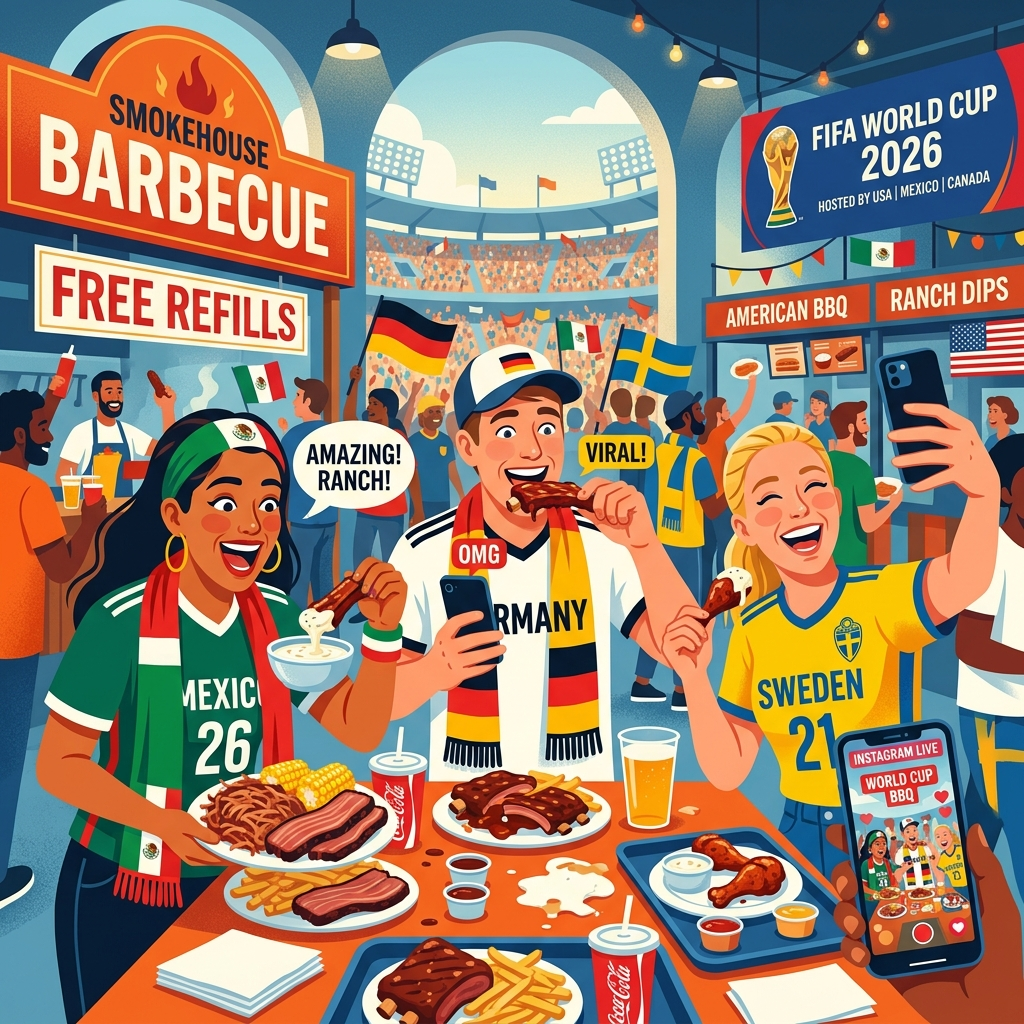
The 2026 FIFA World Cup has catalyzed an unprecedented and historically significant cultural phenomenon: international soccer fans arriving in the United States are experiencing American food culture — ranch dressing, free beverage refills, and supersized portions — for the first time at scale, and the resulting social media explosion has fundamentally disrupted conventional assumptions about American soft power. This moment carries deep historical weight because it fills the one conspicuous gap that five decades of Hollywood, pop music, and digital exports conspicuously failed to close: the actual lived experience of American culinary generosity has never successfully traveled abroad until millions of World Cup visitors arrived to encounter it in person. A German fan's Buffalo Wild Wings ranch-dipping video accumulating 2.7 million views, the TSA issuing official warnings about ranch sauce as carry-on luggage, and a Swedish fan's demand that "EUROPE WE NEED RANCH ASAP" reaching 10 million views together demonstrate that food operates as a more credible national image vehicle than any government-managed diplomatic campaign. The entirely organic, unplanned character of this viral wave — driven by individuals rather than any state, brand, or agency — marks a potential paradigm shift in how national reputation is constructed in the social media era, challenging decades of soft power theory that assumed institutional management was a prerequisite for cultural influence at scale. Whether this combustion crystallizes into a durable chapter of American culinary soft power or evaporates as a World Cup-specific novelty remains the most compelling cultural question of 2026's second half.
Key Points
Ranch Dressing: America's Most Powerful — and Most Invisible — Cultural Export
Ranch dressing represents a one-billion-dollar annual market in the United States and occupies a position of near-total dominance in American refrigerators that has no real parallel in any other country's food culture — and until this summer, it was almost completely unknown internationally. The 2026 World Cup transformed this entirely ordinary American pantry staple into a global cultural phenomenon, with @FreddyLA7's Buffalo Wild Wings dipping video accumulating 2.7 million views and the Swedish fan's "EUROPE WE NEED RANCH ASAP" post reaching 10 million views. What makes the ranch viral moment analytically interesting is that it was not driven by transcendent flavor — it was driven by the shock of invisibility, by the gap between how much American media people around the world had consumed and how little of America's actual daily food life had been represented in that media. For three decades, people have consumed enormous volumes of American films, television, and social media content and believed they understood American culture reasonably well, but Hollywood's treatment of American food is dramatically selective: Thanksgiving turkeys, hamburgers, and hot dogs make their scripted appearances, while the sauce that statistically dominates American home consumption has been systematically edited out because it doesn't fit the dramatic grammar of cinematic storytelling. I'd call this the American Media Food Blind Spot — the largest gap in fifty years of American cultural exports wasn't geopolitical or technological, it was hiding in the condiment aisle of every American supermarket. The TSA's official Instagram post — "One World. One Ranch." — became a secondary viral artifact in its own right, demonstrating that the cultural moment was significant enough to pull a federal security agency into the entertainment narrative. Kraft's rapid commercial response, launching a TSA-compliant ranch travel kit with the tagline "Some visitors leave with souvenirs. Others leave with America's favorite dressing," confirmed that at least one major brand recognized what was happening and moved quickly enough to capitalize on the window. The ranch story is, in miniature, the complete story of the American food soft power phenomenon: hidden in plain sight, discovered by accident, and now impossible to ignore.
Free Refills and the Philosophy of Abundance: A Cultural Statement Hiding in Plain Sight
American free refills culture is not a quirk of restaurant operations or a clever customer retention tactic — it is a material expression of a deeply rooted national philosophy about what hospitality and abundance mean in practice. In most countries across Europe, Asia, South America, and Africa, beverage refills at restaurants come with an additional charge, if they're available at all, and the expectation is that a meal has defined boundaries of quantity and cost. In America, from the smallest roadside diner to the largest fast-casual chain, the coffee keeps coming and the soda glass stays full without the customer asking, and nobody presents a bill for the additional pours. World Cup visitors documented their encounters with this system across thousands of videos and posts, with reactions ranging from delighted confusion to outright disbelief — a British fan's video building toward the sincere and genuinely puzzled question "Is this just... normal here? Do Americans just not pay for drinks?" accumulated hundreds of thousands of views precisely because the bewilderment it captured was authentic. I believe the message that free refills transmits is "you don't have to go without here," and that is, in its own quiet way, a statement about national values that no diplomatic press release has ever captured as effectively. The supersized portions tell the same story in a different register: the to-go box offered without asking, the side dishes that arrive by default, the portion sizes calibrated to ensure nobody leaves the table hungry or feeling that they received less than they were promised. Alabama firefighters who voluntarily grilled barbecue for visiting World Cup fans and distributed it freely to strangers they'd never met encapsulate the same value system in its most human form. The material generosity of American food culture is, I believe, the most authentic cultural message America has ever transmitted — more credible than anything produced by a public affairs office, and more durable than anything a branding consultant could design.
The TSA's Ranch Warning: The Most Absurd — and Most Revealing — Proof That Food Has Become Soft Power
The moment the TSA posted "World Cup visitors — ranch sauce bottles cannot be brought onboard as carry-on" to its official social media accounts, the argument that American food had crossed into genuine soft power territory moved from interesting hypothesis to documented fact. A federal security agency — the same institution that enforces the 3.4-ounce liquid rule and confiscates nail clippers — felt compelled to issue specific, publicly visible guidance about a salad dressing, which means the volume of visitors attempting to transport ranch dressing through airport security had reached a level significant enough to warrant official governmental communication. Yahoo Lifestyle reported that some visitors were caught at security checkpoints attempting to carry ranch home as a souvenir in the same way Korean visitors carry gochujang or Japanese visitors carry soy sauce, treating it as a piece of national culture worth preserving and transporting. The TSA's Threads account responded to Kraft's announcement of its TSA-compliant ranch kit with a simple and characteristically deadpan "It's about time" — which is, for a federal bureaucratic entity, remarkably close to an expression of genuine personality. The TSA warning itself then became a secondary viral event, generating coverage across dozens of major news outlets and dramatically amplifying awareness of the phenomenon it was ostensibly attempting to contain, creating a textbook example of accidental recursive marketing: an attempt to manage a cultural moment that instead turbocharged it. The act of a visitor attempting to smuggle a condiment home represents a form of cultural affection that is difficult to fake — it is the same impulse that drives people to pack Italian olive oil, French cheese, or Japanese matcha powder in their checked luggage despite the inconvenience. When people try to bring your food home by any means necessary, that is soft power in its purest and most unambiguous observable form.
Unmanaged Public Diplomacy: The Social Media Era's New National Image Architecture
The defining characteristic of the 2026 World Cup food viral phenomenon — the characteristic that distinguishes it from every previous major example of food soft power — is that it was not managed by anyone. No government agency designed it. No tourism board funded it. No communications strategy amplified it. South Korea's Hallyu wave was deliberately cultivated through decades of sustained government investment and coordinated corporate strategic alignment between entertainment companies and export agencies. Japan's Cool Japan was an explicit Ministry of Foreign Affairs initiative with a dedicated budget and organizational structure. France's gastro-diplomacy is a long-running Cultural Ministry strategy that includes UNESCO recognition for French cuisine as intangible cultural heritage. But American food soft power in 2026 emerged from millions of individual authentic experiences — a German fan at Buffalo Wild Wings, a Swedish woman trying ranch for the first time, an Alabama firefighter with a propane grill and a willingness to feed strangers — and distributed itself through the organic mechanics of social sharing without any institutional intermediary. Forbes contributor and public diplomacy expert Penny Abeywardena captured the structural shift precisely: "The person at the center of the story is no longer the institution." She also wrote that "the strongest version of it was never what you say about yourself — it is what people conclude after spending time with you." Both observations point in the same direction: in the social media era, the most powerful national image is not produced by state design but by the cumulative weight of authentic individual encounters shared through decentralized networks. I believe the 2026 World Cup represents the first large-scale, well-documented empirical case study of what deserves to be called Unmanaged Soft Power — and I expect this model will receive serious sustained academic attention in the coming years, because it fundamentally challenges the assumption embedded in every major soft power theory since Joseph Nye coined the term in 1990, which is that intentional management is a necessary condition for cultural influence at scale.
The FIFA 15 Phenomenon and America's Food Generosity as a Distinct Cultural Code
Fortune's coinage of the term "FIFA 15" — describing the average 15-pound weight gain that international visitors reportedly experienced during their American World Cup stay — started as a piece of viral sports-culture comedy that spread across social media, but contains within it a remarkably precise diagnostic of American food culture's most distinctive and exportable values. American restaurant portions run consistently two to three times the size of their European equivalents, calibrated around the expectation that diners will take remaining food home in a to-go box provided as a standard courtesy rather than a premium service. The free side dishes that arrive by default, the basket of bread that appears before you've ordered, the chips and salsa that land on the table as a prelude to the actual meal — these conventions encode a specific cultural message that is consistent across price points and geographies: that scarcity is not the operating assumption of this culinary environment, and that you are expected and encouraged to have enough. I believe that "food generosity" represents the one cultural value that American food transmits with complete authenticity and without the ambiguity that accompanies most American cultural exports in the current geopolitical climate. Korean cinema communicates sophistication and emotional intensity. Japanese food communicates artisan precision and disciplined restraint. Italian food communicates tradition and the weight of accumulated culinary history. American food, at its most distinctively American, communicates welcome — an immediate, material, unconditional welcome that doesn't require a visa, a cultural fluency, or a prior relationship. The World Cup gave millions of international visitors a direct, unmediated experience of that welcome at a moment when many of them arrived with significant preexisting reservations about America as a political entity, and the food message cut through the political noise in a way that nothing formally diplomatic could have managed.
Positive & Negative Analysis
Positive Aspects
- Food Crosses Every Political Barrier That Formal Diplomacy Cannot
Food is perhaps the only cultural medium with a demonstrated, consistent ability to create genuine positive affect across political divides that would otherwise be insurmountable. Brand Finance's 2026 Global Soft Power Index documented a 4.6-point decline in America's overall soft power score, with particularly steep drops in its favorability metrics across geopolitical dimensions, including an 11-position fall in its reputation ranking and significant declines in perceptions of international relations and trustworthiness. And yet, through all of that geopolitical deterioration, fans from countries with deeply complicated and sometimes actively hostile diplomatic relationships with the United States were still enthusiastically posting ranch dressing videos, Buc-ee's reactions, and free refill testimonials with what appeared to be genuine affection. That crossover — where political antipathy coexists with, and is partially displaced by, sincere food curiosity and enjoyment — is something that no formal diplomatic channel, no cultural exchange program, and no amount of government communications budget has been able to achieve. This parallels the historical pattern of food transcending political barriers that seemed impenetrable by other means: Coca-Cola crossing the Iron Curtain during the Cold War, American fast food chains becoming aspirational symbols in countries officially hostile to American foreign policy. The fundamental difference between food and other cultural exports is that food provides a direct, embodied, physically pleasurable experience that bypasses the critical faculties that filter other forms of cultural messaging.
- Economic Windfall for Small Cities and Overlooked Roadside America
One of the most consequential and underreported dimensions of the 2026 World Cup food viral phenomenon is that its economic beneficiaries are not the places that typically benefit from international tourism. The major economic winners of this summer are not Michelin-starred restaurants in Manhattan or celebrity chef establishments in Los Angeles — they are Texas barbecue pits, Georgia Waffle Houses, Tennessee hot chicken joints, and Buc-ee's travel centers in locations that would not appear on any conventional international tourism itinerary. Salon reported that Buc-ee's and Waffle House saw sales increases of 40 to 60 percent year-over-year during the World Cup window, representing substantial and immediate economic impact for businesses whose primary customer base has historically been domestic travelers. These effects are likely to persist well beyond the tournament itself: international visitors who had a memorable experience at a regional American food institution will recommend those places to family and friends, generating secondary tourism demand through exactly the kind of authentic word-of-mouth marketing that cannot be purchased. Bank of America data cited by Forbes showed non-local visitor spending in World Cup host cities up 16.7 percent year-over-year, with food and beverage representing a significant share of that increase. This is potentially the beginning of a meaningful structural shift in how international tourism dollars flow through the American economy, toward the regional and the distinctively local rather than the globally generic.
- A Billion-Dollar Domestic Market Discovers Its First Global Audience
The 2026 World Cup food viral wave represents the most significant natural marketing event for American food exports in recent history, and the commercial implications are only beginning to be understood. Ranch dressing holds a dominant position in the American condiment market with approximately one billion dollars in annual domestic sales, yet it has had essentially zero meaningful presence in European or Asian supermarkets — not because of regulatory barriers or distribution difficulties, but simply because global demand had never materialized. That demand has now materialized visibly and measurably, in the form of millions of social media posts, the TSA official guidance that became its own viral event, and Kraft's immediate commercial response with a travel-size product designed specifically for export-minded fans. Hidden Valley Ranch's 800 percent social media mention increase during the World Cup window is the kind of brand awareness signal that typically requires years of sustained international marketing campaigns and hundreds of millions of dollars to generate. The broader implication extends to the entire category of distinctively American sauces, seasonings, and condiments — barbecue sauce, hot sauce, seasoning blends — that have similarly large domestic markets and similarly negligible international distribution footprints. In the same way that Korean gochujang reached Amazon international listings and European supermarket shelves on the back of the Hallyu wave's cultural infrastructure, American condiments now have a cultural moment to leverage.
- The First Empirical Large-Scale Proof of Concept for Unmanaged Soft Power
This phenomenon provides international relations researchers and public diplomacy practitioners with something genuinely rare: a large-scale, real-time, well-documented natural experiment in how national image is built through spontaneous cultural encounter rather than institutional design. Every major case study in soft power theory prior to 2026 — Japan's Cool Japan, South Korea's Hallyu, France's culinary diplomacy, China's Confucius Institutes — has involved explicit state or institutional management as a central component of the cultural influence mechanism. The American food viral wave of 2026 is the first case I'm aware of in which a major nation's international image improved substantially in a specific cultural domain with zero coordinated institutional effort. @FreddyLA7's video almost certainly reached more people with a positive American message than a full year of State Department cultural programming, and it cost the American government exactly nothing. The theoretical implications are significant: if unmanaged authentic experience can generate more effective cultural influence than managed campaigns, then the entire architecture of public diplomacy budget allocation — which heavily favors deliberate programming, structured exchanges, and professional communications infrastructure — may need fundamental reconsideration. This is a case study that will be cited in international relations courses for years, and the countries that draw the right lessons from it first will have a strategic advantage in how they approach soft power investment.
- A Genuine Opportunity to Redefine American Food's Global Identity
For decades, American food has been positioned in global food culture discourse as the antithesis of culinary sophistication — the producer of fast food and processed calories, the country that exported the hamburger and the drive-through window as its most representative culinary contributions. The dominant global food prestige hierarchy, shaped largely by French, Japanese, and Italian traditions, has consistently relegated American food to the bottom tier of serious culinary consideration. The 2026 World Cup is creating the conditions for a fundamental reframing of that evaluation, centered on the value of Generosity that American food culture uniquely embodies. The argument that large portions represent excess rather than hospitality, or that free refills signal waste rather than welcome, is a value judgment that is not universally shared — and the reactions of international visitors this summer suggest that millions of people who encounter American food generosity firsthand find it genuinely appealing rather than culturally inferior. World's 50 Best Restaurants data shows American restaurants moving from 5 entries in 2020 to 8 in 2025, tracking a slow but consistent upward trajectory in global culinary recognition that predates this summer. The World Cup viral wave could be the inflection point that accelerates that recognition from specialty food media to general global consciousness, permanently altering the framework within which American food culture is evaluated and experienced by international audiences.
Concerns
- Glorifying Supersized Portions Creates Serious Public Health Messaging Complications
The FIFA 15 framing — international visitors gaining an average of 15 pounds, roughly 7 kilograms, during their American World Cup stay — circulates as a humorous viral statistic, but the public health implications embedded in that number are not humorous and deserve serious engagement. American restaurant portions run consistently two to three times the size of European equivalents, and this structural overconsumption is causally linked to obesity rates that are the highest in the developed world at approximately 42 percent of the American adult population. The viral content that has circulated this summer has, almost without exception, framed supersized American food culture as a positive discovery — a revelation of abundance and generosity that the rest of the world has been missing out on. When that framing reaches hundreds of millions of people across dozens of countries, it functions as an advertisement for eating habits that public health researchers, nutritionists, and medical communities have spent decades trying to discourage through evidence-based campaigns. The concern is not merely symbolic: culinary tourism research consistently shows that food-related travel experiences influence long-term dietary preferences and food purchasing behavior. If millions of international visitors return home with an affectionate association between American-style portions and positive emotional experiences, and then seek to recreate those portions in their home food environments, the downstream public health implications across multiple countries are potentially significant.
- Viral Mechanics Flatten Complexity Into Caricature
The fundamental problem with viral content as a vehicle for cultural representation is that virality optimizes for the immediately legible, the visually extreme, and the emotionally immediate — none of which are qualities that serve nuanced cultural understanding. The American food content that has dominated social media this summer is, by definition, the most dramatic and visually striking: the largest portions, the most abundant condiment applications, the most overwhelming retail environments, the most extreme examples of free refill culture. This selection mechanism systematically amplifies the most sensational aspects of American food culture while leaving its remarkable complexity entirely invisible. American food culture encompasses New Orleans Creole cooking and its deep African, French, and Spanish roots; Pacific Northwest farm-to-table cuisine and its relationship with local agricultural ecosystems; the extraordinary immigrant food communities of every major American city that have produced genuinely distinctive and sophisticated hybrid culinary traditions; and a craft food movement in beer, cheese, charcuterie, and fermentation that is world-class by any serious evaluation. None of this appears in the viral content, because none of it produces the immediate visual impact that drives shares. The risk is that the world exits this World Cup with a flattened, caricatured understanding of American food culture that is technically positive in sentiment but profoundly inaccurate in its representation of what American food actually encompasses.
- Overtourism Risk and the Commodification of Distinctively Local American Institutions
When a Waffle House in Georgia or a Buc-ee's in Texas becomes an international tourism destination, the experience that made that institution worth visiting begins to degrade in precisely predictable ways. The patrons who gave those places their cultural authenticity — the truckers, the night-shift workers, the road-tripping families, the local regulars — find their familiar institutions transformed into selfie destinations with extended wait times, elevated prices, and a tourist-facing customer service mode that is meaningfully different from the experience that generated the original viral appeal. Barcelona, Amsterdam, and Venice have all provided detailed case studies in what happens when a place's authentic local character becomes the primary tourism commodity: prices rise, locals leave, the authenticity that attracted visitors in the first place is progressively replaced by a performance of that authenticity designed for visitors. There are early indicators that this process is already beginning in some World Cup host city food establishments, with reports of significantly extended wait times and pricing adjustments at popular locally distinctive restaurants. There is also a subtler cultural cost: restaurants that discover their core customer base is now international tourists tend to simplify menus, amplify visual spectacle at the expense of flavor, and optimize for Instagram documentation rather than eating.
- The Viral Soft Power Sustainability Problem
Social media virality is, by its nature, a highly volatile and short-lived phenomenon, and there is a real and significant risk that the 2026 World Cup American food moment follows the same trajectory as other tournament-adjacent food viral events rather than converting into the durable soft power asset I believe it could become. The 2024 Paris Olympics generated considerable social media enthusiasm for French food culture among international visitors and viewers, producing a wave of content that celebrated Parisian café culture, boulangeries, and bistro dining — and that wave was essentially undetectable in social media traffic data within eight weeks of the closing ceremony. American food viral content could follow exactly that pattern: peak during the tournament, sustain briefly as late-summer travel content, and fade by October as the algorithm finds new novelties to amplify. The structural weakness in the American case, compared to the most successful historical examples of food soft power expansion, is the absence of any coordinated institutional support. Thailand's Global Thai program worked because government investment sustained awareness and restaurant support through the periods between peaks. South Korea's Hallyu succeeded because a coordinated ecosystem of government funding, corporate strategy, and entertainment content production maintained consistent momentum across more than two decades. American food soft power has no equivalent infrastructure, and without it, the risk of the trend fading to baseline within 12 months is real and should not be dismissed.
- A Potential Catalyst for Clash in Global Food Culture Hierarchies
The emergence of American food culture as a positive global narrative does not happen in a vacuum — it happens within an existing global culinary prestige hierarchy in which France, Italy, and Japan have invested enormous institutional resources in defending their positions at the top. France has successfully lobbied for UNESCO recognition of French cuisine as intangible cultural heritage, a designation that carries both cultural prestige and practical implications for how French food culture is treated in international forums. French media commentary on the World Cup food viral phenomenon has already included some voices framing it as "the globalization of American excess" — a characterization that, if it gains traction, could create cultural headwinds against the positive reframing that the viral moment seems to be producing. The specific tension between American "food generosity" culture and the European tradition of "quality over quantity" is not merely an aesthetic disagreement — it maps onto deeper value differences about the relationship between consumption, pleasure, restraint, and identity that have genuine implications for how these cultures understand each other. If the American food soft power moment generates a sustained cultural backlash from food cultures that perceive it as a threat to their own prestige positioning, the net soft power impact could be considerably more ambiguous than the current viral enthusiasm suggests.
Outlook
The next three to six months will likely be the most commercially decisive phase of this entire phenomenon. The World Cup runs through July 19th, meaning knockout rounds are still ahead, and the social media content production machine will keep accelerating through the final. Food-reaction videos have been outperforming nearly all other World Cup content in engagement metrics, and as the emotional intensity of the tournament increases, the contrast between high-stakes soccer and the absurdist comedy of airport ranch incidents only becomes more pronounced. I expect American food culture content — YouTube travel guides, TikTok reaction compilations, "what you must try when you visit the United States" videos in dozens of languages — to maintain significantly elevated performance for at least three to four months after the tournament ends. The organic content library built this summer will continue to circulate long after the championship medal is handed out.
On the brand side, moves are already happening and will accelerate. Hidden Valley Ranch reportedly saw social media mentions surge by approximately 800 percent during the World Cup window — a signal so unmistakable that international expansion has to be actively under discussion at the brand level. Ranch dressing currently commands a one-billion-dollar annual domestic market in the United States with virtually no meaningful international distribution presence, and the gap between domestic dominance and global awareness is now wider than it has ever been, which represents a textbook commercial opportunity. Kraft's TSA-compliant ranch travel kit, launched June 19th with the tagline "Some visitors leave with souvenirs. Others leave with America's favorite dressing," is the first overt commercial response to the trend but will not be the last. I expect that by the end of 2026, at least one major American sauce brand will have announced formal European or Asian distribution plans, and American airports — starting with JFK, LAX, and Dallas/Fort Worth — will be testing ranch dressing gift sets in duty-free retail.
The six-month to two-year window reveals more consequential structural changes. American tourism has historically organized itself around a small set of iconic gateway cities — New York, Los Angeles, Las Vegas, Miami. The places that went viral this summer are not those places. Texas barbecue pits, Georgia Waffle Houses, Tennessee hot chicken joints, and Buc-ee's travel centers scattered across the American South and Midwest were the breakout cultural stars of the summer. I believe this World Cup will serve as the founding event for what I'd describe as American Food Tourism as a distinct, recognized travel category — the equivalent of Japan's ramen pilgrimages, Italy's pizza tours, or France's wine trails, but organized around the barbecue route, the diner road trip, and the regional hot sauce sampler. The global culinary tourism market was valued at 1.06 trillion dollars in 2025 and is growing at a compound annual growth rate of 15.6 percent, with 64 percent of international travelers citing food experiences as a primary motivation for destination selection.
The food export dimension deserves its own analysis. United States agricultural exports reached 176 billion dollars in 2024, with the majority concentrated in bulk commodities — soybeans, corn, wheat, and livestock. Processed consumer food products represent a much smaller share of that total, and American sauces, condiments, and seasonings have had essentially no meaningful presence in European or Asian supermarket chains. That is beginning to change. Wingstop is already expanding into Kuwait, Australia, the Netherlands, and Bahrain specifically on the back of social media demand — the brand explicitly says fans are requesting market entry online. Dave's Hot Chicken is moving into Europe and the Middle East. I expect that between 2027 and 2028, American processed food exports will grow by 20 to 30 percent, with particularly strong performance in European markets where ranch dressing and barbecue sauce have been essentially invisible until this summer.
Looking at the two to five year horizon, the most profound change this phenomenon may produce is a redefinition of soft power theory itself. Joseph Nye introduced the concept in 1990, and the dominant framework has always assumed that effective soft power requires a degree of management: a state, institution, or corporation must deliberately cultivate and project the attractive elements of its culture toward a target audience. The 2026 World Cup food viral wave is the largest-scale empirical counterexample to that assumption I can identify. No department planned it, no budget funded it, no communications strategy amplified it. I believe that between 2028 and 2030, international relations scholars will begin developing formal frameworks around what I'd call Unmanaged Soft Power — cultural influence generated not by institutional design but by the accumulated weight of individual authentic experiences distributed through decentralized social networks.
The culinary geopolitics dimension warrants separate attention. The current global food prestige hierarchy is dominated by France's refined technique, Japan's artisan precision, and Italy's tradition-rooted authenticity. American food has been consistently dismissed within that hierarchy, positioned as fast food and junk food — the culinary product of a country too young and too commercially oriented to have developed genuine food culture. The 2026 World Cup is creating conditions for a fundamental reframing of that narrative. I believe that by 2030, American food will be globally associated with a fourth culinary value that the existing hierarchy doesn't adequately capture: Generosity. Large portions are not excess — they are hospitality. Free refills are not waste — they are abundance. World's 50 Best Restaurants data shows American restaurants moving from 5 entries in 2020 to 8 in 2025.
Mapping the scenario range: the bull case — which I'd place at roughly 25 percent probability — involves the United States government or a major food industry consortium formalizing this momentum into something resembling Thailand's Global Thai program, which doubled Thai restaurant counts worldwide and drove a 200 percent increase in tourism to Thailand over a decade. A formal American Food Trail initiative, modeled on what Thailand achieved through sustained government investment, could generate 15 billion dollars in annual food-related tourism revenue by 2030. The base case — which I'd assign roughly 55 percent probability — has no government program at all, with the market sorting this out organically: American food tourism grows at 15 to 20 percent annually, sauce brands slowly build European and Asian distribution networks, and the "American food experience" becomes a recognized but not dominant tourism motivator.
The bear case — at roughly 20 percent probability — sees the trend fade to baseline within 12 months as social media shifts to the next novelty, geopolitical headwinds from America's declining soft power index overwhelm the food goodwill, and cultural critics framing American food culture as culinary imperialism gain enough traction to dampen enthusiasm. I assign the bear case the lowest probability because viral content that crosses a genuine emotional threshold — and the ranch dressing moment clearly did — tends to be self-reinforcing rather than self-extinguishing. The Hallyu wave followed a remarkably similar trajectory after the 2002 World Cup. The comparison between South Korea's post-2002 cultural momentum and America's post-2026 food viral wave is more than superficial — both events put a nation's unexpected cultural warmth in front of a massive global audience at precisely the right moment.
One honest caveat before I close: my projections could be wrong, and intellectual credibility requires acknowledging the specific conditions under which they would fail. A large-scale foodborne illness outbreak during the remainder of the tournament would immediately reverse the positive narrative. If American food culture became politically weaponized in a way that split the international audience along partisan lines, the crossover appeal that makes it powerful would collapse. And the structural absence of coordinated institutional support — no Global American Food initiative, no sustained government investment in the infrastructure that sustained Hallyu for two decades — is a genuine vulnerability that differentiates this moment from the most successful historical soft power expansions. I note these risks not to undermine the overall analysis but to be precise about the conditions under which the more optimistic scenarios would fail to materialize.
Sources / References
- FIFA 15 phenomenon and American culinary diplomacy analysis — Fortune
- World Cup fans obsessed with ranch dressing — Today.com
- The World Cup Is Testing the America the World Thought It Knew — Forbes
- World Cup visitors love ranch dressing Buc-ees and BBQ — Salon
- International tourists love of American food — ABC News
- TSA warning World Cup fans about ranch sauce as carry-on — Yahoo Creators
- World Cup visitors going wild over American food trends — Quartz