
122,072 Became 113,518 — And Everyone Still Calls It an Antarctic Tourism Boom
Summary
Antarctic tourism has now declined for three consecutive seasons, according to IAATO-affiliated final figures: 122,072 visitors in 2023-24, 118,491 in 2024-25, and 113,518 in 2025-26, a cumulative two-year drop of 7.01 percent. Yet the Antarctic and Southern Ocean Coalition (ASOC) — the environmental coalition pushing hardest for stricter regulation — described the same period, in its closing press release from the 48th Antarctic Treaty Consultative Meeting, as "the massive surge in visitor numbers," and numerous travel outlets echoed the phrase as an "explosive increase." This split between measured reality and prevailing narrative traces back to a 2025 academic forecast projecting 2033-34 visitor numbers of roughly 285,000 under a conservative scenario and 450,000 under a less conservative one, a projection whose authors explicitly flagged that the upper figure incorporates pent-up pandemic demand likely to diminish — a caveat that vanished as the number circulated through secondary coverage.
Once the aggregate-growth narrative collapses, what remains are the questions that actually matter: a landing-visitor concentration of roughly 75 percent of all traffic, a governance vacuum resting on largely voluntary guidelines, and the biosafety exposure revealed by a hantavirus cluster aboard the expedition cruise ship M/V Hondius, which departed Ushuaia, Argentina in April 2026. This piece does not treat the volume decline as proof that regulation is unnecessary; instead, it examines how a regulatory push built on the wrong numbers ends up undermining its own legitimacy. I argue that the real risk in Antarctic tourism is not an "explosion in numbers" but the fact that a six-figure visitor base has already become the norm while the rules to manage it remain absent.
Key Points
Antarctic Tourism Isn't "Surging" — It's Down for Three Straight Seasons
The first thing to nail down is direction. Per IAATO-affiliated final figures, Antarctic visitors fell from 122,072 in 2023-24 to 118,491 in 2024-25, a drop of 3,581, or 2.93 percent, then fell again by 4,973, or 4.20 percent, to 113,518 in 2025-26. Combined across the two seasons, that's 8,554 visitors gone, a cumulative 7.01 percent decline. And yet the environmental coalition ASOC, the group pushing hardest for regulation, wrote of "the massive surge in visitor numbers" in its closing press release from the 48th Antarctic Treaty Consultative Meeting, while most travel media kept repeating "explosive growth." The source of this mismatch is forecast data. Co-authors of a 2025 Journal of Sustainable Tourism study put 2033-34 visitor numbers at roughly 285,000 under a conservative scenario and roughly 450,000 under a less conservative one, explicitly stating that the upper scenario includes pandemic-suppressed demand expected to diminish. Secondary media stripped out that conditional clause while attaching even more precise numbers than the original explainer contained, and an expert interview projecting over 400,000 a year within a decade got tacked on as if it were an independent second data point. That expert is a co-author of the very same study, meaning this isn't two independent sources — it's the same research team's same model cited twice. I believe the moment a forecast whose own conditions have already broken down gets rewritten in the present tense, it stops being a forecast and becomes misinformation, and the fact that this misinformation sits inside the regulation camp's own justification is what makes it so costly.
113,518 Is a Sum, Not a Published Total — And Much of the Decline Traces to One Absent Operator
Any number worth using has to come with an account of how it was built. The figure 113,518 is not a single total IAATO printed and published as such — it's what I obtained myself by adding up three categories IAATO published on its official site for the 2025-26 season: cruise-only at 27,217, landed visitors at 85,195, and deep field at 1,106. So the phrase "IAATO announced 113,518 visitors" is not accurate; the accurate phrasing is that summing IAATO's three published components gives 113,518. There's a second caveat about the character of the decline itself. MercoPress, citing IAATO data, specifically noted that a substantial share of the 2024-25 drop traced to a single cruise operator simply not sailing that season — meaning one ship's, one company's schedule can swing the aggregate by thousands of visitors. Reading that decline as "demand collapsed" would be a distortion running in the opposite direction from the "surge" narrative. I think omitting these two caveats while emphasizing only the decline is the exact same category of error as the "surge" narrative it's meant to correct. That's why, throughout this piece, every mention of the decline is paired with both the summation caveat and the scheduling caveat. Being precise about how a number was built, rather than just which direction it points, is what actually makes an argument durable over time.
The Real Indicator Isn't the Total — It's the 75 Percent Landing Share
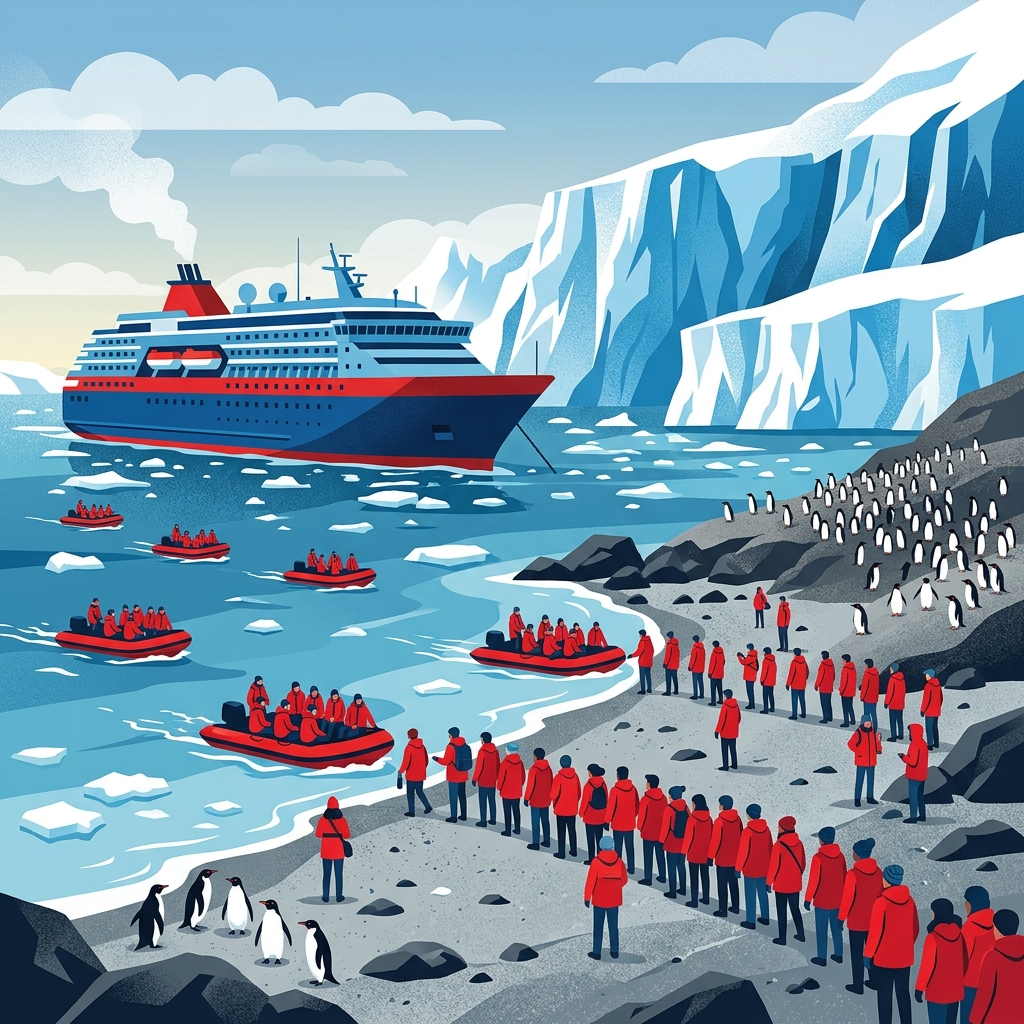
The reason ground-level pressure doesn't ease even as the total falls comes down to composition. Divide the 2025-26 season's three categories by the overall total, and landed visitors — people who actually set foot on Antarctic ground — come to 85,195, roughly 75 percent of everyone who traveled. Cruise-only passengers who never left the ship totaled 27,217, about 24 percent, and deep field came to 1,106, under 1 percent. Ecological pressure isn't generated by headcount; it's generated by how many times boots press moss and snow, and how many times a boat lands on shore. So if the aggregate falls 7 percent but the landing share holds steady, the burden felt by breeding colonies barely changes at all. Risk also doesn't scale proportionally with headcount: a hundred landing visitors spending a few hours on a beach and one expedition team requiring an airstrip, fuel storage, and waste handling deep in the ice sheet cannot be measured in the same unit. I believe Antarctic tourism regulation should start from standards organized by activity type rather than from a single total-headcount ceiling, and this composition data is exactly why. Until landing-site-level visit counts become a standard part of the discussion, the aggregate will keep occupying the seat of the only indicator that matters. The total was never the thing to be managed — it's only the shadow cast by the thing that actually needs managing, and what isn't measured never ends up written into a regulation.
ATCM48 Failed to Adopt Binding Rules, and Emperor Penguin Protection Died to a Small Minority
The 48th Antarctic Treaty Consultative Meeting and the 28th Committee for Environmental Protection closed on May 21, 2026, in Hiroshima, Japan. Negotiations on a framework to govern tourism were assessed as having made progress, but adoption of legally binding rules still fell short. ASOC Senior Advisor Ricardo Roura said commercial tourism cannot keep relying on largely voluntary guidelines while it expands rapidly across the continent, adding that a framework is only a start and the meeting must urgently convert these discussions into mandatory, legally binding regulations before growth outpaces the ability to protect the environment. At the same meeting, a proposal to designate the emperor penguin — a species IUCN had upgraded to "Endangered" — as a Specially Protected Species failed to reach formal designation, blocked by what ASOC's own language called only a small minority of Parties, landing instead on a bare reaffirmation that protection is a priority. WWF's Rod Downie said the barometer is flashing red even as critical protections keep getting stymied by a small number of Parties. In a system built on unanimous consensus, I believe "who can block with one vote" explains outcomes far better than "who supports a measure." I think recording both the meeting's progress and its limits together is the only honest baseline for judging whatever comes out of the next one.
China Hasn't Regulated Antarctic Tourism — It's Reviewing a Draft, and That's Fragmentation, Not Resolution
One fact gets misstated often enough that it needs correcting directly. China's National People's Congress Standing Committee advanced a draft "Antarctic Activities and Environmental Protection Law" to its second reading at the 23rd session of the 14th NPC Standing Committee, held June 23-26, 2026, following a first reading at the 19th session in December 2025. That means this law has neither been enacted nor taken effect. The draft would introduce a permit-application system, requiring an activity plan, environmental impact assessment, emergency-response plan, and financial guarantee or insurance to be filed with the State Oceanic Administration, plus post-activity reporting, with unauthorized activity risking a fine of up to 1 million yuan (roughly 230 million won) and a permit ban of up to ten years; the second-reading draft added a further fine band of 50,000 to 500,000 yuan scaled to environmental damage. I read this as regulatory authority trickling down from the treaty conference room to individual national legislatures while international consensus stalls, and because domestic law only reaches one's own nationals, the outcome is fragmentation of the normative vacuum rather than its resolution. So the accurate summary is "under second reading," not "introduced," "enacted," or "imposed." For context, MercoPress, citing IAATO data, reported that Chinese-nationality visitors hit a record 9,384 in 2023-24, roughly 7.7 percent of that season's 122,072 total, which I treat strictly as background rather than a verified ranking claim.
Positive & Negative Analysis
Positive Aspects
- IAATO's Item-by-Item Data Release Makes Outside Verification Possible
This piece can even exist because of a genuine strength in the system it's criticizing. Antarctic visitor statistics aren't released by a government statistical agency — they're published, item by item, by IAATO, an industry trade association, and not as a single total but broken into cruise-only (27,217), landed (85,195), and deep field (1,106) each season. A self-regulating body publishing its own industry's demand data at this resolution, every single season, is a level of transparency that's genuinely hard to find in other tourism sectors. That transparency is what let an outsider like me sum three line items, cross-check media language against the measured record, and calculate a roughly 75 percent landing share on my own. Having a factual foundation available at all is itself an asset for Antarctic governance — regulatory debates elsewhere often can't even start from agreed facts. Still, faithful data disclosure cannot substitute for binding oneself to enforceable standards; those are two entirely different levels of commitment. I think this transparency is the minimum condition keeping the Antarctic tourism debate a data argument rather than a purely emotional one, and that alone is worth crediting.
- A Measured Plateau Buys Time to Design Regulation
Three straight seasons of decline looks like bad news for the crisis narrative, but it's actually a favorable condition for anyone trying to design policy. When visitor numbers climb by double digits every year, regulatory debate is always running behind reality, and by the time consensus finally forms, the resulting rule is already outdated. By contrast, right now, with the total flat in the 110,000-to-120,000 range, standards like landing headcount caps, wildlife approach distances, and contact-reporting requirements can be tested without shocking the market. The two years sliding from 122,072 down to 113,518 are, in themselves, a grace period. Given that a substantial share of the decline traces to one operator not sailing, setting rules before that company returns is considerably easier than doing it afterward, once volume has already rebounded. This is a rare low-pressure window in which rules can actually be tested, and windows like this don't tend to stay open for long. I think failing to use this time, and instead letting it slip away, is the single most expensive mistake Antarctic governance is making right now.
- Tourism's Promotion to Framework-Negotiation Status Is Itself Unprecedented Progress
Reading ATCM48's outcome as pure failure misses something real. The assessment that a tourism "framework" negotiation made progress means tourism is no longer a peripheral agenda item — it has become a central topic at the meeting. New norms in the Antarctic Treaty system almost always climb, over several years, through agenda-setting, framework, guidance, and finally binding regulation, in that order, and ASOC's own line that "developing a framework is a start" presumes exactly that sequence. Given that even a proposal to protect a single species can get blocked by a small minority of Parties, the fact that an agenda item covering an entire commercial industry survived to carry over to the next meeting is not a small achievement. I believe the most realistic path is binding rules attaching first to narrow, low-resistance areas — deep-field air operations or landing headcount caps, for instance — because binding force in a consensus system always shows up first wherever the fewest parties have reason to object. Once that first piece exists, the negotiating cost of the next piece drops noticeably, and momentum tends to compound from there.
- The Top Source Country's Push for Domestic Legislation Signals Internalizing the Norm
China advancing its "Antarctic Activities and Environmental Protection Law" draft from a first reading in December 2025 to a second reading in June 2026 is the most concrete movement to emerge anywhere while international norms have stalled. The draft requires a permit-application system, environmental impact assessment submission, financial guarantee or insurance, and post-activity reporting, and backs it with fines up to 1 million yuan and a permit ban of up to ten years for unauthorized activity. Judged purely by the fine ceiling, this is an unusually strong design by the standard of Antarctic-related domestic law anywhere in the world. Choosing to regulate one's own nationals' activity under domestic law carries a meaning of its own: it amounts to formally recognizing Antarctic activity as something that needs regulating in the first place. That also opens the door for other major source countries to reference this model going forward. Still, it has to be said in every assessment that this remains an unpassed draft under review, not enacted law, and because domestic law reaches only one's own nationals, this progress shouldn't be read as a substitute for international norms. I see it as a starting point, not a resolution.
Concerns
- A False Aggregate Narrative Undermines Regulation's Own Legitimacy
The most serious problem originates on the environmental side. The phrase "the massive surge in visitor numbers," offered as justification by the camp demanding regulation, points in exactly the opposite direction from the latest measured record. The actual numbers fell for three straight seasons, from 122,072 to 118,491 to 113,518, a two-year cumulative decline of 7.01 percent. When the evidence for urgency doesn't match the facts, the side opposing regulation gets to stall the entire debate by rebutting a single number, without ever having to engage with the substance of what's being proposed. A citation chain that never distinguishes forecast from measurement compounds this vulnerability, promoting an academic scenario into a headline number and an expert's stated "possibility" into a "forecast." I believe trust is the one asset the pro-regulation camp can least afford to spend, and that saving a single adjective would have bought far more credibility than it cost. Getting one number right can generate more negotiating leverage than ten lines of draft regulation, and that is the lesson this episode leaves for environmental communication as a whole.
- Falling Totals Don't Ease Landing Pressure
The reassurance that comes with a declining statistic has nothing to do with what's actually happening on the ground. Of the 113,518 total in 2025-26, 85,195 — roughly 75 percent — landed and set foot on Antarctica. If that share held steady while the total fell 7 percent, the physical burden on breeding colonies and moss beds effectively didn't ease at all. On top of that, Antarctica lacks the resident-population indicators that make total visitor count a useful proxy in city tourism, so using an aggregate headcount as a stand-in threshold indicator is inappropriate to begin with. What's actually needed is data on when, at which landing site, and how many times an approach happened — and yet the debate keeps starting from a single aggregate line regardless. I think the quietest danger in Antarctic tourism is that we've spent more than a decade rehashing the same argument without ever measuring the thing that actually needs managing. As long as landing sites and approach frequency stay unrecorded by category while only the total gets published, every regulation written will keep trying to govern something nobody actually measured.
- Under Unanimity, a Tiny Minority Can Block Protection Measures
The emperor penguin case lays this structure bare. A proposal to designate a species IUCN had upgraded to "Endangered" as a Specially Protected Species was on the table, but in ASOC's own language, it was opposed by only a small minority of Parties, and formal designation failed, landing only on a bare reaffirmation of principle. The Antarctic Treaty system's unanimous-consensus method was, during the Cold War, the key that froze territorial claims and held the continent as a zone of peace and science — but the same mechanism functions purely as a brake when it comes to writing new regulation. One country's "not yet" carries exactly the same weight as every other country's "let's do this now" combined. If protecting a single species takes this much resistance, it's genuinely hard to estimate how long a rule obligating an entire commercial activity would take to achieve unanimous consent. I think this voting structure, more than anything else, is why I rate the odds of a comprehensive, binding international regime within the next several years as low — the issue isn't the size of the objection, it's the disproportionate power the system grants to any objection at all.
- Biosafety and Medical-Evacuation Risk Operates Independent of Visitor Totals
On May 2, 2026, WHO was notified of a cluster of severe acute respiratory illness aboard an expedition cruise ship sailing the Atlantic, and on May 6 confirmed the pathogen as Andes virus. As of May 8, reported cases stood at 8 (6 confirmed, 2 suspected) with 3 deaths; by WHO's May 28 count, as of May 27, cases had risen to 13 (11 confirmed, 2 probable), with 3 deaths and a 23 percent case-fatality rate. The ship had departed Ushuaia, Argentina, on April 1, 2026, sailing through Antarctica, South Georgia, Tristan da Cunha, St. Helena, and Ascension, carrying 147 people — 86 passengers and 61 crew — from 23 nationalities. CDC's May 8 advisory noted that the extent of wildlife contact among those aboard was unknown, while assessing the risk of broad spread within the United States as "extremely unlikely." That is not a pandemic alarm. But the fact remains that 23 nationalities sharing one hull for weeks, then scattering back to their home countries, makes the travel structure itself a biological network. CDC's May 18 follow-up confirmed the vessel as the Dutch-flagged "M/V Hondius" and reaffirmed the overall U.S. public risk as extremely low. I believe Antarctic tourism's risk profile stems from route connectivity and record-keeping gaps far more than from total headcount, and a 7 percent decline in visitors does nothing to make that network safer.
Outlook
Before talking about what comes next, let's re-anchor the baseline. The confirmed figures in hand right now are 122,072 for 2023-24, 118,491 for 2024-25, and 113,518 for 2025-26, a two-year cumulative decline of −7.01 percent. Circulating alongside them is a growth-continuation forecast placing 2033-34 visitor numbers somewhere between roughly 285,000 (conservative) and 450,000 (least conservative), with the upper figure incorporating pandemic-driven pent-up demand the authors themselves say will diminish. I want to restate that caveat one more time, because it's the single most important sentence in this whole debate: the authors explicitly say their upper scenario includes demand suppressed by pandemic shutdowns, and that demand is expected to shrink going forward. The core question for the next several years is simply which of these two number families ends up describing reality. So I've built every forecast below around "what would let us tell the difference" rather than "what will happen." I'm also being explicit about why I'm not attaching probabilities: nothing in the currently published record supports scenario-specific probabilities, and a probability with no evidence behind it isn't a forecast — it's decoration.
Short-term, meaning roughly the next six months, most of what happens is already on the calendar. The 2026-27 season opens around November with the southern summer, and voyage counts start stacking up again out of gateways like Ushuaia and Punta Arenas. The variable I'm watching hardest in this window is whether the operator responsible for much of the 2024-25 decline comes back. As MercoPress noted, one ship's, one company's schedule can swing the aggregate by thousands, so that single return could bounce 2026-27 back up toward the 120,000 line on its own. If the rebound happens, the "surge" narrative comes back with zero self-reflection; if it doesn't, the opposite exaggeration — "Antarctic tourism collapse" — shows up instead. I expect both narratives to repeat exactly the same mistake: summarizing an entire industry with a single aggregate line.
There are three documents worth watching in this short window. First is IAATO's preliminary estimate, customarily folded into the overview it submits to the Treaty meeting, which gives fairly early visibility into the industry's own expectations for 2026-27. Second is the next session of China's NPC Standing Committee — whether the draft Antarctic law clears a third reading or gets postponed again. Third is follow-up reporting on this hantavirus case. Through the May 18 CDC follow-up and the May 27 WHO count, things had settled around 11 confirmed cases and 3 deaths, but whether the wildlife-contact pathway among those aboard gets reconstructed after the fact will determine how specifically Antarctic voyage biosafety rules can actually be written.
Why these short-term variables matter shows up clearly if you trace the chain forward. Say the returning operator pushes the 2026-27 total back into the 120,000s. Media runs "Antarctic tourism surging again" headlines, and this time the rebuttal is harder, because the measured number genuinely did rise. Regulatory debate gets trapped back inside the aggregate frame, and ground-level standards like landing headcount caps and approach-distance rules get pushed to "let's confirm the growth trend first" and bumped to the next meeting. Meanwhile, two seasons' worth of landings accumulate without ever being counted by category. The rebound itself isn't the bad part — it's that the rebound resets the entire conversation, and that's the bad part. I think the only way to break this chain is to pre-commit standards on paper that operate independently of the aggregate number, before the rebound even happens.
Medium-term, roughly six months to two years out, the thing to watch is the framework left unfinished in Hiroshima. The Consultative Meeting convenes annually, so how the tourism framework resurfaces at the next session is effectively a performance test for this entire system. I see three branches here. The framework could get wrapped up as a bundle of non-binding guidance and announced as "consensus achieved." It could split into partial binding rules covering a narrow set of activity types. Or negotiation could simply roll into another year with no resolution. I lean toward the second branch — binding rules attaching first to narrow, low-resistance areas like deep-field air operations or landing headcount caps — because under a consensus system, whatever actually passes is always whatever the fewest parties have reason to object to.
Domestic law will fragment further over this same window. If China's draft passes, a permit-application system, environmental impact assessment submission, financial guarantee or insurance, post-activity reporting, fines up to 1 million yuan with up to a ten-year permit ban, and a 50,000-to-500,000-yuan damage-scaled fine tier will all start operating as one country's domestic law. Once that's in force, Antarctic tourism starts running on a nationality-based regulatory map rather than an international norm. I expect other major source countries to follow, uncoordinated, each demanding different paperwork and different fine schedules. For operators, that doesn't make regulation stronger — it makes it more complicated, and complication always favors the bigger operator. That regulation could end up concentrating the market by squeezing out small operators is a side effect environmental groups should be pricing into their own calculations too.
The other axis of the medium term is the forecast's day of reckoning. If the growth-continuation hypothesis is right, measured numbers should turn back upward by around 2027-28, and a 150,000 line should appear within a few seasons after that. If instead 2026-27 and 2027-28 both stay parked in the 110,000-to-120,000 range, the 450,000-by-2033-34 figure is effectively retired. I lean toward the latter outcome, but not because I think demand is falling. The bottleneck isn't demand — it's ship supply, gateway-port throughput, and the lead time required to bring new polar-class vessels online. Antarctic tourism isn't stalling because fewer people want to go; it's stalling because the fleet can't grow that fast. This distinction matters enormously for policy, because a plateau sitting on live demand can jump in steps the moment supply loosens, rather than climbing gradually.
One more supply-side variable deserves a spot here. Trade press reports that roughly 30 percent of the expedition fleet is now over 30 years old, meaning replacement demand is stacking up. When aging vessels get swapped for newbuilds, passenger capacity per voyage and landing turnover can both rise even with the same total ship count. That opens a window where the aggregate statistic stays flat while landing pressure climbs on its own. Even the authors' conservative scenario of roughly 285,000 by 2033-34 looks far off from today's trajectory in aggregate terms, but measured by landing frequency, a different story may already be under way beneath the surface. I think this is the single most technical reason not to watch the aggregate indicator by itself.
Long-term, roughly two to five years out, the picture splits into two branches. In the first, the six-figure plateau simply hardens. Visitors oscillate between roughly 110,000 and 130,000, media interest cools off, and binding rules keep getting deferred on the logic that "there's no surge, so there's no urgency." I think this path looks calmest on the surface while actually being the worst outcome available. As long as the landing share stays near 75 percent, cumulative on-the-ground pressure keeps building year over year even while the total stays flat. In the second branch, new polar vessels get delivered, demand from Asian markets kicks in in earnest, and the total jumps again. If the rules are still voluntary guidance at that point, Antarctica becomes a destination that doubled its traffic with no enforceable rules attached to it at all. Either branch, environmental indicators like Rothera's midwinter sea-ice loss or a well-below-average sea-ice extent can keep worsening regardless of which way the visitor curve moves.
What I'm most pessimistic about in this long-term picture is the pace of norm-setting itself. Recall the emperor penguin case: a proposal to designate a species IUCN had already upgraded to Endangered as specially protected failed to pass because of a small minority's objection. If protecting a single species takes this long under this system, it's genuinely hard to guess how long a rule obligating an entire commercial activity would take to reach unanimous consent. So I think the odds of a comprehensive, legally binding international regime for Antarctic tourism being adopted within the next five years are low. Instead, I expect the center of gravity for effective norms to scatter across three places: source-country domestic law, gateway-country port conditions, and IAATO members' own internal operating standards.
Fairness demands comparing this to a genuine past success rather than ending on pure pessimism. The Antarctic Treaty system once sealed off a far larger set of interests — mineral resource development — through the Environmental Protocol. So why did that work, and why isn't this working now? I think the decisive difference is that the mining industry didn't yet exist at negotiation time. Mineral development had no actual revenue, no jobs, and no booking list when it was negotiated away, so there was effectively no stakeholder left to object. Tourism, by contrast, is already a living industry booking six figures every season, with gateway-city local economies and thousands of jobs riding on its continued operation. Antarctic governance has proven itself competent at blocking an industry that doesn't yet exist, but it has never once been tested at regulating an industry that already does. This comparison is the biggest single reason I'm keeping my own forecast conservative.
Let me lay out the scenarios directly. For the optimistic scenario to hold, several conditions need to align at once: at least part of the framework has to convert into binding rules at the next Consultative Meeting, China's draft has to pass while other major source countries adopt similar permit-and-guarantee regimes and mutually recognize each other's paperwork, and landing-site-level visit records have to get compiled into genuinely public data. If that combination lands, a total climbing toward 150,000 could still leave ground-level pressure manageable, because the goal of regulation would have shifted from cutting headcount to allocating access intelligently. I see this as a genuinely reachable future, but a fragile combination that fails the moment even one of those three conditions drops out.
The base-case scenario is simply today's inertia continuing. Visitors oscillate between 110,000 and 130,000 depending on operator scheduling; the Consultative Meeting reports framework progress every year without that progress ever acquiring binding force; China's law passes but applies only to its own nationals; and the rest of the normative space stays parked in IAATO voluntary guidance. Media, without checking the measured data each season, keeps picking either "surge" or "collapse" as its headline of choice. The pessimistic scenario layers an accident on top of this base case: a major-vessel grounding or pollution incident, or an infectious event with a higher death toll than this hantavirus case, would force regulation into existence as an improvised ban rather than a prepared design. I think regulation that arrives unprepared is the worst possible outcome for both industry and environment alike, and that risk is the real reason to hurry the current debate along rather than letting it drift.
I'll also note where my own forecast could turn out to be wrong. First, if IAATO issues an official total built on revised methodology that diverges from the 113,518 I got by summing three categories myself, this piece's starting premise — three straight seasons of decline — gets shaky right along with it. Second, if new ships and new gateways both come online in 2026-27 and the total jumps past 150,000 in a single step, my skepticism toward the growth forecast turns out to be wrong. Third, if China's draft passes stronger than expected and major source countries follow quickly and in a coordinated way, my pessimism about the pace of international norm-setting needs revising. So instead of a tidy conclusion, I'll leave recommendations instead. Travelers should get landing-headcount and approach-distance rules confirmed in writing from their operator before booking. Journalists should check the three separate categories — landed, cruise-only, deep-field — instead of reaching for one aggregate line. Policymakers should put activity-type standards on the negotiating table before a total-headcount ceiling. What actually needs managing in Antarctica was never the number of people going. It's where their footprints land, and how many times.
Sources / References
- Our 2025-26 visitor numbers at a glance — IAATO
- Another Antarctica season of over 100.000 visitors, according to IAATO — MercoPress
- ATCM 2026 Closing Press Release — Antarctic and Southern Ocean Coalition (ASOC)
- China pushes Antarctic tourism regulation — fines up to roughly 230 million won for unauthorized activity — Newsis
- More and more tourists are flocking to Antarctica. Let's stop it from being loved to death — The Conversation
- Hantavirus cruise highlights the environmental risks of 'last chance tourism' — Euronews
- IAATO welcomes new members at Annual Meeting 2025 — IAATO
- Chinese tourists growing interest in visiting Antarctica — MercoPress
- Think it's hot here? The Antarctic Peninsula is unusually warm too — British Antarctic Survey
- Briefing on Arctic and Antarctic sea ice — July 2026 — Met Office
- The Continuing Value of Consensus-Based Decision-Making in the Antarctic Treaty System — Wilson Center