
At Least Cigarettes Know What They Are — Ultra-Processed Food Still Can't Even Agree on a Name
Summary
The global debate over ultra-processed food (UPF) regulation has entered a decisive new phase as the FDA moves toward establishing an official federal definition, with more than 5,000 public comments submitted following the joint FDA-USDA Request for Information issued in July 2025. Three competing classification frameworks — Brazil's NOVA system, France's Siga approach, and an AAP-derived hybrid — stand in direct conflict, and whichever definition is ultimately adopted will reshape a global food industry worth $1.9 trillion annually. Regulation advocates draw explicit parallels to tobacco policy, arguing that UPF should carry warning labels, face advertising restrictions, and be subject to taxation — but a deeply paradoxical outcome may see Big Food's legal departments emerge as the regulation's primary beneficiaries rather than public health at large. Evidence consistently shows that UPF consumption is less a matter of personal choice and more a consequence of structural inequities in food pricing and access, with income differences accounting for just a 4.3-percentage-point gap in UPF caloric intake between the lowest- and highest-income Americans. This analysis examines the FDA's definition war, the regulatory paradox that may entrench corporate power rather than dismantle it, the tobacco playbook being quietly replicated by food conglomerates, and the systemic reforms that any meaningful food policy must confront if it is to benefit the populations who need it most.
Key Points
The FDA's Definition War — Three Frameworks in Collision
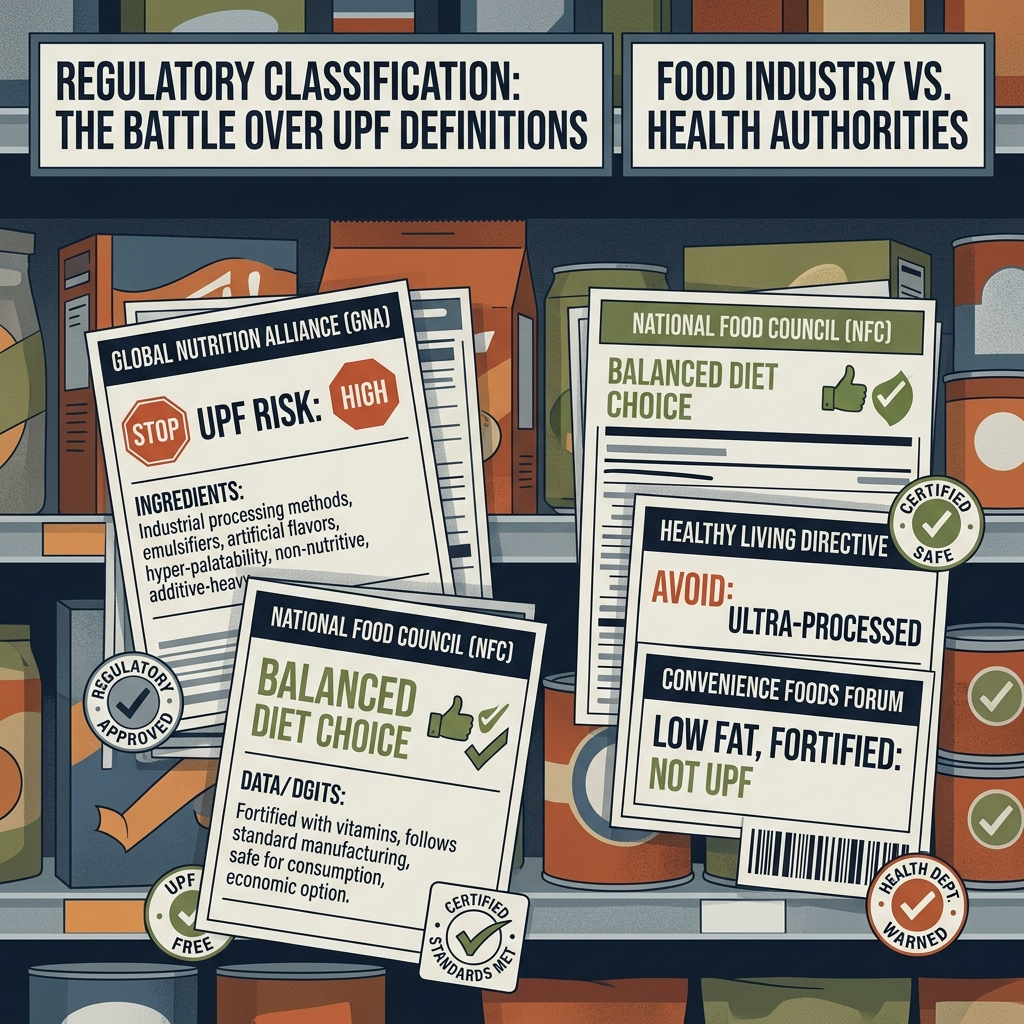
The FDA is currently evaluating three fundamentally different frameworks for defining ultra-processed food, and the choice between them carries consequences that extend far beyond food science into law, trade, and political economy. Brazil's NOVA classification, developed by epidemiologist Carlos Monteiro in 2009, categorizes food by degree of industrial processing rather than nutrient content, placing any product containing industrial formulations not typically found in home kitchens — including emulsifiers, stabilizers, and flavor enhancers — into Group 4, the ultra-processed tier. France's Siga system adds a quantitative nutritional layer to processing markers, incorporating threshold values for sugar, fat, and salt content alongside processing indicators. The AAP-derived hybrid takes a pure ingredient-composition approach, scoring products on sodium, saturated fat, added sugars, artificial dyes, flavorings, and caloric density. The same strawberry yogurt can be classified as ultra-processed under one system and merely "processed" under another — a definitional incoherence that reveals how the choice of framework is inherently a political and economic act as much as a scientific one. The moment FDA adopts any single definition, the $1.9 trillion food industry will possess a legal instrument — functioning simultaneously as a liability shield against criticism and a litigation weapon against stricter future rulemaking.
The Regulatory Paradox — Structurally Different from Tobacco
The tobacco analogy that drives much of the pro-regulation argument contains a structural flaw that tends to get glossed over in the enthusiasm for bold action. Tobacco's alternative is not smoking — a zero-cost, zero-effort choice requiring nothing from the individual beyond simply stopping. Ultra-processed food's alternative is healthier food — an option that is simultaneously more expensive and less physically accessible in the very communities where UPF consumption is highest. Roughly 19 million Americans live in food deserts, where reaching a full-service grocery store requires travel that many residents cannot realistically manage. In those areas, 44% of adults regularly skip healthy food purchases because of cost, and the local convenience store or dollar store functions as the only available food retail option. Removing UPF from those shelves without ensuring viable replacement options doesn't protect public health — it restricts the number of available calories without improving their quality. The paradox sharpens when you recognize that the people who would bear the immediate and heaviest costs of UPF regulation are precisely those who already carry the deepest burden of food insecurity — the populations whom the regulation theoretically exists to protect.
The Industry's Tobacco Playbook in Real Time
The food industry's response to UPF regulatory pressure closely mirrors the playbook that the tobacco industry used to delay meaningful health policy for decades, and the parallels are specific enough to be instructive. Just as tobacco companies maintained for years that nicotine was not addictive, food industry groups insist that "processing itself isn't the problem — look at the nutrient profile." Both tactics deploy scientific language to preserve strategic ambiguity in debates that are actually converging toward clarity. A Foodwatch report revealed that European food companies spent more than €1 billion over two decades specifically to defeat mandatory nutrition labeling, with Nestlé, Mars, Coca-Cola, Unilever, Mondelēz, and PepsiCo all identified as participants. The strategic toolkit included funding research designed to produce industry-favorable conclusions, recruiting former regulatory officials through revolving-door arrangements, developing proprietary alternative labeling systems to push as substitutes for mandatory disclosure, and deploying agricultural ministries for high-level diplomatic lobbying. In 2021, a coalition of 260 scientists and 20 medical associations across 32 countries called for mandatory nutrition labeling; industry lobbying defeated that effort. The EU's long-promised mandatory labeling initiative, previewed in 2022, remains stalled to this day. Recognizing this pattern is not cynicism. It's reading a playbook that has already been used successfully once.
UPF as a Symptom of Poverty, Not Its Cause
One of the most important reframings in the UPF debate is the distinction between ultra-processed food as a driver of poor health outcomes and UPF as a visible indicator — a symptom — of structural poverty and food system failure that requires a fundamentally different policy response. CDC data reveals that Americans below 130% of the federal poverty line get 54.7% of their calories from ultra-processed food, while Americans above 350% of the poverty line obtain 50.4% of their calories from the same category — a gap of just 4.3 percentage points. This is not a story about low-income communities making poor choices while wealthier people eat thoughtfully; it is a story about an entire food system that has defaulted to ultra-processing for nearly everyone, with marginal variation across income brackets. Meanwhile, U.S. agricultural subsidies are heavily concentrated in corn, soybeans, and wheat — the primary raw material inputs for most ultra-processed foods — meaning that government policy has systematically and artificially suppressed UPF prices while leaving fresh produce largely unsupported. Advising someone in a food desert to "make healthier choices" while the surrounding policy environment makes healthy food both more expensive and less physically accessible is not nutritional guidance. It is structural injustice dressed in the language of personal responsibility.
The Free Market Fallacy — A Market Already Engineered Against Consumers
The loudest argument against UPF regulation — "let the free market decide" — requires ignoring the extensive ways in which the food market has never operated as a genuinely free market at any point in recent history. European food industry lobbying alone spent more than €1 billion over two decades to prevent consumers from receiving transparent product information, which is the foundational prerequisite for any market that can claim to be free. U.S. agricultural subsidies artificially lower the production cost of the primary inputs for ultra-processed food through deliberate government intervention, not market efficiency — making UPF cheaper relative to fresh produce as a direct consequence of policy choices. Consumers in food deserts face a choice between a convenience store and no store at all, not between multiple competing options of varying quality. The idea that meaningful consumer sovereignty operates under these conditions is a convenient fiction for industries that profit from the information asymmetries and access barriers they have helped to construct. The food industry systematically distorted market conditions through lobbying, subsidy capture, and strategic information restriction — and then, when regulatory responses arrive, suddenly rediscovers its commitment to free market principles. That pivot from market manipulator to free market guardian is one of the more brazen moves in contemporary industry self-defense.
Positive & Negative Analysis
Positive Aspects
- A Consumer Awareness Revolution Is Already Generating Market Change
The regulatory debate over ultra-processed food is producing a consumer awareness shift that is already altering market dynamics before any formal regulation has taken effect, demonstrating that transparency itself carries real economic force. The term "ultra-processed food" has entered everyday vocabulary in a way that the vaguer "processed food" never quite managed, giving consumers a specific cognitive framework for evaluating products they encounter. Chile's experience with mandatory front-of-package warning labels demonstrated measurable shifts in consumer purchasing patterns after implementation, validating that information provision changes behavior at scale when framing is concrete and clear. Food companies are responding to the resulting social pressure by launching "clean label" product lines that minimize artificial additives — changes driven entirely by reputational and commercial concern rather than regulatory mandate. Consumer engagement with ingredient lists has increased meaningfully in markets where the UPF debate has been prominent, suggesting that awareness effects may generate market improvements even where formal regulation has not arrived. The discussion itself — through journalism, social media, documentaries, and academic publication — is functioning as a distributed informational campaign that is restructuring how tens of millions of people make purchasing decisions.
- Regulatory Pressure Creates a Powerful Incentive for Industry Self-Innovation
The UPF regulatory debate is creating one of the strongest incentives the food industry has faced in decades to genuinely redirect R&D toward healthier product formulations, and the early signs of that redirection are already visible. When facing potential regulatory designation and the reputational costs that accompany it, food companies have concrete financial motivation to reduce the number of artificial additives in their products, simplify processing chains, and develop product lines that sit clearly outside any plausible UPF definition. Several major food corporations have announced voluntary targets for reducing ultra-processed content in their portfolios — commitments that would not have materialized without the regulatory pressure the current debate has generated. New categories including minimally processed convenience foods, fermented products, and plant-based whole-food ingredients are attracting substantial venture capital and corporate R&D investment, driven in part by regulatory anticipation. If the regulatory environment successfully establishes a tiered market where less-processed products command price premiums, industry innovation toward healthier formulations becomes commercially self-sustaining — a structural dynamic that regulatory debate catalyzes but does not need to maintain through enforcement indefinitely.
- Long-Term Reduction in Chronic Disease Burden Carries Real Public Health Potential
If UPF regulation effectively reduces consumption of products associated with increased risk of chronic disease, the long-term reduction in healthcare expenditure and disease burden could be economically and medically significant. A 2025 Lancet series systematically reviewed 104 long-term studies and found that 92 reported increased risk associations between higher UPF consumption and chronic conditions including obesity, type 2 diabetes, cardiovascular disease, depression, and earlier mortality — associations that appeared consistently across multiple countries and diverse research designs. The global economic burden of obesity alone exceeds $2 trillion annually when healthcare costs and lost productivity are combined. Mexico's experience with a sugar-sweetened beverage tax demonstrated measurable consumption reductions following implementation, providing empirical support for the proposition that price-based mechanisms can shift purchasing behavior at population scale. Even given the ongoing scientific debate about causation versus association, precautionary policy that meaningfully reduces UPF consumption carries a plausible public health dividend — especially for conditions that impose enormous systemic costs on healthcare infrastructure and that fall disproportionately on communities with the least healthcare access.
- FDA Action Could Anchor a Much-Needed Global Regulatory Standard
A formal FDA decision to define ultra-processed food could function as a global regulatory anchor, reducing the current patchwork of conflicting national frameworks and providing food manufacturers with a degree of regulatory predictability that the current environment entirely lacks. The same product may currently be classified differently across the EU, UK, Brazil, and individual U.S. states — a fragmentation that creates substantial compliance costs for multinational food companies and generates legitimate consumer confusion. The GDPR precedent in data protection law demonstrates how a single jurisdiction's regulatory standard can become a de facto global standard when that jurisdiction is sufficiently large and integrated into international trade — a dynamic that analysts call the "Brussels Effect" and that could operate equally from Washington. A scientifically rigorous FDA definition would provide a clear international reference point capable of harmonizing regulatory approaches across countries currently developing their own frameworks, potentially reducing trade friction and giving the food industry's global supply chain a consistent compliance target to engineer toward. Regulatory coordination of this kind produces systemic benefits that extend well beyond the jurisdiction that establishes the original standard.
- A Legal Framework Can Protect Children from Deliberately Engineered Marketing
An official UPF definition creates the legal foundation for regulating marketing practices that currently target children during developmental periods when their food preferences and consumption habits are being formed. Today, UPF products — typically high in added sugars, artificial dyes, and palatability-engineered formulations — are aggressively marketed to children through television advertising, social media influencer partnerships, school-adjacent retail placement, and product packaging designed to appeal to young consumers' visual instincts. Without a formal regulatory category, restricting this marketing requires making contested nutritional arguments that industry can challenge indefinitely with its own research. A legally defined UPF category allows for bright-line rules: this class of products may not be marketed to children below a specified age. That protection is substantially harder to litigate against than content-specific nutritional claims. Public health consensus around protecting children from commercial manipulation consistently generates broader social support than adult consumer protection arguments, making child-focused UPF regulation both more politically feasible and more durable against industry legal challenge — potentially establishing the beachhead from which broader reform can expand.
Concerns
- Food Desert Communities Would Bear the Sharpest Immediate Costs
The most serious near-term risk of UPF regulation is that it would impose its harshest consequences on the communities already facing the most acute food insecurity — precisely the populations the regulation is theoretically designed to protect. Approximately 19 million Americans live in food deserts where reaching a full-service grocery store requires significant travel beyond the practical means of many residents, and for these communities the local convenience store, dollar store, or fast food outlet constitutes the effective food retail system. Removing UPF from those shelves without simultaneously ensuring viable replacement options creates a caloric and nutritional void, not a health improvement. Regulation advocates frequently respond with "build healthy alternatives simultaneously," which is correct in principle but historically unreliable in practice — food distribution infrastructure requires years to develop while legislation can be enacted in months, producing a predictable gap period during which low-income communities bear both the restriction costs of regulation and the continued absence of its promised benefits. SNAP (Supplemental Nutrition Assistance Program) recipients already purchase substantial quantities of UPF using their benefits, and proposals to exclude UPF from SNAP eligibility would reduce recipients' purchasing power without making healthier alternatives more financially accessible. The populations who most need food system improvement are thus most exposed to regulation's unintended consequences.
- Regulation May Paradoxically Entrench Big Food's Market Dominance
One of the sharper structural ironies of UPF regulation is that it could consolidate market power in the hands of the largest food corporations — the very entities whose practices motivated the regulatory response in the first place. Large corporations possess the R&D budgets to reformulate products to fall outside any UPF definition, the legal resources to challenge regulatory designations in court, and the lobbying infrastructure to influence how final rules are written. Smaller food producers lack all three advantages. The tobacco regulation history is directly instructive: as cigarette standards tightened, smaller manufacturers were progressively forced out of the market while major tobacco companies' market share increased, because only the largest players could absorb the compliance overhead and extended litigation costs. O'Melveny legal analysts have specifically noted that California's regulatory standard functions as a de facto national standard through supply chain economics — the cost of maintaining separate product formulations across different states makes nationwide adoption of the most stringent applicable standard commercially rational, a dynamic that disproportionately rewards companies large enough to reformulate nationally. The result could be a more concentrated, less competitive food market where a handful of corporations deepen their dominance while publicly appearing to comply with public health objectives.
- Regulating on Contested Science Introduces Structural Fragility
The evidentiary foundation for UPF regulation is substantial but genuinely imperfect, and acknowledging that clearly is a matter of scientific integrity rather than industry apologetics. The vast majority of evidence linking ultra-processed food to health harms comes from observational research, where separating the specific effect of UPF from the many correlated variables — lower income, less physical activity, reduced healthcare access, higher chronic stress — is extremely difficult to accomplish with full rigor. Industry groups correctly note that the magnitude of observed associations is often modest and that confounding variable management remains a persistent methodological challenge across this literature. If regulatory frameworks are constructed around causal claims that subsequent research reveals to be overstated or differently located — specific harmful ingredients rather than the processing degree per se — the entire regulatory architecture requires costly reconstruction at significant public expense. Establishing a precedent that observational associations provide sufficient grounds for major regulatory intervention also creates methodological risks that could affect evidence thresholds in other policy domains where the underlying science is similarly contested. Scientific uncertainty argues for precautionary action, not regulatory paralysis — but it does argue for building regulatory frameworks that are explicitly designed for revision as evidence evolves.
- Nationally Fragmented Definitions Risk Destabilizing International Food Trade
If the FDA definition fails to gain international adoption and competing national definitions proliferate across jurisdictions — as is already happening — the result could be significant disruption to global food trade, with costs concentrated among exporters from lower-income countries least equipped to absorb compliance overhead. A product considered fully compliant in Brazil might face restriction in the EU under different processing criteria, while a product cleared by FDA standards triggers HFSS penalties under UK rules — creating a regulatory mosaic that raises compliance costs for every participant in international food commerce. For food-exporting economies in the Global South, adapting to multiple conflicting destination-market standards imposes costs that can erode export competitiveness and disadvantage small-scale producers who lack the technical resources to navigate simultaneous multi-jurisdictional compliance. Within WTO frameworks, UPF regulations risk functioning as non-tariff barriers if they are designed — or strategically perceived — to protect domestic producers from import competition. The public health and food safety motivation provides political cover that can obscure what is effectively a new form of agricultural protectionism, potentially destabilizing trade relationships that lower-income economies depend on for food export revenue.
- The "Real Food" Framework Institutionalizes Class Bias as Policy
The "real food" discourse underlying UPF regulation carries an embedded assumption about food virtue that regulation threatens to encode into law: that "correct" eating is accessible to everyone when, in practice, it is structurally available primarily to people with sufficient income, time, and physical proximity to act on it. Organic markets, farm-to-table restaurants, farmers' markets, and whole-food cooking are the vocabulary of the wellness economy — disproportionately a middle- and upper-class experience. The loudest voices in the UPF debate — celebrity chefs, wellness influencers, nutrition researchers at elite research institutions — generally have not lived in food deserts or navigated the daily reality of two jobs and no time to cook. When regulation formally encodes the idea that ultra-processed food is categorically inferior and should be restricted or penalized, it institutionalizes a hierarchy of eating that is achievable for people with options and effectively punitive for people without them. Dollar store food sales increased 90% between 2008 and 2020 not because low-income Americans prefer them, but because they represent the available option in their communities. A policy that simultaneously restricts food access for those communities while implicitly signaling moral failure in their consumption patterns is not public health legislation. It is cultural stratification wearing a public health label.
Outlook
The next one to six months will be dominated by a single event: the FDA's definition decision. The agency received more than 5,000 comments following the July 2025 joint FDA-USDA Request for Information, and it is working toward a federal unified definition within 2026. My read is that FDA will not adopt any of the three competing frameworks as-is. The most plausible outcome is a hybrid that uses NOVA as its structural foundation while incorporating Siga's quantitative nutritional thresholds and AAP's specific additive criteria. A pure NOVA adoption invites immediate mass litigation from an industry with effectively unlimited legal resources. A pure ingredient-composition approach would be attacked from the public health community as an industry capture outcome. A compromise produces a definition that satisfies neither camp completely — which means it will be challenged by both — but it survives initial judicial review more readily than either extreme. California's AB 1264 has already moved the de facto national standard forward independently of federal action, with CDPH required to finalize its "ultra-processed food of concern" list by June 2028. The state-level fragmentation is already real; the question is whether federal action harmonizes it or deepens it.
While the regulatory process unfolds, the food industry is preparing along two parallel tracks simultaneously, and it is important to understand both. Track one is reformulation — redesigning products to fall outside whichever definition emerges. The "clean label" movement is already accelerating this, with food companies reducing artificial emulsifiers, stabilizers, and colorants in premium product lines while quietly maintaining original formulations in economy lines. Track two is litigation preparation. Legal analysts at firms including Morrison Foerster have publicly stated that a federal UPF definition does not automatically generate new enforcement exposure — the legal significance depends entirely on how the definition is applied and what regulatory consequences attach to it. Major food companies are preparing scientific challenges to the underlying research and administrative law challenges to the rulemaking process. Most large food corporations will run both tracks simultaneously, reformulating where commercially efficient while preparing to litigate anything that threatens core revenue lines. In the short term, what consumers are most likely to notice is subtle ingredient list changes and an acceleration of "natural" and "minimally processed" marketing claims — signals of reformulation positioning, not fundamental product transformation.
The medium-term question — covering roughly six months to two years from a federal definition — is whether FDA's decision becomes a genuine global benchmark or merely an American standard. The EU is already operating on a separate trajectory. The Safe Hearts Plan's initial ambition on UPF taxation retreated under industry pressure, but the European regulatory apparatus has deeper historical commitment to precautionary food safety approaches than its American counterpart, and it is watching the FDA process closely. Britain's Scientific Advisory Committee on Nutrition (SACN) maintains a "further evidence needed" position, making the UK an unlikely early adopter of either U.S. or EU frameworks. In Asia, South Korea's Ministry of Food and Drug Safety is running active UPF monitoring programs while Japan remains in a watching posture. The analyst concept of the "Brussels Effect" — the dynamic by which EU regulatory standards become global standards because multinational firms find it more efficient to apply the most stringent standard globally than to maintain jurisdiction-specific formulations — may apply here. If the EU adopts stricter UPF standards before or shortly after FDA acts, European standards, not American ones, may become the effective global compliance target.
The medium-term period will also see significant restructuring of the food industry's competitive landscape. The 2026 Mars acquisition of Kellanova for $36 billion is best understood not as an isolated transaction but as an opening signal of a consolidation wave. Facing the prospect of stricter regulation, major food conglomerates have strong financial motivation to acquire brands that are positioned as healthier or minimally processed, providing regulatory hedge and marketing legitimacy simultaneously. We will see aggressive M&A targeting fermented food brands, organic food companies, and whole-food convenience producers. The startups moving into "healthy ultra-processing alternatives" will attract substantial venture capital. The irony is that many of those alternative products, examined through NOVA criteria, are themselves Group 4 — the processing methodology changes but the degree of industrial intervention doesn't necessarily diminish. The industry is very good at marketing transformation while preserving underlying product economics, and investors and consumers should evaluate "clean" alternative food claims with that history in mind.
Looking further out — two to five years — the UPF debate will be impossible to resolve without confronting food system redesign as a whole. The Lancet expert group's seven-point policy framework is instructive on what comprehensive reform actually requires: mandatory front-of-package UPF labeling, restrictions on child-directed advertising, UPF restrictions in public institutions, tax revenue recycled as fresh produce subsidies for low-income communities, structural caps on food industry political influence, food system reform from agricultural production through retail, and research transparency requirements. That is a package, not a menu. Implementing any single element without the others produces results that are incomplete at best and counterproductive at worst. Implementing UPF taxes without fresh food subsidy expansion widens the economic burden on low-income communities. Implementing labeling without advertising restrictions allows marketing to overwhelm information. My assessment is that at least one major economy — most likely within the EU or a Scandinavian country — will move toward this kind of comprehensive framework within the five-year window. The United States is the least likely candidate: touching agricultural subsidies is functionally political suicide in Washington, and without subsidy reform the rest of the package loses its structural coherence.
One variable that receives insufficient attention in the mainstream UPF debate is food technology, specifically the potential for precision fermentation and cellular agriculture to fundamentally disrupt the definitional landscape within the next three to five years. Precision fermentation produces proteins, fats, and flavor compounds through microbial processes rather than traditional agricultural cultivation. Cellular agriculture grows animal proteins from cell cultures without raising animals. Both technologies are approaching commercial scale. These products will be, by any existing definition, among the most intensively processed foods ever created — and simultaneously among the most resource-efficient and potentially nutritionally complete. NOVA, Siga, and the AAP hybrid are all designed around the assumption that more processing equals more industrial additives equals more concern. None of the current frameworks has a conceptual category for "extremely processed but using fundamentally different and potentially superior inputs." The UPF definition debate that FDA is currently having may be rendered partially obsolete by technological change within the same regulatory cycle it is attempting to manage. Regulators who build inflexible definitions risk either blocking innovations that could address multiple problems simultaneously or inadvertently creating loopholes for genuinely harmful products.
Regarding health inequality specifically, I want to be direct about my forecast: UPF regulation implemented without simultaneous structural support will make health inequality worse, not better. The mechanism is straightforward. SNAP recipients already purchase substantial amounts of UPF, and proposals to restrict UPF eligibility under SNAP would reduce recipients' effective purchasing power without making healthier food financially accessible. Dollar store food sales increased 90% between 2008 and 2020 in communities where they represent the primary available food retail, and that growth reflects structural demand, not consumer preference for inferior options. Regulatory restrictions on UPF without fresh food retail infrastructure investment will accelerate the already-visible trend toward food scarcity in underserved communities — fewer options, higher prices for remaining options, continued nutritional inadequacy at the population level. The question of whether UPF regulation helps or hurts the most vulnerable communities is not speculative. It is a design question, and the design is currently pointing toward harm unless actively corrected.
Looking at the three scenarios I find most plausible: the bull case — probability roughly 15 to 20% — involves the FDA adopting a scientifically rigorous and clearly bounded definition, the San Francisco lawsuit against major food companies following a trajectory similar to state-level tobacco litigation and ultimately reshaping industry practices over ten to fifteen years, and comprehensive subsidy reform being bundled into a major farm bill reauthorization. In this scenario, UPF tax revenue gets recycled as targeted fresh produce subsidies for low-income communities, and the Lancet expert group's structural recommendations become policy in at least two major economies. This outcome requires a degree of political will and regulatory coherence that current evidence does not strongly support, but it's not impossible.
The base case — probability roughly 50 to 55% — involves the FDA adopting a compromise definition that establishes a labeling framework and restricts some specific additives, while industry lobbying successfully dilutes the most aggressive provisions. The California standard effectively becomes a de facto national standard through supply chain economics, but full implementation reaches 2035 before meaningful market change occurs. Large food companies reformulate their premium lines while maintaining economy formulations aimed at price-sensitive consumers. Mid-sized producers face disproportionate compliance costs and some exit the market, modestly increasing large-company concentration. The public health benefits are real but smaller than advocates hope, disproportionately captured by higher-income consumers who can access reformulated products, while the populations most at risk for chronic disease experience minimal improvement.
The bear case — probability roughly 25 to 30% — involves the scientific debate within the research community remaining sufficiently contested to stall the definitional process, food industry lobbying successfully deploying federal preemption arguments to challenge and partially defeat state-level regulations, and the UPF market continuing to grow at its projected 9% CAGR while the regulatory process grinds through a decade of administrative and judicial challenge. In this scenario, the Mars-Kellanova consolidation model repeats, market concentration deepens, and when regulation eventually arrives it primarily benefits corporations that consolidated market position during the regulatory delay. Consumer choice narrows and the clean label premium segment caters to higher-income consumers while economy-tier UPF products remain largely unchanged.
Whatever scenario unfolds at the policy level, there is one thing individuals can act on right now without waiting for any government to resolve its definitional argument: read ingredient lists. If you encounter more than five ingredients you cannot identify without looking them up, that product contains significant industrial processing regardless of what any regulatory framework ultimately decides to call it. "Eat healthier" is too vague to be actionable for most people. "Read the back of the package and investigate what you don't recognize" is specific and immediately executable. More importantly, stay engaged with the policy debate and push for the part that mainstream coverage consistently underemphasizes: structural reform. UPF labeling without agricultural subsidy reform, food desert investment, and advertising restrictions is incomplete policy wearing the costume of comprehensive action. The real war is not on the nutrition label. It's in the farm bill, the SNAP structure, and the lobbying architecture that has operated successfully for decades. That's where the meaningful decisions about who eats what will actually be made.
Sources / References
- Lancet UPF Series — $1.9 trillion global annual UPF sales, systematic review of 104 long-term studies — EurekAlert/The Lancet
- WHO Europe — Four industries (tobacco, ultra-processed foods, fossil fuels, alcohol) combined contribute to 2.7 million deaths annually in the European region — WHO Europe
- FDA Human Foods Program 2026 Priority Deliverables — Official document on federal UPF definition development — U.S. FDA
- California AB 1264 — First-in-the-nation law banning ultra-processed foods from school lunches — California Governor's Office
- Nature Food — Editorial debate on UPF framework confirming split within scientific community — Nature Food
- CDC Data Brief #536 — 56% of U.S. adult daily energy intake from ultra-processed food sources — CDC/NCHS
- San Francisco City Attorney — Lawsuit against 10 major food companies over ultra-processed food harms — SF City Attorney
- Foodwatch — European food industry spent €1 billion+ over 20 years to defeat mandatory nutrition labeling — Foodwatch
- FDA competing definitions update — 5,000+ public comments submitted, three approaches in conflict — FoodNavigator
- What the ultra-processed foods debate still gets wrong — the case for whole dietary patterns over individual product classification — Forbes