
The Country That Gave the World Its Favorite Bowl Is Watching That Bowl Kill Its Own Artisans
Summary
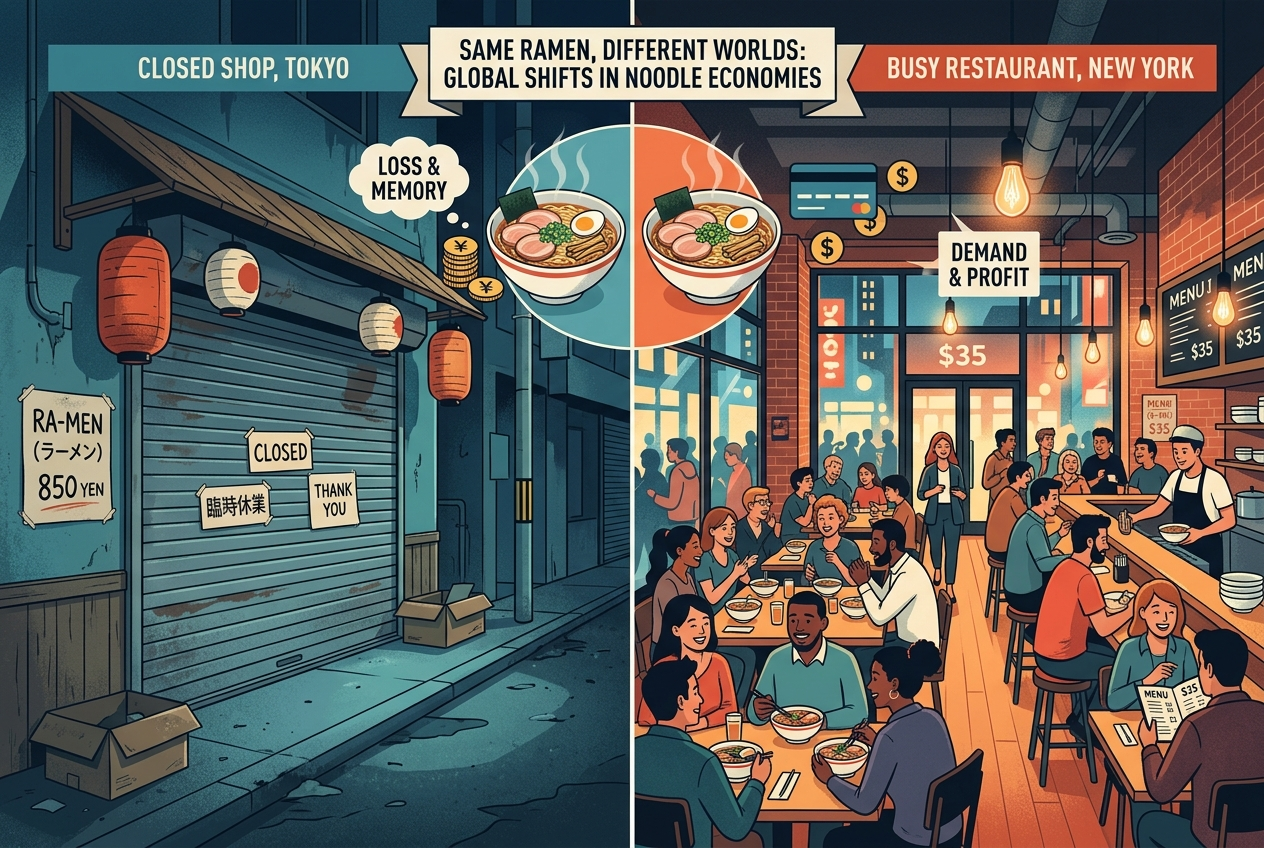
Japan's ramen industry is caught in a historic paradox: 2024 saw a record 72 ramen shop bankruptcies by Teikoku Databank's count — a 30.2% surge year-over-year — while the global ramen market simultaneously hit $62.77 billion and is expanding at an 8.2% CAGR toward a projected $84.99 billion by 2030. The ¥1,000 wall — the psychological ceiling governing the industry for two decades — is not an economic equilibrium but a collective trauma inherited from thirty years of deflation, a period so entrenched that Japan's average ramen price in 2020 was actually ¥27 cheaper than it had been twenty years prior. The structural cost crisis is severe: the ramen production cost index has climbed to 113.5 (up 13.5% since January 2022), pork prices are up 20% annually, cooking oil surged 26%, and Tokyo's minimum wage now sits at ¥1,226 per hour — yet the national average selling price remains anchored at just ¥716. Large food-service chains are absorbing failing artisan shops through M&A and centralized broth production, which superficially reduced bankruptcies to 59 in 2025, but that apparent improvement masks a deeper cultural erosion: the craft is being factory-logistified. The same bowl that sells for $22–$25 in Manhattan — approximately ¥3,400 — dies at ¥850 in Tokyo at a structural loss, and this price paradox is not a market anomaly but the symptom of a society that has learned to undervalue its own culinary heritage through what can only be called cultural self-harm.
Key Points
The ¥1,000 Wall Is a Deflation Trauma Artifact, Not an Economic Reality
The ¥1,000 wall that has governed Japan's ramen industry for two decades is not the product of careful cost analysis or genuine consumer resistance — it is a psychological legacy of thirty years of deflation baked into both business behavior and consumer expectation. Food critic Yamamoto Takeshi's maxim that "if it costs more than ¥1,000, nobody will buy it" operated as industry gospel for twenty years despite mounting evidence against it. The most striking proof of deflationary distortion is that Japan's average ramen price in 2020 was ¥523 — actually ¥27 cheaper than it had been twenty years earlier, in a country where virtually every other cost had risen over that same period. Yet a TBS News survey of 105 Tokyo residents found that only about 20% insisted on prices below ¥1,000, while more than 50% said they'd willingly pay ¥1,000–¥1,500, and younger generations (20s and 40s) frame premium ramen as "affordable luxury." The wall, in other words, was not built by consumers demanding cheapness — it was built by an industry that internalized the fear of being judged for charging fairly. This is the defining characteristic of deflation trauma: the fear of price increases exceeds the actual consumer resistance to them, and the result is a self-imposed constraint that makes the business model structurally unviable.
The Cost Structure Has Hit a Point of No Return
The financial arithmetic of running a ramen shop in Japan has crossed into structurally unviable territory, and the numbers are unambiguous. The ramen production cost index reached 113.5 — a 13.5% increase from January 2022 — while individual input categories have moved even more dramatically: pork bone prices are up 20% annually, cooking oil surged 26% since May 2023, commercial electricity climbed 15% between 2021 and 2023, and cumulative ingredient costs have risen 41% since 2020. Tokyo's minimum wage is now ¥1,226 per hour, the largest single-year increase since 1978, with a government target of ¥1,500 representing another 22% increase ahead. The result for a standard Tokyo shoyu ramen at ¥850: ingredient costs of ¥255 (30%) combined with labor costs of 32–35% produce a prime cost of 62–65%, already above the 60% threshold that marks a financially sustainable restaurant operation. Teikoku Databank's survey of 350 ramen operators found 34% reporting operating losses in fiscal 2023, and when shops experiencing declining performance are included, 61.5% were in the red — the second-worst reading in twenty years of data. Against this cost structure, the ¥716 national average selling price is not a market outcome — it is a slow-motion bankruptcy unfolding across thousands of kitchens simultaneously.
Corporate M&A Is Replacing Artisan Culture with Factory Logistics
Japan's large food-service corporations are systematically absorbing the wreckage of the artisan ramen sector, and what looks like market consolidation is actually a cultural substitution happening in real time. Yoshinoya Holdings acquired U.S. ramen chain Kizuki International for approximately $28.7 million in a move that symbolizes the broader M&A wave transforming the domestic market. Chain restaurants are growing at an 11.08% CAGR while independent operators, who still hold 74.61% of market share, face structural decline as their cost position worsens relative to centralized competitors. The 2025 bankruptcy reduction from 79 to 59 — often cited as encouraging progress — was driven specifically by adoption of centralized kitchen systems and "no-broth" menus designed to eliminate the most costly element of traditional ramen production. In plain terms: the shops that survived did so by ceasing to make ramen the way artisans make ramen. The concentrated broth pack from a central facility has replaced the twelve-hour pork bone simmer in the back kitchen, and regional distinctions — the fermented miso depth of Sapporo, the milky intensity of Hakata tonkotsu, the delicate clarity of Tokyo shoyu — are being reduced to flavor profile labels on standardized product.
The Tourism Boom Creates a Distorted, Fragile Lifeline
Japan's record inbound tourism — 42.7 million foreign visitors in 2025 generating ¥9.5 trillion in spending, with ¥2.1 trillion in food and beverage alone — has created an emergency revenue stream for a subset of ramen shops, but the dependency it has created is structurally precarious. For shops on tourist corridors near Asakusa, Shinjuku, or Shibuya, the weak yen has transformed ¥1,500 ramen into a bargain exotic experience for foreign visitors; for residential neighborhood shops three blocks off those corridors, the tourism boom is entirely invisible, and revenue gaps between the two categories have reached five to ten times. More troubling than the uneven distribution is the qualitative bifurcation: tourist-facing ramen is evolving toward lighter broths, English menus, and Instagram-optimized plating, while traditional neighborhood ramen serves a shrinking local base at unsustainable prices. The structural vulnerability is obvious — the yen at a 54-year real effective exchange rate low will not remain there indefinitely, and when it strengthens, the tourist-dependent ramen economy loses its core competitive advantage simultaneously in all segments. When that shift comes, shops that never built a sustainable domestic pricing model will have no fallback: the inbound windfall will disappear and the domestic consumer base will have long since adjusted to cheaper chain alternatives.
Generational Shift and Artisan Knowledge Extinction Define the Long-Term Stakes
The long-term fate of Japanese artisan ramen hangs on two parallel timelines that are moving in opposite directions. The generational consumption shift — younger Japanese consumers who treat premium ramen as affordable luxury rather than an extravagance — offers genuine long-term hope: the TBS survey showed that 40-somethings and 20-somethings already accept ¥1,000–¥1,500 pricing, and by 2032–2035, this cohort will dominate the market. However, the artisan knowledge that would supply a premium market segment is being eroded faster than the market conditions that would support it are forming. Traditional apprenticeships of five to eleven years are being replaced by five-day commercial training courses costing $2,000–$8,000. Independent shops have fallen from 40,000 to 32,000 in eight years. In 2024, every Michelin-starred ramen restaurant in Tokyo — and therefore on earth — lost its star. The business manager visa collapse (applications down 96% after October 2025 policy changes) has sealed the external talent pipeline. The practical question is whether enough artisan knowledge survives the next decade to supply whatever premium market eventually emerges — and right now, the answer looks uncertain.
Positive & Negative Analysis
Positive Aspects
- The $62.77 Billion Global Market Creates a Real Opportunity for Japanese Brand Premium
The global ramen market's expansion — from $58 billion in 2025 to $62.77 billion in 2026 and a projected $84.99 billion by 2030 — has established "Japanese ramen" as one of the most recognized culinary brand identities in the world, and that recognition carries real economic value that the domestic industry has largely failed to capture. Japanese food exports hit ¥1.7 trillion in 2025, a 13th consecutive annual record, and the number of Japanese restaurants overseas reached 187,000 — up 110% from 89,000 in 2013. Chains like Ippudo and Ichiran operate profitable international locations that generate margins unavailable in the domestic market; those overseas revenues theoretically create a reinvestment pipeline for domestic artisan support programs. The brand premium that makes Manhattan diners pay $25 per bowl is a structural asset that could be redirected toward sustaining the craft culture that created it in the first place. If a mechanism can be built to connect global brand value back to domestic artisan ecosystems — whether through licensing, cultural certification, or direct investment programs — the global ramen boom becomes a rescue mechanism rather than an irony.
- Premium Ramen Is Already Breaking the Wall and Thriving
The market has already generated proof of concept that the ¥1,000 wall is not absolute, and the shops that have broken through are not merely surviving — they are prospering. Hachigo in Ginza raised its standard price from ¥850 to ¥1,200 and found that its most popular item is now a ¥2,200 bowl topped with truffle and foie gras. Ramen Break Beats in Meguro charges approximately ¥2,000, operates on a reservation-only basis, and earned a Michelin Bib Gourmand in 2024. Ichiran's home ramen kit revenue grew 45% in 2025. These examples collectively demonstrate that differentiated value — superior ingredients, distinctive technique, elevated dining context — enables sustainable premium pricing, and that customers who understand the value proposition will pay for it. The TBS survey confirming that over 50% of Tokyo consumers accept ¥1,000–¥1,500 pricing means the viable premium customer base is not a narrow niche — it is the majority. The question facing the industry is not whether premium ramen can succeed, but whether enough shops will take the risk to prove it at scale.
- Record Inbound Tourism Provides a Short-Term Revenue Buffer
The 42.7 million foreign visitors who came to Japan in 2025 — spending an average of ¥229,000 per person and collectively directing ¥2.1 trillion toward food and beverage — have provided a temporary but meaningful revenue cushion for shops in tourist-heavy areas. At the yen's current exchange rate, ¥1,500 ramen costs a European or American visitor the equivalent of roughly $10–$12, making even premium artisan ramen feel like a bargain relative to home-country dining costs. This dynamic allows tourist-corridor shops to charge prices that domestic-only consumer demand would not sustain, buying time for the broader premium repositioning that the industry needs. Beyond the immediate revenue impact, visitors' social media activity generates organic global marketing for Japanese ramen culture at zero cost to individual shops, and the culinary experiences visitors bring home translate into sustained demand for Japanese ramen in their home markets. The per-visitor spending trend has been consistently rising — from ¥213,000 in 2023 to ¥229,000 in 2025 — suggesting that quality-seeking, high-spending visitors are becoming a larger share of inbound tourism.
- Digital and Operational Innovation Is Creating New Survival Pathways
A cohort of forward-thinking independent operators is demonstrating that technology and artisan craft are not opposites but complements, opening new survival pathways that don't require abandoning quality. A Fukuoka ramen shop's AI-driven ingredient management system cut food waste from 40% to 12%, freeing up margin that was reinvested in higher-grade sourcing. A Nagoya cooperative of three independent shops achieved chain-level ingredient pricing through collective purchasing, reducing their cost disadvantage versus corporate competitors. Cashless payment and tablet ordering systems are trimming labor costs by 10–15% across a growing number of independent shops. Ichiran's home kit success and a Sapporo artisan's 500,000-subscriber YouTube channel demonstrate that the ramen experience can be packaged and distributed through digital channels, creating revenue streams that supplement and stabilize the core shop operation. These models reduce the existential dependence on per-bowl margin at a single physical location, which is precisely the vulnerability that has been driving the bankruptcy wave.
Concerns
- Centralized Kitchen Expansion Is Irreversibly Destroying Regional Culinary Diversity
The chain-driven centralization of ramen production is not merely a business efficiency story — it is an act of cultural erasure that, once complete, cannot be reversed. What distinguishes Sapporo miso from Hakata tonkotsu from Tokyo shoyu from Kitakata ramen is not a recipe that can be stored in a database; it is embodied craft knowledge accumulated through years of daily practice, hyper-local sourcing relationships, and micro-adjustments learned through physical intuition. When that knowledge holder closes their shop and the centralized kitchen ships a standardized concentrate to the replacement chain location, the genuine regional variant ceases to exist — what remains is a flavor profile named after a place. Teikoku Databank's data confirms that the 2025 bankruptcy decline was driven by central kitchen adoption and no-broth menu innovation, meaning survival has become structurally incompatible with artisan practice for an increasing share of the market. Independent shops have already contracted from 40,000 to 32,000 in eight years. The five-to-eleven-year apprenticeship system is being replaced by five-day commercial courses. Once this generation of artisans retires or closes, the knowledge does not transfer — it disappears.
- Tourism Dependency Is a Structurally Unstable Foundation That Delays Necessary Reform
The inbound tourism windfall has functioned as a pain-masking mechanism that delays the structural price reform the industry desperately needs. Shops in tourist corridors can charge premium prices to foreign visitors without building the domestic consumer base or cultural legitimacy that would make those prices sustainable over the long term. The yen at a 54-year real effective exchange rate low will not remain there indefinitely — monetary policy normalization, global economic shifts, or geopolitical changes could trigger substantial appreciation within a two-to-four-year window. When that appreciation happens, a ¥1,500 bowl that cost a visiting American $10 will cost $15 or more, and the volume of visitors choosing ramen over other dining options will shift. Shops that built their survival model around the weak-yen tourist premium will face a simultaneous collapse of their core customer base without a domestic alternative in place. The five-to-ten-times revenue gap between tourist-facing and residential shops also means that the tourism benefits remain entirely irrelevant to the majority of independent ramen operators, most of whom operate in residential neighborhoods.
- Price Polarization Is Crushing the Middle Layer Where Artisan Culture Lives
The accelerating split between luxury ramen at ¥1,200–¥2,000 and budget chain ramen at ¥700–¥800 is eliminating the ¥900–¥1,100 middle band — the exact price range where most of Japan's independent artisan operators have historically operated. These shops cannot afford the branding investment, premium ingredient sourcing, or reservation-system infrastructure required to credibly charge ¥1,500 or more, and they refuse to compromise their craft to compete on the cost structure of a centralized chain. They are being squeezed into financial non-viability from both ends of the market simultaneously. Teikoku Databank's bankruptcy profile confirms this: 85.9% of failed shops had fewer than five employees, and 87.7% carried debt below ¥100 million — meaning these are small, honest, craft-driven operations with no structural cushion against the cost environment they face. Economists project 10–15% permanent closures among small restaurants by 2027; for ramen specifically, the concentration of closures in this middle-market artisan segment suggests the actual rate will be higher. When this middle layer disappears, the consumer's remaining choices are a chain location or a destination dining experience — and the everyday neighborhood ramen culture that generations of Japanese people grew up with is gone.
- The Global Ramen Boom Is Paradoxically Marginalizing Traditional Japanese Ramen
The explosive growth of global ramen culture is creating a market in which the original product is becoming a niche within the category it invented. International ramen has evolved rapidly to accommodate local dietary preferences and market conditions: vegan ramen, gluten-free ramen, fusion hybrids, and plant-protein-based broths are mainstream offerings in New York, London, and Sydney ramen markets. Traditional Japanese tonkotsu, shoyu, and miso styles are increasingly positioned as heritage niches within a much larger global category dominated by localized adaptations. The Michelin evidence is symbolic but significant: in 2024, at the moment of the global market's greatest scale, there is not a single Michelin-starred ramen restaurant anywhere in the world. Japan's domestic ramen market — approximately $5 billion — represents roughly 8% of the $62.77 billion global market that it originated. Yoshinoya and other Japanese chains are buying overseas ramen operations rather than exporting domestic artisan culture, which means the economic value of the global ramen brand is being captured by corporate structures rather than flowing back to the craftspeople who built the cultural foundation.
Outlook
The most immediate shift over the next six months is price polarization accelerating beyond anyone's comfort zone. Early 2026 data shows Tokyo's average ramen price already cracking ¥980 — technically still below the ¥1,000 wall, but close enough to feel the pressure from both sides. Premium shops like Hachigo and Ramen Break Beats are pushing into the ¥1,200–¥2,000 range, while major chains are doubling down on ¥700–¥800 value positioning. The segment getting crushed is the ¥900–¥1,100 middle ground — independent shops too principled to go bargain-bin but lacking the capital or brand equity to go premium. These are precisely the shops where most of Japan's ramen artisanship is concentrated, and they are being squeezed from both sides simultaneously. The 59 bankruptcies in 2025 were still the second-highest count since tracking began in 2010. Do not mistake a one-year dip for recovery — the structural cost pressures that drove 2024's record have not been resolved.
The second near-term variable is inbound tourism, which is propping up a distorted version of the market. Japan welcomed 42.7 million foreign visitors in 2025, generating ¥9.5 trillion in spending, with food and beverage alone accounting for ¥2.1 trillion — up 18.8% year-on-year, with per-visitor average spend reaching ¥229,000. For shops positioned on tourist corridors near Asakusa, Shinjuku, or Shibuya, this is a genuine lifeline. For shops three blocks off those corridors, it is essentially irrelevant. Revenue gaps between tourist-facing and residential ramen shops have reached five to ten times. What concerns me more is the qualitative drift: tourist ramen and local ramen are evolving in separate directions, with lighter broths tuned for international palates, English menus priced significantly higher than Japanese equivalents, and Instagram-first plating at the expense of broth depth. That's not internationalization — that's a personality split. When the yen eventually strengthens from its 54-year real effective exchange rate low, that tourist-dependent business model collapses without a domestic fallback to catch it.
Looking toward 2027 and 2028, three structural forces are converging on the industry simultaneously. First, the Bank of Japan's interest rate trajectory: if benchmark rates reach 1% or above, yen appreciation follows, and the inbound tourism windfall evaporates. Shops that restructured around foreign visitors will have no fallback revenue stream. Second, chain concentration: at an 11.08% CAGR, chain restaurants could control 55–60% of the ramen market by 2028, leaving independent operators with a shrinking share of their own native category. Third, labor costs: the government's stated goal of ¥1,500 per hour minimum wage — a 22% increase from the current ¥1,226 — hits ramen shops harder than most categories because of how labor-intensive the artisan model inherently is. If all three variables move in the same direction at the same time, 2027 could see a second wave of mass closures — potentially over 100 bankruptcies in a single year for the first time.
The business manager visa collapse makes this medium-term scenario considerably more likely. Monthly visa applications fell 96% after the October 2025 policy change, from roughly 1,700 to about 70, because the capital requirement was raised sixfold to ¥30 million. Foreign ramen entrepreneurs — who might have injected fresh techniques, business models, and capital into the independent sector — are now effectively locked out. The artisan pool is aging, the apprenticeship pipeline has been shortened from a decade to five days of commercial training, and the talent replacement mechanism from abroad is sealed shut. Meanwhile, cloud kitchen formats are growing at an 11.91% CAGR, creating an uneven competitive landscape: a virtual ramen brand operating from a shared kitchen avoids the rent burden of a Shinjuku storefront while competing for the same delivery orders. The physical artisan shop's fixed-cost disadvantage is structural and widening.
By 2029 to 2031, I expect ramen to be a fundamentally different food category in Japan. The global ramen market will have grown toward $85 billion, but Japan's domestic share will remain around $5 billion — roughly 6% of a market the country invented. Internationally, vegan ramen, gluten-free ramen, and fusion variants will be the mainstream segments; traditional Japanese tonkotsu or shoyu will be niches within that global category. The Michelin story is already pointing in this direction — zero starred ramen restaurants anywhere in the world as of 2024, at the precise moment when the global market is at its historical largest. Independent shops will likely have declined from 32,000 today to 20,000 or fewer. The artisanal craft knowledge that took decades to accumulate — the specific ratios, the sourcing relationships, the timing instincts learned through years of apprenticeship — may be largely irretrievable by this point.
The single most important long-term variable, however, is not any of the market forces listed above — it is whether Japanese society completes its psychological exit from deflationary thinking. If food CPI continues rising at 6.8% annually for two or three more years, consumers will normalize higher prices by sheer necessity rather than choice. The generation that never experienced cheap-everything Japan will become the primary spending cohort around 2032 to 2035, and for them, ¥1,500 ramen will simply be ramen — not a statement, not an extravagance, just a fact of life. That is when the ¥1,000 wall becomes a historical footnote rather than an active constraint on the industry. I'd put the earliest plausible timing for that generational shift at 2032, not sooner. The gap between behavioral change and intellectual acknowledgment runs at least five years in deeply embedded social norms, and Japan's deflationary psychology is three decades deep.
Three scenarios, stated plainly. In the bull case, the 50%-plus of consumers already willing to pay ¥1,000–¥1,500 becomes the market's center of gravity before 2030, the ¥1,000 wall collapses, and artisan ramen repositions like Japanese whisky or Kyoto kaiseki — a premium craft product commanding global respect and domestically sustainable pricing. The ¥2.1 trillion inbound tourism food spend flows partially to independent artisan shops rather than chains, bankruptcy rates fall below 30 per year, and the AOC-style geographic protection system that ramen experts have proposed gets adopted, institutionalizing the cultural value of regional variants. In the base case, the market continues bifurcating: chain ramen at the low end, premium ramen in tourist enclaves, and the ¥900–¥1,100 independent middle quietly disappearing. Ramen survives as a category but the artisan culture is hollowed out — regional styles like Sapporo miso, Hakata tonkotsu, and Tokyo shoyu persist only as marketing labels on chain menus. In the bear case, yen appreciation plus minimum wage hikes plus visa tightening converge between 2026 and 2028, pushing annual bankruptcies above 100 for the first time. Independent shops fall below 20,000 by 2030, traditional apprenticeship goes functionally extinct, and ramen's artisan lineage ends not with a dramatic collapse but with a quiet, shop-by-shop disappearance of people who knew how to do it properly.
One final thought. If you are visiting Japan, find the unmarked door three alleys off the tourist map and sit at the counter. Pay the ¥1,500 or ¥1,800 without hesitation or negotiation. The person behind that counter started work at five in the morning. The broth took twelve hours. The technique took a decade to develop. That price is not a premium or a tourist tax — it is the minimum fair wage for craft. Every time a visitor walks past that door to save ¥500 at the chain next to the station, another piece of what makes Japanese ramen genuinely worth traveling for disappears a little faster. The choice, in the end, belongs to each of us who picks up a bowl.
Sources / References
- Ramen Shop Bankruptcy Trends (2024) — Teikoku Databank
- 2024 Ramen Shop Bankruptcies Hit Record 57 Cases — Tokyo Shoko Research
- Ramen Noodles Global Market Analysis Report 2026: $84.99 Bn Opportunities — GlobeNewsWire / ResearchAndMarkets
- Why Ramen Shops Are Going Bust in Japan — and Booming Abroad — OsakaWire
- Japanese ramen shops must raise prices, or shut, to cope with inflation — Washington Post
- Japan's Ramen Shops Are Shutting Down Faster Than Ever — Unseen Japan
- As Prices Rise, Japan's Ramen Shops Break the 1000-Yen Wall — Unseen Japan
- Japan Welcomes Record 42.7 Million International Visitors in 2025 — Nippon.com / JNTO