
I Think 'Quality Tourism' Is Class Filtering. That's Still Not the Real Problem.
Summary
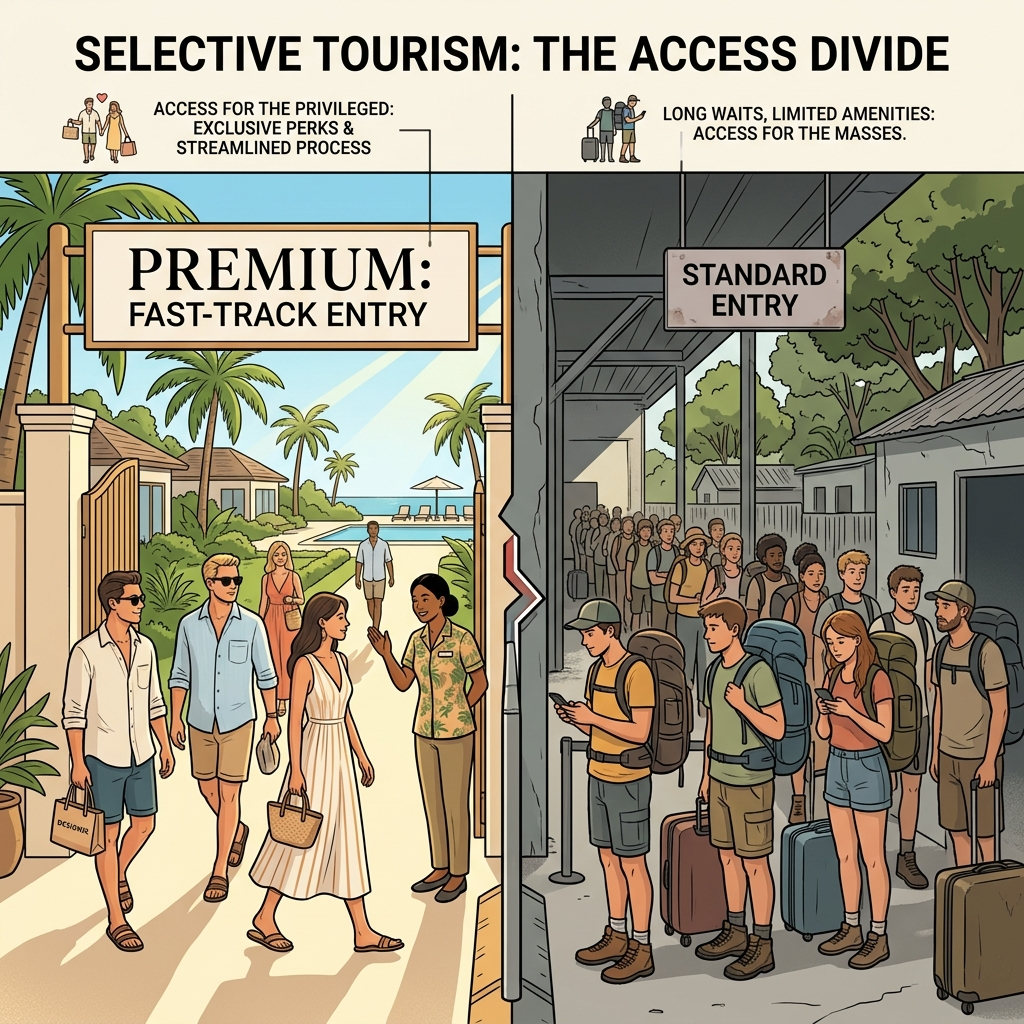
"Quality tourism" policies that spread simultaneously across Asia-Pacific and Europe in 2026 function less as tools for reducing overall visitor volume than as mechanisms for filtering out travelers who cannot spend enough. Bali's governor has publicly proposed screening foreign visitors' three-month bank balances, Japan has tripled its international tourist departure tax from ¥1,000 to ¥3,000, and Indonesian immigration authorities deported 342 foreigners in the first half of the year alone under a new enforcement task force. Though these three developments unfolded in unrelated jurisdictions, they share an identical income-sorting logic dressed in the shared vocabulary of "sustainability". A particularly revealing statistic from 2025 shows that European travel spending rose 9.7 percent while visitor arrivals grew only 3.2 percent, indicating that the underlying policy message is not "there are too many tourists" but "there are too many tourists who spend too little". Yet the more fundamental problem this analysis identifies lies not in the income composition of visitors but in the leakage structure through which tourism revenue exits local economies toward international hotel chains and booking platforms, with peer-reviewed research estimating leakage rates of 40 to 50 percent in developing countries and roughly 70 percent in Thailand specifically. Ultimately, the quality-tourism discourse carries both an ethical problem of class-based exclusion and an economic problem of distributional structure, and addressing only the former while ignoring the latter converts the policy into a regulation that serves tourism capital rather than local residents.
Key Points
'Quality Tourism' Isn't a Metaphor — It's Literally a Bank-Balance Screening
Bali's governor, Wayan Koster, announced through Indonesia's state news agency that starting in 2026 his administration will screen foreign tourists' bank balances over the preceding three months as a condition of entry. He stated explicitly that the province would now focus on quality rather than sheer numbers, and identified a visitor's savings balance as one direct component of that "quality". In typical policy discourse, the word "quality" usually points toward service standards, visitor satisfaction, or environmental impact — but this statement stripped away that ambiguity and named the visitor's own personal wealth as the actual referent. It's rare to see a policy euphemism peeled back this cleanly, and the disclosure moves the "quality tourism equals income-based sorting" interpretation out of the realm of inference and into the realm of direct quotation. Because this statement came from the province's top elected official, reported by the national state news agency rather than leaked by an anonymous bureaucrat, there's no plausible defense of misunderstanding or exaggeration available here. I think this single sentence effectively closes off any rebuttal to the class-filtering critique, because the remaining debate is no longer about guessing hidden intent — it shifts directly to the normative question of whether that kind of sorting is justifiable.
Spending Growing Faster Than Arrivals Reveals the Actual Message
European travel spending rose 9.7 percent year over year in 2025 while visitor arrivals grew only 3.2 percent. Spain's numbers echo the same pattern in isolation: 96.8 million international arrivals, up 3.2 percent, alongside visitor spending of €135 billion, up 6.8 percent — nearly double the arrival growth rate. If overtourism were purely a function of physical crowd size, a 3.2 percent increase wouldn't plausibly account for the scale of anti-tourism protests currently sweeping southern Europe. Read the same numbers from the opposite direction — high-spending visitors already growing rapidly while low-spending visitors remain present in large numbers — and the urgency governments are showing suddenly makes complete sense. A Forbes contributor captured this directly, writing that Europe wants fewer tourists spending more money, and that this is precisely what "quality tourism" means in practice. I think this counterintuitive reading explains the current wave of policy far more accurately than the official "too many tourists" framing does.
The Income Cutline Is Already Written Into the Regulations Themselves
Staying in Bali legally for an extended period requires a remote-work visa, and that visa demands documented proof of at least $60,000 in annual income. Anyone earning less than that is left with only the short-term content-creator visa, capped at a maximum of 180 days. At the same time, current regulations classify sponsored content, brand partnerships, barter-stay arrangements for accommodation, and even unpaid promotional filming as "work" requiring authorization. As a result, the $60,000 income line functions as the actual dividing edge for who gets to stay, which means this selectivity isn't a matter of discretionary enforcement — it's written directly into the statutory text. Indonesian immigration authorities backed this up with enforcement numbers, expanding deportations from 165 at the task force's April launch to 342 for the full first half of the year, demonstrating that this dividing line is actively being applied rather than sitting dormant on paper. I think the formal legitimacy of cracking down on unauthorized labor needs to be evaluated separately from the income filter embedded inside that same justification.
Flat-Rate Tourism Taxes Hide Regressivity Behind Formal Equality
When Japan raised its international departure tax from ¥1,000 to ¥3,000, it applied the identical charge to every traveler regardless of nationality or income, which makes the policy formally neutral on its face. But a flat tax generates real inequality precisely through that uniformity, a concept economics has long formalized under the label "regressive tax". For a student traveling on a total budget of roughly $300, ¥3,000 consumes an entire day's food budget; for someone who arrived on a business-class ticket, it's the price of an airport coffee. Placed alongside the same-day fivefold increase in the short-term visa fee, from ¥3,000 to ¥15,000, the income bracket these measures are actually targeting becomes even clearer. I think it doesn't matter whether this regressivity was deliberately engineered or simply the product of not thinking it through — what matters is that, in effect, it functions as a filter that screens out only lower-income travelers.
Neither Official UN Guidance Nor the Academic Evidence Supports Income Screening
UN Tourism's official strategy list for addressing overtourism contains no recommendation whatsoever to screen visitors' income or wealth. What it recommends instead is spatial dispersal of crowds, temporal dispersal across seasons and times of day, development of new attractions, and data-driven monitoring systems. A peer-reviewed spatial-analysis study of Kyoto's accommodation density empirically confirmed that tourism pressure concentrates tightly around major train stations and World Heritage sites, and in the Higashiyama district specifically, foreign visitor numbers climbed 66 percent while domestic Japanese visitor numbers fell 12 percent over the same period. Wealthy travelers don't scatter away from famous temples into quiet side streets simply because they can afford alternatives, so the causal claim that filtering out low-budget travelers reduces congestion isn't backed by the academic literature. I think the policies various governments have actually adopted are following their own internal class-sorting logic rather than the sustainable-tourism framework that the relevant international body has officially endorsed.
The Real Target Isn't the Tourist's Wallet — It's the Pipe the Money Leaks Through
Even the class-filtering critique remains incomplete as long as it accepts the underlying premise that who arrives is the relevant question. What actually determines a local resident's income isn't the class composition of visitors, but the structure through which visitor spending leaks out of the local economy — what tourism economists call leakage. A peer-reviewed review published in 2024 found that UNCTAD estimates put developing-country leakage at 40 to 50 percent versus 10 to 20 percent for developed economies, with Thailand specifically estimated near 70 percent and Caribbean destinations reaching as high as 80 percent. More decisively, leakage tends to intensify rather than ease as tourism gets more expensive, since all-inclusive resorts route spending through foreign airlines, international chains, and global booking platforms almost by design — while the University of Kent's Mark Hampton found, in a case study of Gili Trawangan, that backpacker tourism actually generates stronger local economic linkages and lower leakage than large resorts. That single-island case study can't be generalized worldwide, and I want to be upfront about that limitation, but the core conclusion still holds regardless: swapping in higher-spending visitors does not automatically narrow the leakage pipe, and I'm confident that conclusion doesn't weaken under scrutiny.
Positive & Negative Analysis
Positive Aspects
- Overtourism's Damage Is Real, and Intervention Is Justified
Barcelona rents have climbed roughly 70 percent over the past decade, and Spain's government has had to order the removal of 65,000 Airbnb listings found in violation of local regulations — this isn't exaggeration, it's a measurable collapse in living conditions. Rising housing costs, the replacement of neighborhood shops with souvenir stores, and overloaded public infrastructure all correlate with tourism pressure in ways that show up clearly in the data. In Kyoto's Higashiyama district, a 66 percent rise in foreign visitors alongside a 12 percent drop in Japanese visitors shows that residents being physically displaced from their own neighborhoods is something statistics can actually capture. The recurring summer protests across southern European cities should be read as signals from residents who've hit a breaking point, not as some passing political fad. Concluding that regulation itself is inherently classist and therefore nothing should be done is a lazy form of opposition that leaves the people actually harmed unprotected. UN Tourism's own designation of overtourism as a manifestation of unsustainable tourism amounts to international recognition that intervention is warranted in the first place. I don't think the need for intervention is actually up for debate here — the only real question is where that intervention aims.
- Price-Based Rationing at Least Leaves Revenue Behind
In destinations where physical capacity has genuinely hit its ceiling, price-based demand management is, economically speaking, one of the most predictable tools available. Somewhere has to absorb the allocation problem when physical space is genuinely scarce — Venice's piazzas, specific alleys in Kyoto — and lotteries or reservation systems generate their own forms of unfairness too. A tourism tax at least creates a channel through which that revenue can flow back to the local community, which gives it an edge over simple entry denial. The fact that Japan's departure-tax increase is earmarked specifically for overtourism countermeasures and infrastructure reinforcement lends some real consistency to this logic. I'll grant that this general direction has an element of inevitability to it. I just think dressing it up in the language of "quality" is dishonest.
- Exposed Policy Language Is Shifting the Public Frame
The moment a policy's real intent gets spoken out loud — as it did when Bali's governor announced bank-balance screening — the "sustainability" wrapper loses much of its persuasive power. The Forbes contributor who flatly summarized "Europe wants fewer tourists spending more money" as the practical meaning of quality tourism is another instance of that same exposure. The shift in this summer's southern European protest demands, from "fewer tourists" toward "give us back our housing," looks like a direct result of that same exposure taking hold. Movements that target individual tourists hand governments an easy exit, but movements that target the rental market and the platforms underneath it don't offer that same escape route, because they go after the structure directly. Spain's removal order against 65,000 illegal listings, and Barcelona's plan to let all short-term rental licenses lapse by November 2028, are exactly the kind of outcome this pressure produces. When the frame shifts, the policy's actual target shifts with it, and that could shorten the political lifespan of the quality-tourism discourse considerably. I think this reframing is the single most encouraging signal to watch over the next two years.
- The Leakage Target Is Already Academically Specified
Tourism revenue leakage isn't a vague intuition — it's a measured, peer-reviewed concept, with estimated ranges already worked out at 40-50 percent for developing countries and 10-20 percent for developed ones. Having a clearly specified target also means the policy tools can get specific: withholding on platform booking commissions, mandatory local-sourcing quotas for resort food supply, and minimum local-ownership requirements for new accommodation licenses are all genuinely actionable designs. Unlike policies that filter out tourists by class, these tools increase the local community's share of revenue regardless of who's actually visiting, which carries far less ethical baggage. Small island states with weak bargaining power, or local governments heavily dependent on tourism, have real incentive to attempt this, since they have no other industry to fall back on if the leak doesn't get plugged. I think this path is narrow but genuinely open, and that a single successful case would spread far faster than tourism taxes ever have.
Concerns
- Sustainability Language Launders Class Exclusion
Leading with legitimate concerns like environmental protection and housing makes it structurally difficult to criticize the sorting happening underneath. The moment you oppose measures that exclude budget travelers, the frame makes you look like you're defending environmental damage and resident displacement instead. That's a strategy that co-opts the very language of resistance, and it shuts down any real opportunity for the policy to get corrected. In practice, critics of Bali's crackdown were easily neutralized by the counter-question "so you're defending illegal labor?" — a rhetorical move made easier by the technical fact that unpaid sponsored shoots on a tourist visa do formally violate immigration law. But the legitimacy of enforcement and the selectivity of enforcement are two entirely separate questions, and the fact that a guest at a luxury resort or an investor-visa holder can exert identical pressure on the local rental market during the same period, in the same location, and remain entirely untouched by this legal language never even enters the conversation under this frame. Pointing out that UN Tourism's official response strategy contains no income-screening provision doesn't dent the argument either, because the higher-order banner of "sustainability" simply absorbs the rebuttal. I think this discursive lockout is, in some ways, a more dangerous side effect than the substance of the policy itself.
- Budget and Long-Stay Travelers' Local Economic Contribution Gets Systematically Undervalued
A traveler staying in a guesthouse, eating from street vendors, and renting a local scooter spends a smaller total amount, but nearly all of it circulates inside the local economy. An all-inclusive resort guest, by contrast, spends dramatically more, but a substantial share of that larger sum exits the destination through airlines, international chains, and booking platforms. The University of Kent's Mark Hampton, in his Gili Trawangan case study, found that backpacker tourism has higher rates of local ownership and local employment and therefore leaks less than large resorts — and while I recognize the limits of generalizing a single-island case study, the fact that policy doesn't even reference this evidence is itself the problem. The moment per-visitor spending becomes the single metric for evaluating a tourist's "value," the paradox emerges that the group actually sustaining local small businesses gets classified as the group worth excluding. I think the choice of measurement metric has already predetermined the policy's conclusion before the analysis even starts.
- Shifting Toward High-End Tourism Can Shrink Local Employment
High-end tourism is inherently less labor-intensive. The reshaping happens because the several small vendors and guesthouses that once served 100 budget travelers get replaced by a single resort serving 20 high-spending guests. In that transition, per-visitor spending and total tourism revenue both improve as metrics, while local employment and the number of small operators shrink. Just as Hampton's Gili Trawangan case study shows backpacker economies running higher rates of local ownership and local employment, large resorts process the same revenue through far fewer workers and far greater reliance on imported goods. Against a backdrop where the World Travel & Tourism Council projects tourism will contribute $12 trillion and support 376 million jobs in 2026, an improving topline figure can conveniently mask a deteriorating employment structure underneath it. In other words, the headline "tourism revenue is up" and the lived reality "the shop down the street just closed" can both be true at the same time, and if policy evaluation only looks at the former, the latter disappears from the statistics entirely. I think this statistical illusion is highly likely to get misquoted as a quality-tourism success story in the years ahead.
- Leaving the Leakage Structure Untouched Means the Outcome Is the Same No Matter Who Visits
Swapping the class composition of visitors while leaving the pipeline through which tourism revenue exits toward international capital fully intact misdiagnoses where the actual problem sits. As long as three pipes — platform commission structures, resorts' dependence on imported food supply, and foreign ownership shares in accommodation — stay exactly where they are, the share that actually remains local gets decided almost independently of who's visiting. The fact that Thailand, with leakage estimated around 70 percent, is precisely the country still fumbling its rollout of a 300-baht entry fee symbolizes this misplaced priority perfectly. If anything, leakage tends to run higher as tourism gets pricier, given the heavier reliance on international chains, meaning the shift toward high-end visitors could shrink the local share rather than grow it. I think this is the most overlooked, and simultaneously the most decisive, point of failure in the entire quality-tourism debate.
- Tourism Taxes Introduced as Deterrents Settle Into Permanent Revenue Lines, and Price Barriers Don't Shrink Total Volume
The fact that a tourism tax gets introduced under the banner of curbing congestion, while its actual amount is calibrated too small to meaningfully dent demand, reveals the real intent all on its own. Japan's ¥3,000 charge amounts to roughly 1-2 percent of a typical Tokyo-bound airfare — far too small to change a travel decision, and comfortably large enough to grow tax revenue from ¥50 billion to ¥120 billion. Venice expanded its day-tripper fee period from 54 to 60 days, and average daily paying visitors still only dropped from 16,676 to 13,046, while the single most crowded day still drew 24,951 paying visitors — proof of just how minimal the volume-suppression effect of a small price barrier really is. In the end, "visitor numbers didn't actually go down" gets recycled into the argument for raising the tax further, and that path — a deterrent tax settling into a permanent revenue line — is a pattern that shows up repeatedly across earmarked taxes generally. I think tourism taxes have already entered exactly that trajectory, and the people filtered out along the way are, without exception, the lower-income travelers.
Outlook
The next six months, essentially the second half of 2026, are fairly predictable. Japan's tripled departure tax only took effect this month, so by year-end we'll have the first full set of revenue and visitor-arrival numbers sitting side by side. I expect tax revenue to land close to the projected ¥50-to-120-billion range, while visitor numbers barely move. ¥3,000 amounts to roughly 1-2 percent of a typical Tokyo-bound airfare — small enough that it won't meaningfully suppress demand, and large enough to meaningfully pad the budget. And I'd bet that exact outcome — no measurable congestion relief — gets recycled into the argument for raising the tax again. Introduced as a deterrent, settling in as a permanent revenue line: that's the well-worn life cycle of earmarked taxes everywhere.
Venice has already run this experiment for us. City officials expanded the number of days its day-tripper entry fee applies from 54 to 60, and average daily paying visitors dropped only modestly, from 16,676 in 2024 to 13,046 in 2025. On the single most crowded day, May 2, 24,951 people paid to enter — more than half the city's resident population arriving in a single day. A fee of a few euros doesn't meaningfully shrink total volume. What it reliably does is decide, in advance, exactly who trips over that barrier. I think this result effectively pre-grades the report card for quality-tourism policy over the next two years.
Whether Bali's bank-balance screening actually gets enforced at scale is a separate question from whether it was announced. Consider Thailand's 300-baht entry fee: approved in 2023, delayed more than three times, still without a confirmed start date. Tourism taxes and entry restrictions belong to a category of policy that announces loudly and executes slowly, because most of the political payoff arrives at the announcement stage, and the incentive to actually enforce it fades fast once that payoff is banked. I expect Bali's balance-screening to settle into visa-processing procedure quietly rather than launch as a headline-grabbing rollout. Folded into visa review, it stops showing up in deportation statistics even as its actual effect grows larger. The 342 figure from the first half of this year may end up being the most visible form this enforcement ever takes.
The short-term outlook in Europe looks a little different. Southern Europe's summer protests are seasonal and will likely quiet down by autumn, but the shift in what protesters are actually demanding — from "fewer tourists" toward "give us back our housing" — matters a great deal. That's a reframing, and I think it's the single most hopeful signal in this entire debate. Movements that target tourists individually hand governments an easy escape route. Movements that target the rental market and the platforms underneath it do not. Spain's removal order against 65,000 illegal listings, and Barcelona's decision to let all short-term rental licenses lapse entirely by November 2028, are direct products of exactly this pressure. Whether that policy survives the threat of capital flight over the next two years is, in my view, the single most important thing to watch.
Over the medium term — the next six months to two years — I expect tourism taxes to standardize across countries. Right now every nation runs its own patchwork of departure taxes, entry fees, accommodation taxes, city taxes, and e-visa charges, but these policies imitate each other quickly. Japan's tripling, Thailand's renewed push on its entry fee, and Bali's tightening levy aren't isolated events; they're each other's homework. By around 2028, I expect something close to a standard package for mid-tier tourism economies to solidify: roughly $15-35 per person at entry or exit, and something like $1-2 per night at the accommodation stage. Amounts in that range won't change the behavior of high-income travelers at all. What they will do is shave one or two trips a year off the travel budget of everyone else.
Digital nomad visas will get reshaped over the same window. When countries rushed to introduce them in the early 2020s, the logic was straightforward: money earned abroad, spent locally, pure upside. That logic has since lost ground to the opposite argument — that nomads are the ones bidding up local rents. I don't think nomad visas disappear; I think they survive by raising the income bar. Bali's $60,000 income-verification requirement is on track to become the de facto international standard, layered with requirements to live in designated residences rather than rent locally, plus separate permitting for any content-monetization activity. This isn't the abolition of nomad policy. It's the class-filtering of nomad policy, formalizing something that's already running as a pilot program in several places.
The genuinely interesting variable is where the first leakage-focused experiment actually shows up. I expect it to emerge not from major tourism economies but from small island states and local governments with weak bargaining power, because large countries have little incentive to confront international chains, while destinations with no industry besides tourism lose everything if they don't plug the leak. Concretely, I'd watch for withholding requirements on platform booking commissions, mandatory local-sourcing quotas for resort food supply, and minimum local-ownership requirements for new accommodation licenses. Thailand, where leakage is estimated near 70 percent, or parts of the Caribbean, where estimates run as high as 80 percent, are plausible first testing grounds. If a regulation like this succeeds even once, it will spread far faster than tourism taxes ever did. If the first attempt gets punished with capital flight, though, nobody will try again for a decade.
Looking further out, two to five years, the picture splits into two paths. The default trajectory is what I'd call Maldivization: visitor numbers get managed downward, per-visitor spending climbs, and destinations split into resort enclaves surrounded by low-wage service hinterlands. By the usual metrics, that reads as success. The World Travel & Tourism Council projects the sector will contribute $12 trillion to global GDP in 2026 — 9.9 percent of world output — growing at 3.2 percent, ahead of the broader 2.4 percent global growth rate. This is an expanding industry, not a shrinking one, so governments have no structural reason to reduce total volume, while every structural incentive points toward maximizing revenue through selection instead. If the current policy mix keeps running on autopilot, I expect a majority of destinations to end up on this path.
The optimistic scenario runs through ownership, not filtering. Instead of screening who arrives, destinations change who the revenue belongs to once it arrives. Cooperative-owned accommodation, locally owned tourism infrastructure, and revenue-sharing arrangements with booking platforms would all make the income bracket of any given visitor far less relevant, because the money stays local either way. Getting there requires a couple of visible, symbolic wins first, followed by those wins becoming politically replicable elsewhere. If Barcelona's full short-term rental phase-out actually survives intact through 2028, that would be the first real proof of concept. I wouldn't rate this scenario's odds particularly high. I also wouldn't call it impossible.
The pessimistic scenario looks like this: tourism taxes and entry restrictions keep tightening, the leakage structure stays exactly as it is, and climate regulation simultaneously pushes airfares upward. Travel quietly reverts to something closer to its mid-twentieth-century status — a wealthy person's hobby again. The genuinely strange part is that per-visitor spending rises while destination-level employment falls, because high-end tourism is far less labor-intensive. A hundred budget travelers supporting a row of street vendors and guesthouses get replaced by one resort serving twenty high-spending guests. Local economic indicators improve while local livelihoods deteriorate — statistics and lived experience pointing in opposite directions. I don't rate this scenario's probability low at all.
Asked whether travelers can actually do anything here, my answer is yes — though not in the "travel poor, feel guilty" sense people usually mean. Simply paying attention to where your money lands is enough. Book locally owned accommodation instead of international chains, reserve directly rather than exclusively through platforms, and eat outside the resort compound at least some of the time. None of that is about moral superiority. It's a small vote for redirecting the plumbing. And every time "let's reduce tourists" comes up in a policy conversation, the question worth asking back is: whose tourists, exactly? I think that's the question missing most badly from this discussion right now.
Let me raise one objection against myself before closing. Is fixing the leakage structure really a higher priority than managing raw visitor volume? In places like Kyoto's narrow alleyways or Venice's central squares, where physical carrying capacity is already maxed out, sheer headcount may be the actual problem regardless of where the money flows. I think that objection is fair. But I'd also note that genuinely capacity-constrained places are rarer than people assume, and in most destinations, the feeling of "too many tourists" comes from displacement, not density. When the shop below your apartment turns into a souvenir stand and your rent climbs 70 percent in a decade, what you're experiencing as "too many tourists" is really the sensation of money passing through your neighborhood without ever touching it. The bank balance that actually deserves scrutiny doesn't belong to the traveler standing at immigration. It belongs to the corporation collecting that traveler's money and wiring it straight back across the border.
Sources / References
- Bali to screen tourists' finances under quality tourism plan — ANTARA News
- Japan triples departure tax in push to combat overtourism — Japan Times
- More Protests Show The High Cost Of Overtourism In Europe — Forbes
- Economic leakages in tourism: A comprehensive review of theoretical and empirical perspectives — Chaitanya & Swain
- Backpacker Tourism and Economic Development: Perspectives from the Less Developed World — Mark Hampton, University of Kent
- Overtourism? Understanding and Managing Urban Tourism Growth beyond Perceptions — UN Tourism
- Bali launches Dharma Dewata task force as 165 foreigners deported — The Bali Times
- Bali tightens immigration rules: foreign influencers and content creators — What's New Indonesia
- Venice daytripper fee to return in 2026 — Euronews
- Spain orders removal of more than 65,000 Airbnb tourist rentals — Euronews
- Thailand to collect 300 baht entry fee from foreign tourists — Khaosod English
- Global Travel & Tourism growth to outpace wider economy — WTTC
- Tourism-accommodation intensity hotspots and spatial concentration in Kyoto — ScienceDirect