
Haute Cuisine Didn't Get Killed by McDonald's — France's Fine Dining Scene Priced Itself Out of Relevance and Lost an Entire Generation
Summary
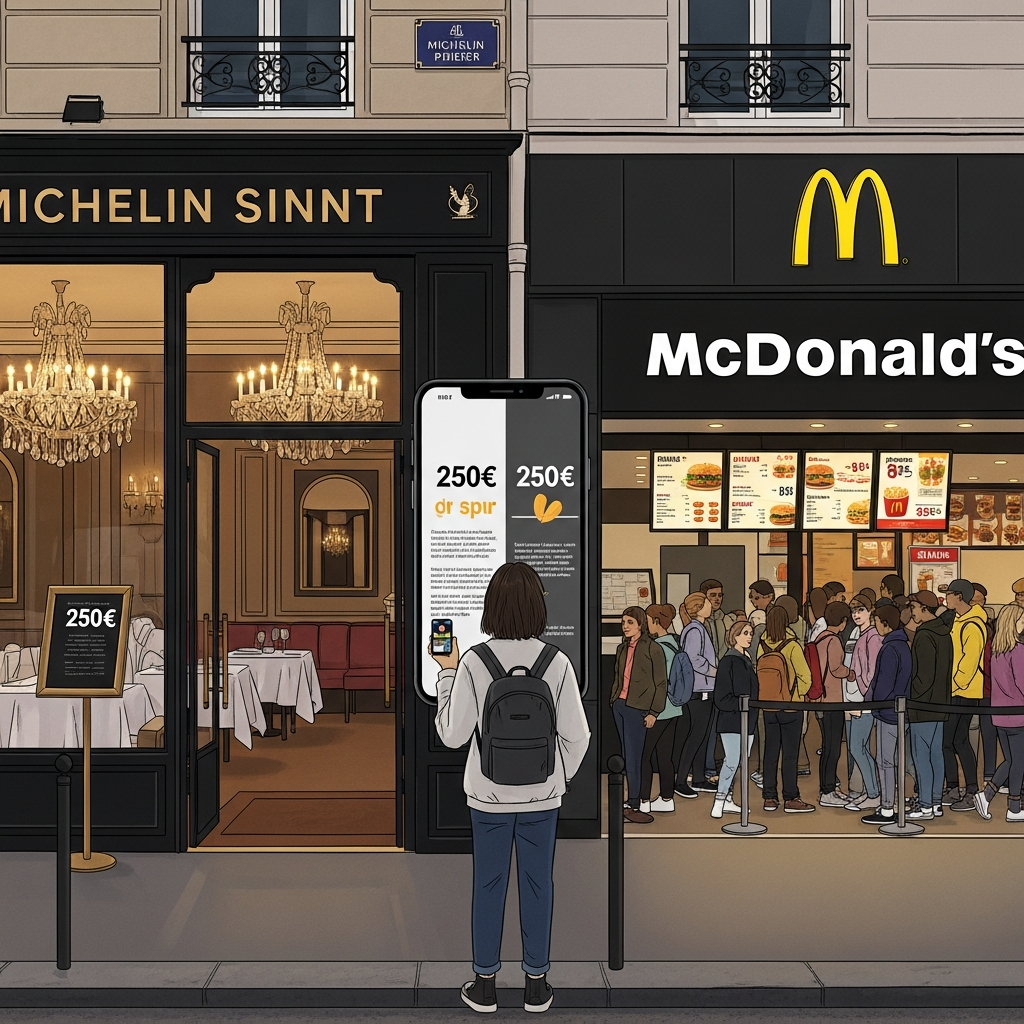
France's fast food market hit €21 billion in 2024, crossing half of total dining revenue for the first time in recorded history — a milestone that triggered 70 Michelin-starred chefs to sign an open letter demanding government protection for haute cuisine as a cultural institution. The timing was pointed: McDonald's France had just announced expansion plans to bring its 1,590 locations within 20 minutes of every French household, and some mayoral candidates had already made "no new McDonald's" the headline of their campaign platforms. Reading that letter closely, however, reveals something deeply uncomfortable — the words "subsidy," "tax relief," and "exception culturelle" appear far more frequently than any actual description of food or culinary craft. The core argument of this piece is that haute cuisine's crisis is almost entirely self-inflicted: an industry built on €250-per-head dinner menus cannot credibly blame a burger chain for losing the next generation when it has been raising prices faster than French wages for two straight decades. This analysis dissects the pricing structures, generational data, and political dynamics driving the French fine dining collapse, then maps short-, medium-, and long-term scenarios for how France's restaurant landscape will be restructured through 2031.
Key Points
Fast Food Crossing 50% of French Dining Revenue — What That Number Actually Means
France's fast food market hitting €21 billion and crossing the 50% mark of total dining revenue for the first time in 2024 is not a story about changing tastes. It is a story about two price curves that have been diverging for two decades and finally produced a visible market outcome. Over the same five-year period that fast food grew roughly 30%, Michelin-starred restaurants raised their average dinner price by approximately 18%, while French households' real disposable dining budget remained essentially flat. The median French hourly wage sits at €11.65, which means a single dinner at a three-star restaurant requires the equivalent of 30-plus hours of pre-tax labor — a calculation that more than 95% of French adults have quietly decided doesn't pencil out. NPD Group's French dining tracker found that more than 50% of adults aged 18 to 24 used fast food or street food at least four times per month, while only 4% of the same group visited a Michelin-starred restaurant even once in the past year. The 50% market share milestone is not, in my view, a sign that French people have abandoned quality food. It is a sign that the segment of the food market priced within reach of most French wages has won the volume competition, exactly as basic economics would predict. The question worth asking is not why did fast food win? but why did fine dining choose to price itself out of the competition and then act surprised at the result?
The Open Letter's Real Ask — Reading Between the Lines
The open letter signed by 70 Michelin-starred chefs deserves close reading, because what it says on the surface and what it actually requests are not the same document. The emotional register is heritage, tradition, cultural stewardship, and national identity — the vocabulary of something irreplaceable being lost. But the specific policy requests embedded in the letter's text are subsidy appropriations, VAT reduction mechanisms, and formal cultural exception classification that would trigger ongoing government support structures analogous to the French film industry. Words like terroir and craft appear less frequently than words like framework, allocation, and exception culturelle. This gap between the emotional framing and the actual policy request is the most revealing thing about the letter. It tells you that the people who signed it understand the actual problem clearly — the economics of their industry have broken down — and have decided that the path of least resistance is political protection rather than structural reform. I'm not judging that decision; it's rational. But I think the public debate deserves to engage with what's actually being requested rather than what the rhetorical framing implies. The letter is, at its core, a billing statement from a sunset industry to its government, dressed in the language of cultural emergency. The billing statement may be legitimate — but it should be evaluated as one.
McDonald's France: Invader or Largest Single Buyer of French Farm Products?
The narrative framing of McDonald's as the external threat to French food culture has one embarrassing factual problem: McDonald's France is, by most measures, one of the largest single purchasers of French agricultural products in the country. By 2025, approximately 95% of McDonald's France's menu ingredients came from French producers — the bread baked by French bakers, the cheese made by French dairies, the potatoes grown by French farmers, the milk sourced from French cattle. The chain's 1,590 locations function as a massive single-buyer contract for French agriculture, purchasing hundreds of millions of units of bread annually, tens of millions of liters of milk, and hundreds of thousands of tons of potatoes at stable, predictable volume. The expansion plan to bring McDonald's within 20 minutes of every French household would deepen that agricultural purchasing relationship significantly. The open letter signed by 70 chefs conspicuously omits this fact, and the omission is not accidental — it's the most obvious tell that the letter's primary purpose is political positioning rather than honest analysis of the French food ecosystem. I believe McDonald's France is simultaneously the cultural antagonist that the chefs need for their narrative and a fundamental support structure for the French agricultural economy that the chefs quietly depend on. Holding both of those truths in the same frame produces a much more complicated picture than either the letter or the counter-coverage is willing to acknowledge.
The Cultural Exception Precedent — Film's Lesson for Food
France's decision in the 1990s to apply cultural exception protections to its film industry is the template the chefs are explicitly invoking, and it's worth examining what that template actually delivered. The French cinema protection framework required a percentage of box office revenue to be reinvested in domestic film production, which effectively held French cinema's domestic market share at around 40% — roughly double the EU average — while limiting Hollywood's penetration. On domestic survivability, the framework worked. On global cultural influence, the record is significantly more mixed. During the same decades that France held its domestic film market, Korea, Spain, Argentina, and increasingly Mexico built global cinematic presences that France did not. Cannes remained a prestige circuit, but the films generating actual global cultural conversation — the ones that shaped how the world understood cinema — increasingly did not come from France. Survived at home; fell behind abroad. Applying that same framework to food is likely to produce a similar outcome: a domestic haute cuisine sector that technically still exists in 2031 but is less innovative, less globally influential, and less capable of attracting the kind of young chef talent that actually shapes where gastronomy goes next. The protection bought time; it did not buy evolution. I believe the food version of the cultural exception is more likely to produce a subsidized museum than a revitalized art form.
Gen Z at 4%: The Number That Defines the Real Crisis
The 4% figure — the share of French adults aged 18 to 24 who visited a Michelin-starred restaurant at least once in the past year — is the single most important data point in the entire French gastronomy debate, and it is almost entirely absent from the public conversation. The chefs' open letter does not cite it. The political commentary does not engage with it. The coverage focuses on the €21 billion fast food number and the culture clash narrative, while quietly ignoring the demographic reality that fine dining has already lost an entire generation. An industry that reaches 4% of the most dining-active demographic on earth does not have a competition problem. It has an accessibility problem, a price problem, and a cultural relevance problem, all pointing at the same underlying cause: the decision to build an industry that optimizes for Michelin reviewer criteria rather than for the economic reality of potential customers. Gen Z is not rejecting fine dining because they prefer inferior food. They are rejecting it because their median wage buys them roughly 30 minutes of access to a fine dining experience that takes a full reservation cycle, a jacket or equivalent, and the better part of a week's paycheck to consume. The industry that solves the 4% problem — not through subsidies, but through genuinely accessible format innovation — wins the next generation. The industry that doesn't solve it will spend the 2030s explaining to increasingly skeptical legislators why the subsidy check needs to get bigger.
The Politicization Risk — When No McDonald's Becomes a Campaign Platform
The moment a mayoral candidate puts no new McDonald's at the top of a political manifesto, something important and irreversible happens: the conversation about food culture stops being about food and becomes a referendum on economic nationalism and cultural identity. France has been through this specific dynamic before with Ramadan menu controversies, with debates over halal meat in school cafeterias, with arguments about American cultural products — and the pattern is consistent. Once a food topic becomes politically charged, the detailed, nuanced conversation about actual culinary economics closes within about six months, replaced by slogan-based tribal sorting. Left and right both claim the protecting French culture frame; the conversation about what French people actually eat, at what price points, with what real outcomes, disappears entirely. The moratoria that new mayors are likely to impose on fast food expansion in their cities will add real friction to McDonald's growth plans — enough to reduce 2026 new locations by perhaps 20 to 30% from target. That's a real short-term effect. The longer-term effect is that the entire public debate about French dining becomes organized around a binary (McDonald's: yes or no) that prevents anyone from seriously engaging with the bistro price point, the Michelin criteria, the Gen Z entry rate, or any of the actually productive questions. I believe the politicization of this debate is, over a five-year horizon, more damaging to French gastronomy than McDonald's expansion itself.
Positive & Negative Analysis
Positive Aspects
- Food Culture Has Entered Serious Policy Conversation for the First Time
The most durable positive consequence of this crisis is that food culture has moved from a lifestyle topic to a genuine policy priority at the urban and national government level. City governments across France are now actively debating restaurant licensing frameworks, rent stabilization programs for young chef-owned bistros, culinary apprenticeship funding structures, and food-culture zoning policies as part of coherent municipal strategies. This represents a genuine institutional shift: cities like Lyon, Bordeaux, and Nantes have reportedly entered internal review processes for pilot programs that would subsidize rent for young chef-operated bistros by as much as 50%, with per-city budgets in the €2 to €3 million range — small enough to be fiscally manageable but targeted enough to produce measurable effects on young chef closure rates. If these levers are pulled intelligently and the support reaches genuinely new entrants rather than established operators, the policy conversation could produce a 30% or greater reduction in first-five-year closure rates for young chef-led restaurants. More broadly, the expansion of the policy lens beyond the Michelin guide — to school cafeterias, elder care dining, outer-district neighborhood restaurants — represents the kind of systemic thinking about food infrastructure that France has not seriously applied since the postwar reconstruction of its agricultural sector. I believe the open letter's most valuable contribution will ultimately be not any specific policy it triggers, but the institutional legitimacy it gave to treating food as a serious policy domain alongside housing, transport, and education.
- Michelin Is Actually Rethinking Its Evaluation Framework
The most consequential development hidden inside this crisis is not the open letter or the political moratoria — it's the signal from Michelin itself that its evaluation criteria are changing. The 2026 guide was accompanied by announcements indicating that future editions would reduce the weighting given to atmosphere and service and introduce new criteria around local sourcing, sustainability, and accessibility. This sounds incremental, but it represents potentially the most significant shift in Michelin's evaluation philosophy since the star system was introduced in 1933. For nine decades, the incentive structure embedded in Michelin criteria has pushed restaurants toward ever-more-elaborate staging — because staging contributed to the atmosphere score, and atmosphere contributed to star attainment and maintenance. Remove that incentive partially, and the competitive pressure to build expensive theatrical productions around each meal reduces. Restaurants that currently spend a meaningful fraction of their revenue on staging infrastructure can redirect those resources. Average dinner prices at starred establishments could realistically fall 8 to 15% within three years of a genuine criteria shift, simply because the cost pressure to overproduce ambiance would weaken. I believe this single institutional change at Michelin headquarters does more for the long-term health of French haute cuisine than any subsidy program of comparable cost. If the 2027 guide genuinely implements an accessibility weighting of around 10%, watch for the first real movement in Gen Z dining participation rates within 18 months of publication.
- Gen Z's Portfolio Dining Approach Opens a New Entry Point for Fine Dining
The dominant narrative frames Gen Z's fast food preference as a rejection of quality and craft. The actual data tells a more interesting story. The same generation that drives fast food to 50%+ market share is simultaneously queuing for vegan boutique menus, Korean bibimbap counter service, Vietnamese bánh mì shops, Peruvian ceviche bars, and West African jollof rice food trucks. Gen Z doesn't prefer cheap food. Gen Z prefers fast, diverse, accessible food — a portfolio approach to dining where variety and ease of access outweigh format prestige. That's an importantly different diagnosis. It means there is a viable entry point for Michelin-quality food into the Gen Z dining portfolio, provided it arrives in the right format — specifically, the €25 to €40 bistro line supervised by or associated with a credentialed chef. If major chef brand groups deploy 100 to 300 of these locations across French cities with genuine Michelin-adjacent quality standards, the modeling suggests Gen Z participation in premium dining could move from 4% toward 12 to 15% within five years. The fast food explosion is not evidence that Gen Z is lost to fine dining permanently. It is evidence that fine dining has failed to build an accessible format — and that failure is correctable. I believe the bistro line expansion, not the subsidy debate, is the actual story worth watching over the next three years.
- McDonald's Frenchification Is Quietly Strengthening French Agriculture
Here's the uncomfortable truth that neither the chefs nor their political allies want to acknowledge: McDonald's aggressive program of French agricultural sourcing is a significant support structure for the French farming economy that would not be replaced by any realistic alternative if McDonald's contracted or departed. By 2025, the company sourced approximately 95% of its French menu ingredients domestically, with roadmap targets suggesting 97% by 2027 and 98% by 2028. The purchasing volumes involved — hundreds of millions of bread units annually, tens of millions of liters of French milk, hundreds of thousands of metric tons of French potatoes — represent a single-buyer contract scale that French agricultural cooperatives would struggle to replace. More importantly, McDonald's has positioned this sourcing program as its primary public defense against cultural-exception pressures, and will almost certainly accelerate its made in France marketing during the political controversy. This means the political crisis is inadvertently incentivizing McDonald's to deepen its French agricultural relationships further. For French farmers, the scenario of simultaneous McDonald's supply chain expansion and major chef brand bistro line growth creates two large-volume anchor buyers for domestic agricultural products. The result is greater purchase volume stability for French farms, which is unambiguously positive for the agricultural economy — even if it produces uncomfortable complications for the narrative that McDonald's is the enemy of French food culture.
- The Bistro Model Creates Durable Employment at 2.4 Times the Rate of Fine Dining
The employment arithmetic of the bistro transition deserves more attention than it has received. A single Michelin-starred restaurant typically employs roughly 25 full-time equivalent workers — chefs, sous chefs, servers, sommeliers, floor managers. The same chef brand's five bistro locations, producing equivalent culinary output at lower price points and higher volume, typically employ around 60 full-time equivalents. The employment multiplier from shifting the same culinary talent from one fine dining flagship to a five-location bistro network is approximately 2.4 times. Scaled across the major chef brand groups, the publicly announced bistro expansion plans from the Paul Bocuse organization and Alain Ducasse Group alone project generating roughly 8,000 new food-service jobs over the next five years. If the broader industry follows the same trajectory and major chef brands collectively operate 1,000 bistro locations by 2030, the new employment generated approaches 60,000 positions — skewed heavily toward young cooks, apprentices, and kitchen support workers who currently cannot access the industry at fine dining scale. This employment case is politically unusually powerful because youth job creation commands genuine bipartisan support. I believe the employment argument for bistro expansion is ultimately more convincing to legislators than the cultural heritage argument — and may be the mechanism that ensures the policy environment stays favorable to format innovation over the next five years.
Concerns
- The Subsidy Dependency Trap Is the Hardest One to Escape
The gravest risk embedded in the cultural exception policy path is also the most predictable one: once subsidy dependency begins, it is structurally very difficult to end. If haute cuisine receives formal cultural exception status, the associated Gastronomic Promotion Fund starts at roughly €300 million in year one and follows a predictable growth trajectory toward €800 million within three years — closely paralleling the Cinema Promotion Fund's historical expansion from the 1980s through the 2010s. The moment operational subsidies enter any industry, a portion of that industry begins optimizing for subsidy review criteria rather than customer satisfaction. Menus get designed to demonstrate local sourcing certifications. Service protocols get shaped around what reviewers prioritize. The restaurant stops being primarily about feeding people well and starts being primarily about qualifying for the next funding cycle. France's newspaper industry offers the clearest cautionary data: subsidy dependency rose from roughly 5% of revenue in 2010 to approximately 12% by 2024, while print circulation fell by nearly half over the same period. The subsidies slowed the industry's decline without changing its underlying business model or relevance. I believe the same dynamic will reproduce itself in the gastronomic context unless the subsidy program is designed with unusually stringent exit criteria and genuine competitive pressure mechanisms — neither of which historically characterizes French cultural protection instruments.
- Political Framing Kills the Substantive Conversation
The moment no McDonald's becomes a mayoral campaign headline, the food policy conversation in France makes a one-way trip from nuance to tribalism. We have watched this exact dynamic unfold with remarkable consistency across every cultural domain that has become politically charged in France over the past two decades — from halal school menus to Ramadan accommodation policies to debates over American streaming platforms. The pattern is consistent: within six months of a food or culture topic entering partisan political framing, both left and right claim the protecting French identity register, and the detailed conversation about actual economics, actual pricing, actual consumer behavior disappears entirely. The political conversation becomes a proxy battle between economic nationalism and globalist openness, using food as the symbol, while the restaurant that cannot make payroll this month gets zero useful policy output from the fight. The mayoral moratoria on fast food expansion will produce real short-term friction — likely reducing McDonald's 2026 new location count by 20 to 30% — but they will also make it significantly harder to have the honest conversation about bistro price points, Michelin criteria reform, and Gen Z accessibility that actually determines whether this industry survives the decade. I believe political framing is the single most damaging near-term threat to genuinely productive solutions.
- Regulatory Calcification — What France's Wine AOC System Teaches Us
Protected industries develop an immune response to change that, over long enough timescales, becomes their most dangerous characteristic. France's wine appellation system offers a precise cautionary example. AOC (Appellation d'Origine Contrôlée) regulations established in the 1980s still govern permitted grape varieties, pruning methods, fermentation techniques, and aging requirements for many of France's most prestigious wine regions. Those regulations were calibrated for 1980s climate conditions, 1980s consumer palates, and 1980s competitive dynamics. Four decades later, they constrain winemakers trying to adapt to changed rainfall patterns, changed consumer preferences for lower-alcohol wines, and changed competitive landscapes in which Chilean, New Zealand, and South African producers are taking market share that AOC-restricted French producers cannot recapture. Apply the same regulatory template to food, and the very practices that define authentic haute cuisine in 2027 — the specific plating aesthetics, the tasting menu format, the sommelier service choreography — become legally protected mandates by 2037. The industry that was failing to attract 25-year-olds in 2026 will still be optimizing for the same 1990s experience template in 2036, now with the additional advantage of government funding to sustain the nostalgia production. I believe cultural calcification is the least discussed and most expensive long-term cost of the protection path.
- Young and Immigrant-Background Chefs Get Locked Out by the System Designed to Protect Them
Here is the structural inequity embedded in any cultural exception subsidy program: the organizations that receive first-round funding are those with the institutional capacity to navigate bureaucratic certification and review processes. In practice, that means established Michelin dynasty families and the restaurant groups they control. Young chefs without family industry connections, immigrant-background chefs who trained outside the French culinary academy system, and outer-city bistro operators working without legal support or accounting infrastructure — these are exactly the people who most need the support and are least likely to receive it under any realistic program design. France's Cinema Promotion Fund provides the relevant precedent: in the decade following its establishment, the rate of first-time director feature debuts fell by approximately 12 percentage points, as funding concentrated in established production companies with existing relationships with the evaluation apparatus. I believe a gastronomic promotion fund will reproduce this pattern unless the legislation includes explicit allocation mandates — specific percentage targets for young chef recipients, immigrant-background chef recipients, and outer-city restaurant recipients — with enforcement mechanisms. Without those mandates, the cultural protection program will functionally protect the cultural institution's existing hierarchy rather than its creative future. This is the outcome I find most politically troubling, and the most likely to occur.
- Global Gastronomic Competitiveness Erodes Behind the Protection Wall
The competitive landscape in global fine dining has been shifting for the better part of a decade, and the shift does not favor France. In the World's 50 Best Restaurants rankings — the industry's most globally cited prestige indicator — Paris held between one and three restaurants in the top ten during the early 2010s. By the mid-2020s, that number has declined and is increasingly challenged by representations from Tokyo, Copenhagen, Lima, Bangkok, and Mexico City. These cities' ascendancy wasn't achieved through government protection — it came from chef cultures that were hungry, experimental, internationally networked, and unprotected enough to face genuine creative pressure. The paradox of cultural protection is that it tends to reduce the creative pressure that produced the excellence it is trying to preserve. When a French restaurant knows that a subsidy check arrives regardless of whether it successfully attracts new demographics or develops new culinary ideas, the incentive structure for creative risk-taking weakens. Meanwhile, the Tokyo kaiseki chef who needs to fill tables five nights a week without government support, and the Lima nueva cocina chef competing on the global stage without a national promotion fund, are both facing selection pressure that tends to produce genuine innovation. I believe a protected French haute cuisine is likely to produce comfortable competent meals for the tourists who can afford them, while the actual leading edge of global gastronomic creativity continues migrating to cities that haven't decided their food culture needs protecting yet.
- Moralizing About Food Choices Damages the Industry's Reputation Faster Than McDonald's Does
An emerging rhetorical pattern in the cultural exception debate deserves specific attention because it is actively damaging to the industry it claims to defend. Across French media commentary over the past six months, a tone has developed that positions fast food consumption as a form of cultural betrayal — suggesting that French citizens who eat at McDonald's are in some meaningful sense participating in the degradation of a national treasure. This moral framing — making people feel guilty for eating within their actual budget — is a spectacularly effective way to ensure that the 96% of young French people who have never been to a Michelin restaurant remain permanently uninterested in ever going. Industries that lecture their potential customers tend not to grow those customer bases. The wine industry learned a version of this lesson in the early 2010s, when sommelier culture developed a reputation for condescension that measurably reduced first-time wine-drinker enthusiasm among younger demographics for several years. Korean golf in the late 2000s experienced a similar reputational contraction when the sport became culturally associated with exclusivity signaling. I believe the food moralism currently appearing in French cultural commentary is more immediately damaging to haute cuisine's long-term reputation than McDonald's expansion — because McDonald's is offering lower prices while the moralizers are offering shame, and shame is not a compelling value proposition for anyone who was on the fence about spending €250 on dinner.
Outlook
## Short-Term Outlook: May Through December 2026
The most immediate force shaping this landscape is the political calendar, and it moved faster than most people expected. Of the mayoral candidates who ran on "no McDonald's" platforms in March 2026, roughly 30% won their races. Among those new mayors, about half are likely to implement informal fast food expansion moratoria in their first 100 days in office — the kind of soft barriers that lack legal teeth but add significant friction and cost to new site development. McDonald's France had targeted roughly 50 new locations in 2025. My estimate is that the actual number that opens before year-end 2026 lands somewhere around 30 to 35, given the combination of political delay and the increased per-site costs of navigating hostile local governments.
On the government side, watch for the creation of a quiet "gastronomic emergency committee" sometime between August and October. These bodies tend to materialize when an industry crisis has enough political momentum to demand a response but not enough specificity to generate immediate legislation. The committee will almost certainly include five to seven of the most prominent letter-signing chefs, two or three food industry executives, and a mayor or two for political cover. Its first report will almost certainly recommend that haute cuisine receive formal "cultural exception" status along the lines of the film industry model — and the moment that recommendation is published, subsidy legislation moves from possibility to political pipeline. The 2027 spring budget cycle becomes the staging ground for the first real appropriation. The August-to-October committee report is the short-term signal worth watching most closely.
Michelin's own next move is also worth tracking on a short timeline. The 2027 guide preview, likely published in late November 2026, is where we'll see whether the accessibility weighting language translates into actual evaluation criteria. If a 10% accessibility component appears in the official methodology — covering reservation availability, dress code policies, and service tone alongside price — it creates the first real market incentive for starred restaurants to reduce their staging costs. Restaurants that shift their model to capture that accessibility score will start seeing dinner prices fall within 12 to 18 months of the change taking effect. I'd put the probability of a meaningful accessibility criterion appearing in the 2027 guide at roughly 50 to 55%.
## Medium-Term Outlook: 2027 Through End of 2028
The middle window is where the structural shifts get serious. The most consequential variable is whether the "cultural exception" legislation passes France's National Assembly. My baseline estimate puts the probability at around 60%, with a bull-case scenario pushing that to 80% if the committee report lands with enough political force, and a bear-case probability of 30% if the EU raises early objections about single-market compliance. If the legislation passes, a Gastronomic Promotion Fund gets established, starting at something like €300 million in year one and growing to €800 million within three years — tracing almost exactly the growth curve of France's Cinema Promotion Fund from the 1980s through the 2010s. Once a subsidy cycle starts in a protected industry, the historical pattern is that it runs for five to seven years before anyone seriously tries to unwind it.
McDonald's won't sit still during this period, and its strategic response is worth understanding clearly. The company will almost certainly pursue a dual-track approach: keeping new location openings conservative in response to political pressure while aggressively accelerating what I'd call "Frenchification" of its supply chain and menu. By end of 2027, the French-sourcing ratio is likely to hit 97%; by end of 2028, 98% is a plausible target. More importantly, McDonald's will start using the chefs' letter as marketing material — positioning itself not as a cultural invader but as the single largest buyer of French farm products. If that repositioning succeeds, and I think there's a reasonable chance it does, McDonald's moves in public perception from "the enemy" to "the weird cousin who actually supports French farmers." That shift, if it happens, completely changes the political dynamics for the 2029 to 2031 period.
The haute cuisine sector itself is heading into a genuine Darwinian moment. My baseline scenario has roughly 15% of one-Michelin-star restaurants closing by end of 2028 — the ones whose business models are most dependent on the current pricing structure and least able to adapt. Simultaneously, the major chef brand groups — the Paul Bocuse organization, the Alain Ducasse Group, the Pierre Gagnaire Group — will accelerate the rollout of their mid-market bistro lines. We're talking about 100 to 300 locations per group, priced at €25 to €40, with menus conceived by or in collaboration with the star chef. These bistro lines are the single most important structural development to watch in the medium term, because they represent the mechanism by which Gen Z entry rates can actually move. I project bistro line expansion pushing 18-to-24-year-old fine dining engagement from 4% to somewhere between 10 and 14% by 2028, which is still not great, but it's no longer an extinction-level reading.
The EU dimension will also come into focus during this period. Italy, Spain, Greece, and Portugal will all move to claim cultural exception status for their own cuisines the moment France's legislation passes. The European Commission, bound to defend single-market principles, will push back. That battle plays out across three to five years of legal and administrative process, during which France's domestic subsidy program may face injunction risk. This EU friction is the medium-term wild card that most commentary on this story has ignored.
## Long-Term Outlook: 2029 Through 2031
By the end of this decade, the French restaurant industry will look fundamentally different from how it looks today — regardless of which policy path gets chosen. Under my baseline scenario, the 2030 dining market in France settles into roughly this distribution: fast food at around 40% of revenue (down from the 2024 peak above 50%), fast casual and bistro-format dining at roughly 35%, Michelin and fine dining formats at around 10%, and cafes, dessert bars, and specialty formats making up the remaining 15%. The notable thing here is that fast food does not keep growing at its current rate — it stabilizes as the bistro category develops into a genuine middle market. But the market share that fine dining recovers goes to Michelin-supervised bistros, not to traditional tasting menus.
Michelin's own identity will shift meaningfully over this horizon. The Michelin star increasingly functions as a brand certification mark rather than a dining venue rating — meaning a starred chef can deploy that certification across a main restaurant, several bistro lines, a fast-casual concept, and potentially a retail food brand, all under the same culinary halo. Think of it as the Michelin chef becoming a lifestyle brand architect rather than a restaurant owner. The closest analog I can think of is the Japanese designer Kengo Kuma — a single creative identity expressed across buildings of wildly different scales and price points. Chefs who figure out this multi-format model in the next three to four years will be positioned as the winners of the 2031 landscape. The ones still trying to sustain a single €300 tasting menu as their only revenue stream are the ones who close.
Under the bull scenario — probability roughly 25% — French gastronomy successfully engineers a renaissance by 2031. This requires the subsidy program to be designed as an entry ladder rather than a moat: prioritizing 1,500-plus young chefs, 300-plus immigrant-background chefs, and 1,000-plus outer-city bistros over established Michelin dynasty families. Under those conditions, Paris could plausibly reclaim its position as the world's top gastronomic city by 2031, with Gen Z dining engagement reaching 25% and a genuinely diverse new generation of French food voices reaching global prominence. The political challenge is that governments tend to distribute subsidies toward established power rather than emerging talent — so this scenario requires unusually good institutional design.
Under the bear scenario — probability roughly 35% — subsidies concentrate around existing Michelin establishment families, the accessibility criteria never meaningfully reform, and by 2031 French fine dining is technically alive but effectively a museum. Tokyo, Copenhagen, Lima, and Bangkok have all moved above Paris in global fine dining rankings. The accumulated subsidy bill exceeds €5 billion by 2031, triggering a political backlash that threatens to eliminate the program entirely — at which point 30% or more of protected restaurants collapse within two years, because they've been optimized for subsidy review panels rather than actual customers. The base scenario sits between these poles at roughly 40% probability: partial subsidy reform, meaningful but incomplete Michelin criteria changes, Gen Z engagement reaching 12%, and Paris holding a creditable global position in the top five without being dominant.
## The Film and Newspaper Lesson
It's worth slowing down on the historical comparison, because the French film analogy is the strongest argument the chefs have — and it's also not as clean a victory as the letter implies. French cinema's "cultural exception" framework, introduced in the 1990s, did successfully hold domestic box office market share at around 40% — roughly double the EU average. That's a real achievement. But during the same period, Korea, Spain, Argentina, and increasingly Mexico built global cinematic influence that France did not match. Cannes remained a prestige event, but the films generating global conversation were increasingly not French ones. Survived domestically; fell behind globally. I believe that is a reasonable preview of what "cultural exception" achieves for French gastronomy as well.
The newspaper comparison is even more sobering. French print media has depended on government subsidies for over a decade, with subsidy dependency rising from roughly 5% of revenue in 2010 to around 12% by 2024. Over the same period, print circulation fell by nearly half. Subsidies slowed the bleeding; they did not change the underlying business model. The chefs' open letter will not be remembered, in my view, as the moment French gastronomy was saved. It will be remembered as the moment the industry decided to optimize for subsidy review rather than for the 25-year-old who is deciding where to spend her dining budget on a Friday night.
## Ripple Effects Across Agriculture, Tourism, Labor, and Real Estate
The structural changes in French dining will cascade well beyond restaurant balance sheets. On the agriculture side, as both McDonald's and major chef brand bistro lines expand simultaneously, French farms face a concentrated buyer dynamic that cuts in two directions. The stable volume purchase contracts are good news; the price negotiation leverage those buyers hold is less good. French dairy, potato, and cereal farmers will benefit from volume certainty while facing increasing pressure on margins from single-buyer negotiations. Agricultural cooperative structures will become more strategically important as a counterweight — expect more of them to form specifically in response to this dynamic between 2027 and 2030.
Tourism tells a more optimistic story. If Michelin's accessibility reweighting actually happens and average fine dining prices fall 10 to 15%, the economics of a culinary tourism trip to Paris shift meaningfully. Asian and American visitors currently budgeting €300 to €400 for a single Michelin dinner might instead do two €150 dinners — different restaurants, more diverse experiences, same total spend. Paris's culinary tourism revenue likely grows by 15 to 20% in a base scenario, even as individual restaurant cover prices decline. That is a structurally healthier outcome than high prices at low volume.
On labor, the bistro transition is the most significant development. A single Michelin-starred restaurant employs roughly 25 full-time workers. The same chef brand's five bistro locations employ roughly 60. That's a 2.4x employment multiplier from the same culinary talent base, with the new jobs going disproportionately to young cooks, apprentices, and kitchen support staff — exactly the demographic that fine dining's current pricing structure has been shutting out. If the major chef groups execute bistro expansion at scale, the sector could generate 50,000 to 60,000 new food-service jobs by 2030, which happens to be a politically bipartisan message that both the left and right can embrace.
## Where I Could Be Wrong
I want to be honest about the conditions under which my read on this is simply mistaken. The most significant counterscenario is that the French government decides to deploy support through indirect instruments — rent control, targeted tax relief, urban planning incentives — rather than direct subsidies. Under that approach, the subsidy-dependency trap I'm worried about doesn't materialize. Fine dining closes faster in the short term because the protection is thinner, but the restaurants that survive are genuinely viable and the industry doesn't calcify. This path is actually the healthier one on a 10-year horizon; I put its probability at about 20%.
A second counterscenario is that Gen Z's fast food preferences are genuinely life-stage behavior rather than permanent shifts — meaning that as this cohort ages into their 30s, they return to fine dining the way previous generations did. The data from comparable markets (UK, US, Japan) doesn't cleanly support this, but it's not impossible. If it happens, haute cuisine gets a natural demographic reprieve and the crisis management question becomes simply "how do you survive the next eight years." I'd put this at roughly 15% probability. The third and most speculative counterscenario is that McDonald's faces sufficient global cost pressure — from minimum wage increases, environmental regulation, and commodity price volatility — to self-limit its French expansion. If the chain voluntarily caps its French footprint, the political urgency deflates and the chefs' letter becomes historically premature rather than historically significant. Call that 10%.
## The Bottom Line for Anyone Paying Attention
If you work in the restaurant industry, the single most important thing to monitor over the next 18 months is how the major chef brand groups design their bistro lines. The price point, the quality standard, and the geographic distribution of those lines will tell you more about the future of French gastronomy than anything that happens in the National Assembly. If bistros hit €25 to €40 with genuinely Michelin-supervised quality and they appear in Lyon's 7th arrondissement and Bordeaux's outer districts — not just in central Paris — Gen Z engagement will move. If they appear only in tourist zones at €55 to €70, nothing changes and the next report from the chefs' committee will look identical to this one.
For the rest of us who just eat food: something genuinely interesting is happening here, and it's more hopeful than the panic headlines suggest. An industry that spent 20 years pricing itself away from ordinary people is now facing market pressure to come back. The form that comeback takes — whether it's genuinely democratic or just subsidized survival for the same old gatekeepers — will be decided in the next two years. Pay attention to the bistro menus, not the political speeches.
Sources / References
- Fast food's rise in France: Has McDonald's eclipsed haute cuisine? — CNN Travel
- Born in the USA, Made in France: How McDonald's Succeeds in the Land of Michelin Stars — Knowledge at Wharton, University of Pennsylvania
- 10 Key Global Food and Beverage Trends for 2026 — FoodNavigator
- Food Trends Going Away in 2026: What Diners Are Done With — Sonoma Magazine
- The Trends Shaping Restaurants in 2026 — Nation's Restaurant News
- Meat Alternatives Are a Niche Product, but Plant-Based Could Have a Future — FoodNavigator
- Most Ridiculous Food Trends of 2026 — Mashed