
"Asian Food" Was Always the World's Laziest Label — And 2026 Is Finally Killing It
Summary
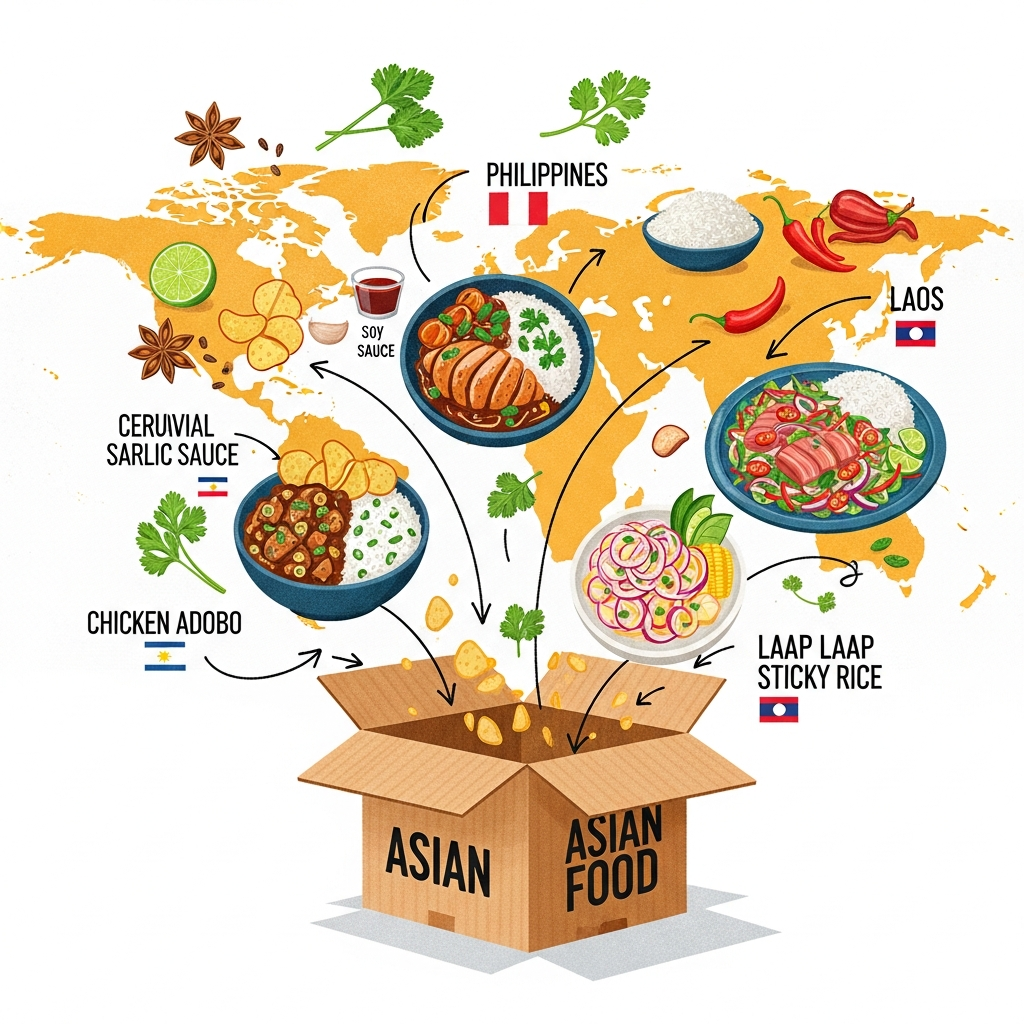
The catch-all label of "Asian food" — a decades-long Western market convenience that flattened thousands of distinct culinary traditions into a single category — is fracturing in 2026. Michelin Guide inspectors and National Geographic both named "Specificity" as the year's defining food culture trend, with Filipino, Laotian, and Peruvian cuisines reclaiming independent identities that had been obscured for generations. This shift is not merely about sophisticated palates: it represents a structural redistribution of cultural power, with consequences for restaurant economics, ingredient supply chains, culinary education, and delivery platform design. The revolution is real, but its benefits are contested — and whether specificity becomes genuine cultural justice or simply a more granular form of extraction will define which direction the global food industry moves over the next five years.
Key Points
"Asian Food" Was a Western Invention, Not an Asian Self-Description
The "Asian food" category was never something Asian cultures created for themselves. It was invented in the 1960s and 1970s by Western food service industries. No one inside Asia thinks of Korean and Laotian cuisine as occupying the same culinary category. Researcher Krishnendu Ray documented how this categorization operated as a structural mechanism for economic suppression. French restaurants were automatically filed as fine dining while Filipino cuisine was held to "ethnic food" price ceilings. The category did not just describe food — it assigned economic value. The 2026 Specificity Revolution is the dismantling of a classification system that was always a power structure in disguise.
Second- and Third-Generation Immigrant Chefs Are the Real Engine
The Specificity Revolution was driven by the children and grandchildren of the first immigrants who entered the "Asian food" category. First-generation restaurants operated in survival mode, adjusting to local tastes. But second- and third-generation chefs carry Western culinary training AND intimate knowledge of their parents' traditions. A decade before Michelin entered Manila, young chefs in Poblacion were already asserting Filipino specificity. Lima's Barranco was incubating Central before any global ranking noticed. Western institutions arrived late — non-Western chefs built something undeniable first. The bottom-up architecture makes this revolution durable.
Authenticity Isn't a Fixed Past — It's a Living Act of Cultural Agency
Filipino adobo bears fingerprints of Spanish colonial rule. Kare-kare emerged from centuries of spice trade. The food Filipinos consider most distinctively their own is already a product of historical encounter. Manila's young chefs are consciously reinterpreting their culinary inheritance from a position of historical awareness. Chef Margarita Forés described her approach as reclaiming a colonized recipe. This positions authenticity not as something you preserve, but as something you perform — a living practice of cultural self-determination. UNESCO recognized ceviche not as a fixed recipe but as a totality of practices and meanings.
The Asian Fusion Business Model Is Facing a Structural Crisis
Asian fusion was built on the premise that Asian food existed as a coherent, interchangeable category. When consumers begin making decisions based on specific national cuisines, that premise collapses. Foodnavigator's 2026 report found restaurants identifying with a specific national cuisine saw sales growth 2.3x higher than fusion-category competitors. Uber Eats data showed country-specific searches outpacing category searches for the first time. By 2027, at least 30% of Asian fusion chains will attempt rebranding or launch national-cuisine sub-brands. A major casual dining group already shuttered its Asian fusion brand in 2025 and relaunched as an Isan Thai specialist.
Delivery App Taxonomies Are Rewriting Cultural Categories in Real Time
When Uber Eats piloted country-level subcategories — Filipino, Vietnamese, Laotian — in select US cities in late 2025, restaurants that had categorized themselves as Asian began registering as Filipino or Vietnamese, creating pressure to deliver on the specific identity. Country-specific searches outpaced category searches almost immediately. The categories inside a delivery app used by hundreds of millions of people are not neutral reflections of a culinary landscape. They actively construct the landscape, determining which culinary identities get visibility and economic sustainability. The platform taxonomy is a political document about which food cultures are allowed to have names.
Positive & Negative Analysis
Positive Aspects
- Economic Value Restoration for Undervalued Cuisines
Filipino fine dining establishments saw average per-cover spend rise 35% after Manila's Michelin Guide launch. The global Filipino restaurant market, valued at USD 6.5 billion in 2024, is projected to reach USD 12.16 billion by 2033. This is the structural destruction of an artificially low price ceiling maintained by the ethnic food categorization.
- Diaspora Identity and Psychological Wellbeing
The 17.5 million Indian diaspora, 10+ million Mexican and Chinese former residents, and the Filipino diaspora across the US, Middle East, and Europe represent a multi-billion-dollar consumer base. When adobo becomes a Michelin-starred signature dish, the relationship between diaspora children and their heritage food shifts fundamentally.
- Ingredient Supply Chain Diversification
Southeast Asian specialty spice exports grew 18% year-over-year in 2025. Specificity demands specific ingredients that cannot be substituted — Filipino kalamansi, Peruvian aji amarillo, Laotian padaek. This growth represents real income for farmers in regions historically on the losing end of global commodity trade.
- De-Westernization of Culinary Education
Le Cordon Bleu, CIA, and Basque Culinary Center have begun adding Southeast Asian and South American cuisines as standalone modules since 2024. When French technique is no longer automatically understood as the foundation, the entire hierarchy of global gastronomy shifts.
- Media Flywheel Creating Self-Sustaining Demand
YouTube's regional food deep-dive category grew roughly 45% in viewership year-over-year in 2025. Netflix and Disney+ are investing in hyper-specific culinary content for 2026-2027. Depth-reward media creates depth-seeking consumers, who create demand for depth-offering restaurants.
Concerns
- Specificity Washing — Label Change Without Structural Change
Large food corporations can swap the label Asian fusion for authentic Filipino cuisine without genuine cultural respect. The craft beer parallel is instructive: the micro-brewery revolution ended with AB InBev quietly acquiring 50+ nominally independent brands. I estimate the probability of Specificity Washing becoming dominant at around 40%.
- Asymmetric Distribution of Economic Benefits
Many Filipino and Peruvian chefs gaining recognition trained at Western culinary schools with Western investment capital. The grandmother in a Manila barangay whose adobo recipe becomes the inspiration for a Michelin-starred dish receives zero economic benefit. If the revolution enriches only elite chefs while source communities remain excluded, this is extraction, not revolution.
- Authenticity Warfare Freezing Culinary Evolution
Even within the Philippines, Visayan adobo and Luzon adobo are completely different dishes. The moment you codify Filipino adobo into a single canonical form, you commit the same error as Asian food at a smaller scale. Japan's sushi globalization created a conservative straitjacket for experimental Japanese sushi chefs.
- Paradoxical Threat to Small Immigrant Restaurants
Old-school immigrant-run restaurants face an uncomfortable dilemma: rebrand as specifically Filipino (expensive and risky) or keep the existing model (increasingly dismissed as inauthentic). Trends don't distribute benefits evenly — they often hit hardest at the most vulnerable operators.
- Western Gatekeeping Power Persists
Michelin recognizing Filipino cuisine means a French-trained inspector deciding whether a Filipino chef's sinigang deserves a star. The fundamental question — Who has the right to evaluate whose food? — has not been resolved. Specificity without democratization of the evaluation system is aesthetic reform without structural change.
Outlook
The next six months represent the moment where the Specificity Revolution becomes visible in infrastructure rather than just discourse. The most concrete near-term development is the rapid overhaul of food delivery platform categorization systems. Uber Eats piloted country-level subcategories — "Filipino," "Vietnamese," "Thai" — in select US cities in late 2025, and the data was striking: searches using country-specific names began outpacing searches for broad regional categories for the first time in the platform's history. This is not a trivial UX change. When a platform's taxonomy shifts, the restaurants within that ecosystem restructure their self-identification accordingly. A restaurant previously listed as "Asian" now has an economic incentive to list as "Filipino" — which then drives menu specialization, ingredient sourcing, and even staff hiring. Platform architecture is culture architecture. The delivery app taxonomy is now one of the most powerful forces shaping what "Filipino food" means in American cities.
Simultaneously, watch for a major acceleration in food media content. Netflix, Disney+, and YouTube Premium are all expanding their production of hyper-specific culinary documentary content for the second half of 2026. Industry reporting suggests Netflix's Chef's Table Season 8 is expected to feature Filipino, Colombian, and Ethiopian chefs in depth. YouTube's regional food deep-dive category is trending at roughly 45% viewership growth year-over-year. This matters because media consumption precedes restaurant visits by roughly three to six months — someone who sees a deep-dive on Laotian larb in June is statistically likely to seek out a Laotian restaurant by December. The media wave creates the demand that the restaurant industry then has to service. For operators, the implication is clear: the window to position your restaurant with a specific culinary identity is right now, not in two years.
Looking at the six-month to two-year horizon, the structural disruption of the Asian fusion business model becomes undeniable. Chains like P.F. Chang's and Wagamama built their entire value proposition on the premise that "Asian food" was a coherent category — you could blend multiple Asian traditions and serve them under one roof without cognitive dissonance. When consumers start making decisions based on specific national cuisines, that premise collapses. I expect that by 2027, at least 30% of Asian fusion chains in the US and UK will either attempt a rebranding or launch specific national cuisine sub-brands. This is not speculative — it already happened in 2025, when at least one major casual dining group quietly killed its "Asian fusion" brand and relaunched as an Isan Thai specialist. That's a harbinger, not an anomaly.
The culinary education system will also face structural pressure in this medium-term window. Le Cordon Bleu, the CIA, and the Basque Culinary Center are already beginning the curriculum overhaul, but the full force of it will hit in 2026–2027 as student demand catches up. Young people entering culinary school in 2026 have grown up watching Chef's Table, following Instagram accounts dedicated to specific Yucatan dishes, and eating at Filipino tasting menus in Brooklyn. They are arriving with expectations about what "serious cooking" means that no longer center French cuisine as the default foundation. By 2027, I expect at least three major culinary institutions to elevate Southeast Asian or South American cuisines into core required courses rather than optional electives. The generational shift in culinary worldview is already in motion; the institutions are just catching up.
In the two-to-five-year range, three scenarios branch from the current trajectory — and they are genuinely uncertain enough that intellectual honesty requires naming all three.
The bull scenario, which I'd assign roughly a 25% probability, is the full de-centering of Western gastronomic authority. In this scenario, Michelin and World's 50 Best see their relative authority diluted by the rise of parallel evaluation ecosystems: Asia's 50 Best staying anchored in Bangkok, Japan's Tabelog emerging as a legitimate East Asian critical platform, and new regional ranking systems emerging in Latin America and Africa. By 2030, the "gold standard" in global gastronomy is no longer French-originated. This scenario is not fantasy — it's already partially underway. But it requires that the non-Western evaluation systems develop sufficient institutional weight and media reach to meaningfully compete with the Michelin brand, which remains one of the most powerful in the food world. That won't happen automatically or quickly.
The base scenario, which I'd put at roughly 50% probability, is what I'd call "partial reform with structural persistence." Filipino, Peruvian, and Laotian cuisines become firmly established as independent categories in fine dining, while "Asian" and "Latin" remain convenient shorthand in everyday restaurant and delivery market contexts. Western gastronomic institutions adopt the language of diversity and specificity while maintaining control of the evaluation apparatus. It's progress — real, measurable, meaningful progress — but it's not transformation. The ceiling moves up; the power structure doesn't invert. This is the most likely outcome because it requires the least from the dominant institutions: they can celebrate specificity while keeping their gatekeeping function intact.
The bear scenario, roughly 25% probability, is the one that keeps me up at night. In this scenario, the Specificity Revolution gets commodified at scale by Western food capital before it can consolidate its gains. Imagine Whole Foods partnering with a private equity-backed "authentic Filipino" sauce brand, or a major restaurant group launching a chain of "genuine Laotian" fast-casual outlets with no meaningful connection to Laotian culinary tradition. When that happens, the specific identity gets mass-produced into genericness — which is exactly what "Asian food" was, just with more granular labeling. The small Filipino and Laotian restaurants that were supposed to benefit from specificity now face competition from a well-capitalized machine using their cultural identity as a brand asset. The craft beer parallel is instructive: the micro-brewery revolution was genuine, but it ended with AB InBev owning 50+ "craft" brands. The same absorption is a real possibility for cuisine specificity.
The quantitative scaffolding supporting this outlook is substantial. The global ethnic foods market stands at USD 101.08 billion in 2026, projected to reach USD 168.79 billion by 2033 at a CAGR of 7.6%. The Filipino restaurant market alone hit USD 6.5 billion in 2024 and is projected to reach USD 12.16 billion by 2033. Michelin's expansion into the Philippines brought recognition to 108 restaurants — one two-star and eight one-star — in its first edition in Manila and Cebu. Peru has won the World Travel Awards' "World's Leading Culinary Destination" title for eight or more years between 2012 and 2021. In 2024, 34% of new menu items launched globally included Asian-inspired flavor profiles or cross-regional combinations, per Modern Restaurant Management data. These aren't vanity metrics — they represent real capital flows, real institutional validation, and real market expansion.
The ingredient supply chain tells an equally compelling story about medium-term impact. As demand for nationally specific cuisines grows, demand for nationally specific ingredients follows. I project that specialty ingredient categories — kalamansi, aji amarillo, padaek, berbere — will see global trade volumes increase 60–80% by 2028 relative to current levels. For the countries producing these ingredients, this is an agricultural GDP story, not just a gastronomic one. Whether that income actually reaches smallholder farmers or gets captured by large agricultural exporters is a distributional question that needs active policy attention.
Looking further out, the secondary and tertiary effects become particularly interesting. The primary effect — culinary identity diversification — is already visible. The secondary effect — restructuring of global ingredient trade — will become measurable within two to three years. The tertiary effect — remaking of culinary tourism — is beginning to emerge. Peru already earns approximately 15% of its tourism revenue from food-motivated travelers. The Philippines, Laos, Colombia, and Ethiopia are actively benchmarking the Peru model. When food becomes not an add-on to a trip but the primary motivation for it, the tourism economics of the Global South shift meaningfully. The specificity revolution, if it holds, is ultimately a development story as much as a food story.
For industry operators, the strategic implication is urgent: the optimal window to establish a specific national culinary identity is now, not in three years. "Asian fusion" as a positioning will face accelerating headwinds. The brands that will command premium pricing in 2030 are not the ones offering breadth — they're the ones offering depth, specificity, and a coherent culinary story. For investors, the opportunity is in the emerging category of nationally-specific fast-casual and QSR concepts — the segment where Filipino, Vietnamese, and Peruvian identity translates into scalable formats that aren't fine dining. For consumers, the most impactful action is deceptively simple: when you search on a delivery app, type "Filipino" or "Laotian" instead of "Asian." That tiny behavioral change becomes data. Data changes platform algorithms. Platform algorithms change what restaurants can economically survive. The consumer's casual search query is, at aggregate scale, a vote for which culinary identities the market rewards.
One underappreciated dimension of the long-term outlook is the role of diaspora demographics in sustaining the specificity trend beyond its current trendy phase. The global Indian diaspora numbers approximately 17.5 million, Mexico and China each have over 10 million former residents living abroad, and the Filipino diaspora across the United States, Middle East, and Europe represents a multi-billion-dollar consumer base with strong, culturally rooted food preferences. These communities don't just consume their cuisines nostalgically — they are actively evangelizing for them in their host countries, introducing colleagues and neighbors to dishes they've never heard of, funding and patronizing immigrant-run restaurants, and generating the word-of-mouth that no marketing budget can replicate. This diaspora-driven demand is structurally different from the tourism-driven trend cycle that elevated Japanese ramen in the 2010s and has since stabilized. Diaspora demand is durable because it is identity-driven, not novelty-driven.
The geopolitical context adds a further variable that forecasters cannot responsibly ignore. US immigration policy, particularly restrictions on legal and undocumented immigrant pathways, directly affects the availability of the skilled culinary labor that makes authentic immigrant restaurant culture possible. Modern Restaurant Management's 2026 industry outlook specifically flagged labor supply constraints for small immigrant-owned restaurants as a near-term operational risk. If restrictive immigration enforcement intensifies, the pipeline of chefs who carry the specific culinary knowledge — learned in a Mandaluyong kitchen or a Cuzco market — that actually grounds the specificity of immigrant restaurants could thin significantly. The Specificity Revolution is not just a cultural or economic story. It is also a labor and immigration story, and the political environment will shape its trajectory in ways that culinary trend forecasters rarely model. Similarly, tariff escalations on imported specialty ingredients — a live risk in the current global trade environment — would increase the cost structure of authenticity-focused restaurants disproportionately, since they rely on harder-to-source, less substitutable ingredients than generic Asian fusion concepts do.
There is also a scenario worth naming that doesn't fit neatly into bull, base, or bear: the "specificity without justice" outcome. In this scenario, Filipino, Laotian, and Peruvian cuisines achieve full market legitimacy — recognized categories in delivery apps, Michelin presence, culinary school curricula, media coverage — but the economic structure of those categories continues to extract value from source communities rather than returning it. The cuisine is celebrated; the community is ornamental. This is not hypothetical. It is the model that American "ethnic" cuisine has always operated on: Chinese food has been a pillar of the American restaurant industry for 150 years, and yet the Chinese American restaurant community has been structurally excluded from the wealth generation of that industry at every stage. The Specificity Revolution's ability to avoid this same outcome depends on deliberate, proactive action — on chefs who insist on supply chain transparency, on investors who prioritize community ownership structures, on diners who ask harder questions about where the profits flow. Without that, specificity becomes the most elaborate version yet of the same story.
Sources / References
- The Biggest Food Trends for 2026 — National Geographic
- Top Food Trends 2026: Michelin Guide Inspectors — Michelin Guide
- 10 Key Global Food and Beverage Trends — Foodnavigator
- What Foods Will Be Hot in 2026 — National Restaurant Association
- 2026 Travel and Dining Trend Predictions — ABC News
- The Ethnic Restaurateur — Duke University Press
- Practices and Meanings Associated with the Preparation and Consumption of Ceviche — Peruvian Traditional Cuisine — UNESCO Intangible Cultural Heritage
- World's 50 Best Restaurants 2023: No. 1 Central, Lima — World's 50 Best
- Western Perceptions of Southeast Asian Minority Cuisines — ScienceDirect
- Philippines Named One of the Most Exciting Food Destinations for 2026 — Philippine Information Agency