
To Win "World's Best," Africa Had to Stop Being African
Summary
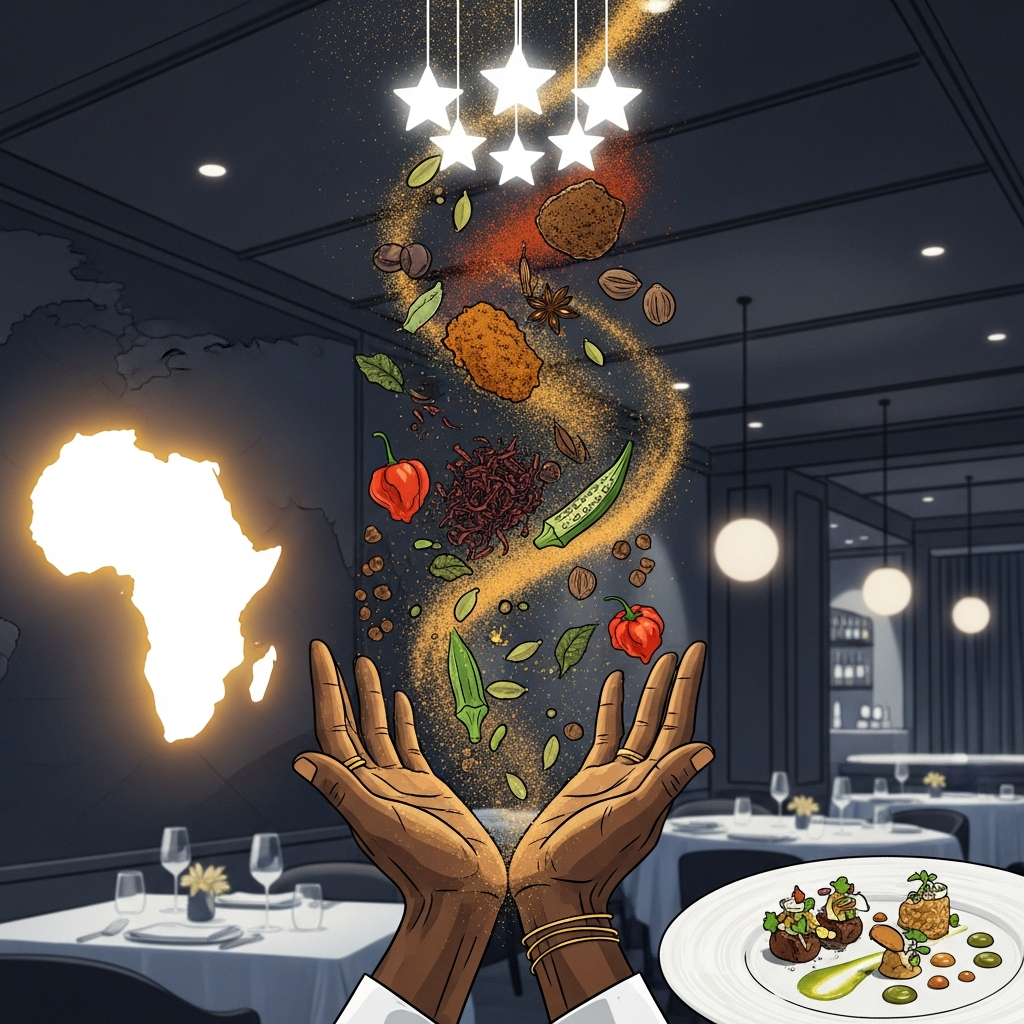
London's Ikoyi made history in April 2026 when Food & Wine's Tastemakers Awards named it the world's best restaurant, a landmark moment for West African culinary traditions on the global stage. Yet the triumph carries an uncomfortable asterisk: Ikoyi achieved this recognition only after consciously shedding its identity as a "Nigerian restaurant" and rebranding itself as a purveyor of "spice-based cuisine." This structural question — whether non-Western foods must first erase their origins before the global culinary establishment takes them seriously — refuses to dissolve beneath the celebratory headlines. The systemic bias runs deeper than one restaurant's story, as not a single restaurant based in sub-Saharan Africa appears in the World's 50 Best Restaurants list, and Michelin's guide covers virtually no African cities. Ikoyi's success is genuine and deserved, but it simultaneously exposes the architecture of a gastronomic power system that remains, at its foundation, defined by Western European frameworks — and that architecture will not change simply because one outstanding restaurant found a way to work within it. The deeper story here is about who gets to define excellence, who holds the authority to validate it, and whether that authority will ever meaningfully expand its geography.
Key Points
The Strategic Identity Trade-Off — and What It Cost
The most significant strategic decision Ikoyi ever made was not a menu change or a relocation — it was the deliberate decision to remove the "Nigerian restaurant" label and replace it with "spice-based cuisine." This was not a marketing refresh. It was a survival-driven recalibration of how the restaurant chose to be legible to a Western fine-dining audience — and it worked. When Ikoyi opened in 2017, London diners primed by the "Nigerian restaurant" label arrived expecting jollof rice, suya, and the familiar comfort foods of West African tradition. What they encountered instead was a sophisticated tasting menu structured around West African spice architecture and British seasonal produce. The expectation gap was commercially fatal, and the "ethnic food" ceiling in Western fine dining is real and documented: it carries automatic assumptions about price point, service level, and culinary complexity that the "spice-based cuisine" framing allowed Ikoyi to bypass entirely. Michelin inspectors and discerning diners could approach the food without the filter of cultural preconception, evaluating the cooking on its own technical merits. The results followed — two Michelin stars, a top-15 global ranking, and ultimately the world's best restaurant designation. But the condition of that success — the dilution of stated cultural identity — is not a personal failing of the founders. It is an accurate map of the terrain non-Western restaurants must navigate to reach the top of a system designed around different values. That map is the uncomfortable truth at the center of this story.
The Geographic Bias of Culinary Authority Systems
Michelin currently publishes guides covering approximately 40 countries, but the African continent is almost entirely absent. The World's 50 Best Restaurants list has never featured a restaurant based in sub-Saharan Africa. This is not because great restaurants do not exist in Lagos, Accra, or Nairobi — it is because the evaluation infrastructure that confers global legitimacy has simply never extended its geographic reach to include those cities. Michelin inspectors visit only markets where guides are published; the organization's roughly 1,080 voter panel for the 50 Best list includes an estimated less than five percent Africa-based voters. The structural effect is that absence of evaluation is functionally indistinguishable from absence of quality — which is precisely the confusion the system perpetuates. Restaurants like Nok by Alara in Lagos or Midunu in Accra — which by numerous accounts offer cooking of genuine distinction — will not appear in global rankings regardless of their quality, because the gatekeepers have not visited and have no infrastructure to do so systematically. The current rankings are therefore not, in any meaningful sense, a global assessment of the world's best restaurants. They are an assessment of the best restaurants in the places where Michelin and the 50 Best voters have chosen to look. That framing matters enormously for how we interpret any result they produce, including Ikoyi's win. A ranking that excludes an entire continent is not a world ranking. It is a Western-centric ranking with a global brand.
The Recurring Pattern of Non-Western Culinary Recognition
Ikoyi's success trajectory is not anomalous — it fits a pattern that recurs with conspicuous regularity when non-Western cuisines achieve global fine-dining recognition. Lima's Maido, ranked second in the 2026 awards, built its reputation not as a Peruvian restaurant but as a purveyor of Nikkei cuisine — the Japanese-Peruvian fusion born from the Japanese immigrant community in Peru. Nobu's global empire in the 1990s followed the same logic: Japanese food filtered through Peruvian and American influences became acceptable as haute cuisine in New York and London in a way that traditional Japanese food, outside Japan itself, initially was not. The consistent thread is that non-Western cuisines apparently require a "translation layer" — a fusion element, a neutral repositioning, a Western chef at the helm, or a European capital as the launch pad — before the global fine-dining establishment grants them the highest recognition. Japanese cuisine represents the notable exception: sushi, kaiseki, and ramen have all achieved top-tier global status in largely original form. But Japan spent decades building enormous economic and cultural soft power, and its culinary recognition is inseparable from that broader geopolitical context — it was not granted by a fair system, it was earned through a level of sustained institutional investment that few nations could replicate. The question for African cuisines is whether a similar path is available, and on what timeline, and at what cost to the authenticity of what gets recognized along the way.
The West African Spice Market Transformation
One of the most practically consequential downstream effects of Ikoyi's recognition is the transformation of West African spices from niche specialty ingredients into globally sought commodities. Scotch bonnet pepper, grains of selim, grains of paradise, ogbono (African mango seed), and dawadawa (locust bean) are foundational to West African cooking but have been almost invisible in mainstream Western markets. The global spice market was valued at approximately $22 billion in 2025, with West African origin spices accounting for an estimated less than three percent of that total. Ikoyi's Michelin recognition and now its world-best designation are catalyzing a meaningful shift in that proportion, with premium distributors in the UK and US actively building West African origin-direct sourcing lines. The critical question — one that determines whether this shift is genuinely beneficial or replicates well-documented patterns of extraction — is whether increased export demand translates into fair farmgate prices for producers in Nigeria, Ghana, and Senegal. The quinoa precedent is instructive and cautionary: when quinoa became a Western superfood trend in the 2010s, prices in Bolivia and Peru tripled, and the indigenous farming communities who had grown it as a dietary staple found themselves unable to afford their own crop. West African spice producers could face the same dynamic if fair trade certification infrastructure does not scale proportionally with demand — and right now, the pace of demand growth is significantly outrunning the pace of supply chain reform.
The Culinary Decolonization Discourse Enters Industry Practice
The language and framework of culinary decolonization — developed primarily in academic food anthropology over the past decade — is now entering the mainstream culinary industry in a meaningful way, and Ikoyi's award has acted as a significant accelerant. The core questions of culinary decolonization are pointed and specific: who holds the authority to evaluate food, what criteria define excellence, and whose culinary traditions get to count as "refined" rather than "rustic" or "ethnic"? These are no longer questions being asked only in university seminars. They are being directed at Michelin and the World's 50 Best as institutional reform demands, with growing pressure from chefs, critics, and culinary scholars who argue that the existing evaluation frameworks embed cultural biases that systematically disadvantage non-Western cuisines. Researchers at institutions including SOAS have observed that Ikoyi's win is not evidence that decolonization has succeeded — it is evidence of how much decolonization remains necessary. The test of whether this discourse produces real structural change will come over the next two to five years, in the form of concrete decisions by Michelin and 50 Best about geographic expansion, inspector diversity, and evaluation criteria. If those decisions happen, Ikoyi's award will mark a genuine inflection point. If they do not, the discourse will have been absorbed without consequence — which is its own kind of answer.
Positive & Negative Analysis
Positive Aspects
- West African Spices Achieve Unprecedented Global Visibility
Ikoyi's recognition as the world's best restaurant has elevated West African spices to a level of global culinary attention they have never previously enjoyed. Scotch bonnet, grains of selim, grains of paradise, and dawadawa are now appearing in conversations — and on menus and in distribution catalogs — that were previously inaccessible to them. Premium food retailers in London and New York have been expanding their West African sourcing lines since Ikoyi's Michelin star run, and this award will accelerate that expansion substantially. The global spice market sustains consistent annual growth of four to five percent, and West African origin spices are now positioned to claim a meaningfully larger share of that growth. Beyond the immediate commercial opportunity, the visibility shift carries cultural weight: ingredients that have sustained West African communities for centuries are now being recognized by global audiences as sophisticated culinary elements, not merely regional curiosities. If managed equitably — with fair trade frameworks that ensure farmgate prices rise alongside export demand — this visibility could translate into genuine economic development for spice-producing communities in Nigeria, Ghana, and Senegal.
- Fine Dining's Acceptable Grammar Has Been Permanently Expanded
This award has done something structurally important: it has demonstrated, through the most conservative validation system available, that a cuisine centered on spice and heat — not classical French technique or Japanese precision — can legitimately occupy the summit of global fine dining. Before Ikoyi's rise, spice and heat were implicitly coded in fine dining as "rustic" or "street food" attributes. Ikoyi has broken that coding at the highest possible level, and that breach is permanent. Future chefs from South Asia, Southeast Asia, Central Asia, and the broader African continent now have a verified precedent when they challenge the traditional boundaries of what fine dining can accommodate. This is not a small thing. The canonical framework of global fine dining has been genuinely expanded, not just diversified with a token inclusion. The implication is that a cuisine's philosophical foundations — however different from European norms — can be validated within the existing system, which at minimum creates a more hospitable environment for the next generation of non-Western fine-dining pioneers.
- African Diaspora Communities Gain Cultural Recognition on a Global Platform
For the approximately 200,000 people of Nigerian heritage living in London, and for African diaspora communities across Paris, New York, and Toronto, Ikoyi's world-best designation carries symbolic weight that extends well beyond gastronomy. Food is one of the most powerful carriers of cultural identity, and an award of this magnitude communicates to those communities that their culinary heritage is not peripheral but central — not an ethnic specialty but a world-class tradition. The energizing effect on the next generation of West African chefs in neighborhoods like Peckham, Brixton, and Dalston is already visible and likely to intensify. The cultural ripple effects can extend beyond food into fashion, music, visual art, and other domains of African diaspora cultural production, creating a broader momentum that scholars of cultural diplomacy sometimes call a "soft power multiplier." A diaspora community's confidence in the global legitimacy of its own culture is not a trivial asset, and this award has contributed to that confidence in a real and lasting way. Paris alone, home to more than one million people of West African heritage, is already seeing a new generation of chefs step up with amplified conviction — and that energy will compound as Ikoyi's recognition filters through diaspora networks across multiple continents.
- Restaurant Investment Capital Is Flowing Toward African Food Concepts
Ikoyi's trajectory has materially shifted the calculus for restaurant investors in London and New York who are now looking seriously at West African-inspired concepts. The risk profile of investing in an African food concept has changed: there is now a proven proof point, and the media narrative makes the sector feel like an emerging category rather than a risky bet. The number of pop-up events and restaurant launches by chefs of Nigerian, Ghanaian, and Senegalese background in European cities is already rising noticeably. This is particularly significant in the context of broader impact investing and ESG-oriented capital, which has been actively seeking investment opportunities in underrepresented cultural sectors. If the investment flows sustainably — and if they eventually extend beyond Western diaspora cities to include the culinary infrastructure of the African continent itself, including culinary schools, cold chain logistics, and independent food media — then Ikoyi's win could catalyze the most durable structural change: the building of the ecosystem that would allow African restaurants on African soil to compete globally.
- Institutional Reform Pressure on Michelin and 50 Best Has Meaningfully Increased
Ikoyi's recognition has given concrete political weight to the longstanding argument that the world's leading culinary evaluation systems carry a structural geographic bias against Africa. This argument existed before — in academic papers, in niche culinary criticism — but it lacked the leverage of a world's-best restaurant behind it. Now it has that leverage, and the institutions cannot simply ignore it. Michelin had already been expanding into non-European markets, adding guides in Dubai, Istanbul, and Kuala Lumpur. The question is no longer whether Africa deserves inclusion — Ikoyi has made that question rhetorically unanswerable — but when and how. The World's 50 Best organization already operates regional lists for Latin America, Asia, and the Middle East; the absence of an Africa list is increasingly impossible to explain on any principled grounds. The reform pressure created by this award is the most important systemic lever available, because systemic change is the only kind that matters long term for the hundreds of talented chefs working on the continent itself.
Concerns
- Culinary Colonialism's Core Logic Has Been Reinforced, Not Dismantled
The most troubling dimension of Ikoyi's success is what it confirms about the terms of inclusion. West African food, in its original form and identity, was not recognized. West African food, translated into neutral fine-dining terminology and routed through a London address, was. This is not a subtle distinction. If this pattern becomes the established formula — if the lesson absorbed by ambitious African chefs is "change your framing and your location and you can succeed" — then the underlying hierarchy between Western and non-Western culinary traditions has not been challenged. It has been validated. Culinary decolonization, properly understood, requires that non-Western foods be recognized as world-class in their own terms, in their own contexts, without assimilation as a precondition. Ikoyi's success model demonstrates the precise opposite: assimilation was not optional, it was the mechanism. The system has not opened its doors to African food — it has identified an African food that learned to knock in the right way. That is a meaningful distinction, and the fact that it is obscured by the euphoria of celebration makes it more dangerous, not less, because it allows the underlying structure to go unreformed while appearing to have already changed.
- Gastronomic Gentrification Could Destabilize West African Food Cultures at Their Origin
The surge in global demand for West African spices carries a serious and underappreciated risk to the food cultures that created them. The quinoa precedent deserves detailed attention here. When quinoa became a global health food trend in the early 2010s, the export price tripled within a few years, and communities in Bolivia and Peru — for whom quinoa had been a dietary staple for thousands of years — found themselves increasingly unable to afford it in local markets. Agricultural production shifted toward export-oriented varieties, disrupting traditional growing patterns and community food systems. West African spices face a structurally identical risk. If scotch bonnet or grains of paradise prices are pulled upward by London and New York restaurant demand, the cost of making a pot of jollof rice or egusi soup in Lagos rises accordingly. The people least able to absorb that price increase are the same communities who developed and preserved these food cultures across generations. Gastronomic trends have a long history of extracting value from origin communities while returning little of it. The question of whether Ikoyi's legacy includes economic benefit for West African farmers or replicates a familiar pattern of extraction is one that the culinary media, which is celebrating the award, has largely not bothered to ask.
- The "African Food Ambassador" Framing Flattens Enormous Diversity
Global media has consistently framed Ikoyi as a representative or ambassador for "African food" — a framing that does significant violence to the actual complexity of West African culinary traditions. Nigeria alone has more than 250 distinct ethnic groups, and the cuisines of the Edo, Yoruba, Igbo, and Hausa peoples differ so fundamentally in ingredients, techniques, and flavoring principles that treating them as variants of a single tradition is a serious analytical error. "African food" is not a cuisine. It is a continent of dozens of distinct culinary cultures, each with centuries of development behind it. Using Ikoyi to represent all of this is roughly equivalent to using Nobu to represent the full range of Japanese cooking — a comparison that illustrates the reductiveness of the exercise. The practical harm of this reductive framing is that it sets a single aesthetic and a single restaurant as the reference point for Western audiences curious about African food, potentially closing off the diverse, granular exploration that would actually serve those cuisines' global recognition. A flattened image of "African food" is not more useful to African chefs than no image at all — it is simply a different kind of misrepresentation.
- Award Systems Operating on Commercial Incentives May Be Running Diversity Theater
It is worth examining honestly the institutional incentives of the awards systems we are celebrating. Food & Wine's Tastemakers Awards, the World's 50 Best Restaurants, and Michelin all operate within commercial frameworks sustained by advertising, sponsorships, travel partnerships, and media visibility. "A West African restaurant named world's best" is a story with extraordinary viral potential — it generates enormous media coverage, positions the awarding organization as progressive and globally minded, and does so without requiring any structural change to the organization's actual practices. Giving an award to a London restaurant with African roots is not the same as expanding coverage to African cities. It is not the same as diversifying the inspector corps. It is not the same as reforming evaluation criteria to remove implicit European-centric assumptions. If the systems that confer global culinary legitimacy respond to Ikoyi's award with symbolic celebration but no institutional reform, the award will have functioned as what critics of corporate diversity practices call "diversity theater" — the appearance of inclusion deployed to relieve pressure for substantive change. This is structurally identical to the greenwashing dynamic in ESG investing, where impressive-looking reports substitute for meaningful environmental action. The test of whether this award matters systemically will be visible within two to three years in the form of concrete institutional decisions, not press releases.
- Africa's Culinary Infrastructure Deficit Remains Structurally Unchanged
Ikoyi's triumph is real and should be acknowledged as such — but it must not be allowed to obscure the structural conditions that made Ikoyi's particular path necessary. The culinary ecosystem across much of sub-Saharan Africa — including West Africa — remains significantly underdeveloped relative to the ambitions of the chefs working within it. World-class culinary schools are scarce. Reliable cold chain logistics for fresh ingredient sourcing are a genuine operational challenge in many markets. Restaurant investment capital is expensive and difficult to access. Independent food media with national reach is limited. The stable power supply that a professional kitchen requires is not guaranteed in many cities. These are not minor inconveniences — they are structural conditions that make it genuinely difficult for talented African chefs to build the kind of restaurant that could enter global rankings on African soil. While the world celebrates Ikoyi in London, those conditions in Lagos, Accra, and Nairobi remain essentially unchanged. The authentic measure of progress will not be another diaspora success story in a European capital — it will be the day when a restaurant in Lagos can compete for global recognition without first boarding a plane. That day is not yet visible on the horizon, and Ikoyi's award, however inspiring, does not bring it measurably closer on its own.
Outlook
In the next one to six months, the most immediately visible change will be a surge of West African-inspired restaurants and pop-up dining concepts across major Western cities. Ikoyi's world-best designation generates serious media momentum — the kind that lasts three to four months at minimum — and that window will dramatically lower the barriers for Nigerian, Ghanaian, and Senegalese diaspora chefs seeking investors in London, New York, Paris, and Sydney. I expect London alone to see five to seven new West African-inspired restaurant openings before the end of 2026, with pop-up activity at venues like Borough Market and Smorgasburg expanding considerably. Global food festivals will almost certainly add West African spice-focused programming. The short-term energy is real and will translate into concrete market activity.
What I think is equally important to track, though, is the geographic asymmetry of this initial boom. The surge will be concentrated overwhelmingly in Western cities, not Lagos or Accra. The capital, the platforms, the media infrastructure — they all remain in the same places they have always been. The time lag between a Western diaspora boom and direct investment flowing into the African continent's own culinary ecosystem is likely to be significant. That gap — between who benefits first and who benefits structurally — is the dynamic I'll be watching most closely in the short term.
On the ingredient side, the shifts are already underway. Scotch bonnet pepper, grains of selim, grains of paradise, ogbono, and dawadawa are West African staples that have been largely invisible to mainstream Western markets until now. Global spice distribution channels in the UK and US are actively expanding their West African origin-direct sourcing lines. Premium retailers like Burlap & Barrel in the United States and Steenbergs in the UK are already moving in this direction, and Ikoyi's win will accelerate that trajectory considerably. I'd estimate West African spice category volumes in global distribution will grow 40 to 60 percent within 2026 compared to the previous year. The critical question is whether that demand spike will translate into fair prices for farmers in Nigeria, Ghana, and Senegal — or whether it will replicate the quinoa crisis, where Andean farmers watched their staple ingredient become unaffordable to local communities as export prices tripled. The supply chain infrastructure to prevent that outcome needs to scale as fast as the demand itself, and right now it doesn't.
In the medium term — roughly six months to two years out — the most significant development to watch is how Michelin and the World's 50 Best respond to intensified pressure about their African coverage gaps. Ikoyi's award puts these institutions in a genuinely difficult position. The question "why does sub-Saharan Africa not exist on your map?" has been asked before, but now it carries the weight of the world's best restaurant in its corner. Michelin has been expanding into non-European markets since roughly 2023, launching guides in Dubai, Istanbul, and Kuala Lumpur. I believe there's a better-than-even chance that by 2027, Michelin will either announce a pilot guide for Lagos or Cape Town, or at minimum publicly commit to an African expansion timeline. That would be the most meaningful medium-term consequence of Ikoyi's recognition.
On a similar medium-term timeline, the World's 50 Best organization — which already operates regional lists for Latin America, Asia, and the Middle East — faces growing indefensibility in its absence of an Africa-specific ranking. Africa's 50 Best Restaurants, if it launches before 2028, will create an entirely new visibility infrastructure for the continent's culinary scene, giving local restaurants a pathway to global recognition that does not require them to relocate to London first. That structural change would matter more than any single award.
The African diaspora food scene in the medium term will also likely produce what I think of as a new middle register. Currently, West African food in London operates on two largely separate tracks: community restaurants in Peckham and Brixton serving traditional dishes at accessible prices, and ultra-high-end venues like Ikoyi in the £150-plus-per-head stratosphere. I expect the next two years to see the emergence of a genuine mid-range modern African category — roughly £35 to £65 per person — that reinterprets traditional recipes with contemporary technique but without the elitism of fine dining. This is the tier that actually changes access, not just prestige. And London won't be alone: Paris, which has a West African diaspora population exceeding one million, New York, and Toronto are all positioned to develop comparable movements.
Looking further out, at the two-to-five-year horizon, the most important question is whether global gastronomic geography itself begins to fundamentally shift. Right now, the world's culinary prestige is almost comically concentrated: northern Europe (Copenhagen, Paris, London, Barcelona), East Asia (Tokyo, Seoul), and a handful of Latin American cities (Lima, Mexico City). The entire African continent, home to 1.4 billion people and some of the world's oldest and most complex food cultures, is effectively absent from this map. I believe Ikoyi's recognition accelerates the process of correcting that imbalance, driven by three structural forces.
The first is the diaspora return trend: chefs who built their credentials in London and New York returning to Lagos, Nairobi, and Accra to open restaurants. This reverse migration is already beginning — quietly but meaningfully. The second is Africa's expanding middle class: McKinsey's projections have the African middle-class consumer base reaching 500 million by 2030, creating the domestic fine-dining market that hasn't existed at scale before. You can't have world-class restaurants without world-class diners who can afford to patronize them consistently. The third is the decentralization of culinary media: the stranglehold that Michelin and 50 Best hold on global tastemaking is loosening, as local platforms like Eat.Drink.Lagos in Nigeria and Eat Out in South Africa build their own credibility with local audiences who no longer require Western validation to trust a recommendation.
At a deeper structural level, the discourse around culinary decolonization is migrating from academic journals into actual industry practice — and that migration is going to accelerate. The fundamental questions of culinary decolonization — who has the authority to evaluate food, what standards define excellence, whose traditions count as "refined" — are now being directed at Michelin and 50 Best as institutional reform demands, not just academic critiques. Researchers at institutions like SOAS have made the pointed observation that Ikoyi's award is not evidence of successful decolonization but rather evidence of how much decolonization remains necessary. I think they're right.
My working projection for 2028 to 2030 is that Michelin will introduce some form of regionalized evaluation framework — or at minimum, add a "cultural context" dimension to its existing criteria — to address the growing illegitimacy of applying identical European standards to cuisines with entirely different philosophical foundations. What makes a great meal in a West African context may legitimately include communal eating rituals, the medicinal functions of spice combinations, and the ceremonial meanings embedded in preparation techniques. None of these map onto Michelin's current criteria, which remain rooted, however subtly, in French gastronomic philosophy. By 2030, I expect at least two or three restaurants based on the African continent to appear in major global rankings — not through diaspora proxies, but as themselves, on their own soil.
Let me lay out three scenarios with rough probability weights. The optimistic scenario — I'd put it at about 25 percent probability — has Michelin launching an African guide by 2027, Africa's 50 Best Restaurants being established, and two or three Africa-based restaurants breaking into global top-50 rankings by 2030. In this scenario, Ikoyi's award functions as the genuine inflection point it was celebrated as being.
The baseline scenario — roughly 50 percent probability — has Michelin's African expansion slipping to 2028 or 2029, West African-inspired restaurants continuing to proliferate in Western capitals while actual investment in African culinary infrastructure remains slow, and Ikoyi-style diaspora success stories multiplying to two or three more cases without a Lagos or Accra restaurant achieving global recognition before 2030. Progress happens, but it remains geographically asymmetric.
The pessimistic scenario — about 25 percent — sees the West African food trend peak as a passing fashion cycle, with no structural reforms to the evaluation systems, leaving Ikoyi as an exceptional isolated success story that the gastronomic establishment points to as evidence that the system is already fair. Historical analogy is instructive here: Peruvian cuisine, catalyzed by Gastón Acurio's Astrid y Gastón in the early 2000s, took roughly a decade to achieve stable global recognition — and Peru had to build that recognition through persistent institutional investment, not just restaurant excellence.
There are real conditions under which my more optimistic projections fail. Political instability across the African continent — Nigeria's security situation, Ghana's economic pressures, Kenya's political tensions — consistently raises the risk profile for restaurant investment in ways that can indefinitely delay entry from major culinary institutions. Michelin, founded in 1900, carries over 125 years of institutional inertia. Organizations with that kind of gravitational weight change slowly, and the pressures driving reform may not be sufficient to overcome it on the timeline I'm describing.
One thing I'd ask readers to take away from all of this: don't confine the significance of this moment to Ikoyi itself. If West African cuisine has caught your attention, go find a West African community restaurant in your city — not the fine-dining version, the real version. Find out what jollof rice and egusi soup actually taste like when made by someone whose grandmother made them the same way. Michelin hasn't been there. That doesn't make it less extraordinary. The most important culinary stories are usually happening in places that don't appear on any ranking.
Sources / References
- Ikoyi Named Best Global Restaurant in Food & Wine's 2026 Tastemakers Awards — Restaurant Online
- This Five-Star London Restaurant Has Been Named the Best in the World — Time Out London
- Food & Wine Names Ikoyi as Best Global Restaurant — The London Economic
- Ikoyi Official Profile — The World's 50 Best Restaurants
- The World's Best Restaurants Have Been Named for 2026 by Food & Wine — Time Out