
Norway Instead of Spain This Summer? Climate Change Is Redrawing Your Travel Map
Summary
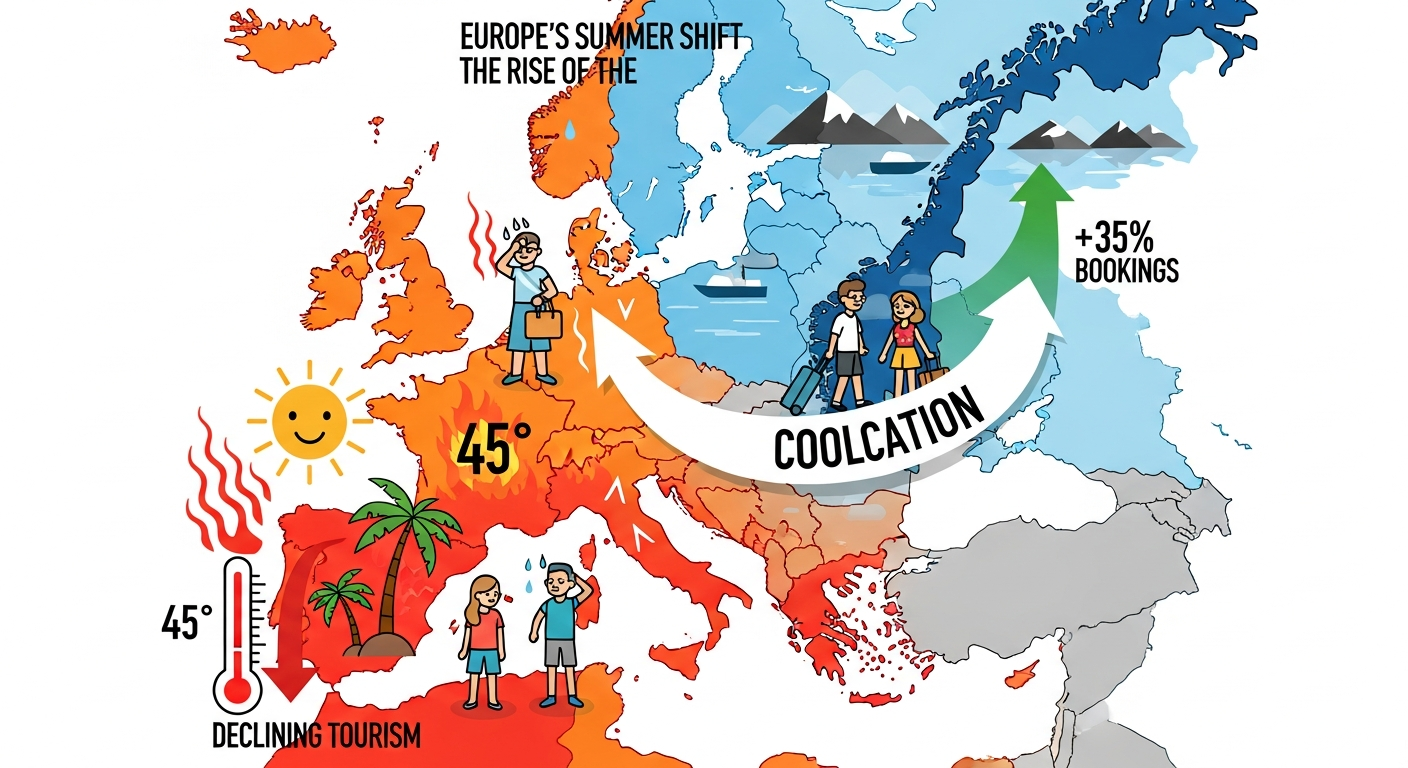
Coolcation is becoming a new paradigm of climate-adaptive travel. Scandinavian bookings surged 35% while Mediterranean peak-season stays declined 11%. This structural shift is dividing tourism's winners and losers.
Key Points
The Great Migration of Tourism: Scandinavia Up 35% vs. Mediterranean Peak-Season Down 11%
Scandinavian bookings surged 35% year-over-year in 2026, with Nordic summer bookings skyrocketing 263%. Finland recorded an all-time high of 7.2 million foreign overnight stays in 2025 with 12% growth, while Norway saw foreign overnight stays climb 10.8%. Meanwhile, Mediterranean peak-season stays in July and August declined 11% compared to 2019, even as shoulder-season stays in May-June and September-October increased 13%. This divergence demonstrates that tourism demand is structurally migrating from Southern to Northern Europe, driven not by a passing fad but by a climate-driven geopolitical reshuffling of the tourism landscape. According to WTTC, global tourism contributed $11.7 trillion to the world economy in 2025 — 10.3% of global GDP — and the geographic coordinates of this massive industry are being rewritten. Swiss mountain railway visitors increased 24% and cable car passengers rose 9%, confirming this northward migration pattern extends well beyond Scandinavia into the Alpine corridor.
Travelers as Climate Refugees: The Rise of Survival Travel
Coolcation is no longer a luxury trend but rather a form of climate adaptation. Forty-two percent of global travelers now prefer cooler destinations, 54% plan to increase evening activities to avoid daytime heat, and 76% of travel advisors report rising shoulder-season demand. Forty-five percent of advisors say clients are directly adjusting travel plans because of climate change. Research shows that for every 1-degree Celsius increase in temperature, international tourist arrivals drop by 8.09% and tourism revenue falls by 6.04%, making clear that this shift is driven not by changing consumer taste but by forced displacement under climate pressure. The fact that Western European surface temperatures were 2.81 degrees above average in 2025 is accelerating this trend further.
Overtourism Migrates North: Relocating the Problem, Not Solving It
The coolcation boom is creating new overtourism in Northern Europe. Lofoten, a region of just 30,000 residents, the rapidly expanding city of Tromsoe, and already-saturated Geirangerfjord are all experiencing accommodation shortages, short-term rental conflicts, cruise capacity limits, and visible environmental damage. Nordic ecosystems are far more fragile than Southern Europe's — fjords, glaciers, and Arctic ecosystems are extremely difficult to restore once damaged. The Norwegian government introduced a visitor contribution of up to 3% on accommodation costs starting summer 2026, and Iceland and Finland are pursuing sustainable tourism policies and visitor dispersal strategies, but they struggle to keep pace with surging demand. In Lofoten's Moskenes municipality, 47% of all housing is now short-term rentals or vacation homes, with local living infrastructure being consumed by tourism. The fundamental reality is that Southern Europe's overtourism problem hasn't been solved — it's been relocated to more vulnerable terrain.
Redefining Good Weather and the Rise of Climate-Based Travel Platforms
What was once the golden condition for summer travel — bright, hot sunshine — has been transformed into a risk factor. By 2026, booking engines are integrating long-term weather models, heat wave alerts, cyclone windows, and snow reliability charts. Travelers now make decisions based not on when is it busiest but on when is the climate window most pleasant and safe. Marketing is shifting too, with temperature data emerging as the key selling point over scenic photography. Hawaii implemented the first U.S. climate-related tourism tax in January 2026, projected to generate approximately $100 million annually for a climate resilience fund — a model likely to spread across Europe. The tourism industry is entering the early stage of transforming climate change from a threat into a new business opportunity.
Structural Crisis in Southern European Tourism Economies and the Limits of Adaptation
For countries like Greece, Spain, and Italy, where tourism accounts for 12-13% of GDP, declining summer peak-season stays are not merely a statistical shift but a signal of economic crisis. The European Commission projects approximately 10% decline in southern Mediterranean tourism and 5% growth in the north. Under a 2.5-degree warming scenario, losses from reduced overnight stays could reach 825 million euros. Southern nations are pursuing shoulder-season strategies, but spring and autumn temperatures are also rising, threatening to undermine the very adaptation strategies being deployed. McKinsey projects that the number of days above 37 degrees Celsius in southern Spain, Turkey, and Egypt will double from approximately 30 to 60 by 2050. Tourism infrastructure takes 10-20 years to build, yet travel patterns are shifting faster each year — this temporal mismatch risks creating a tourism gap that damages both regions simultaneously.
Positive & Negative Analysis
Positive Aspects
- Shoulder-Season Revival and Seasonal Demand Distribution
Tourism demand that once concentrated in July-August is spreading into May-June and September-October, alleviating overcrowding at popular destinations. According to Lighthouse hospitality data, July-August 2025 underperformed relative to May-June and September-October, confirming a more even distribution of tourist flows. In Switzerland, the mountain tourism peak season has extended through September and October, injecting significant vitality into local economies.
- A New Growth Engine for Nordic Economies
Finland's foreign overnight stays hit an all-time record of 7.2 million in 2025, growing 12% year-over-year, while Norway's foreign overnight stays climbed 10.8%. Regions traditionally dependent on winter aurora tourism have now expanded their revenue base into the summer season.
- Creation of the Climate-Smart Travel Market
Climate-data-driven travel decision-making is spawning entirely new business models. By 2026, booking engines are integrating long-term weather models and heat wave alerts, and Hawaii implemented the first U.S. climate-related tourism tax in January 2026, projected to generate approximately $100 million annually for a climate resilience fund.
- Seasonal Diversification Opportunities for the Alpine Region
Switzerland shattered records in summer 2025 with over 25 million overnight stays and a 24% increase in mountain railway visitors, establishing the Alps as a credible summer tourism hub. While 167 ski resorts have closed due to rising snow lines, the crisis-hit winter-dependent economy is finding a new path through the transition to summer mountain resorts.
- Geographic Diversification of Tourism and Discovery of Overlooked Destinations
The coolcation trend is driving travelers to rediscover previously overlooked destinations. Baltic coastlines, northern Germany's shores, the Canadian Rockies, and Iceland's interior are emerging as new tourism hot spots, diversifying demand geographically. Intrepid Travel's UK bookings for Iceland, Estonia, and Scandinavia increased 50% for the July-August period.
Concerns
- Northward Transfer of Overtourism and Ecological Destruction Risk
Lofoten with its 30,000 residents, rapidly expanding Tromsoe, and saturated Geirangerfjord are already experiencing accommodation shortages, short-term rental conflicts, and visible environmental degradation. Nordic ecosystems — fjords, glaciers, and Arctic biomes — are far more fragile and harder to restore than Southern Europe's beach ecosystems.
- Structural Crisis for Southern Europe's Tourism-Dependent Economies
In Spain, Italy, and Greece, where tourism accounts for 12-13% of GDP, the 11% decline in summer peak-season stays triggers cascading economic damage across hotels, restaurants, retail, and transportation.
- The Structural Time-Lag Problem of Adaptation Strategies
Tourism infrastructure requires 10-20 years to build, yet climate-driven changes in travel patterns are accelerating every year. A tourism gap where both regions simultaneously lose could emerge.
- The Carbon Paradox of Coolcation: Climate Escape Accelerates Climate Change
A flight from Frankfurt to Barcelona takes 2 hours, but reaching Tromsoe requires 5-6 hours including connections. Flying farther to reach cooler destinations actually increases travel's carbon footprint. According to EUROCONTROL, just 6% of flights account for half of all aviation CO2 emissions.
- Infrastructure Overload and Resident Conflicts in Small Nordic Cities
Cities of just tens of thousands to a hundred thousand residents — Reykjavik, Bergen, Tromsoe — face structural limitations in handling mass tourism. Reykjavik's tourist-to-resident ratio now exceeds that of Barcelona.
Outlook
Let's start with what's likely to happen in the next few months. Summer 2026 will be the definitive proving ground for the coolcation trend. The UK Met Office forecasts that 2026 global mean temperatures will fall between 1.35 and 1.53 degrees Celsius above pre-industrial levels, with a greater than 99% chance of this year being hotter than any year before 2023. The period from 2026 to 2030 is likely to be the hottest five-year stretch in recorded history. This forecast carries direct implications for Mediterranean tourism. With Scandinavian bookings already up 35% and Nordic summer reservations surging 263%, the first real test when actual summer begins will be whether Norway and Finland's tourism infrastructure can absorb this unprecedented wave of demand.
Sources / References
- European Coolcations: Why More People Will Flock to Norway, Finland and Iceland in Summer 2026 — Euronews Travel
- The Numbers Are In: Scandinavia's Coolcation Boom Is Real — Life in Norway
- Baby Boomers and First-Time Travelers Are Shunning Europe's Summer Hotspots in Favor of Coolcations — CNBC
- Climate Change and Overtourism Put Southern Europe's Economies Under Threat — Bloomberg
- Europe Heat Wave: Tourist Death and Wildfires Spark Travel Warnings — Skift
- Risk of Loss of Tourism Attractiveness in the Western Mediterranean Under Climate Change — Frontiers in Climate
- Is Overtourism a Threat to the Nordics, or Can the Sector Become Sustainable? — Nordic Labour Journal
- 2026 Travel Trends: Climate-Smart Planning, Heatwaves, EES, and the Rise of Coolcations — Travel And Tour World
- How Hot Summers and Disease Could Impact Tourism in the Mediterranean — McKinsey & Company
- Global Travel & Tourism to Reach New Heights in 2025 — WTTC
- Norway to Tax Tourists in 2026 After Record-Breaking Visitor Surge: Lofoten and Tromsoe Among First to Adopt New Fee — Travel And Tour World
- Norway to Introduce Tourist Tax Amid Record Visitor Numbers and Overtourism Concerns — Euronews
- 2026 Outlook: Likely Another Year Above 1.4C — UK Met Office
- EUROCONTROL Data Snapshot on CO2 Emissions and Flight Distance — EUROCONTROL
- Switzerland Shatters Tourism Records with Over Twenty-Five Million Summer Stays — Travel And Tour World
- Hot Seas, Heatwaves and Medicanes — Allianz Commercial