
One TikTok Meme Became State Law, Flipped Restaurant Menus, and Launched a War Over the Oil on Your Plate
Summary
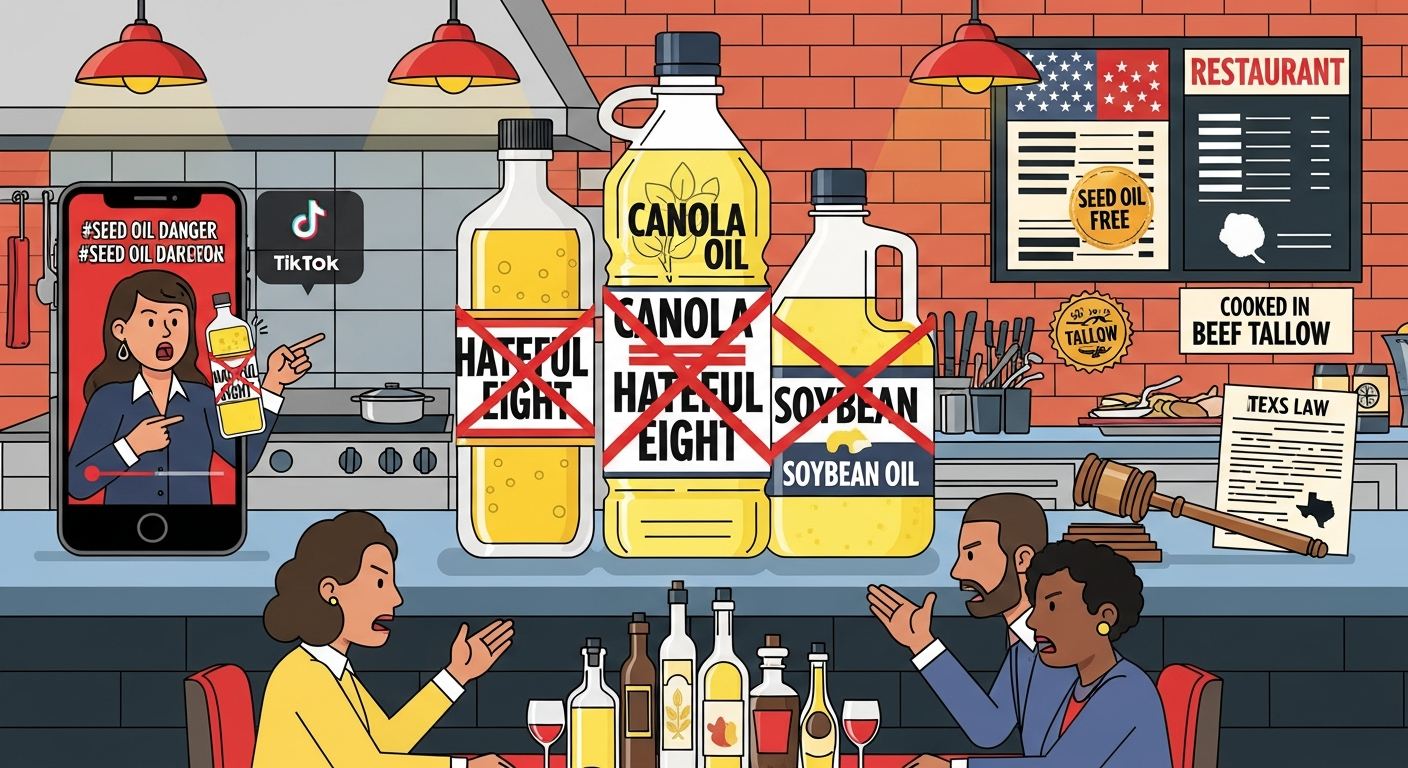
Seed oils — branded the 'Hateful Eight' on social media — have gone from TikTok punchline to actual state law in Louisiana and Texas, an unprecedented leap from meme to legislation. Harvard, the American Heart Association, and Johns Hopkins consistently present scientific evidence that seed oils actually lower cardiovascular risk, yet 43% of American consumers already choose restaurants based on cooking oil, rising to 52% among 18-to-34-year-olds. The MAHA movement's successful weaponization of a meme into policy represents a 21st-century war on the kitchen table, born from the widening chasm between science and public perception.
Key Points
A Meme With No Scientific Basis Just Became State Law
In June 2025, Louisiana Governor Jeff Landry signed SB14, and that same month Texas Governor Greg Abbott signed SB25, turning seed oil restrictions into actual enforceable law. The Louisiana law bans foods containing 15 prohibited ingredients from school cafeterias starting in the 2028-2029 school year, mandates QR code labeling for 44 ingredients, and requires restaurants to post warnings stating 'some menu items may contain seed oils.' Texas SB25 took effect in September 2025, with labeling requirements applying to products manufactured after January 2027.
These bills are the direct product of RFK Jr.'s MAHA movement converting social media memes into political weapons. The 'Hateful Eight' discourse that originated on TikTok and Instagram managed to influence legislation in just five to six years — a timeline without precedent. Harvard, the American Heart Association, Johns Hopkins, and other leading medical institutions have consistently denied any evidence of seed oil harm, yet the laws passed anyway. That scientific consensus can be rendered powerless in the face of political narrative is a warning signal that should alarm everyone.
Major law firms including Greenberg Traurig and Holland & Knight have already published analyses of the legal vulnerabilities in these bills, suggesting that legal challenges from the food industry are all but certain.
Science Sides With Seed Oils — Harvard, AHA, and JAMA Present a United Front
The American Heart Association issued an official science advisory in August 2024 stating there is 'no reason to avoid seed oils and plenty of reasons to eat them.' A large-scale study published in JAMA in 2025 found that higher butter consumption was associated with increased mortality risk, while higher intake of plant-based oils like canola and soybean oil was linked to lower overall mortality. A June 2025 study analyzing blood markers from approximately 1,900 participants found that individuals with higher levels of linoleic acid — the primary component of seed oils — actually showed lower inflammation and better cardiometabolic health.
The central argument of the anti-seed-oil camp — that linoleic acid converts into the inflammatory compound arachidonic acid — has been debunked by research showing the actual conversion rate is just 0.2%. A 2025 systematic review of 11 randomized controlled trials confirmed that canola oil, flaxseed oil, and sesame oil improve lipid profiles and glycemic control. Participants with the highest linoleic acid levels showed a 35% lower risk of developing type 2 diabetes, according to a meta-analysis of 20 cohorts encompassing 39,740 individuals.
Harvard T.H. Chan School of Public Health also concluded in its 2025 analysis that existing research does not support claims of seed oil harm. The scientific evidence is overwhelming and one-directional — yet it barely registers against the viral power of a well-crafted meme.
43% of Consumers Already Choose Restaurants by Cooking Oil — Memes Now Dominate the Market
A February 2026 survey by Coast Packing Company, conducted with 1,005 respondents, found that 43% of Americans say the type of cooking oil a restaurant uses influences their dining choices. Some 24.7% prefer animal fats like butter or beef tallow, while only 15.6% favor seed oils. Among 18-to-34-year-olds, 52% say cooking oil influences their decisions, and 31% would choose a beef tallow restaurant over an identical seed oil competitor.
Steak 'n Shake announced its switch to 100% beef tallow fries in January 2025 and rolled it out by March. South Chicago Packing partnered with Restaurant Technologies to install liquid beef tallow systems in over 40,000 commercial kitchens nationwide. Whole Foods named beef tallow a top food trend for 2026, and industry projections estimate the number of restaurants using beef tallow will increase 54% over the next two years.
The beef tallow market is projected to grow from approximately $3.8 billion in 2025 to $4.8 billion by 2030, at a compound annual growth rate of 4.7%. Coast Packing is investing $30 million in a new refining and packaging facility in Amarillo, Texas, expected to begin operations by summer 2026. What we are witnessing is not a health revolution — it is a market transformation driven entirely by social media narrative.
Seed Oil Panic Is Paradoxically Driving Greater Dependence on Ultra-Processed Foods
Experts at the Johns Hopkins Bloomberg School of Public Health warn that seed oil fear is generating anxiety about cooking itself. When the message becomes 'this oil is bad, that oil is bad too,' consumers give up on home cooking altogether and turn to premium processed foods marketed as 'seed oil free' or simply eat out more. Orthorexia — an obsessive fixation on 'clean eating' — is rising in tandem with seed oil panic, and fear-based marketing by wellness influencers is particularly fueling disordered eating among younger demographics.
More than half of the average American's daily caloric intake already comes from ultra-processed foods. Obsessing over a single ingredient — seed oil — distracts from the real problem, which is overall dietary pattern. There is no scientific evidence that fries cooked in beef tallow are healthier than fries cooked in canola oil. Fried food is fried food, regardless of what it is fried in.
The deeper irony is that seed oil fear is creating exactly the opposite of its intended effect. Instead of pushing people toward healthier diets, it is pushing them toward expensive branded products that exploit their anxiety — while the fundamental quality of their diet remains unchanged or worsens.
The MAHA Movement — Anti-Science Populism Wearing the Mask of Health Sovereignty
The MAHA movement led by RFK Jr. claims seed oil regulation as a signature achievement, but its true nature is closer to a direct assault on the scientific method itself. RFK Jr. has accused The Lancet, NEJM, JAMA, and other leading medical journals of being 'in Big Pharma's pocket' and has declared his intention to ban government officials from publishing in these journals. A 2025 Purdue University survey found that roughly half of Americans hold a positive view of seed oils, and only 9% agree with RFK Jr.'s claim that they are harmful. This is a case where a fringe minority's extreme claims have been translated into legislation.
CNN reported in April 2026 that RFK Jr.'s influence within the Republican Party has been weakening, and a significant number of figures associated with the MAHA movement profit directly from selling 'seed oil free' products — raising serious questions about the movement's underlying motivations. The fact that 11% of Americans believe seed oils increase chronic disease risk, according to the Purdue survey, may seem small, but it was enough to pass laws in two states.
The pattern is clear: manufacture fear, then sell the cure. When the people pushing the panic are the same people selling beef tallow cookware and premium animal fat products, the conflict of interest should be impossible to ignore.
Positive & Negative Analysis
Positive Aspects
- A Surge of Interest in Food Ingredient Transparency
The seed oil debate may have started from a misguided premise, but it has cracked open the public's longstanding indifference to what oils restaurants cook with and what goes into processed foods. Louisiana's QR code labeling mandate and Texas's warning label requirements have reinforced the principle that consumers have a right to know what they are eating. If this demand for transparency extends beyond seed oils to food additives more broadly, it could serve as a long-term catalyst for improving the entire food safety system.
Major law firms like Holland & Knight are already analyzing the potential spread of food labeling regulations, signaling that the entire industry is taking notice.
- Diversification of Cooking Oil Options and Food Technology Innovation
The growth of the beef tallow market has expanded the range of cooking oil choices available to consumers. Whole Foods named beef tallow a top food trend for 2026, and Steak 'n Shake demonstrated a successful transition to 100% beef tallow fries. South Chicago Packing and Restaurant Technologies have collaborated to install liquid beef tallow systems in over 40,000 commercial kitchens nationwide.
The beef tallow market is projected to grow from approximately $3.8 billion in 2025 at a compound annual growth rate of 4.7%, reaching $4.8 billion by 2030. Coast Packing is investing $30 million in a new refining and packaging facility in Amarillo, Texas.
- Heightened Awareness of Ultra-Processed Food Risks
The scientific starting point of the seed oil debate may be flawed, but it has had the secondary effect of drawing public attention to the fact that more than half of the average American's daily calories come from ultra-processed foods. A 2025 Johns Hopkins media briefing emphasized that 'the real issue is not any single oil but overall dietary pattern.' The 2025 HHS dietary guidelines strengthened warnings about ultra-processed foods, partly reflecting this growing public concern.
- Empowered Consumers and the Rise of Food Democracy
The seed oil debate has strengthened the consumer mindset of 'I decide what I eat.' The data showing 43% of Americans now factor cooking oil into their restaurant choices signals that consumers are no longer willing to passively accept whatever the food industry provides. Apps like Seed Oil Scout are reducing information asymmetry, allowing consumers to actively choose restaurants that align with their values.
Restaurants are responding to consumer demand by increasingly listing cooking oil information on their menus.
Concerns
- A Dangerous Precedent Where Scientific Consensus Is Overruled by Political Narrative
JAMA, the AHA, Harvard, Johns Hopkins — the world's most respected medical institutions have unanimously stated there is 'no evidence that seed oils are harmful,' yet social media memes overpowered that entire body of scientific consensus and produced actual legislation. If this pattern is recorded as a success story, meme-driven lawmaking could be attempted on other topics where scientific consensus already exists — climate change, vaccines, GMOs.
Once trust in the scientific method itself is eroded, the foundation for public health policy decisions is fundamentally weakened.
- Fueling Eating Disorders and Spreading Food Anxiety
Seed oil panic is directly correlated with rising rates of orthorexia. The relentless messaging from wellness influencers and celebrity doctors that 'seed oils are poison' is generating excessive anxiety and hypervigilance around food. The finding that 52% of 18-to-34-year-olds are influenced by cooking oil type reveals a particularly high vulnerability among younger demographics.
Johns Hopkins experts have warned of a chain reaction — 'anxiety, hypervigilance, reduced nutritional intake' — in which the effort to become healthier paradoxically undermines health.
- The Paradox of Deepening Ultra-Processed Food Dependence
When the message becomes 'this oil is bad, that oil is bad too,' consumers abandon home cooking and turn to premium processed foods labeled 'seed oil free' or simply eat out more frequently. There is no scientific evidence that fries cooked in beef tallow are healthier than fries cooked in canola oil.
More than half of American daily caloric intake already comes from ultra-processed foods, and fixating on a single ingredient like seed oil diverts attention from the real issue: overall dietary quality.
- Widening Economic Inequality in Food Access
Beef tallow and butter are more expensive than seed oils. Edible tallow prices rose from $49 per hundredweight in 2024 to $58 in 2025. The primary reason seed oils became ubiquitous in the first place was their affordability — regulating them drives up food prices across the board. Low-income households cannot afford premium animal fats, and 'seed oil free' restaurants charge higher prices.
The result is a structure where 'eating healthy' becomes a privilege reserved for the affluent.
- The MAHA Movement's Conflicts of Interest and Fear-Based Marketing Machine
A significant number of individuals connected to the MAHA movement are profiting directly from seed oil fear. 'Seed oil free' products, beef tallow-based cooking equipment, and premium animal fat lines are all marketed on the back of precisely the panic the movement generates. The business model is straightforward: create the fear, then sell the solution.
The 2025 Purdue University survey shows that only 9% of Americans agree with RFK Jr.'s claims about seed oil harm, yet this small minority's voice has been amplified into legislation and market shifts.
Outlook
Let me start with what is going to happen in the next few months. The second half of 2026 will be the period when the seed oil war's front lines expand in earnest. According to reporting by Stateline and KFF Health News, the MAHA movement is already pushing similar bills in state legislatures beyond Louisiana and Texas. 2026 is a U.S. midterm election year, and MAHA intends to exploit that as political momentum. Axios has reported that RFK Jr. and his allies are urgently reorganizing their MAHA strategy for the 2026 midterms, with allies in nearly 30 states having already advanced related legislation. I expect at least three to five additional states to introduce seed oil-related labeling or school meal regulation bills by the end of 2026. Not all of them will pass, though. Louisiana and Texas are deeply conservative states — in more moderate states, the food industry's lobbying apparatus will push back considerably harder. Arizona, a key swing state for the midterms, has already approved MAHA-aligned food bills, which tells us this is not confined to deep-red territory. The question is whether the momentum can survive the inevitable corporate counter-lobbying from the soybean and canola industries, which represent a combined market worth tens of billions of dollars annually.
On the food industry side, short-term changes are already accelerating. Projections show restaurants using beef tallow will increase 54% over the next two years, and Steak 'n Shake's successful transition is being studied as a benchmark by other chains. When Coast Packing's Amarillo, Texas facility — a $30 million investment covering a 10,000-square-foot refining building and 36,000-square-foot packaging and warehouse complex — begins operations in summer 2026, the beef tallow supply infrastructure will strengthen significantly. The facility is expected to create 30 jobs initially, scaling to 60, and signals serious capital commitment to the animal fat supply chain. The mega-chains — McDonald's, Chick-fil-A — are still watching from the sidelines, and their decisions will be the pivotal variable determining the market's direction. My estimate is that there is roughly a 40% probability McDonald's will pilot beef tallow options for at least some menu items between Q4 2026 and Q1 2027. McDonald's used beef tallow until 1990 before switching to vegetable oil, which gives them a ready-made marketing narrative of 'returning to tradition.' If McDonald's moves, the domino effect across the fast-food sector would be massive — we are talking about a company that purchases approximately 3.4 billion pounds of potatoes annually for fries alone.
On the consumer behavior front, the 'seed oil free' label is poised to establish itself as a marketing category similar to gluten-free. Just as the gluten-free market grew far larger than the actual celiac disease population would warrant, seed oil free will become a premium marketing tool disconnected from any genuine health necessity. Apps and websites like Seed Oil Scout, which help users find seed oil-free restaurants, are already operational, and I expect their user base to double or triple within 2026. The consumer psychology here follows a well-documented pattern: once people adopt a food avoidance behavior, they rarely reverse it even when presented with contradictory evidence. The 52% of 18-to-34-year-olds who factor cooking oil into dining decisions today will carry that behavior into their 30s and 40s, baking this preference into the market for decades.
Looking six months to two years out, more fundamental structural shifts come into play. The first key development is the scientific community's counteroffensive. In 2025 alone, major studies and statements supporting seed oil safety poured out of JAMA, the AHA, Johns Hopkins, and Harvard. This trend will continue, and I expect at least two to three definitive meta-analyses on the health effects of seed oils to be published by 2027. Research on whether linoleic acid causes inflammation has already reached a clear conclusion in 2025 studies — people with higher linoleic acid levels actually show lower inflammation — and this direction will only solidify further. The 2025 systematic review of 11 randomized controlled trials demonstrating that seed oils improve lipid profiles and glycemic control is especially significant because RCTs sit at the top of the evidence hierarchy. But the accumulation of scientific evidence does not automatically shift public perception. It has been over 20 years since the vaccine-autism link was thoroughly debunked, yet a substantial number of people still believe it. The fat-cholesterol controversy of the 1980s took three decades to partially correct in public understanding. That is the reality we are dealing with.
The second mid-term key development is the polarization of the food industry. The beef tallow and animal fat market will unquestionably grow. The projection that the beef tallow market will expand from roughly $3.8 billion in 2025 to $4.8 billion by 2030 is a conservative estimate — if seed oil fear continues at its current trajectory, it could surpass $5 billion. But the seed oil industry itself will not collapse. Soybean oil and canola oil account for more than 40% of the global edible oil market, and there simply is not enough animal fat supply on the planet to physically replace that volume. Soybean oil alone accounts for roughly 60% of the U.S. edible oil market, and NPR has reported that replacing seed oils could increase consumer food spending by an estimated 42.8% annually. The market will ultimately bifurcate into a 'premium animal fat' segment and a 'mass-market plant-based oil' segment. This is not a health issue anymore — it is a question of marketing and price positioning. The price of edible tallow has already climbed from $49 per hundredweight in 2024 to $58 in mid-2025, and if demand continues rising while cattle supply remains constrained, further price increases are inevitable.
Third, legal challenges to the regulatory environment will begin in earnest. Louisiana's SB14 and Texas's SB25 face a strong likelihood of legal challenge from the food industry. Major law firms like Holland & Knight, Greenberg Traurig, and Perkins Coie have already published reports analyzing the legal vulnerabilities of these bills, including potential First Amendment issues and federal preemption concerns. Industry groups such as the Food Marketing Institute (FMI) or the American Soybean Association may file lawsuits. The requirement for QR code labeling of 44 ingredients is particularly vulnerable to claims of conflict with federal food and drug safety law, potentially leading to battles in federal court. The National Law Review has specifically flagged Texas SB25 as the first state-level ingredient-specific warning label law, noting its unprecedented implications for interstate commerce. I expect at least one major lawsuit to be filed by mid-2027. The outcome of that litigation will dramatically affect the legislative momentum in other states — a ruling striking down these laws could halt the movement's expansion, while an upholding would open the floodgates.
The fourth mid-term shift is global spread. The seed oil debate is currently U.S.-centric, but given social media's borderless nature, international expansion is a matter of when, not if. In Europe, where food additive regulations are already stricter than in the U.S., the conversation is more likely to merge with ultra-processed food regulation rather than targeting seed oils specifically. The EU's existing NOVA classification system for ultra-processed foods provides a more scientifically grounded framework that could absorb seed oil concerns without the meme-driven extremism seen in the U.S. In South Korea, where interest in 'which oils are healthy' has been growing alongside broader health food trends, the wholesale importation of American-style seed oil panic could produce a unique dynamic as it collides with the traditional culinary culture centered on perilla oil and sesame oil. In Australia and the UK, where health influencer culture closely mirrors American patterns, seed oil discourse has already gained traction on social media, though it has not yet reached the legislative stage.
A fifth dimension worth monitoring is the public health impact on eating disorders. The PLOS ONE systematic review on orthorexia and social media found prevalence rates of 6.9% in the general population, spiking to 35-57.8% in high-risk groups. Instagram, Pinterest, and TikTok usage showed statistically significant correlations with orthorexia tendencies. As seed oil fear intensifies through these exact platforms, the mental health fallout — particularly among younger women — represents a ticking time bomb that public health systems are not prepared for. If the seed oil panic follows the trajectory of other diet culture movements, we could see measurable increases in orthorexia diagnoses within the next two to three years, adding healthcare costs that nobody is currently accounting for.
Looking two to five years ahead, the seed oil war resolves into three scenarios. The bull case is a scenario where the seed oil controversy serves as a catalyst for broadly improved food transparency and nutrition education. The scientific community's pushback succeeds, and a balanced message — 'seed oils are not dangerous, but improving overall dietary quality matters' — reaches the public. Consumers stop fixating on a single oil and start thinking about their dietary patterns holistically, leading to a meaningful decline in ultra-processed food consumption. The FDA maintains its independence and issues clear, science-based guidance. I put the probability of this scenario at roughly 20%. Historically, fear-based food trends rarely land on scientific balance — the egg cholesterol scare, the fat-free craze of the 1990s, and the MSG panic all demonstrate how difficult it is to walk back a fear once it has been implanted.
The base case is a scenario where seed oil free becomes entrenched as a marketing category, much like gluten-free. The scientific debate continues without resolution, and consumers behave according to what they want to believe. Animal fats grow in the premium segment while seed oils continue to dominate the mass market. Seed oil-related laws are maintained in some conservative-leaning states but do not expand nationally. Food companies quietly reformulate some product lines to capture the 'seed oil free' premium without fundamentally altering their supply chains. By 2030, the beef tallow market reaches $5 billion to $5.5 billion, and the share of animal fats in the global edible oil market rises from the current 8% to 12-15%. I put this scenario's probability at 55% — the most realistic outcome.
The bear case is a scenario where seed oil fear escalates to more extreme levels, suppressing scientific discourse itself. If the MAHA movement achieves gains in the 2026 midterms, federal-level seed oil regulation could be pursued. The FDA's independence would be weakened — FactCheck.org has already documented how FDA Commissioner Marty Makary spread unsubstantiated concerns about seed oils in baby formula, suggesting the institutional guardrails are already under pressure. Food policy would be determined by social media sentiment rather than science. Eating disorder rates — particularly orthorexia — would rise meaningfully, and nutritional inequality for low-income populations would deepen as affordable seed oil options face regulatory barriers. Canola farmers, already reporting approximately 5% revenue declines according to NPR, would face existential threats. I put this scenario's probability at 25%. RFK Jr.'s political influence has been weakening recently, which could lower the odds, but the power of memes persists independently of any single politician's fortunes, so vigilance is warranted.
The most fascinating long-term ripple effect is the normalization of the 'political weaponization of memes' pattern. The seed oil war is a case study proving that social media content can bypass scientific consensus and directly influence legislation. If this pattern is recorded as a success, similar attempts will emerge not just in food but in pharmaceuticals, energy, and environmental policy. The HHS's 2025 historic reset of federal nutrition policy — emphasizing 'eat real food' and listing olive oil, butter, and beef tallow as healthy fat sources — has already blurred the line between evidence-based policy and politically motivated messaging. The position that the 2025-2026 U.S. dietary guidelines ultimately take on seed oils will be the decisive variable shaping the next decade's trajectory.
Of course, my predictions could be wrong. If a large-scale clinical trial demonstrating clear harm from seed oils is published by 2027, the current scientific consensus would be completely overturned, and seed oil regulation would be rightly reappraised as a legitimate public health measure. But given that every large-scale study to date points in the opposite direction — the JAMA mortality study, the 11-RCT systematic review, the linoleic acid-diabetes meta-analysis of nearly 40,000 people — I put this possibility at less than 5%.
To map the chain of effects: the first-order effect is strengthened food labeling and menu transparency. The second-order effect is growth in the animal fat market and a premium-versus-mass bifurcation in the plant-based oil market. The third-order effect is the rising influence of social media opinion on food policy decisions, and the widening gap between scientific consensus and public perception spreading into other domains. A single drop of oil on the kitchen table has created ripples this enormous — something nobody could have predicted.
Sources / References
- There's no reason to avoid seed oils and plenty of reasons to eat them — American Heart Association
- Are seed oils healthful or harmful? — Harvard T.H. Chan School of Public Health
- Myth-busting study shows controversial seed oils reduce inflammation — ScienceDaily
- The Evidence Behind Seed Oils' Health Effects — Johns Hopkins Bloomberg School of Public Health
- Survey Finds Cooking Oil Influences Where Americans Choose to Eat — Restaurant Magazine
- Survey: Young Diners Drive Shift Toward Beef Tallow Over Seed Oils — QSR Magazine
- More Food for Thought: Louisiana Enacts Food Product Warning Labels for 44 Chemicals — Holland & Knight
- Texas and Louisiana Enact 'MAHA'-Inspired Food Additive Legislation — Greenberg Traurig
- RFK Jr.'s MAHA Movement Has Picked Up Steam in Statehouses. Here's What To Expect in 2026. — KFF Health News
- As Guidelines Shift, a Curious Debate Over Seed Oils Persists — Undark
- How RFK Jr.'s MAHA agenda keeps hitting roadblocks — CNN
- Are seed oils healthy? The research is unclear — STAT News
- Butter and Plant-Based Oils Intake and Mortality — JAMA Internal Medicine
- Evaluating the effects of seed oils on lipid profile, inflammatory and oxidative markers, and glycemic control: a systematic review of clinical studies — Frontiers in Nutrition
- Dietary Intake of Linoleic Acid, Its Concentrations, and the Risk of Type 2 Diabetes: A Systematic Review and Dose-Response Meta-analysis — Diabetes Care (American Diabetes Association)
- Louisiana and Texas Enact New Laws Regarding Food Ingredient Disclosures and School Nutrition — Perkins Coie
- Texas Enacts Sweeping Food Additive Labeling Law: Implications for the Industry and Interstate Commerce — National Law Review
- Claims that seed oils are harming Americans' health are causing problems for farmers — NPR
- RFK Jr., allies rush to rally the MAHA movement for 2026 — Axios
- States embrace 'MAHA' movement with dozens of bills — Agri-Pulse
- Beef Tallow Market Trends, Growth & Insights: Forecast 2030 — Knowledge Sourcing Intelligence
- Tallow and Lard — Southern Ag Today
- Whole Foods Market Forecasts the Top Food and Beverage Trends for 2026 — Whole Foods Market
- FDA Commissioner Spreads Unsubstantiated Concerns About Seed Oils in Baby Formula — FactCheck.org
- Kennedy, Rollins Unveil Historic Reset of U.S. Nutrition Policy — U.S. Department of Health and Human Services
- Orthorexia nervosa and social media: A mixed-methods scoping review — PLOS ONE