
The Day a CEO's Awkward Bite Beat $18 Billion in Advertising — How the Big Arch Meme Rewrote Fast-Food Marketing
Summary
McDonald's CEO Chris Kempczinski posted an awkward tasting video of the Big Arch burger that instantly became a global meme, generating 5.8 billion impressions and $18.4 million in earned brand value within days. Rather than damage control, the company leaned into the ridicule with a self-aware strategy that turned mockery into one of the most effective organic marketing events in fast-food history. This analysis examines how an unscripted moment of corporate awkwardness triggered a full-blown burger war among rival CEOs and reshaped the playbook for executive-driven social media engagement.
Key Points
The Birth of an Accidental Viral Sensation — How a CEO's Tiny Bite Broke the Internet
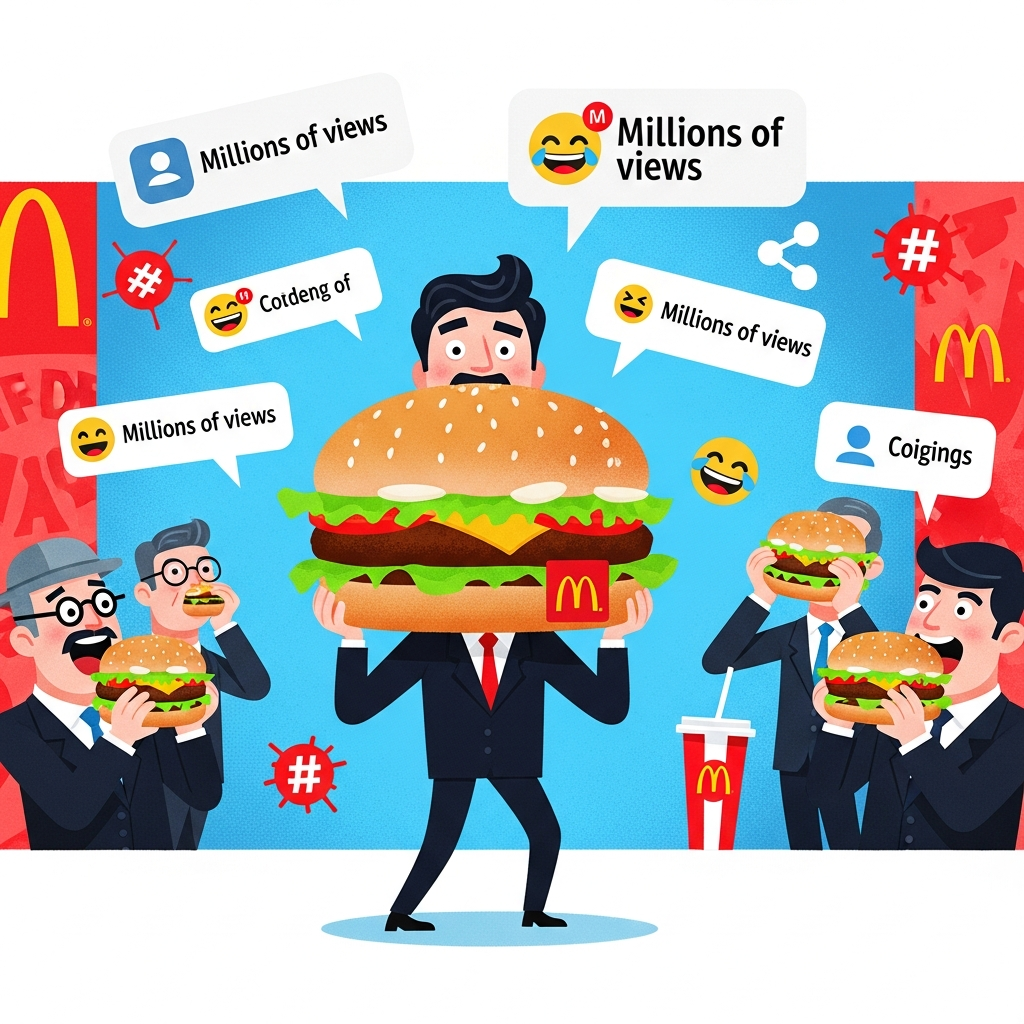
On February 3, 2026, McDonald's CEO Chris Kempczinski posted a short tasting video on Instagram to promote the company's new Big Arch burger. He lifted the burger in front of an office backdrop and took a cautiously small bite — a bite so tiny it would soon become the most mocked moment in fast-food history. The video languished in obscurity for three weeks until February 25, when Irish comedian and influencer Gearoid Nun stitched the clip on TikTok, calling it the funniest video I've ever seen in my life. Nun's reaction video alone surpassed 10 million views, and Cat Sullivan's subsequent parody hit 17 million. People described Kempczinski's bite as a bird pecking at seeds and an alien eating Earth food for the first time, spawning an avalanche of memes. The originally planned marketing had generated zero buzz, but the moment ridicule began, the video conquered global social media overnight.
The Word 'Product' That Exposed the Gap Between Boardroom and Drive-Through
Kempczinski repeatedly referred to the Big Arch burger as a product in the video, and this single word choice became the core catalyst of the meme explosion. To consumers, a burger is food, a meal, comfort — but to the CEO, it was a product that moves quarterly earnings. Gearoid Nun mocked this by joking, Can I get two burger products please? — a quip that generated millions of views on its own. According to PeakMetrics sentiment analysis, 35.3% of related mentions carried a humorous or mocking tone, meaning ridicule overwhelmingly dominated over anger. Consumers felt uncomfortable that the CEO appeared unable to genuinely enjoy his own company's burger. The episode became a textbook case of what happens when a corporate leader fails to speak the consumer's language. In the end, a single word compressed the psychological distance between a CEO earning tens of millions in annual compensation and a consumer paying $6 for a burger into one devastating punchline.
The Burger War Erupts — Rival CEOs Join the Parody Battle
McDonald's misstep became a golden opportunity for competitors. Burger King struck first: US and Canada president Tom Curtis posted a TikTok on March 3 showing himself taking a hearty, exaggerated bite of a Whopper. The very next day, Wendy's US president Pete Suerkein appeared on camera cooking a Baconator patty from scratch, then eating the finished burger and dipping fries into a Frosty in a full-course performance. Wendy's reposted the video on X with a pointed caption: This is how you eat when you actually like your product. Canadian A&W's Allen Rulu mimicked Kempczinski's exact speaking cadence, adding an exaggerated ad-lib about a unique bun that most people call a bun, drawing widespread laughter. Jack in the Box joined the fray as well. A single CEO's awkward video had escalated into a full-blown burger war that pulled in the entire American fast-food industry.
From Mockery to Revenue — The $18.4 Million Brand Value Paradox
The most fascinating twist in this saga lies in the numbers. Advertising consultancy Apex Marketing estimated that the viral episode generated approximately $18.4 million in earned brand value for McDonald's. Throughout March, McDonald's recorded up to 47,900 daily social media mentions, with total cross-platform reach hitting 5.8 billion impressions — the highest conversation volume ever recorded for a single campaign. A McDonald's spokesperson confirmed that early Big Arch sales were exceeding expectations, and Kempczinski's Instagram followers increased 30% after the video. Bloomberg did question whether memes translated directly into store traffic, and Restaurant Dive reported that the traffic uplift was only modest. Nevertheless, the fact that McDonald's obtained $18.4 million worth of free publicity demonstrates an overwhelming efficiency advantage over traditional advertising spend.
McDonald's Counterattack — The Self-Aware Strategy That Flipped the Script
McDonald's true victory came after the mockery began. Instead of suppressing or ignoring the memes, the company posted a photo of the Big Arch on its official social media accounts with the caption: Take a bite of our newest product. They deliberately recycled the exact expression that had been ridiculed. This self-aware strategy completely reversed public sentiment. People felt warmth toward McDonald's for understanding the joke and laughing along, and the meme's tone shifted from ridicule to affectionate teasing. The Washington Post observed that McDonald's won the attention economy by losing. This response rewrote the crisis management playbook. Traditional crisis manuals emphasize rapid clarification and message control, but in the meme era, joining the laughter and deploying self-deprecating humor proved far more effective.
The New Formula of the Meme Economy — When Failed Marketing Becomes the Best Marketing
The global meme industry grew from $2.3 billion in 2020 to $6.1 billion by 2025. Meme-based campaigns achieve 60% organic engagement rates on Facebook and Instagram, compared to just 5% for standard marketing graphics. Over 60% of consumers say they are more likely to purchase from brands that use memes. Duolingo's mascot death campaign saw social media mentions surge 25,560% in a single day, and Gap's KATSEYE campaign generated over 8 billion impressions. Against this backdrop, McDonald's Big Arch episode proved the thesis that unintentional failure can be more powerful than intentional success. A perfectly produced ad fails to stop the scroll, but an awkward, human moment inspires people to create and spread content on their own. I believe this will become the defining marketing paradigm from 2026 onward.
Positive & Negative Analysis
Positive Aspects
- $18.4 Million in Free Publicity — An Unprecedented ROI
McDonald's spent effectively zero dollars on this viral episode. The CEO had filmed a routine video that went viral organically. Apex Marketing estimated the episode generated approximately $18.4 million in earned brand value. To achieve comparable exposure through Super Bowl advertising would require purchasing two to three 30-second spots plus production costs, totaling $40-50 million. From a cost-to-impact perspective, this meme episode delivered an ROI approaching infinity.
- Unexpected Strengthening of CEO Personal Brand
Kempczinski's Instagram followers increased 30% following the incident. More importantly, he was repositioned from a faceless corporate CEO to a relatable, human figure. The public responds more favorably to a CEO who meets mistakes with humor than to one who projects perfection. Kempczinski inadvertently established a new model for executive social media engagement.
- Category-Wide Activation Through Competitor Participation
When Burger King, Wendy's, A&W, and Jack in the Box CEOs joined with parodies, the entire fast-food burger category became the central topic on social media. This brought positive attention not just to McDonald's but to the entire American fast-food industry. As the category leader, McDonald's is positioned to capture the greatest share of this industry-wide attention surge.
- Successful Validation of Self-Aware Marketing Strategy
McDonald's decision to recycle the mocked product expression on its official accounts became a textbook case of meme-era crisis management. Traditional PR focuses on message control and clarification, but McDonald's proved that joining the laughter is more effective in the meme age. This strategy will directly influence crisis response playbooks across other brands going forward.
- Maximum Awareness for the Big Arch Launch
The Big Arch burger's awareness reached levels no traditional advertising could have achieved. According to a McDonald's spokesperson, early Big Arch sales exceeded expectations. The 5.8 billion impressions represent 48 times the Super Bowl audience of approximately 120 million viewers — an unimaginable result for a new menu item launch campaign.
Concerns
- Limited Conversion to Actual Store Traffic
According to Bloomberg and Restaurant Dive analyses, the explosive online attention did not directly translate into store visits. PlaceAI data showed McDonald's store traffic increased only modestly. This reaffirms the longstanding marketing challenge that online virality does not necessarily convert to offline sales. While 5.8 billion impressions is impressive, a sober assessment from a conversion rate perspective is warranted.
- Potential Erosion of CEO Authority and Brand Premiumization
While Kempczinski becoming a meme subject increased approachability in the short term, it could weaken his authority as a business leader over the long term. Investors, franchise operators, and business partners may find it uncomfortable that their CEO has become an internet joke. This could also conflict with McDonald's ongoing brand premiumization strategy.
- The Risk of Uncontrollable Narratives
Memes are inherently uncontrollable content. This time, mockery converted to positive attention, but it could pivot to malicious variations or negative narratives at any moment. If the meme's context shifts or combines with political or social issues, it could deal serious damage to the brand. If McDonald's becomes overconfident and tries to intentionally leverage memes as a marketing tool, it risks a significant backlash.
- Free Benchmarking for Competitors
As McDonald's meme response strategy has been publicly analyzed and praised, competitors received a perfect crisis response benchmark for free. Burger King and Wendy's have already strengthened their CEO personal branding and social media strategies through this incident. The next time a similar situation arises, competitors will respond faster and more effectively, erasing McDonald's first-mover advantage.
- The Irreproducibility of Meme-Dependent Marketing
The most fundamental limitation of this event is that it cannot be reproduced. Memes are spontaneous, unpredictable, and impossible to manufacture deliberately. If McDonald's attempts to systematize this success, it risks generating backlash for appearing inauthentic. Some brands, including Duolingo, are already experiencing meme marketing fatigue. The fact that a single spectacular success is difficult to convert into a sustainable strategy represents a clear limitation.
Outlook
In the short term, the first half of 2026 will be a period where the Big Arch meme's aftermath reshapes the fast-food marketing landscape. McDonald's already dominates competitors in brand awareness and social media presence as the event's greatest beneficiary. Kempczinski's 30% Instagram follower increase is just the beginning, and over the coming months, McDonald's social media strategy will likely continue leveraging self-aware content built on this meme. However, as Restaurant Dive noted, the conversion rate from online virality to actual store traffic remains limited. When McDonald's releases specific Big Arch sales data in its Q2 2026 earnings report, we will be able to more accurately assess the actual revenue conversion impact of meme marketing.
The competitive response also deserves close attention. The CEO parody war demonstrated by Burger King's Tom Curtis and Wendy's Pete Suerkein is unlikely to end as a one-time event. I believe this incident will mark a turning point across the entire American fast-food industry toward social media strategies that put CEOs front and center. Until now, fast-food CEOs appeared only in investor calls and press conferences, but going forward, their presence on TikTok and Instagram will become a core element of brand competitiveness. However, this strategy carries a double-edged sword risk. Not every CEO possesses a meme-friendly character like Kempczinski, and forced attempts at going viral can backfire spectacularly.
In the medium term, from the second half of 2026 through 2027, meme marketing will spread beyond fast food to all industries. With the global meme industry now at $6.1 billion, memes are no longer internet subculture — they are a mainstream marketing channel. The data showing over 60% of consumers are more willing to purchase from meme-using brands supports this. I predict that Duolingo's mascot death campaign (25,560% social media mention surge) and McDonald's Big Arch episode will be recorded as the two defining marketing case studies of 2026.
However, the expansion of meme marketing has clear limitations and risks. First, the problem of irreproducibility. Memes are inherently spontaneous and unpredictable. McDonald's success resulted from three coincidences aligning simultaneously: Kempczinski's genuinely awkward video, the perfect catalyst in Gearoid Nun, and competitors' voluntary participation. Attempts to artificially replicate this formula will mostly fail and may actually damage brand authenticity. Second, the problem of meme fatigue. If every brand tries to leverage memes, consumers will quickly develop fatigue. Some Gen Z consumers are already expressing backlash against excessive brand meme usage, viewing it as corporations exploiting their culture.
Looking at the long term, I believe this event symbolizes a fundamental paradigm shift in the marketing industry. Traditional marketing operated on a model of unilaterally delivering perfectly controlled messages. But marketing in the meme era is shifting to a model where consumers spontaneously spread imperfect, human moments. McDonald's case demonstrates the paradox that brands can gain greater influence when they relinquish control. I expect that from 2027 onward, the share of traditional advertising (TV, digital banners) in marketing budgets will continue declining, while investment in social media content creation and community management will surge.
Furthermore, the importance of CEO personal branding will only grow. If Elon Musk single-handedly handling Tesla's marketing represented the extreme case, Kempczinski's example showed that even traditional corporate CEOs need a personal presence on social media. The key here is authenticity. Consumers respond more favorably to a CEO who shows their real self, however awkward, than to one reading a script written by the marketing team. Kempczinski's video went viral precisely because that awkwardness was genuine.
Finally, I believe the crisis management paradigm will change permanently as well. Traditional crisis management centered on rapid clarification, message control, and legal responses. But McDonald's transformed a crisis into an opportunity by responding to ridicule with shared laughter. I do not think this approach is applicable to every situation. Serious crises involving product defects, safety issues, or ethical scandals still require traditional responses. However, for viral memes, social media mockery, or minor CEO gaffes, self-awareness and humor will become the optimal strategy. Ultimately, the most critical capability in future marketing and crisis management will not be crafting the perfect message, but knowing how to respond correctly the moment you become a meme.
Sources / References
- McDonald's CEO's awkward burger video goes viral — and boosts sales — Axios
- McDonald's and Burger King beef over CEO's viral video — NBC News
- Big Arch, big buzz: McDonald's turns viral moment into marketing opportunity — Nation's Restaurant News
- McDonald's CEO's viral burger taste test has a silver lining — Fortune
- McDonald's won the attention economy by losing — The Washington Post
- McDonald's Big Arch Burger drives only mild traffic boost — Restaurant Dive
- An Irish Comedian Turned the Big Arch Launch into a Global Burger War — Adweek
- That McDonald's Big Arch Viral Video Is Good for Memes. But Sales? — Bloomberg
- McDonald's (MCD) Q4 2025 earnings — CNBC
- McDonald's CEO's viral episode raises questions about executive-as-influencer strategy — eMarketer
- What the Internet Actually Said About the McDonald's CEO Big Arch Burger Moment — PeakMetrics
- When it pays to engage in a brand rivalry—and when it doesn't — Marketing Brew