
What You Eat Every Day Is Stopping Your Heart — What a 67% Increase in Heart Attack Risk from Ultra-Processed Food Really Means
Summary
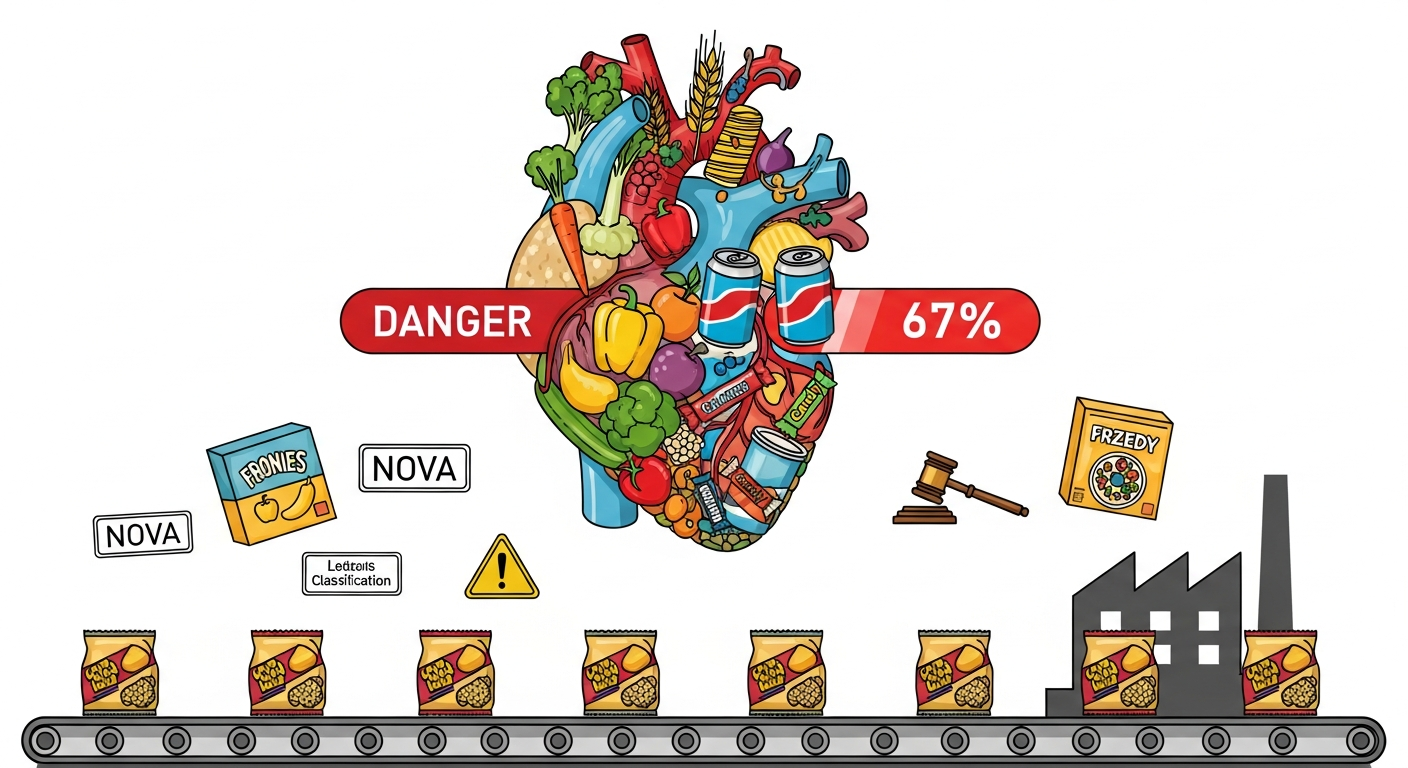
A massive MESA study tracking 6,814 people for 20 years confirms that consuming ultra-processed food more than 9 times a day raises heart attack and stroke risk by 67%. With 70% of U.S. packaged food classified as ultra-processed, this points to systemic failure.
Key Points
Ultra-processed food consumption raises cardiovascular risk by 67%
The MESA cohort study of 6,814 adults aged 45 to 84, tracked over 83,870 person-years, found that those consuming an average of 9.3 servings of ultra-processed food per day were 67% more likely to suffer heart attack, stroke, or cardiovascular death compared to those consuming 1.1 servings. The risk persisted after adjusting for calorie intake and overall diet quality, suggesting an independent risk factor beyond caloric and nutrient composition.
5.1% risk increase per additional daily serving, 6.1% for Black Americans
Each additional daily serving of ultra-processed food increased cardiovascular event risk by 5.1% overall, but by 6.1% among Black Americans compared to 3.2% among non-Black individuals. This racial disparity reflects structural inequality including food deserts, targeted marketing, and limited healthcare access rather than biological vulnerability.
70% of U.S. packaged food is ultra-processed, children get 60%+ calories from UPF
Approximately 70% of packaged products in the U.S. food supply are classified as ultra-processed. More than 60% of calories consumed by American children come from ultra-processed food, with toddlers at 47% and school-age children at 59.4%. This indicates the food system itself is engineered around ultra-processed food rather than being a matter of individual choice.
San Francisco files first municipal UPF lawsuit drawing direct tobacco parallels
In December 2025, San Francisco filed the nation's first municipal lawsuit against 10 major food manufacturers including Kraft Heinz, PepsiCo, Coca-Cola, and Nestle. The lawsuit drew direct comparisons to tobacco litigation, arguing that food companies engineered bliss points to drive overconsumption. Research in The Milbank Quarterly documented direct transfer of personnel, information, and technology from Big Tobacco to the food industry.
FDA ultra-processed food definition effort stalled amid NOVA classification debate
The FDA launched a public comment process in July 2025 to establish an official definition of ultra-processed food, but Secretary Kennedy indicated he would wait for stakeholder consensus. NOVA classification faces criticism for being based on processing degree rather than nutritional content, allowing nutritionally sound foods to be classified as ultra-processed. This ambiguity serves as the food industry's most effective weapon against regulation.
Healthy eating has become a class privilege in a structurally broken food system
Avoiding ultra-processed food requires the privilege of time and money. For low-income households, dual-income families, and food desert residents, ultra-processed food is often the only option. The racial risk gap (6.1% for Black Americans vs. 3.2% for non-Black) exposes this structural problem most sharply, demonstrating that attempting to solve a food problem through food alone evades the root cause.
Positive & Negative Analysis
Positive Aspects
- Government officially placing UPF health risks on the policy agenda
In July 2025, HHS, FDA, and USDA jointly placed ultra-processed food health risks on the official agenda, and January 2026 USDA dietary guidelines explicitly recommended a dramatic reduction in highly processed foods. This signals that the ultra-processed food issue is migrating from academic papers to government policy.
- MESA and other large-scale studies raising scientific evidence quality
The methodological strengths of a multi-ethnic cohort, 20-year follow-up, and multivariable adjustment make the food industry's defense increasingly untenable. Following a 2022 BMJ meta-analysis identifying 32 adverse health outcomes, the MESA study provides cardiovascular-specific risk figures that give policymakers concrete grounds for action.
- Clean label trend and rapid shift in consumer awareness
The clean label trend has gone mainstream, with consumers reading ingredient lists more carefully and food startups positioning minimally processed food as their core value. Some major food companies have begun reformulation efforts to reduce artificial additives. When the market changes, industry follows.
- Individual and municipal lawsuits creating multidirectional legal pressure
Before San Francisco's lawsuit, teenager Bryce Martinez filed what may be the first individual UPF lawsuit in Pennsylvania in December 2024, citing Type 2 diabetes and non-alcoholic fatty liver disease linked to ultra-processed food consumption. Individual and municipal lawsuits proceeding simultaneously are strengthening regulatory momentum against the food industry.
Concerns
- Ubiquity of UPF creates severe feasibility constraints for reduction
With 70% of packaged food being ultra-processed and over 60% of children's calories coming from UPF, the recommendation to reduce is severely limited in feasibility. Fresh food is expensive, perishable, and requires cooking time. For low-income populations and food desert residents, UPF is often the only option, risking the entrenchment of healthy eating as a class privilege.
- NOVA classification limitations as a practical obstacle to policymaking
Because NOVA is based on processing degree, nutritionally sound foods like fortified yogurt and whole-grain bread can be classified as ultra-processed. This ambiguity is the food industry's most effective weapon against regulation. The FDA's delay in establishing a definition buys time for this logic. A February 2026 Food Navigator analysis noted that NOVA criteria are ambiguous and inconsistent.
- Food industry lobbying power rivaling Big Tobacco delays regulation
Ultra-processed food manufacturers rank among America's most powerful lobbying operations, countering regulatory discussions with arguments about employment, food prices, and consumer choice. Given that tobacco regulation required decades of legal battles and social attitude shifts, meaningful UPF regulation could take equally long or longer.
- Structural response to racial health gap remains absent
The additional risk for Black Americans (6.1% vs 3.2%) is a product of food access and socioeconomic inequality, yet current policy discussions focus on ingredients and labeling rather than structural interventions like eliminating food deserts, subsidizing fresh food, or restricting targeted UPF marketing.
- Legal success of UPF lawsuits remains uncertain
Tobacco lawsuits succeeded because internal documents proved intentional concealment of addiction and carcinogenicity. Whether the same level of intentional concealment can be demonstrated against UPF manufacturers is uncertain. The fundamental difference that tobacco is harmful at any level while food consumption is essential poses an unprecedented legal challenge.
Outlook
In the short term (1 to 6 months), the MESA/JACC Advances study will reshape the framing of ultra-processed food regulation discussions. The data presented at ACC.26 will directly influence the FDA's ultra-processed food definition process in the second half of 2026, and the media impact of the 67% figure will accelerate shifts in consumer awareness. When initial court rulings on the San Francisco lawsuit emerge, they will set the direction for subsequent litigation, with successful rulings likely triggering cascading lawsuits from other cities.
Simultaneously, the food industry's response strategy will crystallize in the short term. Major food companies will launch preemptive reformulation announcements for image management, while some will intensify lobbying and research funding aimed at attacking NOVA classification limitations. The clean-label food market will see rapid short-term growth, with ultra-processed-free labels emerging as a new premium marketing tool.
In the medium term (6 months to 2 years), the international spread of ultra-processed food regulation will be the key development to watch. The EU is already strengthening food labeling regulations, and several Latin American countries are adopting Chile's black label warning model. As robust evidence like the MESA study accumulates, regulations such as warning labels and advertising restrictions on ultra-processed food will spread to more countries. There is a possibility that the WHO will issue official guidance on ultra-processed food by 2027.
The food technology industry will also see shifts in the medium term. Investment in food startups built around minimal processing as a core value will surge, and R&D into processing technologies that preserve the food matrix while maintaining convenience will intensify. Some major food companies will incorporate clean-label brands into their portfolios through mergers and acquisitions.
Looking at the long term (2 to 5 years), three scenarios emerge.
In the bull case, success in the San Francisco lawsuit and the FDA's establishment of an official ultra-processed food definition open the floodgates for regulation. Warning labels on ultra-processed food become mandatory, ultra-processed food is excluded from school meals, and advertising of ultra-processed food to children is restricted by law. Social perception begins to shift along the trajectory of tobacco regulation, and ultra-processed food companies undertake large-scale product reformulation. Under this scenario, the percentage of children's calories from ultra-processed food could fall below 40% by the 2030s.
In the base case, regulatory discussions continue but food industry lobbying delays substantive legislation. The FDA establishes a definition of ultra-processed food, but binding regulations based on that definition do not begin until after 2028. Consumer awareness continues to grow, driving the clean-label market to expand by more than 20% annually, but actual reduction in ultra-processed food consumption remains limited. Health disparities improve marginally but persist structurally.
In the bear case, ultra-processed food lawsuits are dismissed by the courts, and the FDA's definition process is indefinitely delayed by industry pushback. The food industry successfully attacks the academic limitations of NOVA classification, weakening regulatory momentum. Ultra-processed food consumption rapidly expands into developing countries, and the global cardiovascular disease burden surges. Under this scenario, ultra-processed food becomes the tobacco of the 21st century — but unlike tobacco, it remains unregulated.
Sources / References
- Association Between Ultraprocessed Food Consumption and Cardiovascular Disease Risk: MESA — JACC: Advances
- Ultra-Processed Foods Linked to Increased CV Risk, Especially Among Black Americans — American College of Cardiology
- Ultra-processed foods linked to 67% higher risk of heart attack and stroke — ScienceDaily
- San Francisco City Attorney sues largest manufacturers of ultra-processed foods — San Francisco City Attorney
- From Tobacco to Ultraprocessed Food: How Industry Engineering Fuels the Epidemic — The Milbank Quarterly
- HHS, FDA and USDA Address the Health Risks of Ultra-Processed Foods — USDA
- The ultra-processed foods debate has nuance — Food Navigator