
Google Just Opened Your Inbox to AI — The Day 2 Billion Gmail Users Became 'Free' Data Pipelines
Summary
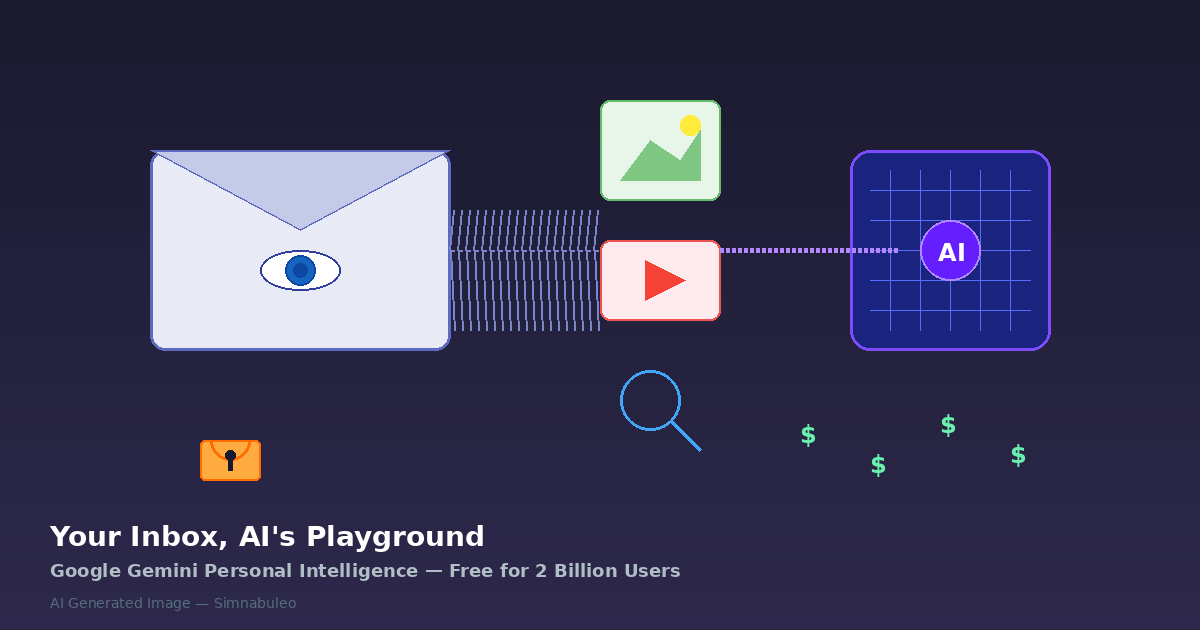
Google Gemini Personal Intelligence is now free for all US users, connecting Gmail, Photos, and YouTube to AI. The convenience is real, but so is the price you might not see on the receipt.
Key Points
Paid Feature Goes Free in 60 Days — Data Is the Real Product
Google launched Gemini Personal Intelligence in January 2026 as a premium feature for paying Gemini Advanced subscribers, then made it free for all US users just two months later on March 17. This rapid free rollout strongly signals that the real revenue model is not subscriptions but the data itself. Google's 2025 advertising revenue was approximately $307 billion, roughly 77% of total revenue. When an AI understands your emails and photos, ad targeting precision reaches previously unimaginable levels. AI-driven advertising is projected to grow 63% in 2026, reaching $57 billion.
The Illusion of Informed Consent
Google emphasizes that Personal Intelligence is strictly opt-in, requiring users to manually grant permissions. But Pew Research (2023) found that 56% of American adults rarely or never read privacy policies before agreeing. The formal checkbox of opt-in has never been the same thing as informed consent, a fact decades of behavioral research have proven. As privacy fatigue accelerates, users gradually click allow on everything, at which point opt-in becomes functionally identical to opt-out. This may be a feature, not a bug.
The Gray Zone of Indirect Learning
Google officially states that Gemini does not train directly on your Gmail inbox or Photos library. However, the questions users ask Gemini and the responses it gives are used for training. The Washington Post analyzed that even if raw email text never enters the training pipeline, reasoning patterns derived from millions of users emails absolutely influence model behavior. Google has not publicly defined the scope of limited prompt and response data, its retention period, or whether derivative data informs future model updates — a fundamental transparency failure.
The Widening US-EU Privacy Protection Gap
Users in the EU, UK, and Japan get stronger privacy protections by default, while American users are comparatively exposed to data collection. When the EU AI Act takes full effect in August 2026 with non-compliance fines of up to 7% of global annual revenue, this gap will become a chasm. The United States still has no federal equivalent. The Trump administration moved in the opposite direction, issuing an executive order in December 2025 discouraging states from regulating AI. Over 300 state-level AI bills are in progress but without unified federal regulation, American consumers remain the most vulnerable.
Apple Intelligence Competition Driving a Privacy Arms Race
Google rushed Personal Intelligence to counter Apple Intelligence. CNBC reported in January 2026 that this was Google's direct challenge to Apple Intelligence. Apple markets on-device processing and your data never leaves your device, while Google does cloud-based processing and promises we do not use your data for training. For consumers, it is nearly impossible to evaluate which claim is more trustworthy, and convenience wins by default. This competition could elevate the entire AI assistant market, but it also risks becoming a privacy arms race where user protection becomes a marketing tool rather than a genuine commitment.
Positive & Negative Analysis
Positive Aspects
- Dramatic reduction in daily cognitive load
The average modern worker receives over 120 emails per day, and the time spent hunting for specific information across those messages is substantial. When Gemini can instantly answer queries by pulling from email, photos, and search history through natural language, it returns time to users. For older users with lower digital literacy, accessing personal data through natural conversation rather than navigating complex app interfaces is a meaningful step toward closing the technology gap.
- Opt-in design and user control
Google adopted an opt-in approach where users must manually grant permissions and can disconnect at any time. Compared to Meta's attempt to use EU user data for AI training which was suspended by Brazilian authorities, Google maintains at least the formality of user choice. While this is not yet genuine informed choice in the meaningful sense, the direction is positive.
- Cross-app AI assistant paradigm shift
An AI that comprehensively understands email, photos, search history, and video viewing habits provides contextual awareness that single-app search simply cannot match. Planning a business trip becomes a single conversation where flight details are extracted from email, photos from past visits are surfaced, and restaurant recommendations from watched YouTube reviews are woven together. This integrated experience makes the old workflow of toggling between apps feel antiquated.
- Competition driving market improvement
As Apple Intelligence, Microsoft Copilot, and Google Personal Intelligence compete, there is potential for a virtuous cycle where both user protection and convenience improve simultaneously. In a competitive landscape, companies are incentivized to differentiate on both capability and trust, which could benefit consumers more than a monopoly environment where user interests take a back seat.
Concerns
- Information asymmetry and transparency failure
Users have no way to technically verify how their data is processed. When Google says it uses limited prompt and response data, it has not defined what limited means, how long that data is retained, or whether derivatives inform model updates. This is a request for trust, not transparency. The track record on trusting tech companies with personal data — from Cambridge Analytica to NSA surveillance pipelines — speaks for itself.
- Suspicious timing of free rollout — data is the real product
Making a paid feature free within two months strongly signals the real revenue model is the data, not subscriptions. Google's 2025 ad revenue was $307 billion, roughly 77% of total revenue. When an AI understands users' emails and photos, ad targeting precision leaps to unprecedented levels, effectively commercializing private context under the guise of more relevant ads.
- Acceleration of privacy fatigue
Every new feature demanding privacy setting reviews gradually numbs users into passivity. Users exhausted by consent fatigue eventually click allow on everything, at which point opt-in becomes functionally identical to opt-out. This outcome may be intentional rather than accidental.
- Expanded security attack surface
If an AI can access emails and photos, attackers who compromise the AI layer gain indirect access to sensitive information. Prompt injection attacks and AI-mediated data exfiltration are scenarios security researchers already warn about. The more personal data an AI system can access, the larger the attack surface becomes.
- Regulatory vacuum for American consumers
The EU AI Act effective August 2026 mandates transparency and human oversight for high-risk AI systems, but the US has no comparable federal legislation. Over 300 state-level AI bills are in progress, but without unified federal regulation, American consumers remain the most vulnerable population in the developed world. Google will likely adopt a dual standard: restricting data access in Europe while maximizing it in America.
Outlook
Over the next six months, Personal Intelligence active users in the US will explode. Google has already signaled that it will expand connections beyond Gmail, Photos, Search, and YouTube to include Docs, Maps, and Calendar. Once that happens, Gemini will understand your schedule, your movement patterns, and your document workflows — essentially comprehending the full spectrum of your digital existence. Competitors will accelerate their responses. Apple is likely to announce Apple Intelligence expansions at WWDC 2026, and Microsoft Copilot will push deeper integration with Office 365 data. By the second half of 2026, an AI assistant that reads all your apps could become the industry standard.
Privacy controversies will intensify during this period. Consumer advocacy groups and congressional attention will grow, and state-level AI data access regulation may pass starting with California. But this will collide with the Trump administration's deregulatory stance, deepening federal-state regulatory conflict. Google will likely respond by enhancing its privacy dashboard and publishing transparency reports. Whether these represent genuine change or regulatory arbitrage masquerading as PR remains to be seen.
Looking out one to two years, the picture becomes considerably more complex. When the EU AI Act takes full effect in August 2026, the privacy protection disparity between European and American users will become stark. With non-compliance fines of up to 7% of global annual revenue, Google will likely adopt a dual standard strategy: restricting data access in Europe while maximizing it in America. This could create a new form of digital inequality called privacy redlining, where citizens of countries with strong regulations are protected while those without become test subjects.
During this period, the AI personal assistant market will mature rapidly. Moving beyond today's app connection level, AI could enter a predictive personalization phase where it learns behavioral patterns and acts preemptively. An AI that has learned your pattern of visiting a particular cafe at a certain time could have your order ready before you arrive. Convenient, but technically indistinguishable from surveillance. The line between service and monitoring dissolves completely. Economically, AI-powered hyper-precise ad targeting will reshape digital advertising. By 2027, the AI-driven advertising market is projected to exceed $90 billion.
Looking three to five years out, the most optimistic scenario sees a global regulatory framework for AI personal assistants forming, establishing clear standards for data access scope and usage purposes. Users would gain genuine data sovereignty with legally guaranteed rights to audit how AI has used their data. The base case sees AI personal assistants becoming as essential as smartphones, making not giving your data to AI functionally equivalent to accepting digital disability. Just as it is now difficult to bank or hail a ride without a smartphone, basic digital services could become inconvenient without an AI personal assistant. The bear case sees data collected by AI personal assistants repurposed far beyond original intent — insurance companies using AI-detected health search patterns to set premiums, employers referencing applicants' AI assistant data in hiring, governments accessing AI data under national security justifications. These are not hypothetical. Historical precedents exist for every single one.
Sources / References
- The privacy risks of Google's Personal Intelligence — Washington Post
- Personal Intelligence: Connecting Gemini to Google apps — Google Blog
- Google launches Personal Intelligence feature in Gemini app, challenging Apple Intelligence — CNBC
- Google's Gemini Personal Intelligence: The Privacy Questions No One Is Asking — Harper Foley
- EU AI Act Takes Full Effect in August 2026: What Changes for Your Privacy — Cambridge Analytica
- Google Makes Gemini Personal Intelligence Free for All US Users — WinBuzzer