
Rejecting Convenience Became the Ultimate Luxury of 2026 — Why Friction-Maxxing Has Its Own Wikipedia Page
Summary
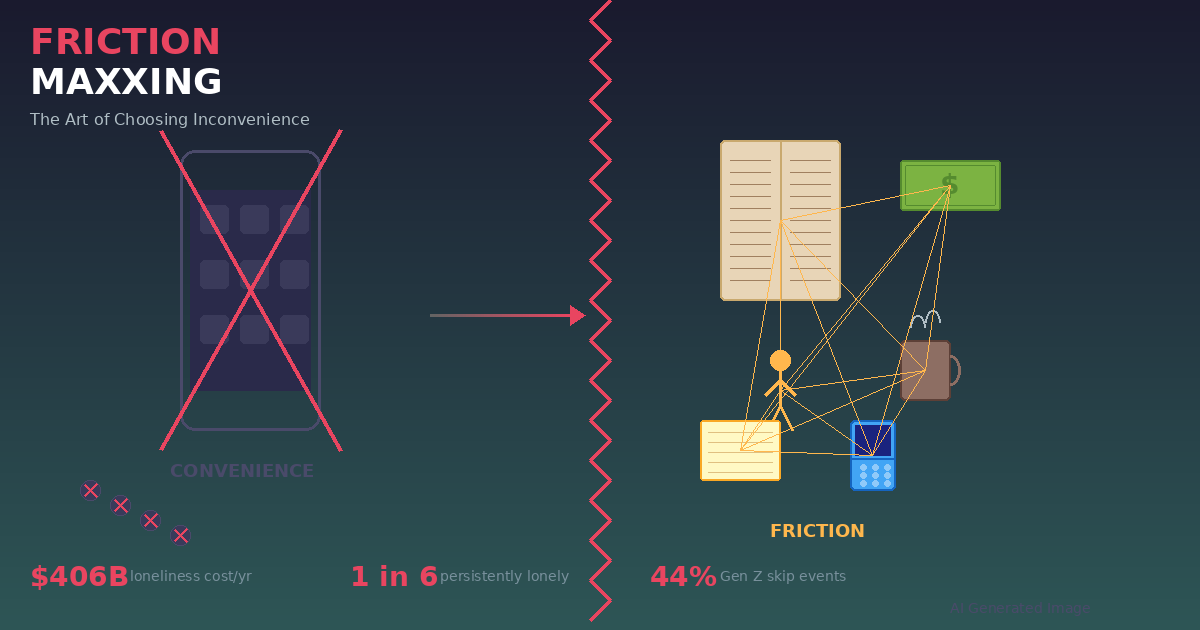
After tech spent a decade removing every friction from life, people realized that friction was life itself. Born in a January 2026 essay in The Cut, friction-maxxing earned its own Wikipedia page within two months, and the act of rejecting convenience is now revealed to be intertwined with the $406 billion loneliness economy.
Key Points
The Birth and Definition of Friction-Maxxing
Coined by The Cut columnist Kathryn Jezer-Morton in January 2026, friction-maxxing is not simply digital detox but an active philosophy of deliberately choosing harder paths. Its essence is building tolerance for inconvenience, where inconvenience means the vagaries of being a person living with other people in spaces impossible to completely control. Cash payments, flip phone switches, and AI summary refusals are its signature practices. The term earned a Wikipedia entry within two months, reflecting how rapidly it resonated. This is interpreted as an instinctive counterattack against technological civilization and an attempt to restore human experience.
Connection to the $406 Billion Loneliness Economy
Loneliness costs the U.S. economy $406 billion annually, and the WHO found that 1 in 6 people worldwide experience persistent loneliness, contributing to 870,000 deaths per year. Fortune reported that a $150 million startup has entered this market, targeting the emerging IRL (In Real Life) economy. Friction-maxxing serves as the consumer-side signal flare of this IRL economy, representing a response to the structural problem where maximizing convenience led to minimizing human connection.
The Shadow of Class Privilege
Andre Spicer, executive dean of Bayes Business School in London, warned that friction-maxxing may be available mainly to high-status workers. Switching to a flip phone requires freedom from instant Slack responses, and insisting on cash payments is a luxury for those not depending on app discounts. With Fortune reporting 44% of Gen Z and millennials skipping social events due to cost, the deliberate choice of inconvenience is meaningless to people whose lives are already structurally inconvenient. Without addressing this gap, friction-maxxing risks becoming experiential asceticism for the privileged.
Cracks in the Friction Removal Equals Innovation Equation
Silicon Valley's absolute premise for the past decade that friction removal equals innovation has begun to crack. Amazon's one-click, Uber's single-tap, Netflix autoplay, and Tinder's swipe stripped away every unnecessary step, but in doing so eliminated the experience of bumping into others in shared spaces. As the IKEA effect demonstrates, process friction elevates outcome value, yet companies ignored this. The fact that consumers are now spending money to reclaim that friction represents a direct challenge to the tech industry's fundamental premise.
The Commodification Paradox and Workplace Conflicts
New business models selling inconvenience are emerging, turning friction itself into a marketing tool. Smartphone-free dinner restaurants charge premium prices and analog lifestyle packages sell as expensive subscription services. This creates an irony where friction-maxxing's original purpose of escaping commercial optimization gets absorbed into yet another form of commercial optimization. Additionally, when individual friction-maxxing choices like preferring in-person meetings or refusing AI tools affect team productivity in workplaces, new conflicts emerge between personal lifestyle rights and organizational efficiency. In remote work environments, one team member's analog insistence can shift additional labor onto others.
Positive & Negative Analysis
Positive Aspects
- Restoration of Human Connection
Handing over cash means making eye contact with the cashier. Walking there yourself means running into neighbors. Using a flip phone means being more present in conversations. In an era when the U.S. Surgeon General warned loneliness carries health risks similar to smoking 15 cigarettes daily, these small restorations of human contact carry significant public health implications. Considering the WHO finding that loneliness contributes to 870,000 deaths annually, each micro-social connection is in reality a lifeline.
- Cognitive Restoration
Reading originals instead of AI summaries, navigating without GPS, and writing notes by hand all require active brain engagement. Brain Wealth topping the Global Wellness Summit's 2026 trends is no coincidence. From a cognitive neuroscience perspective, processes involving friction stimulate the hippocampus and prefrontal cortex more actively, maintaining memory and judgment capabilities.
- Creation of the IRL Economy Market
The IRL economy focused on real-world experiences and encounters rather than online interactions is growing. According to Fortune, a $150 million startup has already entered this market, and 66% of consumers say in-person brand experiences increase their purchase likelihood. An era is opening where accepting only cash becomes a marketing strategy and smartphone-free dinner events become premium services.
- Shift Toward Sustainable Consumption
The core practices of friction-maxxing — going in person instead of ordering delivery, visiting local shops instead of ordering online — naturally reduce carbon footprints. Packaging waste decreases, delivery vehicle trips decline, and local economies are revitalized. Even if the consumer's intent is experience rather than environmentalism, the result is movement toward sustainability.
Concerns
- Inseparability from Class Privilege
As Andre Spicer of Bayes Business School pointed out, this trend is primarily available to high-status workers. Switching to a flip phone is possible for those who won't be fired for not responding instantly to Slack. Insisting on cash payments is affordable for those not depending on app discounts. With 44% of Gen Z and millennials skipping social events due to cost, living inconveniently on purpose is meaningless to people whose lives are already structurally inconvenient.
- Risk of Anti-Intellectual Tech Regression
Read the original instead of AI summaries is a good practice, but extending this to blanket AI is harmful sentiment creates problems. If the push to add friction spreads to areas where convenience saves lives — medical diagnostics, climate modeling, disaster warnings — that is danger not romanticism. Some communities already advocate extreme positions like making hospital appointments by phone only and quitting online banking, which is voluntarily surrendering access.
- Corporate Commodification Paradox
As new business models emerge around selling inconvenience, friction itself becomes another marketing tool. Smartphone-free dinner restaurants charge premium prices and analog lifestyle packages sell as expensive subscriptions. Friction-maxxing's original purpose of escaping commercial optimization ironically gets absorbed into yet another form of commercial optimization. The moment escape from convenience becomes another consumer product, the movement falls into self-contradiction.
- New Workplace Conflicts
When individual choices to prefer in-person meetings, read documents directly, and not use AI tools affect entire team productivity, this becomes organizational inefficiency. In remote work environments, one team member's analog insistence can shift additional labor onto others. The tension between individual friction-maxxing rights and organizational efficiency is something no one is seriously addressing yet.
Outlook
In the short term, over the next 1 to 6 months, friction-maxxing will expand into a broader cultural phenomenon. Having already earned a Wikipedia entry and coverage from Slate, Fortune, Cybernews, and KQED, the term is likely to become everyday vocabulary by the first half of 2026. Cafes and restaurants declaring smartphone-free zones will multiply, and cash-only stores will emerge as marketing differentiators. The flip phone market deserves attention too — as of February 2026, search interest for flip phone design hit a peak score of 92, and book-style foldables are projected to capture 65% of the foldable market by end of 2026. The near-term risk is trend fatigue from media overexposure. Once every brand starts leveraging friction-maxxing in marketing, consumers may react with backlash.
In the medium term, looking 6 months to 2 years out, friction-maxxing will serve as a growth engine for a new industrial category called the IRL economy. Considering loneliness currently costs the U.S. economy $406 billion annually, there is explosive growth potential for startups solving this problem. The $150 million loneliness-solving startup Fortune reported on is just the beginning. Korean AI entertainment startup Wrtn has reportedly surpassed $100 million ARR riding the loneliness economy boom.
The base case scenario is friction-maxxing establishing itself as a wellness industry subcategory. The bull case is this movement influencing urban design and public policy, merging with the walkable city movement. The bear case is excessive corporate commodification diluting its purpose, with growing criticism of it being a game for the privileged leading to cultural backlash.
Looking 2 to 5 years ahead in the long term, friction-maxxing's true legacy won't be the term itself but a redefinition of convenience. The tech industry's absolute premise that friction removal equals innovation has begun to crack. If this fissure deepens, by 2028-2030 it could become commonplace for tech companies to introduce intentional friction into product design. Some social media platforms already implement intentional friction such as read the article before commenting prompts and disable autoplay options.
The most important long-term variable is AI development pace. The more AI replaces human cognitive labor, the more the value of things done by humans directly rises in inverse proportion. Just as handwritten letters became more precious than emails, an era is coming where things directly experienced by humans will carry a premium over things optimized by AI. This means that even after friction-maxxing as a term disappears, the fundamental question it raised — what lies at the end of convenience — will continue to follow us.
Sources / References
- Americans are skipping social events because they can't afford it — Fortune
- Why my $150 million startup thinks it can solve the $406 billion loneliness problem — Fortune
- Friction-maxxing — Wikipedia
- Friction-maxxing: why 2026 is embracing inconvenience to feel more human — Cybernews
- A quiet revolution: Why young people are swapping social media for lunch dates — CNBC
- The Future of Wellness 2026 Trends — Global Wellness Summit
- Our Epidemic of Loneliness and Isolation — U.S. Surgeon General