
Cocoa Prices Crashed 70% but Your Chocolate Got More Expensive — Consumers Never Win This Game
Summary
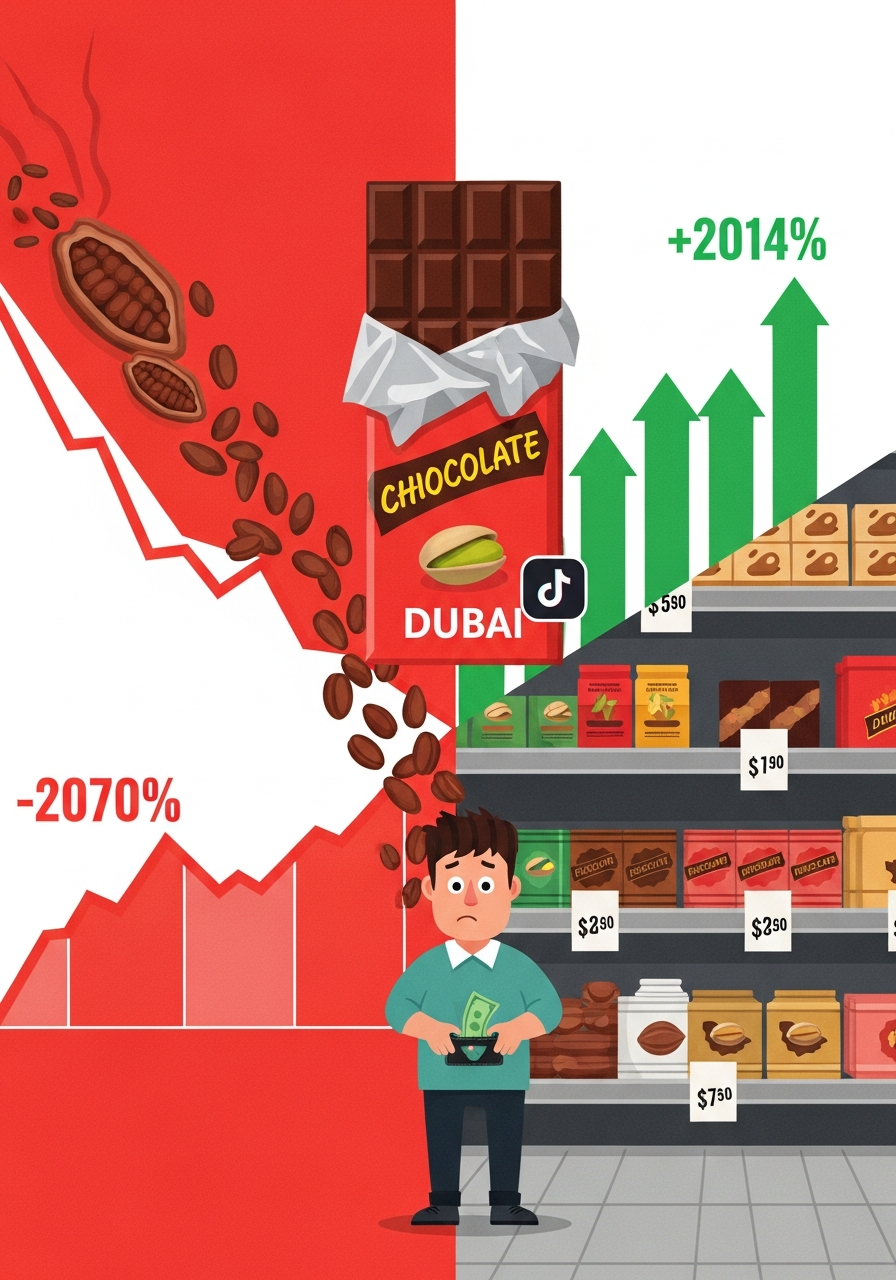
A single TikTok viral shook the global pistachio market, cocoa commodity prices crashed 70%, yet consumer chocolate prices rose 14%. Behind this paradox lies the food industry's structural price asymmetry — a rigged game where consumers always lose.
Key Points
TikTok Has Become the Food Industry's Unofficial R&D Department
Fix Dessert Chocolatier's Dubai chocolate racked up 120 million TikTok views from a single video and fundamentally reshuffled the global food industry landscape. Hundreds of global chains — Starbucks, Shake Shack, Popeyes, Krispy Kreme — scrambled to launch their own Dubai chocolate variations. The ripple effects were staggering: international pistachio prices surged 34%, and U.S. pistachio supply dropped 20%. Traditionally, food trends originated from Michelin-starred chefs or corporate R&D labs, filtered through years of market research and taste tests. Now, a single TikTok creator can compress that entire pipeline into a matter of days. This paradigm shift opens unprecedented global market access for small artisan brands, but it simultaneously reveals a dangerous flip side — viral trends can trigger completely unpredictable supply chain disruptions across seemingly unrelated industries.
Cocoa Down 70% vs. Chocolate Up 14% — The Anatomy of Price Asymmetry
Cocoa futures plummeted more than 70% from their early 2025 all-time highs, yet the U.S. Consumer Price Index shows chocolate prices rose 14% year-over-year. The structural causes behind this paradox break down into three layers. First, manufacturers locked in long-term futures contracts during the 2024 cocoa price spike, meaning they cannot immediately benefit from current spot price declines. Second, cocoa represents only 10-15% of total chocolate production costs — sugar, dairy, energy, packaging, and logistics make up the rest, and those non-cocoa costs are climbing. Third, and this is the most uncomfortable truth, the Big Three manufacturers (Mars, Mondelez, Ferrero) control over 40% of the global market, creating an oligopoly structure with zero incentive to lower prices. What economists call 'downward price rigidity' has become structurally embedded across the entire food industry.
Climate Change Is Threatening Chocolate's Very Existence
West Africa produces roughly 70% of the world's cocoa, and production in Cote d'Ivoire and Ghana has declined by as much as 40% in recent years. Cocoa trees require an extremely narrow climate window — temperatures between 20-30 degrees Celsius and annual rainfall of 1,500-2,000mm — and the West African cocoa belt has seen average temperatures rise 1-1.5 degrees over the past 50 years. Climate scientists warn that if this trend continues, most current major cocoa-growing regions could become unsuitable for cultivation by 2050. The biology of cocoa makes this crisis especially intractable: trees take 3-5 years to bear fruit, meaning once supply shortages begin, recovery takes years. This is not a short-term price fluctuation — it is a structural crisis threatening the long-term viability of an entire industry.
Cocoa-Free Chocolate Has Crossed from Science Fiction into Commercial Reality
Italian startup Foreverland is already selling its carob-based cocoa-free chocolate 'Choruba' in the UK market, with plans to expand across five European countries by the end of 2026. The National University of Singapore (NUS) has developed carob flavor enhancement technology that replicates chocolate taste without cocoa, with commercialization through licensing expected by the first half of 2027. Cell-cultured cocoa technology is also advancing, with startups like California Cultured entering pilot production, backed by partnerships with Puratos and Meiji. Meanwhile, CRISPR-based heat-resistant cocoa variety research is underway through a UC Berkeley and Mars collaboration, alongside Mars's partnership with biotech firm Pairwise. According to Food Ingredients First, the cocoa-free chocolate market is projected to grow at 15-20% annually between 2026 and 2028, with the twin pressures of climate change and cocoa supply instability accelerating this innovation wave.
Angel Hair Chocolate — The Battle for the Next Viral Throne
As Dubai chocolate's viral lifecycle enters maturity, the competition for its successor has begun in earnest. Social media mentions of Angel Hair chocolate surged 3,900%, driven by the product's visually stunning ultra-thin, silk-like chocolate strands that are perfectly optimized for TikTok's short-form video format. However, there is an important distinction: while Dubai chocolate transformed the industry landscape through its combination with pistachio as a premium ingredient, Angel Hair relies primarily on visual novelty. Visual-based virals tend to generate fatigue faster than ingredient-driven ones. The probability of Angel Hair inheriting the viral throne by summer 2026 sits at roughly 60%, but its staying power remains an open question. The acceleration of viral food trends is becoming a new source of instability for commodity markets, as each new cycle brings the potential for fresh supply chain disruptions.
Positive & Negative Analysis
Positive Aspects
- Unprecedented Global Launchpad for Small Artisan Brands
Fix Dessert Chocolatier went from a small local shop in Dubai to a global brand through TikTok virality. What would have taken decades through traditional marketing channels, social media accomplished in weeks. This gives artisan food creators worldwide a realistic sense that 'I could be next.' Since the Dubai chocolate phenomenon, local chocolate brands across the Middle East, Southeast Asia, and Latin America have been aggressively adopting TikTok-first strategies. The democratization of food marketing is real, and it is reshaping who gets to compete on the global stage.
- The Cocoa Crisis Is Accelerating Alternative Ingredient Innovation
The dual pressure of cocoa price volatility and climate change is turbocharging research into alternative ingredients. Foreverland's Choruba, NUS's carob flavor enhancement technology, and cell-cultured cocoa from California Cultured represent diverse innovation pathways converging on the same goal. According to Food Ingredients First, the cocoa-free market is projected to grow at 15-20% annually between 2026 and 2028. If these innovations succeed at scale, they could lower the industry's vulnerability to climate-driven supply disruptions while maintaining the chocolate experience consumers love.
- The Price Paradox Is Sparking a Public Conversation About Food Industry Transparency
The cocoa price paradox has received intense scrutiny from global media, significantly raising consumer awareness about how pricing mechanisms actually work in the food industry. The fundamental question — 'if commodity prices drop, why doesn't the product on my shelf get cheaper?' — has been spotlighted across outlets including the Food Institute, Euronews, and numerous financial publications. This kind of sustained public attention can eventually translate into real pressure on corporate pricing policies. Long-term, this growing scrutiny is likely to contribute to greater transparency across the food sector.
- Consumer Willingness to Pay for Premium Ingredients Is Expanding
Dubai chocolate's runaway success proved that consumers are willing to pay premium prices for quality ingredients and unique experiences. The combination of pistachio cream and kadayif noodles was recognized as delivering genuine value, not just hype. This sent a clear signal to an industry that had been trapped in a race to the bottom on price: differentiate with better ingredients, and consumers will respond. The shift toward quality-driven competition is a genuinely positive development for the food industry and for consumers who want options beyond mass-market mediocrity.
- New Economic Opportunities in Alternative Crop Agriculture and the Carob Industry
The growth of the cocoa-free chocolate market is creating new economic pathways for farmers growing alternative crops like carob. Carob is cultivated in the Mediterranean region, requires less water than cocoa, and has significantly higher climate resilience. As cocoa cultivation becomes increasingly difficult in traditional growing regions, farmers gain a viable transition pathway to alternative crops. This opens opportunities for agricultural diversification and climate adaptation simultaneously, potentially building more resilient food systems for the long term.
Concerns
- Viral Trends Are Disrupting Agricultural Supply Chains in Unpredictable Ways
The 34% spike in pistachio prices didn't just affect chocolate makers — it hammered completely unrelated industries. Middle Eastern baklava producers, ice cream manufacturers, and countless other businesses that depend on pistachios saw their cost structures destabilized by a TikTok trend they had nothing to do with. This 'viral inflation' is emerging as an entirely new category of supply chain risk. The food commodity market is now haunted by a persistent anxiety: 'what's going to be the next shortage?' The unpredictability of social media-driven demand shocks has added a layer of fragility to global food systems that didn't exist a decade ago.
- The Cocoa Price Paradox Is Becoming Structurally Permanent
With the Big Three chocolate manufacturers (Mars, Mondelez, Ferrero) controlling over 40% of the global market, the asymmetric pricing strategy — pass cost increases to consumers, pocket cost decreases as profit — has become an industry standard. Bloomberg analysis shows that these companies' operating margins barely contracted even during the cocoa price spike. If this structure becomes permanently entrenched, the disconnect between commodity prices and consumer prices becomes permanent too. Consumers find themselves in a game they cannot win regardless of what happens in raw material markets.
- West African Cocoa Farmers Face an Existential Survival Crisis
At the very bottom of the cocoa price paradox are the West African cocoa farmers. Even during the price surge, their incomes didn't rise proportionally — middlemen and export traders captured the gains. Now, with prices crashing, their survival is directly threatened. Layer on climate change-driven yield declines, and these farmers face a triple crisis. Given that this region produces 70% of the world's cocoa, the collapse of these farming communities could deepen the fragility of the entire global supply system, creating a feedback loop where supply instability feeds price volatility, which further destabilizes farming communities.
- Climate Change Creates Long-Term Instability for Chocolate Raw Materials
Average temperatures in the West African cocoa belt have risen 1-1.5 degrees over the past 50 years, and projections suggest that most current major cocoa-growing regions could become unsuitable for cultivation by 2050. The 3-5 year fruiting cycle of cocoa trees means that once supply shortages begin, recovery takes years — there is no quick fix. Add in the increasing irregularity of El Nino patterns, and a scenario where cocoa prices re-spike in 2028-2029 becomes very plausible. In that case, consumer chocolate prices could surge 20-30%, with no cocoa-free alternatives yet at sufficient scale to provide relief.
- Angel Hair and Successive Viral Trends Risk Overheating the Market
The 3,900% surge in Angel Hair chocolate social media mentions demonstrates how viral food trends are accelerating in frequency and intensity. The problem is that as these trends hit in rapid succession, they can create repeated cycles of speculative demand and supply chain disruptions across commodity markets. As companies begin attempting 'viral engineering' — deliberately manufacturing trends rather than letting them emerge organically — the authenticity that makes virals compelling starts to evaporate. When consumers catch on and fatigue sets in, the effectiveness of viral marketing as a whole diminishes, potentially weakening one of the food industry's most powerful innovation engines.
Outlook
Let's start with what's going to happen in the next few months. Dubai chocolate's viral lifecycle has already entered its maturity phase. The peak ran from late 2025 through early 2026, and now that major chains have adopted the product, it has entered the "mass market stage." This follows the classic pattern of viral food trends — just as cronuts, tanghulu, and mala tang saw explosive growth followed by stabilization, Dubai chocolate is tracking the same trajectory. I expect Dubai chocolate-related sales to decline 30-40% from their peak by the second half of 2026. But it won't disappear entirely. Just as the cronut remains Dominique Ansel Bakery's signature item, Dubai chocolate will remain a permanent fixture on Fix Dessert Chocolatier's menu.
The contender eyeing that vacant throne is Belgian brand Tucho's Angel Hair chocolate. According to Tastewise data, social media mentions surged 3,900% in 2025. The ultra-thin, silk-like chocolate strands are visually shocking, making it perfectly optimized for TikTok's short-form format. I give Angel Hair chocolate roughly a 60% chance of succeeding Dubai chocolate as the viral king by summer 2026. However, I doubt it will deliver the same level of industry-reshaping impact. Dubai chocolate's real power came from its marriage with pistachio — a premium ingredient that created genuine culinary value. Angel Hair relies primarily on visual novelty, and visual-based virals tend to generate fatigue far more quickly.
The cocoa commodity market will remain volatile in the short term. Cocoa futures are currently hovering around $3,000-4,000 per ton, having dropped dramatically from the early 2025 highs above $12,000 per ton. Improved crop forecasts for the 2025-2026 season in major West African growing regions are keeping prices suppressed. However, the likelihood of consumer chocolate prices declining accordingly is extremely low. Here's the scenario I expect to play out: manufacturers will maintain current retail prices for 2-3 quarters under the guise of "price stabilization," then execute de facto price increases through new premium line launches and product renewals. This is the textbook "stealth inflation" — or shrinkflation — strategy that the food industry has perfected over the past decade.
To put the numbers in perspective, according to the U.S. Bureau of Labor Statistics, chocolate and chocolate products within the CPI rose 14% year-over-year as of early 2026, while cocoa futures had already shed over 70% from their peaks. The USDA Economic Research Service projects that confectionery prices will remain elevated through Q3 2026 at minimum, with any pass-through of lower cocoa costs likely to be partial and delayed by 12-18 months at best. Meanwhile, Mordor Intelligence estimates the global chocolate market at roughly $140 billion in 2026, growing at a CAGR of 4-5%. Even a 1% margin improvement across that base represents over a billion dollars — which explains exactly why the Big Three have zero urgency to lower shelf prices.
Moving to the medium-term outlook of 6 months to 2 years, truly fascinating developments begin to emerge. The cocoa-free chocolate market will enter its serious commercialization phase. Foreverland's Choruba is already selling in the UK market, and the company is operating an IFS-certified production facility in Puglia, Italy, capable of producing over 500 tons annually. Foreverland recently secured EUR 6 million in fresh funding and plans to expand distribution across five major European countries by the end of 2026. NUS's carob-based chocolate flavor improvement technology could be commercialized through licensing agreements by the first half of 2027. Cell-cultured cocoa technology is also progressing, with California Cultured at the pilot production stage, backed by partnerships with Puratos and Meiji, and targeting the start of small-scale commercial production between 2027 and 2028.
Another medium-term development worth close attention is the strategic pivot of major chocolate manufacturers. Mars, Mondelez, and Ferrero have maintained cocoa-dependent business models for decades, but they now face the dual pressure of climate instability and the rise of viable cocoa-free alternatives. I predict that by 2027, at least one of these Big Three will officially launch a cocoa-free or cocoa-blend product line with reduced cocoa content. This represents both a crisis and an opportunity for these companies. Reducing cocoa dependency lowers raw material price volatility risk, and creates a compelling ESG narrative that resonates with sustainability-minded consumers. Mondelez is already expanding its "sustainable sourcing" program, and a cocoa-free line would be a natural extension. The cost math is also increasingly favorable: Vesper Tool's chocolate cost models show that non-cocoa alternatives could reduce ingredient costs by 30-45% while maintaining acceptable taste profiles.
The medium-term outlook for TikTok-based food virals also deserves serious consideration. I expect food companies to establish dedicated "viral engineering" departments between 2027 and 2028. Currently, virals are largely accidental and unpredictable, but as companies build analytical capabilities around TikTok algorithms and consumer response data, "intentional viral design" will become increasingly feasible. Starbucks's seasonal limited-edition menu strategy is already evolving in this direction. The problem is that once this transition happens, the authenticity that makes virals compelling starts to evaporate. As reviews like "I tried it because it was trending on TikTok and it was nothing special" proliferate, the effectiveness of viral marketing itself will erode — a classic case of the medium undermining its own message.
Looking at the long-term horizon of 2 to 5 years, the chocolate industry could look fundamentally different from what we know today. The most dramatic scenario is the climate change-driven cocoa "extinction scenario." According to the CIAT/CGIAR study cited by Down To Earth, if current warming trends continue, global cocoa cultivation area could shrink to 40-60% of current levels between 2040 and 2050. Climate Central's analysis confirms that West Africa's cocoa belt is heating up at an alarming rate. In this scenario, pure cocoa chocolate would become an extremely expensive luxury ingredient — like saffron today — and the mass market would be filled by cocoa blends or cocoa-free products. This won't fully materialize within 3-5 years, but the transition in that direction has already begun, and every year of inaction accelerates the timeline.
Let's examine the three scenarios in detail. The bull case envisions cocoa-free technology commercializing faster than expected, capturing 5-8% of the global chocolate market by 2028. Foreverland, California Cultured, and NUS-licensed products gain mainstream retail distribution. The Big Three respond by launching their own cocoa-free lines, and a virtuous cycle of innovation and consumer adoption pushes market share higher. Consumer chocolate prices stabilize or even decrease for the first time in a decade as competition from alternatives puts downward pressure on pricing. I put this scenario at roughly 20% probability. The technology exists, but consumer acceptance remains the biggest hurdle — people are deeply attached to "real" chocolate, and the taste gap, while narrowing, hasn't fully closed.
The base case sees cocoa-free chocolate remaining in its niche at 1-3% market share, while conventional chocolate prices continue their steady 3-5% annual climb. Major manufacturers maintain their margins through a combination of shrinkflation — Confectionery News has documented how the average chocolate bar has lost 10-15% of its weight over the past three years while prices held steady or rose — and selective premium repositioning. TikTok-driven viral cycles continue at their current pace but with diminishing per-cycle impact as consumer fatigue builds. Cocoa prices remain in the $3,000-5,000 range barring another climate shock. This is the most likely scenario at approximately 55% probability. It's the most boring and frustrating outcome from a consumer perspective, but given the food industry's enormous inertia, it's the realistic bet.
The bear case involves climate change hitting cocoa production faster than expected, triggering another cocoa price surge in 2028-2029. El Nino pattern irregularities — already more unpredictable than at any point in the past century — could deliver a one-two punch of drought in West Africa and flooding in Southeast Asian growing regions. This time, consumer prices surge 20-30%, and cocoa-free alternatives haven't yet reached sufficient scale to absorb the demand overflow. Smaller chocolate companies fold, consolidation accelerates, and the Big Three's market share grows past 50%, further entrenching their pricing power. Meanwhile, West African cocoa farming communities face mass abandonment as younger generations, already reluctant to take up the grueling work, permanently exit the sector. I put this at approximately 25% probability, and given the accelerating pace of climate disruption, it's a scenario that deserves far more attention than it's currently getting.
Several wild cards could invalidate all three scenarios. If massive markets like China or India experience explosive growth in chocolate consumption, the demand side of the equation changes dramatically. China's per capita chocolate consumption currently stands at roughly 0.2 kg — compared to the European average of about 7 kg. If the Chinese market reaches even the Japanese or Korean level of approximately 2 kg per capita, global cocoa demand would spike 15-20%, instantly reversing any price decline trend. India, with its 1.4 billion population and rapidly expanding middle class, presents a similar demand-side wildcard.
Gene-editing technology also holds transformative potential. CRISPR-based cocoa variety improvement research is underway through a UC Berkeley Innovative Genomics Institute and Mars collaboration, along with Mars's 2025 partnership with biotech firm Pairwise. If heat-resistant cocoa varieties can be developed and deployed at scale, the climate change scenario softens considerably. Field trials could begin by 2028, though commercial-scale deployment would take significantly longer.
The regulatory landscape adds another layer of complexity. The EU's Deforestation Regulation (EUDR) is scheduled for full enforcement starting December 2026 for large enterprises and June 2027 for SMEs. Once fully operational, it will impose additional costs on West African cocoa exports to the EU. Farmers must prove deforestation-free production, requiring traceability systems that could add $50-100 per ton. These costs will almost certainly be passed through to consumers. However, this regulation actually favors cocoa-free chocolate — carob and cell-cultured cocoa have no connection to deforestation, giving them a structural cost advantage in the European market. White & Case's analysis of the EUDR's impact on African food security suggests the regulation could accelerate the adoption of alternative ingredients faster than market forces alone would achieve.
The spillover effects into adjacent industries also warrant attention. The chocolate price paradox is echoing across other premium food commodities — coffee, vanilla, and olive oil are all exhibiting similar patterns. Arabica coffee bean prices hit record highs in 2025-2026, then corrected, but cafe prices only went up. This industry-wide price asymmetry is building both consumer frustration and political pressure. Within the next 2-3 years, food price transparency legislation is likely to be introduced in major markets. France has already implemented the EGAlim law mandating agricultural cost disclosure, and this model could expand EU-wide. Sierra Club's reporting on how climate change is reshaping chocolate costs adds further momentum to the transparency movement.
One dimension that often gets overlooked in discussions about the chocolate industry is the role of financialization in cocoa markets. Cocoa futures are not just traded by chocolate manufacturers hedging their supply costs — they are actively traded by hedge funds, algorithmic trading firms, and commodity speculators who have no connection to the physical chocolate supply chain. J.P. Morgan's research on cocoa prices highlights how speculative positioning amplified the 2024 price spike far beyond what supply-demand fundamentals would have dictated. When prices were surging, speculative long positions piled on, driving prices to levels that even industry insiders described as disconnected from physical market realities. Now that prices have corrected, the same dynamic works in reverse — but the crucial asymmetry is that manufacturers already locked in contracts at inflated prices, while speculative traders simply exited their positions and moved on to the next opportunity.
This financialization of food commodities creates a structural disadvantage for both producers and consumers. Farmers in Cote d'Ivoire sell their cocoa at prices set by distant commodity exchanges they have no influence over. Consumers pay retail prices set by manufacturers who use commodity volatility as a one-way ratchet — prices go up with the market but never come back down with it. The only consistent winners are the financial intermediaries and the largest manufacturers with enough market power to set their own terms.
The intersection of viral culture and commodity markets also points to an emerging phenomenon worth tracking: what we might call "meme commodities." Just as Bitcoin and GameStop demonstrated how social media-driven attention can create massive, rapid repricing in financial assets, Dubai chocolate and its pistachio supply shock demonstrate the same dynamic in physical commodity markets. The difference is that financial meme assets affect traders and investors, while meme commodities affect the cost of food that ordinary people need to eat. As TikTok's user base continues expanding — now exceeding 1.5 billion monthly active users — the potential for viral-driven commodity disruptions only grows. This is a new risk category that traditional supply chain management frameworks were simply not designed to handle.
Here's what I want readers to take away from all of this. Next time you're at the store buying chocolate, check whether the price has come down. If cocoa prices have crashed 70% and the chocolate on the shelf hasn't budged, that's direct evidence of the structural problem I've been describing. And if you spot cocoa-free chocolate, give it a try — not just as a novelty, but as a conscious choice. That's the most concrete way any of us can participate in changing the rules of the chocolate industry's deeply rigged game. The paradox of cheaper ingredients and more expensive products isn't an accident. It's a feature of a system that was never designed to benefit the people who actually eat the chocolate.
Sources / References
- Why Are Cocoa Prices Falling? — J.P. Morgan Global Research
- Cocoa Prices Crash After 2024 Record Highs as Demand Slump Hits Global Chocolate Market — Bakery and Snacks
- Consumer Price Index: 2025 in Review — U.S. Bureau of Labor Statistics
- Food Price Outlook — Summary Findings — USDA Economic Research Service
- Dubai Chocolate Craze Causes Global Pistachio Shortage and Scams — Food Navigator
- Dubai Chocolate — Wikipedia
- Is Angel Hair Chocolate the Next Big Confectionery Trend? — Food Navigator
- Foreverland Lands EUR 6M to Tackle Cocoa Supply with Alternatives — Tech.eu
- Chocolate Alternative Innovation Accelerates as Food Innovators Tackle Cocoa Disruption — Food Ingredients First
- Cocoa, Minus the Beans: California Cultured Plans Launch in 2026 — AgFunder News
- Candy Giant Mars Partners with Biotech Firm to Gene-Edit Cocoa Supply — CNBC
- Climate Change Threatens Cocoa Production in West and Central Africa by 2050, Study Reveals — Down To Earth (CIAT/CGIAR study)
- Climate Change Is Heating Up West Africa's Cocoa Belt — Climate Central
- Confectionery's Cost Crisis: Cocoa Shortages, Shrinkflation and Pricing Strategies in 2025 — Confectionery News
- Why Is Chocolate So Expensive — and Where Have Prices Risen Most? — Euronews
- European Deforestation Regulation: Implications for Africa's Food Security — White & Case LLP
- Fix Dessert Chocolatier — The Original Dubai Chocolate — Fix Dessert Chocolatier
- Chocolate Market Size, Trends, Share — 2031 Report — Mordor Intelligence
- The True Cost of Manufacturing Chocolate Bars with Cost Models — Vesper Tool
- Climate Change Is Reshaping How Much Chocolate Costs and What It's Made Of — Sierra Club