
Bombs Fell on the City a Safavid King Called 'Half the World'
Summary
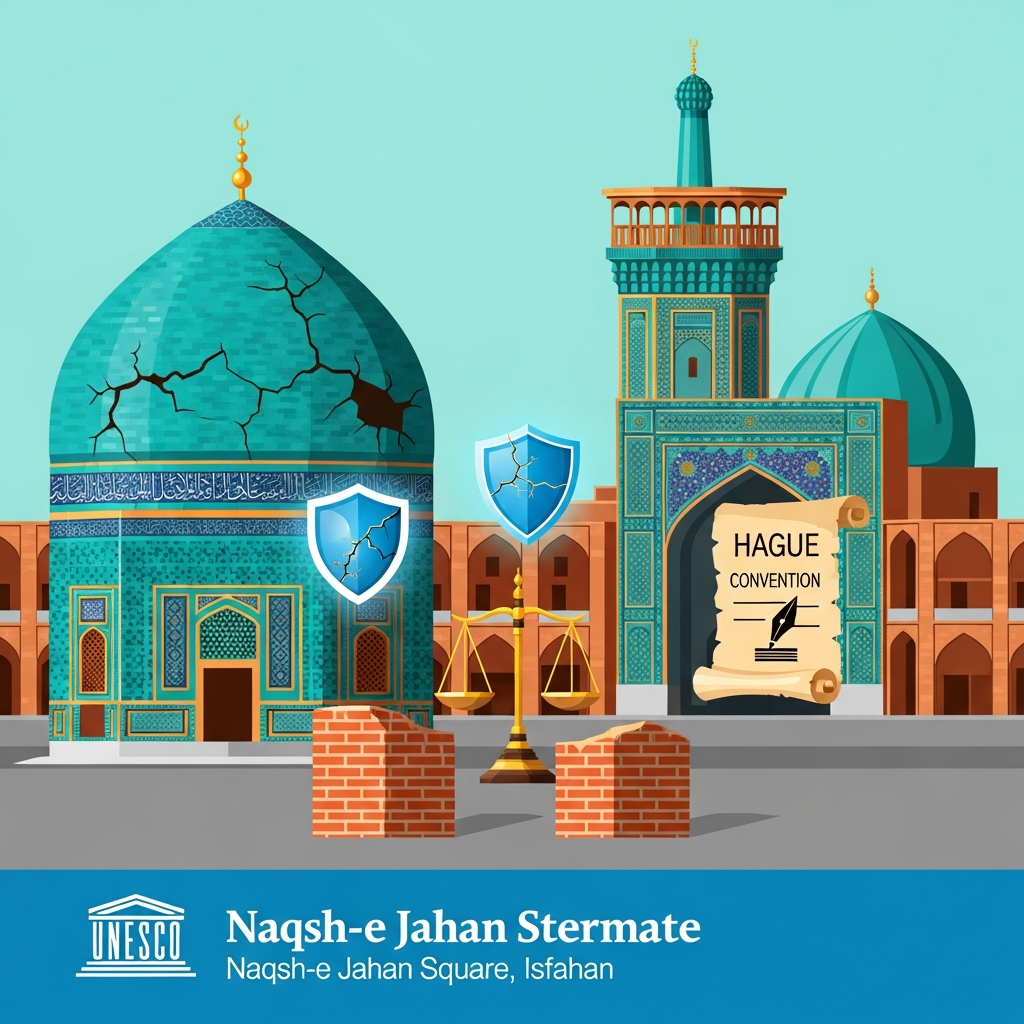
In March 2026, the Naqsh-e Jahan Square in Isfahan, Iran — a UNESCO World Heritage Site built by Safavid Shah Abbas I in 1598 — sustained severe structural damage from U.S.-Israeli airstrikes officially directed at nuclear infrastructure near Natanz, some 120 kilometers away. More than 140 museums and heritage sites across Iran were reported damaged, including five UNESCO World Heritage properties, and over 100 international legal experts issued a joint statement warning the destruction may constitute potential war crimes under the 1954 Hague Convention and the Rome Statute. Western governments, however, responded with near-total silence — a silence that stands in stark contrast to the swift and vocal condemnation those same governments directed at Russia when its forces damaged Ukrainian cultural heritage sites from 2022 onward. This asymmetry exposes a structural double standard at the core of the international cultural heritage protection framework, one in which accountability is applied selectively based on the perpetrator's geopolitical alignment rather than the universal value of what was destroyed. The fractures in Naqsh-e Jahan's 17th-century tilework are not only physical wounds; they are visible cracks in the post-World War II promise that humanity's shared cultural legacy stands above the politics of any single conflict.
Key Points
The Structural Double Standard in International Cultural Heritage Law
The 1954 Hague Convention and the 1998 Rome Statute together form the legal backbone of international cultural heritage protection, mandating respect for cultural property during armed conflict and classifying intentional destruction as a war crime. But the enforcement record of these instruments reveals a pattern so consistent it is no longer plausible to attribute to coincidence: when ISIS destroyed Palmyra in 2015, when the Taliban dynamited the Bamiyan Buddhas in 2001, when Russian forces damaged Ukrainian heritage sites from 2022 onward, international condemnation and legal accountability frameworks mobilized with notable speed. What these cases share is not the severity of the destruction but the geopolitical status of the perpetrator — all were entities Western governments had already designated as adversaries. The March 2026 airstrikes that damaged Isfahan's Naqsh-e Jahan and over 140 other Iranian heritage sites break that pattern definitively, and the resulting silence from Western governments exposes the mechanism. The problem is not the content of the law but the enforcement will, which tracks political allegiance far more reliably than it tracks the historical significance of what was destroyed. The structure of international criminal accountability since Nuremberg has fundamentally been one in which victors judge the defeated, and this architecture has reproduced itself in cultural heritage enforcement with uncomfortable fidelity. When over 100 legal experts issue a joint warning of potential war crimes and the UN Security Council cannot even pass a statement because of veto dynamics, the gap between the law's written principles and its operational reality becomes impossible to close with rhetorical commitment alone.
Naqsh-e Jahan Square: Historical Significance and Extent of Damage
Naqsh-e Jahan Square — "Image of the World" in Persian — was conceived and constructed by Shah Abbas I between 1598 and 1629 as a complete urban statement integrating the religious, political, and commercial dimensions of a civilization at its zenith. At approximately 89,600 square meters, it ranks as the second-largest historic public square in the world after Beijing's Tiananmen, and its design — placing the Imam Mosque, Sheikh Lotfollah Mosque, Ali Qapu Palace, and the Grand Bazaar in deliberate spatial relationship — represents the definitive expression of Safavid urban philosophy and the synthesis of Shia Islam with Persian civilization. UNESCO's 1979 World Heritage designation recognized not merely the age of the structures but their function as a living textbook of Islamic architectural and civic design. The March 2026 airstrikes, though directed at infrastructure near Natanz 120 kilometers away, generated shockwaves that caused structural damage to the Abbasi Jame Mosque and Ali Qapu Palace, produced cracks in the frescoes of Chehel Sotoun Palace, and destroyed sections of haft-rangi tilework — a seven-color ceramic technique that fewer than ten craftspeople in Iran today can reproduce. The Art Newspaper reported the total count of damaged museums and heritage sites across Iran exceeded 140, including five UNESCO World Heritage properties. The significance of this damage extends beyond any accounting of physical loss: what was destroyed includes irreplaceable specimens of material knowledge — craft traditions encoded in objects — that cannot be reconstructed through digital archiving alone.
The 'Collateral Damage' Framing as a Structural Danger
The characterization of Isfahan's heritage losses as "collateral damage" — an unavoidable byproduct of targeting legitimate military infrastructure nearby — creates a logical structure far more dangerous than any single incident of destruction. If shockwaves from strikes aimed at a facility 120 kilometers away can damage a UNESCO World Heritage Site and that falls within acceptable operational parameters, then the blast radius of "acceptable collateral damage" now encompasses virtually every major historic urban center in the world. The Louvre sits in central Paris, the Colosseum occupies the heart of Rome, and the Forbidden City anchors central Beijing — under the proximity-to-military-infrastructure standard, all of these are potentially inside a legitimate strike perimeter, depending on what military assets any future adversary might locate nearby. The relevant provision of the Hague Convention — Article 4, which allows cultural property destruction when "imperative military necessity" requires it — contains no numerical distance threshold, no proportionality test that courts have found binding on P5 states, and no enforcement mechanism that applies to Security Council permanent members. The "collateral damage" framing doesn't just excuse the Isfahan strikes; it systematically degrades the principle that cultural heritage has any special legal status at all. Once that principle is eroded by consistent non-enforcement, recovering it requires not merely a new treaty but a change in the political will that makes treaties meaningful.
Digital Preservation: What Technology Can and Cannot Fix
The digital preservation ecosystem that has developed around the world's major heritage sites provides genuine grounds for measured optimism about Isfahan's long-term recovery. CyArk, Google Arts & Culture, and the Smithsonian Institution had all conducted precision 3D scanning operations at Naqsh-e Jahan before the 2026 strikes, meaning detailed digital twins of the major structures exist and can serve as restoration baselines. Planet Labs published high-resolution before-and-after satellite imagery of Isfahan within 72 hours of the strikes, providing the evidentiary foundation for Blue Shield's damage assessment and demonstrating that verification infrastructure now works at speeds that make real-time documentation of cultural heritage destruction legally viable. The partial reconstruction of Palmyra's Triumphal Arch, displayed in London's Trafalgar Square in 2016 based on CyArk data, demonstrated what precision digital-to-physical translation can achieve. However, the limits of digital preservation must be stated clearly: there are fewer than ten craftspeople in Iran who can reproduce the haft-rangi tilework technique used in Naqsh-e Jahan's 17th-century structures, those individuals are aging, and the transmission of their knowledge to younger artisans has been severely disrupted by decades of sanctions-induced underfunding of traditional craft education. A 3D scan documents the geometry of a tile; it does not document the embodied knowledge required to fire a new one to the same standard. When the last practitioner of a centuries-old technique dies without a successor, no database prevents that loss — and digital archives, however precise, cannot substitute for the living transmission of craft.
The Precedent Effect: How Western Silence Weakens Global Norms
The near-complete silence of major Western governments following the damage to Isfahan's UNESCO heritage sites does not merely fail to address a specific injustice — it actively degrades the normative framework that makes cultural heritage protection meaningful for everyone who comes after. International law derives its authority from consistent application, and the moment a norm is demonstrably applied to some actors but not others based on political allegiance rather than legal principle, it ceases to function as law and begins to function as rhetoric. The term "Isfahan precedent" has already entered circulation among international law scholars as shorthand for the principle that P5 states and close allies are effectively exempt from Hague Convention accountability — and precedents, once established, are extraordinarily difficult to reverse. The asymmetry is starkly documented: UNESCO pursued emergency World Heritage designation for Odessa's historic district in 2023 following Russian shelling; no comparable emergency process was initiated for Isfahan's damage in 2026. Under this precedent, Russia and China now have a documented, internationally visible case study to cite whenever their own military operations are criticized for cultural property damage — "the West accepted this standard when it was their allies doing the bombing." The downstream effect is direct and serious: every UNESCO heritage site in any potential future conflict zone is more vulnerable today than it was in February 2026, specifically because of what was not said and not done in the spring of that year.
Positive & Negative Analysis
Positive Aspects
- Civil Society's Rapid and Coordinated Response
One of the clearest positives to emerge from the Isfahan crisis is evidence that international civil society has substantially improved its capacity to respond to cultural heritage emergencies — independent of, and far faster than, governments. Blue Shield International had a field damage assessment team operational within 48 hours of the initial reports, a response speed that would have been logistically impossible a decade ago. Over 200 international cultural figures issued a coordinated joint statement within a week, demonstrating that the informal network of museum directors, archaeologists, art historians, and cultural policy advocates can mobilize collective pressure with impressive efficiency in the social-media era. Isfahan University and Iran's National Cultural Heritage Organization launched a joint damage assessment almost immediately, showing that even a country under intense international political and economic pressure can marshal substantial domestic professional capacity for heritage defense. The Bamiyan precedent is genuinely instructive here: international civil society pressure following the Taliban's 2001 destruction of the Buddhas ultimately contributed to the foundation for cultural sanctions frameworks applied against the Taliban — a policy outcome that took years but traced directly back to sustained civil society action. In a system where governmental accountability mechanisms are blocked by veto politics, civil society is not merely a supplement to formal enforcement; it is the de facto primary mechanism, and the Isfahan response showed that mechanism is faster and more globally networked than it has ever been.
- Digital Preservation Technology Has Reached Operational Maturity
The technological case for cautious optimism about Isfahan's long-term recovery is more substantive than it might initially appear. CyArk's precision 3D documentation of Isfahan's major monuments — begun in the 2010s and substantially completed before the 2026 strikes — means that restoration architects and craftspeople will have geometrically accurate reference models regardless of how long the political and financial path to reconstruction takes. The 92 percent accuracy of AI-powered damage classification systems, validated through deployment in Syria and Iraq, means that the full scope of Isfahan's heritage losses can be comprehensively assessed and cataloged with a level of evidentiary rigor that would have required years of manual fieldwork in previous conflict contexts. Planet Labs' 72-hour satellite imagery release provided legally usable documentation before most governments had even acknowledged the damage, demonstrating that evidentiary infrastructure for international accountability no longer depends on physical access to conflict zones. As ESA's Copernicus heritage monitoring program moves toward full 2028 deployment, the baseline monitoring infrastructure that makes this kind of rapid response possible will exist for all 1,199 UNESCO sites. Technology doesn't prevent destruction, but it dramatically reduces the ability of any party to make cultural heritage disappear without an internationally admissible record of what was there and what happened to it.
- New Legal Momentum Around the Hague Convention
The Isfahan crisis has generated legal and legislative activity that — while unlikely to produce short-term accountability — contributes to the gradual strengthening of the cultural heritage protection framework in ways that matter over a decade-long horizon. The European Parliament Culture Committee's April 2026 resolution calling for enhanced protection of cultural property in major-power military operations represents the first time an EU legislative body has formally and officially put this issue on the agenda in direct response to an incident involving a Western ally's military operations. The resolution is non-binding, but it initiates a procedural track that could eventually produce binding EU legislation — and EU legislative processes, once started, have a tendency to produce outcomes even when initial political will is ambivalent. The ICC's 2016 conviction of Ahmad al-Faqi al-Mahdi for Timbuktu cultural heritage destruction is being revisited by legal scholars as a potential model for broadening the application of cultural heritage criminal accountability to a wider range of actors. Legal frameworks evolve slowly and often non-linearly, but each case that forces the international community to publicly articulate a position — even a position of inconvenient silence — contributes to the normative record from which future law is built, and the legal doctrinal work happening now lays the foundation for future cases where jurisdictional barriers don't apply.
- Elevation of Cultural Heritage to a Genuine Security Concern
A meaningful silver lining of the Isfahan crisis is that it has accelerated a conceptual shift in how major policy institutions categorize cultural heritage destruction — moving it from the "cultural affairs" column to the "security concerns" column in policy discourse. The Brookings Institution, Chatham House, and several European security think tanks have published analyses drawing explicit causal connections between cultural heritage destruction, forced displacement, loss of collective identity, and long-term social instability — framing these as measurable security externalities of heritage loss, not merely cultural ones. Iraq's Sumerian heritage destruction in 2003 contributed to identity fragmentation that persisted for two decades and arguably made national reconciliation harder; Bosnia's deliberate targeting of Mostar Bridge in 1993 was explicitly intended to destroy cross-ethnic symbolic space, and the difficulty of restoring intercommunal trust after physical reconstruction in 2004 confirmed that heritage destruction operates as a political weapon with quantifiable long-term effects. When cultural heritage enters the security discourse, it competes for policy resources — budget, diplomatic attention, military planning protocols — that it cannot access when it lives only in the cultural affairs silo. The Isfahan crisis has contributed to that conceptual migration in a way that will have slow but compounding effects on how military planners, foreign policy advisors, and international law practitioners approach these questions going forward.
Concerns
- The 'Isfahan Precedent' Weakens Future Protection for Every Heritage Site
The most serious long-term consequence of the international response to Isfahan is the precedent it sets for cultural heritage destruction accountability in conflicts involving great powers and close allies. The term "Isfahan precedent" is already in scholarly circulation, describing a new de facto standard under which Hague Convention accountability is inapplicable to P5 states and their military partners — not because the law has changed, but because its consistent non-application has created a functional norm that supersedes the written text. Precedents in international law operate not through formal citation but through the accumulated weight of examples that frame what "normal" international behavior looks like, and they are extraordinarily difficult to reverse once established. Russia and China, both of whom face ongoing international criticism for their own cultural heritage destruction, now have an explicit, publicly documented case to point to: the international community was silent when U.S.-Israeli strikes damaged UNESCO World Heritage sites in Iran, and any future criticism of their analogous behavior will be met with exactly that citation. The implications for every UNESCO-designated site in any potential future conflict zone — from the Taiwan Strait region to Kashmir to Eastern Europe — are direct and serious. A legal framework whose authority depends on consistent application loses that authority with each selective non-application, and the loss compounds: the most vulnerable heritage sites in any future conflict are more exposed today than they were before March 2026, specifically because of what the international community did not do.
- Restoration Under Sanctions Faces Near-Insurmountable Practical Barriers
The physical restoration of Isfahan's damaged heritage faces a combination of practical obstacles that, taken together, make meaningful restoration within any reasonable timeframe genuinely uncertain. Iran's international sanctions regime severely restricts the import of specialized materials and equipment needed for heritage restoration work, and the humanitarian exemptions that exist in most sanctions frameworks do not explicitly cover cultural heritage restoration, creating legal gray areas that complicate procurement even when political will exists. The haft-rangi tilework technique used in Naqsh-e Jahan's 17th-century structures requires specific mineral pigments, specific kiln temperatures, and most critically, specific embodied craft knowledge that currently resides in fewer than ten living artisans in Iran — all aging, with no clear succession plan and no funded apprenticeship pipeline. Syria's Palmyra case provides the most directly relevant precedent: more than ten years after ISIS's destruction in 2015, and with no active sanctions blocking restoration, full-scale physical reconstruction has not yet begun. In Isfahan's case, sanctions add a layer of difficulty that Palmyra never faced. UNESCO's emergency cultural heritage funds exist but are constrained by the U.S.'s chronic underpayment of its UNESCO dues, which has reduced the organization's operational budget to levels that cannot support major restoration efforts at multiple sites simultaneously. The gap between digital documentation and physical reconstruction may be measured not in years but in generations.
- Cultural Heritage Destruction as a Tool for Identity Erasure
The damage to Isfahan's heritage must be understood not merely as a loss of physical structures but as an attack on the collective memory and cultural continuity of Iranian civilization — and this dimension of the harm is both the hardest to quantify and the most persistent in its effects. Naqsh-e Jahan Square and the surrounding Safavid monuments are not tourist attractions in the conventional sense; they are the spatial embodiment of what it means to be Iranian — the architectural expression of the synthesis of Shia Islam and Persian civilization that has defined Iranian national identity for four centuries. The evidence from analogous destructions is consistent and sobering: Iraq's national identity suffered measurable and long-lasting damage from the destruction of Sumerian and Assyrian heritage sites in 2003 and after, damage that persists two decades later in the form of unresolved questions about historical national narrative. The deliberate destruction of Mostar's bridge in 1993 and the significant difficulties of intercommunal reconciliation even after its physical reconstruction in 2004 demonstrate that rebuilt stones cannot by themselves undo the symbolic violence of targeted heritage destruction. Isfahan's damage will produce psychological and cultural aftereffects in Iranian society that no restoration timeline can fully address, and the failure of the international community to condemn the destruction adds a layer of perceived civilizational dismissal that will shape Iranian national discourse for years.
- Tourism Collapse and the Economic Cascade of Destruction
Isfahan was Iran's most-visited city, receiving approximately five million tourists annually before the 2026 strikes and the broader escalation they were part of. The Grand Bazaar surrounding Naqsh-e Jahan Square housed more than 5,000 shops and supported direct and indirect employment for an estimated 20,000 people — a number that doesn't capture the full economic multiplier effect of a heritage tourism ecosystem extending to hotels, restaurants, transportation, craft production, and guide services throughout the region. The collapse of that tourism economy is not merely an economic statistic; it is the destruction of the financial infrastructure that normally supports the ongoing maintenance and preservation of the very heritage sites that attracted visitors in the first place. Syria provides the most direct cautionary parallel: international tourism that brought 8.5 million visitors annually before 2011 fell to near zero during the civil war, and the resulting collapse in cultural heritage management budgets meant that structures undamaged by fighting deteriorated severely from deferred maintenance — a second wave of destruction that received far less international attention than the dramatic images of deliberate demolition. Isfahan now faces precisely this dynamic: tourism revenue that funded routine heritage maintenance is gone, and the paradox is inescapable — the economic destruction makes authentic restoration more expensive and more logistically difficult at exactly the moment it is most urgently needed.
Outlook
In the near term — the next one to six months — international attention on Isfahan will persist but will almost certainly not translate into concrete protective or punitive action. UNESCO convened an emergency session in April 2026 and is evaluating whether to place Iranian heritage sites on its List of World Heritage in Danger, but that procedural review alone typically takes six to twelve months to complete. By the time any formal designation is issued, the news cycle will have long moved on. The most meaningful near-term development, in my honest assessment, will not be diplomatic or legal — it will be technical. Expect CyArk, Google Arts & Culture, and the Smithsonian's digitization programs to accelerate their partnership with Iranian institutions to complete comprehensive 3D documentation of damaged structures before further deterioration or aftershock damage makes that work significantly harder.
On the legal front in the near term, the evidentiary work being done by Blue Shield International and the international legal expert consortium could theoretically form the basis for an ICC preliminary examination request. But the structural barriers are enormous and need to be stated clearly. The United States withdrew its Rome Statute signature in 2002 and has never rejoined. Israel similarly withdrew its signature the same year. This means the ICC can only establish jurisdiction through Iran's territorial jurisdiction — and Iran is not an ICC member state — or through a UN Security Council referral requiring unanimous P5 support, which is functionally impossible. I'd put the probability of this progressing to formal ICC investigation within six months at below 15 percent. That said, even a preliminary examination opening would carry political weight and would mark the first time the court scrutinized cultural heritage destruction connected to a Western-allied military operation.
Looking at the medium-term picture — roughly six months to two years — three distinct scenarios present themselves, and I want to attach honest probability estimates to each. The bull case involves the European Parliament's cultural heritage resolution evolving into binding EU legislation creating an independent sanctions mechanism for cultural property destruction. Concretely, this would mean that EU-member arms manufacturers supplying weapons used within five kilometers of a UNESCO World Heritage Site could face targeted sanctions — a logical extension of the weapons export restrictions the EU has already applied in other contexts. This scenario is technically coherent and legally achievable without UN Security Council consensus. I put its probability at roughly 20 percent. The friction is real: Eastern European EU members who prioritize the U.S. alliance above almost everything else would resist any mechanism that could theoretically be applied to American military operations, and the political dynamics that have blocked EU defense integration for decades haven't disappeared.
The base case — which I'd assign roughly 55 percent probability — involves meaningful but non-binding progress. Under this scenario, NATO updates its internal STANAG on cultural property protection, adding a mandatory Cultural Heritage Impact Assessment to the military targeting process for operations near UNESCO-designated sites. This builds on the NATO cultural property protection framework that has existed since 2017 but would raise the operational threshold for what constitutes adequate precautionary measures. Separately, UNESCO's World Heritage Committee would likely approve an accelerated emergency response protocol, cutting its field assessment timeline from 24 hours to 12 hours in declared conflict zones. Neither change carries the force of criminal law, but both represent genuine operational improvements that are politically achievable because they allow governments to signal concern without accepting legal accountability.
The bear case — 25 percent probability — is where Isfahan becomes what legal scholars are already calling the "Isfahan precedent": a case where Western silence in the face of allied cultural heritage destruction creates a new de facto standard that renders the Hague Convention functionally inapplicable to great powers and close allies. This scenario doesn't require any new action — it just requires inaction to continue. Under this trajectory, Russia and China would have an explicit, documented precedent to cite in response to any future criticism of their own cultural heritage destruction. The math is uncomfortably direct: if the international community implicitly accepted that American-allied airstrikes causing UNESCO World Heritage damage don't trigger Hague Convention accountability, on what grounds does it credibly object when a different great power applies the same logic to a different conflict?
Looking further out — two to five years — the most structurally significant potential development is what I'd call the depoliticization of cultural heritage protection. The fundamental problem with the current framework is that enforcement lives inside UN Security Council politics, meaning any accountability action against a P5 member or close ally is blocked by veto. The most useful parallel here is climate science: the IPCC was created precisely to separate scientific assessment from political decision-making, giving independent expert evaluation a degree of legitimacy and insulation from direct state manipulation. A similar model for cultural heritage — an International Panel on Cultural Heritage Protection, with the authority to conduct independent damage assessments and issue legally admissible reports — would not solve the enforcement problem on its own, but it would create an authoritative, politically insulated evidentiary layer. Academic work toward this kind of institution is already underway at Leiden University and at ICCROM in Rome, with a realistic possibility of it appearing as a formal agenda item at the 2027 UNESCO General Conference.
The technology dimension of the two-to-five-year outlook also deserves serious attention. AI-powered automated monitoring of all 1,199 UNESCO World Heritage Sites — continuous satellite surveillance with machine-learning damage detection — is within reach, not speculative. The European Space Agency's Copernicus program is running a heritage monitoring pilot with a 2028 full operational target. AI damage classification systems tested in Syria and Iraq have demonstrated 92 percent accuracy. By 2030, the plausible scenario is a world where any significant structural change at any UNESCO site triggers an automatic alert within hours and produces a machine-generated evidence package ready for international review. This won't prevent destruction. What it does is make "we didn't know" and "we can't prove it" unavailable as defenses — and in a legal framework where evidentiary challenges are among the primary obstacles to accountability, that matters enormously.
I also want to be honest about the conditions under which my outlook could be wrong, because intellectual honesty requires acknowledging where upside surprises are most likely. The biggest wildcard is normalization of Iran-West relations. If a successor nuclear agreement to the JCPOA is concluded and international sanctions on Iran are substantially relaxed, cultural heritage restoration could become a confidence-building measure — a diplomatically useful gesture that costs less than most concessions states make in peace negotiations. Japan's sustained financial support for Bamiyan restoration (over $3 million committed since 2003) provides the template. A post-sanctions Iran diplomatically reintegrating with the West would have leverage to request exactly this kind of support, and offering it would be politically convenient for Western governments looking to demonstrate goodwill.
The second wildcard is the Global South. The 2025 UN General Assembly vote on the UK's return of the Parthenon marbles — 143 to 7 in favor of return — showed that the global majority watches how Western powers handle cultural heritage with intense and organized attention. Isfahan could catalyze a coordinated Global South push to bring cultural heritage accountability before the General Assembly as a standalone agenda item, bypassing Security Council veto dynamics entirely. General Assembly resolutions carry no enforcement power, but they shape the normative landscape from which binding frameworks are eventually built. If 100-plus non-Western states co-sponsor a resolution explicitly naming the Isfahan destruction as a Hague Convention violation, the political cost for Western governments of continued silence rises substantially, and the downstream normative effect could prove more durable than any enforcement action in the short term.
My concrete recommendation to anyone reading this: sustained attention is the most powerful tool available at the individual level. Institutional memory in civil society organizations outlasts news cycles, but only when people keep feeding it. Blue Shield International, ICOMOS, and CyArk are the organizations doing the long-term work — following their updates, amplifying their findings, and contributing to their restoration campaigns costs essentially nothing except continued attention. Palmyra was destroyed in 2015 and the world was briefly furious; ten years later, almost no one is publicly tracking its restoration progress. Isfahan doesn't have to follow that trajectory. The craftspeople who can reproduce 17th-century haft-rangi tilework are aging, and there are fewer than ten of them left. The window for preserving that embodied knowledge — not the digital record, but the actual human transmission of a centuries-old craft — is closing faster than any reconstruction timeline. If that knowledge is gone when the political will to restore finally arrives, no amount of 3D scanning will bring it back. Cultural heritage, once truly lost, is gone on a timescale that makes human politics look very small indeed.
Sources / References
- UNESCO sites in Iranian city of Isfahan damaged by US-Israel strikes — The Art Newspaper
- Iran's cultural heritage damaged in war — NPR
- Blue Shield warns of potential war crimes against Iran's cultural sites — Museums Association
- Save our sites: UNESCO raises fresh concerns over Middle East heritage threatened by war — Euronews
- More than 200 cultural figures sign statement criticising response to Iran heritage destruction — The Art Newspaper
- Iran's cultural heritage in the crossfire: expert explains what has been damaged and what could be lost — The Conversation
- Are the US and Israel waging war on Iran's cultural heritage? — Al Jazeera