
The Invisible Great Wall — How a Chinese Printer Quietly Erased History from London's V&A Museum
Summary
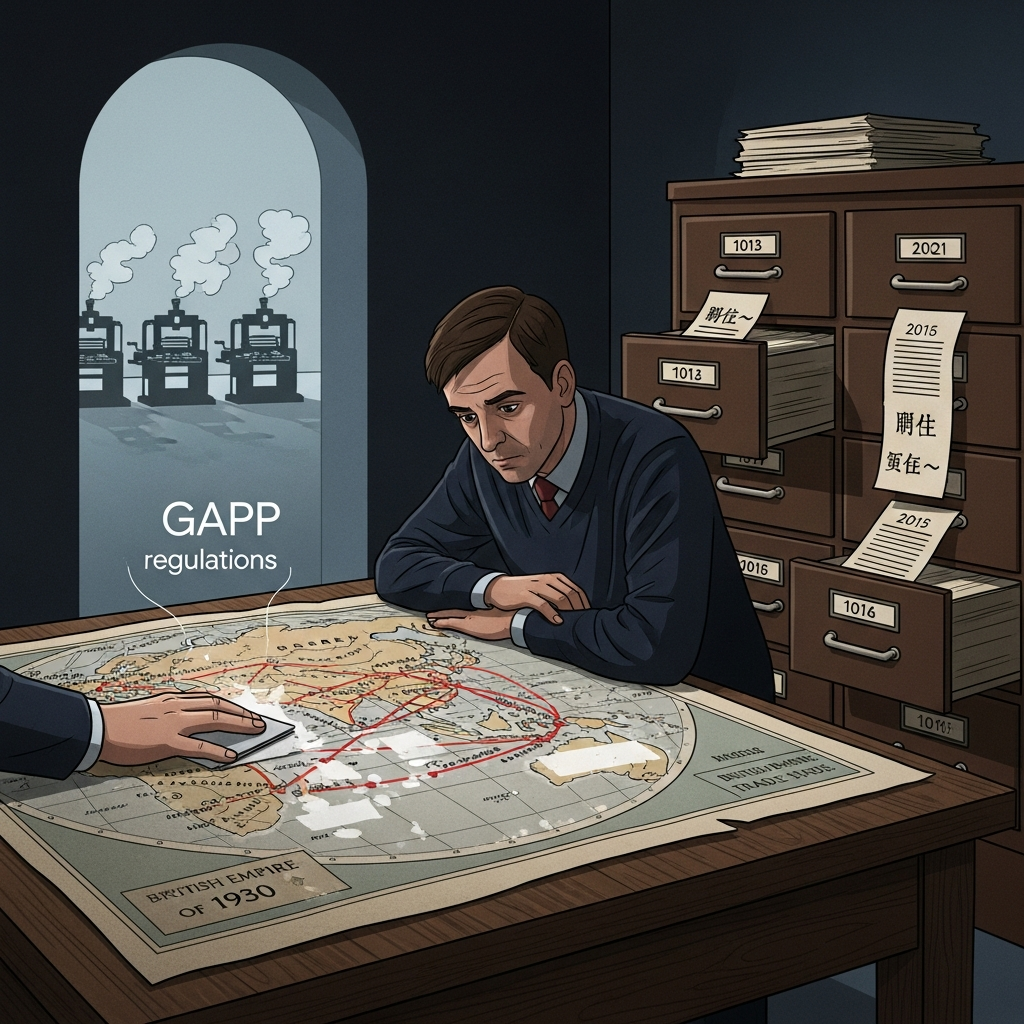
The Victoria and Albert Museum's removal of a 1930s British Imperial trade route map from its exhibition catalog — executed at the direct request of Chinese printer C&C Offset Printing under China's General Administration of Press and Publication (GAPP) regulations — represents a structurally novel form of authoritarian censorship that bypasses diplomatic channels entirely, operating instead through the ordinary mechanics of commercial printing contracts. Guardian investigation subsequently confirmed that the British Museum, Tate, and the British Library face identical pressures through the same Chinese suppliers, revealing that this is not an isolated institutional lapse but a systemic structural dependency embedded across the British cultural sector. The economic logic driving the arrangement is blunt: Chinese printing runs at roughly half the cost of UK equivalents, and with real cultural budgets cut by approximately 30% over the past decade, the financial incentive to comply is nearly impossible to resist on moral grounds alone. What this incident exposes is not primarily an ethics failure by one museum but a structural vulnerability in Western cultural infrastructure — the absence of any policy framework for what might be called cultural supply chain sovereignty. This case ultimately confronts liberal democracies with an uncomfortable but necessary question: what is the cost of protecting your own historical record, and are you actually willing to pay it?
Key Points
The Half-Price Printing Trap — When Economic Logic Becomes Cultural Capitulation
V&A's decision to contract with C&C Offset Printing was, at the time it was made, a straightforward act of responsible budget management rather than any kind of ethical failure. Chinese printing runs at approximately half the cost of equivalent UK or European production for high-quality art catalog work, and for institutions operating under sustained austerity conditions, that cost differential is not a marginal saving but a genuinely significant budget relief. UK museum budgets have been cut by roughly 30% in real terms over the past decade, meaning that every major procurement decision carries real programmatic consequences — a saved printing budget is a funded exhibition, a subsidized admission price, or a preserved education program. When a printing contract worth hundreds of thousands of pounds can be fulfilled at half the price by a Chinese supplier delivering comparable quality and delivery timelines, the financial case against it is almost impossible to articulate in operational budget terms. The people making these decisions aren't acting irrationally or unethically by the standards of institutional management — they're doing exactly what cost-constrained institutions are supposed to do. The complication is the cost that never appears on the invoice. C&C Offset Printing, like every company operating legally in mainland China, is subject to GAPP pre-publication review as a non-negotiable legal requirement, enforceable through license revocation. When GAPP flagged the 1930s British Imperial trade route map in V&A's "Music Is Black" catalog as non-compliant with Chinese territorial representation standards, C&C had no commercially viable option but to pass the requirement down to V&A. Industry estimates suggest the premium for switching to UK printing runs at roughly £30,000–£50,000 per major catalog. That gap — the price of not having your history edited by a foreign government — is what institutions are currently not paying.
Censorless Censorship — How GAPP Turns Business Contracts Into Content Control
The most analytically important feature of this case is the one that's easiest to overlook: the Chinese government never contacted V&A directly. There was no diplomatic note, no threatening communication, no government-to-government pressure applied at any level. The censorship was embedded in the legal and contractual infrastructure of a commercial transaction and operated entirely automatically, without any human actor in the chain making an explicitly political decision. GAPP requirements are domestic Chinese law. C&C Offset Printing was simply doing what any company operating legally in China must do to maintain its operating license. Nobody in this chain made a decision that felt like censorship — they each made decisions that felt like compliance, management, and ordinary business practice. This structural invisibility is what distinguishes supply chain censorship from every traditional form of censorship that Western institutions have experience resisting. Traditional censorship was explicit and attributable — a government body issued a prohibition, the prohibition was identifiable, and resistance was at least conceptually available even if practically difficult. Supply chain censorship has none of those properties: it operates through procurement processes that are indistinguishable from normal commercial administration, the censoring party has a plausible legal defense at every step, and the entity that actually removed the content is the institution itself, acting on a supplier's compliance notification. The question "who censored this?" doesn't resolve cleanly, which means there is no obvious target for accountability, no government decree to challenge legally, and no moment of resistance with a clear moral valence.
This Isn't Just V&A — The Systemic Dependency Across British Cultural Life
The Guardian's investigation revealed a fact that transforms the analytical frame entirely: V&A is not exceptional. The British Museum, Tate, and the British Library — the institutions at the apex of British cultural life — all use the same Chinese printers and have all received similar content-modification requests over the years. Industry estimates place Chinese printing's share of UK premium art book and catalog production at 40–50% of the total market. If that figure holds, then the V&A incident is not an outlier but a representative sample from a practice that has been running quietly across a significant portion of the British cultural sector for an extended period. The structural dependency is not a bug in one institution's procurement policy — it is a feature of an entire industry's economic model. The implications of this scale are significant and uncomfortable. It means that the volume of historical and cultural documentation that has potentially been modified — maps removed, images excised, content adjusted — to comply with Chinese government content standards is substantially larger than the specific V&A cases that have come to light. It also means that the institutions responsible for maintaining Britain's cultural record have been, collectively and largely unknowingly, outsourcing editorial decisions over that record to a foreign government's regulatory framework. This is not a story about one museum making a bad judgment call under financial pressure. It is a story about a structural condition that has created a systematic channel through which authoritarian content standards can shape the historical documentation produced by liberal democratic institutions.
The Soft Great Wall — China's Evolved Approach to External Content Influence
The V&A case is a textbook illustration of how Chinese soft power has evolved into something more structurally potent than its traditional expression through cultural exchange programs and Confucius Institutes. Traditional soft power works by making one party's culture attractive to another — it attracts rather than compels. Supply chain soft power works through a completely different mechanism: it creates economic dependencies that generate self-censorship without any direct political intervention required. The target doesn't need to be attracted to Chinese culture or convinced of Chinese values. They simply need to depend on Chinese manufacturing capacity, at which point Chinese regulatory requirements travel automatically through the commercial relationship. This mechanism has been operating across multiple domains of Western cultural and commercial life for over a decade. Hollywood studios have been preemptively excising Tibet references, softening China-critical narratives, and adding Chinese characters to films targeting Chinese market distribution — all without any explicit pressure from Chinese authorities, purely through the internal calculus of market access. The NBA's response to a general manager's 2019 tweet supporting Hong Kong protesters demonstrated how a single commercial relationship can produce institutional silence at the highest levels of a major Western organization. The V&A case marks the extension of this pattern into cultural heritage — the domain of institutions whose entire institutional purpose is preserving historical accuracy. Each domain that succumbs to this mechanism makes the next one more normalized and more likely.
The Normalization Trap — How Self-Censorship Becomes Institutional Default
Perhaps the most psychologically and institutionally dangerous aspect of this entire situation is the normalization process — the mechanism through which what began as an exceptional accommodation becomes routine procedure and eventually disappears from conscious institutional awareness entirely. V&A's staff almost certainly did not experience the removal of the 1930s map as an act of censorship. They experienced it as a compliance requirement, a supplier constraint, a minor operational adjustment with no material impact on the exhibition's substance. That framing — "this is just a regulation, not a political act" — is the exact cognitive pathway through which self-censorship propagates invisibly within organizations. It does not announce its arrival. It disguises itself as pragmatism. The escalation pattern is predictable once the initial accommodation is made. The first content removal is experienced as exceptional and uncomfortable, even if the discomfort is suppressed for pragmatic reasons. The second is somewhat less uncomfortable, because a precedent exists. By the fifth or tenth iteration, the process of flagging potentially problematic content and accommodating removal requests has become a routine part of the workflow. And once the accommodation has become routine at the production stage, the far more dangerous development becomes possible: self-censorship at the conception stage, where curators and editors begin designing content with awareness of printing constraints, avoiding material that will cause friction long before it reaches the catalog. That upstream self-censorship leaves no trace at all — there's no removed map, no visible deletion, no evidence of external influence — because the content never existed in the first place.
Positive & Negative Analysis
Positive Aspects
- Bringing a Hidden Practice Into Public View
The most significant positive consequence of the V&A case is that it has exposed a mechanism that had been operating invisibly and without accountability for years. Before the Guardian's investigation, this practice was entirely unknown to the general public, to most cultural sector professionals, and almost certainly to the majority of museum trustees and board members. The reporting has changed that completely, and the downstream effects of that transparency are already visible. Parliamentary questions have been raised in the DCMS select committee, the Museums Association has issued statements, and cultural sector leaders are conducting or contemplating supply chain audits that would simply not have happened in the absence of public attention. The Index on Censorship's strong public response has further elevated the issue's seriousness in public discourse. All of this represents meaningful institutional accountability that would not exist if the practice had continued undetected. Transparency is the prerequisite for reform, and the V&A case has produced exactly the kind of transparency — specific, documented, attributable, embarrassing — that tends to generate actual institutional and policy change rather than vague aspirational commitments.
- Catalyzing the Cultural Supply Chain Sovereignty Debate
The V&A incident has provided a concrete, publicly legible case study for a policy debate that advocates have struggled to initiate in more abstract terms. The argument that Western cultural institutions are structurally dependent on Chinese manufacturing and this creates content integrity risks is difficult to make persuasively without a specific, documented, high-profile example. The V&A case provides exactly that. It has enabled advocates for cultural supply chain reform to point to a specific institution, a specific printer, a specific regulatory mechanism, and a specific removed map — making the abstract structural argument immediately comprehensible to policymakers, journalists, and the public who need to understand it in order to support action. The European Chips Act and the European Battery Alliance both required years of argument about abstract supply chain vulnerability before they achieved legislative momentum. The cultural supply chain debate now has the kind of concrete illustrative case that can compress that timeline significantly. That's a meaningful contribution to a policy conversation that needed exactly this kind of visible crisis to progress.
- Accelerating European Printing Industry Revitalization
The controversy creates real market and policy momentum for a revitalization of European printing capacity — a development that would have both cultural sovereignty benefits and meaningful economic ones. The UK printing industry has lost roughly 30% of its workforce since 2010, partly as a result of competition from lower-cost Asian production. If the V&A incident generates sustained pressure toward repatriation of cultural publishing print contracts, it could contribute meaningfully to reversing some of that decline. Central and Eastern European printing industries — particularly in Poland and the Czech Republic — have already developed capacity to offer high-quality art printing at roughly 70% of UK costs, making them credible near-term alternatives that don't require the full cost premium of fully domestic production. Political appetite for friend-shoring supply chains is well established in semiconductor and pharmaceutical contexts; cultural printing is simply the next domain to benefit from that existing political consensus. The V&A case provides the moral and reputational urgency that makes the argument for investing in European printing capacity politically tractable in a way it wasn't before.
- Driving Innovation in Publication Integrity Verification
The incident creates demand for a category of technical solution that barely exists yet — systems that can cryptographically verify the integrity of published content and detect unauthorized modifications between original sign-off and final publication. Blockchain-based content provenance projects like Stanford's Starling Lab and Numbers Protocol are already developing exactly this kind of capability for journalism and digital archives. The V&A case creates a clear institutional use case and a compelling value proposition for applying similar systems to museum catalog publishing: if a cultural institution could demonstrate cryptographically that its catalog content exactly matches the originally approved version, it would remove any ambiguity about whether supply chain censorship had occurred. The reputational value of that guarantee, in a post-V&A environment where audiences are newly aware that catalog content can be modified between approval and printing, is real and growing. Demand-driven technical innovation of this kind often progresses faster than policy-driven solutions, and it would be genuinely exciting to see the V&A incident catalyze meaningful investment in publication integrity technology.
- Opening the Museum Governance Reform Conversation
The revelation that routine procurement decisions can have direct and significant implications for the content integrity of a museum's scholarly publications raises a genuine institutional governance question that the cultural sector has not yet adequately addressed. Decisions about printing suppliers have traditionally been managed as purely operational procurement matters — cost, quality, delivery, relationship. The V&A case demonstrates that they also have editorial and scholarly dimensions that require input from curators, archivists, and academic advisors who understand the content integrity implications. Building that cross-functional review into supplier selection processes is not a radical change, but it is a meaningful one — it creates an institutional checkpoint that might have caught the V&A situation before it became a public controversy. The Museums Association's swift and pointed response to the case signals that the professional sector recognizes this governance gap and is prepared to develop guidance for addressing it. That kind of sector-led governance evolution, driven by a concrete crisis, tends to be more durable than externally imposed regulation.
Concerns
- The Tip of an Iceberg We Cannot See
The V&A case became public because the Guardian's investigative reporters were specifically looking for it. The number of similar cases that have not been investigated, not been publicized, and not entered the public record is entirely unknown and very likely large. The structural conditions driving the V&A situation — cost pressure, dependence on Chinese printing, GAPP requirements, institutional reluctance to publicize uncomfortable compliance decisions — apply equally to institutions across the UK, the United States, France, Germany, and every other country where cultural institutions use Chinese printing services. The Metropolitan Museum of Art, the Louvre, the Rijksmuseum — any institution that has used Chinese printing for high-quality art publications may have navigated similar situations without ever acknowledging them externally. The most dangerous property of self-censorship is that the institution experiencing it has strong institutional incentives never to disclose it: disclosing means acknowledging a compliance arrangement that many stakeholders would regard as disqualifying. The V&A case is probably not exceptional — it is probably representative of a practice whose true scale remains entirely opaque, and that opacity is itself a serious problem.
- The Structural Gap Between Moral Pressure and Viable Alternatives
Condemning V&A is easy and feels righteous. Providing a financially viable alternative that allows the institution to continue producing high-quality exhibition catalogs without either compromising content integrity or significantly degrading its operating budget is considerably more difficult. UK printing costs roughly twice as much as Chinese printing for comparable work. UK government cultural funding has declined by 30% in real terms over a decade. The combination of those two facts means that telling institutions to "just use UK printers" amounts to telling them to absorb a 50% cost increase in a budget category at exactly the moment when their overall budget has been most severely constrained. That's not a moral argument for continuing to use Chinese printers — it's a structural argument that moral demands without structural support tend to produce institutional dishonesty rather than institutional compliance. When the ethical choice is financially impossible, institutions don't typically find new money; they find ways to make the unethical choice invisible. That pattern is almost certainly already occurring in institutions that are watching the V&A controversy and concluding, privately, that the lesson is to be more discreet rather than to change suppliers.
- The Chilling Effect on Future Content Curation
Even setting aside the direct censorship that has already occurred, the V&A case will generate a significant chilling effect on future exhibition design and catalog content development — and chilling effects are structurally more damaging than direct censorship because they produce no evidence of what was suppressed. Curators across the UK cultural sector are now aware, in a way they were not before, that certain categories of content — maps involving Chinese territorial disputes, images connected to events China prefers not to be documented, material related to Hong Kong, Tibet, or Xinjiang — create friction in supply chains that use Chinese printers. Even without any explicit instruction or policy change, this awareness will influence how curators think about what to include in future exhibitions and catalogs. Some will consciously factor supply chain constraints into curation decisions. Others will incorporate the constraint unconsciously, in the same way that any habitually observed limit eventually shapes the pattern of behavior around it. Unlike a directly removed map, which leaves a gap and a record, content that was never created leaves nothing at all — no evidence of censorship, no starting point for accountability, no ability to know what was lost.
- The Risk of Copycat Adoption by Other Authoritarian Regimes
The V&A case has demonstrated — publicly and in detail — that a manufacturing or service supply relationship can be used to transmit content standards from an authoritarian domestic regulatory framework into institutions in democratic countries, operating entirely within the ordinary norms of commercial contracting, without any diplomatic confrontation or international incident. This is a genuinely novel and effective model of cultural influence projection, and the risk that other authoritarian states will observe and replicate it is real and growing. Russia, Saudi Arabia, Turkey, and Iran all have manufacturing, service, or investment relationships with Western cultural, academic, and media institutions that could potentially be structured to transmit similar content requirements. Saudi Arabia has already moved in this direction with cultural projects receiving Saudi investment, requiring compliance with content guidelines that reflect Saudi social standards. The Chinese supply chain model has now been publicly documented as effective, which means it has been effectively demonstrated to potential imitators. V&A's case may mark the beginning of a much broader proliferation of supply chain censorship as a tool of authoritarian soft power projection.
- The Culture of Institutional Silence That Enabled the Problem
The most troubling institutional dimension of this case is not that the V&A situation occurred, but that it occurred and persisted for an extended period without any internal disclosure, any formal escalation to trustees, or any public acknowledgment until journalists independently discovered and reported it. This silence was not a single individual's decision — it was an organizational pattern sustained across multiple people and presumably multiple catalog production cycles. That pattern reflects a culture of institutional risk aversion in which the reputational risk of publicly acknowledging a supply chain censorship arrangement outweighs the institutional discomfort of quietly continuing it. It also reflects the absence of clear institutional frameworks for what to do when a content integrity issue arises in a procurement context — there was apparently no established escalation path, no trustee-level notification procedure, and no external reporting mechanism that would have surfaced the issue through normal governance channels. Without addressing that underlying institutional culture and the governance infrastructure needed to support it, changing the printing supplier alone will not prevent similar situations from recurring in different forms.
Outlook
The immediate political fallout from the V&A case is already escalating in predictable ways, and the trajectory over the next six months looks likely to intensify. Reports indicate that the Department for Culture, Media and Sport select committee has begun asking questions about the broader implications of the case, and I believe a formal parliamentary inquiry or sector-wide cultural supply chain audit is now more probable than not before the close of 2026. Such an audit, if it proceeds, will almost certainly surface similar arrangements at five to eight additional major UK institutions — the British Museum and Tate are already confirmed users of the same Chinese printers, and the logic of the cost differential applies equally to dozens of smaller regional museums and galleries that nobody has yet investigated. When those findings become public, the scale of political and public pressure to act will be substantially larger than anything we're seeing now, because the story will transform from "one museum's embarrassing mistake" into "a systemic failure across British cultural life."
In the very near term, watch for how Chinese printing companies respond to the negative attention. Companies like C&C Offset Printing have powerful commercial incentives to retain Western clients, and several workaround strategies are available to them: routing print jobs through Hong Kong entities operating under partially distinct publishing rules, establishing Southeast Asian subsidiaries in countries like Vietnam or Malaysia with different regulatory environments, or offering informal assurances that GAPP review can be "managed" for foreign-destination publications. Some Western publishers have already been quietly using Hong Kong routing for years as a way to preserve supply relationships while nominally avoiding mainland censorship requirements. However, I'd put the probability at above 60% that Hong Kong-based workarounds become increasingly untenable by the end of 2026. Since the 2020 National Security Law, Hong Kong's publishing environment has been converging with mainland China's standards at a pace that was unthinkable even five years ago.
Over the medium term — roughly six months to two years — the most significant potential development is the emergence of a serious European policy debate around "Cultural Supply Chain Sovereignty" as an explicit policy concept. The EU has already moved decisively on semiconductor supply chains through the European Chips Act and on battery supply chains through the European Battery Alliance; the conceptual and institutional infrastructure for treating a strategic supply chain as something requiring active policy intervention is well established in Brussels. Extending that framework to cultural publishing and printing is a logical next step, and the V&A case provides exactly the kind of high-profile, publicly legible incident needed to put it on the agenda. I'd assign a 50–60% probability to the EU or UK issuing non-binding guidelines by 2027 that steer public cultural institutions toward printing suppliers in countries meeting freedom-of-expression standards.
The technology dimension deserves serious attention as an independent variable. High-quality digital printing technology — particularly production systems from HP Indigo and Heidelberg — is closing the cost gap with traditional Chinese offset printing faster than most policy discussions acknowledge. Industry analysts project that the cost ratio between European digital printing and Chinese offset printing will narrow from roughly 3:1 today to approximately 2:1 by 2027–2028. For smaller print runs and shorter catalog editions, European digital printing is already economically competitive right now. This matters enormously because it changes the binary choice institutions currently face — between "expensive ethical printing" and "cheap censored printing" — into something more nuanced. By 2028, the premium for choosing a European printer may be substantially lower than it appears today.
Looking further out — five to ten years — this incident will likely be remembered as one of the early data points that brought "cultural sovereignty" into mainstream international policy discourse. We already have well-established frameworks for economic sovereignty, data sovereignty, and technology sovereignty as recognized pillars of national strategy. Cultural sovereignty — meaning a state's capacity to maintain control over the production and integrity of its own cultural record — is the logical next frontier. I'd assign a 30–40% probability to a G7 or OECD-level multilateral statement on cultural supply chain principles emerging between 2028 and 2030.
One genuinely exciting long-run development is blockchain-based publication integrity verification. The core concept is simple: a decentralized cryptographic record that allows any reader to verify independently that a published catalog matches the original approved content without any additions, deletions, or modifications. Projects like Stanford's Starling Lab and Numbers Protocol are already experimenting with exactly this kind of approach for digital archives and journalistic records. Applied to museum catalogs, it would mean that any censorship would be technically detectable and publicly verifiable on demand. I'd estimate that 10–15% of major museum digital catalog publications will adopt some form of content integrity verification by 2030.
Breaking down the scenario outcomes: in the bull case — probability roughly 20% — the V&A incident acts as a genuine policy catalyst, the UK passes a Cultural Supply Chain Transparency Act by 2027, and Chinese printing's share of UK museum catalog production falls below 15% by 2028. In the base case — probability roughly 55%, and the outcome I consider most likely — the UK issues advisory guidelines rather than binding legislation, large flagship institutions voluntarily diversify their printing suppliers, but smaller regional museums continue relying on Chinese printing. Chinese printing slowly declines to around 30–35% of the UK market by 2029. In the bear case — probability roughly 25% — initial media and parliamentary attention fades as competing news cycles dominate, structural changes fail to materialize, and self-censorship becomes more sophisticated and harder to detect externally.
Sources / References
- The V&A Catalogue Row Shows China's Censorship Now Travels Through Cultural Supply Chains — The Conversation
- V&A Catalogue Censored at Chinese Printer's Request — Artnet
- Victoria and Albert Pulls Catalog Materials Over China Censorship — ARTnews
- V&A Museum Has Acquiesced to Censorship Requests — Artforum
- V&A Censorship Claim Deeply Worrying Says Index on Censorship — Museums Association
- V&A Censors Catalogues for Chinese Printers — BritBrief