
The Drowned Cities Are Waking Up — What the 2026 Underwater Archaeology Renaissance Really Asks Us
Summary
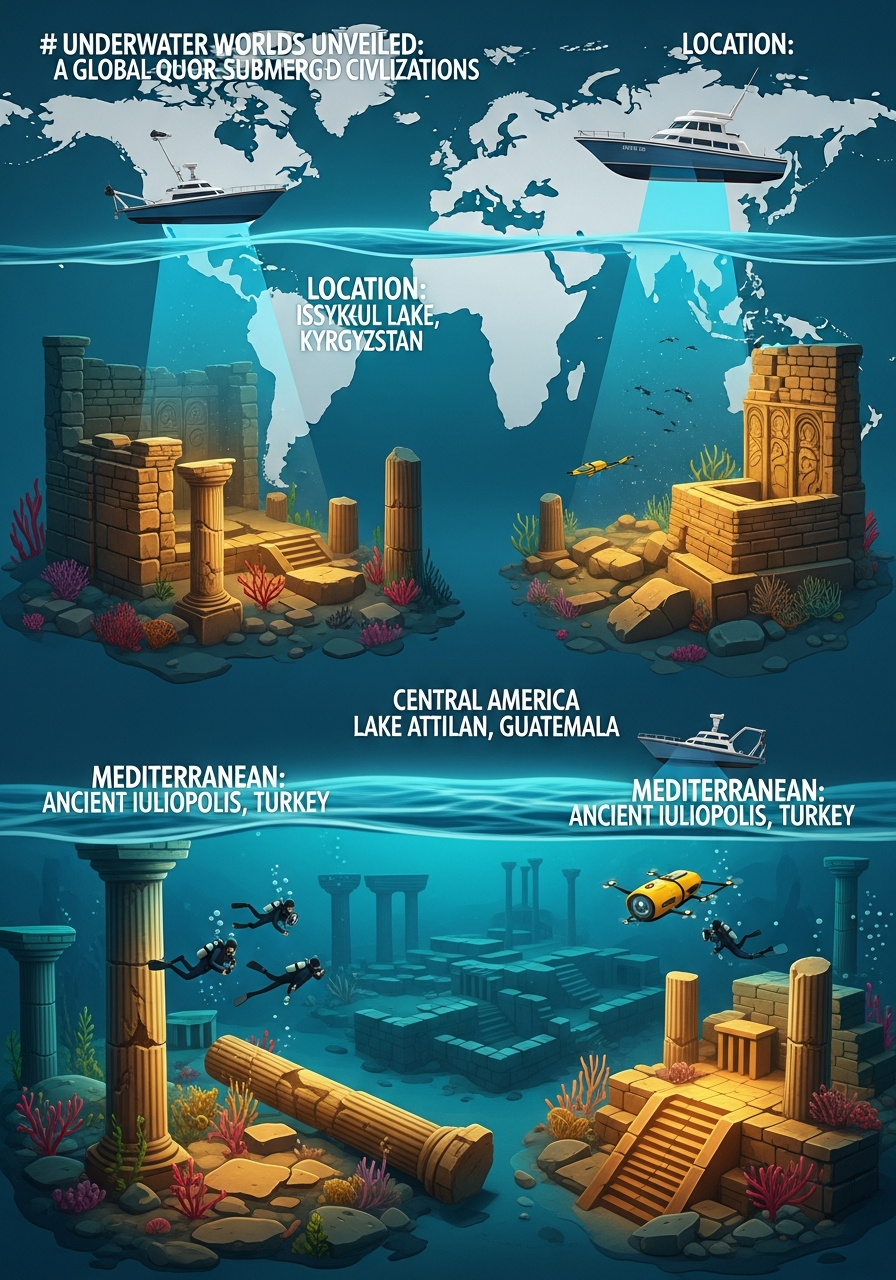
In 2026, sunken cities across four continents are being discovered or reconfirmed simultaneously, ushering in an unprecedented renaissance in underwater archaeology. Technological innovations such as multibeam sonar and 3D photogrammetry are the primary drivers, yet a University of Padua study projecting a four-to-sixfold acceleration in underwater artifact corrosion by century's end under high-emission scenarios underscores the race between discovery and dissolution. The commercialization of Mediterranean underwater sites for yacht tourism and Greece's opening of 24 officially designated underwater archaeological zones deepens the ethical dilemma between preservation and monetization, while the indigenous collaboration model in Guatemala's Lake Atitlán project offers a new framework for cultural heritage ownership debates.
Key Points
Structural Causes Behind Simultaneous Discoveries on Four Continents
The simultaneous discovery or reconfirmation of sunken cities at Kyrgyzstan's Lake Issyk-Kul, Guatemala's Lake Atitlán, Turkey's Iuliopolis, and India's Dwarka is no coincidence. Technologies including multibeam sonar, 3D photogrammetry, and machine learning-based image analysis have crossed a critical threshold, enabling research teams worldwide to produce results simultaneously. The Atitlán project scanned 3.78 square kilometers with sonar to identify five architectural complexes in a single season — a scale that would have taken decades with previous-generation diver-based surveys. This synchronicity of technology diffusion suggests discovery rates will accelerate exponentially over the next five years. The independent adoption of identical technologies by institutions such as the Russian Academy of Sciences, Mexico's INAH, and India's ASI is evidence that the entry barrier to underwater archaeology has been decisively lowered.
Ocean Acidification: The Paradox of Heritage Lost Before Discovery
Experiments conducted by the University of Padua using volcanic CO2 vents off Italy's Ischia island confirmed that ocean acidification exponentially accelerates the corrosion of calcium carbonate artifacts such as marble and limestone. Lead researcher Luigi Germinario warned that 'even seemingly minor surface damage can mean irreversible information loss.' Under high-emission scenarios, corrosion rates are projected to increase four to sixfold by century's end, with the Roman mosaics at Italy's Baia Archaeological Park and Egnazia port ruins in Puglia at particular risk. This reinforces the imperative that underwater archaeology must become a discipline of rescue rather than discovery, and that underwater cultural heritage must be placed on the formal climate agenda.
Indigenous Collaboration Model: The Vanguard of Decolonized Archaeology
The case of the Tz'utujil Maya indigenous community participating as co-investigators in the Lake Atitlán project in Guatemala is virtually unprecedented in archaeological history. Local diver Celany Ruiz was trained as a professional underwater archaeological diver, 3D models were shared with the community in real time, and all artifacts were returned to their original locations after study. The structure of community transparency committees overseeing the entire process completely inverts the existing pattern of 'developed-country researchers excavating and displaying in museums.' If this model spreads, it could fundamentally change how archaeological projects operate worldwide, particularly setting a precedent for centering indigenous rights in underwater heritage exploration across Africa and Southeast Asia.
The Lake That Harbors the Black Death's Origins: Modern Value of Ancient DNA
DNA from skeletal remains in a 60,000-square-meter 13th-14th century necropolis near Lake Issyk-Kul confirmed traces of the 1338-1339 Black Death. This discovery strongly suggests that the origin of the plague that killed two-thirds of Europe's population was a Silk Road trading city in Central Asia. Given that underwater environments often preserve organic materials better than terrestrial ones, this demonstrates underwater archaeology's elevation to a multidisciplinary field contributing to epidemiology and genomics. Further skeletal recovery would deepen understanding of 14th-century pandemic transmission routes exponentially, carrying practical implications for modern public health strategy.
Preservation vs. Tourism: The Commercialization Dilemma of Underwater Heritage
Greece has opened 24 officially designated underwater archaeological zones, and yacht tourism via Mediterranean underwater sites is growing rapidly. At Pantelleria, boat traffic has increased over waters where 4,000 3rd-century BC Carthaginian coins were found, with physical damage from anchor drops already reported. At the Egadi Islands, tourist boats operate over the only confirmed naval battlefield of the 241 BC Punic War. While digital experiences using 3D photogrammetry and 360-degree video are proposed as alternatives, the balance is at risk of collapse once tourism revenue exceeds preservation budgets. This represents a fundamental tension between expanding access and protecting sites, and data from the 2026 summer season will be a watershed determining future policy direction.
Positive & Negative Analysis
Positive Aspects
- Technology Democratization Revolutionizing Survey Efficiency
The falling prices and improved performance of multibeam sonar and 3D photogrammetry equipment are dramatically lowering the entry barrier to underwater archaeology. Guatemala's Lake Atitlán project scanned 3.78 square kilometers in a single season to discover five architectural complexes — a scale that would have taken decades with previous-generation diver-based surveys. With the addition of machine learning-based image analysis, data processing speeds have improved dramatically as well. This technology democratization enables small research teams and developing-country institutions to conduct large-scale underwater surveys, with discovery rates expected to accelerate three to fivefold over the next five years.
- New Hub for Interdisciplinary Research
Underwater archaeology is evolving beyond a subdiscipline of archaeology into a multidisciplinary field integrating epidemiology, genomics, climate science, and geology. The 1338-1339 Black Death DNA secured from the Lake Issyk-Kul necropolis is a crucial dataset for illuminating the origins and transmission routes of the 14th-century pandemic, and as cases accumulate showing underwater environments preserve organic materials better than terrestrial ones, underwater sites are attracting attention as new repositories for ancient DNA research. This interdisciplinary convergence also enables diversification of research funding, contributing to financing large-scale projects that cultural heritage budgets alone could never support.
- Potential for Global Standardization of Indigenous-Led Excavation
The Tz'utujil Maya community collaboration model in the Atitlán project is evaluated as the most advanced example of decolonized archaeology. The four principles of local diver training, community sharing of 3D models, artifact return to original locations, and transparency committee oversight have the potential to completely replace the outdated pattern of 'developed countries excavating and displaying in museums.' If this precedent spreads to underwater heritage exploration in Africa, Southeast Asia, and other regions, it could structurally resolve the longstanding tension between archaeology and indigenous rights. UNESCO has taken notice of this model, and there is a high probability it will be adopted as official guidelines between 2027 and 2028.
- Digital Twin Technology Preventing Irreversible Loss
Technology for creating digital twins of underwater sites through 3D photogrammetry, 360-degree stereo video, and high-resolution 3D modeling is advancing rapidly. Pantelleria and Egadi Islands sites already have precision digital replicas, meaning that even if originals are damaged by ocean acidification, the information itself can be permanently preserved. This technology also enables citizens who cannot dive to access underwater cultural heritage through virtual experiences, contributing to cultural democratization. By 2030, an estimated 30 to 40 percent of major underwater sites worldwide will be preserved as digital twins.
- Potential for Virtuous Cycle with Tourism Industry
Greece's opening of 24 officially designated underwater archaeological zones is an experiment in a virtuous cycle model where tourism revenue flows back as preservation funding. The Mediterranean underwater heritage tourism market is estimated at over 500 million euros annually as of 2026, and if a structure mandating that a certain percentage of tourism revenue be set aside for preservation funds is established under appropriate management protocols, it could provide stable financing for the chronically underfunded field of underwater archaeology. Customized access protocols based on depth, environmental conditions, and artifact vulnerability are already under development, and a systematic tourism-preservation model is expected to take shape after 2027.
Concerns
- Irreversible Heritage Dissolution from Ocean Acidification
According to University of Padua research, under high-emission scenarios where current carbon emission trends continue, the corrosion rate of underwater artifacts is projected to increase four to sixfold by century's end. Calcium carbonate artifacts such as marble and limestone are extremely sensitive to pH changes, with the Roman mosaics at Italy's Baia Park and Egnazia port ruins in Puglia at risk of visible degradation within a decade. As lead researcher Luigi Germinario warned, 'even seemingly minor surface damage can mean irreversible information loss.' This threat is global and cannot be addressed at the individual project level, making it unsolvable without fundamental carbon reduction.
- Physical Damage from Tourism Commercialization
The opening of Greece's 24 officially designated underwater archaeological zones and the surge in Mediterranean yacht tourism products pose direct physical threats to underwater sites. At Pantelleria, damage from anchor drops has already been reported as boat traffic increases over 3rd-century BC Carthaginian artifact waters, and the Egadi Islands' Punic War naval battlefield also faces tourism pressure. With visitor numbers expected to increase 40 to 60 percent year over year during the 2026 summer season, if preservation protocols cannot keep pace with tourism expansion, a major damage incident could occur in the first season. The paradoxical structure where tourism — which should be the premise of preservation — destroys preservation is intensifying.
- Gaps in International Law and Jurisdictional Protection
While 80 countries have ratified UNESCO's Convention for the Protection of Underwater Cultural Heritage, major maritime powers such as the United States, the United Kingdom, and Germany remain non-signatories, weakening practical enforcement. Sites in inland lakes like Issyk-Kul fall outside maritime law frameworks, creating protection blind spots, while India's Dwarka faces tension between religious-nationalistic historical narratives and pure academic inquiry. In the absence of international consensus on ownership, jurisdiction, and access rights to underwater heritage, disputes will inevitably increase proportionally with discoveries, with sites in cross-border waters adding diplomatic complexity.
- Regional Concentration of Research Funding and Attention
Underwater sites in regions with developed tourism infrastructure and high international interest such as the Mediterranean and Egypt attract concentrated funding, while places like Kyrgyzstan and Guatemala with limited tourism infrastructure suffer chronic underfunding. No matter how innovative the Atitlán project model may be, it cannot be sustained without continuous funding, and the Lake Issyk-Kul project depends on intermittent Russian Geographical Society expeditions. Even though technology has become cheaper, the costs of long-term preservation, monitoring, and personnel training remain enormous, making it highly likely that situations of 'discovered but unable to preserve' will recur in developing countries.
- Risk of Political Exploitation and Historical Distortion
Underwater city discoveries carry inherent risks of exploitation for nationalistic historical narratives. India's Dwarka carries significant potential for political utilization of its religious significance as Krishna's city from Hindu mythology, and Turkey's Iuliopolis discovery can be read within the context of Greek-Turkish historical narrative competition. When archaeological evidence is selectively interpreted or exaggerated for political purposes, academic credibility is damaged and international cooperation is hindered. As public interest in underwater archaeology grows, this risk increases proportionally, and institutional safeguards for academic independence remain insufficient.
Outlook
Let me start with what will happen in the next six months. The four continental projects currently underway are entering their peak field season as summer approaches. At Kyrgyzstan's Lake Issyk-Kul, the Russian Geographical Society expedition is set to intensively explore the remaining sectors of Toru-Aigyr during the 2026 summer season. If additional skeletal remains are recovered from the 60,000-square-meter necropolis, the Black Death DNA dataset will expand significantly, and I expect at least two to three new papers on fourteenth-century pandemic transmission routes to emerge. The significance here extends well beyond historical curiosity. The skeletal evidence recovered so far has already reshaped the consensus on where the deadliest pandemic in human history originated, and additional samples could provide granular detail on transmission vectors — information with direct relevance to modern epidemiological preparedness.
Guatemala's Lake Atitlán project is actively pursuing follow-up funding based on the results published in the Journal of Maritime Archaeology following the 2022 UNESCO mission. Three of the five identified architectural complexes have yet to undergo detailed survey, and 3D photogrammetry work on these zones will likely begin in the second half of 2026. The Tz'utujil Maya community involvement adds a layer of complexity to the timeline: every phase of fieldwork must be coordinated with community transparency committees, which slows the pace but dramatically strengthens the legitimacy of the findings.
Another variable to watch during this period is Greece's expanding underwater archaeological zone policy. Twenty-four officially designated underwater archaeological zones have already been opened, and visitor numbers during the 2026 summer tourism season are expected to increase by 40 to 60 percent year over year. This data will constitute the first large-scale case study proving whether underwater cultural heritage tourism is an economically viable model.
Moving into the six-month to two-year horizon, far more structural changes begin to emerge. I predict that by 2027, UNESCO will issue new guidelines to strengthen implementation of the Convention on the Protection of Underwater Cultural Heritage. On the technology front, between 2027 and 2028 the combination of autonomous underwater vehicles (AUVs) and deep learning will become standard tools in underwater archaeology. Where the Lake Atitlán project took an entire season to scan 3.78 square kilometers, an AUV-based system could process the same area in two to three weeks.
Ocean acidification becomes more severe in the medium term. According to modeling by the University of Padua research team, if current carbon emission trends continue under the SSP2-4.5 scenario, surface corrosion rates of Mediterranean coastal underwater artifacts will increase by 40 to 60 percent relative to current levels by 2030. To address this, I expect the EU to establish an emergency preservation fund for underwater cultural heritage by 2027, with an initial scale of 50 million to 100 million euros.
Looking at the long term beyond 2028 to 2030, a fundamental paradigm shift unfolds. I believe underwater archaeology will complete its transition from a discipline that retrieves artifacts to one that records them digitally in situ. By 2030, 30 to 40 percent of the world's major underwater sites will be preserved as high-resolution 3D digital twins.
In the most optimistic bull case, annual global investment in underwater archaeology grows from an estimated 300 million dollars to 1 billion dollars by 2030. The base case is more probable: interest rises but budget expansion proceeds incrementally, with digital twin preservation rates reaching only 15 to 20 percent by 2030. The bear case warrants consideration too: international interest proves fleeting and governments cut cultural heritage budgets.
Comparing this to historical precedent, the situation resembles the Nubian monuments rescue campaign during the construction of the Aswan High Dam in the 1960s and 1970s. The drowned cities are indeed waking up, but whether they wake into a world that protects them or one that consumes them depends on choices being made right now.
Sources / References
- Sunken city discovered in Kyrgyzstan lake was a medieval hotspot on the Silk Road — Live Science
- Lake Atitlán Maya Underwater Settlement Discovery — Ancient Origins
- Ancient Underwater City of Iuliopolis in Turkey — Greek Reporter
- Irreversible loss: How climate change is threatening Europe's sunken civilisations — Euronews
- Lake Where the Black Death Began Discovered — Explorers Web
- Boating Tourism and Underwater Archaeology Routes in the Mediterranean — Press Mare
- Ocean acidification threatens underwater cultural heritage — Nature Communications Earth & Environment
- Submerged Maya Settlement at Lake Atitlán — Journal of Maritime Archaeology
- ASI Underwater Archaeology Wing Dwarka Survey — PIB India
- UNESCO Underwater Cultural Heritage Convention — UNESCO