
Not a Magic Spell, but Homer — How a Papyrus Inside an Egyptian Mummy Overturns 1,600 Years of Common Sense
Summary
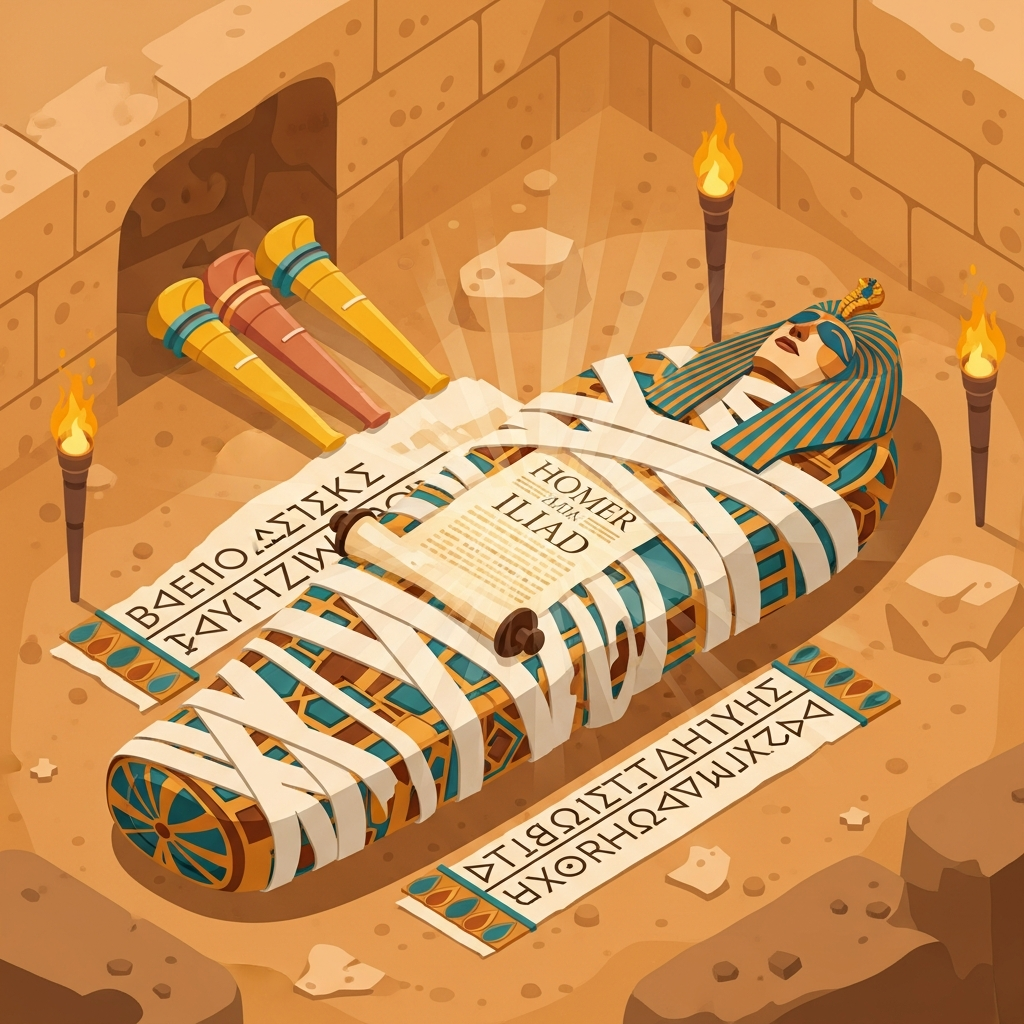
A late Roman-era Egyptian mummy excavated from Tomb 65 at Oxyrhynchus has been found with a fragment of Homer's Iliad Book 2 — the so-called Catalog of Ships — placed deliberately on its abdomen. The find is recorded as the first known case in archaeological history of a Greek literary text intentionally incorporated into the Egyptian mummification process. For over a century, every papyrus pulled from inside an Egyptian mummy belonged to the Book of the Dead or to a magical-spell tradition, so this single artifact shakes a 1,600-year-old assumption about how Egyptians thought about death. The mummy itself, confirmed by the Spanish-Egyptian team led by the University of Barcelona's Maite Mascort and Esther Pons in November 2025, was an unmistakable elite burial — three golden tongues, one copper tongue, and geometric-patterned linen wrappings. I read this papyrus as a passport into the afterlife, a final self-statement that says, "I was a cultivated Greco-Roman citizen," and the question it asks about identity, colonial internalization, and the future of Egyptology is far too heavy to dismiss as just another excavation update.
Key Points
The First Literary Text Ever Found Inside a Mummy
The most distinct significance of the Oxyrhynchus discovery compresses into a single line: it is the first known case in archaeological history. Since the nineteenth century, almost every papyrus pulled from inside an Egyptian mummy has belonged to the Book of the Dead, the magical Spells of Horus, or some other sacred-protection genre. The mummy in Tomb 65, however, was buried with Homer's Iliad Book 2, the Catalog of Ships, an unmistakably literary text placed on the abdomen during the wrapping process itself. Lead excavator Maite Mascort of the University of Barcelona stated in interviews that she had never seen a Greek literary text deliberately incorporated into the mummification process. This single case alone is enough reason to redraw the 1,600-year-old taxonomy that equated funerary papyri with religious-only content. Whether the academic field treats this as an exception or as a new category will quietly determine which chapter of the Egyptology textbook is next to be rewritten.
Why the Catalog of Ships, Specifically
Out of the entire twenty-four-book Iliad, the fact that this mummy carried the Catalog of Ships from Book 2 cannot easily be dismissed as coincidence. The Catalog is the long muster roll of Greek commanders and their ships sent against Troy, widely treated as the oldest, most ritualized, and most "public" passage in the Homeric corpus. Classical scholars have argued for decades that this section functions almost as a Greek civic registration document, a Hellenic citizenship manifesto in narrative form. So this person chose, out of all of Homer, the most politically and communally authoritative passage to take into death. If the goal had been amuletic protection, a more visceral passage like the death of Hector or the wrath of Achilles would be a more obvious pick. The fact that they selected the Catalog instead points more strongly toward social prestige and educational capital than toward religious shielding.
Homer as Status Signal — A Diploma for the Afterlife
In the Hellenistic world, knowing Homer was not a hobby but a core proof of social class. Greek gymnasium education was built around the Iliad and Odyssey, and the ability to quote them fluently signaled either citizenship or near-citizen elite status. The same applied in Greco-Roman Egypt; among the hundreds of thousands of papyri recovered from Oxyrhynchus, Homeric texts dominate the survey by a wide margin, which itself proves the city used Homer as a cultural currency. The owner of this mummy was equipped with three gilded tongues, one copper tongue, and patterned linen wrappings — clear elite-burial markers — and the choice of an Iliad fragment functions as a final résumé carried into the afterlife. I read this as the same human urge that produces a polished LinkedIn photo or a framed degree, only stretched into eternity. Even at the threshold of judgment, this person wanted to certify "who I was" before the gods or whatever they imagined waited on the other side.
The Most Vivid Evidence Yet of Greco-Roman Egyptian Identity Fusion
Oxyrhynchus had used Greek as a public language since Alexander's conquest in 332 BCE, and after Egypt's annexation by Rome in 30 BCE the city was fully embedded in the Greco-Roman cultural sphere. Across more than seven hundred years, indigenous Egyptian religion, Greek philosophy and literature, and Roman administrative structure coexisted and fused inside the same urban space. This single mummy shows that the fusion went far beyond language and administration to reach the innermost layer of the soul itself. Mummification is unambiguously Egyptian, and the gilded tongue derives from the Book of the Dead's instruction that the deceased must speak truth before Osiris. Yet that Egyptian soul packed a Greek conqueror's epic for the afterlife. I think the polite term "cultural hybridity" is too soft for what is happening here, and the more accurate phrase is "colonial internalization."
Non-Invasive Imaging Will Reopen Every Mummy Collection on Earth
The other story embedded in this discovery is the analytical method itself. The Barcelona-IPOA team is reading the badly damaged papyrus through non-invasive multispectral and micro-CT imaging, without removing it from the mummy. These techniques have advanced dramatically over the past five years but lacked a globally famous demonstration. This case is that demonstration. The combined holdings of the top five mummy collections — UK, Germany, Italy, US, Egypt — exceed twenty thousand bodies, and roughly five percent of them, about a thousand mummies, are flagged in the literature as potentially containing internal text. Re-imaging those thousand bodies could plausibly yield not just more Homer, but Hesiod, Menander, or fragments of New Testament apocrypha. The real downstream impact of this discovery is therefore not the single mummy at all, but the thousand mummies it has just made worth reopening.
Positive & Negative Analysis
Positive Aspects
- Healthy Expansion of the Egyptological Paradigm
The clearest positive effect of this discovery is that the classification system inside Egyptology becomes more granular. The hundred-year-old equation "papyrus inside a mummy equals magical spell" now has to admit at least three coexisting categories — religious, status, and literary — and possibly more as new cases surface. A field updating its own taxonomy is one of the strongest signals of scholarly health, and this find essentially forces that update. Mascort's emphasis that nothing comparable has been seen before will pull faculty hiring, grant pipelines, and publishing space toward formally registering the new category. Across the next decade, that broader taxonomy alone will diversify the research landscape and give younger scholars more room to pursue non-traditional angles. The cumulative effect is a more intellectually flexible Egyptology than the one we had a single mummy ago.
- Revival of Greco-Roman Egyptian Studies as a Whole
Greco-Roman Egypt has long been treated as a borderland by both Egyptology and classical studies, sitting on the periphery of each. The thousand-year span from Alexander's conquest in 332 BCE to the Arab conquest in 642 CE is one of the richest archives of identity fusion in human history, yet it has chronically lacked attention and funding. This mummy gives the field a star case study and a media profile that funding agencies and editorial boards respond to. The International Society of Oxyrhynchus Papyrologists and similar bodies now have a clear hook to expand workshops, international conferences, and digital archives. Outlets like phys.org, Smithsonian Magazine, and Scientific American are visibly preparing longer features on the period as a result. A single mummy has become the spark that re-illuminates an entire millennium that had been quietly underlit.
- Restoring One Person's Identity in High Resolution
A perpetual frustration of ancient history is that anonymous individuals are usually accessible only through aggregate statistics. This case, however, lets us reconstruct one person's self-understanding and self-presentation in nearly autobiographical detail. The combination of three gilded tongues, one copper tongue, patterned linen wrappings, and an Iliad Catalog of Ships fragment placed on the abdomen functions as four interlocking signals of social standing and self-identification. The Catalog choice in particular suggests that this person's self-image was civic and public-facing rather than private or sentimental, a useful and uncommonly specific reading. The humanities rarely get the chance to reconstruct an anonymous individual in such fine resolution. The methodology developed for this single body could become a template for reading thousands of other Greco-Roman Egyptian burials.
- Validating the Market for Non-Invasive Cultural Heritage Imaging
The non-invasive analysis stack used here — multispectral imaging combined with micro-CT and X-ray fluorescence — has been advancing in Japanese, German, and US labs for a decade but has lacked headline-grade public proof. The Oxyrhynchus case provides the most dramatic demonstration to date: reading a damaged 1,600-year-old papyrus without removing it from a mummy. That demo will become the strongest single justification for museum, university, and private-lab purchases of analytical equipment in the coming three years. The same toolkit is directly applicable to X-ray analysis of Renaissance paintings, additional Dead Sea Scroll decoding, and the ongoing Herculaneum scroll work. The discovery therefore acts as a stimulus to the broader cross-section between humanities scholarship and advanced analytical engineering. It is the kind of concrete result that turns interdisciplinary collaboration from a slogan into a hiring line.
Concerns
- The Risk of Generalizing from a Single Case
The most important caution is that one mummy cannot, by itself, justify rewriting the entire history of Egyptian funerary practice over 1,600 years. Single-case findings are perfectly adequate for raising new hypotheses, but they are never adequate for elevating those hypotheses into settled doctrine. We do not yet know whether this person was a typical Greco-Roman Egyptian elite or an idiosyncratic individual whose burial choices were unusual even by local standards. If follow-on excavations fail to surface five or more comparable cases within two years, this discovery will likely settle into the literature as a "fascinating exception." Headlines already reading "Egyptian funerary practice has been overturned" are leaping past what the evidence currently supports. The cognitive jump from one data point to a paradigm conclusion is a hazard that both academic and popular audiences need to consciously resist.
- Limits of Preservation and Risk of Reading Errors
Reading a damaged papyrus through non-invasive imaging is technically magnificent, but it carries built-in limits we cannot pretend away. Whether the imaged text is precisely the Catalog of Ships, or instead a closely related Hellenistic passage, cannot be confirmed at one hundred percent confidence at this stage. Where ink has faded, scholarly reconstruction fills the gap, and that reconstruction is inevitably shaped by the scholar's prior hypothesis. So the headline conclusion of "Catalog of Ships" sits at the intersection of imaging fidelity and reader bias. Until an independent team applies the same methods to the same data and produces an independent reading, the right posture is provisional acceptance rather than firm conviction. Humanistic findings that move from initial announcement to media saturation without that intermediate replication step accumulate misreading risk faster than people realize.
- The Trap of Over-Interpreting Through a Postcolonial Frame
I argue in this essay that the discovery is evidence of colonial internalization, but I have to acknowledge that the postcolonial frame can itself be applied too quickly. The vocabulary of "colonial internalization" is one of the most powerful tools twenty-first-century postcolonial scholarship has, but whether a person buried at Oxyrhynchus 1,600 years ago is fully captured by that twenty-first-century vocabulary is genuinely unclear. They may not have parsed their own identity as "Egyptian versus Greek" at all; they may simply have thought of themselves as a citizen of Oxyrhynchus. If we force the colonial-internalization narrative onto them, we may be projecting modern guilt onto a person who didn't share our categories — a kind of interpretive imperialism in its own right. Avoiding that trap requires us to deliberately preserve interpretive plurality rather than locking in the most rhetorically attractive frame.
- Public Misreadings and Sensationalist Content Risk
Discoveries like this travel fast through documentaries, YouTube videos, and social-media threads, and during that travel the core facts often deform into sensational claims. The clean line "Homer was found inside an Egyptian mummy" can mutate into "ancient Egyptians were actually Greeks" or even "ancient Egypt was a fabrication" once it touches the conspiracy-adjacent corner of the internet. There are already early signs of social-media accounts framing this find as a "truth the academic mainstream tried to hide." The faster a finding's path from research lab to public consumption, the faster its accuracy degrades. Unless the excavation team and serious outlets aggressively control the framing during the first analytical release, this otherwise extraordinary discovery could become fuel for the conspiracy-ecosystem economy. That risk is not a side effect; it is a core challenge of contemporary scholarly communication that the field has to take seriously.
Outlook
Over the next one to six months, scholarly activity around this find will intensify quickly. The non-invasive spectral analysis being conducted by the University of Barcelona and IPOA is likely to release its first detailed results within six months, and those results will sharpen our knowledge of the papyrus's exact dating, ink composition, and the level of scribal training visible in the handwriting. I expect at least ten peer-reviewed papers focused on this Catalog of Ships fragment to land within six months of that first release, and the conservative figure may be even higher. Phys.org, Live Science, and GreekReporter have already been posting follow-ups since late April, and Smithsonian Magazine and Scientific American are clearly preparing longer features. At the conference level, the next annual meetings of the Archaeological Institute of America (AIA) and the Society for Classical Studies (SCS) will almost certainly carve out dedicated panels around this discovery within twelve months.
In the same short-term window, museums and educational publishers will move quickly. The Egyptian Museum, Cairo's Greco-Roman Museum, the British Museum, and the Egyptian wing of the Metropolitan Museum of Art now have a reason to revisit every mummy in their care that could plausibly be linked to this case. Special attention will go to mummies excavated in the same broad period as the Grenfell-Hunt papyri haul from Oxyrhynchus, since the link between those papyrus dumps and contemporary burials has never been mapped tightly. From a content-watcher's perspective, the most consequential development is that documentary makers — National Geographic, BBC, Netflix history franchises — will almost certainly produce short-form pieces within six months. Whatever frame those documentaries pick will quietly reshape the popular image of "Egyptian mummy" in a way that lasts. Korean and Japanese museum curators will also have new motivation, within the next year, to audit whether any Greco-Roman Egyptian objects sit in their own collections.
In the medium term, six months to two years out, this discovery will move beyond a single news cycle and become a hairline crack in the Egyptological paradigm. The change I expect to matter most is the breakdown of the hundred-year-old equation "Egyptian funerary text equals magical-religious text," replaced by a more layered taxonomy that explicitly admits "funerary plus status plus literature" as separate but coexisting categories. That redrawing will spawn at least thirty fresh dissertation topics, several of which will reread Greco-Roman Egyptian identity through the lens of colonial internalization. It would not be a stretch to predict that the International Society of Oxyrhynchus Papyrologists schedules a dedicated workshop within twelve months. A more interesting downstream effect is on undergraduate classics curricula. I'd give it better than fifty-percent odds that, by the autumn 2027 semester, major U.S. universities have inserted an "Oxyrhynchus mummy" chapter into their first-semester Homer course.
Within the same medium-term window, the non-invasive analysis stack itself will become a sellable scientific market. Multispectral imaging, micro-CT, and X-ray fluorescence have advanced dramatically over the last five years, but they have not yet had a single global demonstration that grabbed the public imagination. This case is that demonstration. It pushes the message that "we can read a damaged 1,600-year-old papyrus without removing it from the mummy" into mainstream awareness. I expect this to seed a wave of large-scale non-invasive re-examinations of mummy collections worldwide by 2027. Conservative estimates put the combined holdings of the top five collections — UK, Germany, Italy, US, Egypt — at over twenty thousand mummies, and roughly five percent of those, or about a thousand, are flagged in the literature as suspected of carrying papyrus or text fragments inside the wrappings. Re-imaging those thousand bodies could surface not just more Homer, but Hesiod, Menander, even fragments of New Testament apocrypha. On the equipment side, this single demo could plausibly lift museum and university analytical-equipment budgets by twenty to thirty percent over the next three years.
Long-term, on a two-to-five-year horizon, the discovery will not stay confined to archaeology. It will quietly nudge the broader humanities on the question of identity. Postcolonial scholars have spent more than three decades discussing colonial internalization, cultural hybridity, and layered identities, but their strongest physical evidence has almost always been drawn from the sixteenth-to-twentieth-century colonial era. This Oxyrhynchus mummy pulls that evidence back another sixteen centuries. The implication is that the human pattern of writing the conqueror's culture into the deepest layer of one's own identity may not be a modern invention at all but an ancient and persistent human condition. I think that hypothesis carries enough weight, over the next five years, to force at least one chapter of mainstream Western ancient-history textbooks to be rewritten. At the same time, it offers a powerful comparative case for ongoing twenty-first-century arguments about Anglophone cultural absorption in Korea, India, and parts of Africa, which is why I expect the ripple to reach sociology and cultural studies, not just history.
In the same long-term frame, expect subtle tremors in cultural-property diplomacy. A significant share of the original Oxyrhynchus papyri sits in Oxford's Sackler Library, with smaller holdings in Italy, France, and Germany. This discovery gives the Egyptian government a new agenda hook to push for either physical repatriation or — much more plausibly — a digital integration of the entire global Oxyrhynchus corpus. Honestly, I rate full repatriation as low-probability, but I'd put the odds of a coordinated Oxyrhynchus Digital Archive launching within five years above sixty percent. If that archive does launch, it will quietly become the most practical and longest-lasting downstream legacy of this single mummy. On the curation side, museums may also start collapsing the old "Egyptian gallery vs. Greek gallery" partition into a unified "Greco-Roman Egypt" section, which would itself be a paradigm-level admission that the two traditions cannot be cleanly separated.
Three scenarios, then, are worth holding in mind. The bull case is that within two years, five or more additional cases of literary-text mummification turn up at Oxyrhynchus or elsewhere in Greco-Roman Egypt, and "funerary literature" is formally registered as a category in Egyptology. Under that case, expect more than fifty academic papers, ten new museum exhibits, and at least five major documentaries within five years. The base case is that follow-on discoveries are sparse — one to three more cases — but this single mummy embeds itself solidly in museum displays, documentary chapters, and textbook pages, sustaining a five-year academic debate. The bear case is that follow-on analysis raises strong objections to the "deliberate placement" reading, the case shrinks back to a single anomaly, and within five years the mainstream packages it as an exception. I weight these at roughly thirty percent bull, fifty-five percent base, and fifteen percent bear. Under any scenario, the probability that this find disappears from public memory altogether sits very near zero.
Walking through the chain of effects, the first-order consequence is a reshuffling of Egyptological categories, the second is the expansion of the non-invasive analysis market, the third is a fine adjustment to the broader humanities' identity-research paradigm, and the fourth is a new comparative case in twenty-first-century debates about non-Western identity and Anglophone cultural absorption. The most plausible counter-scenario to all this is that better imaging revises the textual identification away from the Catalog of Ships to a different Iliadic passage, or even to a different Homeric author entirely. Even in that case, the larger conclusion — "a Greek literary text was deliberately used in mummification" — survives, so the central analysis of this essay still stands. The narrower interpretation that the passage is a "citizenship statement" is more vulnerable, and I leave its revision probability at about twenty percent.
For readers watching all this from the outside, my practical advice runs three ways. First, the next time you walk through a museum's Egyptian mummy gallery, don't just glance at the "magic spells" placard. Compare it to itself one and two years from now — watching that placard rewrite itself in real time is one of the closest views you can get of a humanities paradigm self-correcting. Second, if you want to track the field at near-real-time speed, set Google Scholar alerts on terms like "Oxyrhynchus mummy," "Iliad papyrus," and "Greco-Roman Egypt funerary"; over the next twenty-four months those alerts will quietly tell you the story before it reaches the headlines. Third, do at least once the exercise this discovery silently demands of every reader: ask what the innermost text of your own identity actually is. If the person in Oxyrhynchus chose the Iliad, what would you choose to inscribe on the surface of your own soul? Sitting with that question is, I think, the most valuable gift this 1,600-year-old papyrus can give us.
Sources / References
- Egyptian mummy with Iliad fragment discovered — CNN
- Archaeologists Unearth a Papyrus Fragment From the Iliad Inside an Egyptian Mummy — Smithsonian Magazine
- Passage from Homer's Iliad Discovered in the Abdomen of a Roman-Era Egyptian Mummy — Scientific American
- Archaeological mission at Oxyrhynchus uncovers Homer's Iliad — phys.org
- Egyptian mummy has part of the Iliad in its abdomen — Live Science
- Homer and the mummy: rare copy of the Iliad poem found inside ancient Egyptian tomb — Euronews
- Homer's Iliad found in Egyptian mummy — GreekReporter