
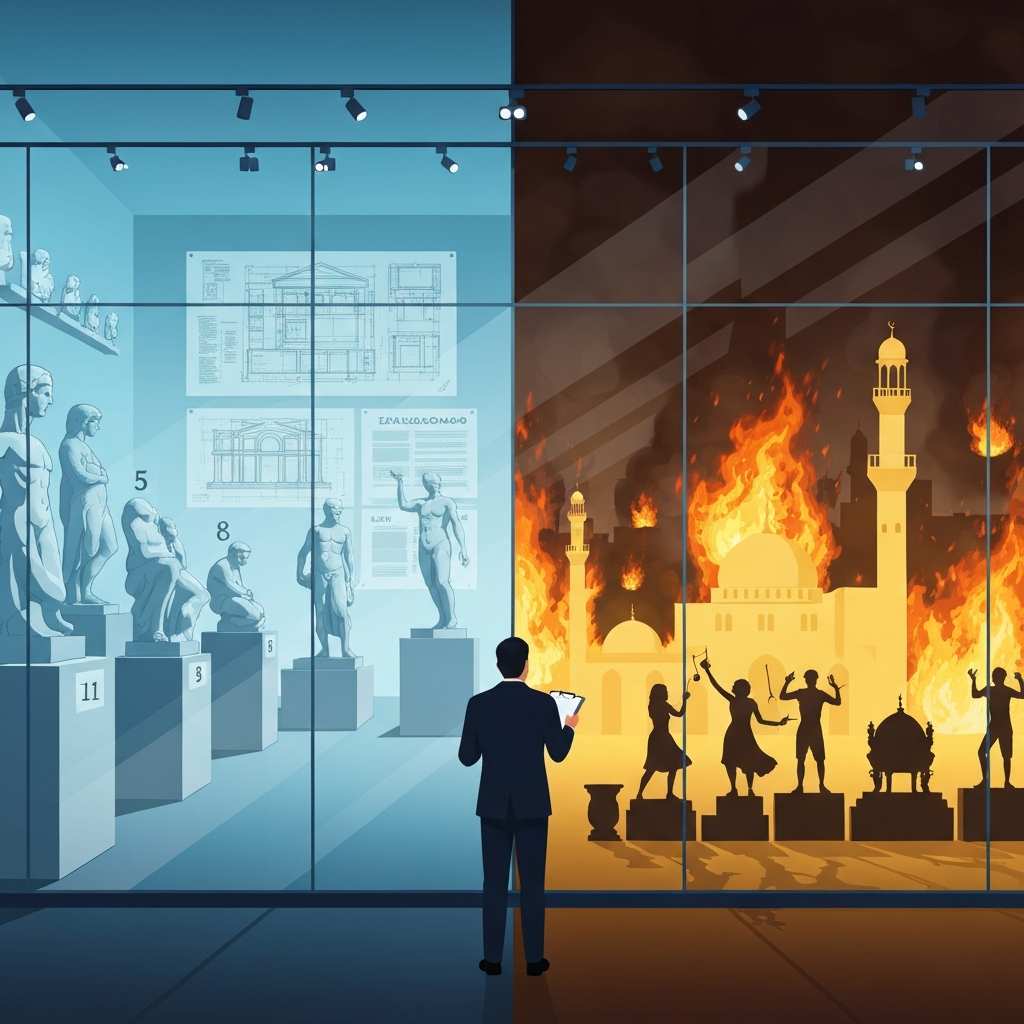
UNESCO Lives in a Museum — While Memories Burn Outside
Summary
The UNESCO 2026 World Heritage Day theme, "Living Heritage in Emergencies: Urgent Responses in Contexts of Conflict and Disaster," represents not a breakthrough in international cultural heritage governance but a long-overdue institutional confession — a formal acknowledgment that 70 years of monument-centric heritage policy have systematically failed the living cultural practices of communities in crisis. In Gaza alone, at least 164 confirmed cultural heritage sites have been damaged or destroyed since October 2023, while UNESCO's most decisive response remained a carefully worded statement of "deep concern" and the 1954 Hague Convention went uninvoked. Palestine's January 2026 emergency registration of 14 sites reveals that the listing system has shifted from a protective instrument to a legal weapon in a sovereignty dispute, demonstrating that the heritage protection framework has been fundamentally repurposed by political conditions it was never designed to navigate. The 48th World Heritage Committee session in Busan, South Korea, in July 2026 presents a potential inflection point for governance reform, though the structural constraints — no enforcement mechanism, geopolitical veto powers, and a chronic budget imbalance between tangible and intangible heritage programs — make meaningful change unlikely without sustained external pressure. The failure of international cultural heritage protection is not a problem of capacity but of political will, and until binding enforcement mechanisms replace symbolic declarations, "living heritage" will remain an elegant phrase printed on brochures while the actual bearers of that heritage disappear.
Key Points
UNESCO's 70-Year "Stone Bias" — The Structural Flaw Baked Into the 1972 Framework
The fundamental bias in UNESCO's World Heritage system starts with the design of the 1972 World Heritage Convention itself. That convention defined "outstanding universal value" in explicitly physical terms: buildings, monuments, sites, natural landscapes — things you can touch, photograph, and put a serial number on. Living cultural practice — the oral traditions, ritual knowledge systems, and communal memory that exist only within and between people — was comprehensively excluded. Intangible cultural heritage did not receive its own separate convention until 2003, a 31-year gap that allowed an enormous volume of living heritage to be destroyed, scattered, and forgotten without ever appearing on UNESCO's legal radar. As of 2025, the World Heritage List includes 1,248 physical sites, while the Intangible Cultural Heritage Representative List carries 676 entries — a 1.85-to-1 ratio that encodes the original bias in quantitative terms. The budget picture makes this even starker: the World Heritage Center receives more than 35% of UNESCO's total cultural sector budget, while the ICH program receives approximately 8%. This is not administrative inertia — it is a Western, monument-centric worldview that got locked into international law in 1972 and has been systematically privileged over non-Western, community-based, and oral heritage traditions ever since. The consequence is a 54-year track record of counting the losses that fit the framework while ignoring the ones that do not.
Gaza: 164 Sites Destroyed, the Hague Convention Invoked Zero Times
The scale of cultural heritage destruction in Gaza since October 2023 is documented and verifiable: at least 164 confirmed sites damaged or destroyed, including mosques, churches, archaeological sites, museums, libraries, and archive collections. This is the largest single-conflict cultural heritage loss event in recent documented history by site count. UNESCO's institutional response — statements of deep concern, damage list updates, no invocation of the 1954 Hague Convention, no formal ICC referral — represents a case study in the gap between stated mandate and actual capability. The 1954 Hague Convention, with 138 state parties, was specifically designed for situations exactly like this; its Second Protocol, which entered into force in 2004, created an enhanced protection category with stronger safeguards. In Gaza, of 164 damaged or destroyed sites, exactly one — Saint Hilarion Monastery — held enhanced protection status under that protocol. The other 163 had none. The double standard is documented: when 351 Ukrainian cultural heritage sites were damaged, UNESCO condemns in the strongest terms and names Russia explicitly; when 164 Gazan sites were destroyed, the language became deeply concerned with notably careful attribution. Independent analyses from The Conversation and SAPIENS have both argued that this asymmetric response sets a dangerous precedent — a de facto signal that the level of international protection available to a heritage site depends significantly on the geopolitical identity of the state doing the destroying.
Palestine's 14-Site Emergency Registration: From Protection to Sovereign Defense
Palestine's January 2026 emergency registration of 14 cultural heritage sites with UNESCO looks, on the surface, like a conventional protection request. The actual strategic logic is more sophisticated and more revealing about the limits of the entire system. Reporting from Al Jazeera makes clear that the registration's primary purpose is defensive legal positioning against cultural appropriation — specifically, blocking Israel from claiming Palestinian heritage sites as part of its own cultural identity and heritage narrative. This means the UNESCO listing system is being used not to protect physical places from physical destruction (which everyone involved understands it cannot do), but to establish international record of cultural ownership in a sovereignty dispute. When inscription becomes a tool for asserting identity rather than preventing demolition, the protective function of the listing system has already been hollowed out. What remains is a registry being deployed as a weapon in a territorial and cultural conflict — a purpose that is fundamentally different from the one the 1972 Convention envisioned. The Palestinian use of UNESCO registration as a counter-appropriation strategy will likely spread: as long as the system cannot protect physically, state actors in cultural conflicts will continue to find ways to weaponize it politically.
The 2026 Theme: This Is What Institutional Guilt Looks Like
The 2026 World Heritage Day theme's timing is simply too on-the-nose to read as genuine programmatic progress. Living Heritage in Emergencies was chosen at the precise moment when the gap between UNESCO's stated mission and its actual record of action in Gaza, Ukraine, Syria, and Yemen had become too large to discuss around. I read this not as a strategic pivot but as a public acknowledgment of failure — a bureaucratic mea culpa delivered in the language of themed initiatives. ICOMOS's formal endorsement of the 2026 theme and its commitment to activating expert networks for conflict-zone heritage protection suggests that the internal critique is real: people within these organizations understand the paradigm is broken. The Intangible Cultural Heritage Convention has 180+ state parties as of 2025 — approaching the 194 parties to the World Heritage Convention — which shows that international appetite for a broader definition of heritage has been there for years. But appetite without budget reallocation and enforcement architecture is just preferences. Unless the 2026 theme generates concrete resource shifts and governance reform proposals at the Busan committee, it risks being remembered as the year UNESCO gave its institutional guilt a very nice logo and called it a program.
Busan 2026: The Committee That Actually Has to Do Something
The 48th World Heritage Committee in Busan, July 2026, is the clearest decision point for whether living heritage becomes policy or remains slogan. Korea's hosting of this committee is historically unprecedented for the Asia-Pacific region, and the country brings genuine credibility — 21 items on the ICH Representative List, a human cultural treasures system established in 1962 that international conservationists regularly cite as a model, and deep institutional knowledge of what it takes to sustain intangible practices across generations. The strategic opportunity is real. But the risks are equally concrete: if K-heritage promotion becomes the dominant agenda, the urgent questions about Gaza and Ukraine and enforcement mechanisms will get diplomatically sidelined. I would argue the committee's success should be measured against exactly two indicators: first, whether an independent conflict-zone heritage monitoring mechanism with actual binding language makes it into the final resolutions; and second, whether a concrete proposal for ICH budget reallocation — from 8% toward something approaching parity — is formally tabled. If both fail, Busan will have been a very well-catered diplomatic event. If either succeeds, it changes the trajectory.
Positive & Negative Analysis
Positive Aspects
- The 2026 Theme as Official Admission — The System Finally Said It Out Loud
The selection of Living Heritage in Emergencies as the 2026 World Heritage Day theme matters as an institutional signal, even if its immediate practical impact is limited. For an organization as conservative and process-bound as UNESCO to officially acknowledge, in a themed initiative, that its 70-year framework has systematically underserved living cultural practices in conflict zones is meaningful — this kind of internal critique does not get to the theme-selection stage without genuine consensus within the organization. ICOMOS's active endorsement of the 2026 theme and its commitment to mobilizing expert networks for conflict-zone heritage protection shows the acknowledgment is not purely cosmetic. The ICH Convention's 180+ state parties — a number that nearly matches the 194 parties to the World Heritage Convention — demonstrates that global appetite for a broader, more inclusive definition of heritage has been building for years. Paradigm shifts in international governance systems are almost always slow, and they typically start with official acknowledgment before resource reallocation follows. The 2026 theme is that acknowledgment on the record — a starting point, not an endpoint, and more significant than another year of themed days about physical monuments.
- Digital Preservation Technology Is Genuinely Getting Good
The rapid maturation of 3D scanning, photogrammetry, and digital archive technology represents a real — not theoretical — new tool for heritage preservation in conflict zones. In Ukraine, drone-based 3D documentation projects have been running in active conflict conditions since 2022, capturing millimeter-precision digital records of architectural heritage even as shells land nearby. The cost of high-accuracy photogrammetric scanning has dropped approximately 60% since 2020, making it accessible to organizations that could not have afforded it half a decade ago. By 2030, estimates suggest that roughly 40% of World Heritage-listed sites will have full digital twins — comprehensive 3D models that preserve structural detail even if the physical site is destroyed. This does not solve the protection problem — a digital model of a destroyed mosque is not the same as the mosque — but it radically changes what lost means. Physical destruction no longer has to mean total erasure. If the Busan committee formalizes a conflict-zone priority digital documentation program with dedicated funding, that is a tangible deliverable that goes beyond declaration and produces something operationally useful within a realistic timeframe.
- Civil Society Is Doing the Work UNESCO Won't
Heritage for Peace, ALIPH (the International Alliance for the Protection of Heritage in Conflict Areas), the Smithsonian Cultural Rescue Initiative, and a growing network of civil society organizations have dramatically expanded their conflict-zone heritage work in the past five years. These groups operate where UNESCO's political constraints prevent it from going — they document damage in real time, coordinate emergency salvage efforts, and maintain independent records that can be used in future accountability processes. The convergence of open-source intelligence (OSINT) techniques, satellite imagery analysis, and digital forensics has made real-time monitoring of conflict-zone heritage damage technically feasible at a fraction of the cost it would have required a decade ago. Bellingcat-style documentation methodologies are now being applied to cultural heritage destruction, and the results are increasingly used in legal and advocacy contexts. This civil society infrastructure matters precisely because it exists outside the political framework that paralyzes UNESCO — when the formal system cannot name a perpetrator, the independent network can. If the Busan committee formally recognizes and funds this civil society monitoring infrastructure as a complement to UNESCO's official activities, the protection architecture becomes meaningfully more robust without requiring changes to the underlying treaty framework.
- Korea as a Host With Real Intangible Heritage Credentials
South Korea is not a neutral convener when it comes to intangible cultural heritage — it is one of the most successful practitioners of living heritage preservation on the planet. Twenty-one items on the UNESCO ICH Representative List, including pansori epic singing, ganggangsullae traditional dance, and kimjang kimchi-making culture, reflect a sustained institutional commitment dating back decades. The human cultural treasures designation system, established in 1962 under the Cultural Heritage Protection Act, funds and supports individual practitioners of intangible heritage traditions — a model that has been widely studied and adapted by other countries. Korea brings to the Busan committee something that most host nations cannot offer: direct, proven experience of what it actually costs and what it actually takes to keep living heritage alive across generations. If the Korean delegation uses that experience to push for substantive policy rather than cultural showcase, and if it deploys its diplomatic capital to keep the committee focused on enforcement and budget questions rather than drifting toward choreographed consensus, Busan could be the most substantively significant World Heritage Committee session in years.
Concerns
- No Enforcement Mechanism — A Watchdog That Can Only Watch
UNESCO's most fundamental limitation is one that has never changed since the organization's founding: it has no binding enforcement authority over sovereign states. Unlike the UN Security Council, UNESCO cannot impose sanctions, authorize military protection, or compel legal proceedings. The 1954 Hague Convention's Second Protocol created enhanced protection status for cultural sites of the highest importance — but in Gaza, of 164 damaged or destroyed sites, exactly one held that status. The other 163 had no specific legal protection beyond the general provisions of international humanitarian law, which has proven spectacularly unenforceable in practice. The maximum available UNESCO response — statements, damage reports, endangered list entries — imposes zero material cost on states that choose to damage or destroy heritage. This is not a fixable problem through better programming or more themed annual days. It is a structural constraint built into the architecture of UNESCO as an intergovernmental organization. I would argue that a heritage protection body with no enforcement capacity is not a protection body — it is a documentation service with better branding. Documentation is genuinely useful, but it is not the same thing as protection, and conflating the two has allowed the gap between UNESCO's stated mission and its operational reality to persist for seven decades.
- ICC Jurisdiction and Security Council Veto: Structural Immunity for the Right Allies
Prosecuting cultural heritage destruction as a war crime requires ICC jurisdiction. The ICC's record on this front consists of exactly one conviction: Ahmad Al Faqi Al Mahdi, in 2016, for ordering the destruction of religious and historic buildings in Timbuktu — sentenced to nine years (reduced to seven on appeal), with a 2.7 million euro reparations order attached. That conviction was possible because Al Mahdi cooperated voluntarily with the Court — an exceptional circumstance rather than a replicable model. For cases involving states whose actions are protected by Security Council permanent members, the ICC route is effectively closed. The United States, China, and Russia do not recognize ICC jurisdiction, which means that cultural heritage destruction carried out with their direct or indirect support is prosecuted at exactly the rate one might expect: zero. This is not a criticism of the ICC specifically — it is a description of the geopolitical architecture within which international justice operates. The result is a system where the severity of legal consequences for cultural heritage destruction tracks inversely with the political power of the state doing the destroying. Small, isolated non-state actors get convicted; major-power conflicts get statements of deep concern.
- Committee Politicization: When Diplomatic Horse-Trading Overrides Conservation
The World Heritage Committee's 21-seat composition and its consensus-based decision-making structure have created a system where diplomatic relationships frequently determine inscription and protection decisions more than conservation criteria do. This is not a secret — it is documented, studied, and acknowledged by ICOMOS advisors who have watched their technical recommendations overridden by committee votes. The politicization affects the Living Heritage in Emergencies agenda directly: any resolution calling for substantive action on conflict-zone heritage protection will need to navigate the interests of committee member states that may be parties to the very conflicts under discussion, or that have strategic relationships with states whose actions are being implicitly criticized. The pattern at World Heritage Committee sessions over the past decade — contested inscriptions decided on bloc-voting lines, urgent protection discussions defused by procedural maneuvers, strongly worded draft resolutions softened to the point of meaninglessness — suggests that Busan will face the same dynamics. Structural reform — specifically, mandatory binding expert panel recommendations that constrain political override — is the only mechanism that changes the underlying incentives.
- The 8% Budget Reality: You Can't Close a 70-Year Gap With a Rounding Error
The ICH program receiving approximately 8% of UNESCO's cultural sector budget while the World Heritage Center takes 35% or more is not a minor imbalance — it is the budget encoding, in numerical form, the same hierarchy that was built into the 1972 Convention. When an organization publicly declares that living heritage is a top priority and simultaneously allocates less than a tenth of its resources to living heritage programs, the declaration does not describe the organization's actual priorities. The declared priority and the budget priority are different priorities. This matters practically because intangible heritage protection in conflict zones is resource-intensive: it requires human networks, practitioner stipends, community-embedded documentation, and sustained relationship maintenance rather than the relatively straightforward physical site cataloging that the World Heritage system excels at. A meaningful rebalancing toward ICH would require not just increased budget allocation but a structural reconfiguration of how UNESCO measures and reports its outcomes. I would argue the Busan committee should table a resolution committing to at least 15% ICH budget allocation by 2027. Whether that will happen depends entirely on whether the major contributing nations decide that living heritage is worth paying for — which is to say, whether political will follows the rhetorical commitment.
Outlook
The 48th World Heritage Committee in Busan, July 2026, is going to be the most politically combustible World Heritage session in recent memory, and I think most observers are underestimating how difficult it will be to manage. The core tension is structural: Arab states and their allies will push for explicit condemnation of cultural heritage destruction in Gaza and formal accountability mechanisms; Western blocs will resist language that names specific state actors; and the Korean presidency will be caught in the middle, trying to preserve the diplomatic consensus necessary to conduct any business at all while simultaneously trying to demonstrate that its hosting has substantive rather than merely ceremonial value. Palestine is almost certain — I would say better than 80% probability — to attempt additional emergency site registrations during the session. That will force a procedural confrontation regardless of what the presidency would prefer to facilitate. Civil society organizations including Heritage for Peace, ALIPH, and a range of academic institutions and archaeological networks are already coordinating pre-session campaigns focused on binding conflict-zone monitoring resolutions, and the intensity of that lobbying will exceed anything we have seen at previous sessions. South Korea's diplomatic balancing act — trying to be genuinely neutral while also wanting to lead — will face its maximum test in the first three days.
The immediate trajectory for documented heritage destruction is not encouraging. The 164 confirmed damaged or destroyed sites in Gaza represent only those accessible to remote assessment; when physical access for systematic archaeological survey becomes possible after the conflict, I expect the documented count to exceed 200. Ukraine's count of 400 or more damaged cultural facilities as of 2024 will almost certainly pass 500 as the conflict extends into its fourth year. Combined, those two conflicts alone represent at least 700 identified heritage sites at risk. Adding Yemen, Sudan, and Myanmar to the calculation, the global count of cultural heritage sites under active conflict threat likely already exceeds 1,000. UNESCO responding to that scale of systematic destruction with damage lists and statements of deep concern is structurally equivalent to a fire service that dispatches assessment teams and writes incident reports but does not carry water. The minimum short-term deliverable from Busan should be a formalized real-time satellite monitoring program for conflict-zone heritage — technically achievable with existing commercial satellite infrastructure, and operationally meaningful as a first step toward independent accountability.
Over the medium term — roughly six months to two years post-Busan — I expect the pressure for intangible cultural heritage institutionalization to intensify significantly, regardless of what Busan actually produces. The 2003 ICH Convention has been in force for over 20 years, but it remains structurally disadvantaged relative to the World Heritage Convention in every measurable dimension: budget, political attention, staff capacity, and — most critically — conflict response capability. The ICH program's annual budget is simply not commensurate with the scale of living heritage at risk globally. For meaningful rebalancing, the ICH program needs at least 15% of UNESCO's cultural sector budget by 2027, which requires renegotiating contributor assessments and almost certainly reducing the proportional share currently flowing to the World Heritage Center. There is also active discussion of a dedicated emergency trust fund specifically for intangible heritage protection in conflict zones — which would be a genuinely useful instrument — but unless the major contributing states commit substantial initial capitalization, it will take two to three years to reach operational scale.
On enforcement mechanisms specifically, the medium-term picture is difficult. The fundamental constraint — Security Council permanent members blocking ICC jurisdiction over their allies — is not going away. What is realistic in the medium term is a strengthened naming and shaming architecture: an independent monitoring body combining satellite surveillance, OSINT analysis, and digital forensics to document and publicly report cultural heritage destruction in real time, with findings that are automatically submitted to the UN General Assembly rather than filtered through the Security Council. This does not create criminal accountability, but it does create reputational cost and evidentiary record. I think this is actually the most consequential realistic deliverable from Busan — not because it solves the enforcement problem, but because it makes the current near-total impunity slightly less total. Several OSINT-capable civil society networks are already doing pieces of this work; a formal UNESCO mandate and funding stream would systematize it.
Looking further out, two to five years, the paradigm that could genuinely shift things is digital heritage. 3D scanning and photogrammetric reconstruction have reached the point where millimeter-precision digital documentation of architectural heritage is possible at costs that continue to decline — roughly 60% cheaper than 2020, and continuing to fall. By 2030, credible estimates suggest that 40% of World Heritage-listed sites will have complete digital twins. The implications are significant: physical destruction no longer has to mean total loss of architectural and spatial information. What I would argue does not follow from this is the conclusion that digital preservation is an adequate substitute for physical protection. A 3D model of the Alhambra Palace and the Alhambra Palace do not have the same cultural weight, the same relationship to the communities whose heritage it represents, or the same irreplaceability. Digital documentation is archiving, not protection. The risk I see in the longer term is that institutions under pressure to do something about conflict-zone heritage destruction will use digital preservation programs to manage the appearance of action while avoiding the harder political work of actual enforcement.
Governance reform at the structural level — changing how the World Heritage Committee is composed, how decisions are made, and how expert recommendations relate to political votes — is the most important long-term target and also the most resistant to change. The 21-seat committee currently protects the interests of the states that hold those seats, and those states have no structural incentive to dilute their own decision-making power. I would put the probability of mandatory binding expert panel recommendations being introduced into the committee process by 2030 at around 30%. It requires sustained external pressure from civil society, academia, and media reaching a threshold that forces governance reform onto the agenda from outside. Gaza and Ukraine are, I think, accelerating the accumulation of evidence that the current system is broken, but we have not yet reached the inflection point where that evidence compels structural change rather than incremental adjustment.
The bull case — probability 15%: the Busan 2026 committee adopts an international declaration on cultural heritage in conflict, establishes an independent conflict-zone heritage monitoring body with binding reporting requirements, passes a resolution committing to ICH budget reallocation from 8% to 12% by 2028, and launches a dedicated emergency trust fund for intangible heritage with initial capitalization from four or more major contributors. In this scenario, by 2028, real-time satellite monitoring covers at least 40% of active conflict-zone heritage sites, and international response time to documented destruction events falls from an average of six months to under two weeks. This scenario requires sustained political courage from the Korean presidency and unusual alignment among major contributing states. It is possible. It is not the way to bet.
The base case — probability 60%: Busan produces a substantive-sounding declaration on living heritage, approves two or three pilot programs including a limited digital documentation initiative, and reaches a political compromise on conflict-zone language that is carefully ambiguous enough to avoid a diplomatic crisis while also specific enough to be cited as progress. ICH budget allocation increases by two to three percentage points. The governance reform proposals are acknowledged, studied, and referred to a working group for consideration at the 49th session. Conflict-zone heritage destruction continues at roughly current rates, and the living heritage declaration is cited in subsequent UNESCO communications as evidence of the organization's commitment to reform, while the structural constraints that make reform difficult remain intact.
The bear case — probability 25%: Busan becomes diplomatically gridlocked over the Gaza and Ukraine agenda items, and the session concludes without substantive resolutions on conflict-zone heritage. The unresolved financial arrears from the U.S. 2019 withdrawal — approximately 600 million dollars left unpaid, representing roughly 22% of UNESCO's assessed contributions — continue to constrain operational capacity. South Korea's presidency prioritizes diplomatic harmony over substantive confrontation, contentious agenda items are procedurally defused, and major contributing nations decline to increase ICH funding. In this scenario, UNESCO's credibility as a heritage protection institution takes a serious, possibly decisive hit. Living heritage becomes another entry in the long list of UNESCO themes that generated press releases and conference panels and then quietly receded. The people who pay the highest price are those whose living heritage is being destroyed right now — the singers, the dancers, the storytellers, the practitioners of traditions that exist only as long as they do. Whatever scenario materializes, one thing is certain. UNESCO cannot protect living heritage from inside a museum. And memories, once burned, cannot be restored from the catalog.
Sources / References
- Gaza: Assessment of Damage to Cultural Heritage — UNESCO
- Gaza's cultural sites have been decimated. UNESCO's muted response sets a dangerous precedent — The Conversation
- Cultural Heritage and the Destruction of Gaza — SAPIENS
- When Protectors Become Perpetrators: The Complexity of State Destruction of Cultural Heritage — International Peace Institute
- Wary of Israeli Appropriation, Palestine Lists 14 Sites With UNESCO — Al Jazeera
- Ahmad Al Faqi Al Mahdi Case Information Sheet — International Criminal Court
- International Day for Monuments and Sites 2026 — ICOMOS
- 48th Session of the World Heritage Committee (Busan, 2026) — UNESCO
- The 2003 Intangible Cultural Heritage Convention in Armed Conflict — Cambridge University Press
- UNESCO 2026 Update Brief: Protecting Cultural Heritage in Conflict Zones — IMUNA