
This 600-Year-Old Bronze Cannon Tells Us Almost Everything — Except When It Was Made
Summary
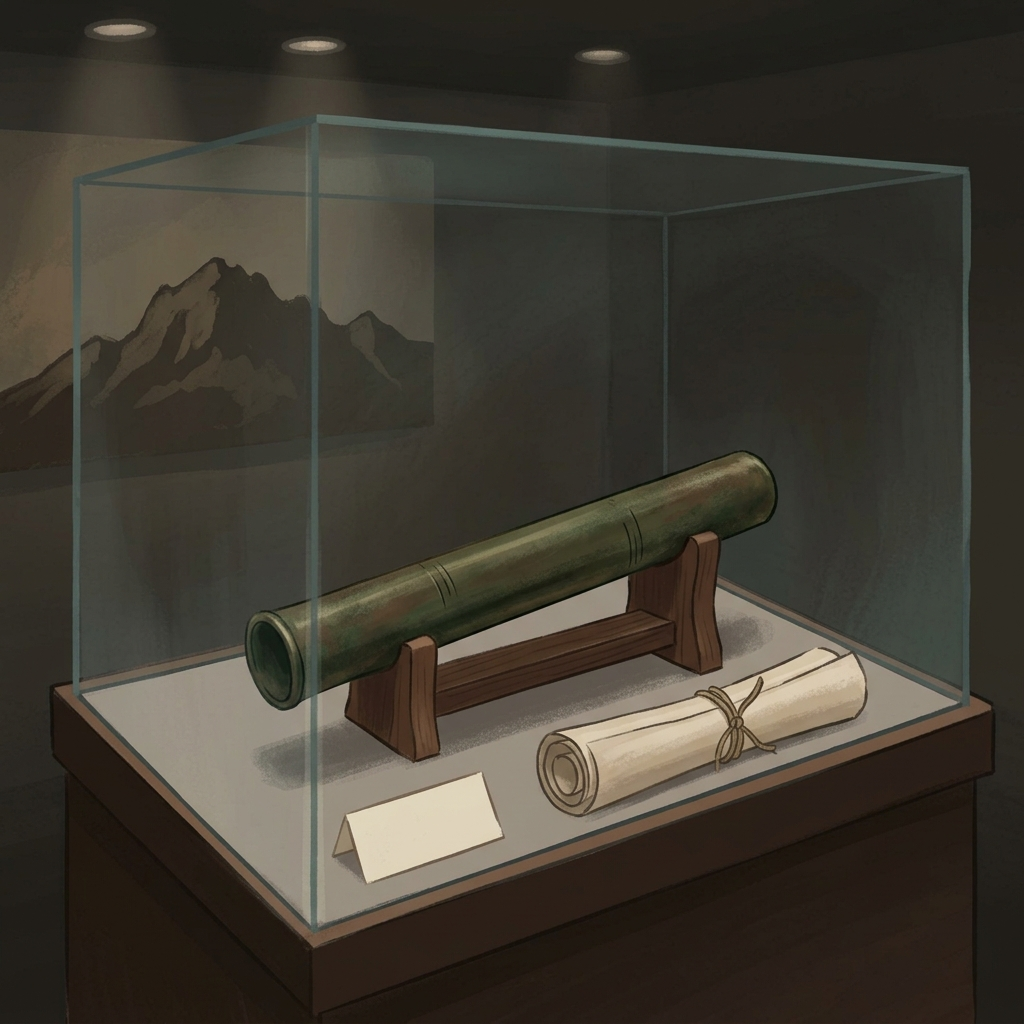
In November 2023, South Korean military personnel conducting landmine detection operations on Geumseong Mountain in Naju, South Jeolla Province, discovered a small bronze hand cannon just 10 centimeters beneath the surface — a find that underwent nearly three years of intensive scientific analysis before being officially unveiled on September 21, 2026, by the National Institute of Naju Cultural Heritage. The artifact, designated the Hwangja Hwatong (黃字火筒), carries a 28-character inscription meticulously recording the supervising official Noksa An Hyu-bo, craftsman Seok, the weapon's weight of one geun fourteen nyang (1,032 grams), and a production number "八" (eighth) at the muzzle — yet the single most critical datum for modern historians remains unresolvable: the precise year of manufacture. The inscribed date "Jeongsa year" could refer to 1377 CE, the very year Goryeo established its dedicated state firearms bureau under Choe Museon, or to 1437 CE during the reign of Joseon's King Sejong — two entirely different dynasties, political contexts, and stages of technological development separated by a 60-year calendrical ambiguity. Regardless of which year applies, the Hwangja Hwatong predates the 1555 Cheonja Chongtong — currently the earliest dated treasure-grade gunpowder weapon in Korea — by a minimum of 118 years, potentially extending to 178 years, representing a transformative expansion of Korea's documented material heritage timeline. What elevates this discovery beyond a record-breaking find is the epistemological paradox it embodies: an inscription so detailed it approaches a modern inventory ledger, rendered permanently ambiguous by the very calendar system its creators used — and that ambiguity, far from diminishing the artifact's significance, makes it one of the most intellectually compelling objects in Korean cultural heritage research today.
Key Points
The 60-Year Calendrical Gap That Made a Perfect Record Imperfect
The Hwangja Hwatong's 28-character inscription is a marvel of medieval administrative documentation: it records the manufacturing month (12th month of a "Jeongsa year"), the weapon's formal name, weight (one geun fourteen nyang), supervising official Noksa An Hyu-bo with title, craftsman Seok by name, and a muzzle production number — essentially a complete manufacturing manifest. Yet the most critical piece of information for modern historians, the precise year of manufacture, turns out to be permanently ambiguous due to the structural architecture of the traditional East Asian sexagenary calendar. "Jeongsa year" repeats every 60 years in the cycle, making it impossible to determine from the inscription alone whether 1377 CE or 1437 CE is the correct reading. That 60-year gap isn't a minor annotation issue: it's the difference between two different dynasties, two different political systems, and two entirely different frameworks for understanding what this artifact means historically. The people who made that inscription had no awareness they were creating a puzzle — to them, "Jeongsa year" was a completely unambiguous date, as clear as any year designation we use today. The epistemological paradox at the heart of this discovery is that the most meticulous medieval manufacturing record anyone could ask for renders its own most important fact permanently uncertain for the modern reader — and that paradox is what makes this artifact intellectually extraordinary, not just archaeologically significant.
What the Bronze Composition Analysis Proved — and Where It Hit Its Limits
The National Institute of Naju Cultural Heritage subjected the Hwangja Hwatong to a comprehensive suite of modern analytical techniques including CT scanning, X-ray imaging, and electron microscopy to establish its authenticity and physical characteristics. The bronze composition — copper combined with tin at under 10% and lead, with trace impurities of sulfur, silicon, and silver detected in fine analysis — was found to align with traditional Korean casting practices, providing decisive evidence that this is not a modern reproduction. Medievalists.net reported that this compositional alignment with historical Korean metallurgy was one of the key markers confirming the artifact's authenticity beyond reasonable doubt. Researchers also identified the rounded interior shape of the barrel chamber as suggestive of an earlier stage of manufacturing development, and the absence of design features associated with later technological evolution has been presented as circumstantial evidence pointing toward the earlier candidate date of 1377. However, there is an important limit to what even this sophisticated analysis can establish: physical and compositional evidence can confirm that the object is genuine and old, and can point circumstantially toward an earlier period, but it cannot resolve a 60-year calendrical ambiguity. The date question ultimately requires a different kind of evidence — comparative study with other artifacts from the same transitional period — and that comparative material is currently exceptionally scarce.
Why 1377 Would Change Everything: The Hwatong Dogam Connection
The year 1377 holds a specific, well-documented significance in Korean history that makes it far more than just one of two candidate dates for the Hwangja Hwatong. According to the Goryeo History records preserved in the National Institute of Korean History database, 1377 is exactly the year that court official Choe Museon successfully persuaded the Goryeo king to establish the Hwatong Dogam — a dedicated state institution specifically created for firearms production and management. Choe Museon had spent the years between approximately 1374 and 1376 acquiring the necessary technical knowledge from Yuan craftsman Yi Won and developing a domestic production capability, before bringing his case to the court and achieving the founding of an official bureau in 1377. If the Hwangja Hwatong was manufactured in the 12th month of the same year the Hwatong Dogam was established, it would represent not merely an old artifact but potentially the physical output of that institution's inaugural year of operation — a direct material link between a documented institutional founding and a surviving physical product. I want to be precise: this alignment is a compelling possibility, not a confirmed connection, and the research institute has clearly stated that comparative study is required before any conclusion can be drawn. The potential for this artifact to bridge textual history and material evidence at the same moment of institutional founding is one of the most historically resonant scenarios in recent Korean cultural heritage scholarship.
28 Characters as Administrative Evidence: The Production System in Bronze
The most underappreciated scholarly significance of the Hwangja Hwatong may be what the inscription reveals about state administrative capacity, entirely independent of the unresolved date question. The presence of the "Noksa" (錄事) title alongside An Hyu-bo's name identifies a dedicated bureaucratic role assigned specifically to supervise production — not a craftsman, not a general official, but a specialized supervisory function within a production accountability chain. The clear textual separation between the supervising official and the craftsman — both named, both assigned distinct roles — documents that accountability was formally differentiated between approval authority and execution authority within the production process. The muzzle production number "八" (Eight) implies that this was at minimum the eighth unit in a continuous production series — serial manufacturing, not commissioned one-off work. Archaeology Magazine identified this serial number as material evidence of an organized state production system. Taken together, these elements constitute proof that 14th- or 15th-century Korea was operating a quality-managed, accountability-tracked, serialized weapons manufacturing system — the essential logic of a production quality management framework, encoded in bronze and preserved for six centuries. This is institutional history and administrative history as much as it is military or technical history, and it speaks to questions about East Asian state capacity that extend well beyond the domain of firearms scholarship alone.
Geumseong Mountain: Why the Discovery Location Deepens the Story
The Hwangja Hwatong wasn't found just anywhere — it emerged from Geumseong Mountain in Naju, a site with documented military significance stretching back centuries before the artifact was even manufactured. Seoul Sinmun reporting notes that this location was the site of conflict between Wang Geon and Gyeon Hwon during the Later Three Kingdoms period and a center of Sambyeolcho resistance in 1270 — making it a recurring nexus of Korean military history across multiple eras. The Yeongsan River basin, of which this mountain is part, served as a strategic military and administrative hub throughout the Goryeo and early Joseon periods, and the Hwangja Hwatong's discovery here is consistent with the site's continued strategic relevance through the 14th or 15th century. The specific findspot — approximately 10 centimeters below ground surface, near a rocky cliff face — is more consistent with accidental loss or battlefield abandonment than with deliberate ceremonial burial or archival storage. This suggests the weapon was actively deployed, not stored or retired, at the time it was lost — giving it a material biography as a working tool of state military operations rather than a preserved collection piece. For future research, I believe Geumseong Mountain and the wider Yeongsan River basin military corridor represent compelling locations for systematic survey that could yield the comparative material necessary to finally resolve the date question.
Positive & Negative Analysis
Positive Aspects
- The Documented Timeline of Korean Firearms History Gets Dramatically Longer
This discovery extends the documented material history of Korean state firearms production by a minimum of 118 years — potentially 178 years — beyond the current earliest dated treasure-grade example, the 1555 Cheonja Chongtong. The significance isn't merely chronological: the 14th and 15th centuries represent a period where, until now, knowledge of Korean firearms production has rested almost entirely on documentary sources like court chronicles and administrative records. A physical artifact from this period provides a qualitatively different kind of evidence — material proof that can be directly analyzed, measured, and compared in ways that textual records cannot replicate. Director Cho Mi-soon of the National Institute of Naju Cultural Heritage described the find as "an extraordinary discovery with immense academic, historical and cultural value," and international scholarly media from Medievalists.net to Archaeology Magazine gave it sustained, substantive coverage. Critically, the historical significance of this expansion is not contingent on resolving the 60-year date question: even the more conservative 1437 date extends the documented material record by well over a century, and that expansion stands regardless of which interpretation ultimately prevails.
- The Inscription Provides Rare Material Proof of Medieval State Administrative Capacity
The 28-character inscription on the Hwangja Hwatong doesn't just record a weapon's physical specifications — it documents a functioning state production accountability system, encoded in the object itself. The named supervisor with official title, the named craftsman with separate accountability, the standardized classification name within a known hierarchical nomenclature system, and the muzzle serial number together constitute material evidence of bureaucratized, quality-managed state manufacturing on the Korean peninsula in the 14th or 15th century. This kind of evidence is rare in any national heritage tradition: most administrative systems leave traces in archival documents subject to destruction and loss, while here the administrative record is cast in bronze and survived six centuries underground. I believe this makes the Hwangja Hwatong a key document not only for Korean military history but for East Asian institutional history more broadly, contributing evidence that speaks to comparative questions about medieval state capacity across the region. For researchers studying how Korean state institutions compared to their contemporaries in Japan and China, this inscription is a primary source that no documentary evidence can replicate.
- The "Unknown Year" Mystery Makes This a Uniquely Engaging Public Heritage Object
The scholarly uncertainty around the Hwangja Hwatong's manufacture date is, paradoxically, one of its greatest strengths as a public-facing cultural heritage object. Most archaeological discoveries are celebrated and then recede from general attention once the initial news cycle ends; this one carries a built-in, ongoing mystery that gives it sustained narrative energy far past the announcement date. The combination of extraordinary detail — a named supervisor, a named craftsman, a serial number, a precise weight — with the single irreducible unknown makes it accessible to general audiences as a genuine puzzle, not just a relic. The special exhibition at the National Palace Museum of Korea, running through November 22, 2026, and the subsequent presentation at the K-DEX defense industry expo in December create a dual-audience strategy that reaches historical enthusiasts and defense professionals simultaneously. I think this discovery has the potential to serve as a model for how cultural heritage institutions communicate ongoing scholarly uncertainty without undermining public confidence in the research — and that model matters for the many other discoveries where academic nuance and public communication need to coexist productively.
- The International Scholarly Attention Opens Long-Term Research Collaboration Potential
The Hwangja Hwatong discovery received substantive reporting from multiple respected international academic and science media outlets, including Medievalists.net, Heritage Daily, Archaeology Magazine, ZME Science, and Arkeonews. This breadth of international coverage reflects a genuine uptick in global scholarly interest in Korean medieval material culture — a field that, compared to Chinese and Japanese medieval heritage studies, has historically been underrepresented in international research networks. The Korea Heritage Service's English-language materials and the international media engagement signal that this discovery is entering global scholarly discourse, not remaining confined to domestic Korean academic circles. I believe the specific scholarly gap this artifact identifies — the transitional period between late Goryeo and early Joseon, characterized by material scarcity and unresolved chronological questions — is attractive enough to international researchers that it could catalyze genuine collaborative investigation. Building that international research network around a specific, well-defined problem would benefit Korean heritage scholarship well beyond the resolution of the Hwangja Hwatong's date question alone.
Concerns
- Media Simplification Is Already Distorting the Scholarly Record
Even within days of the official announcement, some media coverage began characterizing the Hwangja Hwatong as "Korea's first firearm" or describing the 178-year figure as though it were already confirmed — neither of which is accurate. The precise scholarly claim is more carefully bounded: this appears to be the earliest physical artifact that may predate the 1555 Cheonja Chongtong, currently the earliest dated treasure-grade gunpowder weapon in Korea, with the exact manufacture year unresolved between 1377 and 1437. Once a simplified version of the story circulates widely through popular media, corrections become extremely difficult to propagate, and future research that complicates the picture will face the additional burden of overcoming entrenched public misunderstanding. The most damaging specific simplification is the treatment of 1377 as a confirmed or near-confirmed date, when the research institute has explicitly stated that comparative study is required and that relevant comparative material is currently scarce. I think this media simplification dynamic poses a genuine threat to the integrity of subsequent scholarly communication about this artifact, and the research institutions involved will need sustained proactive engagement with science journalists to maintain the complexity the story actually requires.
- Nationalist Framing Threatens to Obscure the Artifact's Real Significance
Some social media commentary has already positioned this discovery as evidence that Korea preceded Western or Chinese civilization in firearms development — a claim that is factually unsupported. The world's oldest known surviving firearm is the Heilongjiang Hand Cannon from Yuan China, which predates 1288. The Goryeo History itself records that Choe Museon acquired the foundational technical knowledge for Korean firearms production from a Yuan craftsman named Yi Won, establishing clearly that Korean firearms development emerged from knowledge transfer rather than independent origin. The real significance of the Hwangja Hwatong is not priority but institutional documentation — it provides material evidence of a sophisticated state-managed production accountability system, which is a genuinely important historical finding in its own right. When nationalist framing replaces that more nuanced story, it simultaneously overstates what the evidence shows and understates what the evidence actually demonstrates, doing a disservice to the discovery in both directions. I believe the artifact deserves to be understood as East Asian institutional history, not national competition — and the institutional story it tells is more durably interesting than any ranking of civilizational firsts.
- The Scarcity of Comparable Artifacts May Leave the Date Question Permanently Open
The research institute has stated clearly that determining the manufacture date requires comparative study with other gunpowder weapons from the late Goryeo and early Joseon period — and that such comparative material is currently "exceptionally rare." Arkeonews reported that the comparative data is insufficient to resolve the question decisively. The transitional period from late Goryeo to early Joseon was a time of significant material disruption: dynastic instability, political upheaval, and the associated loss and destruction of physical artifacts left this era with fewer surviving objects than either the mature Goryeo or established Joseon periods. This structural material scarcity means the comparative research program needed to resolve the date question may encounter an unsolvable supply problem — not a methodological failure but a physical absence of the required comparative evidence. For the public, the likely outcome — "the date remains uncertain" — will register as scholarly failure even though it reflects an honest assessment of a genuine historical gap in the material record. Managing public expectations around a potentially permanent ambiguity is one of the most challenging communication tasks the research institutions involved will face.
- The Treasure Designation Process Creates a Credibility Gap Between Expectation and Reality
Korea Heritage Service has officially announced its intention to pursue treasure designation for the Hwangja Hwatong, but the formal process involves at minimum seven procedural stages, and the artifact is not yet even entered in the National Heritage Portal database. The public announcement of designation intent, combined with intense media attention the artifact has received, creates an expectation of rapid official recognition that the administrative process will almost certainly fail to meet on any popular timeline. The unresolved manufacture date adds a specific procedural complication: a cultural heritage committee documenting the historical significance of an artifact normally specifies the relevant dynasty and period, but an artifact that could be late Goryeo or early Joseon creates an unusual precedent problem within standard documentation frameworks. The general public will not understand why a discovery described as historically transformative in September 2026 remains undesignated as a national treasure one or two years later, and that confusion creates a credibility risk for the institutions responsible for both the research and the designation process. I believe proactive public education about the purpose and deliberateness of the designation process is essential to prevent this gap from eroding confidence in Korean cultural heritage institutions more broadly.
Outlook
In the coming period, the question that matters most is the progress of comparative research into the Hwangja Hwatong's manufacture date. The research institute has been clear that determining whether the inscription date points to 1377 or 1437 requires systematic comparison with other late Goryeo and early Joseon gunpowder weapons. The central obstacle, as Director Cho Mi-soon stated, is that this represents "a crucial transitional period between the late Goryeo and early Joseon dynasties, when physical artifacts of firearms are exceptionally rare." Finding the comparative material necessary to anchor the analysis isn't just a research challenge — it's a physical scarcity problem. I think it's realistic to expect that domestic museum collections will undergo renewed examination of metalwork from the relevant period, looking for items that weren't analyzed in sufficient detail when first catalogued. But this kind of systematic reanalysis takes time, specialized personnel, and institutional prioritization. Definitive results in the near term would be exceptional; what we can more reasonably expect is the initiation of a sustained research program rather than an immediate answer.
The most immediately certain events are the two planned public exhibitions. The National Palace Museum of Korea special exhibition runs from September 23 through November 22, 2026 — a two-month window during which visitor numbers and media response will serve as meaningful indicators of sustained public interest. Then in December, the artifact travels to K-DEX, the Korea Defense Exhibition, held at KINTEX in Ilsan. The visitor data from the National Palace Museum exhibition will matter beyond exhibition metrics: it will function as a proxy for the social attention the Korea Heritage Service considers when assessing the momentum behind a pending treasure designation. High public engagement creates real institutional dynamics, even if those dynamics operate informally rather than through any official mechanism.
The dual-venue exhibition strategy deserves more analytical attention than it typically receives in coverage of this find. The National Palace Museum is the institutional home of Joseon royal heritage — a venue whose programming choices signal the museum's own assessment of an artifact's historical standing. Placing a late Goryeo or early Joseon firearms artifact in a special exhibition there, before formal treasure designation, indicates that institutional confidence in this discovery's significance was established well before the public announcement. The K-DEX context operates by a completely different logic: presenting a 600-year-old bronze cannon at a contemporary defense industry expo, surrounded by the latest military technology from international manufacturers, is a deliberate statement about the historical continuity of Korean defense heritage. I believe this pairing is designed to build a broader social constituency for the artifact's significance, stretching from history enthusiasts to defense policy professionals. That breadth of audience is unusual for any single cultural heritage item, and it reflects the Hwangja Hwatong's genuinely cross-disciplinary relevance — a quality that should sustain its public profile well past the initial news cycle.
The treasure designation process is the most consequential medium-term variable. Korea Heritage Service has formally announced its intention to pursue treasure designation for the Hwangja Hwatong, but the actual process involves at minimum seven procedural stages — owner application, local government review, expert examination by three or more specialists, cultural heritage committee review, a mandatory public notification period of at least 30 days, and final deliberation. Right now, searching the National Heritage Portal for "Hwangja Hwatong" returns no results. The artifact is not yet entered in the official database, which means the formal process hasn't begun. I expect treasure designation will require somewhere between one and two years from the point of formal application, with the unresolved manufacture date functioning as a complicating variable throughout the committee review process. The committee will need to determine how to formally represent an artifact whose historical period spans two possible dynasties — a precedent-setting challenge without an obvious standard template in existing designation practice.
Let me be more specific about why the designation process is likely to be slower than the public expects. When a specialist panel drafts its formal assessment of a cultural heritage candidate, it typically specifies dynasty, period, and institutional context with precision. An artifact that could be late Goryeo or early Joseon creates an unusual documentation burden: the evaluating experts must either take a position on a question the research community hasn't resolved, or find a procedural framework for designating an artifact across a 60-year date range that bridges two dynasties. Neither path has an obvious precedent in the recent history of Korean treasure designations. I want to be clear that the unresolved date is not a legal barrier to designation — the designation criteria do not require confirmed manufacture year. But the academic burden it creates during the committee review stage is likely to slow the standard timeline. Korea Heritage Service has been working toward streamlining designation procedures, and that is a positive development; whether the streamlining applies to a case with this level of scholarly uncertainty remains unclear. My expectation is that treasure designation for the Hwangja Hwatong will move in tandem with comparative research progress rather than running ahead of it.
The comparative research trajectory is perhaps the most consequential long-run variable of all. The problem isn't methodological capacity — CT analysis, metallurgical composition testing, and stylistic comparison are all well-established. The problem is that the transitional era from late Goryeo to early Joseon represents a material gap in Korean cultural heritage: political upheaval surrounding the dynastic transition, and the destruction and dispersal of physical artifacts in that turbulent period, left this era with fewer surviving objects than either the mature Goryeo or the established Joseon dynasty. Many metalwork objects from this era that do survive may be sitting in regional museum collections, catalogued under general labels without the detailed analysis needed for chronological comparison. The Hwangja Hwatong discovery creates a research mandate to revisit those collections systematically — not only for comparative gunpowder weapons but for any metalwork that could help establish the stylistic and compositional chronology of the transitional period. This secondary scholarly consequence of the discovery may ultimately prove more transformative than the initial find itself.
Over the longer term, the most significant effect may be on Korea's international standing in medieval material culture scholarship. The discovery received substantive coverage from Medievalists.net, Heritage Daily, Archaeology Magazine, ZME Science, and Arkeonews — an unusually wide swath of international academic and science media for a Korean cultural heritage story. This reflects a genuine and growing global scholarly interest in Korean medieval heritage that has historically been underrepresented in international research networks relative to Chinese and Japanese medieval material culture. I believe the Hwangja Hwatong has the potential to serve as a catalyst for international collaborative research into the late Goryeo and early Joseon transitional period — not because it resolves outstanding questions, but precisely because it identifies a well-defined scholarly gap that invites international engagement. The combination of administrative documentation, institutional production evidence, and the unresolved date question gives this artifact a rich enough problem space to sustain a multi-year international research program, and that kind of sustained scholarly engagement is what tends to produce transformative changes in how a historical period is understood globally.
Now let me lay out the realistic scenario range for where this goes. In the most optimistic scenario, comparative research over the next two to three years identifies material that narrows the manufacture date toward the earlier candidate, bringing the Hwangja Hwatong into potential alignment with the founding of the Hwatong Dogam in 1377. In that scenario, treasure designation follows relatively quickly, and the artifact anchors a renewed research program into Korea's early firearms institutionalization, with the documentary evidence in its inscription taking on fresh significance as the output of the bureau's inaugural year. In the most realistic scenario, comparative research progresses but does not reach a definitive conclusion for several years. The manufacture date remains formally stated as "1377 or 1437" in official documentation. Treasure designation proceeds despite the ambiguity, with "late Goryeo or early Joseon" accepted as the official period classification. The artifact becomes a standard reference point in comparative studies and generates a sustained scholarly program without the headline clarity of a confirmed date. In the least favorable scenario, comparative artifacts prove impossible to locate or analyze, the date remains permanently ambiguous, public interest declines as the "we still don't know" narrative loses media traction, and the treasure designation process stalls for procedural reasons compounded by the unresolved scholarship. I think the realistic middle scenario is the most probable path.
What would revise my assessment most significantly is a discovery we can't currently predict: another artifact from the same transitional period that provides clear comparative anchor points for stylistic and compositional analysis. The Hwangja Hwatong was found by accident during a landmine sweep — a reminder that systematic survey of historically significant military sites remains incomplete. Geumseong Mountain, the Yeongsan River basin corridor, and other documented late Goryeo military sites represent plausible survey targets. I would encourage anyone with access to the National Palace Museum before November 22, 2026, to take the opportunity to see this artifact in person. Reading about 28 characters that contain a named supervisor, a named craftsman, a precise weight, a production serial number, and one permanently unresolvable year — that is a different experience than reading a summary of it. The object asks a question that no summary can fully convey, and standing in front of it is the most direct way to feel what that question actually means.
Sources / References
- Korea's Oldest Firearm Discovered During Landmine Search — Medievalists.net — Korea's Oldest Firearm Discovered During Landmine Search
- Bronze Hand Cannon Offers Rare Evidence of Early Korean Firearms — Heritage Daily — Bronze Hand Cannon Offers Rare Evidence of Early Korean Firearms
- Early South Korean Gunpowder Weapon Identified — Archaeology Magazine — Early South Korean Gunpowder Weapon Identified
- Korea's Earliest Gunpowder Weapon, Hwangja Hwatong, Discovered — Newspim — Korea's Earliest Gunpowder Weapon, Hwangja Hwatong, Discovered
- Hwangja Hwatong, Awakened After 600 Years, Pushes Korean Firearms History Back 100 Years — Seoul Sinmun — Hwangja Hwatong, Awakened After 600 Years, Pushes Korean Firearms History Back 100 Years
- Korea's Oldest Gunpowder Weapon Hwangja Hwatong Unearthed During Landmine Detection on Naju Geumseong Mountain — Polinews — Korea's Oldest Gunpowder Weapon Hwangja Hwatong Unearthed During Landmine Detection on Naju Geumseong Mountain
- Establishment of the Hwatong Dogam at Choe Museon's Recommendation — National Institute of Korean History Database — Establishment of the Hwatong Dogam at Choe Museon's Recommendation
- Improvement of Cultural Heritage Designation Procedures — Korea Heritage Service — Improvement of Cultural Heritage Designation Procedures