
147 Village Chiefs Stood at the Gate — and the Excavators Were Already Inside the Sacred Mountain
Summary
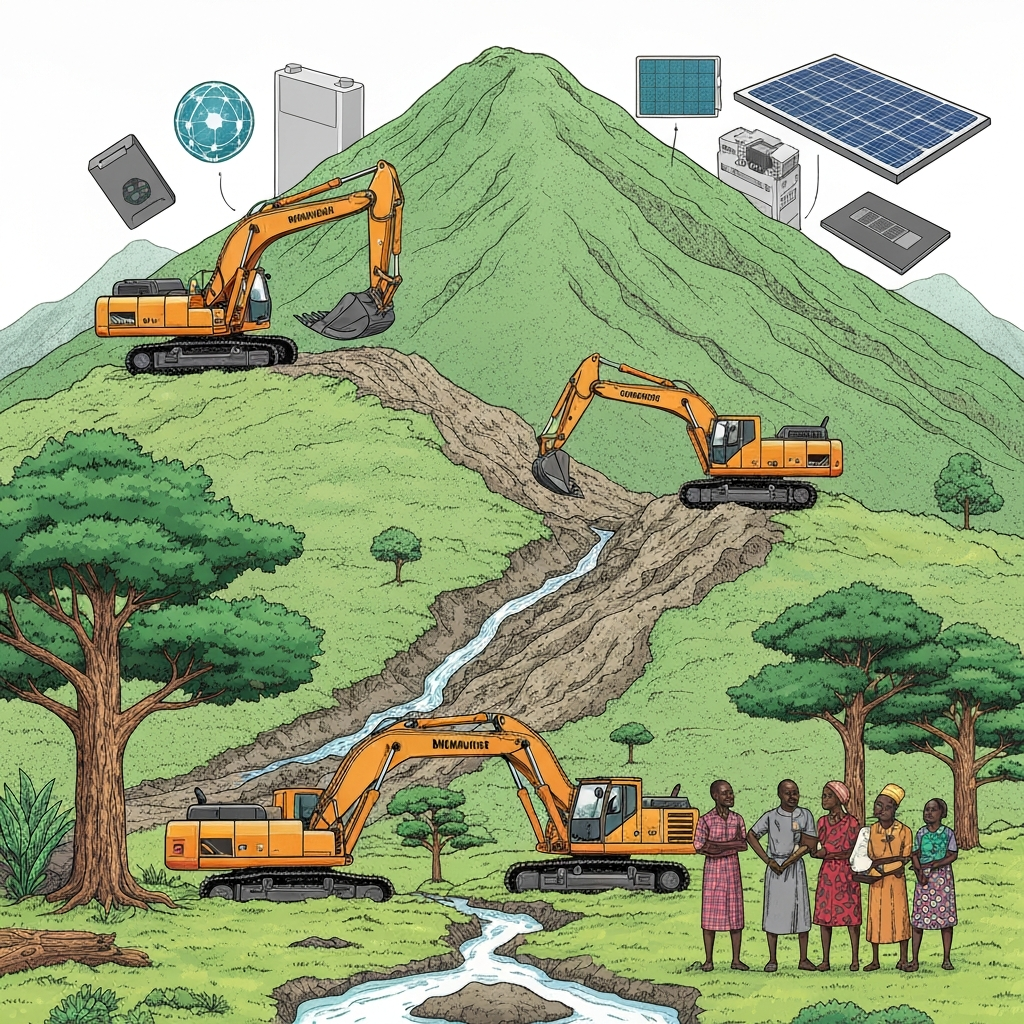
Mount Mulanje in southern Malawi became a UNESCO World Cultural Heritage Site in July 2025, only to face an $820 million bauxite and rare-earth mining project just six months after its inscription. The proposed operation promises $260 million in annual foreign exchange and 1,300 jobs — numbers of enormous weight for one of the world's poorest economies — yet the same mountain serves as the headwaters of nine rivers, the drinking water source for roughly one million people, and the sole natural habitat for more than 70 endemic species. Despite unanimous opposition from 147 village chiefs and a physical blockade mounted by residents in January 2026, regulatory authorities signaled that exploration permit procedures remained active, deepening the conflict and undermining community trust. This case is not simply an environmental dispute; it is a structural portrait of how global demand for aluminum and rare earths — the raw materials of electric vehicles and renewable energy — converts a sacred mountain in a low-income nation into a target for industrial extraction. The inscription of "World Heritage" status, far from shielding Mulanje, risks functioning as a golden shackle: imposing conservation obligations on a poor state while exposing its resources to heightened international scrutiny and commercial pressure.
Key Points
The UNESCO Paradox — Certification Is Not the Same as Protection
Mount Mulanje was inscribed as a cultural landscape at the 47th World Heritage Committee session in July 2025 under Criteria (iii) and (vi) — for its richness of cultural tradition and its deep spiritual significance — yet within just six months it faced an $820 million mining development proposal that showed no signs of stopping. This single fact cuts directly against the widely held assumption that "World Heritage equals safety," and it forces an honest reckoning with what UNESCO inscription actually delivers in practice. The World Heritage Convention carries moral and diplomatic weight, but it holds relatively weak direct enforcement power over what a sovereign state chooses to do within its own territory. If anything, inscription functions as a global advertisement for the exceptional value of the land — and for resource-rich low-income nations, that advertisement can operate as a golden shackle, imposing conservation obligations while simultaneously making the country's natural assets more visible to international extractive interests. The pattern is not unique to Mulanje, and that context matters enormously. An IUCN report released the same month as the inscription found that 97 of 266 evaluated natural World Heritage sites globally — a full 36 percent — have extractive industry interests overlapping with their boundaries, and one in four of Africa's natural and mixed heritage sites faces active mining threats. Mulanje is not an anomaly; it is the latest iteration of a documented structural problem. The Greek Parthenon repatriation debates and the Benin Bronzes disputes have both shown us that World Heritage status simultaneously provides a form of protection and transforms a site into a high-stakes international asset — and the higher the stakes, the more pressure mounts on the host government from multiple directions at once. The implications point toward an urgent need to redesign the protections the system offers. As cases like Mulanje accumulate, serious international policy conversations will likely emerge about binding moratoriums on extraction within inscribed sites, or about international compensation funds that genuinely reimburse low-income states for accepting conservation obligations as a global public good rather than as an unfunded burden. In the 1990s, the United States spent $65 million in federal assets to buy out a gold mine proposed at the entrance to Yellowstone, and the company contributed an additional $22.5 million to a restoration fund. Mount Mulanje has no comparable patron — and acknowledging that gap is not peripheral to understanding the UNESCO paradox, it is its core.
The Asymmetry of Economics vs. Survival — You Cannot Put These on the Same Scale
The project promises $260 million in annual foreign exchange and 1,300 direct jobs — numbers that carry enormous weight in an economy where 75.4 percent of the population lives below the $3-a-day poverty line and official foreign reserves cover less than one month of import spending. In a country where imports run at three times the value of exports and macroeconomic stability directly determines whether hospitals have medicine and schools stay open, those figures are not rhetorical. The government's unwillingness to simply walk away from this proposal is not corruption or recklessness — it is the predictable behavior of an administration facing genuine existential fiscal pressure that most commentators writing from wealthy countries have never experienced personally. But the other side of the scale carries assets that are structurally impossible to compare in the same monetary units. Mount Mulanje is the headwaters of nine rivers; roughly one million people drink from those rivers and farm the land they irrigate. More than 70 endemic species live here and nowhere else on Earth. The Mulanje cedar — Malawi's national tree — exists as a wild species only on this mountain, and a 2017 survey found exactly seven mature specimens remaining. The core issue is irreversibility: foreign exchange can be earned again next year, but a destroyed watershed and an extinct endemic species cannot be recovered at any budget level ever allocated in the history of conservation science. The tea industry around Mulanje and neighboring Thyolo employs over 75,000 people and accounts for roughly 9 percent of Malawi's total foreign exchange earnings — and every plantation in that system draws its water from Mount Mulanje. The real accounting in this deal is therefore 1,300 promised mining jobs against 75,000 existing livelihoods sustained by the mountain's hydrology. Any cost-benefit analysis that treats a single year of mining revenue as equivalent to a century of freely provided natural water infrastructure is, in my view, not rigorous analysis — it is arithmetic designed to produce a predetermined answer. The asymmetry between what is recoverable and what is not must be treated as the central variable in the decision, not a footnote.
The Structural Complicity of the Green Transition — Where This Extraction Demand Really Comes From
The reason Mount Mulanje is under threat is not primarily because of Malawian policy decisions or Akatswiri Mineral Resources as a corporate actor. It is because the global aluminum market and rare earth market are driven by the green energy transition, and that transition's demand curve runs directly through this mountain's geology. Bauxite becomes aluminum, and aluminum goes into EV body panels, solar panel frames, and the lightweight structures of wind turbines. Rare earths go into the permanent magnets that make electric motors and wind generators function. The IEA projects critical mineral demand could grow up to sixfold by 2040 as the world pursues net zero emissions, with aluminum demand alone rising 40 percent by 2030, and a single EV requires 60 to 80 kilograms more aluminum than a conventional vehicle. This means the engine powering the excavators toward Mulanje is not Malawian greed — it is the demand curve generated by consumers in wealthy countries who want electric vehicles and renewable energy while remaining largely insulated from the extraction costs those products require. The environmental costs of bauxite extraction stay concentrated in the villages at the foot of the mountain; the value-added from refined aluminum flows to factories and consumers on other continents. I describe this structure as eco-colonialism not as a rhetorical flourish but as a structural description: the flow of resources and the distribution of risk follow a pattern nearly identical to 19th-century colonial extraction, with only the justification having changed from "civilizing mission" to "green transition." Any serious engagement with the Mulanje case must grapple with this supply chain complicity. Consumers who purchase EVs, solar installations, and renewable energy products are structurally connected to the demand that makes Mulanje a mining target — not through malice, but through the architecture of global commodity markets. The question of who bears the cost of the green transition is not an abstract moral inquiry. It is a concrete question with a concrete current answer: communities like those around Mulanje bear the environmental costs while capturing almost none of the financial benefits, and this distribution will continue as long as supply chain transparency requirements and conservation-linked due diligence remain inadequate or unenforced. That is the central structural fact this case forces us to confront.
The Collapse of Procedural Legitimacy — What Happens When Consent Becomes a Formality
The 147 village chiefs of communities surrounding Mount Mulanje voted unanimously against the mining project — not a majority, not a supermajority, but unanimous — and in January 2026, residents took direct physical action to block company personnel from entering the mountain. These are not modest signals. They represent an extraordinary degree of organized democratic opposition at the community level, expressed through both formal traditional governance structures and direct action. The fact that regulatory authorities simultaneously signaled that exploration permit procedures remained active under these conditions is the central procedural legitimacy crisis at the heart of this dispute. When community consent is treated as a formality to be documented rather than a genuine veto right to be respected, the consequences are not simply normative — they are practical and costly over time. Development without consent does not eliminate conflict; it postpones and compounds it. Once the precedent "unanimous community opposition doesn't ultimately stop the process" is established in a high-profile case, the next dispute enters negotiations with one side already knowing that legal channels can be bypassed. That knowledge produces harder resistance, higher eventual social costs, and longer conflict timelines, consistently costing more in total — through litigation, security expenses, and production disruptions — than genuine prior consent processes would have required. Free, Prior, and Informed Consent is not a bureaucratic hurdle designed to slow economic development. It is a mechanism that ensures the people who bear the costs of a decision have a genuine voice in making it. The first decision about whether to mine a mountain should belong to the communities whose lives depend on that mountain's water, biodiversity, and spiritual heritage. I believe any extraction operation that proceeds without authentic consent cannot claim legitimacy regardless of the revenue figures it promises, and that the precedent set by Mulanje will reverberate through Malawi's resource governance credibility for decades. Procedural legitimacy, once shattered at scale, cannot be restored by financial compensation after the fact.
Market Reputational Risk as a Faster Protector Than Environmental Law
Electric vehicle manufacturers, renewable energy developers, and the financial institutions that back them are growing increasingly sensitive to "conflict mineral" and "contested source" risk as ESG rating systems tighten and supply chain due diligence regulations expand across major markets. European supply chain due diligence legislation is moving toward requiring upstream source traceability for critical materials, and battery regulations in both the EU and major importing economies are evolving to demand documentation of where raw materials originate. Under these frameworks, a source that carries documented community opposition, ongoing legal disputes, and UNESCO advisory body concerns becomes a commercial liability for downstream buyers, regardless of the formal legal status of the permits involved. If Mulanje bauxite becomes internationally labeled as a "conflict source" or "disputed origin" material, downstream buyers in the automotive and energy sectors may withdraw independently — letting market forces cool the project before regulatory mechanisms can act. This dynamic has precedents in other critical mineral contexts, where supply chain transparency requirements and NGO documentation campaigns have made certain sources commercially untouchable despite their formal legality. The market-driven pressure has the potential to move faster and land harder than the slow machinery of environmental law or international conservation advocacy, particularly given the aggressive timelines on which EV supply chains are currently being built out and audited by major manufacturers. The paradox embedded in this scenario is worth sitting with carefully. What ends up protecting the sacred mountain may not be environmental activism or international heritage law but the reputational risk calculations of purchasing managers at automobile manufacturers in Germany, South Korea, and the United States. This protection, if it materializes, is entirely contingent and not principled — it exists because loss avoidance serves corporate interests, not because justice is being served. A cheaper, quieter alternative source appearing on the market could dissolve it instantly. That fragility underscores why structural reforms to the World Heritage system remain necessary even if market pressure provides near-term relief — a point that should not be lost in the relief of any short-term win.
Positive & Negative Analysis
Positive Aspects
Concerns
Outlook
## Near-Term Outlook (1–6 Months)
Over the next six months, the center of gravity in the Mulanje dispute will rest on a single administrative line: the exploration permit. The government and regulatory authority are currently trapped in a double bind — neither full approval nor full withdrawal is politically viable. Full approval invites backlash from international opinion and UNESCO advisory bodies; full withdrawal means publicly surrendering the foreign-exchange and jobs narrative the government has been building. The most probable near-term scenario, in my assessment, is a compromise: a conditional exploration permit paired with a mandated supplementary environmental impact assessment. This middle path temporarily appeases both sides without satisfying either, and it stockpiles fuel for future conflict rather than resolving the underlying tension.
I put the probability of at least one additional physical confrontation or injunctive legal challenge within the next six months at above 60 percent. Having already demonstrated the tactical effectiveness of physical blockades in January 2026, the local resistance is highly likely to deploy the same playbook if pressure escalates again. The 147 chiefs'' unanimous opposition represents a degree of organized community coordination that does not dissolve under regulatory delay — if anything, protracted uncertainty tends to harden resistance positions on both sides of these disputes, raising the eventual cost of resolution.
International variables will also accelerate quickly. UNESCO''s World Heritage Committee and advisory bodies like IUCN can request monitoring reports or raise the specter of "World Heritage in Danger" listing when credible threats to a newly inscribed site emerge. The moment that card reaches the table, the Malawian government''s calculation transforms from a single-line question about $260 million in annual foreign exchange into a multidimensional cost: foreign exchange versus international credit standing, development aid relationships, and tourism brand equity. Placing a site on the Danger List just six months after inscription carries a symbolic weight that no government can casually dismiss.
My read is that the most likely near-term government posture is "strategic delay" — slowing procedures rather than canceling the project, buying time without committing to either direction. But delay is not resolution. Every month spent managing optics rather than addressing the real question further erodes governance credibility, and the mounting trust deficit simply becomes the next administration''s inheritance. The danger of strategic delay is that it mistakes a deferred problem for a solved one.
## Medium-Term Outlook (6 Months–2 Years)
The six-month to two-year window is where the real inflection points lie. The decisive variables in this period are: what exploration data actually reveals about commercially viable reserves, and whether Malawi moves toward institutionalizing a genuine Free, Prior, and Informed Consent mechanism with real veto authority rather than consultative theater. If the exploration confirms commercially viable reserves, pressure on the government will intensify dramatically beyond anything visible now. External investors and downstream commodity buyers will engage in earnest, and the political gravity of an $820 million project will narrow the government''s effective options in ways that are very difficult to reverse.
Conversely, if exploration results come in below commercial viability, the conflict could quietly dissolve — a scenario I assign roughly a 30 percent probability. What is striking about that scenario is that the mountain''s protector would be geological chance rather than environmental governance or legal protection. That tells you something important about how fragile the current protection mechanisms actually are, regardless of which way this particular exploration round goes. The variable I''m watching most closely in the medium term is the judicialization of this dispute. If environmental and human rights organizations push this into administrative courts or international human rights mechanisms, a single ruling creates the baseline for every future protected-area versus critical-mineral dispute in the region.
A third medium-term variable deserves serious attention: global supply chain pressure from downstream buyers. EV and renewable energy companies are growing increasingly sensitive to "conflict mineral" risk as ESG ratings tighten and supply chain due diligence regulations expand. European due diligence legislation and battery regulations are evolving toward requiring upstream source traceability, making controversial origins a commercial liability. If Mulanje bauxite gets labeled a "conflict source," downstream buyers may pull out independently — letting the market cool the project before any regulation acts. This market-driven pressure may ultimately move faster and hit harder than slow-moving government regulation, and the paradox is that what ends up protecting the sacred mountain may not be environmental law but reputational risk aversion in corporate purchasing departments in Germany and South Korea.
## Long-Term Outlook (2–5 Years)
Over a two-to-five-year horizon, I anticipate three substantial paradigm shifts. The first is growing pressure to redesign the World Heritage system itself. As cases like Mulanje accumulate, the assumption that "UNESCO inscription equals protection" will face sustained scrutiny, and serious international policy conversations will emerge about binding moratoriums on extraction within inscribed sites or international compensation funds that reimburse low-income states for absorbing conservation obligations as a global public good rather than as an unfunded burden. I assign roughly a 50 percent probability that within five years, at least a draft norm around an "inscribed-site mining moratorium" or a "conservation compensation mechanism" will appear as a formal multilateral agenda item. The intellectual pivot this requires is treating conservation not as an unfunded mandate but as a service with a price — one that wealthy nations, as the primary beneficiaries of global cultural heritage preservation, should be expected to pay.
The second long-term shift is the reshaping of African conservation politics by critical mineral geopolitics. As structural demand for aluminum and rare earths grows toward 2030 and beyond, Mulanje will not be the last conflict of this type — it will be the opening chapter of a long series. Similar pressures will spread to other inscribed sites, protected forests, and watershed conservation zones across the continent, and each time the same core question will repeat itself: who pays the cost of the green transition? Without a genuine social consensus on the answer, the mining frontier will keep eroding the boundaries of protected areas from the inside outward. The paradox that a carbon-neutral transition generates new extraction demand must be confronted directly; without that reckoning, the green transition becomes another name for outsourcing costs onto the world''s most vulnerable communities.
The third long-term shift is the potential for decentralized resource governance to gain real institutional force. If the Mulanje resistance achieves a genuine institutional victory, it becomes a powerful model for communities across Africa to convert free, prior, and informed consent from a procedural courtesy into a meaningful veto right backed by legal precedent. The unanimous opposition of 147 chiefs is, in symbolic capital terms, a formidable demonstration of decentralized democratic legitimacy. Conversely, if consent is overridden and mining proceeds anyway, that precedent will weaken community sovereignty for decades and push resistance toward more extreme forms. I believe Mulanje is not simply an environmental dispute — it is a de facto constitutional moment defining who gets to decide the fate of land in sub-Saharan Africa.
Sources / References
- Hands off Mulanje: Fury as mining plan threatens Malawi's sacred UNESCO mountain — Nyasa Times
- A 'big no': Opposition grows to proposed mine in Malawi's newest UNESCO site — Mongabay
- No bauxite mining in Mulanje Mountain — Malawi24
- In Malawi, green light for mining exploration causes outcry — The Africa Report
- Malawi: Traditional chiefs, environmentalists and residents oppose proposed mine in newest UNESCO site — Business & Human Rights Resource Centre
- Akatswiri Mineral Resource rolls its Mulanje bauxite project, over 1300 jobs created — Nyasa Times
- Flouted procedures and questionable legitimacy — Investigative Platform Malawi
- Opposition to Mulanje mine — allAfrica
- Akatswiri's $820M aluminium project — a game changer for Malawi's economy — AlCircle
- Clean energy demand for critical minerals set to soar — IEA
- World Heritage sites at risk from extractive industries — IUCN
- "What Do We Get Out of It?": Human rights impact of bauxite mining in Guinea — Human Rights Watch
- Malawi overview — poverty and economic data — World Bank
- Malawi: World Bank approves grant for 358.5MW Mpatamanga hydropower project — World Bank
- Protecting the critically endangered Mulanje cedar tree — African Mountain Research