
Pandora's Library — The Question 10,000 Authors Asked with a Blank Book, and Whether AI Can Answer
Summary
In early 2026, 10,000 authors published 'Don''t Steal This Book,' an 88-page volume containing nothing but their names, as a powerful protest against unauthorized AI training data usage. With the UK government's official withdrawal of its opt-out approach, Anthropic's landmark $1.5 billion settlement, and the US Supreme Court's refusal to recognize AI copyright all converging simultaneously, the global AI copyright war has reached a genuine watershed moment. This analysis examines whether symbolic protest through a blank book can actually reshape industry power structures, evaluates the realistic options for addressing the 'opened Pandora's box' of billions of already-ingested texts, and proposes royalty pools and licensing models as the most viable path forward for both creators and technology companies.
Key Points
The Blank Book Paradox — Emptying Content Reveals Its Value
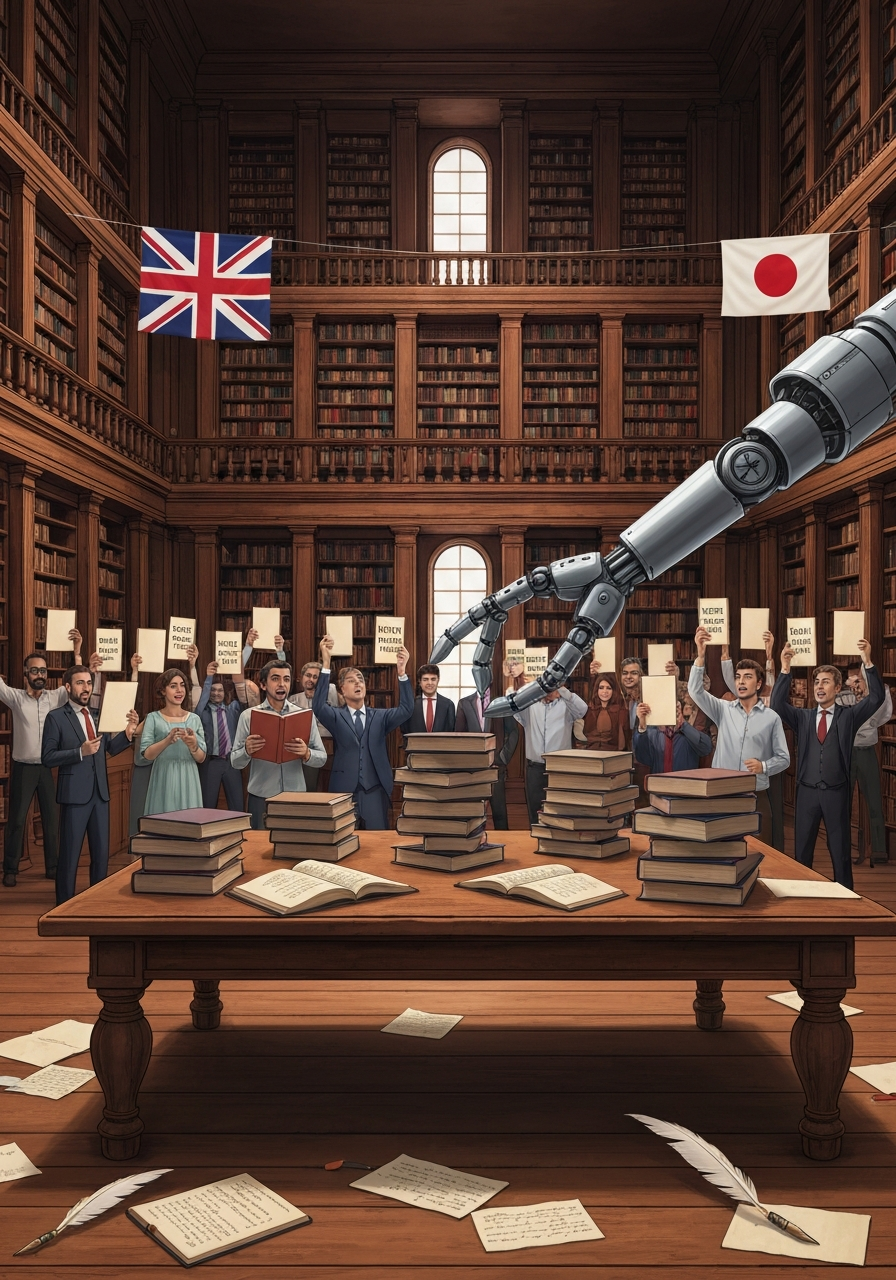
The 10,000-author 'Don''t Steal This Book' is an 88-page volume containing nothing but names, and it has become the defining symbol of the 2026 AI copyright movement. The campaign went beyond simple protest, paradoxically proving that human creative works are the irreplaceable core of AI training data. Similar movements are now being organized on visual art platforms like DeviantArt and ArtStation, with usage of AI training prevention tools like Glaze and Nightshade surging 340% compared to 2025.
The UK's U-Turn — Symbolic Victory or Empty Gesture
The UK government's official withdrawal of the opt-out approach for AI training data on March 18, 2026, appears to be a landmark victory for authors, but the reality beneath the surface is far more complex. Whether the framework is opt-out or opt-in, there is currently no technical method to reverse data that has already been learned by AI models. The UKIPO has begun a formal public consultation on a new framework, with approximately 60% probability of introducing compulsory licensing.
The Four-Pole Global Copyright War
The global regulatory landscape around AI copyright has fractured into four distinct poles. The US has become a case law laboratory with over 70 active lawsuits. The EU takes a transparency-centered approach through the AI Act. Japan maintains the world's most permissive stance. The UK is now seeking a new framework after withdrawing opt-out. This regulatory inconsistency creates regulatory arbitrage, with approximately 40% probability of a WIPO-led international treaty between 2028 and 2030.
The $1.5 Billion Dilemma — Can Money Change the Structure
Anthropic's $1.5 billion settlement is the largest copyright-related settlement in AI industry history. OpenAI also spent approximately $500 million on copyright-related legal costs in 2025 alone. However, compensation is almost certain to be skewed toward major publishers and famous authors. Nevertheless, considering the music industry precedent of 14 years from the Napster lawsuit in 2001 to Spotify stabilization in 2015, the publishing industry may find a new equilibrium by the early 2030s.
The Rise of Synthetic Data — The Ultimate Solution to Pandora's Box?
Synthetic data technology is emerging as the most discussed long-term solution. Nvidia and Meta are already investing hundreds of millions of dollars in synthetic data generation pipelines. By 2029, an estimated 30-40% of all AI training data could be replaced by synthetic datasets. However, the initial seed data underlying any synthetic data pipeline is still human creative work, meaning the dependency relationship won't be easily severed.
Positive & Negative Analysis
Positive Aspects
- Opportunity for Fundamental Redesign of Creator Compensation
The music industry offers a compelling precedent of transforming the Napster-era crisis into the Spotify streaming model. Anthropic's $1.5 billion settlement serves as a critical first step. The global AI training data licensing market is projected to grow to $5-8 billion by 2027.
- Elevated Public Awareness and Shifting Political Landscape
The blank book campaign has been remarkably effective at raising intuitive awareness of AI training data issues among the general public. The 340% increase in usage of AI training prevention tools demonstrates creator communities are moving beyond protest into active self-protection.
- Formation of a Global Regulatory Laboratory
The EU's AI Act, US case law accumulation, UK policy shifts, and Japan's permissive approach are simultaneously conducting different regulatory experiments. If the EU's transparency requirements spread as a global standard, ingredient labeling for AI training data will become an industry norm between 2027 and 2028.
- Reaffirmation of Premium Value in Human Creative Works
In an era where AI can generate virtually unlimited content, the premium value of genuinely human-written works is paradoxically being highlighted rather than diminished. An era where the Human-Written label becomes a recognized quality assurance mark is rapidly approaching.
- Voluntary Expansion of AI Company Licensing
Awareness of escalating legal risk and rapidly shifting public opinion are driving major AI companies to voluntarily build licensing models. OpenAI's agreements with AP and Axel Springer, Google's deal with Reddit demonstrate genuine market-driven momentum toward creator compensation.
Concerns
- The Unleashed Genie — Irreversibility of Already-Learned Data
Machine unlearning remains firmly in early research stages with no production-ready solutions on the horizon. With current technology, selectively deleting training data from models with billions of parameters is virtually impossible.
- Structural Skewing of Compensation — Royalties Concentrated in the Top 1%
The music streaming industry's royalty distribution provides a sobering precedent. The same structural dynamic is very likely to be replicated in AI training data compensation. Median full-time author income has already dropped to just $20,000 annually, a 42% decline from a decade ago.
- Global Regulatory Arbitrage — The Trap of a Borderless Digital World
As long as Japan maintains the most permissive stance, companies can strategically relocate training infrastructure to jurisdictions with looser regulations. A WIPO-led international treaty is expected to take at least 3-5 years.
- The Time Gap Between Law and Technology
The 70-plus AI copyright lawsuits currently in progress are expected to take an average of 2-3 years. By the time courts issue definitive rulings, the technological reality may be entirely obsolete.
- Innovation Suffocation Risk — Counterproductive Effects of Excessive Regulation
Excessive restriction of AI's access to humanity's knowledge could severely dampen critical public-interest applications. If AI training costs increase 200-500%, small startups and research institutions would be effectively priced out.
Outlook
The ripple effects of 'Don''t Steal This Book' are only just beginning. I expect at least 3-5 similar campaigns to emerge in the first half of 2026. Visual artists, photographers, and illustrator communities are particularly likely to mount their own symbolic protests. Usage of AI training prevention tools like Glaze and Nightshade has increased 340% compared to 2025.
Sources / References
- Key Findings: Authors Guild Author Income Survey — Authors Guild
- UK Drops Plan to Let AI Firms Use Copyrighted Works by Default — Reuters
- Anthropic Reaches $1.5 Billion Copyright Settlement Over AI Training Data — Wired
- 10,000 Authors Published a Blank Book to Protest AI Training — The Verge
- Regulatory Framework for AI - EU AI Act — European Commission
- Artificial Intelligence and Intellectual Property — World Intellectual Property Organization
- The Times Sues OpenAI and Microsoft Over A.I. Use of Copyrighted Work — The New York Times
- U.S. Supreme Court Declines to Hear Dispute Over Copyrights for AI-Generated Material — CNBC
- Anthropic Pays Authors $1.5 Billion to Settle Copyright Infringement Lawsuit — NPR
- Copyright and AI Progress - Written Statement — UK Parliament