
'It's a Fake' — How One Verdict Made National Treasures Disappear
Summary
A Nanjing Museum deputy director declared authentic masterpieces as forgeries for 30 years, exposing deep flaws in global museum governance.
Key Points
30 Years of Systematic Looting — The Deputy Director's Playbook
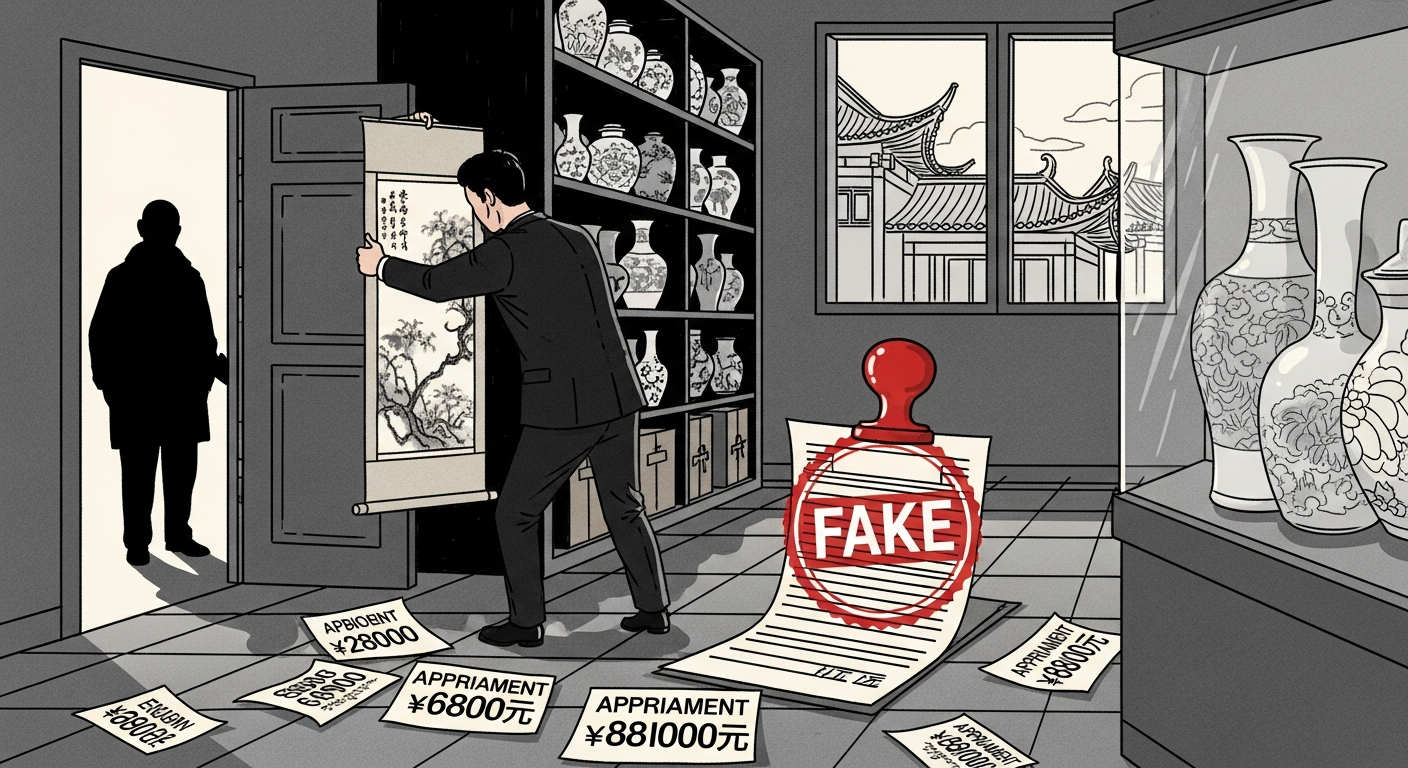
Xu Huaping, the former executive deputy director of the Nanjing Museum, systematically siphoned off donated national treasures during his tenure from the 1990s through 2005. His methods were disturbingly sophisticated. First, he would have an internal expert panel declare authentic works as 'forgeries.' Then, using that verdict as justification, he would remove the pieces from the museum's official inventory. Finally, he would sell them at rock-bottom prices through the Jiangsu Province Cultural Relics Store, which fell under his jurisdiction. Qiu Ying's 'Spring in Jiangnan,' donated by the Pang Laichen family in 1959, traveled this exact route and was sold in 2001 for a mere 6,800 yuan — roughly $940. When that same painting resurfaced in a 2025 Beijing auction catalog with an estimated value of 88 million yuan (approximately $12 million), the scandal was blown wide open. A massive investigation involving interviews with 1,100 individuals and review of 65,000 documents identified 24 government officials facing disciplinary action, confirming that this was no rogue operation but a case of deeply embedded institutional corruption.
The Politics of 'Forgery' — Monopolized Authority in Art Authentication
At the heart of this scandal lies the structural vulnerability of art authentication systems. When an internal expert panel at a museum declares a work a 'forgery,' that verdict carries effectively final and irreversible authority. In the absence of external independent audits or any mechanism for challenging such determinations, the power to authenticate becomes the power to dispose. There is now no way to verify whether the appraisals conducted in the early 1960s were genuine scholarly judgments or the groundwork for theft, and that ambiguity speaks volumes about the severity of the problem. Much like medicine recognizes the value of second opinions, the art world urgently needs a system in which multiple independent appraisal bodies cross-verify each other's findings. When the power of judgment is monopolized by a handful of experts, the temptation for abuse becomes structurally inevitable. This is not a uniquely Nanjing problem — it is a shared structural deficiency across museums worldwide.
The Courage of an 80-Year-Old Whistleblower — Guo Lidian's Exposure
The detonator for this scandal was Guo Lidian, an 80-year-old retired museum employee. On December 21, 2024, he appeared on WeChat holding his former staff identification card and publicly accused Xu Huaping of systematic corruption by name. Having worked in the museum's collection management department, Guo alleged 'organized, premeditated, and large-scale theft and smuggling of artifacts relocated from the Palace Museum during the wartime Southern Migration.' The fact that he could only speak out after retirement — that he dared not open his mouth while still employed — starkly reveals the absence of internal reporting channels. His social media exposé triggered an explosive wave of public attention across China, and within just two days, on December 23, the National Cultural Heritage Administration launched an official investigation. This case proves that in the digital age, the power of whistleblowing operates on an entirely different scale than it once did, while simultaneously demonstrating just how powerless traditional internal reporting channels had become.
6,800 Yuan vs. 88 Million Yuan — The Arbitrariness of Cultural Property Valuation
The case of Qiu Ying's 'Spring in Jiangnan' — sold in 2001 for 6,800 yuan and then estimated at 88 million yuan at a 2025 auction — lays bare the extreme arbitrariness of cultural property valuation. A 13,000-fold price difference cannot be explained by market fluctuations alone. A single label of 'forgery' transformed a national treasure into scrap, and once that label was removed, astronomical value was instantly restored. This case reveals both how enormous the economic consequences of art authentication can be and how opaque the process behind those determinations remains. The physical object never changed — yet someone's word alone could swing its value by a factor of 13,000, which is damning evidence of fundamental flaws in the current authentication system. The descendants of the Pang Laichen family have since filed legal proceedings to block the auction of the painting, setting a potentially groundbreaking precedent for the protection of donor rights.
A Global Museum Governance Crisis — Nanjing Is Just the Tip of the Iceberg
This scandal extends far beyond Nanjing. In 2023, it was revealed that over 2,000 artifacts had been stolen from the British Museum over a 20-year period and sold on eBay for as little as 40 pounds. Italy has faced repeated scandals involving the smuggling of ancient artifacts, and Greece and Egypt are not immune to internal theft either. The fact that nearly identical patterns of corruption emerged on opposite sides of the globe — in Nanjing and London — demonstrates that this is not a problem unique to any particular country or individual, but an inherent vulnerability of the museum as an institution. Three layers of structural failure exist in common across museums worldwide: opaque internal collection management, absence of external auditing, and uncritical acceptance of expert determinations. That ICOM's Code of Ethics has gone without revision for 22 years since 2004 is a telling measure of just how neglected this problem has been.
Positive & Negative Analysis
Positive Aspects
- Collapse of a 30-Year Cover-Up and the Pursuit of Truth
The very fact that a corruption structure concealed for three decades has finally surfaced is itself a meaningful achievement. One person's courage — Guo Lidian's — brought down an enormous edifice of institutional rot, triggering a massive investigation that involved interviewing 1,100 people and reviewing 65,000 documents. Three of the five missing works have already been recovered and returned to the museum, while a fourth was found registered under a different name within the museum's own collection. With disciplinary proceedings underway against 24 implicated officials, the scope of accountability is expanding from the individual to the systemic level. This stands as proof that no matter how impenetrable a corrupt structure may appear, it eventually crumbles. In the age of social media, the ripple effect of whistleblowing has grown incomparably greater than anything the past could have imagined.
- A Catalyst for Digital-Era Museum Management Innovation
This scandal will serve as a powerful catalyst for accelerating the digital transformation of museum collection management. The British Museum has already announced plans to invest approximately 1.3 billion pounds in the digitization of 8 million artifacts following its own theft scandal. Blockchain-based collection registration systems can create immutable records of every change, fundamentally eliminating the possibility of record tampering. The technological groundwork is already being laid — Florence's Uffizi Gallery has piloted a blockchain authentication system, and Art Basel in Switzerland has been experimenting with NFT-based artwork certification. The Nanjing scandal has dramatically underscored both the legitimacy and urgency of adopting such technologies. It is projected that within five years, a majority of major national museums will have implemented digital collection management systems.
- Momentum Toward Mandatory Independent External Audits
A fundamental question has finally been asked: why do museums lack the external auditing that corporations take for granted? Following the British Museum scandal, the UK has already established an independent audit committee and is implementing a reform roadmap containing 36 recommendations. This model now has the momentum to become an international standard. The fact that ICOM's Code of Ethics has not been revised since 2004 — a 22-year gap — has drawn sharp attention, and international pressure is building for a comprehensive overhaul of governance guidelines. This could mark a historic turning point in shifting museums from a 'trust-based model' to a 'verification-based model,' fundamentally redefining how these institutions are held accountable.
- A Catalyst for Strengthening Whistleblower Protections
The fact that Guo Lidian could not speak out while employed and had to wait until age 80 after retirement to blow the whistle starkly reveals how severely whistleblower protection mechanisms are lacking. In the wake of this scandal, discussions about establishing internal reporting channels within cultural institutions and strengthening whistleblower protection laws have gained significant momentum. In China specifically, a culture of 'real-name reporting' is spreading through social media, opening the possibility of new checks and balances that do not depend on traditional organizational hierarchies. The precedent set by Guo Lidian's WeChat video — which triggered a national investigation within just two days of its release — will serve as a crucial reference point for future whistleblowers contemplating whether to come forward.
- An Evolution in the Art Authentication Paradigm
This scandal has raised fundamental questions about the absolute authority vested in small expert panels for art authentication. Just as medicine embraces the second opinion, there is now serious discussion about systems in which multiple independent appraisal bodies cross-verify each other's determinations. Advances in scientific authentication technologies — X-ray fluorescence analysis, infrared reflectography, carbon dating — are providing objective means of verifying subjective judgments. Regulations mandating that such scientific data be incorporated into authentication procedures are expected to take shape in the coming years. Reports that South Korea's National Museum is also actively considering the adoption of scientific authentication methods suggest that a paradigm shift in appraisal practices across East Asia is accelerating.
Concerns
- A Severe Chill on the Culture of Donation
The Pang Laichen family donated their heirlooms for the good of the nation, and the result was a betrayal in which authentic masterpieces were reclassified as 'forgeries' and sold off at a fraction of their value. As this case becomes widely known, there is a real possibility that a worldwide 'donation chill' will take hold, with private collectors worldwide growing reluctant to entrust their collections to museums. Reports have already emerged of several Chinese collector families withdrawing their intentions to donate. Given that museums rely significantly on donations to expand their collections, a sustained chill could deal serious long-term damage to institutional growth and cultural preservation, with implications reaching well beyond China's borders.
- Extremely Low Probability of Recovering Missing Cultural Property
One of the five missing works remains unaccounted for, and there is a strong likelihood it has already been smuggled abroad. The international black market for illicit cultural property is estimated at roughly $10 billion annually, and once a work enters this market, tracking it becomes extraordinarily difficult. This particular case is further complicated by the fact that the works were classified as 'forgeries' and sold through ostensibly legitimate channels — making it a legal nightmare to prove they were stolen in the first place. For works that have passed through multiple owners over decades, the principle of good-faith acquisition may clash with restitution claims, potentially rendering recovery practically impossible. Even when registered with Interpol's stolen artwork database, the historical recovery rate stands at only 10 to 15 percent.
- Copycat Effects and the Emergence of New Methods
With the Nanjing scheme's methodology now publicly known in detail — 'forgery declaration, inventory removal, bargain sale, auction or overseas transfer' — there is a concern that it may inadvertently serve as a playbook for corrupt actors at other institutions. While heightened surveillance will naturally follow, the development of new methods designed to circumvent that surveillance is only a matter of time. There is particular concern about a potential surge of rushed thefts during the gap period before digital record-keeping systems are fully implemented. Historical patterns show that major scandals are frequently followed by a spike in copycat offenses, as bad actors attempt to exploit what they perceive as a 'last window of opportunity' before reforms take effect.
- A Blow to China's Cultural Property Repatriation Diplomacy
China has long been an aggressive advocate for the return of cultural properties held overseas, claiming the moral high ground in these negotiations. The revelation that the country could not even properly manage national treasures within its own institutions has handed its critics a ready-made rebuttal: 'You cannot even take care of your own.' This could deal considerable damage to China's cultural diplomacy efforts, which have pursued the repatriation of hundreds of artifacts each year. Western museums now have an additional justification for refusing return requests, and China's negotiating leverage in UNESCO-level repatriation talks will inevitably weaken as a result.
- The Risk of Retaliation Against the Whistleblower
Guo Lidian is an 80-year-old man who stood up against a formidable power structure to expose systemic corruption, and the possibility of retaliation or legal pressure against him cannot be entirely ruled out. Whistleblower protection systems in China remain underdeveloped compared to those in Western nations, and exposing corruption within politically sensitive cultural institutions carries particular risks of institutional pushback. If Guo Lidian's safety is not assured, this will send a powerful chilling signal to other potential whistleblowers, likely resulting in similar corruption being swept under the rug. Reports have already surfaced indicating that associates of Xu Huaping have signaled possible legal action against Guo Lidian's claims, suggesting the road ahead will not be smooth.
Outlook
Let me start with what is likely to unfold in the coming months. By the first half of 2026, formal judicial proceedings against Xu Huaping will be well underway. He is currently subject to disciplinary action for 'serious duty-related violations,' and additional judicial review of 24 implicated individuals is scheduled. Based on precedents in Chinese criminal cases involving cultural property, a scandal of this magnitude will almost certainly be escalated to direct investigation by the provincial-level procuratorate. In my estimation, a formal indictment decision will come by June 2026, and if convicted, a sentence exceeding ten years is to be expected. The legal proceedings themselves will likely become a bellwether for how seriously China treats institutional corruption in the cultural sector, and the entire art world will be watching.
Simultaneously, the international hunt for the last missing work will intensify. Procedures to register the piece with Interpol's stolen artwork database are in progress, and Chinese authorities have already requested cooperation from major international auction houses. But to be frank, if this work has already passed into a private collector's hands, the probability of recovery falls below 20 percent. The legal status of an object that was classified as a 'forgery' and then sold through ostensibly legitimate channels is profoundly ambiguous in the illicit cultural property market. Even in best-case scenarios, the litigation required to reclaim such works typically drags on for years, if not decades, crossing multiple jurisdictions with inconsistent legal frameworks on cultural property restitution.
The most significant near-term development to watch is the policy response from China's National Cultural Heritage Administration. The Jiangsu provincial cultural heritage authorities have already released their investigation findings, but national-level institutional reform has yet to materialize. I predict that by the second half of 2026, a directive for a nationwide inventory audit of all museum collections will be issued. China has more than 7,000 registered museums as of 2024 — 7,046 to be precise — and an audit of this scale would be unprecedented in the history of any nation's cultural heritage management. The costs alone could run into the billions of yuan, and the likelihood of uncovering additional corruption is considerable. Nanjing may prove to be only the tip of the iceberg. There are already unconfirmed whispers from museum insiders in other provinces suggesting that similar practices may have occurred elsewhere, though no concrete evidence has surfaced publicly.
Looking at the medium term, there is a substantial probability that this scandal will serve as a detonator for global museum governance reform. Within six months to two years, the International Council of Museums (ICOM) is expected to significantly strengthen its international guidelines for collection management. ICOM's Code of Ethics was established in 1986 and last revised in 2004 — the fact that 21st-century museums have been governed by standards unchanged for 22 years is remarkable in itself. Mandatory independent external auditing will emerge as a central agenda item, backed by growing public demand for institutional accountability. The question of why museums have never been subject to the kind of external financial auditing that corporations take for granted can no longer be deflected. The UK has already established an independent audit committee in the wake of the British Museum thefts, and that model is poised to become an international standard. I expect that by 2027, more than 70 percent of major national museums will have adopted external auditing, with the remaining holdouts facing increasing pressure from government funding bodies and public opinion alike.
The adoption of blockchain-based collection registration systems will also accelerate. Current museum collection management relies overwhelmingly on internal databases — systems in which an administrator can alter records without leaving a trace. Blockchain technology records every change immutably, which would fundamentally prevent schemes like 'forgery declaration followed by inventory removal followed by sale.' Florence's Uffizi Gallery has already piloted a blockchain authentication system, and Art Basel in Switzerland has been experimenting with NFT-based artwork certification. Several major technology companies, including IBM and Microsoft, have expressed interest in developing museum-specific blockchain solutions. The Nanjing scandal has dramatically amplified both the justification and the urgency for deploying these technologies at scale, and I expect to see at least three to five major national museums announce blockchain pilot programs by the end of 2027.
The paradigm of art authentication will also shift over the medium term. Currently, the judgment of a small expert panel functions as effectively the final word, a system that has operated virtually unchanged since the Renaissance era of connoisseurship. But much like medicine's embrace of the second opinion, there is growing momentum for systems in which multiple independent authentication bodies cross-verify each other's findings. Advances in scientific authentication technology will play a major role here. X-ray fluorescence analysis, infrared reflectography, carbon dating, and increasingly sophisticated spectroscopic techniques have already reached considerable levels of sophistication. These tools can detect pigment compositions, canvas aging patterns, and stylistic signatures that are invisible to the human eye. Regulations mandating that such objective data be incorporated into authentication procedures are on the horizon. I expect that by 2028, major museums will require at least two independent scientific analyses as a mandatory component of their authentication processes, effectively ending the era in which a single panel's subjective judgment could seal a work's fate.
Taking the long view, two to five years out, we are approaching a period in which the very identity of the museum as an institution will be redefined. Until now, museums have centered their mission on 'collection' — acquiring, preserving, and displaying objects. But as digital technology advances and governance crises converge, 'accessibility' and 'transparency' will emerge as the new core values. The 'Open Museum' model — in which 3D scan data of collections is made available worldwide and provenance histories can be tracked in real time — is likely to be piloted at leading institutions within three to five years. This is not merely a technological upgrade; it is a paradigm shift that fundamentally redefines the relationship between museums and the public. The Smithsonian Institution has already released more than 3 million collection items as open-access data, demonstrating that such a transformation is entirely achievable. The Metropolitan Museum of Art has similarly expanded its Open Access initiative, and the Rijksmuseum in Amsterdam has made high-resolution images of its entire collection freely available. These early movers are charting the course for what will become industry standard.
The most dramatic change in this process will be the reshaping of donation culture. In the short term, donations will certainly decline. The psychological impact on potential donors cannot be understated — the Pang Laichen family's story is a cautionary tale that will echo through collector circles for years. But over the longer term, the proliferation of 'conditional donation' models may actually make giving more structured and sustainable. Under these models, donors would contractually reserve the right to periodically verify the condition of their donated works, to request independent authentication, and to demand return of the works in the event of improper disposal. Some American university museums are already implementing this approach, and several major foundations have begun drafting template agreements that incorporate these protections. I expect conditional donation frameworks to become an international standard by 2028, ultimately making the donation process more transparent and trustworthy than ever before.
Let me lay out the scenario analysis. In the bull case, the Nanjing scandal becomes the tipping point for global museum governance. China's government conducts a nationwide collection audit, ICOM comprehensively revises its governance guidelines, and blockchain-based collection management becomes standard within five years. In this scenario, museum-related corruption could decline by 60 to 70 percent over the next decade. International cooperation on cultural property tracking would be significantly enhanced, and a new global registry — something akin to a universal provenance ledger — could emerge. I put the probability of this scenario at roughly 30 percent.
In the base case, reform is partial but meaningful. Significant institutional improvements proceed within China, but global change moves slowly, hampered by budget constraints, institutional inertia, and political complexity. ICOM guideline revisions do not materialize until after 2028, and blockchain adoption remains limited to pioneering institutions in Western Europe and North America. Donation culture contracts for three to five years before gradually recovering as new safeguards restore confidence. The missing Nanjing work is never recovered, but the scandal serves as an enduring reference point in governance reform debates. This is the most realistic projection, and I assign it a probability of approximately 50 percent.
In the bear case, the scandal is politically managed and winds down without substantive change. Xu Huaping faces individual punishment, but systemic reform fizzles out as bureaucratic resistance and competing political priorities dilute reform momentum. Other institutions quietly bury their own irregularities during the media furor, taking advantage of the spotlight on Nanjing. In this scenario, a similar-scale scandal at another museum within five years is highly likely. Public trust in museums declines over the long term, and donation culture suffers severe and lasting damage. I put the probability at approximately 20 percent — though given the Chinese government's overall anti-corruption posture, a complete cover-up would be difficult to sustain.
There are ripple effects that also deserve close attention. First, the museum insurance market will shift. Insurers will reassess collection management risk, potentially raising premiums by 10 to 20 percent or refusing coverage altogether to museums that fail to meet updated governance standards. Second, as provenance verification standards tighten in the international art market, transaction costs for works of Chinese origin could increase by 15 to 25 percent in the short term, as buyers and auction houses demand more rigorous documentation. Third, there will be repercussions for China's cultural property repatriation diplomacy. China has been pursuing the return of hundreds of overseas cultural artifacts annually, but the exposure of internal mismanagement will weaken its moral authority and negotiating position in repatriation talks at both bilateral and UNESCO levels.
Of course, there are scenarios in which my predictions could prove wrong. If the Chinese government seizes this crisis as the catalyst for a wholesale digital transformation of its cultural property management system and commits to massive investment, China could paradoxically emerge as a global leader in museum governance. Given the speed and scale at which China builds digital infrastructure — consider the pace of its social credit system, its cashless payment ecosystem, or its high-speed rail network — this is not an entirely far-fetched possibility. Conversely, if the investigation is scaled back due to political sensitivities, or if additional corruption is uncovered on a scale that overwhelms the investigative apparatus itself, the situation could grow far more complicated than any forecast can accommodate.
For readers seeking practical guidance: if you are a cultural property collector or are considering making a donation to a museum, insist on independent authentication and legal counsel before proceeding. When donating, contractually specify storage conditions and disposal restrictions, and secure the right to periodic verification of your donated works. Ask pointed questions about whether the museum publicly discloses its collection inventory, whether it submits to external audits, and what mechanisms exist for challenging authentication decisions. Make these factors core criteria in your decision. These are no longer 'nice to have' conditions — they are essential safeguards for protecting your cultural heritage. The Nanjing scandal has taught us that trust alone is not enough. Verification is the new foundation upon which the relationship between donors and museums must be built.
Sources / References
- Declared a Fake, Sold, Then Valued at 88 Million: The Case Shaking the Nanjing Museum — ArtMajeur Magazine
- Whistleblower Rocks Nanjing Museum as Ex-Director Accused of Looting National Treasures — THE VALUE
- China Launches Probe Into Alleged Art-Theft Scheme at Nanjing Museum Involving a Former Director — ARTnews
- China Probes Museum Art Theft Claims That 'Make the Louvre Thieves Look Dumb' — South China Morning Post
- China's Nanjing Museum Artwork Scandal Probe Uncovers Historic Mismanagement, Corruption — South China Morning Post
- Investigators Find Decades-Long Mismanagement, Corruption at China's Nanjing Museum — ARTnews
- Museum's Donated Painting in Spotlight — China Daily
- Review Into British Museum Thefts Calls for Fundamental Reforms — The Art Newspaper
- 'Mismanagement and Corruption' Alleged at Nanjing Museum — ArtReview
- In Depth: A Lost Masterpiece's Return Exposes Scandal at a Top Chinese Museum — Caixin Global
- Investigation Uncovers Mismanagement of Donated Artifacts — China Daily
- Probe Finds Major Art Mismanagement at China's Nanjing Museum — Sixth Tone