
Eight Organizations Just Sued Trump Over the Kennedy Center — America Is Demolishing Its Own 'Living Memorial'
Summary
In a country that overwrites an assassinated president's name with the sitting president's name, what does heritage preservation even mean? The Kennedy Center lawsuit is not about architecture. It is a war over the symbols of American democracy itself.
Key Points
Eight Architecture and Cultural Groups File Federal Lawsuit
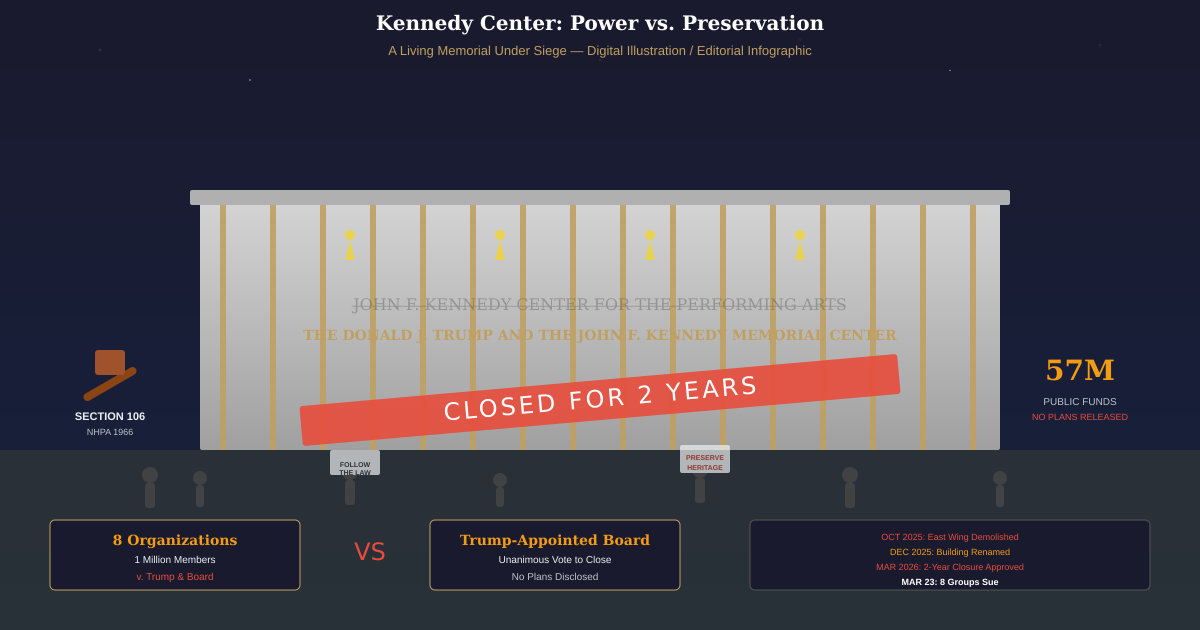
The American Institute of Architects, National Trust for Historic Preservation, DC Preservation League, and five other organizations representing over one million members filed suit in U.S. District Court in Washington, D.C. They argue President Trump and his hand-picked Kennedy Center board are pushing a $257 million renovation without complying with Section 106 of the 1966 National Historic Preservation Act, which requires public review before undertaking projects affecting historic properties. The fact that architectural plans have not been disclosed to the public while a two-year complete closure was unanimously approved makes this the most significant heritage preservation lawsuit in recent American history.
Trump-Kennedy Center Renaming Controversy
In December 2025, the Trump-appointed board unanimously renamed the building to The Donald J. Trump and The John F. Kennedy Memorial Center for the Performing Arts. The Kennedy family pushed back immediately, with Joe Kennedy III declaring that the center, named by federal law as a living memorial to an assassinated president, can no sooner be renamed than can someone rename the Lincoln Memorial. Congresswoman Joyce Beatty filed a separate lawsuit, and Rep. April McClain Delaney introduced legislation to restore the original name. Legal experts unanimously agree the name change requires an act of Congress, not merely a board resolution.
Two-Year Complete Closure and Performing Arts Ecosystem Shock
The board voted unanimously to shutter the Kennedy Center for two years following July 4, 2026 celebrations. Between 75 and 175 of the Center's roughly 300 employees face displacement, while resident companies including the Washington National Opera and National Symphony Orchestra must find alternative venues. With major artists already boycotting and ticket sales plummeting, debate rages over whether the closure serves renovation needs or provides cover for halls emptied by an artist boycott. Once performing arts infrastructure stops, audiences form new habits, artists relocate, and technical staff transition to other industries, making ecosystem recovery extraordinarily difficult.
White House East Wing Demolition as Precedent
In October 2025, Trump demolished the entire White House East Wing to build a grand ballroom, proceeding without National Capital Planning Commission review or historic preservation consultation. Costs doubled from an initial $200 million to $400 million. The National Trust for Historic Preservation sued but a federal judge allowed construction to proceed. This precedent is ominous for Kennedy Center plaintiffs but also demonstrates a repeated pattern of procedural bypass that strengthens the argument for judicial intervention before the pattern becomes normalized.
Secret Plans vs. Internal Documents Revealing Modest Scope
Internal memos obtained by NPR reveal the actual planned work is relatively modest — Concert Hall seat replacement, marble armrest installation, and changing the Grand Foyer carpet color from red to black with gold pattern. This contrasts sharply with Trump's public references to a complete rebuilding, and the $257 million budget and two-year complete closure seem disproportionate to cosmetic changes. Architectural plans remain undisclosed to the public despite a federal judge ordering the board to provide renovation plans to trustees before the closure vote, which the board approved anyway.
Positive & Negative Analysis
Positive Aspects
- Civil society institutional checks still functioning
Eight organizations representing over one million members bringing suit in federal court proves that institutional checks on power still function in America. In many countries no legal mechanism exists for civil society to block government alterations to historic buildings. The NHPA and Section 106 process remain among the world's most systematic heritage protection frameworks, even as they face unprecedented pressure.
- Genuine renovation needs are real
The Kennedy Center has aged 55 years, and deteriorating concert hall seats, damaged stage flooring, and aging infrastructure are legitimate problems. Congress authorizing $257 million acknowledges this facility's national-level significance. The fundamental issue is not whether renovation should happen but how it is conducted — with legal compliance and transparency, or without.
- Unprecedented public awareness of heritage preservation
The East Wing demolition and Kennedy Center controversy have generated record-breaking public awareness of historic preservation law. Google search volume for NHPA surged after the East Wing demolition, and millions of Americans learned about Section 106 for the first time. Paradoxically, the act of ignoring the law has most effectively demonstrated why it exists.
- Potential to establish vital legal precedent
The Kennedy Center case brings stronger plaintiff composition and clearer legal grounds than the East Wing lawsuit. Two independent legal claims — Section 106 violation and Congressional naming authority violation — give courts multiple grounds for intervention. A favorable ruling could reverse the trend of procedural bypasses and strengthen protections for all federal cultural institutions.
Concerns
- Two-year closure devastating to performing arts ecosystem
Shutting America's only national performing arts center for two years displaces over half its 300 employees, cancels two years of scheduled performances, and destabilizes Washington's entire cultural ecosystem. Performing arts infrastructure, once interrupted, proves extraordinarily difficult to rebuild as audiences, artists, and technical staff all scatter to alternatives.
- Repeated pattern of legal procedure bypasses
Three procedural bypasses in six months — East Wing demolition in October 2025, Kennedy Center renaming in December 2025, Kennedy Center closure in March 2026 — establishes an intentional pattern, not administrative oversight. The concern is this pattern extending to other federal cultural institutions like the Smithsonian, Library of Congress, or Lincoln Memorial.
- Non-disclosure of architectural plans and transparency deficit
A $257 million publicly funded renovation proceeding without disclosed architectural plans is abnormal for any democracy. Internal documents suggesting modest cosmetic changes deepen the disconnect between a two-year closure timeline and the stated budget, raising legitimate questions about fund allocation that secrecy cannot answer.
- Erosion of international moral authority on heritage protection
America modifying its own historic buildings without legal process undermines the moral authority it claims when condemning other nations' cultural heritage destruction. This coincides with Iran's Isfahan heritage destruction and the British Museum's Palestine labeling erasure, signaling cultural heritage has become a global political battlefield.
- Artist boycott paradoxically enabling closure justification
Artists refusing to perform at the Kennedy Center exercised moral resistance, but the resulting ticket sales collapse may have provided justification for the two-year closure. If the boycott has been co-opted as a tool legitimizing closure, it presents the classic resistance dilemma — participate and provide legitimacy, or refuse and provide empty seats.
Outlook
In the short term, this lawsuit must secure a temporary restraining order or preliminary injunction before July 4 to have meaningful impact. Time is the enemy. Three months remain, and federal courts do not move quickly. The East Wing precedent is ominous, as preservationists sued there too but the judge allowed construction to proceed. However, the Kennedy Center case has stronger plaintiff composition. Eight organizations representing one million members bring two clear legal claims: Section 106 violation and Congressional naming authority violation. Odds sit at roughly 50-50, swinging heavily on how aggressively courts will intervene against the executive branch.
In the medium term, regardless of the lawsuit's outcome, a two-year Kennedy Center closure would force structural changes to Washington D.C.'s performing arts ecosystem. Within six months to two years, several consequences unfold. The Washington National Opera, National Symphony Orchestra, and other resident companies that call the Kennedy Center home will need alternative venues, with some potentially downsizing or relocating to other cities. Washington's independent theaters and galleries may benefit from the displacement but none can match the Kennedy Center's scale. The Smithsonian could serve as a temporary performance venue, though this risks conflicting with its own institutional mission.
Simultaneously, the legal battle over the Kennedy Center's name change proceeds on a parallel track. Congresswoman Joyce Beatty's lawsuit and Rep. April McClain Delaney's legislative bill advance in parallel, with strong potential to become a cultural issue in the November 2026 midterm elections. If the Kennedy Center becomes a midterm campaign issue, it marks a new phase where heritage preservation itself becomes a political weapon.
Looking at the long-term horizon of two to five years, this case becomes a stress test for America's entire cultural heritage protection system. Whether the 1966 National Historic Preservation Act retains its effectiveness, whether Section 106 can be neutralized by executive will — these questions are now on trial. If courts side with the administration on the Kennedy Center case too, NHPA effectively becomes advisory law with no enforcement mechanism. Conversely, if courts rule for the plaintiffs, the trend of procedural bypasses that began with the East Wing could reverse.
The most optimistic scenario (bull case) envisions courts granting the injunction, halting construction, and triggering Section 106 review. Plans would be made public, dialogue with the arts community would resume, and renovation would proceed through proper legal channels — potentially with phased partial closures rather than a two-year complete shutdown. The baseline scenario (base case) sees courts denying the injunction while the lawsuit continues, reaching a ruling on procedural violations two to three years later. By then, construction would be complete, making the legal victory more moral than practical but establishing precedent for future cases. The most pessimistic scenario (bear case) has courts dismissing all lawsuits, the Trump-Kennedy Center reopening in 2028, and this becoming precedent for renaming and modifying other federal cultural institutions. In this scenario, NHPA Section 106 loses enforcement power, and heritage preservation becomes a system dependent on presidential goodwill.
Regardless of which scenario materializes, one thing is certain: the Kennedy Center lawsuit is not a simple architectural dispute. It is a test of how America treats its own cultural memory, and the answer will serve as a vital sign diagnosing the health of the American project itself.
Sources / References
- Kennedy Center board and Trump are sued by 8 architecture and culture groups — NPR
- Top architectural and historic preservation groups sue Trump over Kennedy Center plans — CNN
- Kennedy family members slam move to rename Kennedy Center — The Hill
- Internal memo details cosmetic changes and facility repairs to Kennedy Center — NPR
- Kennedy Center votes to shut down operations for 2 years — CBS News
- The White House East Wing is now demolished — CNN
- Section 106: National Historic Preservation Act of 1966 — GSA