
The British Museum Erased the Word 'Palestine' — Does Any Museum Have the Right to Delete a 2,500-Year-Old Name?
Summary
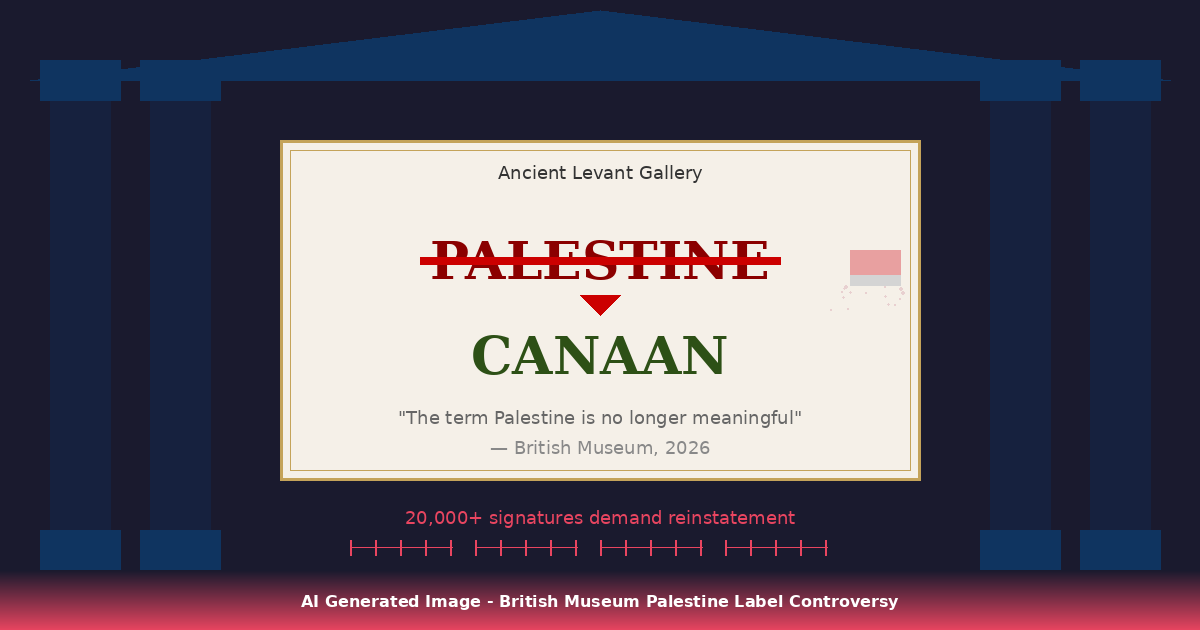
The British Museum quietly erased 'Palestine' from its ancient Middle East galleries. Academics are revolting against the deletion of a historical term used for over 2,500 years, and more than 20,000 people have signed a petition demanding its reinstatement. Was this relabeling during an active war a scholarly update — or a political act of erasing a people's identity?
Key Points
Deletion of a 2,500-Year-Old Academically Established Term
Since Herodotus recorded 'Palaistine' in the 5th century BCE, dozens of ancient scholars including Aristotle, Pliny the Elder, and Ovid have referred to this region as Palestine. The Roman Empire used the official administrative designation 'Syria Palaestina' in the 2nd century CE, and the Byzantine era subdivided it into Palaestina Prima, Secunda, and Salutaris. Ancient history scholars at Cambridge, Oxford, and the Open University have officially confirmed that 'ancient Palestine' is a term used as standard in current academic literature. This is not a political position but a historical-geographic fact based on over 150 years of scholarly tradition. Erasing a single word is tantamount to denying the entire 2,500 years of context that word carried.
The Contradiction Between UKLFI Lobbying and the Museum's 'Voluntary Change' Claim
The pro-Israel legal group UK Lawyers for Israel (UKLFI) sent a letter to British Museum director Nicholas Cullinan on February 6, 2026, protesting that the use of the term 'Palestine' was 'historically inaccurate and misleading.' The museum claimed the label changes were a 'routine refresh' following departmental staff changes in early 2025 and occurred before the UKLFI letter. However, according to in-depth reporting by The Art Newspaper, testimony from current and former curators conflicts regarding the connection between the timing of changes and UKLFI's campaign. If the museum changed labels due to external pressure, it represents a surrender of scholarly autonomy; if it changed them voluntarily, it needs to explain why it made a decision contrary to scholarly consensus.
Over 20,000 Petition Signatures and an Open Letter from 200+ Cultural Figures
The Change.org petition started by activist Taghrid Al-Mawed gathered 6,800 signatures in a single day and surpassed 20,000 cumulative signatures by mid-March. Separately, over 200 prominent cultural figures including Brian Eno signed an open letter criticizing the British Museum's actions. The letter connected the label changes to the museum hosting a private event for the Israeli Embassy and maintaining its BP partnership, denouncing what it called the museum's systematic erasure of Palestinian identity. The fact that an academic dispute expanded into a mass cultural resistance movement demonstrates that this issue transcends mere terminology — it is a question about identity and existence itself.
The Irony of an Imperial Looting Institution Invoking 'Historical Accuracy'
The British Museum still holds cultural artifacts looted during the colonial era, including the Benin Bronzes, the Parthenon Marbles, and the Rosetta Stone, and has refused repatriation under the banner of 'preserving the collection.' In 2023, it was revealed that over 2,000 items had been stolen by an internal staff member, completely destroying the museum's claim of being 'the safest custodian.' While museums in France, Germany, the Netherlands, and Scotland returned Benin Bronzes, the British Museum used the British Museum Act as a shield to refuse repatriation. For such an institution to delete the historical names of colonized peoples while invoking 'scholarly accuracy' is nothing less than a modern variation of imperialism.
The Weight of Cultural Erasure During Active Warfare
The label change occurred in February-March 2026, during the Iran war that destabilized the entire Middle East and the ongoing Israeli-Palestinian conflict. This is not merely a matter of timing. In the same period when UNESCO reported damage to over 56 museums and cultural heritage sites in Iran from airstrikes, and Art Dubai postponed its 20th anniversary edition due to the war, a London museum quietly deleted a people's name. A dual erasure is underway — cultural heritage being physically destroyed while simultaneously being linguistically deleted. Bombs destroying ruins and labels erasing names differ in scale but point in the same direction.
Positive & Negative Analysis
Positive Aspects
- Regular updating of scholarly terminology is a natural obligation of museums
Museum labels are not permanent fixtures and should be regularly updated as new archaeological discoveries emerge or scholarly consensus evolves. The British Museum's use of 'Canaanite' is based on the scholarly argument that this term may be closer to what the people of that era called themselves. It is true that ancient peoples did not call themselves 'Palestinians,' and distinguishing between geographical names assigned by later generations and contemporary self-identification is a legitimate scholarly endeavor. Interpreting every label change as political could actually inhibit academic freedom.
- Attempts to correct historical anachronism are not inherently blameworthy
There is merit to the argument that using 'Palestine' in the Levant gallery covering the period 2000-300 BCE may be anachronistic. Since Herodotus's first recorded use dates to the 5th century BCE, applying this term to exhibits from earlier periods does contain a historical inaccuracy in the strict sense. The practice of retroactively applying modern nation or ethnic names in ancient history has sparked controversy in other regional exhibitions as well, and dismissing all such correction efforts as purely political attacks may be an overreaction.
- Displaying multiple historical names can enhance visitor comprehension
Using refined designations appropriate to each period and region — Canaan, Kingdom of Israel, Kingdom of Judah, Phoenicia — can provide visitors with more accurate historical context. The museum stated it received feedback through 'audience testing' that the term 'Palestine' could cause confusion for modern audiences in certain contexts. As an educational institution, the effort to use the most accurate and clear terminology possible can be viewed positively, and this does not necessarily imply an intent to deny any particular people's existence.
- A museum's cautious approach to conflict-zone terminology
In a situation as sensitive as the Israeli-Palestinian conflict, a museum exercising caution in its use of specific terms can be seen as an attempt to maintain political neutrality. In a scenario where any terminology choice will provoke backlash from one side, replacing contested terms with less controversial ones (Canaan) could be a strategy to focus on the museum's educational function. While this logic has flaws, the intent to prevent the museum from becoming a political battleground is understandable.
Concerns
- Deleting a 150-year-established scholarly term on non-scholarly grounds constitutes historical revisionism
Cambridge Palestine Studies, Oxford's Middle Eastern archaeology department, and the World History Encyclopedia all use 'ancient Palestine' as standard scholarly terminology. The fact that the catalyst for change was not an academic paper or archaeological discovery but a protest letter from a pro-Israel legal organization clearly demonstrates this was not a scholarly update. Changing terminology when scholarly consensus has not changed is, by definition, historical revisionism, and this directly contradicts the museum's own stated principle of 'evidence-based exhibition.'
- The coincidence between the UKLFI letter and the timing of changes constitutes strong circumstantial evidence of external pressure
While the museum claims the changes were a 'routine refresh following early 2025 staff changes,' the fact that UKLFI's February 2026 letter identified the exact same galleries and panels is difficult to dismiss as coincidence. Testimony from current and former curators interviewed by The Art Newspaper also conflicts regarding the circumstances of the changes. If the museum altered its scholarly judgment due to external lobbying, this represents a serious case of compromised autonomy at one of the world's most influential cultural institutions, potentially setting a precedent for similar pressure on other museums.
- The symbolic violence of deleting a people's name during wartime
In 2026, with the Israeli-Palestinian conflict ongoing and the Iran war physically destroying Middle Eastern cultural heritage, the world's largest museum deleting the name 'Palestine' sends a powerful symbolic message regardless of intent. The deletion of a name connects to the deletion of existence, and this is one of the mechanisms of cultural genocide. In the 21st century, when the UN Declaration on the Rights of Indigenous Peoples enshrines the preservation of cultural identity as a fundamental right, the world's largest museum deleting a specific people's historical name is not merely a label swap.
- The structural irony of an imperial looting institution deleting colonized peoples' historical terms
A substantial portion of the British Museum's collection was acquired through looting, seizure, and unfair transactions during the British Empire's colonial era. The Parthenon Marbles, Benin Bronzes, and Rosetta Stone are prominent examples, and the museum has refused repatriation requests using the British Museum Act as a shield. For such an institution to delete colonized peoples' historical names from its Levant gallery while claiming 'scholarly accuracy' is structurally identical to a looter erasing the names of their victims.
- Selective 'anachronism correction' reveals a double standard
If the British Museum takes issue with anachronism, why delete only 'Palestine' while retaining modern names for other regions? 'Egypt' in the Egyptian galleries derives from the Greek 'Aigyptos,' a name assigned later, and 'Iraq' in the Mesopotamian gallery is similarly anachronistic. Applying modern nation names like 'Greece' and 'Italy' to ancient artifacts in European galleries constitutes the same anachronism, yet these remain unchallenged. The selective deletion of 'Palestine' alone proves that this was a political choice rather than a scholarly principle.
Outlook
The British Museum's erasure of 'Palestine' from its galleries is not an isolated incident but the opening salvo in a structural crisis confronting cultural institutions worldwide. The ripple effects of this decision deserve examination across short, medium, and long-term horizons.
In the next one to six months, this controversy will almost certainly escalate rather than subside. With the Change.org petition surpassing 20,000 signatures and over 200 cultural luminaries — including Brian Eno — signing an open letter condemning the decision, pressure on the museum will intensify. The matter may be raised in the UK Parliament, particularly under the Labour government, potentially triggering a broader review of cultural heritage policy. Simultaneously, UKLFI and similar pro-Israel organizations are likely to pursue comparable campaigns targeting other museums and universities that use 'Palestine' in their historical displays. In the United States, the Trump administration's elimination of NEA funding and ideological interference in museum programming has already set a parallel precedent — one-third of American museums have lost federal funding, according to the American Alliance of Museums. While the Iran war continues, political pressure on Middle Eastern exhibitions and academic events will only intensify, as Art Dubai's postponement of its 20th edition demonstrates.
Over the medium term of six months to two years, this incident will likely become a global precedent for what might be called 'museum terminology wars.' If the perception solidifies that external lobbying successfully altered the British Museum's scholarly terminology, political groups, lobby organizations, and governments worldwide will replicate the tactic. China has already pressured museums regarding Taiwan-related terminology; Turkey has contested 'Armenian genocide' labeling; Japan has objected to 'comfort women' exhibitions. The British Museum precedent would legitimate these efforts at an entirely new level. Furthermore, as AI-powered digital archiving expands, physical label changes that cascade into digital records could enable systematic distortion of historical documentation at scale. The counter-movement will also gain momentum: decolonial scholars and activists will use this case to press the fundamental question of 'who has the right to write history,' potentially reinvigorating the campaign for repatriation of the museum's most contested holdings.
In the long term — two to five years — this event could become a turning point in redefining the very identity of the 21st-century museum. The 'encyclopedic museum' model established in the 19th-century imperial era — collecting the world's cultural heritage in a single location and presenting it from a 'universal perspective' — will face existential challenge. As digital reproduction technology and virtual museums advance, physical possession will no longer be a prerequisite for exhibition, rendering the model of 'retaining looted objects while editing their history' unsustainable. In the most optimistic scenario, the British Museum uses this controversy as a catalyst for genuine reckoning with its imperial legacy and adopts collaborative exhibition models with source communities. In the baseline scenario, the museum partially restores the term 'Palestine' through a 'Canaan/Palestine' dual-labeling compromise, setting a precedent for other contested terms. In the most pessimistic scenario, politically motivated alterations to historical narratives become routine, museums degrade into battlegrounds for culture wars, and scholarly autonomy suffers systematic erosion.
The broader picture connects this incident to the question of how 'historical truth' should be governed in the digital age. Like Wikipedia edit wars, bias in AI training data, and the spread of misinformation on social media, museum label changes are fundamentally about who controls 'authorized historical narratives.' When physical erasure cascades into digital spaces, the impact grows exponentially. The labels at the British Museum — visited by over 6 million people annually — carry the authority of a textbook, and a name deleted here risks being deleted from millions of minds.
I believe this situation presents cultural institutions with a binary choice. One path is to capitulate to political pressure and avoid controversy. The other is to stand by scholarly evidence, accepting political costs to preserve historical accuracy. The British Museum appears to have chosen the first path, and the price will be paid not just in the erasure of a 2,500-year-old name but in the erosion of public trust in the institution of the museum itself. Museums exist to preserve history, not to edit it.
Sources / References
- British Museum did not remove Palestine from labels due to pressure campaign, museum sources say — The Art Newspaper
- Row after British Museum removes term Palestine from some displays — Museums Association
- Backlash Erupts After British Museum Removes Palestine — Artnet News
- Erasing history: British Museum criticised for removing references to Palestine — Middle East Eye
- Did the British Museum Remove Palestine From Its Displays? — Hyperallergic
- British Museum Removed the Word Palestinian from Some Displays Amid Pressure from Pro-Israel Group — ARTnews
- Palestine - World History Encyclopedia — World History Encyclopedia