
The British Museum's 25-Year Free Admission Myth Is Crumbling — And I Think That's Perfectly Reasonable
Summary
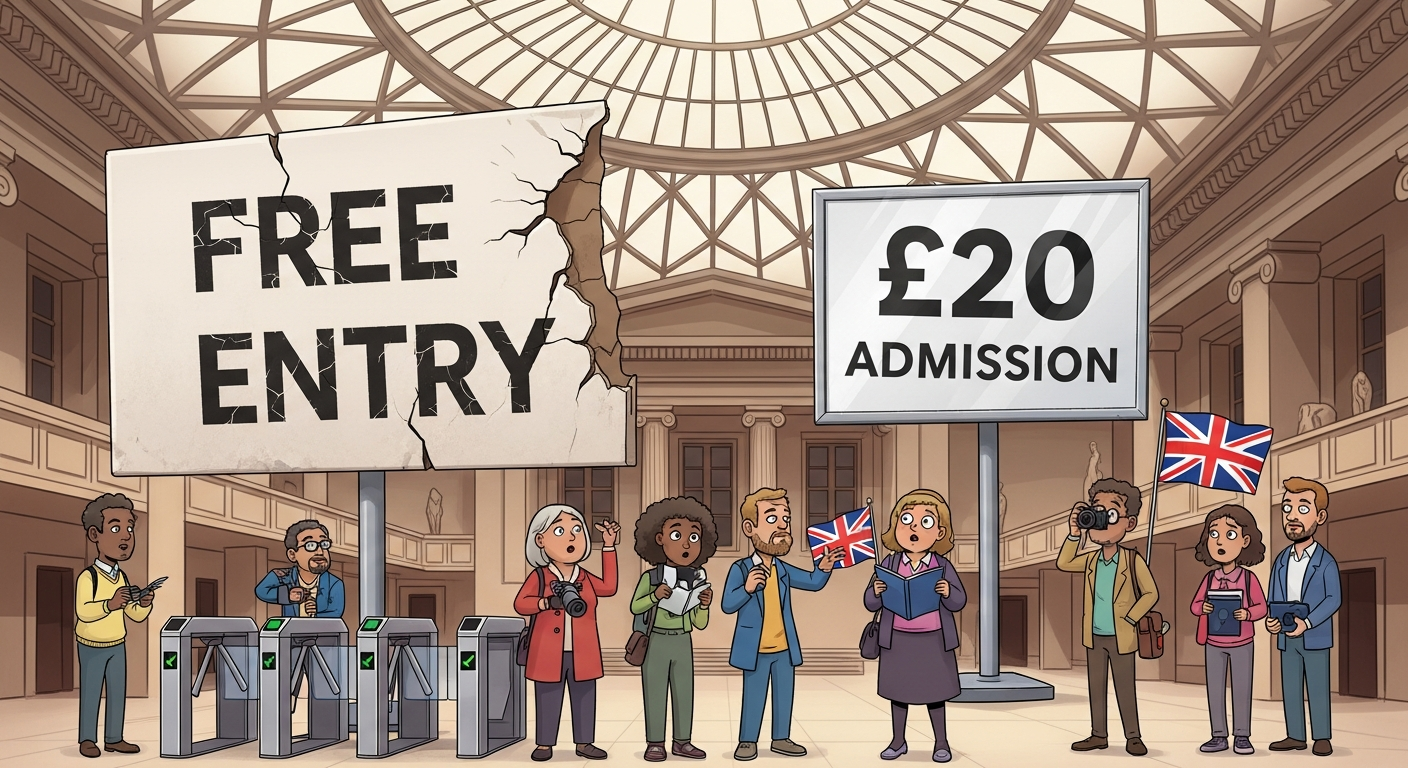
The UK's 25-year free museum policy faces collapse as 43% foreign visitors strain taxpayer-funded budgets amid growing fairness debates.
Key Points
The 25-Year Free Policy Has Hit Its Financial Ceiling
The free admission policy for national museums, introduced by Tony Blair's government in 2001, delivered a 151% surge in visitor numbers. The Natural History Museum and the V&A saw increases of 187% and 180% respectively, while National Museums Liverpool skyrocketed by 269%. But 25 years on, government grants that have failed to keep pace with inflation and post-pandemic fiscal pressures mean museums cannot secure the hundreds of millions of pounds needed for building maintenance, collection preservation, and digitization.
DCMS per-capita spending has been slashed by 32.3% in real terms, falling from 48.43 pounds in 2010/11 to 32.79 pounds in 2025/26. The 15 national museums received a combined 480 million pounds from DCMS in 2024-25, yet their 42.1 million visitors remain 15% below pre-COVID levels of 49.7 million in 2018-19. DCMS estimates that introducing foreign visitor charges could generate up to 350 million pounds in additional annual revenue.
The British Museum itself hit a ten-year high of 6.5 million visitors in 2024, but behind that headline figure lies severe infrastructure decay requiring a billion-pound masterplan renovation. Decades-old roofs leak so regularly that staff catch water in buckets as a matter of routine, and in 2018, footage of water pouring into the Parthenon Marbles gallery was broadcast on Greek television. The fundamental question now is whether maintaining the 'free' label matters more than the physical collapse of the buildings themselves.
The 43% Foreign Visitor Ratio Creates a Structural Inequity
Approximately 43% of UK national museum visitors — around 17.5 million people annually — are international tourists. This figure comes from official statistics covering the 15 DCMS-sponsored museums and galleries for the 2023-24 fiscal year. These visitors pay no UK taxes, yet they enjoy the same free services funded entirely by British taxpayers. Resentment over this structural imbalance has been building steadily among the public.
Baroness Hodge's independent review of Arts Council England, published in December 2025, formally recommended introducing charges for international visitors in conjunction with a digital ID system, and the government announced in March 2026 that it would begin 'exploring options.' A poll of 2,000 people commissioned by Art Fund through More in Common found that 72% believe tourist levy revenue should be used to keep museums free for all.
With the Metropolitan Museum in New York charging 30 dollars, the Louvre at 32 euros, and the Prado at 15 euros, every major museum in the world charges admission. Whether it is truly rational for Britain to insist on remaining the sole holdout is now a live political debate. This issue transcends mere pricing policy — it strikes at the fundamental principle of fairness between who benefits from public services and who pays for them.
The Louvre Effect — A Domino Collapse of Europe's Free Culture Paradigm
On January 14, 2026, the Louvre raised its admission price for non-EEA visitors from 22 euros to 32 euros — a 45% increase. This was the largest single price hike in the Louvre's history and the first time it formally distinguished between EEA and non-EEA visitors. Citizens of Norway, Iceland, Liechtenstein, and other EEA member states were exempted from the increase. The decision targets an additional 17.5 million euros in annual revenue, earmarked for enhanced security and infrastructure modernization.
The Louvre welcomed approximately 9 million visitors last year — roughly double its designed capacity. The museum's move sends a powerful signal that even a 'temple of culture' will choose fiscal reality over idealism when pushed to the wall. If Britain follows France's lead in modifying its free admission policy, the resulting domino effect across European museums could be profound.
Germany and Italy's public galleries are already beginning to explore a tiered pricing model of 'EU citizen discount, non-EU full price.' The Uffizi Gallery in Italy already offers EU citizen discounts, making the spread of this model practically a foregone conclusion. American tourists represent the largest share of the Louvre's international visitors, with Chinese visitors accounting for roughly 6%. If differential pricing for these non-EU visitors does not significantly dent actual attendance, this model is poised to become the new standard across European museums.
The Enforcement Dilemma of Two-Tier Pricing Without Digital ID
The UK government has explicitly stated that building a 'digital identification system' is a prerequisite for implementing two-tier pricing. Baroness Hodge's December 2025 ACE review also noted that digital ID card adoption would provide a 'valuable opportunity to revisit charging international visitors.' However, Britain lacks a universal identification system comparable to South Korea's resident registration cards, and Tony Blair's national ID card scheme, proposed in 2006, was scrapped amid fierce civil liberties opposition.
Prime Minister Keir Starmer announced mandatory digital ID in September 2025, but political and public backlash forced the government to retreat to a voluntary system. GOV.UK One Login currently has approximately 12 million registered users and, as of February 2026, connects to over 200 government services following HMRC's integration, but it falls far short of universal coverage.
Expecting visitors to carry passports to a museum is impractical, and an app-based voluntary verification system would inevitably trigger privacy debates. These technical and political obstacles could delay actual implementation by at least two to three years. The cost of building enforcement infrastructure may well offset admission revenue for the initial years, a point that cannot be ignored.
Tourist Tax — A More Pragmatic Alternative Than Admission Charges
Central London Forward's modeling indicates that a 3% tourist tax on accommodation across London could generate 352 million pounds annually. Westminster alone would contribute over 95 million pounds, with Camden, Kensington & Chelsea, and Tower Hamlets each yielding over 20 million pounds per year. Edinburgh is set to launch the UK's first tourist tax on July 24, 2026 — a 5% levy on accommodation costs, capped at five consecutive nights — projecting annual revenue of approximately 50 million pounds.
London is also moving forward, with Mayor Sadiq Khan having secured the authority to impose a tourist levy, currently under discussion at 2 to 4 pounds per person per night or 5% of accommodation costs. A tourist tax is psychologically less intrusive because it blends into accommodation bills, sparing visitors the experience of pulling out their wallets at museum doors.
Barcelona's tourist tax surged 128% from 1.75 euros per person per night in 2023 to 4 euros in October 2024, and tax revenue rose from 95 million euros to 115 million euros, yet visitor numbers actually increased. Venice began charging day-trippers a 5-euro entry fee, and Amsterdam has repeatedly raised its tourist tax since 2018 without any measurable decline in visitor numbers. This accumulating data from pioneer cities — demonstrating that tourist taxes do not meaningfully reduce visitor flows — significantly lowers the political risk of adoption.
Positive & Negative Analysis
Positive Aspects
- Financial Stabilization and Long-Term Survival of Museums
Introducing foreign visitor charges could generate up to 350 million pounds in additional annual revenue. This funding would be channeled into building repairs, collection preservation, digitization, and accessibility improvements. The British Museum alone faces urgent maintenance work on a scale of billions. Financial stability translates directly into more ambitious exhibitions and a higher quality visitor experience, ultimately guaranteeing the survival of these institutions for the next century and beyond.
- Achieving Fairness in Cost Sharing
When 43% of visitors are foreigners who pay no UK taxes, creating a rational cost-sharing structure would address legitimate taxpayer grievances. British residents already contribute through taxation, so maintaining free access for them while charging international visitors a reasonable fee represents a two-tier model that is already standard practice globally. This perceived fairness could actually shift domestic public opinion in favor of museums rather than against them.
- Catalyst for Innovation in Global Museum Funding Models
If Britain follows the Louvre's lead, this becomes an international trend rather than an isolated decision. The transition from 'unconditional free access' to 'sustainable funding models' addresses a challenge common to museums worldwide. Should the UK successfully demonstrate a working combination of tourist tax and tiered pricing, it would set a positive precedent for the entire cultural sector. Beyond short-term controversy, this could drive structural change that strengthens the fiscal health of the museum industry as a whole.
- Ancillary Benefits of Digital Governance Modernization
Building a digital ID system for two-tier pricing enforcement creates infrastructure applicable far beyond museums — spanning healthcare, transport, and public services broadly. The UK is one of the few OECD countries without a universal digital identification system, and this debate could serve as the catalyst for long-overdue digital governance modernization. If an app-based digital verification system succeeds in the museum context, efficiency gains would cascade across tourism, financial services, and public administration.
- Potential for Expanded Tourism Infrastructure Investment
Tourist tax revenue could be directed not only toward museum finances but toward improving London's tourism infrastructure as a whole. This means alleviating public transport congestion, upgrading the environment around tourist sites, and strengthening multilingual information systems. Evidence from Barcelona and Venice shows that reinvesting tourist tax revenue locally creates a virtuous cycle that elevates the overall quality of the tourism experience. The outcome is not fewer visitors but a higher quality visit.
Concerns
- Weakened Tourism Competitiveness and Visitor Decline
One of London's greatest draws is the ability to visit world-class museums completely free of charge. Removing this advantage would directly damage tourism competitiveness. Visiting just the British Museum, the National Gallery, and Tate Modern could cost 45 to 60 pounds — equivalent to a night's budget accommodation. For backpackers, student travelers, and visitors from developing countries, this represents a serious barrier to entry. An initial decline of 10 to 15% in visitor numbers is anticipated, which would cascade through surrounding businesses including cafes, gift shops, and restaurants.
- The Symbolic Retreat from Cultural Accessibility
Blair's free admission policy was a declaration that culture belongs to everyone. Reversing it is not merely a pricing adjustment — it reads as a retreat from the cultural values Britain has projected to the world for 25 years. The fact that much of the British Museum's collection was acquired during the colonial era makes this particularly fraught: the criticism that 'you will not return these objects to their original owners, yet you now want to charge people to see them' becomes unavoidable. This dynamic risks becoming a boomerang that intensifies cultural repatriation debates.
- Enforcement Costs and Technical Complexity
Without a universal digital ID system, Britain must build infrastructure to distinguish domestic from international visitors essentially from scratch. Given the failed precedent of Blair's 2006 national ID card scheme, privacy debates are likely to escalate significantly. Introducing ticketing systems, entry gates, and staffing to museums that have been free for 25 years requires substantial upfront investment, and these costs could offset admission revenue for several years. This is a fundamentally different challenge from the Louvre, which merely raised prices on an existing paid system.
- Risk of Damaging British Soft Power
The UK's free national museum policy has been recognized worldwide as a symbol of cultural leadership. Abolishing it risks being interpreted not just as fiscal policy but as a voluntary abdication of global cultural leadership. This would compound the already weakened international image Britain has suffered since Brexit. The impression of a 'closed Britain' could be reinforced in areas including cultural exchange with developing nations, international student recruitment, and academic collaboration.
- Uncertain Allocation of Tourist Tax Revenue
While a tourist tax is being discussed as an alternative, there is no guarantee that collected revenues would actually reach museum budgets. The funds could easily be absorbed into local government general revenue, forced to compete with transport, policing, and other priorities. If London-wide implementation is delayed or the tax rate is reduced, annual revenues could fall far short of the projected 350 million pounds. In that scenario, the worst outcome materializes: tourist taxes prove insufficient, and museum admission charges are layered on top, creating a double burden.
Outlook
Let me start with what is likely to happen within the next few months. The Department for Digital, Culture, Media and Sport (DCMS) has pledged to deliver an update on 'two-tier charging model' options before Christmas. This effectively means a concrete policy framework will emerge in the second half of 2026. Simultaneously, the London tourist tax is moving forward — Mayor Sadiq Khan has already signaled his support, and discussions are centering on 2 to 4 pounds per person per night or 5% of accommodation costs. With Edinburgh launching its own tourist tax from July 2026, London is highly likely to follow suit by late 2026 or early 2027.
Reports have already surfaced that the British Museum's board of trustees is informally reviewing foreign visitor admission options. George Osborne, the former Chancellor who now chairs the board, appears to be leading a fiscal realism faction that is increasingly clashing with academic trustees who champion cultural universalism. A recent YouGov survey found that 59% of British adults support introducing admission charges for foreign visitors, a trend in public opinion that is giving politicians the cover they need to act.
What matters here is that museum admission charges and a tourist tax are being discussed in parallel. In my view, these are not an either-or proposition but will be introduced sequentially. The tourist tax comes first, and if its revenue proves insufficient, admission charges follow. From the government's perspective, if a tourist tax generates 350 million pounds annually, the political incentive to touch the far more controversial issue of museum admission charges diminishes considerably. But there is no guarantee that tourist tax revenue will be directly earmarked for museums. It could easily be absorbed into local government budgets. This is precisely why Edinburgh's pilot matters so much — the actual revenue allocation structure and scale of Edinburgh's tourist tax will serve as a direct reference point for London's policy design.
The political dynamics around this issue deserve closer attention. Within the Labour Party, there is a growing divide between fiscal pragmatists who see museum charges as an inevitable concession to reality and cultural egalitarians who view free museums as a non-negotiable Labour legacy. The Conservatives, meanwhile, are in an awkward position — they oversaw the austerity cuts that created the funding crisis, yet they also championed market-based solutions during their time in government. The Liberal Democrats and the Greens have broadly opposed charges, arguing for higher general taxation on tourism instead. This cross-cutting political landscape means that any legislation will require delicate coalition-building, and the timeline could slip if a general election or party leadership contest intervenes.
Within one to two years, the picture gets considerably bigger. Once the Louvre's tiered pricing for non-EU visitors becomes established, a domino effect across Europe will begin in earnest. Spain's Prado already charges 15 euros, but Germany's free museums and Italy's public galleries may follow the precedent set by Britain and France. A model of 'EU citizen discount, non-EU full price' is showing signs of becoming standardized within the European Union. This is effectively a form of cultural protectionism, and among the major tourism nations, resisting this current will be extremely difficult.
Berlin's Museum Island (Museumsinsel) currently offers a combined ticket at 22 euros. If the German government introduces a domestic citizen discount model, it would trigger a full-scale debate about the justification of price discrimination in European cultural institutions. Italy's Uffizi Gallery already provides EU citizen discounts, making the proliferation of this model practically inevitable. The Netherlands' Rijksmuseum at 22.50 euros and Austria's Kunsthistorisches Museum at 21 euros already operate on full-price models, and both have explored tiered pricing discussions in response to the Louvre's precedent. Scandinavia's approach is also worth watching — Sweden's national museums went free in 2016, but attendance data has been mixed and the government has periodically revisited whether to reintroduce charges.
Domestically in the UK, the digital ID debate is set to accelerate. Britain currently has no universal identification document comparable to national ID cards found across continental Europe and East Asia. Enforcing museum two-tier pricing requires resolving this in some form, and doing so risks detonating a privacy controversy. The British public has a deep-seated aversion to state identification systems. Tony Blair's national ID card scheme, pushed in 2006, was abandoned after a fierce backlash over civil liberties. This time, the same debate could reignite under the somewhat lighter pretext of 'museum admission,' though the outcome remains genuinely unpredictable.
I expect an app-based voluntary digital identity verification system to emerge as the compromise solution, but full deployment will take two to three years. Leveraging existing government digital infrastructure such as the NHS app or the GOV.UK app seems the most realistic path, but GOV.UK One Login currently has only about 12 million registered users — nowhere near universal coverage. One alternative gaining traction in policy circles is a simpler proof-of-residency approach — a council tax bill, utility statement, or bank letter shown at museum reception — which would avoid the digital ID minefield entirely, though it introduces its own practical headaches around verification speed and forgery risk.
Looking at the longer-term horizon of two to five years, this goes far beyond museum admission fees. It becomes a fundamental paradigm shift in how we finance public cultural services. Under the 20th-century welfare state model, free access to cultural institutions was treated as a core public good alongside education and healthcare. But the fiscal realities of the 21st century are casting serious doubt on the sustainability of that model. If Britain modifies its museum free admission policy, it becomes the trigger for a worldwide reassessment of public cultural funding models.
The digital museum is also emerging as an alternative worth watching. The British Museum has already digitized approximately 2 million of its roughly 4.5 million objects. A 'hybrid access model' that charges for physical visits while keeping digital access free could become the new form of cultural universalism in the long run. A strategy of strengthening virtual reality tours through partnerships like Google Arts & Culture, positioning them as complements to physical visits, is expected to gain serious momentum from 2028 onward. The Smithsonian Institution in Washington D.C. offers a potential model here — it has invested heavily in 3D scanning and virtual exhibitions while maintaining free physical admission through federal funding, though that model depends on a level of congressional appropriation that the UK Treasury is unlikely to match.
The broader question is what 'free access to culture' means in a digital age. If anyone on the planet can explore the British Museum's collection in high resolution from their phone, does charging 20 pounds to walk through the physical doors really constitute a betrayal of cultural universalism? I would argue it does not. Physical museum visits are inherently exclusive — they require the financial means to travel to London, the leisure time to visit, and often the physical ability to navigate large buildings. Digital access democratizes culture far more effectively than a free front door in Bloomsbury ever could.
Let me sketch out specific scenarios. The most optimistic scenario — the bull case — looks like this: the tourist tax is successfully implemented, generating 350 million pounds or more annually, with over 40% — roughly 140 million pounds — allocated to cultural budgets. Free museum admission is maintained while finances stabilize, striking an ideal equilibrium. Simultaneously, digital visitor donation systems are activated, boosting voluntary contributions. The British Museum currently receives approximately 8 million pounds per year in voluntary donations; with mobile payment-based donation systems, this figure could more than double. Corporate sponsorship and international lending programs also expand to fill funding gaps, with major tech companies and sovereign wealth funds competing to associate their brands with premier cultural institutions. In this scenario, Britain becomes the global benchmark as 'the only country that kept free admission while building a sustainable funding model.' I put the probability at roughly 25%.
The base case scenario involves both a tourist tax and foreign visitor admission charges being introduced. The tourist tax launches in 2027 but underperforms expectations, generating only around 200 million pounds annually. As a result, museum admission charges of 15 to 20 pounds for international visitors are introduced around 2028 to 2029. UK residents and children remain free, but international visitor numbers initially drop by 10 to 15% before recovering over two to three years. Given that the Louvre saw no significant attendance decline after its 45% price hike, this level of adjustment should be absorbable by the market.
For the British Museum specifically, applying a 20-pound admission charge to its approximately 2.8 million international visitors would generate roughly 56 million pounds in additional annual revenue. After deducting ticketing infrastructure and operational staffing costs, net revenue would be in the range of 40 to 45 million pounds. The National Gallery, with approximately 2.4 million international visitors, could generate an additional 36 million pounds at a 15-pound admission price. Across all 15 DCMS-sponsored museums, total net revenue from international charges could reach 180 to 220 million pounds annually once the system matures. I consider this the most likely outcome, with a probability of approximately 50%.
The pessimistic scenario — the bear case — is one of political paralysis where nothing moves forward. The tourist tax bill stalls in Parliament, the digital ID debate becomes mired in privacy disputes, and museum admission charges are deemed 'too politically hot to handle.' As a result, museum finances continue to deteriorate, leading to scaled-back exhibitions, reduced opening hours, and staff cuts. We have already seen early signs of this — the V&A reduced its late-opening Friday hours in 2024, citing budget constraints, and several regional museums have cut education programs.
In the British Museum's case, government grants have already been cut by approximately 30% in inflation-adjusted terms since 2010. If this trend continues, by 2030 the museum could be forced to rotate or close some of its major galleries — an extreme measure. The 'free' sign stays up, but the actual quality of cultural service declines precipitously. Visitors arrive to find galleries cordoned off, conservation backlogs growing, and temporary exhibitions becoming rarer. I assign this scenario a probability of 25%, though given the chronic decision-making delays in British politics, this is a possibility that cannot be dismissed.
The ripple effects on related industries are substantial. Tourism as a whole will be affected. London welcomed approximately 20 million international tourists in 2024, making it one of the world's top tourism destinations, and free museums are a core component of that appeal. If admission charges are introduced, the per-tourist spending structure shifts, with cascading effects on businesses surrounding museums. A tourist who pays 20 pounds to enter the British Museum may spend less at the museum shop, the cafe around the corner, or the restaurant in Bloomsbury that evening. Conversely, the tourist tax model places a direct burden on the accommodation industry, but the hotel sector already has data from Barcelona, Paris, and Venice showing that tourist taxes do not reduce visitor numbers.
The technology sector also stands to benefit from emerging opportunities. Digital ID, mobile payments, and dynamic pricing solutions are creating demand in the museum sector. Some museums have already adopted visitor flow management systems, and the move toward paid admission would accelerate these technology investments significantly. Companies specializing in cultural technology — ticketing platforms, crowd analytics, personalized audio guides driven by machine learning — are already positioning themselves for what they see as an inevitable market expansion. The global museum technology market is projected to grow from approximately 3.2 billion dollars in 2025 to over 5 billion by 2030, and the UK policy shift would be a major demand catalyst.
The labor market implications should not be overlooked either. Introducing ticketing at institutions that have never charged admission requires hiring front-of-house staff, training existing employees on new systems, and potentially dealing with trade union negotiations. The Public and Commercial Services Union (PCS), which represents many museum workers, has expressed concern that admission charges could lead to job cuts if visitor numbers fall, even as new roles are created in ticketing and verification. The net employment effect is ambiguous and will depend heavily on implementation details.
From a cultural diplomacy perspective, Britain's decision is highly likely to reignite the debate over repatriation of colonial-era cultural artifacts. Demands for the return of Nigeria's Benin Bronzes, Greece's Elgin Marbles, and Egypt's Rosetta Stone could intensify as a direct consequence. The argument has always been that these objects serve as global heritage accessible to all — but once 'accessible to all' comes with a 20-pound price tag, that rhetorical defense collapses. Greece's culture ministry has already signaled that any move to charge foreign visitors would strengthen its case for the Parthenon Marbles' return to Athens, where a purpose-built museum offers free admission. These represent second and third-order effects that Britain may not have fully anticipated.
The educational dimension also warrants attention. School trips to national museums have been a cornerstone of British education for generations. While UK school groups would presumably remain free under any two-tier model, international school groups — summer camps from France, exchange students from Japan, university study tours from the United States — would face new costs. Universities with partnerships involving international student visits to London museums are already inquiring about potential exemptions. How these edge cases are handled will determine whether the policy is perceived as targeted and fair or as broadly exclusionary.
One practical piece of advice for readers: if you are planning a trip to London after 2027, it would be wise to budget for museum admission charges. The assumption that 'London museums are all free, so I only need money for transport' is a calculation that will very likely stop working in the near future. For those who visit London regularly, keeping an eye on whether reciprocal agreements emerge — such as EU residents receiving discounted access in exchange for British residents getting the same at European museums — could also prove financially worthwhile.
Sources / References
- UK Government Plans to Charge Admission to National Museums for International Visitors — ARTnews
- Louvre Museum to Hike Entrance Fee by 45% for Non-European Visitors — CNN
- Louvre Hikes Ticket Price by 45% for Most Non-EU Tourists in Revenue Push — France 24
- London Tourist Tax Could Raise 350 Million Pounds a Year — Construction Magazine UK
- Tourist Tax to Be Introduced Across England — Euronews
- Ten Years of Free Museums — GOV.UK (DCMS)
- Revealed: British Museum's Visitor Figures Hit Ten-Year High — The Art Newspaper
- UK Government to 'Explore' Charging International Visitors to Museums in England — The Art Newspaper
- Arts Council England — An Independent Review by Baroness Margaret Hodge — GOV.UK (DCMS)
- Government Response to the Recommendations from the Independent Review of Arts Council England — GOV.UK (DCMS)
- British Museum Suffering from Leaking Roofs as Wait for Huge Redevelopment Project Goes On — The Art Newspaper
- Erosion of DCMS Funding 'Threatens Vital Cultural Institutions' — Arts Professional
- Edinburgh Visitor Levy — City of Edinburgh Council
- London Tourist Tax Could Raise 352 Million Pounds Every Year — Waltham Forest Echo / Central London Forward
- Public Backs Using Tourist Levy to Keep Museums Free — Art Fund
- Financial Resilience of Government-Sponsored Museums and Galleries — UK Parliament — Culture, Media and Sport Committee
- Self-Generated Income for UK Museums 'Can Only Go So Far' in Filling Gaps Left by Funding Cuts — The Art Newspaper
- New Digital ID Scheme to Be Rolled Out Across UK — GOV.UK
- What to Know as the Louvre's Ticket Price Goes Up by Nearly Half — The Washington Post
- Do Europe's Tourist Taxes Really Work? How the New Fees Impact Tourists and Locals — National Geographic
- New Analysis Reveals Further 6% Cut to Culture Department This Year — Campaign for the Arts
- The British Museum Annual Report and Accounts 2024 to 2025 — GOV.UK
- DCMS to Explore Foreign Visitor Fee at National Museums — Museums + Heritage Advisor