
A Joke Brought a 2,300-Year-Old Genius's Last Page Back From the Dead
Summary
A missing page of the Archimedes Palimpsest was found in a museum drawer in Blois, France, after a CNRS researcher followed up on a half-serious joke among colleagues. The rediscovery of this 2,300-year-old mathematical manuscript reveals both the structural failures of cultural heritage management and the transformative potential of digital restoration technology.
Key Points
A Joke That Launched the Rediscovery of a 2,300-Year-Old Manuscript
CNRS researcher Victor Gysembergh, based at the Centre Léon Robin for Research on Ancient Thought at Sorbonne University, identified the missing page 123 of the Archimedes Palimpsest at the Musée des Beaux-Arts in Blois, France. The search began after colleagues exchanged a half-serious joke about whether a missing page might be sitting somewhere in France. Gysembergh confirmed the identification by comparing the leaf with photographs taken by Danish scholar Johan Ludvig Heiberg in 1906, preserved at the Royal Danish Library. The findings were published on March 6, 2026 in the journal Zeitschrift für Papyrologie und Epigraphik. One side contains largely legible text from On the Sphere and the Cylinder, Book I, Propositions 39-41, with geometric diagrams. This case demonstrates that structural serendipity — the combination of scholarly intuition and digital archive infrastructure — can yield remarkable discoveries.
Triple Overwriting — Three Layers Burying 2,300 Years of Mathematics
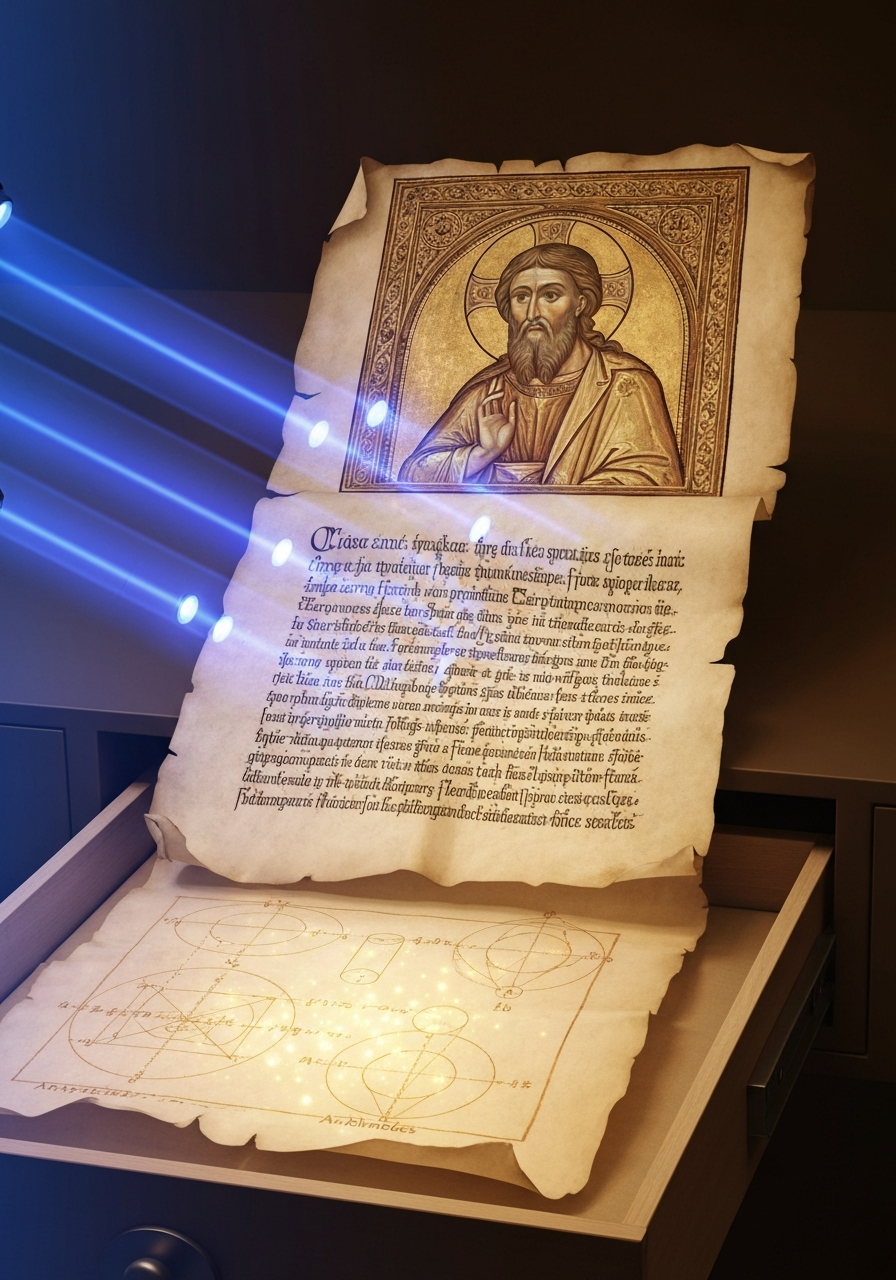
Page 123 of the Archimedes Palimpsest compresses the entire history of knowledge overwriting into a single artifact. Archimedes' original mathematical text from the 3rd century BCE was copied onto parchment in the 10th century, then erased by 13th-century monks who recycled the expensive material for prayer texts. But this page has an additional layer: in the 20th century, someone painted a gilded illumination of the Prophet Daniel over the prayer text. The result is a three-layer palimpsest with 2,300-year-old mathematics buried under medieval prayers, buried under a modern painting. The Walters Art Museum palimpsest body suffered similar 20th-century forgery paintings, indicating this damage pattern is systemic rather than isolated.
Structural Failure in Cultural Heritage Management
The fact that Heiberg photographed this page in 1906 means its existence was known 120 years ago, yet nobody seriously tracked it down. This reveals fundamental flaws in global cultural heritage management systems. UNESCO estimates that approximately 60% of worldwide museum collections have not been fully digitally catalogued, and according to CNRS, only about 30% of French public museums make their collection databases available online. Nobody knows exactly how this page ended up in the Blois museum. A 2,300-year-old mathematical manuscript sitting neglected in a drawer at a small-town museum strongly suggests that similar undiscovered treasures exist elsewhere in the world.
Cutting-Edge Technology Resurrects Ancient Text
The research team plans to combine multispectral imaging with synchrotron-based X-ray fluorescence analysis within the next year to read text hidden beneath the 20th-century illumination. Multispectral imaging uses light at various wavelengths from ultraviolet to infrared to detect ink traces invisible to the naked eye, while synchrotron X-ray fluorescence uses powerful X-rays from particle accelerators to detect microscopic residues of ink elements like iron. This combination proved decisive in the Walters Art Museum restoration project, where it successfully decoded the complete text of Archimedes' Method of Mechanical Theorems. The technique is non-destructive, meaning it can reveal hidden text without damaging the original parchment.
Archimedes and Integral Calculus — Rewriting the History of Mathematics
The palimpsest body decipherment already revealed that Archimedes used proto-calculus methods nearly 1,900 years before Newton and Leibniz. In the Method of Mechanical Theorems, Archimedes employed concepts of infinite series and infinitesimals to calculate areas and volumes of curved figures — and this treatise survives only in the palimpsest, with no other known copies. The newly discovered page 123 contains additional propositions from On the Sphere and the Cylinder, with undeciphered text remaining on the reverse side. If additional content related to integral calculus is found, the conventional narrative that calculus was a 17th-century European invention could be fundamentally challenged.
Positive & Negative Analysis
Positive Aspects
- Potential Recovery of Ancient Mathematical Knowledge
The combination of multispectral imaging and synchrotron X-ray fluorescence analysis opens the possibility of non-destructively reading Archimedes' text hidden beneath the 20th-century illumination. The Walters Art Museum restoration project successfully decoded the complete Method of Mechanical Theorems using these techniques, establishing a proven precedent. New propositions or proofs could significantly expand our understanding of ancient mathematics. Additional evidence of Archimedes' proto-calculus could potentially rewrite mathematics history textbooks.
- Catalyzing Global Re-examination of Uncatalogued Collections
The Blois museum case could trigger a worldwide wave of collection re-examination at small and mid-size museums. UNESCO estimates approximately 60% of global museum collections remain undigitally catalogued, suggesting similar undiscovered treasures likely exist. Precedents include the 2023 discovery of unpublished Newton correspondence at Leeds Central Library and a 2024 rediscovery of 12th-century Arabic medical texts at the University of Bologna. The EU Horizon Europe program has allocated approximately 500 million euros to digital cultural heritage preservation, and this discovery provides strong justification for expanded funding.
- Model for Interdisciplinary Research Collaboration
This project brings together physics, computer science, philology, and history around a single manuscript, serving as an exemplary model for interdisciplinary research. Google DeepMind's 2022 ancient Greek inscription restoration AI Ithaca set a precedent, and similar AI-driven approaches could be applied to palimpsest restoration. This convergent research model is likely to spread to other ancient document restoration projects, potentially accelerating the pace of ancient knowledge recovery dramatically.
- Growth Driver for Digital Archaeology
The emerging field of digital archaeology — systematically surveying uncatalogued collections using AI and imaging technology — has gained significant momentum from this discovery. Related projects are launching across Europe and North America, with AI systems expected to be operational by 2028 that can automatically scan museum storage photographs and identify potential ancient texts. The impact extends beyond academic value to cultural tourism, digital content industries, and multiple other sectors.
Concerns
- 120 Years of Structural Management Failure
Despite Heiberg photographing this page in 1906, nobody seriously tracked it for 120 years, exposing severe structural flaws in cultural heritage management systems. Only about 30% of French public museums make their collection databases available online, with the rest relying on paper catalogues or having incomplete inventories altogether. The small size of the ancient manuscript research community, insufficient funding, and dysfunctional information-sharing systems between museums enabled this neglect.
- Physical Deterioration and Further Damage Risk
Parchment degrades through exposure to temperature, humidity, and light, and chemical pigments painted over this page in the 20th century may accelerate damage to the original text through chemical reactions. While synchrotron analysis is non-destructive, the possibility of irreversible deterioration before analysis cannot be entirely excluded. The Walters Art Museum palimpsest body suffered permanent damage to some pages from forged illuminations painted in the mid-20th century, making the race against time a realistic concern.
- Potential Complexity of Cultural Heritage Ownership Disputes
The palimpsest body resides at the Walters Art Museum in Baltimore while the missing page sits in Blois, France, requiring cross-border cultural property negotiations for reunification. Greece could claim the original text as ancient Greek heritage, while France could assert ownership as a museum collection item. The Elgin Marbles debate has continued for over 200 years, illustrating how ownership questions can overshadow the actual priorities of preservation and research when academic value collides with national pride.
- Over-Romanticization of the Serendipity Narrative
The media narrative of a discovery starting with a joke risks being romanticized to a counterproductive degree, potentially obscuring the urgent need for systematic research infrastructure investment. The real question should not be how lucky but rather why it took 120 years. With millions of undigitized ancient documents worldwide, without systematic surveying and large-scale digital archiving investment, the next comparable discovery could require another century of waiting.
Outlook
In the next six months to a year, synchrotron X-ray fluorescence analysis results will be the most significant development. Full decipherment will likely require 2-3 years minimum, though technological advances since the early 2000s could accelerate results. Over 1-3 years, digital archaeology will see major growth, with EU Horizon Europe funding for digital heritage preservation likely expanding. The real breakthrough could come 5-10 years out if additional text related to Archimedes' Method of Mechanical Theorems is discovered, potentially forcing a fundamental revision of mathematics history.
Sources / References
- Lost page of the Archimedes Palimpsest identified in Blois, central France — CNRS
- Long-Lost Page of Archimedes' Writings Rediscovered in France — Scientific American
- Lost Page from Archimedes Manuscript rediscovered in France — Heritage Daily
- Lost Page From the Archimedes Palimpsest Discovered in France — Greek Reporter
- Lost page from Archimedes palimpsest resurfaces in France — France24
- Missing Page of Archimedes Manuscript Found in France — ARTnews