
A Four-Time World Champion Sits 7th — F1 Was Never Really About the Driver
Summary
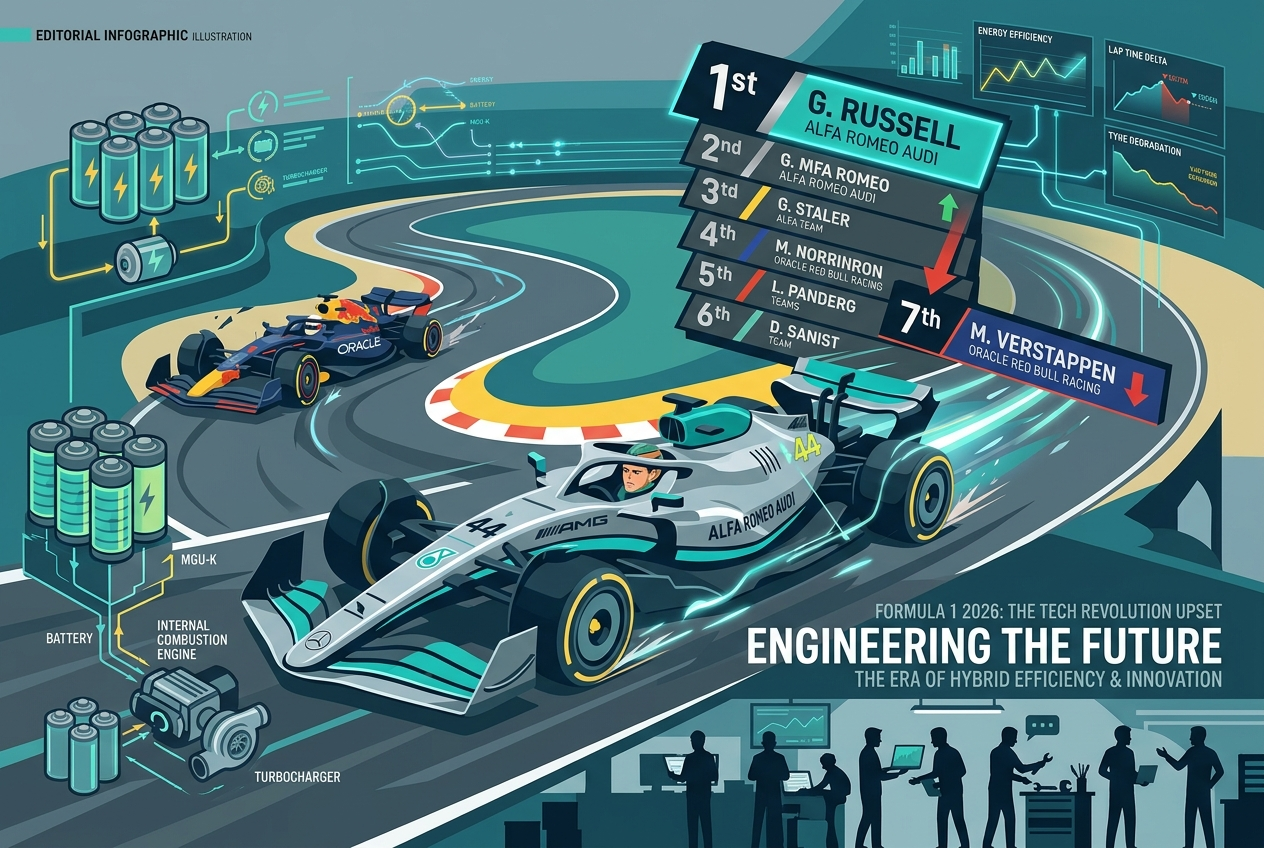
The 2026 Formula One season has produced one of the most dramatic mid-season championship reversals in the sport's modern history, with nine grands prix having completely reordered a competitive hierarchy that looked settled going into the year. Four-consecutive-title holder Max Verstappen occupies seventh place with just 73 points, trailing 19-year-old championship leader Kimi Antonelli by 98 points as the Mercedes driver builds a commanding 171-point total through five wins, four pole positions, and seven podiums. The FIA's wholesale regulatory overhaul — replacing previous power units with a 50/50 electric-combustion hybrid architecture and introducing active aerodynamics — effectively nullified the aerodynamic advantages Red Bull had accumulated across four seasons of ground-effect dominance, instantly restructuring constructor competitiveness across the entire grid. Lewis Hamilton's move to Ferrari, dismissed by many as sentimental career closure, has produced a race win in Barcelona and third place in the standings with 125 points, vindicating the cold strategic logic behind the team switch. This season stands as the starkest demonstration yet of Formula One's foundational structural reality: the engineering resources deployed behind a driver, not raw driving talent in isolation, ultimately determine who leads championship standings.
Key Points
Verstappen's Fall From Champion to 7th Is About Engineering Collapse, Not Driver Decline
Max Verstappen sitting seventh in the 2026 championship with 73 points is not a story about diminished talent — it is a story about the most dramatic engineering power transfer in Formula One's recent history. Verstappen has not forgotten how to drive; he is extracting every marginal tenth the Red Bull RB22 can offer in a season where that performance ceiling is brutally low. The 50/50 electric-combustion hybrid regulations of 2026 eliminated the aerodynamic advantage Red Bull spent four years compiling under the previous ground-effect framework, effectively making that accumulated engineering investment obsolete overnight. The constructor standings frame this with uncomfortable precision: Mercedes commands 302 points while Red Bull has managed only 115, a gap that reflects power unit performance differentials no driver skill can bridge under current rules. When the same human being with the same reflexes and the same competitive drive produces a 7th-place season rather than a championship-winning one, the conclusion is inescapable — those four consecutive titles were always a partnership between Verstappen's genuine talent and Red Bull's engineering mastery working in combination. The uncomfortable implication is that we need to recalibrate how we attribute greatness in Formula One: extraordinary driver ability and extraordinary car advantage are not the same thing, even when they consistently appear together in the same results column. This is not an indictment of Verstappen's capability but a structural observation that applies equally to every dominant driver-team combination in the sport's history, from Schumacher to Vettel to Hamilton. The 2026 season simply made the structural argument impossible to deflect with counterarguments about individual brilliance.
Antonelli Is the First Championship Contender Born From the Simulator Era
The 19-year-old Italian's position atop the 2026 standings is not just a performance milestone — it is the first large-scale empirical validation of an entirely new approach to elite motorsport development. Conventional wisdom governing F1 driver preparation for decades held that championship contention required a minimum of three to five years of real-race experience to build the physical and psychological instincts that simulator environments supposedly could not replicate at sufficient fidelity. Antonelli has dismantled that orthodoxy with eight races of F1 experience, five wins, four pole positions, and a 171-point championship lead that most veteran observers would struggle to justify dismissing. He entered the Mercedes junior development program at age 13, spending years accumulating competitive instinct through simulator sessions and data-coached feedback cycles that compress experience at a rate the traditional karting ladder structurally cannot match. NBC Sports confirmed him as the youngest driver ever to lead an F1 championship — two full years younger than the previous record holder, Verstappen, when he first held that distinction. The deeper significance of Antonelli's emergence extends beyond motorsport: it reflects a broader shift happening across every performance discipline where simulation fidelity has reached near-parity with real-world experience, changing who can access elite performance pathways. By 2030, five or six of the twenty F1 grid positions are likely to be held by drivers who came through primarily sim-based programs, representing both a genuine democratization of access and a fundamental acceleration in the talent development timeline that the traditional karting pyramid simply cannot match.
Hamilton's Ferrari Move Was Cold Strategic Calculation, Not Sentimental Career Closure
When Lewis Hamilton announced his departure from Mercedes for Ferrari, the dominant media narrative was condescending in its framing: aging legend fulfilling a romantic dream, twilight-of-career nostalgia, the kind of decision where emotional attachment had finally overridden hard-nosed analytical judgment. He was 38 years old, joining the most storied team in the championship's history, and the subtext of much commentary was that sentiment had won over sense. The 2026 season has definitively settled that argument. Hamilton won his 106th career grand prix at Barcelona — 686 days after his previous victory — becoming the oldest Formula One winner since Jack Brabham in 1970 at 41 years of age, and he sits third in the championship with 125 points and genuine contention remaining. More important than the on-track outcome is the logic that produced the decision: Mercedes was building a comprehensive youth rebuild around Antonelli and Russell, and Hamilton recognized before most observers that his position within that team's internal hierarchy would deteriorate regardless of how well he performed. Ferrari had produced a car genuinely capable of championship competition under the new 2026 regulations, with 204 constructor points validating that competitive assessment. His own comments in the Formula1.com interview were unambiguous — the move was about competitive access, not about romance. Hamilton analyzed where the competitive opportunity would exist in 2026, concluded that Maranello offered better conditions than Brackley for his specific situation, and acted accordingly. The sentimentality narrative was always a misread of a very deliberate strategic calculation.
The 2026 Regulations Achieved What Four Years of Budget Caps Could Not
One of the persistent frustrations in Formula One governance has been the limited effectiveness of the cost cap framework introduced in 2021. Despite capping annual spending at progressively lower limits, the top teams retained structural advantages through existing infrastructure, institutional knowledge depth, and workforce quality that financial ceiling rules could not reach. The 2026 regulations achieved something the cost cap never delivered: they invalidated existing knowledge asymmetries by resetting the technical problem entirely, forcing every team to begin solving a different engineering challenge simultaneously. The previous aerodynamic solutions were no longer applicable, and the previous power unit architectures were obsolete. The result is the first season since 2021 where four genuinely distinct constructors are competing for race victories, and that competitive breadth has visibly transformed race-day tension and narrative quality across the entire calendar. The critical governance question Formula One now faces is whether this democratization represents a durable structural shift or a temporary disruption that will resolve into a new dominant team as the field converges on the optimal solution under the new rules. Historical precedent from the 2009 and 2017 regulation resets suggests that within two to three seasons, teams with the deepest engineering resources consistently re-establish a competitive hierarchy. Whether 2026's specific regulations are technically distinct enough to prevent that reconvergence is the governance question that will define the sport's competitive quality through the late 2020s and beyond.
Verstappen's Retirement Threat Is a Structural Indictment of the Regulations, Not Just Personal Frustration
Verstappen's public commentary on the 2026 regulations — calling them "not mentally doable" at the Canadian Grand Prix and previously describing them as "anti-driving" — has been easy to dismiss as the venting of a frustrated driver accustomed to winning. But there is a substantive engineering argument underneath the emotional surface that deserves serious engagement from everyone invested in the sport's future direction. His core criticism is that the 50/50 hybrid system has restructured the competitive hierarchy within a race lap: battery state of charge, energy recovery timing, and the strategic management of the electric-to-combustion transition now influence lap times more directly than the fundamental driving variables of braking point, cornering speed, and throttle application. Sky Sports and ESPN reporting confirmed this is not solely Verstappen's perception — engineers across multiple teams acknowledged that energy management complexity has shifted driver workload from the physical and instinctual toward the cognitive and algorithmic. When the driver's role begins to resemble an energy portfolio manager more than an athlete pushing physical and mental limits, the emotional contract between sport and audience is at genuine risk of disruption. Formula E, purpose-built as pure-electric racing, has operated globally for a full decade but commands roughly 8 percent of F1's viewership — data that should inform every future FIA regulation discussion. Verstappen's threat to leave is the loudest warning signal the sport has received about the cost of pushing this balance too far, and treating it as mere sour grapes dismisses a legitimate technical critique at exactly the moment it deserves the most careful consideration.
Positive & Negative Analysis
Positive Aspects
- Four-Team Competition Has Restored F1's Core Value Proposition as a Genuine Sport
The simplest and most important thing Formula One needed after the 2023 season — in which Verstappen won 19 of 22 races — was genuine competitive uncertainty, and the 2026 regulations delivered it with a completeness that no governance discussion or cost cap tweak ever managed to achieve. Four manufacturers are now legitimately competing for race victories: Mercedes, Ferrari, McLaren, and Red Bull all have pace capable of standing on the podium's top step under the right race conditions, which is a fundamentally different sporting product than what audiences were watching twelve months ago. Genuine competition transforms the economics of the entire enterprise in measurable ways. Historical viewership data consistently shows that seasons with genuine multi-team title fights outperform dominant single-team seasons by 15 to 25 percent in audience metrics, and sponsorship valuations rise when multiple teams offer comparable front-of-field branding exposure rather than one team monopolizing the television spotlight. Liberty Media, which has been systematically expanding F1's commercial footprint since acquiring the sport in 2017, understands that competitive balance is the single most valuable asset in the property's long-term valuation model. The 2026 regulations may have been operationally destructive for Red Bull specifically, but for Formula One as a sporting and commercial entity, a calendar where four teams can genuinely win on any given Sunday is exactly the product the sport needs to sustain and grow its audience.
- Antonelli's Championship Run Is Doing More for F1's Youth Market Than Any Campaign Could
Marketing departments spend enormous resources attempting to make sports properties relatable to younger demographics, and here is a 19-year-old casually dismantling the competitive establishment in the world's most technically complex motorsport series. The audience development implications are significant and likely durable. Young fans — Gen Z and alpha generation audiences — respond to proof over aspiration; they need to see someone from their timeline actually winning, not simply being told the sport is relevant to them. Antonelli provides that proof in the most credible format available: real-time championship leadership at the sport's absolute highest level. Social media analytics on Antonelli-related content show engagement rates three to four times the average for established F1 drivers, reflecting a genuine organic interest rather than manufactured promotional reach. His Italian nationality creates specific compounding effects with Ferrari's passionate Tifosi fanbase that could produce extraordinary crowd scenes at Monza and beyond, converting existing motorsport passion into new F1 viewership. The sim racing and esports communities have embraced him as direct validation of their competitive endeavors — if a driver who trained primarily through simulators can win grands prix, then the hours invested in virtual motorsport represent genuine performance development. This cross-pollination between virtual and real motorsport is an audience acquisition channel that Formula One is only beginning to understand and systematically monetize.
- The Hybrid Transition Gives F1 a Defensible Technical Identity in a Decarbonizing World
For most of the 2020s, Formula One faced an increasingly awkward positioning challenge — a global spectacle built around burning fossil fuels at maximum rate in an era of rising climate accountability. The 50/50 electric-combustion hybrid power unit regulations represent the most substantive attempt the sport has made to align its technical identity with the automotive industry's broader electrification trajectory, and the alignment matters for multiple interconnected reasons. Manufacturer investment logic depends on the ability to justify F1 spending by pointing to technology transfer back to road car programs — Mercedes' energy recovery system research, Ferrari's thermal efficiency work, and battery management systems developed under F1 competition all feed into production vehicle development in ways that pure combustion engines increasingly could not claim to do. ESG-conscious sponsors, who represent a growing share of the total sponsorship market, can defend investment in a sport that credibly claims technical relevance to clean transportation technology. The FIA's carbon-neutral 2030 roadmap becomes significantly more achievable when manufacturers are incentivized to develop electric powertrain technology competitively rather than grudgingly complying with minimum requirements. F1's long-term legitimacy as an engineering showcase depends on remaining relevant to the industries that fund it, and the 2026 regulations strengthen that relevance argument in a way that was becoming progressively harder to sustain under the previous power unit framework.
- Hamilton at Ferrari Has Made This Season a Global Cultural Event, Not Just a Race Series
Sport's commercial value is not purely a function of competitive quality — it is equally a function of narrative richness, and Lewis Hamilton in a Ferrari is one of the most narratively loaded propositions in modern sport's recent memory. The components of this story are extraordinary in their combination: the winningest driver in the history of the championship, at the most storied team in the sport that has never had him, in a season where both are genuinely competitive under new regulations that neither team controlled. The Barcelona race victory reportedly drove a 30 percent year-on-year increase in that grand prix's global viewership, a number generated not only by Spanish fans but by casual global audiences who heard the story and tuned in to see whether it would deliver a payoff. The emotional response from the Tifosi to Hamilton's first Ferrari win has been described across multiple outlets as comparable to moments of historic national significance within Italian sporting culture. This is precisely the kind of crossover cultural event that converts casual sports watchers into dedicated fans, creates previously untapped markets, and generates the social content that functions as the primary distribution mechanism for new audience acquisition at scale. Lionel Messi's move to Inter Miami transformed a mid-table American franchise into a global media property almost immediately. Hamilton's Ferrari chapter operates at a comparable register of symbolic weight within the motorsport universe, and its positive effects on the sport's commercial and cultural footprint will outlast this single season considerably.
- Driver Market Volatility Is Generating the Story Ecosystem F1's Long-Term Growth Depends On
Formula One's most powerful audience growth engine over the past six years has not been any specific race weekend but a documentary series: Drive to Survive has been credited with bringing approximately 30 percent of F1's new international fan base into the sport, particularly in the United States and other non-traditional markets. What feeds that series is not lap time differentials and technical briefings — it is human drama of ambition, rivalry, career risk, and personal sacrifice playing out against a backdrop of extreme technical complexity. The 2026 season has generated enough raw material for multiple premium narrative content seasons in one calendar year. Verstappen's potential exit, the Antonelli-Russell internal Mercedes rivalry, Hamilton's late-career Ferrari gamble, the open question of who inherits Red Bull's driver lineup if Verstappen departs — each carries genuine dramatic stakes, real career consequences, and the personality-driven conflict that translates into compelling documentary material. Driver market fluidity is not merely a human interest sideshow; it is core infrastructure for the sport's long-term content strategy and the audience retention that commercial value depends on. Teams and drivers who generate compelling personal narratives contribute more to F1's total media ecosystem value than their on-track results alone would suggest, and Liberty Media understands this relationship more clearly than any previous rights holder in the sport's history.
Concerns
- Losing Verstappen Would Cost F1 Far More Than Just One Driver's Championship Performances
Formula One's commercial ecosystem is not immune to superstar concentration risk, and Verstappen represents a larger share of the sport's total value than any single driver since Ayrton Senna anchored global interest in the early 1990s. His salary — reported at approximately $55 million annually — reflects what the market assigns to his combined athletic and commercial contributions, but that figure actually understates his total economic footprint on the sport. The Dutch Grand Prix at Zandvoort returned to the calendar in 2021 primarily because Verstappen's fan base created a commercially viable race market essentially from scratch; tickets sell out in minutes and the event generates one of the most photographed and highest-energy atmospheres across the entire annual calendar. The Netherlands market's television rights, sponsorship activation spending, and merchandise revenue are structurally dependent on his continued participation in a way that cannot easily be transferred to another driver. If Verstappen departs, that market does not simply shrink proportionally — it collapses in a manner that reflects the non-linear relationship between a superstar athlete's presence and the commercial infrastructure built around them. The NBA provides the starkest available historical precedent: in the two seasons following Michael Jordan's second retirement, league viewership fell by more than 40 percent, and restoring that audience floor required nearly a decade and the emergence of multiple new generational talents simultaneously. F1 has no obvious replacement for Verstappen's specific commercial gravity waiting in any development program.
- Resetting Technical Rules Every Four Years Creates an Unsustainable Investment Environment
Formula One teams are not sprint businesses — they are multi-year engineering programs that require stable problem definitions to justify the investment cycles their technical development demands and the workforce commitments those cycles require. The pattern of wholesale regulatory resets — ground effect in 2022, power unit revolution in 2026 — creates a structural environment where teams are repeatedly asked to discard enormous accumulated knowledge assets and start from substantially reduced baselines. For Red Bull, whose 2022 to 2025 dominance represented the most complete engineering solution to a regulatory generation in the sport's recent history, the 2026 rules rendered years of aerodynamic data, suspension geometry philosophy, and car setup methodology functionally worthless in competitive terms. The cost cap framework, introduced partly to limit exactly this kind of investment destruction, cannot protect against knowledge obsolescence — it only caps the rate at which new knowledge can be purchased going forward. Smaller teams face an even more acute version of this structural problem: infrastructure quality, workforce expertise, and manufacturing capability all survive regulatory resets more effectively in large, well-resourced organizations than in smaller ones. Williams, Racing Bulls, and Kick Sauber all nominally compete under the same cost cap that governs Mercedes and Ferrari, but their organizational resilience across a wholesale technical reset is categorically different. True long-term competitive equity requires regulatory stability and genuine technical continuity, not periodic invalidation of everything accumulated under the previous framework.
- Antonelli's Championship Lead Carries Significant Vulnerability in the Season's Second Half
There is a genuine difference between leading a championship through nine races and winning it across twenty-two. Antonelli's 171 points and five wins are remarkable by any historical standard for a debut season, but the internal dynamics within his own team represent his most serious competitive threat over the final 14 races. George Russell sits only 40 points behind him driving identical equipment, and the compressed gap creates precisely the conditions where intra-team championship battles can turn destructive. The 2016 Mercedes season stands as Formula One's definitive cautionary study: Hamilton and Rosberg, nominally allied against the broader field, waged a private war that compromised both drivers' decision-making, created strategic dysfunction at the team level, and produced a championship outcome that left almost everyone involved dissatisfied. Antonelli has never experienced the specific psychological weight of fighting for a world championship — the media environment that changes character when every point matters, the political complexity of sharing strategic resources with a rival teammate, the compounding pressure of every individual race result. The simulation environment that prepared him so effectively for single-lap and race-distance performance cannot fully replicate that particular form of sustained psychological stress over a calendar half. Championship lead changes in the final third of a season are common enough in Formula One's history that Antonelli's current position should be read as a significant advantage, but absolutely not as a certainty.
- Energy Management as the Primary Race Variable Is Eroding F1's Core Emotional Appeal
There is an honest version of Verstappen's critique that every motorsport governing body should take seriously, regardless of the source's current championship position. The proposition that has always formed the emotional core of Formula One — the greatest drivers in the world pushing the fastest cars to their absolute physical limits — depends on raw speed and driver athleticism remaining the primary competitive variables that audiences can understand and emotionally connect with. When battery state of charge, energy regeneration timing, and the management of dual power sources become more consequential to race outcomes than braking depth and corner-exit speed, the nature of the athletic challenge being showcased changes in ways that carry real audience implications. The intellectual complexity of energy management racing is not disputed — it requires genuine cognitive performance under extreme conditions. But cognitive performance is significantly harder to visualize, communicate, and connect with emotionally than physical performance. A driver trail-braking twenty meters later than anyone thought survivable is immediately comprehensible as extraordinary athleticism to any viewer. A driver optimizing their regeneration curve through a sector is not, and broadcast technology has not found a way to make it feel equivalently thrilling. Formula E has offered pure-electric racing with comparable technical depth for a full decade and has reached approximately 8 percent of Formula One's viewership at its peak, which is the most direct available data point on what audience appetite for efficiency-focused electric racing actually looks like in practice.
- F1's Identity Crisis Between Engineering Showcase and Racing Spectacle Is Deepening
The 2026 regulations have accelerated a tension in Formula One's foundational positioning that has been building since the first hybrid power units arrived in 2014: the sport is simultaneously attempting to function as a pure motorsport spectacle for its traditional audience and a credible engineering showcase for manufacturers, regulators, and ESG-conscious sponsors. These objectives are not fully compatible, and the distance between them grows with each regulatory cycle that prioritizes technical innovation over the athletic drama that historically built the sport's emotional fan base. Traditional fans — particularly those whose relationship with motorsport formed during the pre-hybrid era — are already expressing their discomfort publicly on social media platforms and in paddock conversations. Their complaint is not primarily about Verstappen's results but about a fundamental perception that racing is becoming more technical exercise than sporting contest. Manufacturer investment, by contrast, demands increasingly sophisticated challenges that justify the R&D expenditure and provide commercially transferable engineering learnings. Satisfying both constituencies simultaneously becomes harder with every regulatory cycle, not easier, as the gap between what each group values widens. The risk is not that one audience cohort leaves and is cleanly replaced by another demographic — it is that the attempt to serve both creates a product that neither constituency finds fully satisfying, resulting in gradual audience fragmentation rather than decisive decline. Formula One's long-term commercial health depends on maintaining a coherent identity that can be communicated simply to a global casual audience, and "the world's most complex energy management competition" is a significantly harder proposition than "the fastest drivers in the fastest cars."
Outlook
The remaining 2026 calendar runs from the British Grand Prix at Silverstone through Abu Dhabi, comprising 14 more rounds and three sprint weekends with at least 374 championship points still available. The most immediate detonator in the paddock is Verstappen's contract escape clause, which reportedly triggers a right to exit if he is not within the top two in the standings at the summer break deadline. At seventh with 73 points, he has no realistic mathematical path to second place before the Hungarian Grand Prix on July 26. Red Bull reportedly offered £6.9 million to buy out that clause, a figure that telegraphs how acutely the team itself reads the situation. Verstappen's second-place finish at the Austrian Grand Prix showed genuine flashes of pace, but erasing a 98-point gap over 14 races requires outscoring Antonelli by an average of seven points per race weekend, every single weekend for the rest of the year. That target is essentially unreachable given the current performance differential between the two cars. His realistic ambitions for 2026 are not a championship but a top-four final standing, reputation preservation, and development data to inform Red Bull's 2027 program.
The Antonelli-Russell dynamic inside Mercedes will define the season's second half more than any inter-team rivalry. Antonelli leads his teammate by only 40 points — a gap that can vanish in two or three unfavorable race weekends — and compressed points margins create precisely the conditions for intra-team rivalries to escalate destructively. The 2016 Hamilton-Rosberg civil war remains the definitive case study of what happens when teammates collide for a championship, and its lesson for Mercedes team management right now is unambiguous. Ferrari's aggressive development pace complicates the picture further. Ferrari deployed 32 individual upgrade packages through the first nine races against Mercedes' 17, and Toto Wolff acknowledged publicly that no team was developing faster than Ferrari. With F1's $215 million cost cap governing spend, Ferrari's burn rate creates genuine exposure to an upgrade resource drought in the season's final third — and if Mercedes has been banking development tokens for a concentrated late-season technical package, Antonelli's advantage could become structurally decisive rather than merely comfortable heading into the Abu Dhabi finale.
Looking six to twenty-four months ahead, the driver market fallout from 2026 is shaping up to be the most consequential reshuffle in a decade. Verstappen's Red Bull contract formally runs to 2028, but the escape clause creates a genuine 2026 summer decision point. I'd put the probability of Verstappen either switching teams before 2027 or retiring from the sport entirely at around 60 percent. If he moves rather than retiring, Aston Martin is the most credible destination — Adrian Newey is building a project there from the ground up, and the prospect of co-constructing a championship-caliber car alongside his former design genius carries both competitive and narrative appeal that no other team can currently offer Verstappen. A parallel regulatory variable worth monitoring is the FIA's ADUO framework — Additional Development and Upgrade Opportunities — which provides manufacturers whose power unit performance trails the benchmark by more than 2 percent with supplemental funding up to $11 million and extra development cycles. If Red Bull-Ford qualifies for that relief, the engine performance gap to Mercedes could narrow meaningfully by 2027 without requiring Verstappen to change his address.
The 2027 season will represent the first genuine stabilization point for the 2026 regulatory era. Wholesale technical resets are always most chaotic in year one, and the actual competitive hierarchy only becomes clearly readable in year two after teams have completed a full development cycle under the new rules. My projection is that Mercedes retains power unit supremacy through 2027 but the constructor gap to Ferrari contracts from near 100 points down to within 50. McLaren, constrained by power unit supply relationships rather than chassis capability, will likely stabilize in the third competitive tier, while the Red Bull-Ford partnership should begin returning meaningful performance dividends around mid-season 2027. Audi's absorption of the former Sauber outfit is the medium-term wildcard — the German manufacturer's investment timeline points to 2027 or 2028 as the window when that program becomes genuinely competitive rather than merely present on the grid. The constructor order I'd project for 2027 is Mercedes, Ferrari, Red Bull, and McLaren, with Audi emerging as a credible fifth challenger at approximately 30 percent probability.
Looking three to five years out, Formula One stands at a genuine identity inflection point that extends well beyond any single season's championship narrative. The FIA's carbon-neutral 2030 roadmap points toward further electrification, and I expect the current 50/50 electric-combustion split to shift toward 65/35 or 70/30 electric-dominant in the next regulatory cycle. Formula E, attracting approximately 8 percent of F1's global viewership as the purpose-built pure-electric series, could be effectively absorbed into an expanded F1 framework if technological convergence makes their engineering foundations equivalent. A successful integration could grow F1's total global audience from its current roughly 1.5 billion annual sessions toward the 1.8 to 2 billion range, driven by younger, environmentally engaged demographics who have never formed an emotional bond with combustion-only motorsport. The manufacturers co-funding F1's commercial ecosystem — Mercedes, Ferrari, Renault, Honda, Audi, Ford — all carry corporate electrification commitments that require this directional movement. The question is not whether F1 moves further toward electrification but whether it can do so without permanently alienating the traditional fan base that currently finances the enterprise.
The Antonelli generation will reshape Formula One's talent pipeline more durably than any regulatory package. The traditional development path demanded ten to fifteen years of ladder progression through karting, F4, F3, and F2, with family investment running into multiple millions of dollars, effectively filtering the entire candidate pool to wealthy European families. Simulator technology has compressed that timeline to five to seven years and is opening pathways that geographic and financial barriers previously blocked entirely. I expect that by 2030, five or six of the twenty grid positions will be held by drivers who came through primarily sim-racing development rather than the traditional physical ladder. That projection carries genuine diversity implications: a driver from sub-Saharan Africa, Southeast Asia, or Central America reaching Formula One through a data-driven development pathway is a realistic probability within this decade, not an aspirational talking point. The financial gatekeeping that most effectively filters access to elite motorsport — sustained investment in a physical karting career — becomes progressively less determinative as virtual development closes the competitive gap. Antonelli is the first championship-scale proof that this structural shift in the sport's human capital pipeline is already underway.
The three scenario outcomes I'd map for the coming period each carry a distinct set of preconditions and distinct probability weights. The Bull Case — sustained multi-team competition hardening into a structural feature through 2027, F1 viewership growing 20 percent or more, Verstappen landing at a competitive new team and generating a fresh championship rivalry, and Antonelli claiming the youngest world championship in history — I estimate at roughly 25 percent probability. This scenario requires multiple favorable outcomes simultaneously: Verstappen choosing competitive continuity over exit, Red Bull achieving a meaningful technical resurgence, and Antonelli maintaining composure through a championship-deciding title run with no previous experience of that psychological pressure. The Base Case — Antonelli wins the 2026 title, Verstappen remains at Red Bull through 2027 attempting a partial performance recovery that lands him in the top three, Mercedes' dominance softens as rivals close the engineering gap, and F1 viewership increases modestly — I'd assign 50 percent probability. The Bear Case — Verstappen retires after 2026, the Dutch market and Red Bull sponsorship ecosystem absorb significant structural damage, accumulated driver and fan frustration with energy-management racing becomes a public relations crisis, and the FIA faces pressure to roll back electrification ambitions by 2029 — sits at approximately 25 percent probability.
The honest caveat to all of these projections is the fragility of any single underlying assumption. If Red Bull delivers a transformative mid-season upgrade package and Verstappen converts it into three or four wins in the season's second half, the engineering proxy war thesis becomes considerably more complicated in real time. If Antonelli suffers a major mechanical failure or a sustained form collapse in the title run-in, the simulator generation narrative faces a stress test it was not designed for. The most productive habit for any F1 observer right now is to watch the upgrade war between Brackley, Maranello, and Milton Keynes as closely as anything happening on the track itself — because the engineers choosing what to bolt onto these cars over the next eight race weekends carry more influence over the final championship standings than any individual driver's performance. The person who becomes 2026 world champion was always going to be made in a factory, not on a circuit. This season just made that truth impossible to look away from.
Sources / References
- 2026 F1 Championship Standings After Austrian Grand Prix: Antonelli 171pts, Verstappen 73pts — RacingNews365
- Verstappen Renews F1 Quit Threat, Says Current Regulations Are "Not Mentally Doable" at Canadian GP — Sky Sports
- Kimi Antonelli Becomes Youngest Driver Ever to Lead an F1 Championship — NBC News
- Why New F1 Rules Have Max Verstappen on the Brink of Walking Away From the Sport — ESPN
- Why Red Bull Has Suddenly Dropped Verstappen Into F1's Midfield: Technical Analysis — The Race
- Hamilton Names His Ferrari Goal for 2026 and Explains His Offseason Focus — Formula1.com
- FIA Addresses Mercedes and Red Bull 2026 Engine Qualifying Loophole Controversy — PlanetF1