
Federer Got a Standing Ovation for His Farewell. Serena Gets Suspicion for Her Comeback. — Sports' Double Standard
Summary
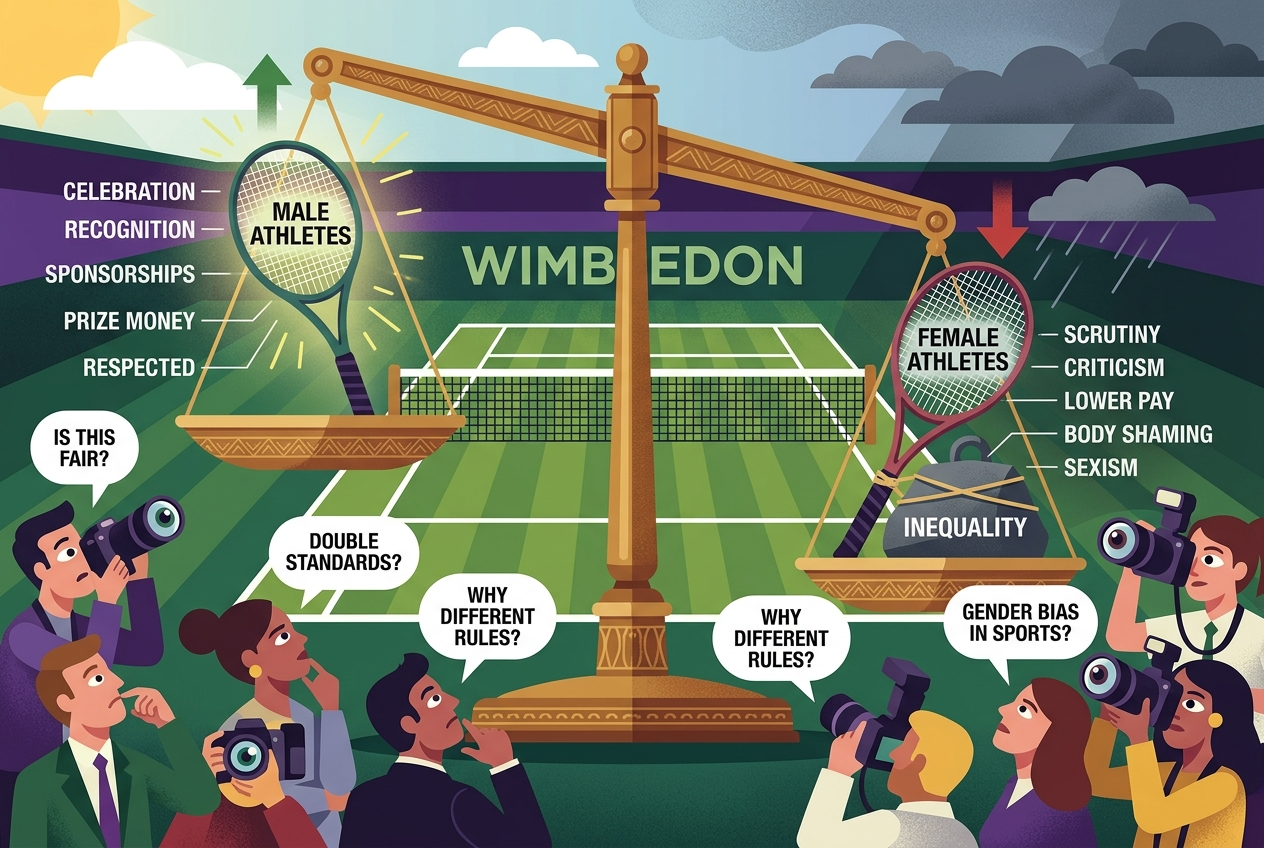
The decision to grant Serena Williams a singles wild card for Wimbledon 2026 has fractured the tennis world along familiar fault lines, raising simultaneous questions about wild card legitimacy, GLP-1 drug policy in sport, and a decades-long pattern of subjecting Williams' body to scrutiny that comparable male legends have never faced. Williams, 44, has not competed in singles since a third-round exit at the 2022 US Open, yet the All England Club extended both singles and doubles wild cards for the June 29 tournament opener. The revelation that Williams used Zepbound, a GLP-1 receptor agonist, to lose 34 pounds intensified the debate — despite WADA classifying GLP-1 agents only on its monitoring list, not as prohibited substances, with a final ruling expected between late 2026 and early 2027. A direct comparison between the global celebration of Federer's 2022 Laver Cup farewell and the suspicion directed at Williams' comeback exposes a structural asymmetry that has tracked her career for over two decades: the target of criticism never changes, only the angle of attack. This moment is less about one wild card or one medication and more about what sport still believes regarding whose body is permitted to evolve, age, and return on its own terms.
Key Points
A Four-Year Absence, a 44-Year-Old Body, and the Most Contested Wild Card in Wimbledon History
Serena Williams' last Grand Slam singles appearance was a third-round loss at the 2022 US Open to Ajla Tomljanović, after which she effectively announced her departure from professional singles competition. For the four full years that followed, she competed in no singles matches at the tour level. Then in June 2026, the All England Club extended wild cards for both the singles and doubles draws to a 44-year-old player who had, by all conventional measures, retired from singles. Tennis analyst Pavvy G labeled the decision "one of the craziest ever made in this sport," and other insiders reached for the word "stunt." The criticism is pointed: wild cards are historically given to players recovering from injury, to host-nation prospects, or to recent past champions — not to legends who have been absent from the singles game for four consecutive years. What makes this case particularly volatile is that it exposes the absence of any clear, agreed-upon eligibility criteria for wild card allocation across the Grand Slams, each of which currently operates its own system without unified standards. Comparing this to Federer's 2022 Laver Cup appearance — where a player who had effectively retired competed in a ceremonial farewell that drew global adulation — raises an unavoidable question: if legacy-stage participation is a valid and valued part of sports culture for certain athletes, why is the same principle received so differently when applied to Serena Williams? The wild card itself is not the problem here; the selective application of the standards surrounding it is what demands serious examination.
GLP-1, WADA, and the Line Between Medical Management and Competitive Enhancement
Serena Williams publicly disclosed using Zepbound (tirzepatide), a GLP-1 receptor agonist, which contributed to a 34-pound reduction in body weight before her Wimbledon preparations. The disclosure was transparent and voluntary, yet it triggered near-immediate accusations of pharmaceutical shortcutting that undermines competitive fairness. What the outrage largely bypassed: WADA placed GLP-1 drugs on its monitoring list for 2026, not on the prohibited substances list, with final classification expected between late 2026 and early 2027. The current scientific picture — still being built in a field where rigorous data collection is ongoing — does not support the claim that GLP-1 drugs meaningfully enhance performance in tennis, where endurance, agility, and fine motor control matter far more than body composition alone. GLP-1 agents are known to reduce muscle mass alongside fat tissue and to suppress appetite in ways that can make caloric replenishment during long matches harder — effects that could work against rather than for a competitive tennis player. The accusation that Serena gained an unfair athletic edge is therefore not a scientific argument; it is an emotional response expressed in the vocabulary of fairness. WADA's eventual ruling will be the authoritative word on this question — until that ruling arrives, characterizing Williams' GLP-1 use as a doping issue is, at minimum, premature and, at most, a repackaging of social discomfort as regulatory concern.
Forty-Two Years of Moving Goalposts — The Criticism Changes, the Target Never Does
In 2015, The New York Times published a piece comparing Serena's physique to those of other women on the tennis tour, with an implicit message that her body was somehow wrong for the sport she was dominating. Early in her career, she was criticized for being "too muscular" and insufficiently feminine. At her peak, commentary shifted to her weight being "unprofessional." Now, having lost 34 pounds through disclosed, legal medication, she faces the accusation of being "too medically altered." The specific charge cycles on roughly a decade's rotation. The accused — Serena's body — has not moved once across four decades of her life in this sport. This is not Serena's individual failure to manage external perception; it is a structural pattern in how sport assigns standards to women's bodies — standards that recalibrate in response to whatever Serena's body happens to be doing at any given moment, rather than being anchored to any consistent, universally applied principle. The Federer-to-Serena comparison makes this visible with particular clarity: a male legend competing past his prime in a ceremonial context generates reverence, while a female legend returning in a changed body after a legally managed health process generates suspicion. These two reactions, placed side by side, constitute the clearest available evidence for the double standard at the center of this controversy.
The Wild Card System's Structural Blind Spots, Made Visible at the Worst Possible Moment
This controversy has brought the Grand Slam wild card system's eligibility vacuum into public view at a moment when the system can no longer avoid scrutiny. Each of the four Grand Slams currently allocates its wild cards autonomously, with no shared, codified eligibility criteria across the majors. There is no agreed-upon rule specifying how long a player's singles absence disqualifies them from consideration, or at what level of historical achievement such a restriction might reasonably be waived. Serena's case has become the extreme test of how wide that discretionary space actually extends: a four-year singles absence for a player with 23 Grand Slam titles. WTA and ATP leadership will face meaningful pressure to develop a joint framework — likely requiring singles activity within a two-to-three-year window as a precondition for wild card consideration. If that framework had existed when the All England Club made this decision, Serena would not have received the invitation. The deepest irony is that Serena's very presence at Wimbledon may generate the institutional pressure that eventually reforms the system to prevent a repetition — she may become simultaneously the catalyst for change and the last player for whom the pre-reform window stayed open.
What "Sports Legacy" Actually Means — Competitive Arena or Living Museum?
The philosophical question underneath Serena's return is one that sports culture has not been forced to answer clearly before: is a Grand Slam tournament a purely competitive arena where outcomes alone carry value, or is it also a living record of sports history where the presence of transformative figures carries independent meaning? If the former, a four-year singles absence and a 44-year-old body represent disqualifying circumstances, and the wild card is indefensible on performance grounds. If the latter — and there is considerable evidence that sports culture already operates this way for certain athletes — then 23 Grand Slam titles represent a form of standing that does not expire because years have passed. Jordan's Wizards tenure and Federer's Laver Cup both suggest elite sport has already accepted the second position for some athletes. The tension worth acknowledging is that treating Serena as a "historical figure" rather than a "current competitor" carries its own form of condescension: to honor someone as living sports history is simultaneously to frame them as something other than a working athlete. Whether Wimbledon's gesture reads as genuine respect or as commercially motivated legacy tourism is a question whose answer depends almost entirely on which lens you are willing to apply — and to whom you are willing to apply it.
Positive & Negative Analysis
Positive Aspects
- Breaking the Age Ceiling in Women's Sport at the Highest Level
Competing in Grand Slam singles at 44 sends a message across the sport that the career arc for elite women athletes does not have to follow the compressed timeline historically imposed on them. Martina Navratilova won a doubles major at 49; Serena's return to singles extends that tradition of refusing to treat age as an automatic exit ramp. Women's tennis in particular has long applied earlier retirement pressure — post-childbirth return skepticism, competitive longevity doubts in the late thirties — that simply does not operate at the same intensity in the men's game. Serena's comeback functions as a direct rebuttal to those structural assumptions, and its value as a rebuttal does not depend on the outcome of any individual match. Young women athletes across every discipline will receive a clear signal: the body's timeline is not as fixed as the industry has historically led them to believe, and challenging that timeline at the sport's most prominent stage is both possible and meaningful. That message, transmitted at Wimbledon's level of global visibility, represents a kind of value that cannot be expressed on a scoreboard.
- Accelerating the GLP-1 Regulatory Conversation Before It Becomes a Crisis
Serena's public disclosure of Zepbound use has forced a debate about GLP-1 drugs and sports fairness into mainstream coverage years earlier than it would otherwise have arrived. WADA's decision to add GLP-1 to its 2026 monitoring list represented a formal commitment to systematic scientific study, but that announcement attracted nowhere near the public attention that Serena's case generated. With GLP-1 use estimated at roughly 6 percent of American adults and rising, the population of competitive athletes already using these drugs is substantial and growing. An early, evidence-based regulatory framework developed before the drugs become ubiquitous is far preferable to a reactive prohibition issued after widespread adoption across all competitive levels. Serena's transparent disclosure effectively pulled forward a governance conversation that sport was going to need to have regardless — the only question was when it would happen. Having it now, with time to develop sport-specific, nuanced policy before the 2028 Olympics, is better by every measure than having it as a crisis at the Games themselves. Her candor, whatever its unintended consequences, is structurally useful for the long-term governance of sport.
- Creating a Documented Moment in Sports History That Outlasts Any Match Result
A 23-time Grand Slam champion returning to Wimbledon's Centre Court after a four-year absence is a sports history event regardless of what happens between the baselines. Sports culture is built not only from results but from moments — and Serena Williams on Centre Court in 2026 is the kind of moment that anchors collective memory in ways that decade-old statistics do not always achieve on their own. The commercial impact is real and broadly distributed: the elevated global attention Serena brings to the tournament amplifies every other player in the draw, increases sponsor reach, and drives the kind of multi-generational viewership — parents watching with children who are seeing Serena compete for the first time — that no other current tennis storyline could produce. Wimbledon, by extending this invitation, has committed itself to hosting a cultural event that will be referenced in sports journalism for years after the draw is complete. That is a form of institutional value creation that extends well beyond the singles bracket.
- Elevating the Double Standard Conversation Into Mainstream Public Discourse
In past decades, the scrutiny applied to Serena's body was most often discussed within sports media specialty coverage or in academic contexts that reached limited general audiences. This Wimbledon moment has brought that conversation into mainstream sports columns, general news coverage, and public social media debate in a way that prior controversies did not quite achieve at the same scale. The Federer comparison — "why is Federer's farewell a tribute and Serena's comeback a scandal?" — is being raised publicly and widely, including by writers who have not historically framed their sports coverage in these terms. That framing shift matters because awareness is a precondition for the cultural change that tighter regulatory language cannot deliver on its own. The visibility of this double standard, documented in real time at one of sport's most prominent stages, creates a public record that future advocates, athletes, and journalists can point to directly. The conversation being forced right now is uncomfortable — and it is exactly the right conversation to be having.
Concerns
- The Precedent Problem: What Happens When the Next Legend Asks?
Extending a singles wild card to a player with a four-year singles absence creates a precedent the All England Club will be unable to apply consistently without either offering the same courtesy to every comparable legend who requests it or making arbitrary distinctions between equally qualified cases. Rafael Nadal, should he request a Wimbledon wild card in two or three years after retiring from singles competition, will have Serena's invitation to cite as documented precedent. A refusal at that point would demand explicit justification. A grant would further erode whatever remains of the wild card's original purpose as a pathway for players who need competitive access rather than ceremonial platforms. Each Wimbledon wild card represents one of approximately eight invitations available to the entire field — the opportunity cost of that slot, measured in terms of a legitimately ranked player in current competitive form, is not negligible. The system works best with clear and defensible criteria; this decision has made those criteria harder, not easier, to articulate going forward.
- An Unintended Signal About GLP-1 Adoption Before the Science Is Settled
Serena's public disclosure and her subsequent Wimbledon participation — however legally straightforward under current WADA policy — sends a functional message to other athletes that GLP-1-assisted body management followed by competitive return is an accepted model, even while the regulatory picture remains unresolved. If a meaningful number of professional and semi-professional athletes begin using GLP-1 drugs in the window before WADA's final ruling, a classification shift to prohibited status would create a complex and potentially contentious retroactive situation involving competitors who relied in good faith on current rules. At the collegiate level, where NCAA oversight differs from WADA's, the spread of GLP-1 use among developing athletes carries additional considerations tied to the muscle-mass and appetite effects that are particularly relevant during years of physical development. The pattern in sports drug history — social adoption outrunning scientific consensus, creating a retroactive reckoning — has repeated itself enough times to be recognized as a structural risk whenever a popular substance occupies WADA's gray zone. Serena's case, unintentionally, is moving that adoption curve faster than the governance process is moving.
- The Real and Documented Risk to Serena's Own Legacy Narrative
There is a meaningful difference between what Serena's legacy actually is — 23 Grand Slam titles, four Olympic gold medals, a career that reshaped women's tennis structurally — and what the final frame of public memory will fix on if this Wimbledon appearance goes badly. A first-round exit by a heavy scoreline will generate "stunt" coverage across every major sports outlet, and while that coverage cannot undo the statistical reality of her career, it will color the emotional memory of how she departed from the sport. The 2022 US Open exit was received with genuine warmth because the circumstances were clearly beyond her control; a Wimbledon exit framed as a comeback gamble that failed would be read very differently by a sports media culture that runs on narratives. Physical risk compounds the concern: a 44-year-old body that has been through the specific stresses of a professional tennis career faces a genuine injury probability during Grand Slam competition, and a mid-match retirement would produce the worst possible version of this narrative. Serena knows this risk better than anyone observing from outside, and she has chosen to accept it — but those watching should be honest about what the downside scenario looks like.
- The Media Crowding Effect on Wimbledon's Real Structural Conversations
Wimbledon 2026 carries several substantive reform discussions that deserve serious coverage: the first implementation of video review technology in the tournament's history, ongoing debates about prize money distribution across the early and late rounds, and broader governance conversations about scheduling and player welfare. The oxygen in the media cycle has been almost entirely consumed by the Serena wild card story and the GLP-1 debate, leaving these structural issues effectively invisible to general sports audiences for the duration of the controversy. The pattern of a single high-profile personal narrative crowding out institutional reform coverage is well-documented in sports journalism, and this Wimbledon moment is a near-textbook case. Lower-ranked players whose prize money stakes and scheduling concerns should be part of the tournament story are simply not part of the story at all right now. The players who would benefit most from coverage of prize distribution reforms — those in the first and second rounds competing for the smallest shares of the purse — are the same players whose interests are most completely invisible in a news cycle dominated by one returning legend.
Outlook
Let me trace what I believe will happen, working from the near term outward to the larger picture that this Wimbledon moment is actually opening.
The most immediate variable is Wimbledon's draw, released in the days before the June 29 opener. Whoever Serena faces in the first round will calibrate the entire tone of tournament coverage. A seeded opponent drawn early will generate conspiracy talk about the event engineering her survival; an unseeded lower-ranked opponent will invite "manufactured path" accusations from the same critics who wanted a harder draw. Wimbledon is far too commercially sophisticated not to have gamed the draw implications carefully, and I expect Serena's first match to land on Centre Court at a prime viewing slot. This is a business decision wearing sporting clothes. UK broadcast numbers for that match could approach Wimbledon final levels, and ESPN's US viewership may challenge tournament records — not because of the tennis, but because of the narrative.
How Serena actually performs on court will set the trajectory of the GLP-1 debate for the following twelve to eighteen months, regardless of what the science actually shows. If she advances three or four rounds — unlikely, I'll admit, but not impossible given the depth of her grass-court instincts — the claim that GLP-1 enhances athletic performance will spread virally without waiting for peer-reviewed data. The social media cycle does not pause for science. Conversely, if she exits in the opening round by a heavy scoreline, the immediate GLP-1 fire cools quickly but the "stunt wild card" framing immediately fills that space. Either outcome sustains criticism of Serena. Only the specific accusation changes. This structural dynamic is itself one of the clearest pieces of evidence for the double standard being examined here.
Later in 2026, attention shifts to WADA's final ruling on GLP-1 agents — a decision that may represent the most consequential sports doping policy moment since EPO was classified in the 1990s. WADA's scientific committee is conducting a systematic review of whether GLP-1 drugs confer measurable performance advantages across different sport types. My expectation is that the final ruling — likely arriving between late 2026 and early 2027 — will take a sport-differentiated form rather than a blanket prohibition or blanket clearance. Weight-class sports such as boxing and wrestling, where body-composition shifts translate directly into competitive advantage, face a meaningful probability of restriction. Open-weight endurance sports like tennis and soccer, where GLP-1's muscle-reduction effects can actually work against performance, will likely remain unrestricted. This outcome is scientifically defensible, and I believe WADA's committee will follow the evidence rather than the noise generated by this controversy.
Looking ahead six to twenty-four months, the GLP-1 conversation will not stay confined to Wimbledon or professional tennis. Estimates already suggest GLP-1 drugs are used by approximately 6 percent of American adults, a figure that likely understates usage among competitive athletes at the collegiate and semi-professional levels. The NCAA and international federations below WADA's direct umbrella are positioned to face their first GLP-1 eligibility disputes beginning in 2027 — cases involving athletes who used the drugs legally under current rules and who then face reclassification uncertainty. The International Olympic Committee, already under pressure to develop a unified biomedical framework ahead of the 2028 Los Angeles Games, will face landmark decisions about GLP-1 policy that have no clean historical precedent to draw from. Los Angeles 2028 will almost certainly be the first Olympics where GLP-1 policy is a live, unresolved issue going into the opening ceremony, and the pressure to resolve it is now accelerated by Serena's Wimbledon profile.
For Serena personally, the most significant decision will be whether Wimbledon represents a pivot toward a renewed competitive chapter or a final, self-defined farewell on her own terms. I estimate roughly a seventy percent probability that she competes at Wimbledon and steps back from singles entirely afterward. The reasoning is straightforward: Wimbledon is where her career narrative carries the most symbolic weight as an endpoint. Her 2022 US Open exit was on someone else's timeline — this Wimbledon would be on hers. A continued campaign through the Australian Open or French Open would require sustained physical preparation that the body-math makes increasingly difficult. That said, if Wimbledon goes unexpectedly well, the thirty percent scenario — a limited 2026 to 2027 competitive campaign — becomes genuinely real.
Within tennis governance specifically, this moment has almost certainly accelerated the timeline for wild card eligibility reform. Each Grand Slam currently allocates its own wild cards with no unified eligibility standards across the four majors. Serena's case has made the absence of those standards visible in a way that demands an institutional response. The most probable outcome is a joint WTA and ATP guideline requiring competitive singles activity within a specified recent window — likely two to three years — as a precondition for wild card eligibility. If that rule had existed when the All England Club made this decision, Serena would not have qualified. Serena may therefore become both the catalyst for this reform and the last player to benefit from the pre-reform system. That particular irony has not been fully absorbed by tennis governance yet.
Looking five to ten years ahead, the larger implication of this Wimbledon moment is that GLP-1 is only the first skirmish in a far longer contest between biotechnology and the concept of "clean sport." By 2028 to 2030, gene therapy-based muscle recovery, stem cell joint regeneration, and AI-optimized training protocols are projected to enter elite sport ecosystems in meaningful ways. Against those tools, the GLP-1 debate will look, in retrospect, like a dispute over a very modest instrument. The concept of "natural" athletic performance — which underpins the entire anti-doping framework — will face an existential definitional challenge. WADA and the IOC will need an entirely new conceptual architecture for what fair competition means when the boundary between recovery and enhancement has been dissolved by medicine. Serena's Wimbledon return will likely be recognized as the first major public flashpoint in that transition — the moment when sport was forced to begin asking questions it had previously been able to defer.
Mapping the range of plausible outcomes: in the optimistic scenario — roughly twenty percent probability — Serena advances to the third or fourth round, the cultural reception embraces the moment as a triumphant and self-authored closing chapter, and WADA issues a measured, sport-differentiated ruling in early 2027 that becomes the model for rational GLP-1 governance. Wimbledon's wild card criteria gain clear and defensible eligibility standards before the 2028 tournament season. In the baseline scenario — roughly fifty-five percent probability — Serena exits in the first or second round but produces at least one genuine Centre Court moment that the broader public receives warmly. The GLP-1 debate detaches from Serena personally and becomes a governance-level process running through 2027. Wild card reform moves forward on a two-to-three-year timeline. In the pessimistic scenario — roughly twenty-five percent probability — Serena withdraws due to injury or exits with a lopsided scoreline that fuels "it was a stunt" coverage across every major outlet. Unverified GLP-1 performance claims dominate social media before any scientific ruling arrives, and some sports federations preemptively restrict GLP-1 use outside WADA's framework, creating an inconsistent patchwork of rules that harms athletes who used the drugs entirely legally.
What cuts across every one of these scenarios is a single uncomfortable constant: Serena's body will remain the text that sports media reads, interprets, and judges. She wins, and her body is attributed to the drug. She loses, and her body is invoked as evidence she shouldn't have returned. She withdraws due to injury, and her body becomes proof the whole thing was reckless. The regulatory questions around GLP-1 — while genuinely important for the sport — will not resolve this underlying dynamic. That dynamic is not a regulatory problem. It is a cultural one, and cultural change operates on a significantly slower clock than rulemaking does.
There are conditions under which my projections shift considerably. If Serena performs significantly better than expected — advancing past the second week — the scientific pressure on GLP-1 research will intensify rapidly, potentially altering my expectation of a moderate, sport-differentiated WADA ruling. If major clinical data on GLP-1 athletic effects is published in the second half of 2026, the entire framing of this debate could shift before WADA's committee completes its review. And there is a generational dynamic worth watching: Gen Z and Gen Alpha now form the majority of active sports consumers, and data consistently shows higher baseline sensitivity to gender and race equity concerns in this cohort. If they drive the Wimbledon narrative in a direction that older demographics don't, the cultural shift I would otherwise project on a decade-long timeline could compress considerably. The one question worth carrying with you as these events unfold: when you watch Serena on Centre Court, pay attention to what you are actually feeling — and whether your reaction is about the tennis, or about a set of assumptions you didn't know you were carrying about whose body is allowed to change and whose isn't.
Sources / References
- Serena Williams to Play Wimbledon Singles With Wild Card — ESPN
- Serena Williams Returning to Tennis: GLP-1 Debate and WADA Explainer — Tennis.com
- Serena Williams Coming Reckoning With GLP-1 — Yahoo Sports
- One of the Craziest Decisions Ever: Tennis Analyst Questions Serena Williams Wimbledon Wild Card — Yardbarker
- Anyone Upset About Serena Williams Wimbledon Wild Card Is Missing the Point — Yardbarker
- Serena Williams Comeback: Doubles Queens and the Return to Centre Court — Andscape
- Serena Williams to Return to Wimbledon Ladies Singles — NBC News