
He Gave Up $113 Million — and Broke the Knicks' 53-Year Curse
Summary
The New York Knicks' 2026 NBA Championship ended a 53-year title drought while simultaneously delivering a direct challenge to the foundational pro sports axiom: maximum salary does not always equal maximum value. Jalen Brunson voluntarily forfeited approximately $113 million in 2024 free agency — declining a 5-year, $269 million max contract to sign for 4 years at $156.5 million — creating the cap space that funded acquisitions of Karl-Anthony Towns and Mikal Bridges, then went on to earn unanimous Finals MVP honors at 32.6 points per game, including a 45-point Game 5 performance that sealed the title. This championship formula was the product of highly specific converging conditions — the gravitational pull of the New York market, Brunson's strategically accurate self-assessment as a non-superstar talent, and a front office with the execution ability to convert the freed space into exactly the right roster — rather than a universally reproducible blueprint. The debate over the Greatest Knick of All Time, pitting Walt Frazier's individual brilliance against Brunson's roster-design genius, commits a category error by measuring two fundamentally different forms of greatness against a single yardstick, revealing more about our assumptions than about either player. Brunson's choice is simultaneously a beautiful narrative and a structurally dangerous precedent: it risks weaponization as salary-suppression leverage in upcoming CBA negotiations and advantages big-market franchises in ways that smaller markets structurally cannot replicate.
Key Points
Brunson's $113M Pay Cut Was a Calculated Investment, Not a Sacrifice
The framing of Jalen Brunson "giving up" $113 million is fundamentally wrong, and correcting that framing is essential to understanding what actually happened and why it matters. Brunson declined a 5-year, $269 million max contract in 2024 and signed instead for 4 years at $156.5 million — deliberately engineering the salary cap space that allowed the Knicks to acquire Karl-Anthony Towns (an All-Star center) and Mikal Bridges (widely considered the league's best 3-and-D wing). Professional athletes' total economic picture is never limited to their contract: endorsements, sponsorships, media deals, and the long-tail post-retirement value of a championship personal brand are all part of the full financial calculation. The Michael Jordan parallel is instructive — Jordan's Air Jordan royalties from Nike have generated more than ten times his total NBA salary, demonstrating how championship-adjacent brand equity can dramatically dwarf contract income over time. In New York specifically, the commercial value of being the man who ended a 53-year drought in the world's densest concentration of global brand headquarters, financial firms, and media companies is qualitatively different from what any other market could offer a player. Brunson's endorsement income is projected to recover 40-50 percent of the $113 million salary differential within six months alone, before accounting for the compounding effects of a permanent championship narrative. When the full arc of his career earnings is tallied across the next two decades, this decision will almost certainly register as a substantial net financial gain — making "sacrifice" the wrong word and "investment" the only accurate frame.
Ending a 53-Year Drought and What It Actually Means to New York City
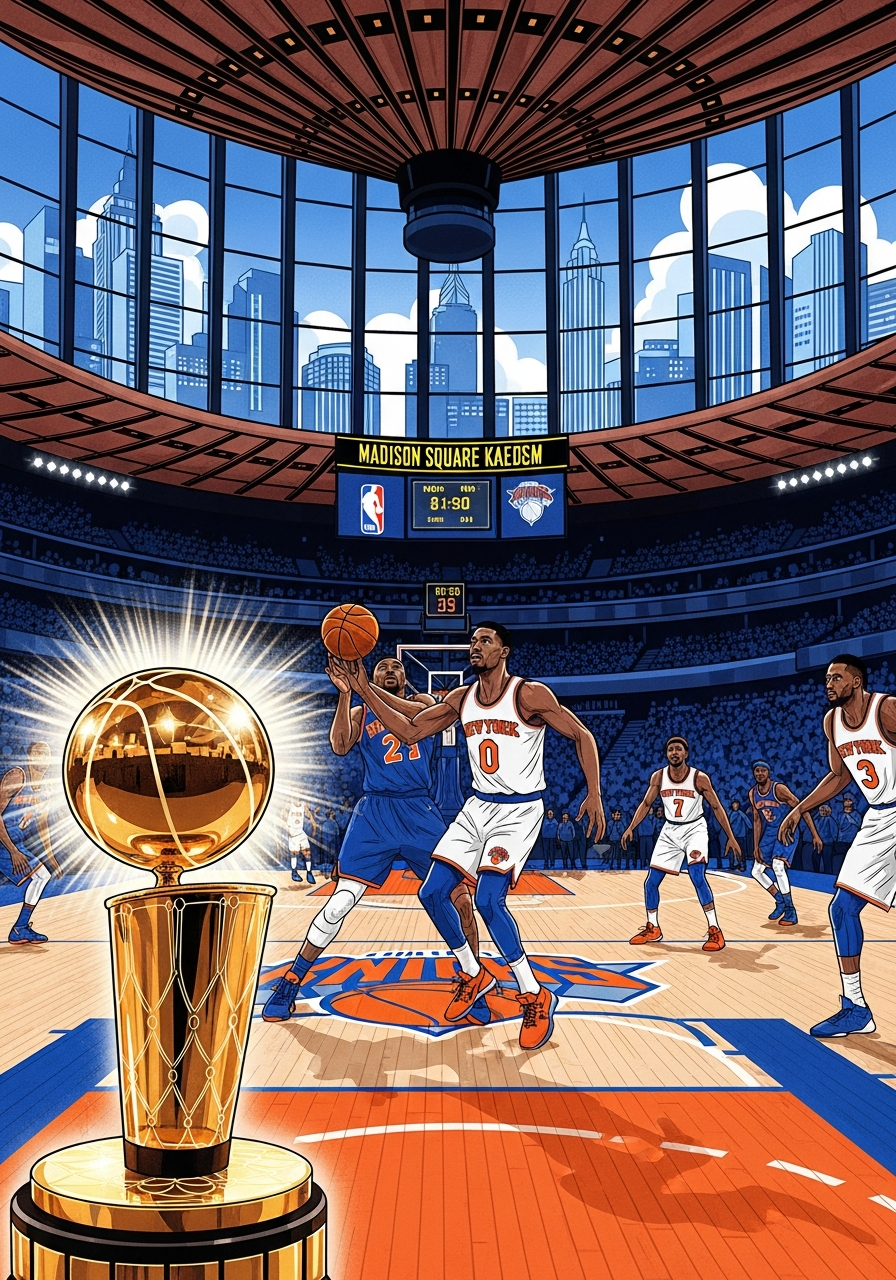
The Knicks' last championship was in 1973 — before Watergate broke, before the internet existed, before hip-hop emerged as a genre, before most of the 2026 roster's parents were born. In the 53 years between that title and June 14, 2026, New York watched the Yankees win multiple World Series championships and the Giants hoist multiple Super Bowl trophies, but never got a basketball title. Patrick Ewing played some of the most compelling Knicks basketball in history during the 1990s, reached the Finals in 1994, and left without a ring — a wound in New York sports culture that never fully closed across three decades. The Knicks became the quintessential symbol of expensive failure: consistently among the league's highest payrolls, consistently absent from serious championship contention. When the 2026 title finally came, the celebration wasn't just a sports party — it was 53 years of compressed urban frustration releasing simultaneously. An estimated 2 million people attended the championship parade, producing approximately $202 million in direct economic activity across the five boroughs and making it one of the largest civic gatherings New York has seen in years. Forbes projects the Knicks franchise value — already the NBA's highest pre-championship — will rise an additional 10-15 percent, a gain measured in multiple billions of dollars attributable directly to the title. The Madison Square Garden area's surrounding businesses reported record revenue during the playoff run. This is what 53 years of waiting looks like when it ends: not merely a sports result, but a city-wide identity restoration that reshapes how New Yorkers see themselves and their teams collectively.
The Greatest Knick Ever Debate Is Built on a Category Error
Within hours of the final buzzer, the debate erupted everywhere: Is Jalen Brunson now the greatest Knick of all time? Walt Frazier declared himself still the uncontested champion of that title. Charles Oakley backed Frazier enthusiastically. Kendrick Perkins countered that Brunson had definitively earned the crown. The debate is passionate, entertaining — and based on a fundamentally flawed premise that conflates two entirely different categories of excellence. Frazier and Willis Reed represent one archetype of NBA greatness: individual brilliance, where a player's personal talent is the direct, proximate engine of championship success. Frazier's 36-point, 19-assist Game 7 performance in the 1970 Finals remains one of the most extraordinary individual outputs in playoff history. Reed's injured-leg entrance in that same game is arguably the single most iconic moment in New York sports history across any era or sport. These men were elite individual players in an era that both rewarded and celebrated dominant individual performance. Brunson's greatness occupies an entirely different structural category: systemic architect and sacrificial leader, a player who deliberately restructured his own finances to design a championship-caliber roster and then led that roster to the title as its primary playmaker and emotional core. Asking "who's greater, Frazier or Brunson?" is structurally identical to asking whether a master jazz improviser or a world-class orchestra conductor is the more valuable musician — the question misunderstands both roles simultaneously. The debate's real value isn't in crowning a winner; it's in forcing fans and analysts to expand their understanding of what greatness in professional sports can legitimately mean.
Why Brunson's Championship Model Cannot Be Simply Replicated
The most important intellectual discipline required when analyzing Brunson's championship formula is resisting the temptation to generalize from a sample of one under highly specific conditions. Brunson was not a top-five NBA player — and that single fact is load-bearing for everything else in the analysis. LeBron James, Steph Curry, or Giannis Antetokounmpo can single-handedly carry a team to the playoffs through individual dominance; voluntary max salary refusal for those players would be economically irrational and their players' associations would actively oppose it. Brunson's accurate, clear-eyed self-assessment — "I am not that caliber of player, I need elite teammates to win a championship" — is precisely what made the financial sacrifice strategically rational rather than merely idealistic. His talent limitations forced him toward the correct strategy, which is a genuine paradox worth sitting with. The New York market provided a gravitational pull that small-market teams simply cannot replicate: the Knicks could promise Karl-Anthony Towns and Mikal Bridges the platform of Madison Square Garden, the largest media ecosystem in America, and franchise infrastructure no minor market can match. Leon Rose's front office had to correctly identify, value, and successfully acquire exactly the right players with the freed cap space — a scouting and execution requirement most organizations demonstrably cannot meet. Brunson also needed to remain healthy across two full seasons, a factor that is never guaranteed for any athlete. This convergence of non-superstar self-awareness, big-market recruiting power, front-office execution excellence, and health fortune represents a combination so specific that genuine replication is statistically unlikely for any foreseeable player or team combination.
A Third Path for Championship Construction — Influential but Not a Universal Template
For the better part of three decades, the NBA's championship blueprint came in exactly two formats: import multiple established stars onto one roster (the superteam, epitomized by Kevin Durant's 2016 move to Golden State), or identify generational talent in the draft and build patiently around it over years (Milwaukee's eight-year project centered on Giannis Antetokounmpo). Brunson introduced a third structural option — voluntary strategic salary deferral by a core player, deliberately freeing cap resources for roster optimization around him. This third path carries real advantages over both alternatives: superteam formation reliably generates fan backlash and accusations of undermining competitive balance across the league, while draft-and-develop demands five to eight years of losing seasons and the constant risk that the developed star simply leaves via free agency once ready to compete. Brunson's approach produced a champion in two years while generating enthusiastic, organic fan support at every stage. However, projecting this model as a dominant future trend would be analytically premature. Sports agents' core value proposition is maximizing client salary; voluntary pay cuts reduce both client earnings and agent commission percentages simultaneously, creating deep structural resistance from the agency industry. The NBPA will also resist this pattern becoming normalized, correctly identifying that individual generosity unchecked by structural protections can become systemic pressure on all players. The "Brunson path" will likely produce at most one or two genuine imitators per NBA season going forward — significant as a conceptual shift in how we think about team building, marginal as a statistical phenomenon.
Positive & Negative Analysis
Positive Aspects
- It Opened a Third, Fan-Beloved Path to an NBA Championship
Brunson's voluntary pay cut and the resulting championship introduced something the NBA hadn't witnessed in modern history: a core player deliberately engineering their own supporting roster by declining maximum compensation, then leading that assembled team to a title while earning unanimous Finals MVP honors. This third path matters because it sidesteps the most significant downsides of the two established alternatives in meaningful ways. Superteam construction — established stars consolidating onto a single roster — generates massive fan backlash and is widely perceived as unfair competitive manipulation; Durant's 2016 move to a 73-win Golden State team remains the canonical example of how this strategy poisons the well even when it produces championships. Draft-and-develop requires years of losing seasons, expensive organizational patience, and the ever-present risk that the developed star leaves for a bigger market the moment their rookie contract expires. Brunson's approach delivered a championship in just two seasons from the pivotal decision and generated the kind of organic, city-wide emotional investment that no manufactured superteam can ever replicate. The parade's estimated 2 million attendees were not merely celebrating a trophy — they were celebrating a story, a set of values, and a form of player loyalty that felt genuinely earned rather than commercially assembled. NBA front offices will now carry "Is our core player willing to structure their contract around team success rather than individual maximum?" as a genuine roster-building variable, meaningfully expanding the strategic vocabulary of team construction.
- The Cultural and Economic Impact on New York Was Genuinely Transformative
The scale of what the Knicks' championship delivered to New York City extends substantially beyond a sports result, touching the city's cultural identity, collective psychology, and direct economic activity simultaneously. A 53-year championship drought ending generates a form of collective catharsis that affects urban self-image — not just among dedicated Knicks fans but across the city's broader cultural fabric. The economic ripple effects are substantial and measurable by any standard: Madison Square Garden area businesses reported record revenue during the entire playoff run, the championship parade generated an estimated $202 million in direct economic activity across all five boroughs, and the franchise's Forbes valuation is projected to increase by 10-15 percent in direct response to the title — a gain denominated in multiple billions of dollars. The Knicks' global merchandise business will accelerate dramatically, as championship gear from the world's most famous arena in the world's most photographed city carries commercial reach that no other NBA market can replicate at equivalent scale. On a less quantifiable but equally real dimension, the championship gave New Yorkers a shared cultural touchstone — something to celebrate collectively in a city that often feels fractured by inequality, political tension, and the lingering psychological weight of pandemic-era isolation. Sports championships at this scale function as social cohesion mechanisms, and New York clearly needed this particular form of communal healing and shared triumph.
- It Proved That Servant Leadership Generates Team Performance More Powerfully Than Salary Status
The organizational behavior concept of servant leadership — where a leader's visible personal sacrifice generates powerful, self-sustaining commitment from teammates — has been theorized in academic literature for decades without ever finding a cleaner real-world test than the 2025-26 New York Knicks. When your team leader visibly forfeits nine figures to make the collective enterprise better, it creates an entirely different locker room culture than the one produced by a max-salary player who demands that others rise to meet his level. The on-court evidence across the Finals was unmistakable: Josh Hart's relentless hustle on plays that never appear in box scores or highlight reels, OG Anunoby's championship-caliber defensive intensity on every possession, Towns' late-game physicality in the moments of highest pressure — all of it reflected a team whose collective sacrifice mirrored and honored its leader's foundational choice. Organizational psychologists call this phenomenon "upward contagion of commitment," and Brunson's case provided a championship-level proof of concept at the highest competitive stakes. The cultural DNA of a team whose leader sacrificed $113 million is qualitatively different from a team whose leader wrote inspirational messages on the locker room whiteboard. This evidence will influence how coaches, general managers, and — interestingly — corporate executives outside sports think about the relationship between compensation structure and team performance culture.
- It Demonstrated That Championship Brand Equity Can Dwarf Salary Sacrifice Over Time
One of the most structurally significant long-term implications of Brunson's decision is what it reveals about the evolving economics of professional athletic careers in the personal-branding era. The traditional model — maximize contract value because your competitive playing window is short and unpredictable — made complete rational sense in an era before social media personal branding, before athlete-owned media companies, before athletes routinely became equity stakeholders in businesses rather than mere product endorsers. Brunson's case demonstrates that in 2026, a championship in New York unlocks a compounding multi-decade income stream that a four-year salary differential almost certainly cannot match in total economic value. His projected endorsement recovery of 40-50 percent of the $113 million within six months is merely the beginning of an arc that will continue generating returns for twenty years. The "man who ended New York's 53-year drought" narrative will remain commercially valuable long after Brunson's playing career concludes. Michael Jordan's Nike relationship continues generating over a billion dollars annually — decades after his final championship. Brunson's equivalent, necessarily smaller in absolute scale, illustrates the same underlying principle: in the personal-branding economy, the right championship at the right moment in the right market compounds into something worth more than any single contract. This insight will become increasingly recognized as more athletes understand that brand equity is a long-duration asset while contracts are short-duration instruments.
Concerns
- Team Owners Will Attempt to Weaponize This as Salary Suppression Leverage
The most serious structural risk embedded in Brunson's celebrated decision is how readily it hands team owners a powerful new argument in collective labor negotiations. "Be like Brunson — sacrifice for the team" sounds like a values-based appeal to championship ambition and collective purpose. In practice, it functions as a wage suppression argument wearing idealistic clothing, and the NBPA needs to recognize and treat it as exactly that. The 2027-28 CBA opt-out cycle will almost certainly feature team ownership invoking Brunson's voluntary pay cut as supporting justification for structural provisions expanding what they'll diplomatically call "player salary flexibility" — a euphemism for mechanisms designed to make it structurally easier for teams to pay star players below their genuine market value. The history of professional sports labor negotiations is a consistent, well-documented history of ownership groups finding new leverage points to constrain player earning power, and Brunson's narrative — emotionally resonant, publicly celebrated, impossible to argue against on its face — is the most powerful such leverage point the ownership side has encountered in years. Players who spent decades building collective bargaining power through strikes, lockouts, and contentious negotiations did so specifically to prevent individual generosity from metastasizing into systemic expectation. The vigilance the NBPA applies to this specific threat in the next negotiating cycle may determine the salary landscape for the entire next generation of NBA players.
- This Model Structurally Benefits Big-Market Teams at Small Markets' Expense
Brunson's salary strategy worked because New York's gravitational pull in free agency is genuinely incomparable to any other NBA market. The salary cap space created by his pay cut attracted Karl-Anthony Towns and Mikal Bridges to the Knicks not primarily because of the raw dollar figures available but because of what "playing at Madison Square Garden in New York City" means for an athlete's commercial profile, global visibility, and long-term brand development. A player in Memphis, Indiana, or Oklahoma City who made the structurally identical financial sacrifice would not attract equivalent caliber free agents — because those markets cannot offer the platform, the media reach, the commercial partnership ecosystem, or the cultural cachet that New York guarantees its champions. If the "Brunson model" becomes an aspirational cultural template across the league, it will systematically accelerate competitive imbalance rather than reduce it: big-market franchises benefit disproportionately from salary deferral strategies because they can convert freed cap space into elite free agent acquisitions more reliably and predictably than small-market teams. The NBA has invested significant regulatory energy in constructing systems designed to give all 30 franchises a theoretical path to championship contention. A cultural norm that rewards voluntary salary cuts primarily in cities already possessing structural advantages directly undermines that goal.
- The Draft Asset Cost Plants the Seeds of a Long-Term Vulnerability
To acquire Towns and Bridges alongside the salary cap space created by Brunson's sacrifice, the Knicks traded away multiple future first-round draft picks — a transaction that received far less public attention than Brunson's pay cut but carries equally significant long-term consequences. This is the part of the championship story that gets glossed over in celebration mode but will matter enormously in three to four years when the current core begins to age. Brunson at 29, Towns at 30, Bridges at 29, Hart at 31 — this group's collective competitive prime realistically spans two to three more seasons. When that window inevitably closes, the Knicks will face rebuilding without the draft capital that normally fuels roster regeneration from within. The 2011 Dallas Mavericks provide the most instructive historical warning: Dirk Nowitzki accepted below-market contracts to give Dallas flexibility, the team won the championship that year, and then spent nearly a full decade in rebuilding purgatory because the roster was structured for one concentrated window rather than for sustained long-term competitiveness. The 2016 Cleveland Cavaliers and 2019 Golden State Warriors followed similar structural patterns — short-term glory, medium-term vulnerability, prolonged rebuilding. The emotional and commercial triumph of the 2026 championship is real and fully deserved, but the structural choices that made it possible have embedded genuine risk into the franchise's competitive future.
- The Inspiring Narrative Is Built on Survivorship Bias That Misleads Young Players
The single most uncomfortable truth about the Brunson championship story is that every element of its moral is entirely contingent on the outcome. If Brunson had suffered a torn ACL in February 2025 — a realistic, non-trivial probability for any professional athlete at any moment in any game — he would have become the player who gave up $113 million and never competed for the ring that sacrifice was supposed to unlock. The story would have been told as a cautionary tale about financial idealism and the dangers of prioritizing legacy over security, not as an inspiration. The NBA career average is approximately 4.5 years, and serious injuries end careers without warning, without compensation adjustments, and without second chances. The maximum contract exists precisely because that vulnerability is permanent and unpredictable. Survivorship bias — our cognitive tendency to draw sweeping lessons from successful outcomes while discounting equally informative failed attempts that disappeared from public memory — is operating at full intensity in how media, fans, and athletes themselves are processing this story. The danger is acute: young players will absorb the "Brunson model" as a general principle applicable to their situations and attempt to replicate it in contexts where the specific enabling conditions — big market, capable front office, ideal roster fit, multi-year health fortune — are absent. For the vast majority of professional athletes, accepting maximum compensation when it is genuinely offered remains the only rational default, and the Brunson narrative's uncritical consumption risks dangerously obscuring that reality.
Outlook
In the next one to six months, the most immediate consequence of this championship will be a commercial explosion centered on Brunson's personal brand. Within 48 hours of the June 14 title clinch, his social media following grew by an estimated three million accounts — a surge that signals the beginning of what will be a sustained, compounding endorsement bonanza. Not just Nike and New Balance, but global luxury brands, Manhattan-based financial firms, and media conglomerates are actively pursuing Brunson partnerships. Based on comparable championship-era endorsement portfolios in the New York market, I'd estimate Brunson locks down at least five major commercial deals within six months, with a combined value somewhere in the $45-56 million range — recovering roughly 40-50 percent of his $113 million salary sacrifice through off-court income alone, before even counting the long-term compounding effects.
The Knicks front office will almost certainly move to extend Brunson before the 2026-27 season opens. This time, expect a near-max or super-max structure, which would mean Brunson ultimately receives a version of the maximum-value contract he declined two years ago — just on the back end of a championship, rather than the front end of an uncertain bet. The economic logic here is circular and elegant: the pay cut funded the team that won the title that justified the larger extension. In New York's media ecosystem, the franchise's naming-rights value, arena premium revenue, and global merchandise sales will all accelerate in parallel. Brunson's complete financial recovery arc, when fully tallied over the next three to five years, will likely exceed the original sacrifice — making his 2024 decision not just a championship strategy but a long-term wealth optimization play that most financial advisors would recognize as sophisticated.
On the broader NBA level, the short-term market response will be genuinely fascinating. The 2026-27 free agency cycle will almost certainly feature at least two or three prominent players publicly invoking the "Brunson model" during contract negotiations. I'd expect Jaylen Brown in Boston and Jamal Murray in Denver to be among those exploring similar conversations with their front offices. However — and this qualification is critical — the number of players who actually follow through with a meaningful salary reduction will be one or two at most. The conditions that made Brunson's gamble rational are not broadly reproducible. New York's market magnetism attracted elite free agents in a way that Memphis, Indiana, or Charlotte simply cannot — and salary deferral in those markets would not generate equivalent roster construction returns.
From a medium-term perspective — six months to two years out — the most consequential outcome may be the NBA's collective bargaining dynamics. The current CBA runs through the 2029-30 season, but both parties hold a 2027 opt-out clause. I believe there is greater than a 55 percent probability that team owners will deploy the Knicks' championship narrative as a supporting argument for expanding what they'll call "player salary flexibility" provisions in any renegotiated agreement. Owners will frame this as enabling "more players to make the Brunson choice." The NBPA will counter — correctly — that voluntary individual sacrifice and structural coercion are fundamentally different things, and that using one player's extraordinary circumstances as a systemic template constitutes labor rights erosion dressed in feel-good language. This tension will be one of the defining storylines of the 2027-28 CBA negotiations, potentially influencing the competitive landscape for the next decade.
For the Knicks themselves over the next one to three years, the medium-term outlook is genuinely complicated, and I want to be honest about the constraints. Brunson at 29, Towns at 30, Bridges at 29, Anunoby at 28, and Hart at 31 represent a core whose collective prime window realistically spans two to three more seasons at maximum. NBA history is consistently unkind to defending champions: the 2023 Nuggets and 2024 Celtics both struggled to replicate championship-level intensity and focus the following year. The psychological challenge of maintaining hunger after achieving what you've spent years chasing is real and documented across sports. I'd put the Knicks' back-to-back championship probability at roughly 15-20 percent. The obstacles are cumulative fatigue, the fact that every opponent in the conference will have redesigned their defensive schemes specifically targeting this roster, and the natural psychological deflation that follows a long-awaited peak achievement.
Looking at the two-to-five-year horizon, Brunson's choice will generate conversations that extend well beyond basketball. In the NFL, Patrick Mahomes demonstrated that the max-salary-plus-championship model is achievable with his 10-year, $503 million deal. In MLB, Shohei Ohtani restructured his $700 million Dodgers contract with 97 percent deferred to give the team immediate payroll flexibility. Brunson's model is a third, structurally distinct option from both: genuine voluntary sacrifice rather than structured deferral. My forecast is that within five years, we'll see at least three to five Brunson-style voluntary salary reductions across professional sports — NFL, MLB, or international soccer. But these will remain outlier events rather than industry trends. The structural incentives of professional sports labor markets are deeply weighted against voluntary pay cuts, and the agent community will work systematically to ensure that exceptions remain exceptions.
The deepest structural shift may be the beginning of the end for "salary as the sole measure of player value." The personal branding economy of the 2020s is fundamentally altering the financial architecture of athletic careers. NBA players' non-salary income — endorsements, media equity, investment returns, social media monetization — has been accelerating rapidly. There are already multiple documented cases of players generating more off the court than on it in a given year. If that trajectory continues at its current pace, I'd project that by 2030, at least ten of the top twenty NBA players will be earning more from non-salary sources than from their contracts annually. At that structural tipping point, the entire framework of salary cap negotiation transforms — and Brunson's 2024 decision will be recognized as the first clear market signal that this transformation was already underway. He didn't just make a smart personal choice; he inadvertently mapped the trajectory of athlete compensation for the next generation.
Now let me walk through the three scenarios I consider most plausible for the next three to five years. The bull case — which I'd assign 15-20 percent probability — goes like this: Brunson signs a super-max extension worth $300 million or more over five years, while simultaneously generating $50-plus million annually from endorsements and media partnerships. The Knicks win a second championship within three years, cementing Brunson's legacy as the most impactful Knick in franchise history by any measure. The "Brunson model" earns a formal place in sports management curricula, and two to three genuine imitators appear each NBA season. NBA global revenue — particularly in Asia and Europe — reaches record levels driven partly by the New York championship narrative. This is the scenario where the story's inspiration fully justifies its risks, and where Brunson's financial gamble reads as one of the greatest individual economic decisions in professional sports history.
The base case — which I'd call the 50-55 percent most likely scenario — unfolds roughly like this: the Knicks advance to the Conference Finals in 2026-27 but fall short of back-to-back titles, losing to a refreshed opponent with better rest and motivated hunger. Brunson individually recovers 70-80 percent of his salary sacrifice through endorsements, media work, and a substantial (if not maximum) extension. The "Greatest Knick" debate continues indefinitely without resolution, but Brunson earns a unique and respected category of his own — distinct from Frazier and Reed, not comparable to them on either's terms, but permanently honored as the player who designed and delivered the championship that ended 53 years of New York suffering. In this scenario, one player per season across professional sports consciously echoes his approach — a philosophical shift at the margins, not a structural revolution.
The bear case — which I'd weight at 20-25 percent — centers on a serious injury to Brunson in the early portion of the 2026-27 season. This is the scenario that makes the entire retrospective pivot on its axis and reveals how much of the current narrative is outcome-dependent. Without Brunson healthy, the Knicks' championship window closes immediately. The roster was built around his specific skills and leadership; it doesn't function at the same level without him. Without future draft assets and with an aging core, a substantial rebuild becomes necessary — and the financial sacrifice that made this roster possible will look, in retrospect, more like a vulnerability than a strategy. The $113 million pay cut will be reframed as the decision that left the franchise without the resources to rebuild after the window closed. This probability is non-negligible and deserves full acknowledgment.
For historical comparison, the closest precedent to Brunson's situation is the 2010-11 Dallas Mavericks. Dirk Nowitzki accepted below-market contracts across his career to give Dallas flexibility, and that contributed directly to the 2011 championship. But Dirk's financial concessions were accumulated gradually across many seasons and were smaller in absolute terms than Brunson's single decisive sacrifice. Dallas then spent nearly a full decade in rebuilding mode. Tim Duncan's repeated below-market signings in San Antonio across five championship runs offer another reference point, but Duncan's was a decades-long strategic approach — not a single concentrated, nine-figure sacrifice. The second-order effect analysis points to a consistent pattern: short-term brilliance, followed by structural vulnerability, then a long rebuilding arc. The Mavericks, the 2016 Cavaliers, the 2019 Warriors — championship windows built on traded assets and salary compromises all eventually face the same structural reckoning.
One final observation about where this entire forecast could be wrong: if the NBA introduces a hard salary cap in 2028, the structural conditions that make voluntary salary reduction strategically valuable disappear entirely. Hard caps eliminate the cap space leverage that Brunson created — every dollar saved by one player simply becomes a dollar unavailable elsewhere under a different structure. Additionally, if the agent community establishes internal guidelines actively discouraging voluntary pay cuts from clients — effectively a "reverse Brunson clause" — the model's replication pathway gets blocked at the institutional level. And perhaps most importantly: the success of this specific case was not merely the result of Brunson's decision. It required Leon Rose identifying exactly the right players to acquire with the freed cap space, Tom Thibodeau deploying them in the right tactical system, a scouting department that correctly evaluated both Towns and Bridges before the market fully priced them, and two full seasons of health fortune for every member of the core. Replicate the financial decision without replicating those surrounding conditions, and the outcome is not the same. That honest qualification belongs in every analysis of what the Knicks accomplished in 2026.
Sources / References
- Jalen Brunson Wins Bill Russell Trophy as 2026 NBA Finals MVP — NBA Official
- Jalen Brunson Talks 113M Pay Cut Energy of Entire City During Knicks Title Run — Bleacher Report
- Jalen Brunson Pay Cut Praised by Mike Brown After Knicks Win 1st NBA Title in 53 Years — Bleacher Report
- Jalen Brunson: Greatest Knicks Player of All Time? — CBS Sports
- How the Knicks Won the 2026 NBA Championship — NBA Official
- New York Knicks Win 2026 NBA Finals Path to Championship — ESPN
- New York Knicks NBA Championship Finals 2026 Jalen Brunson — The Ringer