
FIFA Said "We Are One World" — Then Left Iran, Somalia, and 39 Nations at the Door
Summary
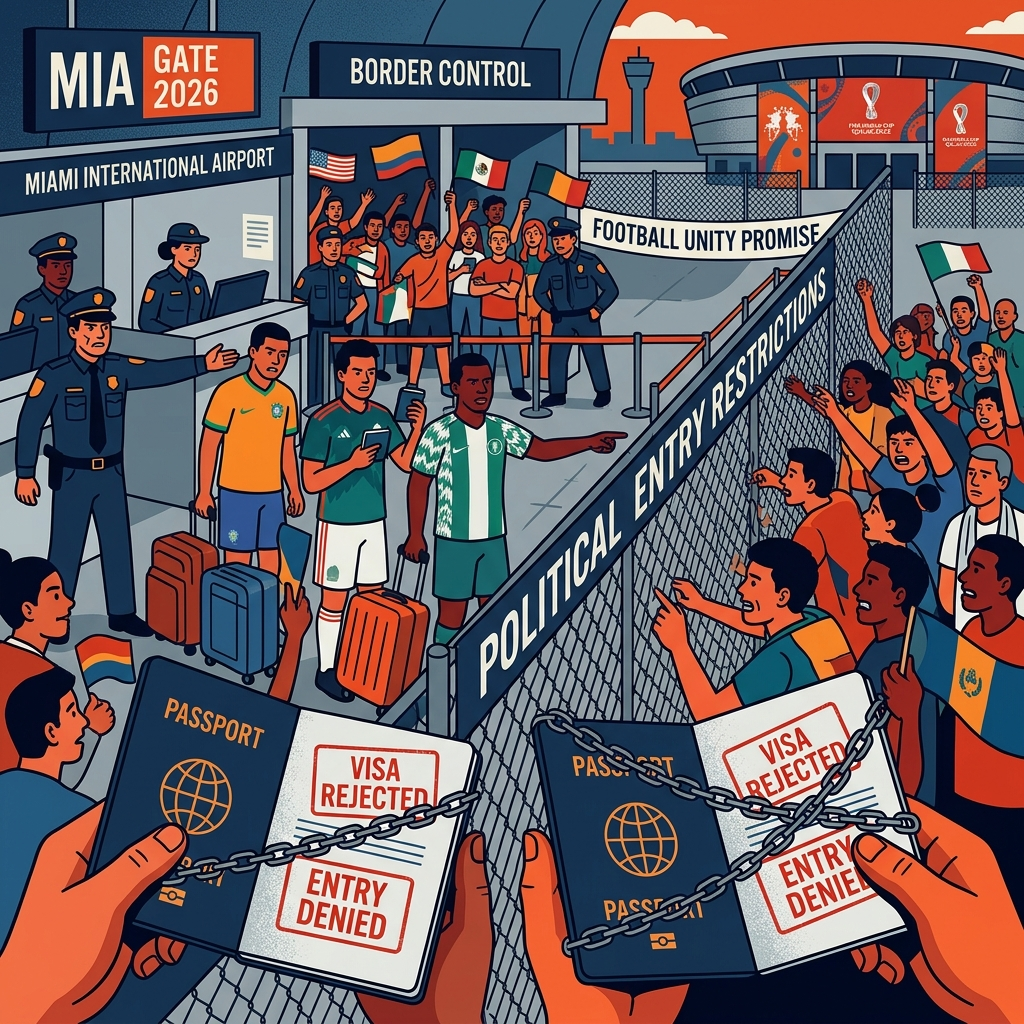
The 2026 FIFA World Cup has unfolded in direct contradiction to its own branding as "the most inclusive World Cup in history," as the Trump administration's entry bans against nationals from 39 countries triggered an unprecedented cascade of visa denials affecting fans, team officials, and even the referees assigned to work the matches. Omar Artan — Somalia's first-ever FIFA World Cup referee and the 2025 African Best Male Referee award winner — was turned away at Miami International Airport despite carrying both a valid U.S. visa and a Somali diplomatic passport, with CBP citing "suspected terrorist ties" as justification. Iran's national team received their visas a mere ten days before their opening match, after months of bureaucratic limbo that forced the squad to relocate their training base from Tucson, Arizona to Tijuana, Mexico, while more than 15 key administrative staff members were denied entry entirely. In the Netherlands, 174,000 citizens signed a boycott petition — a scale of organized civic resistance unprecedented in football history — and Amnesty International formally published a report titled "Humanity Must Win," designating the United States as a country in a "human rights emergency." FIFA President Gianni Infantino's now-notorious "chill and relax" response and the organization's official declaration that it "does not interfere in host country immigration procedures" have exposed what critics have argued for decades: that FIFA's 96-year-old principle of "sports transcends politics" was never more than a convenient fiction, and that the world's most popular sport remains a hostage to the geopolitical ambitions of the powerful nations that host it.
Key Points
The "Selective World Cup" Built by 39-Country Visa Bans
The Trump administration began by suspending visa issuance for nationals from 19 countries in June 2025, citing national security concerns, and expanded that list to 39 countries by December of the same year — producing what became, in practical terms, a World Cup with a significantly restricted guest list. Among the nations affected were World Cup participants: Iran and Haiti faced complete visa bans, while Ivory Coast and Senegal fell under partial restrictions. Official exemptions were created for players, coaches, team officials, and immediate family members, but this carve-out masked the scale of exclusion affecting everyone else — particularly the fans, journalists, and lower-tier officials who make a World Cup a genuine global event rather than a closed competition. Of the 42 members of Morocco's official national supporters' association, 40 were denied visas; approximately 150 Ghanaian fans were rejected in a single coordinated wave. These individuals had already committed substantial sums — hotel deposits, airfare, match tickets — that in many cases represented months of income at local wage levels, creating financial losses that no FIFA statement addressed. The American Immigration Council characterized the situation as one where "national security and public safety concerns" served as official cover for what amounted to geographic and ethnic targeting, with the burden falling disproportionately on nationals from African, Middle Eastern, and Muslim-majority countries. FIFA's response — claiming it "does not interfere in host country immigration procedures" while simultaneously marketing the event as "the most inclusive World Cup in history" — created a credibility gap that no official attendance statistic can bridge. The result is an event whose stated universal aspiration and actual implementation are in direct, documented contradiction, establishing a historical precedent that future host nation selection processes cannot responsibly ignore.
Omar Artan and the Symbolic Weight of a Single Rejection
Omar Artan's exclusion from the 2026 World Cup is the kind of story that crystallizes an entire controversy into a single human moment, with a clarity that policy debates rarely achieve. Artan is Somalia's first-ever FIFA World Cup referee — a milestone representing decades of football development in a country where the sport has served as one of the few consistent sources of national identity through prolonged conflict and instability. He won the 2025 African Best Male Referee award, the highest individual officiating honor on the continent, and arrived at Miami International Airport carrying both a valid U.S. entry visa and a Somali diplomatic passport — documentation that, under any standard interpretation of international travel norms, should have guaranteed his entry without question. U.S. Customs and Border Protection denied him anyway, citing "suspected ties to terrorist organizations," and FIFA confirmed he would be unable to participate in any tournament capacity whatsoever — not refereeing, not training, not even attending matches as an observer. When he returned to Mogadishu, tens of thousands of Somalis turned out to welcome him as a national hero, an outpouring that said as much about what his journey had represented to them as about the injury of his exclusion from the event he had spent years preparing to work. His case was not isolated: Palestinian FIFA official Jibril Rajoub was denied a visa and stranded in Mexico City, and Iraqi player Ayman Hussein was detained for seven hours at Chicago O'Hare while CBP agents examined his phone. Taken together, these incidents describe a consistent pattern whose targets are overwhelmingly from specific regions and religious backgrounds, and they constitute the defining human face of this tournament's governing credibility crisis — one that will be cited in FIFA reform discussions for years to come.
Infantino's "Chill and Relax" and FIFA's Structural Abdication
When FIFA President Gianni Infantino was asked to respond directly to Omar Artan's denial of entry, he advised the public to "chill and relax" — a statement that immediately became one of the defining quotes of the tournament, though not in any way FIFA's communications team would welcome. Infantino characterized the problems as "normal" for an event of this scale and expressed no regrets about the United States hosting the 2026 edition, framing systematic exclusion as routine tournament friction. FIFA's official organizational statement went further still: the governing body declared it "does not interfere in host country immigration procedures, including visa screening" — a position that is impossible to square with FIFA's own public commitments. In 2023, FIFA announced that host contracts for the 2030 and 2034 World Cups would include "fully binding human rights obligations" on host nations, which is a public acknowledgment that FIFA already possesses the legal architecture to impose conduct standards on host governments and has chosen to build those standards into future agreements. Choosing not to deploy that architecture in 2026 is a policy decision, not a legal necessity, and the distinction matters enormously for how this crisis should be understood. What makes Infantino's framing particularly indefensible is the revenue arithmetic: FIFA is projecting $8.9 billion in tournament revenue while asserting zero organizational responsibility for whether the fans and officials that revenue theoretically serves can actually reach the venues. The IOC spent years developing systematic political risk assessment processes following the 1980 Moscow Olympics; FIFA, four decades later, appears to have concluded that those lessons either don't apply to football or don't affect the bottom line enough to act on.
The Netherlands Boycott Petition and the Possibilities and Limits of Civic Resistance
The boycott petition organized by Dutch journalist Teun van de Keuken gathered 174,000 signatures, making it by any reasonable measure the largest organized civic resistance movement in football history directed at a specific tournament's participation decision. The petition's framing was direct and unambiguous: signatories did not want the Netherlands national team's participation to serve as implicit endorsement of what it characterized as President Trump's "violent terrorist policies against innocent immigrants," positioning the act of competing as a political statement independent of the sport's merits. Former FIFA president Sepp Blatter publicly announced his support for the boycott, lending the movement a degree of institutional credibility that fan-led campaigns rarely attract from within football's own power structure. Despite all of this, the Royal Netherlands Football Association voted to participate, and no other national football association seriously entertained the boycott option — which is itself a meaningful data point about the gap between civic expression and institutional action in international sports governance. GZERO Media's historical analysis of sports boycotts found that such campaigns are most effective at "changing perceptions rather than changing policies," a characterization that seems likely to define this petition's ultimate legacy in the 2026 context. The movement's real significance lies not in what it achieved immediately but in the precedent it sets: organized, large-scale public civic pressure on a national federation's tournament participation decision is now an established part of the football governance landscape, and future FIFA officials will have to account for it in ways that their predecessors simply did not.
FIFA's $8.9 Billion Revenue Against a $250 Million Host City Deficit
The financial architecture of the 2026 FIFA World Cup reveals an asymmetry that extends well beyond the human rights controversy and speaks to the fundamental structural condition of international football governance. FIFA projects $8.9 billion in tournament revenue while the 11 U.S. host cities are collectively projected to run deficits exceeding $250 million — an extreme imbalance embedded in the standard host contract structure, where security, transportation, stadium renovation, and operational costs are borne by host cities while ticket sales, broadcasting rights, and sponsorship revenue flow almost entirely to FIFA. The U.S. federal government committed $846 million specifically to World Cup security — a figure representing American taxpayer money, not FIFA expenditure — while host city governments absorbed the costs of infrastructure upgrades, traffic management, and municipal services that will be required long after the tournament concludes. The macroeconomic backdrop makes this starker: WTTC reported that international visitor spending in the United States fell $14 billion year-over-year in 2025, with visa restriction policies identified as a direct contributing factor, meaning the World Cup was not generating the tourism economic boost that justified hosting bids. AHLA found that 80% of host city hotels missed their booking targets, more than 176,000 tickets remained unsold on FIFA's official resale portal, and secondary market prices dropped 20% in a month. I believe this financial model — where revenue certainty flows to FIFA while democratic nations with transparent budgets and accountable public officials absorb cost overruns and political damage — will, over time, make democratic host nations an endangered species in the World Cup ecosystem, accelerating the tournament's dependence on governments where those accountability mechanisms don't exist.
Positive & Negative Analysis
Positive Aspects
- A Global Catalyst for Human Rights Awareness in Sports
This visa controversy has ignited a level of global public discussion about the intersection of sports and human rights that exceeds anything produced by previous World Cup controversies, reaching audiences who had never before engaged seriously with sports governance as a human rights issue. Amnesty International's decision to publish a formal report titled "Humanity Must Win" — officially designating the United States as a "human rights emergency" country and systematically documenting the tournament's access failures — elevated the discourse from social media commentary to institutional analysis that will remain in the public record and serve as reference material for future advocacy campaigns. The case of Omar Artan became a globally shared story that gave millions of people a specific, human-scale understanding of what systematic exclusion looks like in practice, in a way that abstract policy debates and statistical summaries rarely achieve across cultural and linguistic barriers. Where previous World Cup controversies focused primarily on migrant worker conditions at construction sites (as in Qatar 2022), this tournament's controversy extended the frame to encompass fan access, official travel rights, referee participation, and the fundamental question of who gets to physically attend a global sporting event — a broadening that speaks to concerns shared by football supporters in every country. I believe this expansion of the human rights conversation in international football will prove durable, because it speaks to something fans across all demographics can viscerally understand — the experience of being told you are not welcome to something you invested in — and that emotional accessibility is what transforms a news cycle into a lasting reform movement.
- A New Playbook for Civic Resistance in International Sport
The 174,000-signature Dutch boycott petition has accomplished something important regardless of whether it achieved its immediate goal: it has demonstrated that organized, large-scale public civic resistance to a national federation's tournament participation decision is possible, sustainable, and capable of generating sustained international attention across the full duration of a World Cup cycle. Previous instances of sports boycott were typically driven by governments — as in the 58-nation 1980 Moscow Olympics withdrawal — or by individual athletes making personal decisions, as when Johan Cruyff refused to participate in the 1978 Argentina World Cup, without the architecture of an organized citizen campaign behind them. The 2026 petition represents something structurally different: a citizen-led movement organized through civil society channels, explicitly targeting the governance decision of a national football association, and sustaining public pressure over a period of months rather than dissipating after the initial news cycle. Former FIFA president Sepp Blatter's public endorsement of the boycott gave the movement a level of institutional credibility that citizen-led sports campaigns rarely attract, suggesting that the walls between fan sentiment and formal institutional opinion are more permeable than previously assumed in football governance structures. The petition may not have changed KNVB's decision in 2026, but it has provided a detailed operational template — petition strategy, media engagement, coalition building, institutional targeting — for future campaigns in similar situations involving future host nation controversies. When the next major human rights concern emerges around a World Cup host selection, the activists who organize the response will have 174,000 signatures and a documented playbook to build from and improve upon.
- Iran's Eventual Participation as Proof That Pressure Can Work
The fact that Iran's national football team ultimately received U.S. visas and competed in the 2026 World Cup — despite the United States and Iran being in an active state of military hostility — is, in its own complicated and highly qualified way, evidence that international pressure and sustained diplomatic engagement can produce movement even in the most adversarial geopolitical circumstances. The visa outcome was the product of a specific combination of forces converging over an extended period: FIFA's behind-the-scenes mediation, sustained international media scrutiny, diplomatic signaling from multiple governments, and ultimately a White House political calculation about the reputational cost of being the country that prevented a qualified national team from participating in a tournament it had qualified for on merit. The conditions under which Iran's players competed were severely constrained — over 15 key administrative staff members denied entry, training relocated to Mexico, arrival timed to the day before the first match — but the team reached the pitch, which was genuinely not guaranteed as recently as two weeks before the tournament began. I view this as a limited but real demonstration that the mechanisms for generating change exist, even if they currently require extraordinary and sustained levels of external pressure to produce outcomes that should be entirely routine administrative matters. The lesson is not that the system worked as designed, but that the system can be made to work — partially, imperfectly, and with enormous effort — when enough institutions apply coordinated pressure simultaneously, which is a more useful lesson than either "nothing can be done" or "it all worked out fine."
- Building the Evidentiary Foundation for Stronger Host Nation Standards
Whatever its immediate policy impact, the 2026 tournament has produced an unusually robust body of documented evidence that future FIFA reform advocates will be able to deploy in governance debates for years. Amnesty International's "Humanity Must Win" report, the 21-organization joint condemnation of the 2034 Saudi Arabia selection, the 174,000-signature Netherlands petition, the specific documented cases of Artan, Rajoub, and Hussein — these are not just news stories. They constitute a formal evidentiary record of systematic access failures, produced and archived by credible international institutions, that cannot be dismissed as anecdotal, politically motivated, or exaggerated by reform-minded critics. FIFA's own 2023 commitment to "fully binding human rights obligations" in future host contracts creates a specific legal and rhetorical framework that reform advocates can work with: they can now argue, with documented institutional support, that FIFA promised to have these standards in place and then chose not to apply them to its largest tournament — establishing a "you said X, you did Y" accountability gap that is the foundation of effective institutional reform campaigns. I think the practical effect of this accumulated evidence will be most visible in 2030 host preparation negotiations, where the 2026 record will serve as the baseline against which the host nations' specific commitments are measured, and where failure to enforce those commitments will carry a political cost that FIFA's leadership cannot credibly claim ignorance of the way their predecessors might have.
- Excluded Fans Are Forcing Football's Fundamental Questions Into the Open
The exclusion of fans, officials, and referees from the 2026 World Cup has had an unexpected constructive dimension: it has forced a genuinely fundamental question back to the center of global football discourse in a form that no amount of official statement management can neutralize or redirect. When Moroccan fans who spent months of savings on travel arrangements land back home without having seen their team play, they are not asking a political question — they are asking a human one that every football supporter anywhere can understand: who is this sport actually for? When tens of thousands of Somalis pour into the streets of Mogadishu to welcome a referee home as a hero, they are not making a policy argument — they are demonstrating what it means when a country's first-ever presence at a global event is stripped away by a bureaucratic decision made by a government on the other side of the world. These experiences carry a moral weight that academic reports and legal frameworks cannot replicate, because they are lived rather than argued, and they travel across cultural and linguistic barriers in ways that position papers do not. I believe this emotional, human-scale pressure — the specific documented pain of specific named people — is ultimately more powerful than institutional advocacy as a driver of long-term change, because it is the kind of story that doesn't fade between tournament cycles or get absorbed into footnotes. The international football audience now has names, faces, and stories attached to the concept of exclusion in a way it didn't before 2026, and that is a resource for reform that will outlast this tournament by years.
Concerns
- Devastating and Largely Uncompensated Financial and Emotional Harm to Denied Fans
The visa denials have inflicted direct, concrete, and largely uncompensated harm on individual fans whose only relevant characteristic was holding a passport from a country the host government had chosen to restrict — a harm that FIFA has done nothing substantive to address. Members of Morocco's national supporters' association reported total trip costs in the range of 20,000 Moroccan dirhams per person — approximately $2,000 — which, in the context of Moroccan average wages, represents several months of savings spent on non-refundable hotel reservations, airfare, and match tickets that became worthless when the visa was denied. Ghanaian fans who were collectively rejected, Ivorian fans navigating partial restrictions, and Senegalese fans facing similar uncertainty all encountered versions of the same calculation: invest in a dream and absorb the full financial loss when the system produces a rejection, or don't try at all — either way, bearing a cost that FIFA accepted no responsibility for creating. The psychological dimension may be harder to quantify than the financial loss but is no less real: the experience of having a lifelong aspiration of watching your national team in a World Cup denied by a government that never engaged with your application on its actual merits creates a specific kind of institutional betrayal that doesn't simply fade when the tournament ends. I believe the long-term consequence for international football's fan base in affected countries will be a durable distrust of global sporting institutions — a distrust that will manifest in declining engagement with FIFA's products and platforms for years after 2026, with measurable commercial consequences that FIFA's revenue projections do not currently account for.
- FIFA's Structural Powerlessness Exposes the Rot in International Sports Governance
The most troubling aspect of this crisis is not what happened to any specific individual, as serious as those cases are. It is what the institutional response has revealed about the structural condition of international sports governance at the highest level of the sport. FIFA's official position — that it "does not interfere in host country immigration procedures" while simultaneously collecting $8.9 billion in revenue from a tournament those procedures are actively disrupting — represents a governance model so structurally divorced from accountability that it approaches institutional absurdity. The IOC developed systematic host nation political risk assessment protocols following the 1980 Moscow Olympics debacle; FIFA has had more than four decades to develop comparable frameworks and has consistently chosen not to operationalize them in any meaningful sense. The critical fact is that FIFA's 2023 announcement of "fully binding human rights obligations" for 2030 and 2034 host contracts was a public declaration that the organization possesses the legal capacity to impose enforceable standards on host governments — making the 2026 failure not an absence of legal power but a deliberate exercise of organizational discretion in the wrong direction. I believe this structural vacuum — where the world's most commercially successful sports organization has no functional enforcement mechanism over the conditions in which its events take place — will continue to produce crises of this magnitude or greater in every tournament cycle, because the incentive structure that created it remains entirely intact and the leadership that benefits from it has demonstrated no internal motivation to change it.
- The Vicious Cycle Pushing FIFA Toward Authoritarian Dependency
If the pattern established by this tournament continues — democratic nations with transparent municipal finances and active civil societies absorbing substantial losses while facing international reputational damage for political decisions made by national governments — the logical institutional consequence is that fewer democratic nations will submit competitive bids to host future World Cups. A $250 million collective deficit across 11 host cities, combined with the scale of international human rights criticism, creates a political environment in which no accountable mayor or city council can easily justify a hosting bid to their constituents when the financial downside is this clear and the reputational upside is this uncertain. This calculus systematically favors governments where financial transparency is structurally limited and civil society pressure can be legally suppressed, which is precisely the governance profile of Qatar 2022 and Saudi Arabia 2034. The 21 human rights organizations that condemned the Saudi Arabia selection as a "violation of FIFA's own human rights framework" were identifying a structural trend accelerated by each successive controversial tournament, not an isolated anomaly in the host selection process. As democratic host nations become economically and politically less viable and authoritarian governments become FIFA's primary institutional partners, the governance vacuum at the center of international football will systematically deepen, because the very governments most willing to absorb FIFA's cost structure are precisely the ones least subject to the civic and institutional pressures that might otherwise produce meaningful reform.
- Boycott Campaigns That Fall Short Risk Leaving FIFA More Comfortable, Not Less
The Netherlands boycott petition's failure to produce an actual national federation boycott — despite 174,000 signatures, former-FIFA-president endorsement, and sustained international media coverage across multiple months — creates a potentially problematic precedent that cuts against the movement's own long-term goals. FIFA can now point to a scenario in which the largest organized civic resistance campaign in football history was met with full national federation participation by every affected country without exception, which is a data point the organization will use to argue that market demand for the World Cup product consistently overrides political objections to its governance decisions. The gap between the 174,000 signatories and the KNVB's ultimate decision illustrates a structural problem with boycott campaigns as a governance tool: the decision-making authority sits with institutional bodies — federations, not fans — whose incentives run strongly toward participation and whose accountability to their individual membership is diffuse enough to absorb significant dissent without changing course. The 1980 Moscow Olympics boycott involved 58 nations actually refusing to participate and produced exactly zero change in Soviet Afghanistan policy, while definitionally harming the athletes who had trained for years to compete at that specific event. I think the specific risk here is that a failed boycott campaign at this scale signals to FIFA's leadership that the threshold for actual institutional action in response to human rights concerns is substantially higher than civic campaigns can currently reach — which may make the organization's decision-makers even more comfortable with their current approach heading into the 2034 Saudi Arabia tournament.
- Politicization Is Eroding the Athletic Value the Tournament Was Built to Deliver
The sustained political controversy surrounding this World Cup has done something that rarely gets discussed within human rights advocacy framing but deserves direct acknowledgment: it has substantially diminished the ability of the tournament to function as the celebration of athletic excellence and global sporting competition it nominally exists to provide. Iran's players competed under conditions — arriving the day before their first match, training in a different country, doing so without their full support staff, against the backdrop of active military conflict between their nation and the host country — that constitute a meaningful impediment to fully prepared and fair competition, regardless of the final scorelines. The 176,000 unsold tickets and the 20% decline in resale market prices represent not just a commercial failure but an atmosphere deficit with direct consequences for the quality of the event: sporting occasions derive much of their intensity from full, engaged stadiums, from the energy of supporters who traveled to be present, and this tournament has been systematically deprived of that atmosphere in ways directly traceable to the visa policy's reach. The historical precedent worth noting is 1966, when African and Asian federations' mass withdrawal — however justified in its political motivation — weakened the tournament's credible claim to represent global football competition. When political controversy dominates tournament coverage to this degree, the athletes whose performances constitute the actual content of the event are reduced to supporting characters in a governance story — and that is ultimately a disservice both to them and to the billions of fans who care about football because of what happens on the pitch.
Outlook
With nearly a month still remaining before the final, the tournament's most politically charged moments may still be ahead. As the knockout rounds progress from the Round of 16 through the quarterfinals and semifinals, matches will concentrate in the largest U.S. cities, and media and activist scrutiny will intensify accordingly. The 176,000-plus unsold tickets on FIFA's official resale portal, combined with the 20% month-over-month drop in secondary market prices, already signal a cooling of fan engagement that will become harder for FIFA to explain as the competition reaches its closing stages. I think the probability of large-scale human rights demonstrations outside the World Cup final at MetLife Stadium in New Jersey is high — Amnesty International has already published its formal framework through "Humanity Must Win," and organized advocacy groups have had the entire group stage to coordinate. The $846 million the U.S. government committed to World Cup security spending may find a significant portion redirected toward managing civil demonstrations rather than game-day logistics. FIFA will almost certainly report near-perfect official attendance figures, but those numbers will not capture the story of who wasn't in those seats, and why.
The three to six months immediately following the tournament may prove more consequential for FIFA's trajectory than the event itself. The organization will cite official attendance figures in the high 90-percentile range, but the economic and reputational analysis that follows will complicate any triumphalist narrative. The central question will be whether the World Cup offset the $14 billion year-over-year decline in international visitor spending in the United States that was already underway in 2025. Paired with AHLA's finding that 80% of host city hotels missed their booking targets, there is a real possibility that a sustained media narrative of "the World Cup was an economic disappointment" takes hold — not just in the United States but globally. Once the final confirmed deficit figures for all 11 host cities are published and the total exceeds $250 million, the political environment for bidding on future large-scale international events in American cities will cool substantially. This is not merely a FIFA problem. It is a credibility problem for the entire U.S. sports tourism and events industry, and it will affect how city governments, sponsors, and local legislatures approach similar proposals for the next decade.
In the medium term — roughly six months to two years after the tournament — the most significant variable to watch is whether FIFA's internal governance discussions produce binding policy changes. A formal FIFA Congress review of this tournament's human rights failures seems unavoidable to me. I expect the following provisions to be on the table: a mandatory requirement that host nations guarantee non-discriminatory visa access for nationals of all participating countries; explicit protections for fans, media, and accredited officials; and defined sanctions FIFA can impose if a host government violates those standards. The 174,000-signature Netherlands petition, Amnesty International's formal report, and the 21-organization joint statement will serve as the evidentiary foundation for those arguments. I want to be direct, though: I do not expect FIFA to pursue these reforms voluntarily. The organization publicly committed to "fully binding human rights obligations" for 2030 and 2034 host contracts back in 2023, and chose not to apply that framework in 2026. The real engine of any meaningful change will be commercial pressure — specifically, what major global sponsors decide to do when their ESG commitments are placed directly against their FIFA partnership renewals.
Looking at the 2027 to 2028 window, structural changes in the international football landscape become more clearly visible. The 2030 World Cup's three-nation format — Morocco, Portugal, and Spain — creates a fundamentally different geopolitical dynamic than the 2026 U.S. tournament. Portugal and Spain, as EU members within the Schengen Area, can theoretically offer relatively open entry for most nationalities. Morocco's role as a hub for African and Middle Eastern supporters is geographically significant, but the country carries its own human rights concerns regarding the Western Sahara and its treatment of migrants and political dissidents. My view is that 2026's visa controversy will produce direct learning effects on 2030 preparations — but there is no guarantee that learning translates into positive change. There is a genuine risk that some governments will interpret the U.S. precedent as license: "America did it, so our restrictions are also defensible." FIFA's stated revenue target for the 2026-to-2030 cycle is $13 billion, and if the human rights dimension becomes a significant risk factor in sponsorship negotiations, that target starts to look genuinely precarious.
Taking the long view — two to five years out — the most fundamental question is whether FIFA can develop democratic governance mechanisms at all. The organization's current structure provides no practical enforcement tools against host country governments that violate the values FIFA markets to the world. Revenue flows to FIFA's coffers; costs, security obligations, and infrastructure burdens flow to host cities and their taxpayers. If democratic nations with transparent finances and accountable city governments increasingly decline to host, FIFA will become even more dependent on authoritarian states — precisely the governments best positioned to absorb the financial burden without civil society pushback. Saudi Arabia 2034 is the clearest manifestation of this trajectory. The relevant historical comparison cuts in two directions: sports boycotts against apartheid South Africa ultimately contributed to regime change, but it required sustained international pressure over more than a decade. The 1980 Moscow Olympics saw 58 nations refuse to participate and changed precisely nothing about Soviet Afghanistan policy. Civic pressure on international sports institutions works — but it works slowly, and only when it is sustained and organized across multiple tournament cycles.
On the 2034 Saudi Arabia World Cup, I want to be direct: 2026 is the preview, and the sequel will be harder. The human rights context in Saudi Arabia — migrant worker exploitation on a documented industrial scale, criminalization of LGBTQ+ identity, systematic suppression of political speech and journalism — makes the 2026 U.S. visa controversy look comparatively moderate. The significant structural difference between the two situations is this: in 2026, the access problems emerged from one administration's immigration enforcement policies and can theoretically be reversed by a different government; in 2034, the access and safety problems will be embedded in the host country's legal code and constitutional structure. If FIFA does not build genuinely enforceable human rights standards into the 2030 host contracts — not announced commitments, but mechanically enforced requirements with real consequences for non-compliance — the 2034 conversation will be fought on even starker terms. The element I will be watching most closely is not FIFA's public statements. It is whether Coca-Cola, Adidas, and Visa begin conditioning their sponsorship renewals on independently verified human rights performance metrics, because if they do, the economic foundation of FIFA's current model faces a challenge it has never encountered before.
Pulling the three scenarios together: in the optimistic case, this tournament becomes the genuine catalyst for structural FIFA reform. Following 2026, the FIFA Congress formally embeds fan visa access guarantees in future host contracts, sustained sponsor pressure creates conditions for meaningfully more transparent governance, and the 2030 World Cup begins with substantially stronger accountability standards in place. I estimate this at roughly 25% probability. In the base case — the one I consider most likely at around 60% probability — the institutional structure stays unchanged and the controversy becomes a historical footnote. Just as the Dutch Football Association participated despite 174,000 signatures against it, real institutional resistance proves limited across the board. FIFA cites near-perfect attendance figures, manages the post-tournament narrative carefully, and the structural incentives that produced the 2026 problems remain intact heading into 2034. In the pessimistic scenario — roughly 15% probability, but with watershed-level consequences if it materializes — FIFA suffers irreparable credibility damage from a second consecutive cycle of severe human rights scandals running from the U.S. in 2026 to Saudi Arabia in 2034, causing major sponsors to exit, European federations to formally reconsider their FIFA relationships, and the foundations of the current governance model to crack in ways that require fundamental reconstruction.
Let me end by being direct about where my analysis could be wrong. The central driver of the 2026 crisis is Trump-era immigration policy, and if a different U.S. administration after 2028 takes a fundamentally different approach to entry and visa access, this crisis may ultimately be remembered as a temporary disruption tied to a specific political moment rather than a structural inflection point. I also do not entirely rule out the possibility that FIFA moves toward genuine governance reform faster than its institutional history would suggest — the combination of civic pressure, sponsor scrutiny, and academic analysis is more organized and globally coordinated than anything FIFA has faced before. But when I look at the host nation lineup — the United States in 2026, Morocco and Spain and Portugal in 2030, Saudi Arabia in 2034 — my conviction remains that what we are witnessing is not primarily about one administration's policies. It is about FIFA's host selection philosophy and the governance vacuum at the center of international football. The question this tournament has raised — whether football is truly for everyone, or only for those with the right passport from a government that permits their entry — deserves a better answer than "chill and relax." Right now, the sport is failing to provide one.
Sources / References
- World Cup Travel Bans — American Immigration Council
- Iran Visa Issuance — Al Jazeera
- Somalia Referee Denied Entry — NPR
- World Cup Geopolitics — Council on Foreign Relations
- Infantino "Chill and Relax" — ESPN
- Dutch Boycott Petition — NL Times
- US Tourism Decline — Fortune
- FIFA Revenue vs Host City Deficit — Fortune
- Humanity Must Win — Amnesty International
- Sports Boycotts — GZERO Media