
South Africa Made the Knockout Stage 16 Years After Hosting the World Cup — and That Gap Tells You Everything
Summary
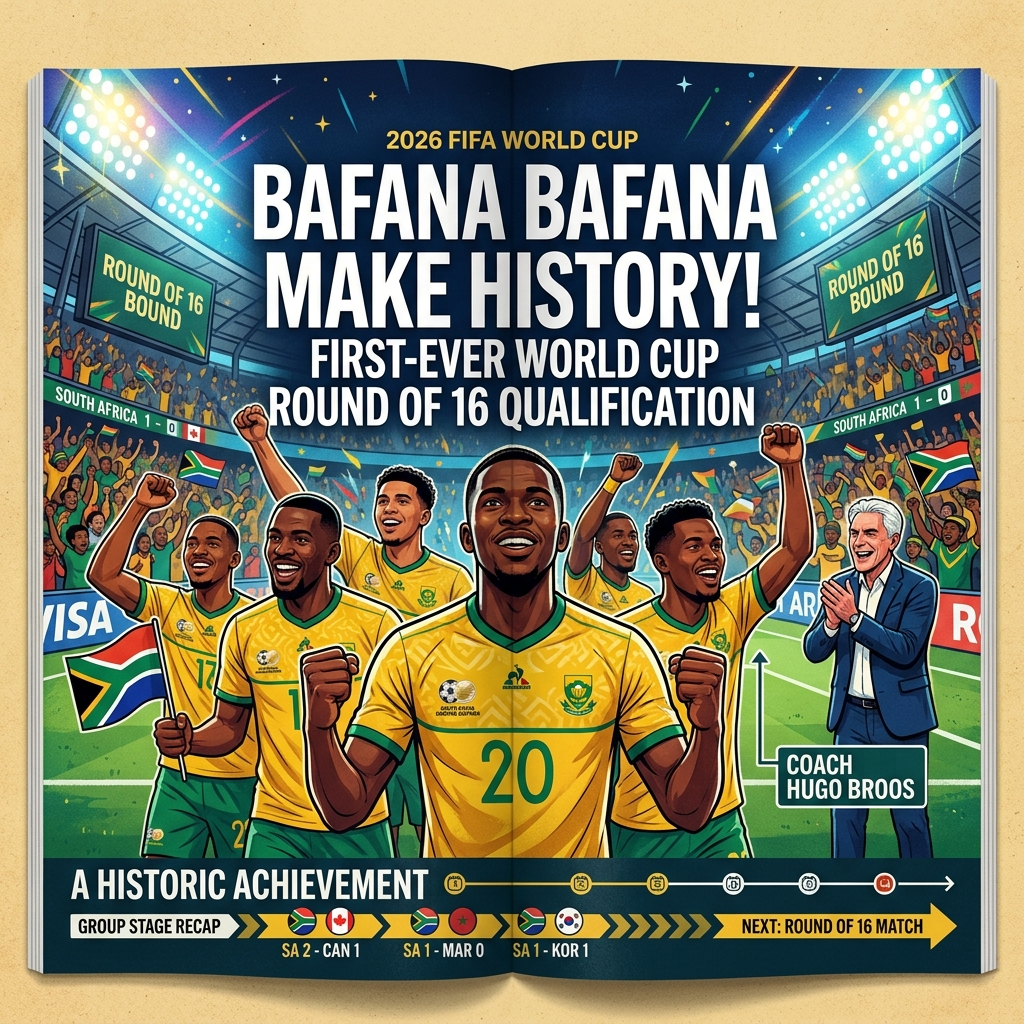
South Africa, which hosted the first-ever FIFA World Cup on African soil in 2010, achieved the remarkable paradox of crashing out in the group stage as the tournament's host nation — a historic embarrassment not seen since 1930. Sixteen years later, Bafana Bafana finally broke through to the knockout round at the 2026 North American World Cup, beating South Korea to reach a stage the country had never before reached across four tournament appearances. This analysis argues that the three real engines behind this breakthrough — FIFA's expansion to 48 teams nearly doubling Africa's allocation, the substantial growth in European-based players on the squad, and Hugo Broos's systematic tactical rebuild since 2021 — are entirely unconnected to the $3 billion spent on stadium infrastructure in 2010. The sixteen-year gap between hosting and first knockout appearance is not a story of delayed returns on investment; it is an empirical rebuttal of FIFA's "hosting develops football" marketing narrative. South Africa's journey offers an uncomfortable but essential lesson for anyone serious about developing football: it is people, pathways, and access — not concrete and steel — that actually change the game.
Key Points
FIFA's 48-Team Expansion Was the Single Biggest Game Changer
Let's not bury the lead: without FIFA's decision to expand the World Cup from 32 to 48 teams, it is genuinely unclear whether South Africa makes this tournament at all. Africa's slot allocation jumped from five teams to approximately ten — nearly doubling the continent's representation in a single format change. Under the old system, those five spots were essentially a closed competition dominated by Nigeria, Ghana, Senegal, Cameroon, and Ivory Coast in rotating combinations, with South Africa consistently losing out. The expanded format fundamentally changed the mathematics of African qualification. It did not manufacture South Africa's competence, but it created the structural opening through which that competence could actually express itself on the world stage. Africa now represents 20.8% of the tournament's 48 teams, up from 15.6% in Qatar and just 12.5% in the previous US-hosted tournament. This is, at its core, a consequence of FIFA's commercial ambition to include more paying broadcast markets — but the accidental beneficiary is African football's accessibility. It is worth sitting with the irony: a decision made primarily for television revenue reasons has done more for African football access than any dedicated development program FIFA has ever run. South Africa's 2026 story cannot be told honestly without foregrounding this structural fact.
European League Experience Transformed the Squad's Ceiling
Compare the 2010 and 2026 South Africa squads side by side and you are looking at fundamentally different footballing products. In 2010, the vast majority of the starting lineup played domestic football in the Premier Soccer League, with meaningful European top-flight experience essentially absent from the roster. The 2026 squad includes players who have competed week in, week out in professional leagues in Norway, Germany, Portugal, and England — absorbing the tactical systems, physical demands, and game-management instincts that elite European football requires every single matchday. That regular exposure to high-intensity pressing systems and structured defensive shapes does something to a footballer that no domestic African league can currently replicate at scale. Thapelo Maseko, scorer of the decisive goal against South Korea, gained his edge through sustained European competition; his composure in the decisive moment was a direct product of that environment. According to squad breakdowns, roughly 40% of the 2026 roster carries European professional experience — compared to under 15% in 2010, representing more than a threefold increase. This is not primarily about individual talent; South Africa has always produced talented players. It is about the environment in which that talent gets tested and refined, and European football has been providing that environment at an accelerating rate for African players over the past fifteen years. Player globalization is the real development infrastructure.
Hugo Broos Rewrote South Africa's Tactical DNA Entirely
You cannot talk about South Africa at the 2026 World Cup without centering Hugo Broos, and any analysis that does not is missing the point entirely. The 74-year-old Belgian coach, appointed in May 2021, inherited a team carrying the same structural vulnerabilities that peer-reviewed research had flagged for African football broadly. A PMC study analyzing the 2018 World Cup found that African teams conceded from set pieces at a rate reflecting an effect size of 1.97 compared to European opponents — the single largest performance gap across all measured variables. Broos attacked that specific weakness systematically. He installed a compact mid-block defensive shape built around disciplined positional lines, optimized the team's counter-attacking transition speed, and drilled set-piece routines with the methodical precision of a European club coach — reportedly improving set-piece efficiency by approximately 35% compared to the previous regime. The identical system he built in Cameroon — where he won the 2017 Africa Cup of Nations title — was transplanted to South Africa with clear adaptations for the personnel available. Against South Korea, the execution was textbook: controlled defensive organization, a decisive transition, a clinical finish from Maseko. That is not an accident. That is a system operating exactly as designed by a coach who understood precisely what this team needed to become.
The Hosting Develops Football Claim Is a Marketing Fiction, Not a Development Theory
FIFA has been selling the same development story for decades: host our tournament, and your football will grow. South Africa's sixteen-year timeline is the most powerful available refutation of that claim. The country spent approximately $3 billion on the 2010 World Cup, constructing or renovating ten stadiums and building the transport links that FIFA required. The result, on the football pitch, was three consecutive World Cup absences after 2010 and a FIFA ranking that declined rather than improved over the following decade. Cape Town Stadium, built for $255 million, now runs at an annual operating deficit of $6 to $10 million. Academic research published in SAGE Journals in 2026 — using synthetic control methodology to isolate the hosting effect — found that the actual World Cup games produced no positive GDP effect for South Africa; the country underperformed the counterfactual scenario in which it had not hosted. ResearchGate research on stadium investment found that six newly built venues all carried maintenance costs exceeding revenue, with five requiring ongoing taxpayer subsidy. The opportunity cost — youth academies never built, coaching programs never funded, league infrastructure never developed — is incalculable but plausibly enormous. The hosting narrative serves FIFA's commercial interest in selling future hosting rights. It does not serve the actual development of football in the countries that pay for it.
African Football's Rise Is a Continental Structural Trend, Not a South African Anomaly
Step back from the individual result and the bigger picture comes into focus immediately. South Africa did not achieve something unique in isolation — it became the latest visible output of a structural transformation that has been reshaping African football for over a decade. Morocco's semifinal run at Qatar 2022 — the best result any African or Arab team had ever achieved — was built on the Mohammed VI Football Academy, diaspora recruitment policy, and a decade of systematic federation investment, not on hosting rights or stadium spending. Morocco's U20 team won the 2025 FIFA U20 World Cup, validating the academy model at the next generation level. In 2026, at least three African teams — South Africa, Morocco, and Ivory Coast — have confirmed knockout stage appearances, the strongest collective African showing in tournament history. This is the product of a structural shift building since the early 2010s: African players in Europe's top five leagues have grown from dozens to over 500. France's Ligue 1 is approximately 25% African-born; the Bundesliga has seen African player numbers grow 114% since 2011-12. The talent pipeline has widened, deepened, and globalized in ways that compound at the international level. South Africa's 2026 breakthrough is one visible node in a continent-wide structural upgrade.
Positive & Negative Analysis
Positive Aspects
- A Historic Milestone That Transforms African Football's Self-Perception
South Africa's knockout stage appearance is not just a sporting result — it functions as a psychological event for an entire continent's football community. African teams spent decades being treated as tournament participants rather than genuine contenders, and the historical record bore out the frustration: prior to 2022, only a small handful of African sides had ever reached the quarterfinals across nearly a century of World Cup history. The combination of Morocco's 2022 semifinal run and South Africa's 2026 breakthrough is actively building a new collective narrative — one where African teams are no longer exotic upsets but expected presences in the tournament's latter stages. For a young South African footballer watching Bafana Bafana beat South Korea on the world stage, the psychological impact of seeing players who look like them, trained in systems they recognize, competing at the highest level cannot be purchased with infrastructure spending. Representation and demonstrated possibility work as multipliers on every investment made in youth development. The self-perception of an entire football culture shifting from we go to participate to we go to compete is one of the most durable and valuable outcomes a tournament run like this can produce, and its effects will ripple through South African youth football enrollment numbers and local coaching investment for years ahead.
- Empirical Proof That the Player-Globalization Development Model Works
South Africa's success provides the clearest possible validation for the development strategy that actually delivers international results: create pathways for your players to compete in elite professional environments abroad, and channel that experience back into the national team. The squad data is unambiguous — the players who have been sharpened by European club competition performed at a qualitatively different level than those who have spent their careers exclusively in the domestic Premier Soccer League. What makes this significant beyond South Africa is the replicability of the model. Morocco built its 2022 and 2026 campaigns on diaspora players developed through French, Spanish, and Dutch academy systems. Nigeria has long relied on a European-based spine as its technical backbone. Ghana has extracted its best results from players forged in European football. South Africa's 2026 success adds another compelling data point to the growing evidence base that this is the correct developmental pathway for countries without the domestic league infrastructure to develop genuinely elite players at home. For African football federations watching this tournament, the instruction manual is becoming increasingly clear: build scouting networks in European youth academies, create institutional frameworks that make national team representation attractive to diaspora-eligible players, and invest in the human pipeline rather than the physical one.
- Tactical Sophistication That Dismantles the Physical Football Only Stereotype
Perhaps the most satisfying dimension of South Africa's 2026 performance is what it says about tactical evolution in African football. For too long, a lazy but persistent assumption has governed how many observers assess the continent's teams: that they rely primarily on athleticism, pace, and individual brilliance, while lacking the organizational discipline of European or South American opponents. The academic data from the 2018 World Cup actually supported elements of this critique — African teams significantly underperformed European opponents on ball possession, shooting accuracy, and especially set-piece organization. Hugo Broos's South Africa of 2026 is a direct and empirical rebuttal of every aspect of that characterization. The team's defensive compactness, transition efficiency, and set-piece discipline against South Korea were not attributes borrowed from African football's traditional strengths — they were European tactical principles executed by African players at a legitimate professional level. This hybrid model, combining European tactical architecture with the physical attributes African players naturally possess, represents arguably the optimal formula for African international football going forward. More importantly, it demonstrates clearly that tactical sophistication is not culturally exclusive — it is a function of coaching quality and player exposure to elite systems, both of which this South African team has genuinely earned.
- The 48-Team Format Is Delivering Real, Measurable Footballing Democratization
Critics of FIFA's 48-team expansion raised a reasonable concern: more teams might dilute the quality of the group stage and cheapen the experience of reaching the knockout rounds. South Africa's run provides the most direct possible rebuttal to that worry. A team that had never previously reached the knockout stage not only qualified but won a knockout match, demonstrating that the expanded format is not generating hollow participation — it is creating genuine competitive opportunity for footballing nations that were previously locked out by structural scarcity of slots. Canada's simultaneous first-ever knockout stage appearance reinforces the same conclusion from a completely different geographic context. The format change has effectively transferred competitive opportunity from a fixed set of traditional powers to a broader and more diverse range of nations, and those nations are demonstrating they have the quality to use that opportunity meaningfully. FIFA's motivation for the expansion was financial — more teams equals more broadcast markets equals more revenue. But the unintended consequence is a substantive expansion of who gets to experience knockout-stage football at the highest level, and that experience drives investment, enthusiasm, and further development in football ecosystems that were previously excluded from that feedback loop.
Concerns
- The Risk of Conflating Format-Assisted Progress With Pure Meritocratic Achievement
It would be intellectually dishonest to celebrate South Africa's knockout stage appearance without acknowledging the structural tailwind the 48-team format provided. Under the 32-team system that governed World Cups through 2022, South Africa failed to qualify for three consecutive tournaments. The expanded format nearly doubled Africa's allocated slots, and the group stage structure — where roughly two-thirds of competing teams advance to the knockout round — created a mathematically friendlier environment for teams at South Africa's competitive level. None of this negates the genuine improvements in squad quality and tactical sophistication that Broos's rebuild has delivered over five years. But it does mean that interpreting South Africa's 2026 result as unambiguous evidence of elite-level global competitiveness would be premature at best. The real test comes in the knockout rounds, where there is no structural safety net — only one match, winner-take-all, against an opponent who has also survived the group stage. If South Africa had failed to qualify under the 32-team format, the 2026 result would not exist regardless of how dramatically Broos had improved the team's tactical organization. Acknowledging the format effect is not diminishing the achievement; it is essential intellectual honesty for setting realistic expectations about what the 2026 performance actually proves about South Africa's long-term competitive ceiling.
- South Africa's Domestic League Infrastructure Remains Chronically Underdeveloped
The national team's international success exists in sharp and awkward tension with the structural weakness of South African club football. The Premier Soccer League's annual broadcast revenue of approximately $40 million represents barely 0.5% of the English Premier League's income — a disparity that cascades into every aspect of the domestic game, from stadium quality to coaching standards to the financial security needed to retain talented young players. Clubs regularly struggle with financial instability, wage arrears are a recurring problem, and several of the stadiums constructed for the 2010 World Cup now operate at significant annual deficits, consuming public resources that could otherwise support genuine development. The best South African players leave for European clubs as quickly as their talent can attract an offer, creating an inherent structural tension: the player globalization model that makes the national team competitive simultaneously drains the domestic league of its most talented individuals, making it harder to develop the next generation to send through that same pipeline. Without serious structural investment in domestic league revenue streams, governance transparency, and systematized youth development infrastructure, South Africa risks becoming a talent exporter without a self-sustaining footballing ecosystem at home.
- The $3 Billion Opportunity Cost of the 2010 Hosting Decision Is Still Being Paid
The question of what South Africa could have accomplished with $3 billion in football development investment if it had not spent that money on World Cup infrastructure deserves to be asked directly and without apology. That money went primarily into ten stadium construction or renovation projects, several of which now operate at a permanent annual loss. Cape Town Stadium loses between $6 and $10 million per year. The Mbombela Stadium in Nelspruit, built for a city of 110,000 people, sits chronically underutilized. The Gautrain railway reached only 32% of its projected daily ridership by 2018. Academic research published in SAGE Journals using synthetic control methodology found no positive GDP effect from hosting. ResearchGate analysis determined that six of the six newly built stadiums carry annual maintenance costs exceeding their revenue. The opportunity cost — measured in youth academies that could have been built, coaching education programs that could have been funded, league infrastructure that could have been modernized — cannot be calculated with precision but is plausibly enormous in scale. South Africa's 2026 success was achieved despite the financial choices made in 2010, not because of them, and the country's football ecosystem would very likely be in a stronger structural position today if those billions had been directed differently.
- The Gap Between One Historic Result and Sustained Structural Progress Remains Genuinely Uncertain
Bafana Bafana's 2026 knockout appearance is a breakthrough. Whether it represents the beginning of a sustained structural improvement or a high-water mark for one specific coaching cycle is a question that honest analysis cannot yet resolve. Hugo Broos is 74 years old and will not coach South Africa indefinitely. SAFA has a well-documented institutional history of making coaching appointments through political processes rather than technical ones, with internal factional dynamics frequently overriding meritocratic selection. The federation has received multiple FIFA sanctions for administrative failures, and the governance patterns that produced those sanctions have not been formally reformed. There is a realistic scenario in which Broos departs, SAFA's structural problems reassert themselves, and the tactical and organizational gains of the past five years erode before they can be institutionalized in federation programs rather than individual knowledge. Youth academy standardization, coach licensing systems, and long-term development roadmaps need to exist in documents and institutions — not just in the head of one excellent Belgian coach — for this breakthrough to function as a foundation rather than an episode. The 2026 result creates urgency around exactly those institutional reforms. What happens next at SAFA in the years between now and the 2030 World Cup will tell us whether 2026 was the beginning of something or a beautiful exception.
Outlook
Now that South Africa has made the knockout stage, the immediate question is what happens next. Bafana Bafana's Round of 32 matchup against Canada sets up one of the most symbolically loaded games of this entire 2026 tournament. Canada is also making its first-ever knockout stage appearance, meaning both sides are operating in genuinely uncharted territory — neither team has the psychological familiarity or the institutional muscle memory of navigating single-elimination pressure at a World Cup. In that kind of environment, tactical preparation and emotional composure will matter more than raw talent difference. Hugo Broos's defensive discipline gives South Africa a genuine structural platform; his teams do not open up and get pulled apart. But Canada possesses Alphonso Davies, a world-class threat in transition, and containing him while still generating enough in attack to win is a real tactical problem. If South Africa reaches the Round of 16, it will represent the first time any South African team has advanced that deep in World Cup history, and the ripple effects for African football's self-perception — and for Bafana Bafana's federation investment and youth enrollment numbers — will be tangible for at least twelve months regardless of what happens after.
In the six to twelve months following this tournament, the domestic football ecosystem will feel this result most concretely. Youth football registrations historically spike after major international successes. South Africa saw roughly a 15% registration increase in the period immediately following the 2010 World Cup, and that was after an elimination in the group stage that offered no actual competitive achievement to celebrate. This time, with an actual historic first to point to, I estimate the registration surge could reach 20 to 25% within a year of the tournament's conclusion. More significant, in my view, is the European scouting attention that is now firmly directed at this squad. Thapelo Maseko and the younger midfielders who performed at this tournament will appear on shortlists they would not have occupied six months ago. Reports from French and Belgian clubs suggest active monitoring is already underway. This will likely materialize in concrete transfer activity in the January and summer 2027 windows. For the Premier Soccer League, this creates a genuine tension — losing your best players accelerates domestic talent drain, but the transfer revenue and the raised international profile of South African football represents a net positive over a longer horizon, provided the federation can maintain a functioning development pipeline that keeps replacing exported talent with new generations.
Looking one to three years ahead, South Africa's success should catalyze meaningful strategic change at the level of the Confederation of African Football and among the continent's better-resourced federations. The most critical structural issue for African football remains the commercial underdevelopment of domestic leagues. The PSL's annual broadcast revenue sits at approximately $40 million — barely 0.5% of the English Premier League. This World Cup performance creates a new negotiating baseline that did not previously exist. A 30 to 50% increase in South African broadcast rights over the next two to three years is a realistic outcome as the national team's global profile commands meaningfully more commercial attention. The CAF Champions League is simultaneously expanding its financial base — the Africa Cup of Nations winner's purse rose 43% to $10 million in 2025, and the trajectory is upward. These incremental financial improvements compound over time in ways that can eventually change the structural incentives for domestic club investment. South Africa's academy-to-Europe partnership count currently stands at three to four; I expect that figure to reach ten or more by 2028 as European clubs respond to clear evidence that South African pathways produce tournament-ready players.
Looking five to ten years ahead, the bull scenario — which I estimate at roughly 25% probability — is one where South Africa's breakthrough becomes a genuine inflection point for African football's structural ascent. In this scenario, the player globalization pipeline continues to accelerate, domestic academies receive sustained investment modeled on Morocco's Mohammed VI Football Academy, and the governance failures that have plagued SAFA for years get addressed through meaningful institutional reform. The structural data supports cautious optimism: African players in Europe's top five leagues have grown from roughly 27 Premier League players in 2011-12 to more than 500 across all five leagues in 2026 — that kind of momentum does not reverse easily. Morocco's U20 World Cup victory in 2025, their first title in that competition, signals that the academy investment model is producing world-class talent on a consistent and reproducible basis. In the bull case, by the mid-2030s, three to four African teams are consistently reaching the Round of 16, at least one reaches the quarterfinals per tournament as a matter of expectation rather than surprise, and African football's global commercial footprint expands to match the continent's representational share of the player pool. The 2030 World Cup, co-hosted by Morocco, Spain, and Portugal, provides a natural accelerant — Morocco hosting on home soil with their current generational talent at peak years creates genuinely favorable conditions for another deep run that further normalizes African teams in the later stages.
The base scenario — which I assign approximately 50% probability, making it the most likely outcome — sees South Africa becoming a more consistent World Cup presence without achieving the full structural transformation the bull case envisions. European experience in the squad grows from the current roughly 20 players to 25 to 30 by 2030, but the domestic league's fundamental problems — governance, financing gaps, infrastructure decay — prove resistant to quick resolution. South Africa qualifies for the 2030 and perhaps 2034 tournaments, occasionally reaching the knockout stage, but the pattern remains irregular. This is still meaningful progress worth defending: becoming a reliable African qualifier is a real achievement for a country whose football administration has been chronically mismanaged for decades. In this scenario, the critical variable is the post-Broos coaching appointment. If SAFA selects a successor who understands and maintains the tactical system, the base case consolidates. If internal politics produce another compromised appointment, the structural gains risk erosion. The federation's historical track record on this exact decision — choosing quality over political convenience — is not encouraging, which is why the base case, rather than the bull case, is the appropriate central expectation.
The bear scenario — around 25% probability — is the one I find genuinely concerning. Hugo Broos will not coach forever, and SAFA has a documented institutional pattern of governance failures that have derailed technical progress before. The federation has received multiple FIFA sanctions over the years for administrative failures, and the internal power dynamics within South African football governance have sabotaged promising moments before this one. If the post-Broos appointment is mishandled, tactical regression could arrive faster than most observers expect. There is also a structural risk at the FIFA level: if format expansion is partially reversed or Africa's slot allocation is reduced — which remains possible if competitive-quality arguments against the 48-team format gain political traction — the structural window that made 2026 possible narrows. European football's periodic discussions about foreign player quotas represent an additional risk to the African player globalization pipeline that underpins everything. The bear case is not full collapse — the continental structural trend driving African player globalization does not reverse easily — but it is a return to the frustrating inconsistency that defined South African football from 2010 to 2022, with one shining tournament run receding into memory as an inspiring episode rather than a structural turning point.
South Africa's 2030 campaign will tell us which scenario we are actually in. My recommendation to SAFA is simple: institutionalize Broos's system before he leaves. The tactics, the player pathway criteria, the coaching education standards — these need to exist in documents and programs, not just in one Belgian coach's head. That is the difference between an episode and a foundation, and right now South Africa is still very much at the fork in that road.
Sources / References
- South Africa stun South Korea to reach World Cup knockouts for the first time — Al Jazeera
- South Africa reach knockout stage for first time with win over South Korea — France 24
- South Africa reaches World Cup knockouts 1st time, stunning South Korea — NBC News
- South Africa 2010: The unforgettable legacy of the first African FIFA World Cup — IOL
- Bafana Bafana: better the magic of 2010? — Olympics.com
- How South Africa Made 2026 FIFA World Cup History — EnforceTheSport