
Calling It an "Upset" Is Europe's Arrogance — Morocco Was Ranked 6th in the World
Summary
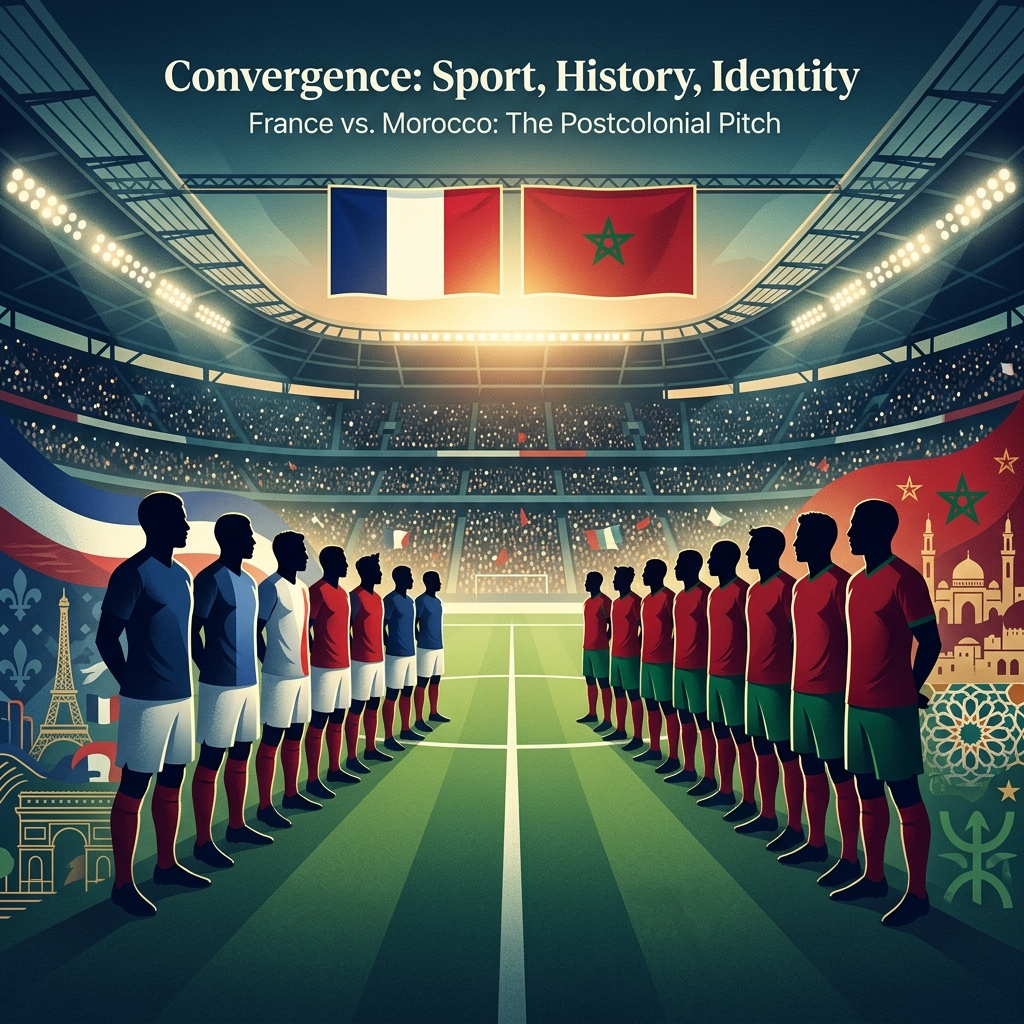
At the 2026 FIFA World Cup quarterfinal in Boston on July 9, France and Morocco will collide in a match that is far more than a soccer game — it is a 114-year colonial history being replayed on a pitch. The fact that 21 of France's 26-man squad (81%) carry African heritage exposes just how hollow the "Europe vs. Africa" framing really is. This tournament saw nine of Africa's ten teams advance through the group stage and into the Round of 32, a historic high-water mark for the continent, yet mainstream media still described FIFA-ranked No. 6 Morocco's victories as "upsets." Against a projected $8.9 billion in FIFA revenues, Africa's nine teams will take home a combined prize share of barely 1.3%, while UEFA holds 16 slots to CAF's 9 — a disparity that one peer-reviewed study calculated as a 2.42× overallocation to UEFA relative to on-field performance. The structural Eurocentrism operating off the pitch turns out to be at least as consequential as anything that happens on it, and this quarterfinal is where every one of those tensions will be concentrated into ninety minutes.
Key Points
The Word "Upset" Has Eurocentrism Built Into It
When Morocco defeated the Netherlands in the 2026 World Cup Round of 32 — winning 1-1 after extra time, then 3-2 on penalties — ESPN and FOX Sports immediately reached for the phrase "major upset." At that moment, Morocco was ranked No. 6 in the world (1,776.40 points) and the Netherlands was ranked No. 7. The higher-ranked team won, and it was called an upset. That is not a sporting observation; it is a structural prejudice masquerading as neutral commentary. A study published in SAGE Journals analyzed media coverage of Morocco at the 2022 World Cup and found evidence of what the researchers termed "colonialist practices" — established outlets struggling to find analytical frameworks for Morocco's success because none of their existing templates fit an African team winning at this level. The implicit assumption encoded in "upset" is that European teams winning is the default state of affairs, and any deviation from that is anomalous. Back in 2022, when Morocco (then ranked 22nd) beat 7th-ranked Spain and 7th-ranked Portugal, the 15-place gap offered at least a statistical excuse for the word. In 2026, even that excuse is gone. The day that "upset" stops appearing in headlines when an African team with a higher FIFA ranking defeats a European side is the day football's media language catches up with football's actual reality.
France's 21 African-Heritage Players Destroy the "Europe vs. Africa" Frame
The "France vs. Morocco equals Europe vs. Africa" narrative is not just imprecise — it is factually wrong, and the facts are specific. Of France's 26-man squad, 21 players (81%) carry African heritage: Mbappé (Cameroonian), Dembélé (Mauritanian, Senegalese, Malian), Olise (Nigerian, Algerian), Konaté (Malian), Barcola (Togolese), among others. According to OkayAfrica, England brought 15 African-heritage players to this tournament, the Netherlands 14, Switzerland 11 — but France's 81% is the highest proportion among all European sides. At the same time, 19 of Morocco's 26 players were born outside Morocco, many of them in France, Spain, or the Netherlands. Neither squad is "nationally pure" in any traditional sense of the term, which makes the simple Europe-Africa binary not just misleading but absurd. Al Jazeera put it precisely: minority-ethnicity players are embraced as "part of the nation" when they win, and treated as foreigners when they lose. The racist abuse directed at Black players after the Netherlands lost to Morocco in the Round of 32 illustrated that double standard with brutal clarity. What this match actually stages is not a clash of continents — it is the most visible possible demonstration of how postcolonial migration, diaspora identity, and national belonging collide in the 21st century.
Nine African Teams, Round of 32 — But the Prize Share Is 1.3%
The 2026 World Cup expanded to 48 teams, and CAF used its nine slots to produce a historic result: nine of Africa's ten teams cleared the group stage and reached the Round of 32. That has never happened before in any World Cup format. The further reality, though, is sobering. Of those nine teams, only Morocco (beating Netherlands on penalties) and Egypt (beating Australia on penalties) survived the Round of 32. Only Morocco reached the quarterfinal. Seven other African teams — Ivory Coast, South Africa, Algeria, DR Congo, Senegal, Ghana, and Cape Verde — were eliminated in the round of 32. The 48-team format gave Africa more seats at the table; it did not give Africa equivalent infrastructure, funding, or development systems to compete deep into the knockout rounds. Morocco's quarterfinal presence is substantially built on players developed by European club academies — Hakimi at PSG, Díaz at Real Madrid — not by domestic Moroccan football institutions. Against FIFA's projected $8.9 billion in total 2026 revenue, those nine African teams will collectively receive roughly $112.5 million in minimum prize money, representing 1.3% of the total. A Springer/Annals of Operations Research study found that UEFA's 16 slots represent a 2.42× overallocation relative to UEFA's proportional on-field performance. One team's extraordinary success should not be mistaken for the structural health of an entire continent's football ecosystem.
The 2022 VAR Shadow and What It Means in 2026
France's 2-0 semifinal win over Morocco at the 2022 Qatar World Cup left behind a controversy that has not been resolved in four years and will not be resolved tomorrow. In that match, Morocco was denied two clear penalty-kick situations without VAR review: a foul on Boufal in the 27th minute, and a suspected handball by Tchouaméni just before halftime. Former Egyptian FIFA referee Gamal El-Ghandour publicly analyzed both incidents and stated that both should have been penalties. Morocco's Royal Football Federation filed a formal protest with FIFA. The protest produced no change to the result and no disciplinary or procedural action was announced. When the same two nations now meet again in a quarterfinal — in a tournament generating $8.9 billion in revenue — the memory of those uncorrected calls hangs over the entire event for Moroccan fans and for anyone paying close attention to how officiating fairness functions in high-stakes football. I am not saying refereeing decisions are predetermined, but I am saying that the absence of transparency about how VAR is applied inconsistently across different matchups is a structural problem. If anything resembling those 2022 incidents occurs tomorrow, the reaction will not be contained. The FRMF set a precedent by filing a formal protest; that precedent makes future protests more likely, not less.
Hakimi's 15 Chance Creations: A Historical Benchmark No One Is Talking About
There is a statistical data point about this Morocco squad that has been almost entirely absent from English-language coverage, and it deserves serious attention. Achraf Hakimi has created 15 chances at this 2026 tournament — the most by any African defender in a single World Cup since 1966. When you add his 2022 performance, his two-tournament total reaches 21 chance creations. For context, Hakimi is a right-back. That kind of creative output from a defensive position would be remarkable for any player from any football tradition; from an African defender, it represents a level of technical and tactical sophistication that the "upset" framing categorically fails to account for. Brahim Díaz has added 6 goals and 4 assists since the 2025 AFCON, operating as the creative engine of Morocco's attack. Morocco's 19-game international winning streak from 2024 through 2026 is a world record, and it was built on a tactical system — organized deep defense combined with precisely timed counter-attacks — that has now defeated Spain (4-3 on penalties, 2022), Portugal (1-0, 2022), and the Netherlands (3-2 on penalties, 2026). That is three top-seven FIFA-ranked European nations eliminated in two tournaments by the same system. Calling any of those results an "upset" requires ignoring both the rankings and the evidence.
Positive & Negative Analysis
Positive Aspects
- Morocco's Run Is Building Irreversible Evidence for African Football
Morocco has now become the first African nation to reach back-to-back World Cup quarterfinals. Their 2022 run reached the semifinal — also an African first — and their 2026 run has at minimum equaled that round. Combined with a world-record 19-game international winning streak from 2024 through 2026 and the 2025 AFCON title, Morocco is not producing occasional results that can be rationalized away. They are building a consistent record. Every time a major outlet reaches for the word "upset" to describe Morocco beating a lower-ranked opponent, that word becomes slightly harder to use with a straight face. The accumulation of evidence has a compounding effect on perception, and perception eventually shapes policy — specifically, how FIFA and CAF approach slot allocation, prize money, and development funding for the continent. Morocco's success is also creating a psychologically significant precedent for the next generation of African footballers, who are watching and absorbing the message that competing at this level is not exceptional or unlikely, but achievable and repeatable. One generation's ceiling becomes the next generation's floor.
- The Postcolonial Dialogue Entering Mainstream Media Through Football
New Lines Magazine, Al Jazeera, SAGE Journals, and OkayAfrica are now publishing substantial analyses connecting Morocco's World Cup journey to colonial history, media bias, and structural inequality — and those pieces are being read by audiences that extend well beyond academic circles. The 1937 Casablanca "teacher vs. pupil" match, the colonial regulation mandating three European players per team, the 1912 Treaty of Fez — these are becoming accessible reference points for mainstream sports audiences because Morocco keeps winning and giving journalists a reason to write this history. The structural conversation that has been confined to postcolonial studies programs is gaining mass-media circulation, and that is a meaningful shift. Short-term, it increases pressure on FIFA and on sports broadcasters to examine their framing conventions. Long-term, it has the potential to change the baseline assumptions that shape how editors, commentators, and algorithm-driven platforms cover non-European football. Sport has always been a more effective vehicle for cultural reframing than formal policy debate, and Morocco is demonstrating that principle in real time at a tournament watched by five billion people.
- The 48-Team Format Is Giving Africa More Competitive Runway
The expanded 48-team format gave CAF nine slots instead of the previous five under the 32-team structure, effectively doubling Africa's World Cup participation. The direct result in 2026: nine of ten African teams cleared the group stage. That means nine squads accumulated the competitive experience of knockout-round football at the highest level — additional international games, additional exposure to top-tier opponents, additional development data for coaching staffs. Cape Verde, making their World Cup debut, reached the Round of 32. That kind of milestone generates domestic investment in football infrastructure, youth academies, and coaching development that would not have materialized without the qualifying slot. The 48-team format is not a perfect solution to structural inequality, and prize money distribution remains deeply skewed, but it is a real expansion of African football's competitive runway. Each additional World Cup game that an African squad plays at this level is a data point that cannot be argued with, an investment in experience that the continent's football development will draw on for years, and a piece of evidence that makes the "Africa isn't ready" argument progressively harder to sustain.
- Multi-Heritage Squads Are Forcing a Healthier National Identity Conversation
The specific composition of these two squads — France's 81% African-heritage roster and Morocco's 73% diaspora-born roster — is making a conversation about national identity unavoidable for the five billion people watching this tournament. That conversation is uncomfortable, and uncomfortable conversations are often the most productive ones. "Who is French?" and "Who is Moroccan?" are questions that nation-states have been trying to avoid answering honestly for decades, and this quarterfinal forces them into the open. The discomfort is not a side effect to be managed; it is evidence that football is performing one of sport's most important social functions — catalyzing public dialogue about who belongs and who gets to claim belonging. The implications extend beyond football into immigration policy, citizenship law, and anti-discrimination frameworks across Europe and North Africa. Sport has historically been one of the most effective accelerants of these conversations, and this match is a case study in that function operating at global scale.
- Morocco's On-Field Success Strengthens Its 2030 World Cup Hosting Bid
Morocco is actively pursuing co-hosting rights for the 2030 FIFA World Cup, and on-field success at consecutive tournaments provides the single most powerful argument available in FIFA's internal political deliberations. Hosting a World Cup delivers returns that compound across infrastructure investment, tourism revenue, national brand projection, and long-term sports development — all of which Morocco is now positioned to make credible claims about. A quarterfinal or semifinal appearance in 2026, following the 2022 semifinal, demonstrates that Morocco can generate the kind of compelling football narrative that fills stadiums and maximizes broadcast revenue. From FIFA's perspective, a successful 2030 tournament on African soil would be the organization's most significant step toward genuine global inclusivity since South Africa 2010. Morocco's footballing credibility makes that argument easier to fund and harder to oppose.
Concerns
- FIFA's Revenue Structure Actively Constrains African Football Development
The math here is not ambiguous. FIFA projects $8.9 billion in 2026 World Cup revenue, a record. Nine African teams' combined minimum prize money amounts to roughly $112.5 million — 1.3% of total projected revenue. UEFA's sixteen teams are guaranteed minimum prize payouts exceeding $200 million. Per-team prize-share disparity is real even after accounting for the slot-count difference. The Springer/Annals of Operations Research study's finding that UEFA receives 2.42 times its proportional allocation is not a marginal critique — it is a peer-reviewed quantitative conclusion about a system's fundamental unfairness. When African football federations receive 1.3% of a $8.9 billion ecosystem, their capacity to build domestic leagues, youth academies, coaching infrastructure, and medical support systems is structurally limited in ways that European federations — flush with Champions League and domestic broadcast revenue on top of World Cup prize money — simply do not face. FIFA's 2016-to-present $1.1 billion African development investment works out to roughly $110 million per year: meaningful in isolation, but representing just 1.24% of a single tournament's projected revenue. The structural gap between what Africa contributes to global football's commercial value and what Africa receives from that value is not a minor inefficiency. It is the central reason why Morocco reaching a quarterfinal remains extraordinary while European teams reaching quarterfinals is expected.
- Morocco's Individual Success Can Become FIFA's Alibi for Avoiding Reform
There is a genuine risk that Morocco's consistent excellence becomes the argument FIFA reaches for to deflect calls for structural change. "Look," the logic goes, "an African team is in the quarterfinal. The system is working." But nine African teams reaching the Round of 32, with seven eliminated there, and only one reaching the quarterfinal, does not demonstrate a working system — it demonstrates a system where occasional individual excellence can break through despite structural disadvantage. Morocco's success model is built substantially on players developed at Real Madrid, PSG, and other European megaclubs, not at Moroccan domestic academies. That model is not scalable to the CAF's other 53 member associations. Ivory Coast, Senegal, Egypt, and others have real talent pools, but they lack the combination of European club development and coherent national coaching systems that Morocco has built over a decade. The danger is that FIFA cites Morocco as proof that the current slot-and-revenue structure is fair, avoids the fundamental reform that the Springer study's data calls for, and leaves the rest of Africa's football development locked in its current underfunded state for another generation. One flower does not make a spring, and one team's quarterfinal does not prove continental equity.
- European Club Dependency Is Preventing African League Development
Morocco's starting lineup at this tournament reads like a Who's Who of European football: Hakimi at Paris Saint-Germain, Díaz at Real Madrid, Ziyech a Chelsea alumnus. The transfer fees and wages generated by these players flow directly into European club finances. The Moroccan domestic league — the Botola Pro — captures almost none of that economic value. This is not unique to Morocco; it describes the structural position of virtually every African football federation. European clubs scout African talent young, develop it within their own academies, and reap both the sporting and commercial rewards. African leagues are left functioning as raw-material suppliers. The stronger Morocco's national team performs, paradoxically, the more visible and attractive their players become to European clubs, which deepens the dependency rather than resolving it. For African domestic football to reach commercial and competitive self-sufficiency, it needs both revenue redistribution from FIFA and deliberate investment in league infrastructure — not just occasional international success by players who were developed elsewhere. The current dynamic is one in which African football contributes enormously to the global game's talent supply while retaining almost none of the economic surplus that talent generates.
- Media Bias Is Academically Documented but Practically Unchanged
The SAGE Journals study confirmed what many observers had long argued: media coverage of Morocco at the 2022 World Cup exhibited colonialist framing patterns. The Danish broadcaster incident — comparing a Morocco player's embrace with his mother to footage of a monkey — was the extreme end of a documented bias spectrum, not an isolated aberration. Four years later, in 2026, Morocco defeated a lower-ranked Netherlands team and was still described as pulling off a "major upset" by major outlets. The academic documentation of the problem has not translated into substantive changes in editorial decision-making at the major networks and platforms that shape global football perception. The reason is structural: the editorial decision-making pipelines at ESPN, FOX, Sky Sports, and the major European broadcasters are still predominantly staffed and led by people for whom the European football frame is the default. Changing that requires either significant demographic shifts in media leadership or strong institutional mandates for alternative framing — neither of which materializes quickly. Media bias operates at the level of instinct and cultural assumption, which means that peer-reviewed academic criticism, however well-founded, takes years or decades to percolate into actual editorial behavior.
- Refereeing Transparency Deficits Threaten the Tournament's Legitimacy
The VAR irregularities in France's 2022 semifinal win over Morocco are not just a historical grievance — they are a live variable in how tomorrow's match will be perceived. Morocco was denied two penalty-kick reviews. The FRMF filed a formal protest. FIFA took no corrective action and issued no transparency report on the VAR decisions in question. In a tournament projecting $8.9 billion in revenue, the absence of a clear, publicly accessible record of why VAR was or was not applied in specific high-stakes moments is a governance failure. The commercial incentives around high-profile matchups create at least the structural conditions for conflicts of interest in officiating, even if no individual referee acts in bad faith. When Moroccan fans and African football supporters cannot access a clear explanation of why specific VAR calls were or were not made in a semifinal, their suspicion that the system is not neutral is both understandable and functionally impossible to disprove. If comparable incidents occur tomorrow, the backlash will be larger, more organized, and better documented than in 2022 — and FIFA's credibility as a fair governing body will take a measurable hit that no amount of development investment messaging can quickly repair.
Outlook
Let me start with the short-term picture — tomorrow's game itself. On pure numbers, France is the heavy favorite. Opta's 25,000-simulation model gives France a 60.9% win probability, a 22.2% chance of a draw heading to extra time, and only a 16.9% chance for Morocco in regulation. Kalshi's prediction markets read almost identically: France 62%, draw 25%, Morocco 15%. The moneyline odds are even more direct — France at -175, Morocco at +500, draw at +290. For advancement, the market sits at France -410 versus Morocco +310. These numbers, stacked together, make France's passage look close to inevitable. I think it's worth stepping back from that assumption for a moment, though, because football does not always read Opta's spreadsheets.
France's attacking output at this tournament has been exceptional. Five games, 14 goals, 2.8 per match. Their expected goals (xG) reads 2.02 in attack and just 0.72 conceded — among the best attack-to-defense ratios in the field. Mbappé has 7 goals and 2 assists and now stands at 19 career World Cup goals, second all-time. Dembélé has contributed 4 goals, and Olise is generating chances at a frightening rate — 11 successful dribbles and 10 chance creations. France's head-to-head record against Morocco reads 6 wins, 2 draws, 0 losses across eight all-time meetings. The base-case scenario, with roughly 61% probability, is France winning by one or two goals in regulation, using their pace and positional dominance to limit Morocco's counter-attacking opportunities, and finding the decisive goal in the second half as Morocco's defensive intensity fades.
But write Morocco off at your peril. Achraf Hakimi has created 15 chances at this tournament alone — the most by any African defender since 1966. Add his 2022 output and the career total reaches 21 chance creations across two World Cups. Brahim Díaz has produced 6 goals and 4 assists since the 2025 AFCON, driving Morocco's creativity from the front. The 19-game international winning streak from 2024 through 2026 is a world record and it tells you something about this team's mental and tactical resilience that no simulation can fully capture. Morocco knocked out Spain on penalties (4-3) and Portugal (1-0) at the 2022 World Cup, and in 2026 they eliminated the Netherlands on penalties (3-2) in the Round of 32. That is three top-seven European nations dispatched in two tournaments using the same organized, counter-attack-based defensive system. The bull scenario — Morocco winning, roughly 17% probability — runs through Hakimi's chance-creation combining with Díaz's finishing to exploit France's high defensive line. A 1-0 win after a first-half goal, followed by ninety minutes of suffocating defensive organization, is exactly the template Morocco used against Portugal in 2022, and it remains entirely realistic.
The bear scenario — a draw into extra time and penalties, roughly 22% probability — is arguably the most intriguing outcome to think about. Morocco's defensive organization is capable of shutting France out. If France cannot break through in ninety minutes, the penalty shootout becomes Morocco's tournament. They have already won two shootouts at these two tournaments (Spain 2022, Netherlands 2026), and they have the psychological infrastructure for it. What makes this scenario unpredictable, though, is the unresolved variable of officiating. Morocco was denied two penalty-kick reviews by VAR against France in the 2022 semifinal. If anything resembling that happens again tomorrow, the match's legitimacy — regardless of the final score — will be contested for years. The FRMF's 2022 protest set a precedent, and the precedent matters in a tournament generating $8.9 billion in revenue: questions about whether the playing field is actually level will not be dismissed as sour grapes.
Looking six months to two years out, the structural stakes of this match extend well beyond the bracket. If Morocco advances to the semifinal, their leverage in the 2030 World Cup co-hosting negotiations increases dramatically. Morocco is already in discussions for a joint bid for the 2030 tournament, and consecutive deep runs in 2022 and 2026 would provide compelling proof-of-concept for their ability to host at the highest level. The CAF slot-expansion conversation — currently nine slots for CAF vs. sixteen for UEFA — will almost certainly reach the next FIFA Congress agenda. Nine African teams reaching the Round of 32 this tournament has already made "Africa isn't ready to compete at this level" an unsupportable argument. The only question is whether FIFA acts on the evidence or finds a way to preserve the structural status quo. If France wins the tournament, on the other hand, Mbappé's all-time scoring narrative will dominate every headline for months, and the story of Africa's structural football growth will once again be pushed to the margins.
Over the next two to five years, I believe FIFA's revenue distribution model will face a serious legitimacy crisis regardless of who wins tomorrow. The math is stark: $8.9 billion projected revenue, $112.5 million to nine African teams, 1.3%. FIFA announced it has invested $1.1 billion in African football since 2016 — that is roughly $110 million per year, or 1.24% of a single tournament's revenue. When a peer-reviewed academic study (Springer, Annals of Operations Research) concludes that UEFA receives 2.42 times its proportional share of slots, and the tournament generates fifty billion viewer-engagements globally, the legitimacy gap between what Africa contributes and what Africa receives becomes politically untenable. African football federations' dissatisfaction is already showing in slot-allocation discussions, and I think it will escalate toward a fundamental challenge to the revenue-sharing model itself — not just slot counts — within this time frame. The only thing that might delay that confrontation is FIFA offering a sweetened prize-money deal as a substitute for structural reform, which is the path of least resistance for the governing body.
The longer horizon — five to ten years out — leads to what I think will be the most consequential legacy of this specific match: the redefinition of what a "national team" even means. France's 81% African-heritage representation is not going to decline; if anything, it will increase as the next generation of French footballers matures. Across Europe, England, the Netherlands, Belgium, and Switzerland are all building their squads on African diaspora talent. Meanwhile, 19 of Morocco's 26 players were born outside Morocco — diaspora going the other direction. The concept of a "national team" as a representation of a single ethnicity or culture is already functionally obsolete, and this match makes that undeniable for five billion viewers at once. By the 2030 World Cup, I expect "which football system developed you" to matter more as a category than "which passport do you carry." When that shift completes, this Boston quarterfinal will be remembered as the moment the old framing became impossible to defend. That is a longer arc than any scoreboard can capture, but it is the arc that will matter most.
My forecast carries the risk of being wrong on specific mechanisms while being right on direction. If Morocco exits early, the 2030 bid stumbles, and African federations fail to act collectively, structural change could be pushed back another generation. FIFA is skilled at incremental concessions — a few extra prize-money millions here, a symbolic new development program there — that absorb pressure without changing the underlying architecture. But the 19-team Round-of-32 performance that Africa delivered in 2026 has already created irreversible evidence. "Africa isn't ready" is no longer a defensible statement. What I want every person watching tomorrow's game to do is this: watch the scoreboard, yes, but also watch the language used to describe what happens. The day the word "upset" disappears when an African team beats a European team with a lower FIFA ranking — that is the day football actually becomes a global sport.
Sources / References
- French protectorate in Morocco — Wikipedia
- How Morocco's World Cup Run Reignited a Debate on Soccer Colonialism — New Lines Magazine
- Nine out of ten African teams secure World Cup round of 32 berth — ESPN
- The allocation of FIFA World Cup slots based on the ranking of confederations — Springer/Annals of Operations Research
- France vs Morocco Prediction: World Cup 2026 Match Preview — Opta Analyst
- The World Cup is exposing the contradictions of national identity — Al Jazeera
- Exploring National Identity in World Sports: Media Portrayals of Morocco 2022 — SAGE Journals
- World Cup teams will be paid a record $871 million — Fortune
- Ounahi fires Morocco into historic second straight World Cup quarter-final — CAF Official
- 2022 Officiating Controversy Looms Over Morocco-France Quarter-Final — Morocco World News