
NCAA Women's Final Four Viewership Drops 64% — Was Women's Sports a Caitlin Clark Bubble, or Is It Still Evolving?
Summary
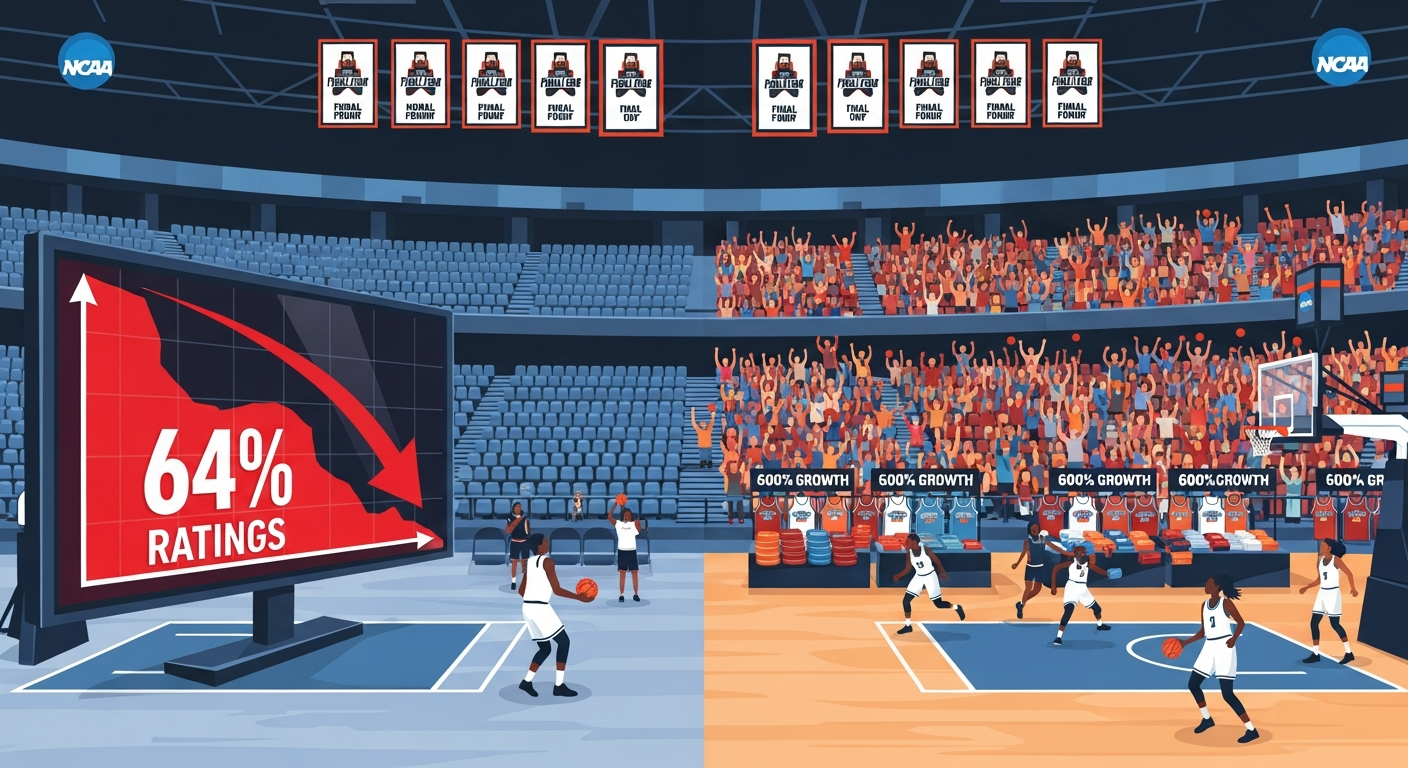
The NCAA Women's Final Four saw a 64% viewership decline from the previous year, reigniting the Caitlin Clark dependency debate — yet those numbers still rank as the third-highest in tournament history. The WNBA secured an 11-year, $2.2 billion media deal and introduced the first-ever revenue-sharing CBA in women's professional sports, signaling a structural inflection point. With total women's sports revenue surpassing $2.35 billion in 2025, judging the entire movement by a single TV ratings metric amounts to a double standard that no one applies to men's sports.
Key Points
The 64% Drop Is Misleading — The Baseline Was an Anomaly
The 2026 NCAA Women's Final Four averaged 3.9 million viewers, a 64% decline from the prior year's 10.8 million. However, this figure still ranks as the third-highest in Final Four history — and the all-time best when you exclude the two Caitlin Clark years of 2024 and 2025.
WNBA's $2.2 Billion Media Deal — Nobody Bets 11 Years on a Bubble
The WNBA's 11-year, $2.2 billion media deal with Disney, Amazon Prime Video, and NBCUniversal is 3.3 times larger than the previous contract.
The CBA Revolution — Women's Pro Sports' First Revenue Share
The 2026 WNBA CBA introduced the first comprehensive revenue-sharing model in the history of women's professional sports. The minimum salary quadrupled to $270,000.
The Double Standard in Men's Sports
Star dependency is a universal phenomenon across all professional sports, not something unique to women's leagues. Yet nobody labels men's baseball the Ohtani Bubble.
Growth Beyond Ratings — 46 Billion Minutes and a 430% Surge
Americans consumed 46 billion minutes of women's sports content in 2025 — an all-time record. Combined broadcast viewership hit approximately 370 million viewer-hours in 2024, a 430% increase from 2021.
Positive & Negative Analysis
Positive Aspects
- The $2.2 Billion Media Deal Guarantees 11 Years of Stability
The WNBA's Disney-Amazon-NBC deal delivers $200 million annually over 11 years, totaling $2.2 billion — a 3.3x increase from the previous contract.
- The CBA Revolution Simultaneously Elevates Player Welfare and League Competitiveness
The new salary structure — $270,000 minimum, $1.4 million maximum, $583,000 average — creates compelling financial incentive for elite players.
- Multi-Dimensional Growth Metrics Offset the Ratings Headline
46 billion minutes consumed in 2025, WNBA attendance up 25%, merchandise revenue surging 500%+, and TV viewing hours up 430% since 2021.
- Sponsorship and Private Equity Capital Are Flowing In Simultaneously
Sponsor spending on WNBA and NWSL reached $195 million in 2025, a 32.7% year-over-year increase.
- The Normalized Ratings Level Matches the All-Time Pre-Clark Peak
The 2026 Final Four's 3.9 million viewers represents the all-time best when you exclude the Clark era.
Concerns
- Star Dependency Remains a Real and Present Risk
One player's absence triggered a 64% ratings drop, exposing that women's basketball hasn't yet built league-level loyal viewership.
- A Potential Gap Between Media Deal Scale and Actual Viewership
The $2.2 billion media deal is fundamentally a bet on future viewership growth. If actual numbers don't meet projections, WNBA enters post-2036 renegotiations weakened.
- Franchise Valuation Overheating Is a Legitimate Concern
Some WNBA and NWSL franchise valuations have surged dramatically, but the gap between reported values and actual financial performance is real.
- Ratings Stagnation Could Slow Sponsorship Momentum
Sponsors ultimately pay for eyeballs. Persistent TV ratings stagnation gives conservative sponsors justification to trim budgets.
- The Paradox of Too-Fast Growth
NWSL expansion, new franchise launches, and PE capital inflows are all converging at once. If pace outruns fanbase development, some franchises risk financial distress.
Outlook
Women's sports stands at an inflection point comparable to the internet after the dot-com bubble. Short-term, the 2026 WNBA season becomes a massive live experiment as the first under the $2.2 billion media deal. Medium-term, the next-generation star pipeline and NWSL expansion are key variables. Long-term, McKinsey's $2.5 billion 2030 forecast appears achievable. Regardless of scenario, women's sports will never return to pre-Clark levels.
Sources / References
- Women's Final Four Delivers Nearly 4M Viewers, Still 64% Drop — Front Office Sports
- NCAA Women's Tourney Trails Past Two Years, Still on Higher End Historically — Sports Media Watch
- WNBA Secures Monumental Media Deal With Disney, Amazon, NBCU — ESPN
- What the 2026 WNBA CBA Means for the League, Players, and Salaries — ESPN
- WNBA Releases CBA Term Sheet With Salary Spike and Revenue Sharing — Sportico
- Women's Elite Sports Exceed Expectations as Revenues Projected to Surpass $2.3 Billion in 2025 — Deloitte
- Nielsen: 46 Billion Minutes of Women's Sports Were Consumed in 2025 — Nielsen
- Closing the Monetization Gap in Women's Sports: A $2.5 Billion Opportunity — McKinsey
- WNBA and WNBPA Reach Tentative Deal on Historic CBA — WNBA
- WNBA Delivers Record-Setting 2024 Season — WNBA
- Women in Sports Marketing Partnerships Across North America 2024-25 — SponsorUnited
- Investing in Sports: Women's Sports and the Future — Goldman Sachs