
Saudi Arabia Spent $5.3 Billion and Still Couldn't Buy a Golf League — The Real Reasons LIV Is Dying
Summary
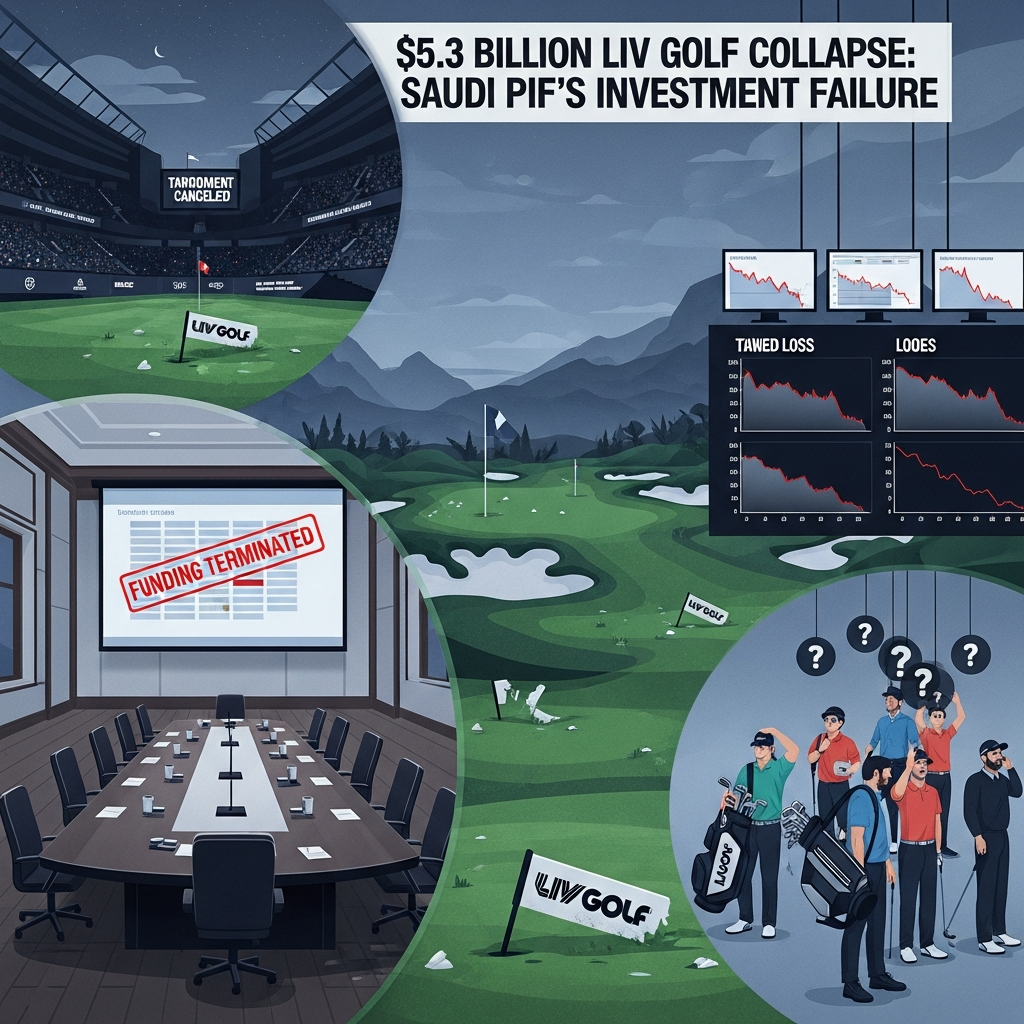
LIV Golf, launched in 2022 with $5.3 billion in backing from Saudi Arabia's Public Investment Fund, will have its financial support terminated after the 2026 season — ending the most expensive sportswashing experiment professional sports has ever seen. Cumulative annual operating losses, reaching $461.8 million in the UK entity alone in 2024, combined with viewership figures just one-eighth those of PGA Tour broadcasts, have systematically dismantled the premise that sovereign wealth can manufacture competitive legitimacy in an entrenched sport. PIF's 2026–2030 strategic pivot formally excludes sports from its six core domestic investment sectors, implicitly acknowledging that golf failed to deliver the geopolitical image rehabilitation Saudi leadership expected. The Iran-US war's blockade of the Strait of Hormuz and a projected $80–90 billion Saudi fiscal deficit in 2026 accelerated the timeline, though the structural failure predates the crisis. LIV Golf's irreversible legacy — an 82% surge in PGA Tour prize money at the 30th FedEx Cup slot, a $6.3 billion broadcast rights deal, and a revived DOJ antitrust investigation into PGA Tour's monopolistic practices — persists even as the league itself dies, and the risk that PGA Tour's restored dominance will erode those hard-won gains in player compensation now constitutes professional golf's defining challenge.
Key Points
Saudi Arabia's $5.3 Billion Investment and the LIV Golf Funding Cutoff
Saudi Arabia's Public Investment Fund has invested a total of $5.3 billion in LIV Golf since the league's 2022 launch, but funding will be discontinued after the 2026 season, according to reporting by Sportico and corroborating industry sources. LIV Golf's UK entity alone recorded cumulative operating losses exceeding $1.1 billion across three years — $243.7 million in 2022, $395.9 million in 2023, and $461.8 million in 2024 — with the US entity's figures remaining private but widely estimated to be substantially larger. CEO Scott O'Neill had previously assured stakeholders that funding was secured well into the 2030s, but subsequently revised that claim to "through the 2026 season only," a revision that functions as a tacit admission that the funding decision had already been finalized at the PIF board level. PIF's concurrent 2026–2030 strategic plan formally excludes sports from its six core domestic investment pillars, signaling that the reorientation is comprehensive rather than sport-specific or budget-driven alone. The simultaneous sale of 70% of Saudi soccer club Al-Hilal's equity to Kingdom Holding Company and the Iran war's fiscal pressures — including a Goldman Sachs estimate of $80 to $90 billion in Saudi fiscal deficit for 2026 — confirm that LIV Golf's funding termination is one element of a portfolio-wide restructuring, not an isolated decision about a single league.
LIV Golf's Viewership Failure — The Structural Inability to Build a Fan Base
The most decisive failure point in LIV Golf's four-year run was not its financial losses or its geopolitical controversy — it was its inability to attract and retain television audiences at any commercially viable scale. LIV Golf's 2025 Fox broadcast average of 338,000 viewers across 17 events compared catastrophically to PGA Tour's 2.66 million average across 26 final rounds during the same period, representing a gap of nearly eight to one that no amount of marketing investment could close. On cable channels FS1 and FS2, LIV's average fell to just 101,000 viewers — a number that makes sustainable advertising sales essentially impossible and signals structural market rejection rather than temporary audience unfamiliarity. The structural explanation runs deeper than scheduling or marketing: LIV signed player contracts but couldn't transfer the fan loyalty those players had accumulated on PGA Tour, which is built over years of world ranking implications, major championship drama, and cumulative narrative investment from dedicated viewers. The league's failure to obtain World Golf Ranking recognition meant its tournaments had no effect on players' major championship eligibility, stripping events of the stakes-based viewing motivation that drives sustained audience engagement and differentiating LIV events from meaningfully competitive golf in the eyes of the core fan base. LIV's Fox broadcast contract, estimated at approximately $150 million annually, was already one-fifth of PGA Tour's $700 million annual broadcast value — and even at that discounted rate, the viewership numbers made the deal a poor return for the network.
The PGA Tour Prize Money Revolution That LIV Golf Forced
Whatever else LIV Golf failed to accomplish, its single most concrete and lasting achievement was forcing a dramatic restructuring of PGA Tour player compensation that extended to every professional on tour, not just those who crossed to the rival league. In 2023 alone, PGA Tour injected an additional $153 million in player prize money — a sum that represented direct competitive response to LIV's financial offers, not organic tour growth driven by broadcast revenue increases. The FedEx Cup 30th-ranked player's annual earnings rose from $3.85 million to $7 million, an 82% increase that applies not just to the handful of players who defected but to every professional competing on the circuit. Players ranked 70th on the money list saw their earnings jump from $2.15 million to $3.5 million, a 62% increase driven entirely by competitive labor market pressure rather than any endogenous tour decision. PGA Tour's 9-year, $6.3 billion broadcast deal with CBS, NBC, and ESPN — representing a 75% increase over its prior contract and valued at $700 million annually — was negotiated from a position of demonstrably stronger leverage precisely because LIV had signed a competing Fox agreement that established golf broadcast content as a commercially competitive market. The 13 designated events on PGA Tour now offer individual purses of $25 million, up from $15 million, a change that directly traces to LIV's competitive existence and that will prove difficult to reverse even after the rival league dissolves.
LIV Players Trapped in Contractual Limbo — DeChambeau, Rahm, and the Path Forward
The most immediately consequential human cost of LIV Golf's dissolution falls on its player roster, many of whom find themselves in a position with no clean exit from the professional structure they entered in good faith when they signed LIV contracts. Bryson DeChambeau requested a $500 million contract extension from LIV and was declined, leaving him facing a 2026 contract expiration with PGA Tour reinstatement blocked under current rules because he missed the February 2025 reinstatement deadline. Jon Rahm, holding a reported $300 million contract with remaining time, faces the additional complication of a DP World Tour membership dispute that threatens his eligibility for the 2027 Ryder Cup and potentially his major championship qualification pathway. Cameron Smith faces structurally similar restrictions, and for all three players, any reinstatement pathway involves conditions that make Koepka's established precedent — $5 million in mandatory charitable donations plus five years of equity program revenue forfeiture — look like the floor rather than the ceiling of what PGA Tour will require. World Golf Ranking non-recognition during LIV participation means players' major championship qualification records are incomplete, compounding the competitive disadvantage they'll face upon return regardless of financial terms, and creating a reputational hole that takes seasons rather than months to climb out of.
Sportswashing's Return on Investment — The $510 Billion Experiment's Final Accounting
Saudi Arabia has deployed over $51 billion into sports assets since 2016, with LIV Golf's $5.3 billion representing the single largest and most strategically ambitious piece of that portfolio and one of the most expensive bets on soft power in the history of professional sports. The Council on Foreign Relations characterizes this investment explicitly as an attempt to use sports' global reach to manage international perception of Saudi Arabia's governance and human rights record, though CFR also acknowledges that empirical evidence on sportswashing's actual effectiveness remains limited and contested in the academic literature. A ResearchGate analysis classified PIF's sports strategy formally as a "loss leader" in economic terms — deliberately accepting financial losses in sport to generate benefits in unrelated domains, including political relationships, tourism attraction, and foreign direct investment incentives. What PIF's 2026–2030 strategic reorientation implies — by dropping sports entirely from its core investment framework — is that the loss leader didn't generate the expected cross-domain returns, and that the geopolitical and reputational ROI of LIV Golf specifically fell materially short of what the investment's scale demanded. The simultaneous disposal of the Al-Hilal majority stake and the broader sports portfolio review suggest the reassessment is comprehensive: the sportswashing model across all of Saudi Arabia's sports asset classes underperformed expectations, and the fiscal constraints created by the Iran war provided both the motivation and the political cover to exit the strategy cleanly.
Positive & Negative Analysis
Positive Aspects
- Revolutionary Structural Improvement in Player Compensation
LIV Golf's entry into the professional golf market produced the most significant across-the-board improvement in PGA Tour player compensation in the sport's modern history, delivering gains that extended well beyond the handful of players who actually defected to the rival league. PGA Tour committed an additional $153 million in player prize money in 2023 alone, driven directly by the need to retain players who were receiving unprecedented financial offers from LIV's recruitment operation, and that competitive pressure showed no signs of abating while the league remained operational. The 30th-ranked FedEx Cup player's annual earnings rose from $3.85 million to $7 million, an 82% increase that represents a structural shift in what professional golf pays its working-level competitors — the professionals who populate the bulk of the leaderboard at every tour event but rarely capture mainstream media attention. Players ranked 70th on the money list experienced a 62% income increase — from $2.15 million to $3.5 million — a gain that flows directly from the labor market competition LIV introduced rather than from any endogenous PGA Tour decision to improve player welfare. The economic principle at work is straightforward and well-established: competing employers in a labor market drive wages up for all workers, not just those who switch employers, and golf provided a real-time demonstration of that dynamic at a scale and speed that few sports had previously exhibited in such compressed timeframes. Even if PGA Tour eventually moderates prize money as competitive pressure recedes, the new baseline established during the LIV era is substantially higher than what independent PGA Tour evolution would have produced over the same timeframe, representing a durable structural gain for the entire professional golf ecosystem.
- Structural Increase in Golf's Broadcast Market Value
PGA Tour's 9-year, $6.3 billion television rights agreement with CBS, NBC, and ESPN — valued at approximately $700 million annually — represented a 75% increase over the preceding contract, and that increase would not have materialized at those terms without LIV Golf's competing Fox broadcast agreement establishing a market floor for premium golf content that networks had previously had no reason to price competitively. The fundamental leverage dynamic shifted when LIV signed with Fox: networks that had previously operated with PGA Tour as the only major golf content supplier suddenly faced a market where two competing entities were bidding for broadcast dollars and viewer attention, and that competition drove the price up sharply in a way that benefited the established institution even as the challenger struggled. Golf broadcast content's overall commercial value increased in measurable, durable ways — the $6.3 billion deal runs through 2032, locking in elevated royalties regardless of whether LIV survives its final season. The 13 designated PGA Tour events now carry individual purses of $25 million, up from $15 million, with broadcast partners factored into those premium structures as high-value inventory that commands proportionally higher advertising rates. This revaluation will likely serve as a reference point in future sports broadcast negotiations beyond golf, establishing a precedent that competitive market pressure — even from a rival league that ultimately fails — can substantially shift the commercial terms available to established sports properties in ways that persist long after the challenger exits. The revenue increase creates a funding base for expanded player support programs, venue improvements, and digital infrastructure development that will compound meaningful benefits across the remaining contract years.
- Geographic and Demographic Expansion of Golf's Market
LIV Golf staged events in Bangkok, Jeddah, Mexico City, and other markets that PGA Tour had systematically overlooked, physically extending professional golf's geographic footprint and establishing relationships with local audiences, sponsors, and media outlets in regions where PGA Tour had no meaningful presence or strategic investment. Global golf tourism is expanding at a 9.1% compound annual growth rate toward a projected market size of $41.8 billion by 2030, and LIV's aggressive international marketing contributed to the awareness foundation that supports that growth trajectory in emerging markets that traditional golf had never prioritized. US golf participation reached an all-time high of 47.2 million people in 2024, with the 18-to-34 demographic leading all age groups at 6.3 million course players — a generational shift that LIV's explicit focus on younger audiences and shorter formats actively encouraged through event structure and content strategy. LIV's team-based competition model, however imperfectly executed at the professional level, represented a genuine effort to make golf more legible and engaging for audiences unfamiliar with 72-hole stroke play and world ranking systems, and the lessons from that experiment — both its successes and its documented failures — provide useful data for future format innovation by any tour organization willing to study them. The golf equipment market is projected to grow from $8 billion in 2025 to $15.3 billion by 2035 at a 6.7% CAGR, with the demographic expansion LIV helped accelerate contributing to the demand growth underlying those projections and creating a larger commercial foundation for the sport's second decade of participant growth. PGA Tour's future international expansion, wherever it occurs, will benefit from the market intelligence and audience development groundwork LIV laid in non-traditional geographies.
- Catalyzing Long-Overdue Sports Governance Reform
LIV Golf's challenge to PGA Tour's dominant structure triggered a formal antitrust investigation by the US Department of Justice in 2022, launched specifically because LIV's complaints about PGA Tour's restrictive practices drew governmental attention to structural issues that had existed for decades without prompting scrutiny from any regulatory body. UC Cincinnati Law Review documented PGA Tour's practice of classifying players as independent contractors — a classification that exempts PGA Tour from certain labor obligations — while simultaneously controlling their media rights, restricting their outside competition access, and requiring prior approval for broadcast appearances, a combination of controls that raises legitimate Sherman Antitrust Act concerns that the legal academy had not previously examined in depth. The player labor rights conversation, which barely existed in golf discourse before LIV's arrival, is now an established and ongoing policy discussion that will continue influencing both the regulatory and the collective bargaining landscape regardless of whether LIV itself survives through the end of its final season. DOJ investigations, once formally opened, generate institutional records and precedents that shape future regulatory posture even when immediate enforcement actions don't materialize — meaning LIV's governance challenge has effects on the regulatory environment surrounding professional golf that extend well beyond the league's operational lifespan. The broader precedent that a credible external competitor can trigger governmental scrutiny of an established sports monopoly's labor practices has implications for professional sports governance beyond golf, potentially influencing how leagues in baseball, basketball, and other sports structure their player relationships and market controls when future competitive challenges emerge.
Concerns
- Career Disruption and Competitive Limbo for LIV Players
The most immediate and concrete harm from LIV Golf's collapse falls on its player roster, many of whom accepted enormous financial guarantees in exchange for defecting from tour structures that have now effectively locked them out of their natural professional homes with no obvious or affordable exit. Players who missed PGA Tour's February 2025 reinstatement deadline — including DeChambeau, Rahm, and Cameron Smith — are currently ineligible to return to PGA Tour under existing rules, and the terms under which case-by-case exceptions might be granted remain unclear, unpublished, and potentially designed to be prohibitive enough to deter most applications. Brooks Koepka's return precedent established that reinstatement requires a $5 million charitable contribution and forfeiture of five years of player equity program revenues — terms that function economically as a significant financial penalty rather than a neutral administrative reinstatement procedure, and which signal PGA Tour's institutional intent to make defection costly in retrospect for anyone seeking readmission. The World Golf Ranking non-recognition of LIV events means that players competing exclusively in LIV for three-plus years have accumulated no ranking points during that period, weakening their major championship eligibility positions and creating competitive disadvantages that will persist well into any reinstatement period regardless of the financial terms ultimately negotiated. For professional athletes whose prime competitive years are finite and cannot be recovered, two to three years of tournament competition in a structurally unrecognized league represents a genuine and permanent career cost that no financial compensation can fully offset — and some players may effectively face forced early retirement if reinstatement terms remain economically prohibitive.
- PGA Tour Monopoly Reassertion and Erosion of Player Labor Rights
The disappearance of LIV Golf as a competitive alternative to PGA Tour removes the primary market mechanism that constrained PGA Tour's ability to dictate terms to players, and historical precedent from analogous competitive dynamics in other professional sports provides little reason for optimism about how PGA Tour will exercise its restored monopoly position. The USFL's collapse in the mid-1980s was followed by measurable NFL salary suppression that reversed much of the compensation escalation the competing league had generated; the WHA's merger into the NHL in 1979 produced an immediately similar pattern in hockey compensation, confirming that the suppression dynamic is not league-specific but structural. I'm genuinely skeptical that the additional $153 million in annual prize money PGA Tour committed under competitive pressure in 2023 will survive intact through the 2027–2028 budget cycle, when the competitive justification for that expenditure no longer exists and cost reduction represents pure margin improvement. The three-events-per-year limit on outside tournament participation, the media appearance approval requirement, and the independent contractor classification that denies players collective bargaining protections all become harder to challenge or negotiate away once there is no alternative employer creating the labor market leverage that players used, however imperfectly, during the LIV era. DOJ's Sherman Act investigation remains open but has produced no enforcement action, and the USFL v. NFL damages award of $1 — tripled to $3 under the antitrust statute — establishes that legal recognition of monopoly behavior doesn't automatically produce market remedy in any commercially meaningful sense.
- Loss of Competitive Innovation Pressure in Professional Golf
LIV Golf, whatever its structural failures as a business, represented the only sustained external pressure on PGA Tour to experiment with tournament format, event geography, and viewer experience design — and the disappearance of that pressure creates genuine risk that professional golf's pace of innovation slows to the historical rate of established monopolies, which is, by definition, very slow. LIV's team-based competition framework, shotgun starts, 54-hole format, and events in Bangkok, Mexico City, and Jeddah were imperfect experiments, but they were genuine experiments whose outcomes — including the failures — generated data that PGA Tour now inherits without needing to run its own parallel tests or accept any of the financial and reputational risks involved. American golf participation currently sits at an all-time high of 47.2 million, with 18-to-34-year-olds representing the largest participating demographic at 6.3 million course players — a cohort whose engagement with the sport was partly shaped by LIV's deliberate appeal to younger audiences through shorter formats, team-narrative structures, and social media-native content strategies that PGA Tour had no organic incentive to develop. Fifty-one percent of Gen Z golfers cite mental health and self-care as primary motivations for playing the sport, suggesting their relationship with golf is meaningfully different from prior generations and that the format innovations LIV was attempting may have been directionally correct even if the execution was commercially flawed and the business model fundamentally unsustainable. The long-term risk is that PGA Tour, freed from competitive necessity, optimizes exclusively for its existing core audience of older, tradition-oriented viewers at the expense of the engagement innovations that could sustain the sport's generational growth and ensure it remains culturally relevant as the demographic composition of the player base continues to shift.
- Saudi PIF's Sports Exit and Global Sports Finance Destabilization
Saudi Arabia's strategic withdrawal from sports investment doesn't end with LIV Golf, and the cascading effects across the global sports economy could significantly exceed what the golf market specifically will absorb, given the scale and interconnectedness of PIF's broader sports asset portfolio. PIF's already-initiated sale of 70% of Al-Hilal's equity to Kingdom Holding Company is one early signal; the 2026–2030 strategy's formal exclusion of international sports investment from core priorities suggests that Newcastle United, premium boxing events, and UFC hosting contracts face similar sell-side pressure on potentially accelerated timelines driven by fiscal necessity rather than strategic choice. If PIF becomes a forced seller of sports assets under fiscal pressure from the Iran war's economic disruption, the market will price in the distress, and PIF will likely recover substantially less than its original cost basis across its sports portfolio — a financial loss that ultimately falls on Saudi citizens whose sovereign wealth fund made the original investment decisions. Sports leagues, events, and venues that expanded their financial and operational models based on expectations of continued Saudi investment may face funding shortfalls without adequate time or market alternatives to replace that capital on equivalent terms, creating second-order disruption in markets that had no direct relationship with LIV Golf itself. The broader systemic implication is that the "sovereign wealth fund as permanent sports patron" model — which Qatar, Abu Dhabi, and to a lesser extent Norway have also pursued with varying degrees of commitment — may be entering a secular retreat, and the global sports infrastructure partially built in anticipation of indefinite SWF support will need to find a structurally different and more commercially sustainable capital foundation.
Outlook
Short-term — the next six months — is both predictable and quietly chaotic. LIV Golf's 2026 season will proceed as scheduled, but everyone in the ecosystem knows it's the final lap. CEO Scott O'Neill's public confirmation that funding runs only through the season's end has turned this into a lame-duck operation while the games are still being played. Players will be negotiating their next contracts while simultaneously competing for LIV prize money, a genuinely surreal dynamic that has no clear parallel in recent sports history. My expectation is that PGA Tour reinstatement negotiations will accelerate sharply in the second half of 2026, likely picking up pace after the midseason point when the league's end becomes impossible to mentally bracket. PGA Tour CEO Jay Monahan's previous signals that reinstatement "pathways" are under review mean the private conversations are already well underway — "under review" in tour commissioner language typically means the deal framework exists and the fine print is being worked out.
The two players who will dominate the short-term narrative are DeChambeau and Rahm, and for very different reasons. DeChambeau has over 10 million social media followers, a brand that transcends any single tour structure, and enough content business infrastructure to operate independently of a traditional tour if reinstatement terms prove too punitive. He's genuinely one of a handful of athletes whose golf career doesn't require PGA Tour's blessing to remain viable. Rahm's situation is considerably more precarious — his unresolved DP World Tour membership dispute threatens not just PGA Tour reinstatement but eligibility for the Ryder Cup and potentially the major championships themselves. How these two cases resolve will set the precedent for the remaining 50-plus LIV players making analogous calculations. My rough projection: 60 to 70% of LIV's active roster secures some form of return pathway by end of 2026, while the remaining 30 to 40% faces multi-year competitive disruption. Fox Sports announced plans to expand LIV broadcast coverage by 30% for the final season — less a vote of confidence than a strategy to extract maximum advertising value from the swan song.
Looking at the medium-term window — six months to roughly two years out — the real story shifts to golf governance, and this is where I have genuine concern. PGA Tour faces a real fork in the road once the competitive threat disappears. One path maintains the elevated prize structure and player-friendly policies that LIV's competitive pressure forced into existence. The other treats the absence of competition as an opportunity to compress costs and reassert structural control. Historical precedent is unambiguous here. When the USFL collapsed in the mid-1980s, the NFL moved deliberately to contain the salary escalation that inter-league competition had produced. When the WHA merged into the NHL in 1979, the same suppression pattern appeared almost immediately. I'm genuinely skeptical that the additional $153 million in annual prize money PGA Tour committed in 2023 will survive intact through the 2027–2028 budget cycle. Once the board's threat model disappears, the financial justification for the elevated commitment follows it out the door.
The Department of Justice antitrust investigation represents the most important wildcard in the medium-term picture. Launched in 2022, the probe has generated no concrete enforcement action despite spanning more than four years. While LIV operated, PGA Tour could make a credible argument that the golf market contained a genuine competitor — a necessary element of the monopoly defense. That argument becomes structurally untenable once LIV ceases operations and no alternative major tour exists. UC Cincinnati Law Review's analysis identified PGA Tour's independent contractor classification combined with its media rights lockup and event participation restrictions as legitimate Sherman Act exposure. But the realistic enforcement trajectory isn't forced structural breakup — it's a consent decree, where PGA Tour voluntarily modifies certain practices in exchange for the investigation closing. Consent decrees take two to three years to negotiate and implement, which means players have no formal legal protection during that entire window and must rely on PGA Tour's institutional goodwill. History suggests that's a fragile position.
The long-term picture — two to five years — presents three distinct scenarios, and I want to be specific about each. The bull case runs as follows: a private equity consortium or major media conglomerate acquires LIV Golf's operational assets — event infrastructure, existing player relationships, and broadcast frameworks — and operates a leaner but genuinely viable alternative tour. This preserves market competition, supports current prize money floors, and gives players meaningful leverage against PGA Tour. The tailwinds for this scenario are real: US golf participation hit an all-time high of 47.2 million in 2024, the 18-to-34 age bracket leads all demographics at 6.3 million course players, and global golf tourism expands at 9.1% annually toward a projected $41.8 billion market by 2030. A media-savvy investor who can solve the viewership equation might find a viable business that a sovereign wealth fund, unconstrained by return requirements, never needed to optimize. I assign this scenario roughly 20% probability — the annual operating losses are simply too large for normal private capital without a fundamentally restructured business model.
The base case — roughly 55% probability in my assessment — sees LIV Golf dissolve completely after the 2026 season, with the player population dispersing across PGA Tour, DP World Tour, and Asian Tour over a two-to-three-year period. PGA Tour prize money remains nominally stable in the short run, supported by the $6.3 billion broadcast deal running through 2032. But revenue availability and revenue distribution are meaningfully different questions, and the incentive to redirect broadcast dollars away from player purses grows steadily as competitive pressure recedes. My projection is that the FedEx Cup 30th-place earnings drift from $7 million back toward the $5 to $6 million range by 2029 — still a net gain over the pre-LIV baseline, but a meaningful retreat from the peak. This is the slow normalization scenario, less dramatic than either extreme but probably the most honest forecast given what we know about how sports monopolies behave when the external threat is removed.
The bear case — roughly 25% probability — imagines PGA Tour maximizing its monopoly position in ways that make the post-USFL NFL look restrained by comparison. This scenario involves returning LIV players facing uniformly punitive reinstatement terms, the three-events-per-year outside tournament cap surviving intact or tightening further, prize money reverting toward pre-LIV levels within three to four years, and the DOJ investigation concluding with no binding enforcement beyond a weakly worded letter. The USFL antitrust precedent — where courts found monopoly behavior and awarded $1 in damages, tripled to $3 under the statute — is the cautionary case study here. Legal recognition of monopoly behavior doesn't automatically translate into practical market reform. The one realistic counterweight is the social media generation now dominating golf participation: millennials and Gen Z players who bring sharply different expectations about fairness and athlete treatment, and who aren't culturally conditioned to quietly accept whatever the establishment decides. Whether that pressure translates into sustained economic leverage against PGA Tour remains genuinely uncertain, but it's the most realistic check available absent effective antitrust enforcement.
Zooming out beyond golf specifically, the Saudi PIF withdrawal is likely to trigger broader consequences across global sports economics that haven't been fully priced in yet. The Al-Hilal sale is just the opening move. PIF holds significant positions in Newcastle United, premium boxing events, and UFC event hosting rights — a portfolio assembled under a geopolitical thesis that the 2026–2030 strategy has now formally abandoned. If PIF moves to divest these assets under fiscal pressure, it will be negotiating from a weaker position than it built from, and buyers will price that weakness into their offers. The broader implication runs deeper than any individual asset: the "sovereign wealth fund as permanent sports patron" model may have reached its natural ceiling. If the LIV experiment demonstrates that sports leagues require genuine competitive sustainability rather than indefinite subsidy, the next wave of breakaway leagues will need structurally different funding architectures that private capital with fiduciary obligations can actually support.
My forecasts could be wrong, and intellectual honesty demands I say so clearly. If the Iran conflict ends earlier than anticipated and the Strait of Hormuz reopens, PIF's fiscal pressure eases and a funding extension for LIV Golf becomes politically and financially feasible again — the 2026 cutoff was a decision, not an irreversible structural constraint. If LIV's final 2026 season generates a surge in curiosity viewership from fans watching the goodbye tour, and demonstrates audience potential the prior four seasons didn't, a private acquirer could emerge faster than my 20% bull case implies. I flag these not as likely scenarios but as genuine uncertainty ranges around a base case I feel reasonably confident about. What I'm confident of, regardless of how the specific scenarios resolve, is the meta-lesson: half a century of compounded institutional credibility cannot be purchased with a sovereign wealth fund's checkbook, no matter how large. The $5.3 billion price tag on that lesson is unlikely to be forgotten quickly by any future fund with sports ambitions. Watch the reinstatement terms for returning LIV players and track the FedEx Cup prize money structure through 2028 — those two data points will tell you more about PGA Tour's true intentions than any official statement ever will.
Sources / References
- LIV Golf $5.3B Total Investment and Funding Termination Report — Sportico
- LIV Golf CEO Scott O'Neill's Revised Funding Timeline Confirmation — Yahoo Sports
- 2026–2030 Strategy Excludes Sports from Core Pillars — PIF Official Press Release
- Iran War's Fiscal Impact on Gulf Oil Exporters Analysis — Chatham House
- PGA Tour's $153M Prize Money Increase in Response to LIV Golf — Golf Digest
- PGA Tour's 9-Year $6.3B Broadcast Rights Deal Analysis — VideoNuze
- Saudi Arabia's Sports Investment and Sportswashing Questions — CFR
- PGA Tour Sherman Antitrust Act Vulnerability Analysis — UC Law Review
- LIV Golf vs. PGA Tour Viewership Gap Analysis — Awful Announcing
- LIV Golf's $461M Non-US Operating Loss in 2024 — Front Office Sports