
167,000 Arrests, 65.1% With No Criminal Record, 43 Dead in ICE Custody: Why the 2026 FIFA World Cup Became Immigration Enforcement's Biggest Stage
Summary
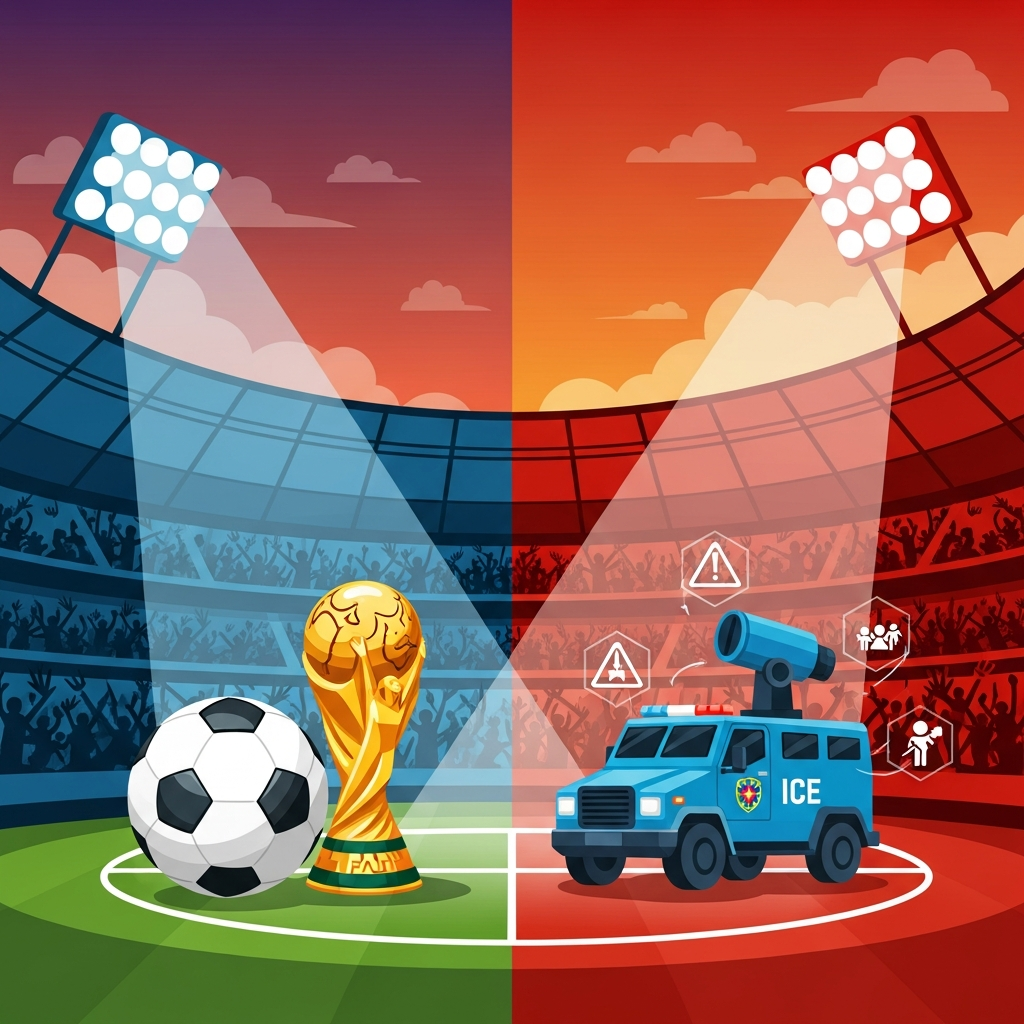
The 2026 FIFA World Cup — spanning 16 cities across North America with most matches concentrated in 11 U.S. venues — is the first tournament in the sport's history to formally operate under FIFA's published Human Rights Framework, yet ICE has maintained its position that enforcement operations near stadiums will continue uninterrupted, producing the most visible institutional contradiction in the tournament's century-long history. According to Human Rights Watch, between January 20, 2025 and March 10, 2026, ICE arrested at least 167,000 people across the 11 U.S. World Cup host cities — 65.1 percent of whom had no U.S. criminal record — and 43 people died in ICE custody during that same period. Twelve of the 16 North American host cities have yet to submit the human rights action plans that FIFA's own July 2024 Human Rights Framework formally required, while a concrete preview of what non-compliance looks like arrived on July 13, 2025, when an asylum seeker attending the FIFA Club World Cup final was arrested near MetLife Stadium, detained at Newark's Delaney Hall facility, and ultimately deported after abandoning his appeal. Amnesty International and Human Rights Watch are formally demanding an ICE truce, while three congressional bills propose a one-mile enforcement exclusion zone around venues, and approximately 2,000 hospitality workers at Los Angeles's SoFi Stadium have threatened to strike if ICE is not formally excluded from World Cup operations. This analysis argues that the crisis is not administrative friction but a structural exposure of international sports governance's limits, with consequences for FIFA's credibility, U.S. mega-event viability, and the immigrants who will staff and attend this tournament that will outlast the final whistle by years.
Key Points
FIFA's Human Rights Framework Contains a Built-In Self-Contradiction
The 2026 World Cup is the first tournament to formally operate under FIFA's published Human Rights Framework — a document released in July 2024 requiring all host organizing committees to submit action plans covering inclusion and protection, labor rights, and access to remedy. But it is simultaneously the first major sporting event in recent memory where the host nation's federal enforcement agency has publicly committed to continuing arrest operations in stadium-adjacent areas, and where the pre-tournament data — 167,000 arrests, 65.1 percent without U.S. criminal records, 43 in-custody deaths — makes the stakes concrete rather than hypothetical. This is not a tension that emerged by accident; it is the product of a host-selection process that prioritized the North American market's broadcast revenue and infrastructure capacity over the framework's own stated screening function. The July 2025 Club World Cup incident — an asylum seeker detained near MetLife Stadium during the final, held at Delaney Hall, and eventually deported after abandoning his appeal — was not a one-off failure but a structural preview of what happens when enforcement and mass public gatherings intersect in the same geography under the current administration. The twelve cities not having submitted their required action plans as of April 2026 is the clearest available evidence that FIFA's framework has no real enforcement mechanism after the hosting deal is signed, and the political officials involved know it.
The Numbers Behind the Collision: 167,000, 65.1%, 43, and 11x
Between January 20, 2025 and March 10, 2026, ICE arrested at least 167,000 people across the 11 U.S. World Cup host cities, according to Human Rights Watch's April 2026 report. Of those arrested, 65.1 percent had no U.S. criminal record at all, meaning the enforcement is not targeted at a specific category of offenders but operates as a general-population sweep in the same urban areas where World Cup venues are located. Forty-three people died in ICE custody during that same window, and street arrests increased by approximately 11 times compared to the prior year — reflecting a deliberate policy decision by the current administration to treat immigration enforcement as an ambient feature of daily life in major cities rather than a last-resort tool. The structural implication is that the same enforcement pressure that produced those numbers applies at World Cup venues as everywhere else in those cities, and that large public gatherings with international crowds represent a higher-visibility instance of a pattern that is already well-established and will not pause for a tournament schedule. The base scenario for the World Cup is not whether enforcement will intersect with the tournament but how visibly, how often, and whether those moments become the primary international narrative coming out of the event.
Fan Entry Restrictions Break the Sport's Own Fairness Promise
Under current U.S. State Department travel restriction and visa suspension policies, supporters from four qualifying nations — Haiti, Côte d'Ivoire, Senegal, and Iran — face entry barriers that make attendance practically inaccessible for ordinary fans, with Iran and Haiti receiving only narrow exemptions covering players and immediate team staff but not general supporters. The Trump administration's travel restrictions as of January 2026 affected a total of 39 countries, with immigrant visa processing suspended for an additional 75. The practical consequence is a World Cup where stadium crowds are structurally skewed toward fans from countries with unconstrained U.S. entry, and where teams from restricted nations play their matches without home-country supporters in the stands. FIFA's official brand positioning is the World Cup for all. The documented reality is a tournament primarily accessible to fans holding the right passports — a gap between marketing language and operational fact that the federation cannot bridge without directly confronting U.S. visa policy, which it has no authority to do. When sporting qualification is merit-based and fan access is geopolitically filtered, the foundational fairness claim of the sport is not merely strained; it is specifically and verifiably violated, and FIFA's human rights framework contains no mechanism for addressing that violation in the current cycle.
SoFi Stadium's Unite Here Local 11 Strike Threat Is the Highest-Probability Operational Risk
At Los Angeles's SoFi Stadium, Unite Here Local 11 — representing approximately 2,000 workers in food service, catering, and stadium operations — has publicly demanded that FIFA formally exclude ICE and the U.S. Border Patrol from all World Cup venue operations and signaled the possibility of a strike if that demand is not met. The workers' concern is operationally grounded: their employers have received intensified I-9 documentation requirements and, in some cases, requests to cooperate with ICE data-sharing that would expose undocumented workers to enforcement based on their own employment records. This is not a symbolic protest — it is a workforce that actually operates the venue, and a labor disruption during a high-profile match at SoFi would simultaneously create an operational problem for FIFA and a globally broadcast illustration of the gap between FIFA's stated commitments and the conditions under which the tournament actually operates. The three congressional bills address adjacent enforcement surfaces but do not directly resolve the labor conflict, which depends on FIFA making a concrete commitment to exclude enforcement from venue operations — a commitment the federation has so far declined to make. I put the probability of at least one visible labor action in the two weeks around the opening ceremonies at fifty percent or higher.
Positive & Negative Analysis
Positive Aspects
- FIFA's Own Written Framework Gives Critics a Contractual Lever
FIFA's decision to formally publish a Human Rights Framework in July 2024 — even one with limited enforcement mechanisms — has created a specific and concrete reference point that advocacy organizations can use to hold the federation accountable in its own language. Amnesty International and Human Rights Watch are not asking FIFA to adopt a new standard; they are asking it to honor a standard it already published, which is a materially stronger legal and rhetorical position. Without the written framework, the demand for an ICE truce would be an external political request; with it, the demand carries the character of a compliance requirement derived from FIFA's own contractual obligations to its host organizing committees. This structural difference matters for how post-tournament enforcement plays out: sponsors can reference the framework in contract renewals, broadcasters can incorporate it into editorial standards, and future host-city agreements can use it as a baseline that must be demonstrated rather than merely asserted. The framework's weakness as an enforcement instrument does not make it worthless — it makes it a documented starting point that external pressure from sponsors, broadcasters, and continental federations can strengthen across successive hosting cycles, potentially culminating in the formal evaluation-rubric addition I put at 55 percent probability before 2030.
- Host Cities' Political Incentives Create a Realistic Pathway for Partial Compliance
Several U.S. World Cup host cities are governed by mayors with strong existing political incentives to publicly differentiate their cities from federal enforcement priorities. Los Angeles, Seattle, Boston, and others have previously maintained sanctuary policies or limited-cooperation frameworks on immigration enforcement, and for those mayors, releasing a human rights action plan before the tournament is an opportunity to signal political values, generate positive international media coverage, and demonstrate local governance capacity independent of federal policy. The four cities that have already submitted plans — Atlanta, Dallas, Houston, and Vancouver — demonstrate that compliance is not inherently politically costly. I estimate that between eight and ten of the sixteen host cities will release some form of action plan before late May, producing a visible comparative record that distinguishes compliant from non-compliant cities and creates pressure on the remaining holdouts. City-level action does not legally restrict ICE operations, but it cumulatively produces a patchwork of informal de-escalation and heightened local scrutiny that materially improves conditions on the ground, and it gives domestic and international media a concrete tracking mechanism that sustains coverage pressure throughout the tournament.
- Three Congressional Bills Establish a Multi-Layered Legislative Template for Future Events
The Pou, Swalwell, and McIver bills together represent the most architecturally comprehensive legislative framework yet produced for separating international sporting events from domestic immigration enforcement. The three-pillar design — venue perimeters, transit infrastructure, and local law enforcement participation in federal programs — covers the full geographic footprint of a major tournament. Even if all three bills fail to pass in the current session, their combined existence in congressional record establishes documented testimony, agency responses, and legislative history that strengthens the evidentiary foundation for post-2026 litigation, IOC contract negotiations, and state-level policy development. I estimate the probability of some version of the three-pillar approach being incorporated into the 2028 Los Angeles Olympics hosting agreement at around 50 percent, and the probability of at least one element being adopted by a major U.S. professional sports league within six months of the World Cup's conclusion at around 35 percent.
- Sponsor ESG Risk Is Aligned With Human Rights Advocacy Goals
FIFA's top-tier sponsor roster — Coca-Cola, Visa, Adidas, Hyundai-Kia, Lenovo, Qatar Airways, Aramco, Bank of America, Verizon — represents an estimated $2.5 to $3 billion in partnership value, and the ESG exposure of those brands is directly tied to the visual and narrative environment in which the tournament plays out. The 2022 Qatar precedent demonstrated that Coca-Cola, Adidas, and Visa will make public statements when the reputational cost of silence becomes visible enough, and that four sponsors offered financial compensation to affected workers. The threshold for action is lower when the enforcement context is geographically and visually immediate rather than offshore, which the 2026 situation is. I estimate roughly a 70 percent probability that at least three sponsors are currently transmitting quiet pressure signals to FIFA, and a 40 percent probability that at least one makes a public statement before the tournament opens. When commercial risk and human rights advocacy point in the same direction, combined pressure is historically more effective than either alone, and 2026 is one of the clearest recent examples of that convergence operating at scale.
Concerns
- Venue Reversal Is Physically and Economically Impossible at This Stage
FIFA's most credible enforcement tool — stripping hosting rights from non-compliant cities — is functionally unavailable two months before kickoff. Broadcast contracts, sponsorship agreements, ticket sales, hotel blocks, venue security plans, and operational staffing for sixteen cities across three countries are committed at a combined scale that makes reversal catastrophically expensive and logistically impossible in any realistic timeframe. This structural reality means that FIFA entered the final preparation period without the leverage it would need to compel meaningful compliance from either non-submitting host cities or the federal government's enforcement posture. All remaining tools are symbolic: statements, requests, expressions of concern. The party being pressured — the federal government — understands that FIFA cannot revoke hosting rights at this stage, and operates accordingly. The structural implication extends beyond this tournament: as long as hosting decisions are finalized years in advance with multibillion-dollar commercial commitments, the federation will always lose its enforcement leverage before the enforcement situation becomes visible enough to act on. Fixing this requires front-loading enforcement mechanisms to the pre-selection phase — a structural reform that requires political will FIFA has not yet demonstrated.
- Federal Sovereignty Logic Provides a Robust Defense Against External Pressure
The U.S. federal government's legal and political position on immigration enforcement is both straightforward and legally robust: it is a sovereign domestic function that does not require the approval or acquiescence of international organizations, including FIFA. The current administration has explicitly rejected the concept of enforcement-free zones around cultural and sporting events as a precedent it will not set, on the grounds that agreeing to suspend enforcement for the World Cup would create a template that every subsequent major event could invoke. This reasoning is legally coherent and not easily overcome by public advocacy, sponsor pressure, or congressional bills that lack the votes to pass. ICE public statements have consistently described World Cup venues as non-exempt, meaning a reversal would require the administration to explicitly contradict its own stated position — a political cost the current administration has given no indication of willingness to pay. FIFA's formal compliance machinery contains no mechanism that can compel a sovereign government to limit its own enforcement authority within its own territory, which is the fundamental structural gap that the 2024 Human Rights Framework failed to address.
- Risk Is Concentrated on the Most Vulnerable, Furthest From Decision-Making
Perhaps the most ethically significant feature of this situation is who actually bears the downside. FIFA will generate substantial revenue regardless of enforcement outcomes; host cities will receive significant economic activity; broadcasters and sponsors will receive their contracted exposure. The people carrying the concentrated physical risk are immigrant fans who may be detained while attending matches, workers whose employment exposes them to enforcement, and families — including children of the individuals affected, as documented in the MetLife Stadium incident — who may experience permanent separation as a direct consequence of attending or working at a World Cup event. This asymmetric distribution is structural, not incidental: it is the predictable outcome of staging a global event in an environment where the people most exposed to enforcement lack the political power to negotiate equivalent protections to those enjoyed by commercial stakeholders. FIFA's Human Rights Framework, to be materially meaningful for these populations rather than merely reputationally useful for the federation, would need to include concrete protective mechanisms — legal support funds, real-time enforcement monitoring with public reporting, contractual commitments from host governments on event-area conduct. None of those mechanisms exist in the current framework, and none are being publicly demanded by FIFA from its host partners.
- The Governance Failure Narrative Is Already Established Regardless of Tournament Outcomes
The evidentiary record that already exists — a documented arrest at the 2025 Club World Cup final, 12 of 16 host cities declining to submit human rights plans two months out, 167,000 arrests and 43 deaths in custody documented by Human Rights Watch, three congressional bills acknowledging the enforcement conflict — is sufficient to sustain a credible narrative that FIFA's human rights framework is decorative in international sports journalism and governance research for years, regardless of whether any major incident occurs during the tournament itself. This narrative does not require a bear-scenario event to take hold; it only requires the existing record to be systematically assembled and published, which is already happening at Human Rights Watch, Amnesty International, Al Jazeera, and the Council on Foreign Relations. Once the framing attaches — as the successor to the Qatar 2022 labor rights narrative — it becomes the default interpretive context for FIFA's future hosting decisions. Recovery from that kind of long-run reputational damage typically requires a decade-scale demonstrated commitment change, not a single corrective action, and 2026 may represent the entry point into exactly that extended remediation cycle.
Outlook
Looking at the two months between now and the June opening, and then the years stretching beyond it, this situation breaks into three distinct time horizons that are worth separating carefully, because the short, medium, and long-term dynamics here are structurally different from each other.
In the short term — April through the end of the World Cup in July — the most likely scenario is managed ambiguity with periodic ruptures. FIFA will almost certainly issue some kind of statement before the opening ceremony, but I expect it to be deliberately vague — something like "we call on all authorities to ensure the safety and dignity of all visitors during the tournament," language that sounds responsive without committing to anything enforceable or creating a direct confrontation with the federal government. I'd put the probability of exactly that kind of statement at around 75 percent. On host city action plans, I expect somewhere between eight and ten of the sixteen cities to release some version of a formal document before opening day. The four cities that have already submitted — Atlanta, Dallas, Houston, Vancouver — demonstrate that compliance is not inherently politically impossible; it depends on the local political context. Los Angeles, Seattle, and other progressive-mayor cities have both the political incentive and the existing policy infrastructure to follow. These plans will mostly be symbolic — they won't legally restrict ICE — but they'll give local officials something to point to, and their cumulative effect matters even without federal coordination.
The short-term risk scenarios cluster around three specific event types. First: a filmed arrest incident near a World Cup venue that circulates on social media — I put this at around 65 percent for at least one occurrence during the tournament, given the July 2025 Club World Cup precedent and current enforcement tempo. Second: a documented and widely reported case of qualifying-nation fans being denied entry or detained on arrival, particularly from Haiti, Côte d'Ivoire, Senegal, or Iran. Third: the Unite Here Local 11 strike at SoFi materializing into actual disrupted operations during a match, which I put at roughly 45 percent given the union's explicit warning and the absence of any FIFA commitment to their demands. The probability of at least one of these three events occurring during the World Cup period is approximately 72 percent. The bull scenario — a quiet informal understanding between the federal government and FIFA that produces genuine de-escalation near venues without a public announcement — I'd give about 15 percent. The base scenario, where two or three incidents occur but the tournament runs to completion, sits at roughly 55 percent. The bear scenario, where a major broadcast-moment incident triggers coordinated protests in multiple host cities, runs at about 30 percent. Current bull:base:bear distribution: approximately 15:55:30.
The short-term numerical tracking thresholds are straightforward: ICE arrests within venue perimeters totaling fifty or more during the tournament triggers bear scenario escalation; ten or fewer arrests maintains base scenario; five or fewer with no viral footage is the bull entry point. FIFA sponsor public statements on enforcement reaching three or more companies during the tournament period is a structural change signal regardless of tournament outcomes.
In the medium term — six months to two years post-tournament — the structural effects become clearer regardless of how the tournament itself plays out. The three congressional bills that didn't pass before the World Cup will almost certainly be reintroduced with expanded scope targeting the 2028 Los Angeles Olympics and the 2034 World Cup. I'd put the probability of some version of a stadium-area enforcement limitation passing before the 2028 Olympics at around 35 percent. More significantly, I expect FIFA's sponsor ecosystem to push substantially harder for explicit human rights compliance language in post-2026 contract renewals than they did after Qatar. The 2022 Qatar precedent showed the mechanism exists; 2026 tests whether it can produce actual behavioral change in the federation's decision-making rather than just producing statements and compensation pledges.
The medium-term scenarios: the bull case is the World Cup ending without a major incident, FIFA successfully packaging the outcome as proof that its Human Rights Framework worked, and carrying that narrative into 2030s hosting negotiations. Probability approximately 20 percent. The base case is two to four documented enforcement incidents, FIFA absorbing a real but contained credibility hit, and the 2028 Olympic hosting process beginning with explicit human rights conditions built into the U.S. agreement — specifically around immigration enforcement conduct. Probability roughly 55 percent. The bear case is a major incident combining with a labor disruption to create the dominant international narrative, materially affecting FIFA's sponsor renewal leverage and creating friction for future U.S.-based bids. Probability approximately 25 percent.
The medium-term IOC variable is the most important structural unknown. If the International Olympic Committee responds to the 2026 World Cup outcome by formally requiring "immigration enforcement conduct" assurances from the United States as part of the 2028 Los Angeles Games hosting agreement, that sets a binding precedent that FIFA will face in its own 2034 and future hosting negotiations. I put the probability of IOC making such a formal requirement at around 40 percent, with the probability increasing to roughly 60 percent if the bear scenario materializes during the World Cup.
In the long term — two to five years out — the 2026 World Cup will function as a norm-setting event in the same way the 2022 Qatar World Cup did, just on a different axis. Qatar shifted the conversation about labor rights in host-country selection; 2026 will shift the conversation about immigration enforcement and event-area civil liberties. I think the probability that FIFA adds a formal "immigration enforcement conduct" criterion to its host evaluation rubric before 2030 is around 55 percent, driven not by voluntary internal reform but by external pressure from CONCACAF, UEFA, and the sponsor ecosystem acting in combination. The long-term bull scenario is U.S. mega-event infrastructure normalizing around informal de-escalation agreements, creating a workable model that future administrations can replicate. The base scenario is incremental tightening across hosting cycles, with each successive U.S. bid facing slightly more explicit contractual conditions. The bear scenario is U.S. enforcement posture hardening to the point where mega-event bidding requires sustained legal and diplomatic scaffolding that materially affects the economics of hosting.
The long-term value at stake is substantial. The 2026 World Cup was projected to generate approximately $80 billion in economic activity for the host nations and $11 billion in direct revenue for FIFA. If a governance failure narrative attaches durably — "North America 2026 is the tournament that proved FIFA's human rights framework was decorative" — the discount applied to future North American bids in broadcaster and sponsor negotiations will be real and measurable. I estimate a 15 to 25 percent reduction in U.S. mega-event hosting competitiveness over the following ten years in the bear scenario, reflected across broadcast rights negotiations, sponsor contract unit pricing, and athlete appearance fees.
Three specific metrics are worth tracking as leading indicators for which scenario materializes. First: how many of the 16 host cities publish human rights action plans before May 31st — if the number reaches ten or more, the base scenario holds; if it stays near the current four, the bear scenario probability climbs above 40 percent. Second: whether FIFA headquarters issues any official statement before the opening ceremony that explicitly names "ICE" or "immigration enforcement" as a specific concern — if it does, that is a historic governance precedent regardless of whether the request is honored; if it does not, FIFA's 2024 Human Rights Framework will have been demonstrated as functionally decorative for the purposes of this specific tournament, and that verdict will be cited for years. Third: whether MLS, NFL, or NBA issue their own event-area civil liberties policies within six months of the World Cup's conclusion — that would signal the U.S. commercial sports ecosystem is independently absorbing the governance lesson that FIFA failed to apply, and would accelerate the medium-term base scenario. I put the probability of at least two of these three indicators moving positively at approximately 40 percent as of today. The 2026 World Cup's place in sports governance history will ultimately be written not by the score of the final but by the answer to a much simpler question: did FIFA use the tools it said it had, and did the people most exposed to enforcement receive any protection from a framework that was nominally designed for them?
Sources / References
- FIFA faces pressure to call on Trump to stop ICE raids at 2026 World Cup (2026-04-14) — Al Jazeera
- World Cup 2 Months Out, FIFA and Host Cities Sideline Rights (2026-04-10) — Human Rights Watch
- US: ICE Arrest at FIFA Event Spotlights Dangers for World Cup (2025-12-03) — Human Rights Watch
- Human Rights Framework for FIFA World Cup 2026 (2024-07) — FIFA
- The U.S. Is Co-Hosting the World Cup, But Much of the World Can't Attend — Council on Foreign Relations
- Los Angeles stadium workers urge FIFA to bar ICE from World Cup (2026-04-07) — Al Jazeera
- The World Cup Needs an ICE Truce (2026-04-07) — Human Rights Watch
- Global FIFA and World Cup Hosts Must Prevent Tournament Becoming a Threat to Fans and Communities (2026-03) — Amnesty International
- No ICE World Cup Act Press Release — Rep. Pou — U.S. House
- Three bills push to ban ICE from FIFA World Cup — Newsweek
- Reps. Pou, Swalwell, McIver Introduce Bills to Block ICE Mass Deportation Sweeps at World Cup — House Homeland Democrats