
I'm With Verstappen on This — But Not for the Reason You Think
Summary
The 2026 Formula 1 season launched alongside a 50-50 hybrid power unit reset that reconfigured the fundamental output balance between the internal combustion engine and the electric motor — a seismic shift from the previous 80-20 ICE lean. Four-time world champion Max Verstappen publicly condemned the new rules as "Mario Kart" in the immediate aftermath of both the Australian and Chinese Grands Prix, a characterization that other drivers including Fernando Alonso and Charles Leclerc subsequently echoed in their own registers. In the same early-season window, Mercedes and Red Bull came under formal FIA investigation for exploiting a measurement-timing loophole inside the new 18.0-to-16.0 compression-ratio cap, with an estimated lap-time benefit of 0.4 seconds per lap — enough to swing a championship. The popular framing of this controversy as a green-versus-racing binary obscures the structurally deeper problem: the FIA anchored the headline 50-50 ratio and then effectively delegated the governance details — measurement procedures, simulation fidelity standards, track-suitability calls — to the manufacturer negotiating table, producing asymmetric outcomes that map directly onto lobbying proximity rather than engineering merit. Verstappen''s anger should be read not as nostalgia for the V8 era but as a legitimate governance critique against a structure in which the manufacturer with the best lobbyists, not the fastest driver, determines the season result.
Key Points
What the 50-50 Hybrid Ratio Actually Means on Track
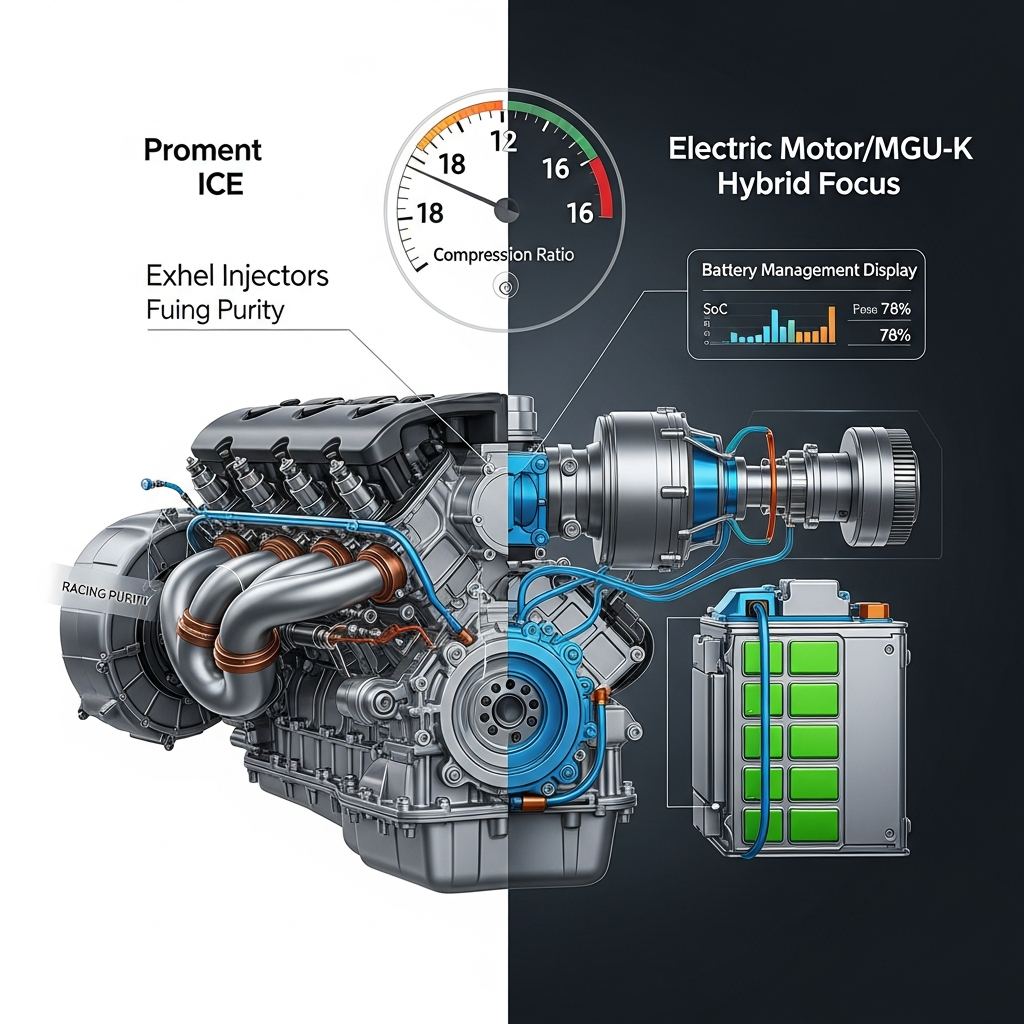
Starting in 2026, F1 power units run the ICE and electric motor at a 50-50 output split, a dramatic shift from the prior 80-20 lean toward the combustion side. This is less a tuning change and more a paradigm reset of the sport's entire power-unit philosophy. The same regulatory package bundles in 100% sustainable e-fuel, welcomes Audi as a full new manufacturer, locks in Cadillac's 2026 entry, and reactivates Honda and Ford as full works engagements — on paper, a story of F1 deliberately aligning itself with the global auto industry's electrification arc. Raising the headline ratio, however, doesn't automatically justify the dozens of measurement, simulation, and track-design details that flow downstream from it, and it's precisely those details that have blown up in the opening weeks of the season. Readers should treat the 50-50 number as a direction-setter, not as the actual battleground. The battleground is everything that happens in the spaces the headline doesn't cover.
Lift-and-Coast and Super Clipping as F1's New Driving Language
The first words drivers reach for when describing the 2026 rules are "lift-and-coast" and "super clipping" — and both refer to the same defensive behavior: lifting the throttle before the end of a straight purely to manage battery state of charge. Drivers can no longer push wide-open throttle to the very edge of a straight, and they must build braking calls around regenerative recovery distance rather than pure stopping physics. Beyond the visual problem — cars no longer visibly stretching to the limit — this matters because it compresses the driver's on-track autonomy, which is an identity issue for the sport, not just an aesthetics one. Verstappen repeating the same critique in Australia and China two months apart lands precisely on this point. When a regulation quietly demotes the driver into a battery management subroutine, motorsport loses its strongest narrative asset: a single human pushing a machine to its absolute edge, with no safety net. That loss is what gives this controversy its genuine weight.
The Compression Ratio Drop and the Measurement-Timing Loophole
The new regulation lowered the engine compression-ratio cap from 18.0 to 16.0, which looks on its face like a conservative power-cutting measure. The decisive trap is that the measurement is taken not at full operating temperature but in a relatively cool state. Mercedes and Red Bull reportedly identified the gap in that measurement window and exploited it to run an effectively higher real-world compression ratio — and the FIA opened a formal investigation. The estimated lap-time benefit is 0.4 seconds, enough to flip championship positions in a sport where 0.1 seconds shifts two grid rows. Mercedes' W17 front wing is additionally under suspicion for operating in two distinct deployment stages inside the FIA's 400-millisecond rule window, prompting a second investigation right before the Japanese Grand Prix. Taken together, this isn't a story about technical detail — it's a story about which side of the table the rule-writing pen is leaning on, and about what happens when measurement design is delegated to the people it's supposed to constrain.
The Governance Diagnosis Embedded in Verstappen's Statements
In Australia, Verstappen described the regulations as fundamentally wrong. In China he sharpened that to "horrible, political, an absolute joke," and in a separate interview delivered the line that anyone who enjoys these rules doesn't understand racing at all. The fact that the same person hits the same critique with the same intensity across two months of season opener can't be explained as mood — it's a sustained diagnosis. The added weight here is that his own team, Red Bull, sits on the suspect side of the compression-ratio investigation, yet he still directs his fire at the regulation rather than his garage. Most driver complaints are tied to their own car's relative pace. Verstappen is talking about the identity of the sport itself, and that distinction is what gives his statements their real density. Reducing this to a champion's nostalgia for the V8 era misses the governance critique embedded in the language. Read structurally, the statement makes complete sense.
Chronic Governance Failure and the Manufacturer Lobbying Problem
The real epicenter of this story is neither the engine bay nor the cockpit — it's the rule-drafting table. The FIA set the 50-50 headline and then effectively delegated measurement procedures, track-suitability calls, and simulation-fidelity standards to the manufacturer negotiating table. Mercedes finding the measurement-timing gap first is not coincidence but an instance of a general principle: the team sitting closest to the drafting room always finds the loopholes first. This structural defect is not unique to F1. UEFA refereeing its own referees, the NBA's media-rights architecture treating fan access as an afterthought, and the politics of FIFA host selection all share the same fault line. The conclusion is that 21st-century sports governance is converging on the same problem everywhere: the people writing the rules and the people profiting most from those rules sit at the same table while the fans are structurally excluded — and the F1 2026 controversy should be read inside that larger frame.
Positive & Negative Analysis
Positive Aspects
- Real Alignment of F1 R&D with Auto-Industry Electrification Pipelines
The 50-50 hybrid framework genuinely links OEM R&D spending in F1 with their production-side electrification roadmaps, which is the structural reason Mercedes, Ferrari, Audi, Honda, Ford, and Cadillac all deepened their F1 commitments in the same regulatory window. In past eras when F1 technology decoupled from production cars — the late V10 years being the clearest example — marketing payback on F1 spending eroded quickly and OEM exits followed in waves. The current ratio change rebuilds that link and materially raises the cost of leaving for major manufacturers. There's a credible case that regenerative braking strategies, battery thermal management, and high-efficiency power electronics validated under F1 race conditions will diffuse into mainstream EV products on a five-to-seven-year lag. In that framing, F1 is reconstructing its identity as a technology incubator rather than a pure entertainment property, which is a more defensible long-term position than the previous era's reliance on spectacle alone.
- Grid Diversity Driven by New Manufacturer Entry
This regulation set pulled in Audi as a brand-new full manufacturer, locked in Cadillac for 2026, and brought Honda back as a works partner — all in a single regulatory cycle. The last decade of F1 was shaped by an entrenched Mercedes-Ferrari-Red Bull power triangle, and that structural lock-in compounded gap inertia and viewer fatigue simultaneously. With new manufacturers entering, the grid stands a genuine chance of broadening into a five- or six-way meaningful contender field, opening the possibility of different manufacturers excelling on different track types within the same season. The Cadillac entry functions as a strong identity anchor for the US fan base and could push F1's North American audience growth up another notch beyond the "Drive to Survive" platform gains. Grid diversity isn't just a count of cars — it multiplies the number of plausible championship narratives, and that storytelling depth is itself the product Liberty Media is selling.
- F1 as a Proving Ground for 100% Sustainable E-Fuel at Scale
The 2026 regulation set functions as a real-world proving ground for 100% sustainable e-fuel under conditions far harsher than any laboratory bench test. With aviation and shipping under intensifying pressure to find synthetic-fuel pathways for sectors where electrification isn't realistic, F1's high-load, high-temperature race environment becomes one of the most demanding validation arenas the synthetic-fuel industry can access. Twenty-four grands prix per season across roughly ten constructors generates a deep accumulated dataset on stability, efficiency, and emissions profiles across multiple fuel batches and climatic conditions. That dataset is likely to be cited directly in EU and Japanese synthetic-fuel regulatory frameworks and in aviation's sustainable-aviation-fuel policy design. F1, in this framing, isn't only shrinking its own footprint — it's doing infrastructure-level validation work that other industries will lean on for their own decarbonization decisions over the coming decade.
- A New Axis for Evaluating Driver Talent
The 2026 rules create a new layer of driver evaluation that didn't exist before: the ability to manage battery state of charge dynamically while simultaneously executing on full-throttle lines, braking points, and tire-degradation strategies. Historically, the evaluation axes were raw throttle control, braking limits, and race-pace management over a stint. Energy-management judgment now sits on top of all of that, and it may well advantage a different profile of driver than the previous era rewarded. In particular, drivers with strong simulator fluency and data-interpretation skills — traits more common among younger cohorts — can surface faster in this environment than they could when raw mechanical feel dominated. The whole motorsport talent-development ecosystem gets nudged into a new phase by this, and the long-term pipeline effect is a genuine positive externality of the 2026 reset, even if it creates short-term disruption for veterans who built their edge under the old framework.
Concerns
- Measurable Erosion of Overtaking and the Visual Drama of Speed
The most concrete downside of the new rules is a documentable drop in overtaking frequency and in the raw visual drama of speed. With lift-and-coast and super clipping now standard practice, scenes of cars running flat out to the end of a straight and diving late into a braking zone have largely disappeared, and the frequency and success rate of overtaking attempts have declined with them. In motorsport, an overtake is not merely a position change — it is the sport's most compressed dramatic unit, the moment one human physically overcomes another at the limit of physics, and shrinking that unit directly weakens the emotional payoff for viewers. Historically, when pole-to-win conversion rates climb past fifty percent, midseason championship tension also erodes quickly and late-race audience retention suffers. The sport has effectively traded a chunk of its core content value for surface-level environmental optics, and that trade carries a real risk of suppressing new-fan acquisition and accelerating casual-fan attrition over a full season.
- Structural Lock-In of Performance Gaps Through Lobbying Proximity
The cruelest thing this controversy has exposed is how manufacturers with greater resources and greater political access can extract additional competitive advantage from the rule details themselves — advantages that compound the inherent resource gap rather than counterbalancing it. The compression-ratio measurement loophole was found first by Mercedes and Red Bull, the teams sitting closest to the drafting process, delivering an estimated 0.4-second-per-lap benefit. Even if Ferrari, Honda, or Audi eventually identify and replicate similar gap-exploits, mid-season catch-up windows are too narrow to reverse constructors' standings inside a single year. The result is a structural lock-in where the same regulatory framework produces fundamentally asymmetric outcomes depending on which team held the deepest seat at the table when the measurement language was finalized. That asymmetry tends to compound — dominant positions self-reinforce through resource advantages and further lobbying access — which is why "wait for catch-up" is not a credible answer to this problem.
- Non-Linear Fan Trust Collapse and a Plausible Ratings Crisis
When structural governance failures get exposed twice in the same early season, fan trust doesn't erode linearly. It steps down. The "Mario Kart" line is a short-run ratings card — confrontation sells in the moment — but if that same critique runs in the same tone every race weekend and every round produces another investigation headline, casual viewers end up locked onto one meta question: is this sport even honest? Given that a significant share of F1's recent audience growth is a casual loyalty layer attached to characters and drama rather than technical knowledge of the sport, the moment that meta question hardens negatively, attrition accelerates fast. The bear scenario in which late-season grand prix audiences drop by a double-digit percentage versus the prior year isn't a thought experiment but a plausible trajectory. In that path, Liberty Media's broadcast-rights valuation, sponsorship pricing, and new-OEM retention all come under pressure simultaneously and reinforce each other.
- Loss of Driver Autonomy and the Sport's Identity Crisis
When battery state-of-charge management starts dominating driving decisions, the driver is quietly demoted into a subsystem of the car. Full-throttle calls, braking-point selection, and overtaking-line choice — the historical territory of driver autonomy that made champions legible as individuals — get pre-constrained by regenerative recovery distance calculations and charge-level readouts relayed from the pitwall. That shift doesn't just change the aesthetics; it disturbs the seventy-year-old narrative of motorsport as the sport where a single human breaks the limits of a machine, and that narrative is what makes F1 meaningfully different from a simulation or a strategy game. Verstappen calling his own discipline "Mario Kart" is, at its core, a protest against this autonomy collapse. And in the space the driver's autonomy vacates, engineering-room decisions and simulator data move in — whose dominance in turn maps directly back onto resource and lobbying advantage, which is exactly why this concern is structurally inseparable from the two cons above it.
Outlook
Start with the immediate horizon. As of 10 May 2026, the next major events are the Emilia-Romagna GP on 24 May, the Monaco GP on 1 June, and the Canadian GP on 15 June — a brutal three-race stretch that will serve as the first real checkpoint for the compression-ratio investigation. The FIA opened parallel probes into Mercedes' W17 front wing and the compression-ratio measurement procedure right before the Japanese Grand Prix, and both are likely to produce a first-pass conclusion sometime between late May and mid-June. If the verdict tilts toward "technical breach," Mercedes and Red Bull could see season constructor points clawed back. If it tilts toward "permitted under current wording," Ferrari, Honda, and Audi will immediately demand a regulation tweak in the next FIA cycle. Either way, the political map of the season gets shaken once more inside June, and Verstappen's public posture splits along that fork: a breach verdict moves him into "I told you so" mode, while a permission verdict hardens him into "the system is rotten" mode. From a Liberty Media perspective, both outcomes are short-term bullish for ratings.
Splitting the near-term into bull, base, and bear scenarios sharpens this. The bull path is the FIA quickly standardizing the measurement on a full-operating-temperature basis and bundling that with downforce tweaks that shrink the lift-and-coast windows between July and September. If that happens, expect overtaking counts in the back half of the season to recover by something in the range of 30 to 40 percent versus the early-race baseline. The base path is the FIA delivering a breach verdict but leaving the measurement procedure essentially intact — patching the regulation rather than reworking it — which means super clipping stays normal through the rest of the year and Verstappen's critical tone only hardens. The bear path is the FIA siding with Mercedes and Red Bull and clearing them under the current wording. In that scenario, the political backlash from the Ferrari-Honda-Audi bloc and a collapse in fan trust land at the same time, and the average audience for the remaining 14 to 16 grands prix could plausibly drop by a double-digit percentage versus the prior season.
Stretching the view to a six-month to two-year horizon makes the picture more consequential. The two key variables are how aggressive the 2027 regulation tweak turns out to be, and how the 2026 constructors' standings actually distribute. If the 2026 title clearly lands with either Mercedes or Red Bull and the consensus read is that the compression-ratio loophole drove that result, the probability of a four-way alliance — Ferrari, Honda, Audi, and Cadillac — forming for the 2027 negotiation is very high. Their core demands would almost certainly include measurement-procedure standardization, joint submission of simulation data, and the introduction of independent third-party audits. If the FIA accepts that package, it would represent the largest governance reform in F1 history. If it refuses, the OEM exit threat moves from rhetorical to operational. Either path turns the six months before the 2027 season opener into the loudest negotiating window this sport has ever seen.
The same mid-term window ties directly into TV ratings, new fan acquisition, and platform dynamics. F1 essentially doubled its US viewer base between 2018 and 2024 through the Netflix "Drive to Survive" effect, and by 2024 the global fan base had reportedly grown to roughly 826 million, with cumulative TV viewer-events crossing 1.6 billion across the season. A meaningful share of that growth is a casual loyalty layer attached to characters and storylines — Verstappen, Alonso, Leclerc, the team-radio set pieces. If super clipping becomes routine and the pole-to-win conversion rate starts pushing past fifty percent, this casual layer is the first to drift away. Conversely, a champion publicly trashing the rule book is, in the short run, a ratings card. So 2026 to 2027 is shaping up as a strange period where governance crisis and content boom run on parallel rails, and Liberty Media has to walk a tightrope between short-term revenue and long-term trust. Step on the wrong rail, and the post-2028 audience foundation cracks.
Pushing out to a two-to-five-year horizon brings the genuinely big question into view. Does the global auto industry actually go fully electric in the 2030s, or does e-fuel and synthetic fuel survive in meaningful production volumes? If the EU and China effectively ban new ICE car sales around 2030, the 50-50 hybrid stops looking like a clever transitional compromise and F1 has to reopen the ratio fight from scratch. The most likely base path is another ratio tweak between 2028 and 2030, probably toward 30-70 or 20-80 in favor of the electric side. In that scenario, Verstappen's current critique either becomes the canonical "I told you so" or, conversely, the textbook example of a champion reading the trend slightly too late. The bull path for the long term is e-fuel finding real market share in aviation and shipping, with F1 reverting to a 100% e-fuel format and a reduced ERS share — effectively redefining itself as a "preservation sport" decoupled from the auto industry's electrification arc. I'd put the probability of that bull path at around 25 percent right now.
The real fork in all of these scenarios is, in the end, governance. For F1 to remain the world's premier motorsport beyond 2030, the rule-writing authority needs to be separated from the manufacturer negotiating table and housed in an independent technical commission. The model already exists in other sports. UEFA has been pushed for years to introduce external oversight precisely because letting the same body referee its own referees is structurally indefensible — F1 faces the same shape of problem, only more entangled. The catch is that F1's OEM bargaining power and the FIA's internal political architecture are even more tightly interlocked, so an external audit body is unlikely to emerge organically within the next three to five years.
Two catalysts could compress that timeline. The first is one major OEM actually walking away from F1. The second is an external shock from the EU competition authority or the US Congress wading into sports governance. One of these has to happen for the structure to be forced open from outside. Until then, the only meaningful counterweight is the voice of a superstar driver like Verstappen — which is exactly why his anger should not be reduced to comic relief. His tone is rough, but the direction he's pointing in is precise, and the moment that direction blurs, the next regulatory cycle locks in an even bigger asymmetry than the current one. The remaining sixteen to seventeen grands prix are essentially a natural experiment that will tell us whether the data backs that direction or buries it.
The OEM exit-threat scenario deserves to stay in view. The most plausible candidate is a path where rising entry costs and weakening marketing returns push Honda or Audi to start evaluating exit options within one or two seasons. Honda returned as a full works partner with Aston Martin specifically because of road-car R&D synergy — if governance asymmetry breaks that synergy, the rationale for staying erodes fast. If even one OEM publicly announces a withdrawal, it's not a one-off event: it forces every other OEM to reassess their own bargaining cards. In that scenario, the FIA loses the political room to keep outsourcing rule details to the manufacturer table, and the timeline for an independent technical commission compresses from a five-to-ten-year window into a one-to-two-year sprint. Short-term, that path is brutal. Long-term, it might be the fastest available route back to a healthy governance baseline.
A simple action item closes this out. Across the next five grands prix, track four numbers: overtaking counts per race, the pole-to-win conversion rate, the average lap-time delta between the front and the midfield, and the constructor-points gap between the Mercedes-Red Bull pair and the Ferrari-Honda-Audi triplet. If overtaking counts rebound toward early-2025 levels, the FIA tweak is working. If they stay flat or fall further, patch-level fixes aren't solving the core problem. If the pole-to-win share crosses fifty percent, expect the championship to lose tension faster than usual. If the constructor gap hardens early in favor of Mercedes and Red Bull, the 0.4-second lap-time advantage becomes effectively decisive for the season result. Tracking those four numbers in parallel will tell you, more honestly than any pundit's soundbite, whether Verstappen's hand has gotten heavier or whether his outburst simply gets re-absorbed as character comedy. The answer matters far beyond one driver — it's a small but real test of whether 21st-century global sport can fix its own governance from the inside.
Sources / References
- Trick at centre of 2026 F1 engine loophole controversy — The Race
- Max Verstappen on F1 rules 2026 — every car complaint judged — ESPN F1
- Verstappen: F1 fans who enjoy 2026 rules don't understand racing — Motorsport.com
- Explained: F1 2026 rule tweaks — what changed and the impact — ESPN F1
- Explained: F1 2026's compression ratio furore — Autosport
- Mercedes and Red Bull under scrutiny over F1 2026 engine compression ratio — Motorsport.com
- Mercedes Formula 1 team under FIA front-wing investigation — Yahoo Sports / Reuters
- Max Verstappen has crossed the line — scathing F1 2026 rules attack — Crash.net
- Fans back Verstappen in voicing his criticism on 2026 F1 regulations — GPblog
- Max Verstappen 2026 rules criticism listened — 2023 echo — PlanetF1