
PSG's UCL Trophy Is Just a $22 Billion Receipt — And That's Football's Biggest Problem Right Now
Summary
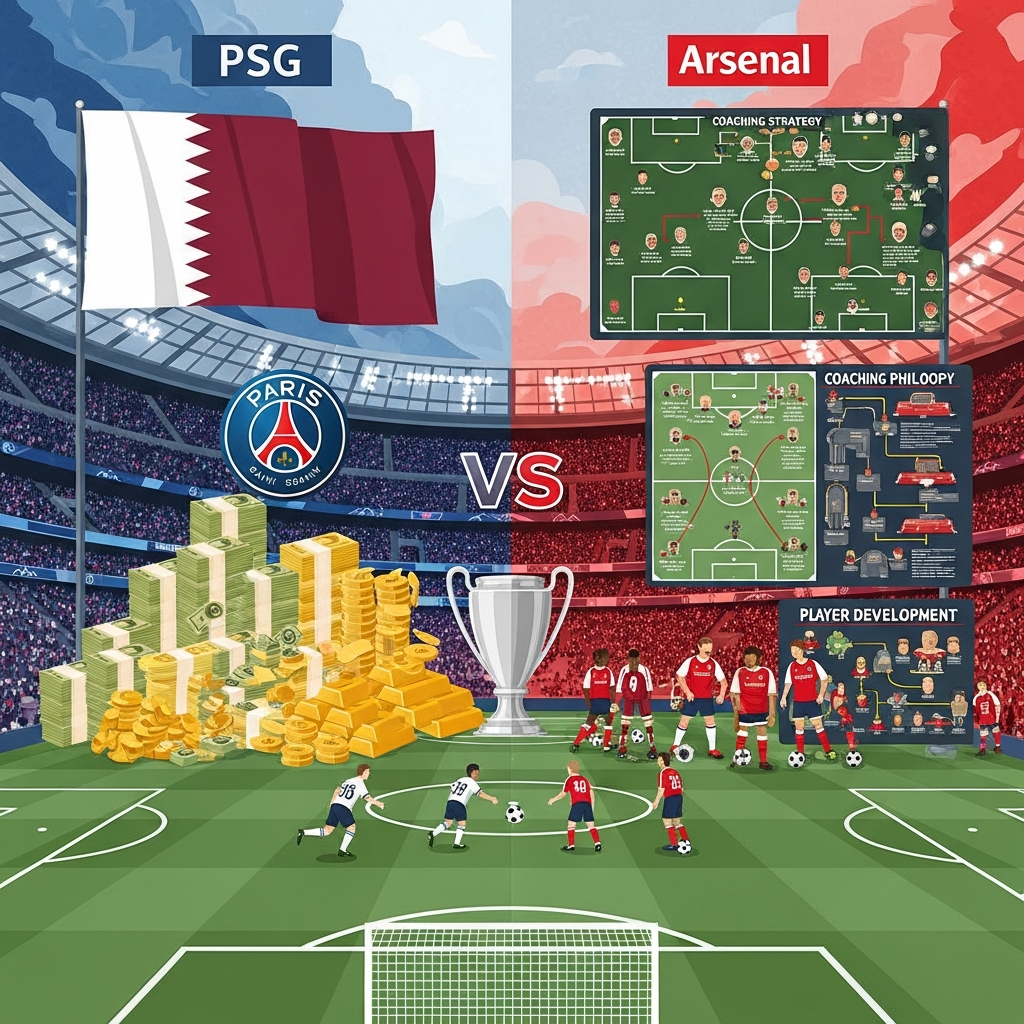
The 2026 UEFA Champions League final between PSG and Arsenal at Budapest's Puskás Aréna on May 30 represents far more than a football match — it is a civilizational reckoning between two fundamentally opposing models of club management. PSG, backed by Qatar's QSI sovereign wealth fund with approximately €20 billion in cumulative investment since 2011, seeks a historic back-to-back UCL title, while Arsenal, rebuilt under Mikel Arteta since 2019 without lavish spending, returns to the final stage for the first time since 2006. Opta's statistical model places Arsenal as the slight favorite with a 54.6% win probability versus PSG's 45.4%, suggesting that systematic cohesion demonstrably outperforms raw financial power at the elite level. This clash directly implicates ongoing debates around sportswashing, UEFA's Financial Sustainability Regulations, and the framework being constructed by England's incoming Independent Football Regulator for screening foreign sovereign wealth fund ownership. The outcome will reverberate across European football governance, transfer market dynamics, and the existential question of what football clubs are truly meant to be — community anchors or geopolitical investment instruments.
Key Points
The $22 Billion Receipt — PSG Real Return on Investment
Since QSI acquired PSG in 2011, the Parisian club has received approximately 20 billion euros in investment — a figure that exceeds the GDP of several small nations — yet the first UCL title only arrived in 2025, a full 14 years into the project. When you measure trophy efficiency against resource deployment, the math is deeply uncomfortable: Real Madrid won three consecutive UCL titles from 2016 to 2018 on a fraction of PSG cumulative spend, with a narrative built on Zinedine Zidane tactical mastery and Cristiano Ronaldo decisive brilliance in knockout football. Bayern Munich, operating under the fan-controlled 50+1 ownership structure, has lifted the Champions League and accumulated dozens of trophies across the same period at roughly half PSG investment level, demonstrating conclusively that money is a tool with diminishing returns rather than a guarantee. The 222 million euro Neymar transfer, the Mbappe saga, the Messi experiment — each was marketed as the missing piece that would finally unlock UCL glory, yet every cycle ended in Champions League elimination before the business was finished, creating a pattern that is embarrassing in its repetition. There is a profound difference between we built something and we spent until it worked, and PSG history firmly belongs in the second category — calling the 2025 UCL win an achievement rather than an eventual statistical inevitability given the resource volume requires a remarkably generous interpretation of sporting merit. The comparison that stings most: Borussia Dortmund, operating on a budget a fraction of PSG, has produced UCL finalists and genuine European royalty through academy investment and tactical identity — proof that money is a tool, not a guarantee, and that patience in system-building generates compound returns that no transfer window can replicate.
Arteta Five-Year Blueprint — How Arsenal Got Here Without a Sovereign Wealth Fund
When Mikel Arteta walked into the Emirates Stadium in December 2019, Arsenal were a club that could not qualify for the Champions League proper, had lost their tactical identity entirely, and were hemorrhaging the institutional confidence that had defined the Wenger era. Rather than reaching for the transfer market panic button, Arteta made a counterintuitive decision that was widely mocked at the time: build a system first, then populate it with the right players — not the most famous or expensive ones. The acquisition of Declan Rice, one of England most complete midfielders, and the deployment of Martin Odegaard as the orchestrator of Arsenal high-press, high-tempo system exemplifies this philosophy in action — both players were chosen for systemic fit, not box-office appeal or short-term commercial calculation. The result, four-and-a-half years later, is an unbeaten UCL campaign, a semifinal victory over Diego Simeone defensively formidable Atletico Madrid, and a first Champions League final appearance since 2006 — a 20-year gap closed not by a billionaire wire transfer but by a coaching staff intellectual conviction. For perspective, Arsenal annual net transfer spend under Arteta sits at roughly one-quarter of PSG equivalent figure, yet the on-field metrics — pressing efficiency, expected goals differential, defensive shape under pressure in knockout football — compare favorably at the elite European level. The comparison to Chelsea simultaneous 1 billion-plus spend producing results that pale next to Arsenal efficiency makes the contrast almost uncomfortably sharp, and Manchester City ongoing FFP legal challenges add another dimension to Arsenal institutional cleanliness that financial metrics alone do not capture.
Opta 54.6%: When the Data Votes for Philosophy Over Money
Opta win probability model — arguably the most sophisticated publicly available pre-match statistical framework in European football — assigned Arsenal a 54.6% probability of winning the 2026 UCL final against PSG 45.4%, and that number tells a story more interesting than most match previews are willing to acknowledge. This model synthesizes dozens of performance variables across the full season: expected goals (xG) created and conceded per 90 minutes, pressing intensity measured by PPDA (passes allowed per defensive action), defensive shape stability under high-press situations, build-up pattern efficiency, and set-piece effectiveness at both ends of the pitch. The fact that a defending champion — a team that already proved it can win this competition — comes out on the lower end of that probability distribution suggests something structural and systematic rather than circumstantial or sample-size-dependent. Arsenal UCL defensive record this season places them among the top performers in the tournament history for goals-against-average in the knockout rounds, and their xGA figures indicate that their defensive solidity is engineered rather than fortunate. The model is essentially saying that Arsenal architecture is more reliably built for this specific challenge than PSG assembled superstar roster — that cohesion, pressing coherence, and positional discipline are quantifiable competitive advantages that outweigh individual talent differentials. In the era of data-driven football analytics, having the numbers take the side of disciplined system over financial investment power is itself a statement about how elite football is evolving, and it validates every analyst and sporting director who has argued that building beats buying.
Qatar Real Game — The Geopolitics Behind PSG Trophy Hunt
PSG pursuit of back-to-back UCL titles is not a football story in any narrow sense — it is the sporting arm of a multi-decade Qatari geopolitical strategy to build global soft power and diplomatic legitimacy on the world stage, and understanding that context is essential to understanding why this final matters beyond sport. Following the 2022 FIFA World Cup, which Qatar used to force a global reckoning with its international standing despite widespread criticism of its human rights record and the treatment of migrant workers during stadium construction, PSG UCL success completes the second phase of that narrative: not just we can host world football but we own world football most prestigious club competition. The death toll among migrant workers during Qatar World Cup construction programs was documented by multiple major international news organizations, yet post-tournament coverage rapidly shifted toward sporting legacy narratives — demonstrating, with uncomfortable clarity, the practical effectiveness of this strategy for managing international reputation. A PSG back-to-back UCL title sends an unmistakable signal to Saudi Arabia, the UAE, and other Gulf states with similar ambitions: this playbook works, the investment is worth it, and European football governance lacks the mechanisms to prevent it at scale. The term sportswashing is accurate but underestimates the sophistication of what is actually happening; this is geopolitical infrastructure investment that happens to produce football trophies as a byproduct.
Fans vs Funds — The Existential Ownership Crisis Football Will Not Survive Ignoring
At its deepest level, the 2026 UCL final is a referendum on what football clubs are fundamentally supposed to be — community assets or investment portfolio holdings — and the outcome carries genuine structural consequences for the sport long-term health that extend well beyond which trophy cabinet gets heavier. Germany 50+1 rule, which mandates that supporters associations retain voting majority over club governance, has produced Bayern Munich sustained continental excellence and Borussia Dortmund perennial relevance without requiring sovereign wealth fund dependency, demonstrating that democratic ownership is not an obstacle to elite performance but potentially a competitive advantage. Barcelona socio membership model, despite navigating serious financial turbulence in recent years, maintains over 140,000 active member-owners who can vote on sporting directors, infrastructure projects, and the club strategic direction — a form of democratic accountability that no PSG supporter possesses under QSI ownership. In England, the newly legislated Independent Football Regulator — scheduled to become operational in late 2026 — will face its first genuine test in setting criteria for foreign sovereign wealth fund ownership, with the PSG precedent functioning as both case study and pressure point in those deliberations. The risk is not simply that PSG wins football trophies; it is that PSG model becomes the aspirational template for ambitious clubs worldwide, creating a dynamic where clubs court sovereign wealth fund investment not because it builds something lasting but because it temporarily wins trophies while destroying the competitive ecology that makes football worth watching.
Positive & Negative Analysis
Positive Aspects
Concerns
Outlook
Let's start with what happens in the immediate aftermath of this final, because the ripple effects will be rapid and consequential in ways that extend far beyond the weekend sports pages.
If PSG win, the transfer market implications are staggering. A back-to-back UCL title is the ultimate weapon in player recruitment negotiations — it signals a project that delivers at the highest level, attracts the world's best agents, and justifies whatever wage demands superstar players make. PSG are already reportedly pursuing several high-profile free agents, and a second consecutive UCL trophy would give them leverage to execute summer transfer business worth anywhere from €300 million to €400 million. On the other side, an Arsenal victory would trigger an immediate Arteta contract extension — his deal reportedly runs to 2027 — and would catapult the club into the Forbes top-five most valuable football brands globally. Either way, the summer window will be directly shaped by what happens on May 30. I'd estimate at least five major transfer deals will be directly influenced by this result within two weeks of the final, with PSG player valuations fluctuating by 10-20% depending on the outcome, and Arsenal's core players facing intensified interest from Europe's wealthiest clubs regardless of the result.
The short-term UEFA reaction is equally worth watching closely. UEFA is due to publish its annual assessment of Financial Sustainability Regulation effectiveness this summer. A PSG back-to-back UCL win transforms the tone of that report entirely — instead of "competition is balanced and regulations are working," the report faces an uncomfortable counter-narrative: "sovereign wealth fund clubs remain structurally unchecked." I put the probability at over 70% that within six months of this final, UEFA's internal discussions will shift meaningfully toward strengthening owner eligibility screening criteria. An Arsenal win gives UEFA the opposite gift — a PR moment to declare the current framework vindicated. But make no mistake: the ownership governance debate doesn't disappear either way. It simply changes urgency and speed.
The medium-term picture — six months to two years out — is where the ownership model debate gets truly structural and institutional. England's Independent Football Regulator is on schedule to formally launch in the second half of 2026, and its first major policy challenge will be establishing criteria for foreign capital entering the football system, specifically sovereign wealth funds and state-linked ownership vehicles. A PSG victory generates exactly the political pressure that weakens those criteria, as Premier League clubs point to Paris and ask why similar investment should be restricted in England. I expect that by 2027, at minimum two additional Premier League clubs will become acquisition targets for sovereign wealth funds or large-scale private equity structures. An Arsenal victory doesn't stop this capital flow entirely — Everton and several lower-tier clubs already have active Middle Eastern interest operating below public scrutiny — but it reduces the political momentum toward deregulation and gives the IFR more space to set meaningful standards.
The Ligue 1 broadcasting rights negotiation scheduled for 2027 represents another critical medium-term flashpoint that doesn't get enough attention. Currently, Ligue 1's international broadcasting revenue sits at roughly one-third of the Premier League's — a reflection of competitive predictability rather than talent quality. PSG's UCL back-to-back could temporarily inflate Ligue 1's global profile, but history tells a very different story about monopoly leagues. Bayern Munich's decade-long Bundesliga dominance drove German football viewership toward burnout rather than growth. Juventus's nine consecutive Serie A titles contributed to a measurable decline in international audience share the league is still working to reverse. I give roughly a 60% probability that Ligue 1's global broadcasting value stagnates or declines relative to the Premier League and La Liga over the next five years regardless of PSG's UCL success — precisely because single-club dominance repels the casual international viewer that modern broadcast rights valuations depend upon.
Looking further out — two to five years — the fundamental question this final raises is whether fan-centric ownership models can survive in elite European football, and the answer carries stakes well beyond any single trophy. Germany's 50+1 rule has produced Bayern Munich's sustained UCL competitiveness and Borussia Dortmund's perennial relevance without a sovereign wealth fund in sight. Barcelona's socio model has navigated genuine financial turbulence and still maintains the world's largest club membership base. These are not theoretical constructs — they are live demonstrations that alternative structures function at the highest level. If Arsenal win this final, "the day a community-rooted club defeated the sovereign wealth fund model on football's biggest stage" becomes a historical marker that fuels fan ownership advocacy movements across Europe for years. Within five years of an Arsenal victory, I expect at least three major European leagues to see formal legislative proposals advancing fan ownership protections reach parliamentary committee stages. A PSG victory doesn't kill those movements, but it arms their opponents with the most damaging possible counterargument.
The long-term governance trajectory points toward EU-level intervention regardless of this result, but the timeline depends heavily on public sentiment generated by this final. The European Parliament is already in preliminary discussion around a "European Sports Model" framework that would mandate transparency requirements for foreign state-linked investment in sports organizations — a direct response to concerns about Qatar's PSG ownership and Saudi Arabia's involvement across golf, tennis, and football simultaneously. I place the probability of a formal EU-level sports investment transparency framework reaching draft legislation stage by 2029 at approximately 45%. Each high-profile moment of sovereign wealth fund sporting success moves that probability upward. If PSG win again, we may be accelerating toward a regulatory reckoning that reshapes not just football but European professional sport broadly — cycling, handball, basketball, and athletics are all watching this proxy battle with considerable institutional anxiety.
Now let me lay out the scenarios clearly, because they matter for anyone trying to understand where this is all heading.
The bull scenario — Arsenal win and the Arteta model genuinely proliferates as a template — carries approximately a 30% probability. In this version of the next five years, at least four of the Premier League's top-six clubs formally adopt "sustainable growth" frameworks as their stated commercial philosophy by 2028. UEFA's Financial Sustainability Regulations get meaningfully strengthened with actual enforcement teeth rather than repeatedly negotiated exceptions. Fan ownership legislation reaches the UK Parliament's committee stage with genuine cross-party support. The key catalyst in this scenario is the two weeks immediately following the final: if Arsenal lift that trophy, the global media cycle produces such intensive focus on Arteta's methodology that public and political appetite for governance reform reaches a rare peak.
The base scenario — PSG win their back-to-back, but face competitive decline within three to four years as key players age out and squad rebuild costs mount again — sits at around 45% probability. In this version, oil money doesn't prove permanently dominant; it proves cyclically dominant. PSG's squad demographics and elite-player concentration create natural vulnerabilities within a two-to-three-year window post-victory. The oil money model gets recorded as "impressive but unsustainable without continuous reinvestment at enormous scale," not "definitively superior as a long-term strategy." UEFA tightens some regulations without fundamentally restructuring anything. The transfer market absorbs the PSG victory as one market signal among many and moves on.
The bear scenario — PSG win a third UCL title by 2028, cementing sovereign wealth fund dominance as European football's permanent structural reality — sits at roughly 15% probability. If this scenario materializes, the consequences are severe and lasting: mid-tier European clubs lose the ability to realistically aspire to continental relevance, fan engagement with domestic leagues in France and potentially elsewhere falls sharply, and the competitive product that makes football the world's most-watched sport begins to erode in ways that damage broadcast rights valuations across the board. The remaining 10% of probability space belongs to match-specific variables — red cards, serious injuries, penalties — that could produce an outcome neither statistical model nor narrative framework fully captures in advance.
I also need to be honest about where my analysis might miss the mark entirely. If PSG's back-to-back success is genuinely the product of Luis Enrique's tactical innovation and authentic team cohesion — not just financial volume — then my "receipt not a medal" framing becomes an unfair characterization of real sporting achievement. PSG's youth academy has produced a remarkable number of French national team regulars, suggesting that QSI's investment has built genuine footballing infrastructure rather than purely functioning as an image-laundering exercise. The counterfactual — what Arsenal might accomplish with PSG's budget — is one I cannot cleanly answer.
My advice to everyone watching May 30 in Budapest: don't just watch the scoreboard. Watch the patterns. Watch how each team wins and loses the ball, how the pressing triggers work, where the positional rotations create space, and how each side's tactical discipline holds — or breaks — under the maximum pressure of a one-game-take-all final. Then ask yourself the honest question: which model do you want the club you love to follow for the next decade? That question — not the final score — is what this match is actually deciding. And the answer matters for football far beyond Budapest.
Sources / References
- UEFA Champions League Final 2025-26 — PSG vs Arsenal — UEFA
- 2026 UEFA Champions League final — Wikipedia
- PSG vs Arsenal Referee — 2026 Champions League Final — Sports Illustrated
- Arsenal vs PSG UEFA Champions League Final 2026 Guide — RG
- PSG and Arsenal head for Budapest — SportsAdda Asia