
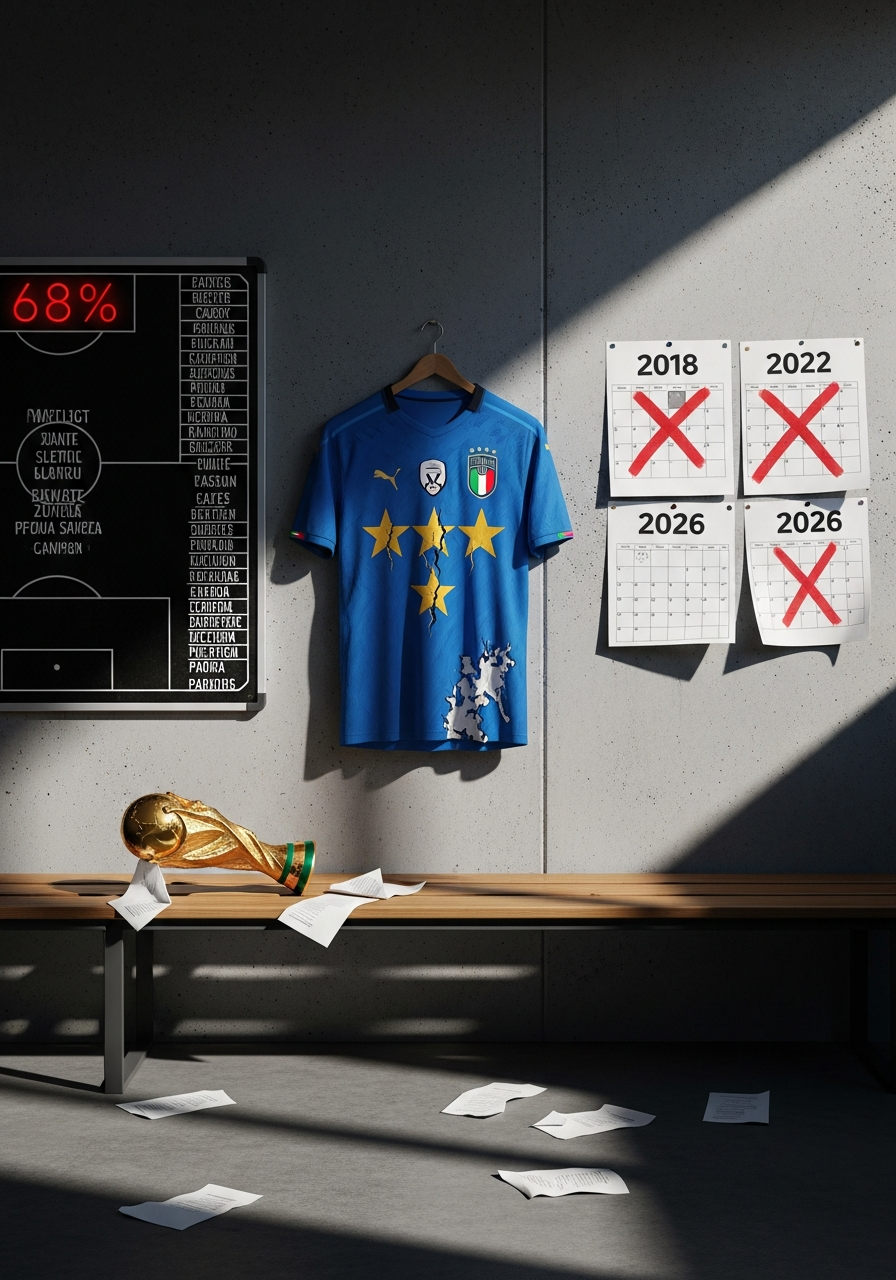
4 Titles, 3 Consecutive Failures, 68% Foreign Players — Three Numbers That Killed Italian Football
Summary
Italy's failure to qualify for the 2026 North American World Cup marks an unprecedented third consecutive tournament absence, a humiliating record for a four-time champion. Even with the expanded 48-team format providing more berths than ever before, the Azzurri could not secure their place — a collapse compounded by a bonus scandal, the structural decay of Serie A, and the simultaneous resignation of the entire football leadership. From the glory of Berlin 2006 to the humiliation of a playoff loss in Bosnia in 2026, Italy's twenty-year decline stands as a textbook case study in how a nation's football can systematically implode.
Key Points
A Four-Time Champion Eliminated in the 48-Team Era — A Historic Humiliation
The 2026 North American World Cup expanded dramatically from 32 to 48 teams, with Europe alone allocated 16 berths. For a country that has lifted the World Cup trophy four times to fail to qualify under these expanded conditions represents a structural failure that transcends mere underperformance. Among UEFA's 55 member associations, nations like Georgia, Albania, and Slovenia earned their spots at the tournament, yet Italy could not. Among the nations with four or more World Cup titles — Brazil (five), Germany (four), and Italy (four) — Italy is the only one to suffer three consecutive absences. Brazil comfortably qualified through South American qualifying in third place, while Germany topped their European group, making the contrast all the more stark.
The sheer scale of the 48-team expansion underscores the gravity of Italy's failure. Sixteen European berths means roughly 29% of UEFA's member nations can qualify, compared to approximately 24% under the old 32-team format with 13 European slots. Failing to pass through a door that has been widened this significantly provides mathematical proof that Italian football has slipped into the lower tier within Europe itself. This record demonstrates not a temporary slump but a system-level collapse, symbolizing a fundamental shift in the global football balance of power.
The 300,000-Euro Bonus Scandal — Evidence of Cultural Decay
Reports that Italy's national team players demanded a total bonus of 300,000 euros — approximately 10,000 euros per player — contingent on World Cup qualification delivered a shock that went beyond the sporting result itself. This incident is not simply a matter of individual moral failings among the players; it symbolizes the broader pathology of Italian football culture as a whole. A league ecosystem where money has become the ultimate measure of everything, a climate where the national team is treated as subordinate to club commitments — these systemic realities are directly reflected in the players' conduct. The scandal was simultaneously reported by Gazzetta dello Sport and Corriere della Sera, exposing Italian football's moral bankruptcy beyond the pitch.
A culture in which representing the national team has become an obligation rather than an honor, and World Cup participation has become a bargaining chip rather than a source of pride, does not emerge overnight. As reported by La Repubblica, the squad demanded a total of 300,000 euros contingent on qualification — and the controversy centered not on the amount itself but on the fact that bonus negotiations were prioritized ahead of a match carrying the weight of national prestige. When contrasted with Japan's national team players, who generate national fervor at the World Cup and gratefully accept whatever bonuses are offered, the depth of cultural decay in Italian football becomes vividly apparent. This scandal is not a mere episode but a compressed illustration of the collapse of values across the entire Italian football system.
Serie A's 68% Foreign Player Ratio — A Depleted Youth Pipeline
According to the CIES Football Observatory's analysis of the 2025/26 season, Serie A's foreign player ratio stands at 68%, exceeding the Bundesliga (59%) and La Liga (44%). Only the Premier League (72%) ranks higher, though England's situation is unique given the separation of its talent pool across four home nations. In practical terms, this means approximately seven out of every eleven players on the pitch in a Serie A match are foreign nationals, severely limiting first-team opportunities for young Italian players. While it is rational for clubs to purchase proven foreign talent for immediate competitive advantage, this approach directly depletes the national team's talent pool.
The specific numbers are telling: of the approximately 534-588 players who appeared in Serie A during the 2025/26 season, only about 167-187 (31-32%) held Italian nationality, and among those, the number of players in their early twenties performing at starter level could be counted on one hand. The contrast with Spain is striking — La Liga limits non-EU players to three per team and has produced a continuous stream of homegrown talents like Pedri, Gavi, and Yamal as a result. Germany similarly maintains its domestic player ratio at approximately 41% in the Bundesliga, protecting the youth pipeline. The paradox at the heart of Italy's crisis is that the more Serie A functions as a global talent marketplace, the darker the Azzurri's future becomes.
The Simultaneous Leadership Resignation — Institutional Reset or Repeated Band-Aid?
The simultaneous departure of FIGC president Gravina, technical director Buffon, and head coach Gattuso is an event with few precedents in Italian football history. In previous cycles, the standard response was to replace the manager while leaving the federation's structure intact — a band-aid approach repeated time after time. This time, the entire leadership has stepped down, creating the conditions for reconstruction from a genuine blank slate. After the first failure in 2018, only coach Ventura was sacked and FIGC president Tavecchio resigned, but no substantive structural reform followed whatsoever. After the second failure in 2022, Mancini resigned voluntarily, but the response again amounted to nothing more than appointing a successor, Spalletti.
Whether this mass resignation becomes a true institutional reset or merely another iteration of the same pattern — swapping faces while preserving structures — depends entirely on the choices of the incoming leadership. Germany's response after its Euro 2000 debacle provides a model: the DFB undertook structural reform at the organizational level, investing over 500 million euros in youth infrastructure and achieving a World Cup title fourteen years later. But given Italy's track record of relying on Mancini alone after 2018 while avoiding structural reform, there is more than sufficient reason to believe that FIGC's political dynamics and entrenched interests could once again obstruct fundamental change.
2006 to 2026: A Twenty-Year Decline — The Loss of Italian Football's Identity
The 2006 World Cup triumph in Germany was achieved through the collective brilliance of a legendary generation: Cannavaro, Buffon, Pirlo, Gattuso, Totti, Del Piero. But after that generation retired, Italy failed to develop successors of comparable caliber. While Spain nurtured Pedri and Gavi in the wake of Xavi and Iniesta, and France continued to produce extraordinary talents like Mbappe and Thuram, Italy's youth pipeline ran dry. Compounding the talent gap, the traditional Italian footballing identity of catenaccio — resolute defense and tactical cunning — has been losing its competitive edge in the modern game.
The failure to establish a new philosophy amid the competing paradigms of Spain's possession football, Germany's high pressing, and England's physical style lies at the heart of the twenty-year decline. The trajectory has been consistently downward: group-stage elimination at the 2010 World Cup in South Africa, group-stage elimination at the 2014 World Cup in Brazil, followed by three consecutive failures to qualify at all. The Euro 2020 title was an exceptional flash driven by Mancini's individual acumen, not a reversal of systemic decline. Twenty years is enough time to develop at least two full generations of players, yet Italy squandered that window entirely. This decline is not the product of misfortune — it is the consequence of negligence.
Positive & Negative Analysis
Positive Aspects
- The Simultaneous Leadership Resignation Creates a Genuine Institutional Reset Opportunity
The concurrent departure of FIGC president Gravina, technical director Buffon, and head coach Gattuso marks a break from the past pattern of replacing only the manager while leaving the federation's structure untouched. For the first time, the entire leadership has stepped aside, creating the environment for reconstruction from a true blank slate. Germany's response after its Euro 2000 humiliation provides an instructive precedent: the DFB established a dedicated reform committee, built 366 regional youth centers, and invested over 500 million euros, ultimately winning the World Cup fourteen years later.
If FIGC requires the incoming leadership to present not just a managerial appointment but a ten-year structural reform blueprint, this could become the most significant reset in the history of Italian football. The fact that the entire leadership departed voluntarily grants their successors the political freedom to make bold decisions unconstrained by their predecessors' legacy. A clean slate of this magnitude is unprecedented in Italian football, and whether it can be transformed into genuine opportunity will define the next decade.
- The Atalanta Model Could Spread League-Wide
Atalanta has built a successful model centered on players developed through its own youth system, maintaining competitiveness in both Serie A and European competition while generating annual transfer revenue of 70-100 million euros. Despite being based in Bergamo, a city of just 120,000 people, the club has qualified for the Champions League every season since 2019, establishing a virtuous cycle where youth-produced transfer fees sustain sound club finances.
The shock of three consecutive World Cup absences has catalyzed growing consensus among Serie A club owners that foreign player dependency must be reduced and youth academy investment increased. Reports indicate that Juventus and AC Milan have already boosted their youth academy budgets by over 40% compared to the previous year for the 2025/26 season. If the Atalanta model proliferates across the league, Italy's talent pool will grow richer while club sustainability is simultaneously strengthened. For smaller clubs in particular, Atalanta's case demonstrates that competitiveness can be achieved without massive capital injection.
- Fan Anger Is Functioning as a Genuine Engine for Reform
Italian football fans are among the most passionate and demanding supporter bases in world football. Their fury over three consecutive absences has evolved beyond raw emotional reaction into concrete reform demands directed at the federation. According to a Gazzetta dello Sport poll, 87% of fans indicated they want a complete system overhaul, not just a new manager — a markedly different sentiment compared to previous failures.
Scrutiny and pressure on the incoming leadership have reached unprecedented levels, making it far more difficult for the old playbook of swapping personnel while neglecting structures to succeed. In the social media age, organized fan campaigns can influence sponsor negotiations and broadcast rights deals, meaning this external pressure could prove to be the decisive energy needed to overcome political lobbying and entrenched resistance. Germany's youth reform after Euro 2000 was itself driven in part by national outrage and media pressure forcing the DFB's hand.
- A Latent Next-Generation Talent Pool Still Exists
A broken youth system does not mean that Italy's football talent has vanished. Next-generation players like Barella, Tonali, and Gnonto have already proven their potential at club level. Barella has developed into a core midfielder who helped drive Inter to a Serie A Scudetto, while Tonali has demonstrated his quality in the English Premier League. The problem was never an absence of individual talent — it was the lack of an organized system for identifying and developing it.
Italy has a population of 60 million and a deep-rooted football culture, with professional infrastructure ranking among Europe's finest: 20 clubs in Serie A, 20 in Serie B, and 60 in Serie C — over 100 professional clubs, each operating a youth academy. The foundation for rebuilding already exists. France's experience after investing in the Clairefontaine academy system in the 1990s — subsequently becoming the world's foremost talent-producing nation — shows that systematic investment can transform a country's football output when the underlying pool of talent is already there.
- Proven Global Football Reform Models Are Available for Benchmarking
Germany's transformation after Euro 2000 (fourteen years of youth reform culminating in the 2014 World Cup title), Spain's La Masia-driven philosophy (three consecutive major tournament wins from 2008 to 2012), and France's Clairefontaine academy system (2018 World Cup title, 2022 runner-up) provide a rich library of successful reform models. Italy is in a position to benchmark approaches that have already been validated, significantly reducing the trial-and-error that other nations endured.
The DFB's investment of over 500 million euros and establishment of 366 regional centers offers specific guidance on both the scale and direction of investment required. Japan's footballing journey is also noteworthy: since the founding of the J-League in 1993, three decades of systematic youth investment led to the remarkable achievement of defeating both Germany and Spain at the 2022 Qatar World Cup. The existence of these diverse success models eliminates any excuse that Italy doesn't know where to begin. The issue is willpower and execution, not a shortage of blueprints.
Concerns
- The Entrenched Pattern of Personnel Swaps Without Structural Reform
After the 2018 failure, the Italian Football Federation brought in Mancini, who delivered the dazzling Euro 2020 title — but zero fundamental structural reform accompanied the appointment. The moment Mancini left, everything reverted to square one. This experience conclusively proved how dangerous the one great manager will fix everything mindset truly is. Over eight years, four managers were cycled through — Ventura, Mancini, Spalletti, Gattuso — while youth infrastructure and league structures remained completely untouched.
If the response this time is once again to focus on hiring a marquee coach while postponing systemic reform, a fourth consecutive absence becomes a matter of timing, not probability. FIGC's internal political dynamics compound the problem: the federation presidency depends on votes from club owners, making it extremely difficult in practice to push through reforms — such as foreign player restrictions — that those same owners oppose. Italy's addiction to the quick fix of a prestigious manager appointment is its most intractable cultural malaise, and until this cycle is broken, no change in personnel will carry lasting significance.
- Serie A Clubs' Economic Interests Create Powerful Resistance to Reform
While debate over foreign player quotas has begun, club owners' resistance will be formidable. Serie A clubs operate in a structure where Champions League performance translates directly into broadcast revenue, sponsorship deals, and brand value — and competing in European competition without elite foreign talent presents a near-impossible proposition. Champions League broadcast revenue alone generated approximately 300 million euros for Serie A clubs in the 2024/25 season, and no owner is willing to put that income at risk.
With the Premier League commanding over 40% of the global football market, implementing foreign player restrictions in Serie A risks further diminishing the league's competitiveness in the short term. Serie A's global broadcast rights value has already declined to roughly one-third of the Premier League's, and any further drop in on-pitch quality would weaken the league's position in broadcast negotiations. Unlike Spain or Germany, Italy lacks strong governance mechanisms such as the 50+1 rule, making enforcement of regulations difficult. Additionally, EU labor law complications mean that restricting the movement of EU-national players could invite legal challenges with uncertain outcomes.
- Youth System Reconstruction Requires a Minimum of Ten Years
Even if massive investment in youth academies begins immediately, a player developed in that system needs at least 8-10 years before becoming a key contributor for the senior national team. The 2030 and 2034 World Cups will arrive in the interim, and whether Italian football possesses the institutional patience to stay the course is a genuine question. Germany's example is instructive: reform began after Euro 2000 and the payoff didn't arrive until the 2014 World Cup — fourteen years of unwavering commitment to a single direction.
Italy's fans and media exert short-term performance pressure that ranks among the most intense in world football. In a culture where calls for the manager's dismissal erupt after three or four consecutive draws, a long-term youth-focused project faces enormous survival challenges. Moreover, before youth investment bears fruit, Italy is likely to struggle in 2030 World Cup qualifying as well. Should a fourth consecutive absence actually materialize, the very momentum for reform could evaporate entirely. Striking the balance between long-term vision and short-term results represents the most practical challenge in Italian football's reconstruction effort.
- The Loss of Italian Football's Tactical Identity and Strategic Direction
Italian football once defined itself through catenaccio — impregnable defense, tactical intelligence, and tournament resilience — forming one of the pillars of world football. But this identity has been losing its competitive relevance in the modern game. Caught between Spain's possession-based football, Germany's high pressing, and England's physically dominant style, Italy has failed to articulate a new philosophy of its own. Under Mancini, there was an attempt at attacking possession football; Spalletti insisted on a 3-5-2 system; Gattuso tried to revert to grit and physicality. The fact that three consecutive managers pursued three entirely different tactical directions is itself proof that no agreed-upon philosophy exists.
The loss of identity goes beyond tactical considerations — it destabilizes the very direction of youth development. Without consensus on what kind of football to teach, no amount of academy investment will produce systematic results. Spain concentrated on developing midfielder-type talents under the clear banner of tiki-taka; Germany defined a modern player profile that combined technique with tactical comprehension. Italy has nothing comparable — no unifying vision from which development programs can take their cues. This is simultaneously the most fundamental and the most difficult problem to solve.
- The Rapidly Shifting Global Football Competitive Landscape
While Italy devotes time to reconstruction, emerging football nations like Japan, South Korea, Morocco, and Senegal are growing at speed. Players from these countries are accumulating experience as starters across Europe's top five leagues, and their domestic youth systems are rapidly modernizing. Japan's victories over Germany and Spain at the 2022 Qatar World Cup, and Morocco's semifinal run, demonstrated that the global balance of football power is undergoing fundamental change.
With 8.5 berths now allocated to Asia and 9.5 to Africa under the 48-team format, the football standards across these continents will only accelerate. As of 2025, more than 40 Japanese players are active in Europe's top five leagues, while South Korea fields over 20 players in European football behind the banner of Son Heung-min. If Italy's reconstruction fails, this gap will continue to widen, and the title of traditional powerhouse may be found only in history textbooks. The globalization of football is an irreversible trend, and the cold reality is that even a successful Italian rebuild would find reclaiming former status far more difficult than it would have been a decade ago.
Outlook
Let's start with what's going to happen in the coming months. The simultaneous resignation of Gravina, Buffon, and Gattuso has created a leadership vacuum at the Italian Football Federation (FIGC), and how that vacuum is filled will determine the short-term future of Italian football. Names like Massimiliano Allegri, Luciano Spalletti, and Antonio Conte are being floated as candidates for the managerial position, but the real question isn't who gets the job — it's what authority and vision the appointee will carry. If Italy once again takes the approach of one great manager will solve everything, it will be repeating the same mistake for the fourth time. In my view, the incoming leadership must announce a ten-year roadmap alongside the managerial appointment. Only then can the system survive changes in personnel.
The second half of 2026 will bring the first test under the new managerial regime: the UEFA Nations League. Unlike the World Cup or the Euros, the Nations League provides room for experimentation — a stage where the new coach can give young players opportunities while testing a new tactical identity. If results are encouraging, it will signal the beginning of genuine reconstruction; if Italy struggles yet again, pessimism about the national team will deepen considerably. What kind of football Italy shows in the Nations League will set the tone for the next two to three years. Personally, I believe the new manager must push boldly for generational renewal. Continuing to rely on veterans in their mid-thirties is simply recycling the formula for failure.
The fallout from the bonus scandal is another issue that demands attention in the short term. The episode laid bare the cultural rot within Italian football, and how the incoming leadership handles it will determine their credibility. Beyond disciplinary action against individual players, the entire compensation framework for national team duty needs to be overhauled, and the protocols governing international call-ups need to be fundamentally restructured. Just as the German Football Association (DFB) reformed its national team culture after 2018, FIGC must develop programs that re-instill in players the value that representing the national team is the highest honor in the sport.
Looking at the medium term — the six months to two years ahead — a fierce debate over Serie A's foreign player regulations is inevitable. How to adjust the current 68% foreign player ratio will be the central point of contention, with two competing interests in direct collision. On one side is the argument that domestic player opportunities must increase to rebuild the national team talent pool; on the other is the counterargument that Serie A needs top-tier foreign players to remain internationally competitive. I find Spain's La Liga model worth studying. La Liga limits non-EU player registrations to three per team while allowing EU-national players to be signed freely, striking a balance between domestic player development and league competitiveness. If Serie A were to adopt a similar approach by tightening non-EU player quotas, first-team opportunities for Italian players could increase meaningfully. However, for such regulations to have real teeth, league-wide consensus and alignment with UEFA rules are necessary — and that process won't be smooth. I expect a concrete quota reform proposal could emerge by 2027, though there's a better than 50% chance that club resistance will water it down from its original form.
Youth system reform is equally critical from a medium-term perspective. The problems with Italian football's youth academies aren't simply about insufficient investment — they're about the absence of a development philosophy. Systematic development programs like Spain's La Masia, Germany's DFB Elite Youth Program, and France's Clairefontaine teach not just technical skills but tactical thinking from a young age. Italy has nothing comparable at the national level. If FIGC establishes a new youth development master plan and introduces regulations mandating youth investment for each Serie A club, change can begin. But realistically, these reforms need a minimum of five to seven years to bear fruit. If the first reform generation shows even a glimpse of potential at Euro 2028, that can be read as an early signal of success — but full results shouldn't be expected until the early 2030s.
Looking further out — two to five years into the future — three broad scenarios emerge. Let me begin with the optimistic scenario, the bull case. In this scenario, the shock of three consecutive absences fundamentally shakes Italian football to its core, triggering a systematic reform effort modeled on the German experience. If FIGC establishes a dedicated youth development agency, introduces domestic player quotas in Serie A, and completely overhauls the national team's operating culture, Italy could not only return to the World Cup in 2030 but come back as a competitive team. Germany's journey — from the humiliation of Euro 2000 through a decade of reform to World Cup triumph in 2014 — provides the real-world evidence that this scenario is achievable. Under this scenario, Serie A's foreign player ratio would decline from the current 68% to approximately 55-58% by 2030, and Italy's U-21 team could reach the semifinals or better at a European tournament. I assign this scenario a probability of roughly 20-25%.
Next is the baseline scenario, the base case. Partial reforms are implemented, but they fall short of fundamental structural change. The new manager delivers stable results, some youth programs are introduced, and foreign player regulation discussions proceed — but practical impact is limited by club pushback. Under this scenario, Italy barely qualifies for the 2030 World Cup but remains a Round of 16-level team at best. The former status as a perennial semifinalist is not recovered, and Italy settles into the position of a second-tier European football nation — comparable to the Netherlands or Portugal. Serie A's foreign player ratio declines modestly to 63-65%, and the changes remain cosmetic rather than structural. I assign this scenario the highest probability at approximately 50-55%.
Finally, the pessimistic scenario — the bear case. This is the most feared outcome: personnel change once again without structural reform, and time simply passes. All responsibility is dumped on the new coach, Serie A reform is blocked by club opposition, and youth investment remains at the level of empty declarations. Under this scenario, Italy could set the unprecedented record of four consecutive World Cup absences in 2030. One of football's founding nations would be systematically overtaken by rising powers from Asia and Africa, and the name Azzurri would become nothing more than a nostalgic reminder of past glory. In this scenario, Italian football wouldn't settle at the level of the Netherlands — it could slide toward the tier occupied by Turkey or Scotland. I assign this scenario a probability of 20-25%.
One key variable runs through all three scenarios: whether Serie A's economic model can change. With the Premier League already commanding over 40% of the global football market, Serie A is falling behind in broadcast revenue, sponsorship income, and matchday attendance alike. Introducing foreign player restrictions in this environment could further diminish the league's quality in the short term, and this is the single biggest obstacle to reform. However, I believe that investing in domestic player development is the more rational economic choice in the long run. As the Atalanta model proves, developing players through the youth system and selling them to bigger clubs at premium transfer fees is a more sustainable business model than perpetually buying finished foreign talent. Atalanta's annual transfer revenue averages 70-100 million euros — a remarkable figure for a mid-table club.
Between 2028 and 2030, the genuine redefinition of Italian football's identity must take place. Catenaccio is an outdated tactical approach, but mimicking Spain's tiki-taka isn't the answer either. I believe Italy needs to build a hybrid style that combines its traditional strengths — tactical flexibility and defensive organization — with the high-intensity pressing demands of modern football. Atalanta coach Gasperini's high-intensity man-marking system offers one possible direction. This process requires a cultural shift within Italian football itself: a transition from results are everything to trust the process. Because this is a change that requires a generational shift, it will take five to ten years.
One more factor deserves attention: the impact of Italy's crisis on the broader European football power balance. Italy's decline, Germany's 2018 group-stage exit, even France's failure to defend their title in 2022 — these events suggest that the era of guaranteed dominance for traditional powerhouses is over. Nations like Japan, South Korea, Morocco, and Senegal are growing rapidly, and their players are gaining experience as starters across Europe's top five leagues. If Italy fails in its reconstruction, the gap will only widen. Global football is evolving in ways that make it progressively harder for historically dominant nations to coast on reputation alone.
The financial dimension of this crisis deserves deeper examination, because it shapes every other variable in the equation. Serie A's total commercial revenue for the 2024/25 season was approximately 3.6 billion euros — compared to the Premier League's 7.5 billion euros. This economic gap directly affects clubs' ability and willingness to invest in youth development. When a mid-table Serie A club generates roughly half the revenue of its Premier League counterpart, every euro spent on youth infrastructure is an euro not spent on immediate competitive needs. This creates a perverse incentive structure: clubs that invest heavily in youth development risk falling behind in the league table in the short term, while clubs that spend on proven foreign talent maintain their competitive position but contribute nothing to the national team pipeline. Breaking this cycle requires either external intervention — through federation-mandated youth investment minimums — or a fundamental shift in how clubs calculate return on investment.
The governance structure of FIGC itself presents a structural obstacle that deserves scrutiny. The federation's decision-making body includes representatives from professional clubs, amateur football, players' unions, and referees — a complex political ecosystem where reform proposals can be blocked by any sufficiently organized faction. The club representatives, who hold the most influence, have historically prioritized league-level concerns over national team development. Reforming this governance structure to give the national team program greater institutional weight would require amendments to the federation's statutes — a process that is both politically contentious and procedurally slow. Yet without governance reform, any youth development initiative risks being underfunded, deprioritized, or quietly shelved the moment it conflicts with club interests.
The coaching pipeline is another dimension that has received insufficient attention. Italy's coaching tradition is world-renowned — the nation has produced tactical innovators from Arrigo Sacchi to Marcello Lippi to Carlo Ancelotti. But the current coaching education system within Italy is not optimized for youth development. The emphasis remains on tactical preparation for senior football, with relatively little systematic training on age-appropriate development methodologies, sports science integration, or psychological development of young players. Countries like Germany and the Netherlands have invested heavily in coach education programs specifically designed for youth football, ensuring that the philosophies taught at youth level align with the senior national team's tactical identity. Italy needs a similar overhaul of its coaching pathway, ensuring that youth coaches are not failed senior coaches relegated to junior teams, but specialists trained specifically in player development.
For Italian football fans watching from the sidelines during yet another World Cup summer, this is a time of profound soul-searching. But history teaches that the deepest crises can produce the most transformative responses — if, and only if, the response addresses root causes rather than symptoms. Germany rebuilt from the ashes of 2000 to lift the World Cup in 2014. Spain transformed its football culture from perennial underachievers to three consecutive major tournament winners between 2008 and 2012. Japan, a country with no significant football tradition before the 1990s, systematically built its program from the ground up over three decades and now routinely competes with Europe's best. These precedents prove that national football can be rebuilt — but only through sustained, systemic commitment spanning a decade or more.
The infrastructure question also looms large. Many of Italy's stadiums are aging relics from the 1990 World Cup, with an average age exceeding 60 years. Modern football requires modern facilities — not just for matchday revenue generation but for the training complexes and youth development centers that surround them. The new stadium projects at clubs like Inter, Milan, and Roma could catalyze broader infrastructure investment, but the notoriously slow pace of construction permitting in Italy means these projects face years of delays. A comprehensive national football infrastructure plan, coordinating stadium development with youth facility construction, could accelerate both the commercial modernization of Serie A and the rebuilding of the talent pipeline.
The psychological dimension should not be overlooked either. Three consecutive World Cup absences have created a generation of young Italian footballers who have never experienced the emotional intensity and developmental pressure of a World Cup campaign. For players aged 18-22 today, the World Cup has been something that happens to other nations. This psychological disconnect from the tournament that once defined Italian football's greatest moments — Tardelli's screaming celebration in 1982, Grosso's penalty in 2006 — risks creating a self-reinforcing cycle where the national team loses its gravitational pull on the country's best young athletes. Re-establishing the emotional bond between Italy's youth players and the national team jersey is an intangible but essential component of any reconstruction effort.
The numbers that define Italy's current predicament — four World Cup titles, three consecutive absences, 68% foreign players in Serie A — tell a story of a football nation that has been living off inherited glory while failing to invest in its future. The question now is whether this third failure will finally be the catalyst for genuine, structural reform, or whether Italian football will continue to change faces at the top while the foundations continue to crumble. The next twelve to eighteen months will provide the first definitive signals. The appointment of a new FIGC president, the selection of a new head coach, the initial policy positions on youth investment and foreign player regulations — each of these decisions will reveal whether this time is truly different or whether it is, once again, the same script with different actors. The world will be watching — though, if current trends hold, it may be watching a World Cup without Italy once again in 2030.
Sources / References
- Italy Out as Bosnia and Herzegovina Reach World Cup 2026 on Penalties — Al Jazeera
- Italy Players Sought 10k Bonus for World Cup Qualification — Report (via La Repubblica) — Football Italia
- Share of Domestic Footballers vs Foreigners in Europe's Top 10 Leagues (2025/26) — Sportingpedia
- Italy Only Have Themselves to Blame for Missing a Third Straight World Cup — ESPN
- Italy Soccer President and Delegation Chief Buffon Resign After Another World Cup Failure — The Washington Post
- 500M Euros from Selling Young Players — Why Atalanta Are One of Europe's Smartest Clubs — Transfermarkt
- How Germany's Awful Euro 2000 Forced a Mass Restructure — FourFourTwo
- Italy's Third Apocalypse: Why a Team Who Won Four World Cups Now Can't Reach One — Sky Sports
- Foreign Alarm Goes Off for Serie A as Italians Only Make Up 32% (via La Stampa) — Sempre Milan
- 2026 FIFA World Cup Qualification — UEFA Group I (Norway, Italy Standings) — Wikipedia