
NFL Referee Lockout 2026 — Do You Remember What 150 Replacement Refs Did 14 Years Ago?
Summary
The NFL-NFLRA CBA is collapsing. 150 replacement refs could bring back the 2012 Fail Mary nightmare.
Key Points
A Negotiation Table Shattered in Three Hours
The two-day NFL-NFLRA negotiation session scheduled for March 26 collapsed after just three hours on the first morning. NFLRA executive director Scott Green condemned the NFL's approach as a 'take-it-or-leave-it' ultimatum. The referees' association went further, accusing the NFL of sending 'empty suits' to the table — negotiators who lacked the authority to make real concessions. The current CBA expires on May 31, and the core disputes center on the wage increase rate (NFLRA's 10.3% versus the NFL's 6.7%) and whether to introduce a performance-based compensation system. The NFL wants to tie referee bonuses to performance metrics and extend the probationary period for new officials, while the union views these proposals as tools of labor control and has pushed back forcefully. The gap between the two sides is just 3.6 percentage points, but the fact that a league pulling in more than $23 billion in annual revenue cannot close that gap speaks volumes about a fundamental lack of negotiating good faith.
Referee Pay at $205K Versus a Rookie Minimum of $885K
The average NFL referee earns between $205,000 and $250,000 per year, with total compensation including benefits reaching roughly $350,000. They are officially classified as part-time employees. Meanwhile, the NFL rookie minimum salary is $885,000 — meaning a bench player who never sees a single snap earns three to four times more than the officials responsible for the fairness of every play. With NFL annual revenue now surpassing $23 billion and the league targeting $25 billion by 2027 when new media contracts take effect, this disparity becomes increasingly difficult to justify. Per-referee, the actual wage gap between what the union is asking and what the league is offering amounts to only about $12,600 annually. Officials are expected to commit nearly full-time hours during the season — studying film, attending meetings, traveling — yet remain locked into part-time classification, which denies them full benefits including health insurance. This compensation imbalance reflects how the NFL fundamentally undervalues the profession of officiating.
150 Small-College Officials and a Four-Day Training Camp
The NFL has assembled a replacement roster of 150 small-college officials and scheduled a four-day training clinic for May. Pat McAfee blasted the plan, declaring that 'high school refs should not be officiating NFL games.' In reality, the pool may be even weaker than advertised — many credentialed college officials are reluctant to volunteer for fear of retaliation from the NFLRA, meaning the league could end up scraping even further down the barrel. Four days of training to prepare for the fastest, most complex professional football in the world is a logistical fantasy. In 2012, replacement officials struggled with basic rule applications, and game time increased by approximately 6 minutes on average, with penalty inconsistency spiraling out of control. NFLRA executive director Scott Green issued an official warning that replacement referees would be vulnerable to gambling-related manipulation — a risk that barely registered in 2012 but looms enormous today. The NFL's insistence on a quantity-over-quality approach to replacement is a statement of contempt for the product on the field.
The Paradox of Expanding the New York Replay Booth
At the Phoenix owners' meetings, the NFL is expected to vote on rule changes that would allow the New York replay booth to directly call fouls or overturn incorrect calls during games with replacement officials. This is the NFL tacitly admitting that replacement officials are inadequate — while simultaneously using that inadequacy as a reason not to pay the real ones. The logical contradiction is stark: if the replay booth can handle everything, why do you need on-field officials at all? And if on-field officials are necessary, why won't you compensate the experienced ones fairly? The deeper danger is that this rule change, introduced as a temporary measure, could become permanent. If the booth's expanded authority outlasts the replacement referee period, it sets a precedent that permanently diminishes the role and authority of on-field officials. Technology should be a tool that assists referees, not a pretext for replacing them.
The Fail Mary Was Not an Accident — It Was a Structural Inevitability
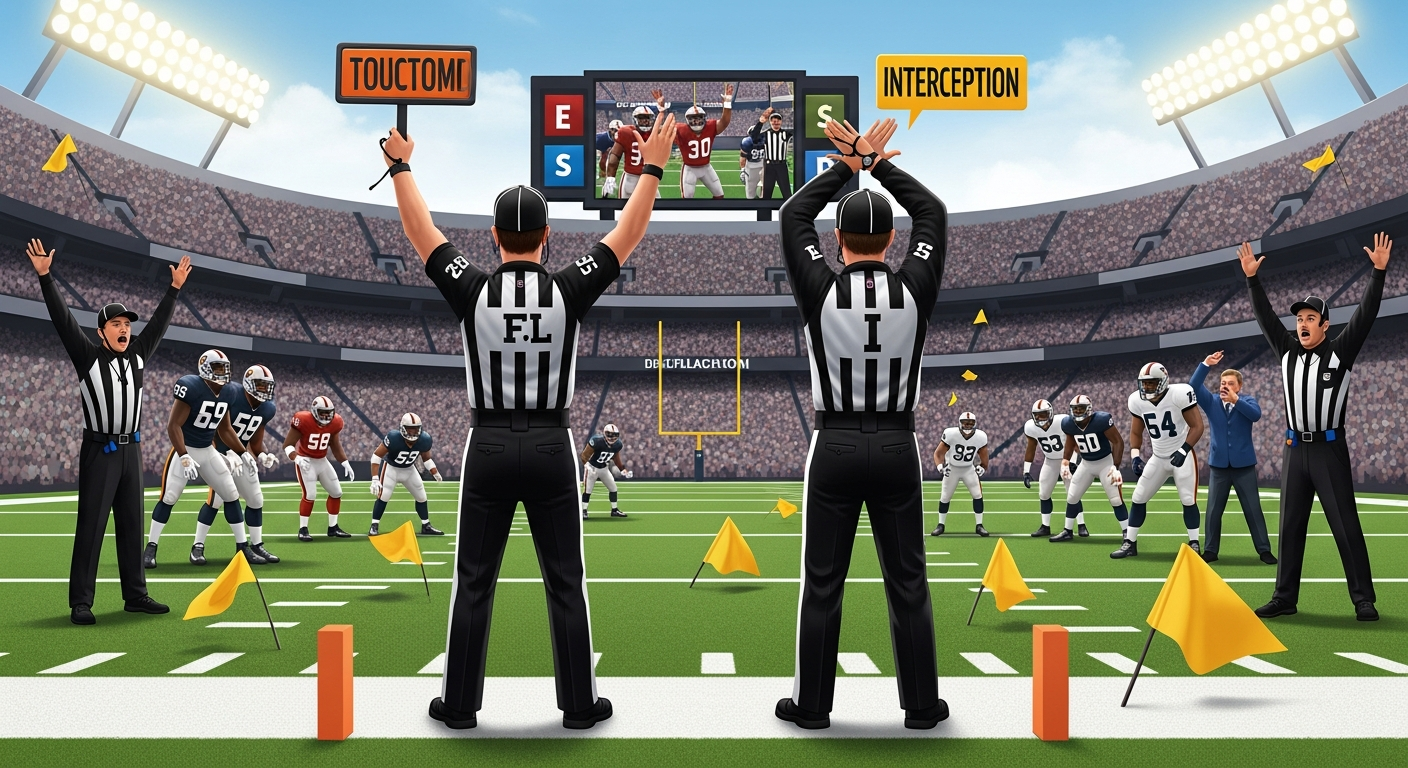
On September 24, 2012, during the Seattle Seahawks versus Green Bay Packers Monday Night Football game, two replacement officials standing side by side made opposite calls on the same play — one signaling touchdown, the other interception. The resulting 'Fail Mary' became one of the most controversial moments in American sports history. Within 48 hours, the NFL and NFLRA reached a dramatic settlement. Fourteen years later, the NFL is setting up the exact same scenario. What has changed since 2012 is the scale of the stakes: the legal sports betting market has grown to exceed $160 billion on a handle basis, making any officiating error a potential financial landslide. In 2012, a blown call was an embarrassment. In 2026, a blown call could trigger lawsuits, regulatory investigations, and a crisis of market confidence. The 2012 Darrius Heyward-Bey incident — a flagrant helmet-to-helmet hit that went unpenalized by replacement officials — demonstrated that the danger extends beyond bad calls to genuine player safety failures. The Fail Mary was never just one referee's mistake. It was the inevitable product of a system that treats the people enforcing fairness as disposable. That system has not changed.
Positive & Negative Analysis
Positive Aspects
- Catalyst for Full-Time Professionalization of Officials
This crisis could finally force a serious conversation about converting NFL officials to full-time status. Currently classified as part-time employees earning $205,000 to $250,000 annually, officials could see their compensation rise above $300,000 with full-time designation. Full-time officials would gain access to significantly more training hours and video analysis time, directly improving call accuracy. The NBA already runs a full-time officiating program and has reported positive results. The growing public awareness of how little referees earn relative to the league's $23 billion revenue machine could build the political pressure needed to make this transition happen.
- Accelerated Development of Replay Technology
The expansion of the New York replay booth's authority, when combined with experienced officials rather than used as a substitute for them, could raise the accuracy of officiating to a new level. MLB's experience with the Automated Ball-Strike Challenge System, which the league has officially adopted for the 2026 regular season, confirms that hybrid models combining technology and human judgment produce the best outcomes. If this crisis accelerates the refinement of replay technology and ultimately leads to a well-designed tech-assisted officiating framework, the long-term benefit extends to every team, every player, and every fan. The key is ensuring technology is designed to complement human officials, not replace them.
- Crisis as a Path to Reasonable Compromise
Negotiation theory consistently shows that when both sides stake out extreme positions, the resulting pressure can actually accelerate convergence toward a middle ground. The 2012 precedent is instructive — the Fail Mary produced a deal within 48 hours. The current gap between NFLRA's 10.3% and the NFL's 6.7% leaves ample room for a landing zone around 8-9%. On the performance evaluation dispute, a joint labor-management committee overseeing an autonomous peer-review process could satisfy both the league's desire for accountability and the union's insistence on professional autonomy. Sometimes a crisis is the only thing that moves entrenched parties off their positions.
- Expanding the Officiating Talent Pipeline
NFL officiating has one of the highest barriers to entry in all of professional sports — the typical path from college officiating to the NFL takes 15 to 20 years. This crisis, for all its risks, does expose small-college officials to the NFL-level game environment, which could broaden the long-term talent pool. The short-term quality drop is undeniable, but if this moment catalyzes a broader reform of how officials are recruited, trained, and developed, the lasting impact could be positive. A more robust developmental pipeline — similar to what exists for players — would strengthen officiating for decades to come.
- Raising Public Awareness of Sports Labor Rights
This dispute is pulling the curtain back on the working conditions of professional sports' most invisible workforce. The conversation will not stop at the NFL — officiating labor conditions in MLB, the NBA, and the NHL will face renewed scrutiny alongside it. If the spotlight extends to NCAA collegiate officials, whose compensation and working conditions are often far worse, the ripple effect could drive structural improvements across the entire sports industry. When fans and media direct sustained attention toward these issues, the resulting public pressure becomes a powerful lever that league executives cannot easily ignore.
Concerns
- Catastrophic Decline in Game Quality
The 150 replacement officials have only small-college experience, and four days of training cannot possibly prepare them for NFL-speed football. During the 2012 replacement referee period, per-game penalty counts spiked erratically, game time increased by approximately 6 minutes on average, and the consistency of rule application deteriorated visibly from week to week. NFL games are high-velocity contests where millions of dollars ride on every snap — in that environment, inexperienced officials making hesitant or incorrect calls fundamentally compromise the product. Fan frustration would mount quickly, and viewership could decline as audiences lose confidence in the legitimacy of outcomes. The NFL's brand is built on competitive integrity, and replacement officials put that foundation at risk from the opening whistle.
- Escalating Player Safety Risks
Inexperienced officials are far more likely to miss dangerous plays — helmet-to-helmet hits, late hits, unnecessary roughness — that experienced referees are trained to catch in real time. This is not just about wins and losses; it is about the physical health and career longevity of players. The 2012 replacement referee period saw notably rougher play, including the Darrius Heyward-Bey incident where a flagrant helmet-to-helmet collision went completely unpenalized. With chronic traumatic encephalopathy (CTE) now a major public health and legal issue, any failure to protect players carries immediate litigation risk. The NFL publicly declares player safety its top priority while simultaneously undermining the experienced officials who are the primary enforcement mechanism for that safety — a contradiction that could have devastating consequences.
- Integrity Crisis in the Sports Betting Market
Unlike 2012, legal sports betting in the United States now exceeds $160 billion annually on a handle basis. The NFL is the single largest beneficiary of this market. NFLRA executive director Scott Green explicitly warned that replacement officials would be more vulnerable to gambling-related manipulation — a warning the league appears to be ignoring. If unstable officiating by replacement refs directly alters betting outcomes, the fallout moves beyond sports into financial market integrity. State gaming commissions could raise formal objections, betting operators might restrict NFL wagering or dramatically adjust odds, and the legal exposure for the league could be enormous. The intersection of inexperienced officials and a $160 billion betting market is a regulatory and reputational powder keg.
- A Fail Mary Sequel in the Age of Social Media
The original Fail Mary took three weeks of replacement officiating to produce. The odds of a similar catastrophic blown call this time around are at least as high. But the media environment has transformed since 2012. In the age of 4K broadcasts, instant social media amplification, and 24-hour sports news cycles, every bad call will be dissected, memed, and broadcast globally within minutes. The damage to the NFL's credibility will compound faster and cut deeper than it did 14 years ago. Sponsors and broadcast partners will be forced to reassess their risk exposure. The NFL's brand equity rests on the perception of fair competition, and once that perception cracks, the repair timeline is measured in years, not weeks.
- Career Destruction for Replacement Official Volunteers
College officials who volunteer as replacements face the near-certain prospect of permanently damaged relationships with the NFLRA. Once the lockout ends and regular officials return, those who crossed the line will be effectively blacklisted from future NFL advancement. The 2012 experience proved this — vanishingly few replacement officials ever earned regular NFL positions afterward. This chilling effect is already at work: qualified college officials are declining to participate, which means the replacement pool skews toward less experienced, less capable individuals. The result is a vicious cycle — the best potential replacements stay away, and the officials who do show up are the least prepared for the job. This self-selecting quality erosion makes every other risk described here worse.
Outlook
Let's start with what is going to unfold in the next few months. Once the CBA expires on May 31, both sides will officially be operating without an agreement starting in June. The NFL has already scheduled a four-day training clinic for 150 replacement officials in May. This is not mere preparation — it is an unmistakable pressure signal aimed at the referees' union, broadcasting the message: "We can run the season without you." The referees' association responded by accusing the NFL of sending 'empty suits' to the negotiating table — representatives who lacked any real authority to make concessions. That accusation, reported by Steelers Depot and NBC Sports, tells you everything about how far apart these sides actually are. The owners are expected to vote on expanding the New York replay booth's authority at the Phoenix meetings, and since this measure is predicated on replacement officials being deployed, it amounts to the league playing its lockout card in full public view.
August's preseason will be the first real flashpoint. If no deal is reached by then, replacement officials will actually take the field for preseason games. Remember what happened in 2012: game time increased by approximately 6 minutes on average, penalty consistency collapsed, and basic rule applications became a nightly embarrassment. What makes 2026 fundamentally different is the sheer scale of the financial ecosystem surrounding every NFL game. Back then, legal sports betting barely existed in the United States.
Today, the American legal sports betting market exceeds an estimated $170 billion annually on a handle basis. The NFL is the single biggest beneficiary of that market, and its annual revenue has now passed $23 billion, with the league targeting $25 billion by 2027 when new media contracts — including a potential CBS deal worth an additional $1 billion or more — take full effect. If shaky calls from replacement refs start directly affecting betting outcomes, this stops being a sports entertainment problem and becomes a financial market integrity issue. NFLRA executive director Scott Green issued an explicit warning that replacement officials would be vulnerable to gambling-related manipulation. Betting operators and state gaming commissions will raise immediate concerns, and I believe this pressure will be the strongest catalyst forcing NFL executives back to the bargaining table.
Looking at the six-month to two-year window, the scenarios diverge significantly. The most likely outcome is a repeat of the 2012 pattern: replacement officials take the field, a catastrophic blown call on the scale of the Fail Mary erupts within weeks, public outrage explodes, and the NFL ultimately settles with the referees' union. In 2012, the deal was struck within 48 hours of the Fail Mary. But this time the situation carries additional complexity. Beyond the wage gap, the structural dispute over the performance evaluation system adds a dimension that did not exist in the previous lockout. Wages can be split numerically — the difference between what each side is asking amounts to only about $12,600 per referee annually — but performance accountability touches the core of officiating autonomy, leaving considerably less room for compromise.
If negotiations drag past the midpoint of the regular season, there is a genuine danger that the replay-booth-centric officiating system becomes a de facto 'new normal.' The NFL could construct the argument: "See, the season runs fine with replacement refs and the replay booth." If that narrative gains traction, the union's bargaining power collapses. The precedent that officials are replaceable would hand the NFL overwhelming leverage in every future labor negotiation. With annual revenue already exceeding $23 billion and set to grow further under the new media deals, the slice of the pie allocated to officials could shrink permanently. This is not just a fight over a few percentage points — it is a fight over whether the profession of officiating retains any structural bargaining power at all.
Projecting two to five years ahead, this conflict could serve as the opening signal of a paradigm shift across all of professional sports. The NBA, MLB, and NHL could all face similar officiating labor disputes in the near future. MLB has officially adopted the Automated Ball-Strike Challenge System for the 2026 regular season, and the NBA has been steadily expanding its Replay Center's role. If the NFL establishes the precedent that officials are fungible — interchangeable parts rather than skilled professionals — other leagues will adopt the same logic. A domino effect could begin in which technology steadily erodes both the labor rights and professional standing of human officials across every major sport.
From a technology standpoint, the transition to hybrid officiating systems will accelerate regardless of how this dispute resolves. The NFL's current replay system operates on a challenge basis, but if the new rule change grants the New York booth the power to intervene autonomously during games with replacement officials, that authority is unlikely to be rolled back even after regular officials return. Within five years, as AI-assisted officiating technology becomes far more sophisticated than anything available today, the role of the on-field official could shift from 'final arbiter' to 'first-pass caller subject to technological review.' That represents a fundamental redefinition of what it means to be a referee — not just in football, but across professional sports.
In a scenario analysis, the Bull Case envisions a dramatic settlement before the May 31 CBA expiration. Wages would land in the 8-9% range, splitting the difference between NFLRA's 10.3% and the NFL's 6.7%, and the performance evaluation system would be introduced on a pilot basis under a joint labor-management committee. This could catalyze a genuine conversation about full-time officiating, potentially elevating NFL officials to full-time positions earning $300,000-plus annually by 2028. The per-referee cost of bridging the wage gap is modest enough — roughly $12,600 per official — that the financial argument for settlement is overwhelming. I would put this scenario at roughly 20% probability.
The Base Case mirrors the 2012 playbook almost exactly: replacement officials work the preseason or early regular season, a major blown-call scandal erupts within two to four weeks, and the resulting public pressure forces a deal. The referees would likely concede on wages, landing around 8%, while the NFL backs off on performance evaluation, accepting an autonomous peer-review model rather than the top-down accountability system it originally proposed. Sports Illustrated and Pro Football Network have both published pieces warning that disaster awaits if replacement referees return, and Pat McAfee and analytics expert Warren Sharp have publicly criticized the plan — this level of media and industry opposition suggests the backlash would be swift and intense. I estimate this scenario at about 55% probability.
The Bear Case sees the NFL operating with replacement officials and the enhanced replay system for half the season or more, effectively neutralizing the union's leverage through sheer attrition. In this scenario, multiple blown-call scandals erupt, player injuries increase — as the 2012 Darrius Heyward-Bey helmet-to-helmet incident foreshadowed — and lawsuits challenging game integrity emerge from the betting industry. The intersection of inexperienced officials and a $170 billion betting market creates regulatory exposure that the league has never faced before. Brand damage could reach billions of dollars, and the NFL's long-term credibility recovery timeline would stretch to three to five years. I would put this scenario at 25% probability.
Beyond these three scenarios, there is a financial dimension worth examining in isolation. The NFL's media revenue structure is about to undergo a seismic upgrade. The current round of broadcast rights deals — with CBS, Fox, NBC, ESPN, and Amazon — represents the most lucrative television package in sports history. CNBC has reported that the NFL and Paramount are in discussions over a CBS deal that could add an additional $1 billion or more to the league's annual media income. When these contracts reach full effect around 2027, the NFL projects its revenue will approach $25 billion.
Against that backdrop, the cost of settling with the referees becomes almost comically small. The total wage gap between the two sides, spread across approximately 120 active officials, amounts to roughly $1.5 million per year — a rounding error for a league of this financial magnitude. The fact that the NFL is willing to risk the integrity of its product, the safety of its players, and the stability of a $170 billion adjacent betting market over a sum that represents less than 0.01% of its annual revenue reveals something deeper than a labor dispute. It reveals a philosophical commitment to the principle that management must never appear to lose a negotiation, regardless of the actual cost.
The player safety dimension deserves its own extended analysis. Since the original 2012 lockout, the scientific and legal landscape around brain injuries in football has transformed completely. The NFL's $1 billion concussion settlement, the growing body of CTE research, and the increasing willingness of players and their families to pursue litigation have created an environment in which every missed call on a dangerous hit carries potential legal liability. Replacement officials, who lack the trained instincts to spot and penalize dangerous contact in real time, represent a significant regression in player protection.
The 2012 Darrius Heyward-Bey helmet-to-helmet hit — a textbook illegal hit that went completely unflagged — occurred during a nationally televised game. In 2026, with concussion protocols under far greater scrutiny and player advocacy groups watching every snap, a similar incident would trigger not just public outrage but potentially immediate legal action. The NFL Players Association has remained relatively quiet on the officiating dispute so far, but if replacement officials lead to a serious player injury that experienced refs would have prevented, the NFLPA's stance will harden rapidly — and the league could find itself fighting on two labor fronts simultaneously.
The international dimension also warrants consideration. The NFL has been aggressively expanding its global footprint, with regular-season games in London, Munich, and Sao Paulo, and the league exploring permanent international franchises. These games serve as the NFL's shop window for global audiences who are still forming their impressions of American football. Deploying replacement officials in international games — where the viewing audience is less forgiving of disorganization and more accustomed to the relatively smooth officiating of soccer, rugby, and cricket — could set back the league's global brand-building efforts significantly. The optics of the world's richest sports league fielding visibly unqualified officials would be devastating in markets where the NFL is still trying to establish credibility.
For fans, bettors, and industry observers, the practical takeaway from this analysis is straightforward. If you are a bettor, the early weeks of the 2026 season under replacement officials will carry dramatically elevated variance — treat any NFL wager during that period with extreme caution, as the officiating variable becomes essentially unpredictable. If you are a fantasy football player, factor in the likelihood that game flow will be disrupted by erratic penalty patterns and extended stoppages. If you are a season ticket holder or Sunday Ticket subscriber, prepare for a stretch of football that may test your patience in ways it has not been tested since 2012 — but also know that history strongly suggests this phase will be temporary, as the public and commercial pressure to restore experienced officials will be immense.
The ripple effects beyond the NFL are impossible to ignore. Officiating labor conditions across all American professional sports will come under renewed scrutiny, and the treatment of NCAA collegiate officials — who often earn a fraction of what their professional counterparts make — will surface alongside it. Zooming out further, this confrontation sits squarely at the intersection of one of the defining questions of our era: can technology replace specialized human labor? The NFL's attempt to substitute replay technology for experienced officials is structurally identical to automation replacing experts in countless other industries. The difference is that in sports, the consequences play out on national television every Sunday, in real time, in front of millions of viewers and billions of betting dollars.
Regardless of how this particular dispute ends, a fundamental redefinition of the human official's role and value in sports has become an unavoidable trajectory. The question is no longer whether that redefinition happens, but whether it happens on terms that respect the professionals who have dedicated their careers to getting the calls right — or on terms dictated by a league that has demonstrated, twice now in 14 years, that it views those professionals as expendable.
Sources / References
- Sources: NFL, referees break off labor talks amid impasse — ESPN
- NFL referee standoff could lead to replacement officials in 2026 — CBS Sports
- NFL officiating negotiations break down after 3 hours — Football Zebras
- Pat McAfee blasts potential high school refs as NFL weighs replacement officials — Fox News
- Fail Mary Part 2? Negotiations turning nasty as NFL and its referees barrel toward a lockout — The Boston Globe
- NFL Accused of Lacking Commitment as CBA Talks Break Down With Referees Association — Yahoo Sports
- NFL Minimum Salaries — Spotrac
- What are the issues in the NFL, NFLRA tug of war? — NBC Sports
- NFLRA executive director Scott Green is surprised NFL would consider replacement officials — NBC Sports
- Referees Association Accuses NFL Of Sending Empty Suits To Negotiations — Steelers Depot
- NFL Revenue Reportedly Passes $23B in Latest Fiscal Year — Bleacher Report
- NFL, Paramount discussing media deal that could mean CBS pays an extra $1 billion or more — CNBC
- MLB to use ABS Challenge System starting in 2026 — MLB.com
- Disaster Awaits the NFL If Replacement Referees Return in 2026 — Sports Illustrated
- NFL Replacement Refs Plan Draws Criticism From Pat McAfee, Warren Sharp — Pro Football Network